

Note: This article contains affiliate links. If you click on these links and make a purchase, I may earn a small commission at no extra cost to you. This helps support my research and content. Read my full affiliate disclosure here.
If you grow on an allotment you need cover crops that mend tired soil between vegetable rotations and fit tight seasonal windows. Choosing the right green manure affects soil structure, nutrient supply, and how quickly beds are ready for the next sowing. This guide walks through the top shortlisted green manures suited to allotments, explaining how each helps with organic matter building, nitrogen fixation, and weed suppression. Below are the evaluation criteria used to compare the picks and a practical overview to help you choose the best option for your plot.
Top Picks at a Glance
| Best Overall The best all-around choice for most situations | No-Till Solutions 13-Seed Cover Crop Mix (1 lb) |  |
| Best Quality Built to a higher standard if you want something more solid | Mountain Valley Seed Co No-Till Garden Cover Crop Mix |  |
| Best Budget The cheapest option that still gets the job done reliably | Sow Right Seeds Austrian Winter Pea (cover crop) |  |
| Highest Rated A top-rated pick with lots of positive feedback | Vitalize Seed Carbogro Fall No-Till 16-Species Cover Crop Mix, 1 lb |  |
| Most Popular A crowd favorite that many people choose with confidence | Outsidepride Crimson Clover Seed (1/4 lb) – Inoculated, Coated Cover Crop Seed |  |
No-Till Solutions 13-Seed Cover Crop Mix (1 lb)

| Sunlight Exposure | Full Sun, Partial Sun |
|---|---|
| Soil Type | No-Till |
| Moisture Needs | Moderate Watering |
| Unit Count | 13 Count |
| Plant or Animal Product Type | peas |
This 13-seed No-Till Solutions mix is designed as a biodiverse cover crop blend for quick ground cover and soil improvement in no-till and raised-bed settings. The bag combines clovers (about half the mix) with vetch, peas, cowpeas, buckwheat, millet, lentils, flax and fenugreek to provide both rapid surface canopy (buckwheat, millet) and nitrogen-fixing roots (clovers, vetch, peas). It is inoculated with Rhizobium and marketed as GMO-free, which supports nitrogen fixation and a boost to beneficial soil fungi over time. Typical use is broadcasting or shallowly sowing in early spring or late summer, then mowing or cutting before seed set to leave a mulch layer that protects soil and suppresses weeds. Practical benefits include faster visual cover, improved soil structure and increased biodiversity of beneficial insects. Limitations are that performance depends on timing and moisture—some species need moderate watering and full to partial sun—and that a mixed blend can produce uneven dominance from the faster growers, so you may need to adjust seeding rate or management for a specific result.
Best for: Gardeners seeking a single, balanced cover-crop blend to establish quick ground cover while building soil biology in no-till beds and raised beds.
Less Ideal for: Growers who need a single-species lawn alternative or an exact crop composition for forage or seed production should look for a dedicated monoculture mix instead.
- Wide species diversity combines fast-covering plants and nitrogen fixers for both quick canopy and soil building
- Inoculated with Rhizobium to aid legume nitrogen fixation
- Suitable for no-till, raised beds, and container gardening so it fits small-scale and larger plots
- Non-GMO, nitro-coated seed from U.S. sources supports organic-friendly use
- Mixed blends can lead to some fast species dominating and reduce evenness of the stand
- Requires correct sowing time and consistent moisture to establish all included species
Verdict: Choose this mix when you want one balanced bag that establishes fast ground cover and builds soil fertility in no-till and raised-bed gardens.
Mountain Valley Seed Co No-Till Garden Cover Crop Mix

| Indoor Outdoor Usage | Outdoor |
|---|---|
| Other Special Features of the Product | High Germination Rate |
| Sunlight Exposure | Full Sun |
| Expected Planting Period | Fall |
| Moisture Needs | Moderate Watering |
This cover crop mix is designed as a performance-focused blend for gardeners who want rapid soil improvement with minimal tilling. It combines peas, winter wheat, triticale, radish, vetch, clovers, mustard, and collards so you get nitrogen-fixing legumes, deep-rooting radish for compaction relief, and quick-growing cereals for biomass and weed suppression. Typical use is broadcasting the seed over prepared soil in fall or spring, lightly raking, and watering; in 30 to 70 days the mix produces significant ground cover you can cut, mow, or mulch into the soil. Notable features include non-GMO seeds, some inoculated legumes to aid nodulation, and a formula suited for both small raised beds and larger no-till plots. Practical benefits are faster improvement of soil tilth, reduced erosion, and a supply of organic matter without intensive labor. Limitations are that a mixed-species cover can include plants that overwinter or reseed in milder climates and that performance on heavy clay will depend on initial drainage and planting timing rather than the seed mix alone.
Best for: Gardeners and small-scale growers who prioritize measurable soil improvement and want a no-till solution that adds nitrogen and organic matter with minimal labor.
Less Ideal for: Those seeking a single-species groundcover or an ornamental lawn substitute should look for specialized turf or monoculture options instead.
- Diverse nine-species blend delivers complementary functions: nitrogen fixation, deep rooting, and quick biomass.
- Includes deep-rooted daikon radish to help break up compacted soil.
- Some legume seeds are pre-inoculated to improve nitrogen fixation and germination.
- Suitable for no-till, raised beds, containers, and larger farm applications.
- May contain species that overwinter or self-seed in mild climates, requiring management.
- Effectiveness on very heavy clay depends on drainage and timing rather than the seed mix alone.
Verdict: Choose this diverse no-till cover crop mix when you want a performance-driven, low-labor way to rebuild soil structure and fertility.
Sow Right Seeds Austrian Winter Pea (cover crop)

| Plant or Animal Product Type | Pisum sativum subsp. arvense |
|---|---|
| Indoor Outdoor Usage | Outdoor |
| Expected Planting Period | Winter |
| Sunlight Exposure | Full Sun |
| Material Features | GMO Free, Heirloom |
These Austrian Winter Pea seeds are packaged for gardeners who want a low-cost winter cover crop to protect and enrich allotment soil. The peas are winter-hardy, germinate in about 7–14 days at moderate soil temperatures, and will climb to roughly 2–3 feet, fixing nitrogen and adding organic matter as they grow. One packet contains enough seed to cover an 8'×4' bed (minimum 17 g, about 200 seeds) and comes with planting instructions for fall sowing in USDA zones 6–10. Practical benefits include drought tolerance, edible late-fall pods if planted early, and the ability to suppress winter erosion while improving soil structure for the next season. The seed is non-GMO heirloom and marketed with a high germination rate. Limitations to consider are that peas need full sun and regular moisture to perform well over winter, and in colder zones they may not survive extreme freezes below their tolerance. Also, the packet size is aimed at small beds, so larger allotments will require multiple packets or bulk seed purchases.
Best for: Gardeners managing small to medium allotments who want an affordable, low-effort winter cover crop to improve soil fertility and reduce erosion.
Less Ideal for: Large-scale growers looking to seed many beds from a single purchase or gardeners in very cold climates where winter-kill is likely.
- Winter-hardy cover crop that helps fix nitrogen and add organic matter
- Non-GMO heirloom seed with a stated high germination rate
- Enough seed in one packet to cover an 8'×4' garden bed, convenient for small plots
- Drought-tolerant once established and can produce edible pods in late fall
- Requires full sun and regular watering to reach potential
- Packet quantity is modest so not efficient for large allotments without buying multiple packets
- May not survive extreme cold outside its recommended USDA zones
Verdict: A convenient, budget-friendly packet for allotment gardeners who want an easy winter cover crop that builds soil fertility.
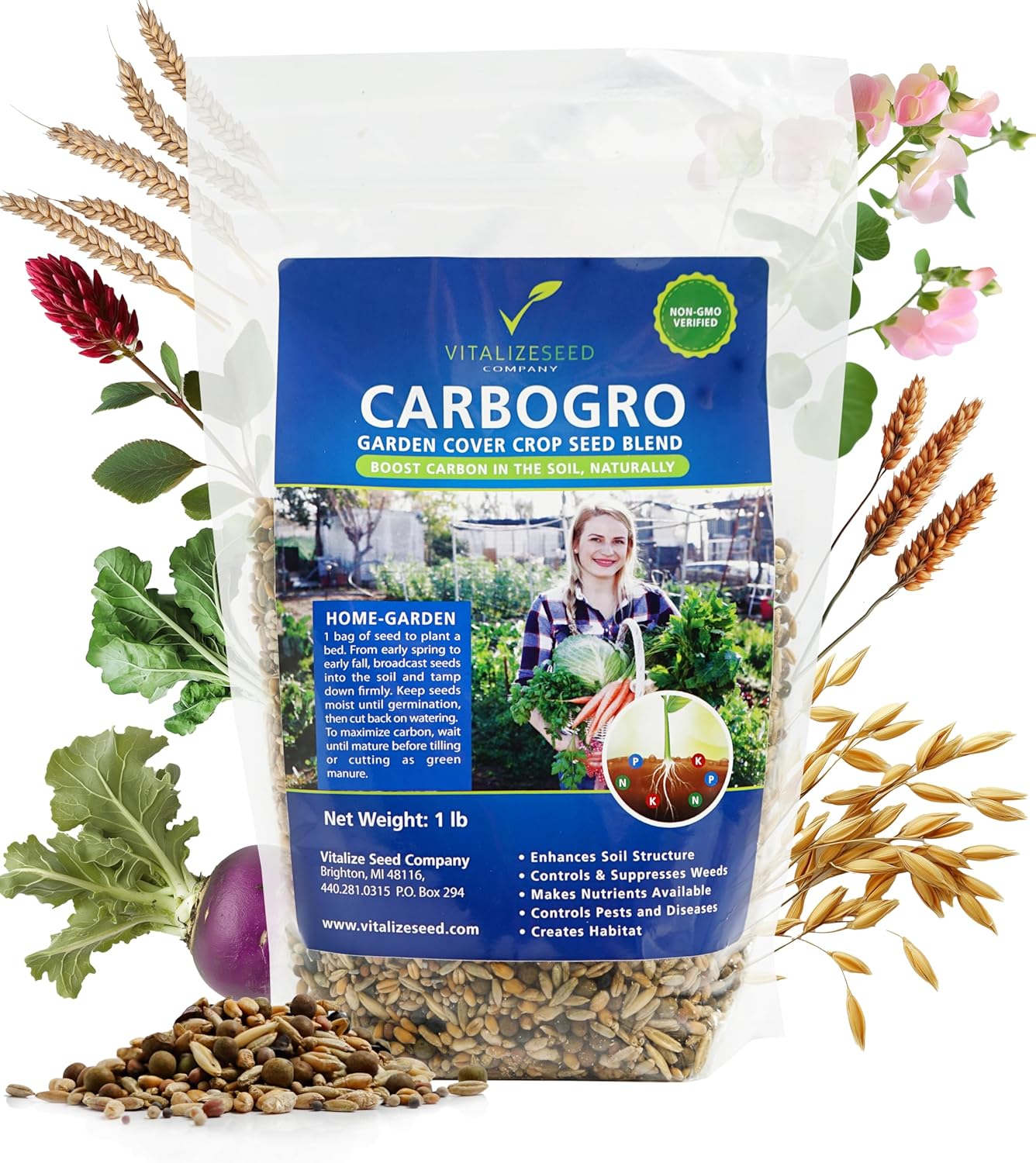
Vitalize Seed Carbogro Fall No-Till 16-Species Cover Crop Mix, 1 lb
| Sunlight Exposure | Full Sun |
|---|---|
| Item Type Name | Seed |
| Unit Count | 16 Ounce |
Carbogro is a premixed cover-crop blend designed for fall planting to establish quickly, survive winter, and produce heavy spring biomass. You sow it as a broadcast or shallowly incorporated stand to create a dense thatch for no-till systems or to grow as green manure for later tilling. The 16-species mix of grains, brassicas, and clovers promotes diverse root structures and flowering that feed microbes, capture leftover nutrients, and help reduce erosion. For gardeners and small farms focused on dependable soil improvement, it simplifies planning because the mix balances scavengers and nitrogen-fixers in one bag. The 1 pound unit is convenient for testing or smaller plots but may require multiple bags for larger areas. It is formulated for full-sun sites and best used in typical fall planting windows; success still depends on timely seeding and local winter severity. If you want a ready-to-use, research-backed option to consistently boost soil health between cash crops, Carbogro performs well when managed as part of a seasonal cover-cropping plan.
Best for: Gardeners and small-scale growers who prioritize a reliable, low-hassle cover crop that improves soil biology and captures nutrients over winter.
Less Ideal for: Large-acreage farmers or anyone needing bulk seed for many acres should consider larger-volume commercial seed options instead.
- Contains 16 species for biological diversity and multifunctional cover cropping
- Balanced mix of grains, brassica, and clovers for nutrient scavenging and nitrogen contribution
- Formulated for fall planting with good winter survival and strong spring biomass
- Versatile for no-till thatch or green-manure incorporation
- Sold as a 1 pound unit which may be insufficient for larger garden or field areas
Verdict: Choose Carbogro when you want a reliable, ready-made fall cover crop blend that builds soil biology and delivers strong spring biomass.
Outsidepride Crimson Clover Seed (1/4 lb) – Inoculated, Coated Cover Crop Seed

| Unit Count | 4 Ounce |
|---|---|
| Plant or Animal Product Type | crimson clover |
| Material Features | GMO Free |
| Other Special Features of the Product | Drought Tolerant |
| Expected Planting Period | Summer |
Outsidepride Crimson Clover seed is designed as a multipurpose cover crop for improving soil fertility and providing winter grazing or forage. The seed is inoculated and coated to support reliable germination and nitrogen fixation, so you can plant it alone or mixed with grasses, rye, or other clovers to build green manure or improve pasture. It tolerates sandy and clay soils and moderate acidity, and the red blooms attract pollinators while suppressing weeds and reducing erosion. Typical uses for allotments include sowing in late summer or fall for winter cover or planting in spring at the recommended shallow depth to establish a dense sward. Practical benefits are improved soil nitrogen, increased organic matter when incorporated, and seasonal forage value before bloom. Limitations are inherent to crimson clover as an annual that needs replanting each season and is not a long-term perennial groundcover; it also requires appropriate seeding rates and timing to avoid patchy stands in poor seedbed conditions.
Best for: Gardeners and allotment growers who want a reliable, soil-building green manure that also supplies seasonal forage and boosts pollinator activity while fitting into crop rotations.
Less Ideal for: People seeking a permanent, no-maintenance groundcover or a perennial solution for erosion control should consider perennial legumes or grasses instead.
- Inoculated and coated seed for higher germination and effective nitrogen fixation
- Attracts bees and butterflies, supporting pollinators while the crop grows
- Tolerant of sandy and clay soils and medium acidity, adaptable to varied allotment soil types
- Good winter grazing and forage value when harvested in the pre-bloom stage
- Annual crop that requires replanting each season rather than providing permanent cover
Verdict: Choose this inoculated crimson clover seed when you want a dependable annual green manure that fixes nitrogen, attracts pollinators, and fits into allotment crop rotations.
Choosing the Right Green Manure for Allotments: Key Factors to Consider
Establishment and Germination
Good establishment matters because allotment plots are often exposed, compacted, or variable in fertility. A seed that germinates reliably at common sowing depths will produce consistent ground cover, which reduces weed pressure and builds biomass quickly.
Consider how tolerant a green manure is of cool, dry spring conditions or an early autumn sowing. Faster germination reduces the window during which weeds can get ahead and lowers the chance that bare patches will form on the plot.
Biomass Yield and Growth Rate
High biomass production gives you more organic matter to work into the soil, improving structure, water retention, and biological activity. For allotments you often need options that produce solid bulk within a limited time frame, such as a few months between crops.
Choose species that match the growing window on your plot. Fast-growing mixes can supply quick results in summer, while slower growers may be better for overwintering covers that protect soil over the colder months.
Nitrogen Fixing and Nutrient Benefits
Some green manures, especially legumes, add biologically fixed nitrogen to the soil, reducing the need for synthetic fertilizers. Other non-legume covers can help conserve and mobilize nutrients by preventing leaching and capturing residual nitrogen from previous crops.
Think about the nutrient needs of your next vegetable crop. If you plan heavy feeders such as brassicas or potatoes, a nitrogen-fixing cover can boost fertility. For light-feeding crops, a carbon-rich cover can improve structure without over-supplying nitrogen.
Ease of Incorporation and Soil Impact
How easily a green manure can be cut and incorporated affects labor on small plots. Some covers break down quickly when dug or forked in, while others form woody stems that take longer to decompose and may need composting first.
Also consider root behavior. Deep-rooting covers can relieve compaction and improve drainage, but their residues may tie up nitrogen briefly during decomposition. Shallow-rooted covers produce surface organic matter more rapidly but may do less to loosen compacted layers.
Seasonal Timing and Flexibility
Allotment gardeners work to a tight calendar, juggling sowing dates, harvests, and plot-sharing rules. A useful green manure fits into the available gaps and tolerates the local climate windows for sowing and frost.
Some species are ideal for short summer covers, others are suited to overwinter protection. Pick covers whose life cycle matches the period you have free before the next planted crop.
Weed Suppression and Ground Protection
A dense green manure reduces weed emergence and protects soil from erosion and nutrient loss. For small plots, effective weed suppression lowers hand-weeding effort and prevents persistent weeds from taking hold between crops.
Assess how quickly a cover shades the soil and how long it stays intact. Some mixes create a mulch-like mat that blocks light, while others remain patchy and leave room for weeds to establish.
When to Sow Green Manure on Allotments
Timing depends on what you want the cover to do. Sow quick-growing summer covers after an early harvest to capture nutrients and build organic matter before autumn. For winter protection and erosion control, sow hardy mixes in late summer or early autumn so they establish before cold weather.
If you have short gaps of just a few weeks, choose species that germinate and bulk up rapidly. For longer fallow periods, select slower-growing or overwintering covers that continue protecting and feeding the soil until spring.
- Short summer gaps: fast-growing annuals
- Autumn sowing: hardy overwinterers for protection
- Spring sowing: quick biomass before summer crops
How to Establish and Manage Small Plots
Prepare a fine, firm seedbed free of large clods and big perennial weeds. Broadcast seed evenly and rake in lightly or use a roller or board to press seed-to-soil contact-this improves germination on allotments where birds and dry conditions can be an issue.
Monitor for pests and slugs, especially when seedlings are small. Water newly sown beds if a dry spell follows. When it is time to terminate the crop, cut or mow before seed set to avoid adding volunteer plants to the next rotation.
- Light raking improves seed contact
- Cover seed with horticultural fleece if slugs or birds are a problem
- Terminate before flowering to prevent volunteers
Incorporation Techniques for Allotment Gardeners
Small-scale gardeners can fork or dig green manures in by hand. For rapid breakdown, cut plants into small pieces and mix with the topsoil. Allow at least two weeks after incorporation before planting sensitive seedlings so microbial activity and temporary nitrogen tie-up decline.
Alternatively, leave cut residues as a surface mulch or add them to a compost heap for fuller decomposition. Avoid deep rotovation on light soils where mixing too much fresh green matter can disrupt structure or encourage short-term compaction.
- Fork in chopped material for faster decomposition
- Allow a rest period after incorporation to avoid nitrogen tie-up
- Use as surface mulch if immediate planting is planned
Combining Green Manures with Compost and Organic Matter
Green manures work best alongside regular compost additions. Compost stabilizes nutrients and supplies slow-release organic matter while green manures provide fresh biomass and living root action. Combining both speeds improvement in tilth and soil biology.
On plots with low organic matter, alternate green manure seasons with dedicated compost top-ups. This balances rapid nutrient cycling from fresh cuts with the long-term humus build-up compost provides.
- Rotate green manure seasons with compost applications
- Mix chopped green matter into compost for richer material
- Top-dress with compost after incorporation to replenish microbial activity
Common Mistakes to Avoid on Allotments
Skipping termination is a frequent error. Letting a cover go to seed can create volunteer weeds that complicate later crops. Always mow or cut back before flowering to control seed set.
Another mistake is sowing the wrong species for the season. Slow-growing covers planted late in autumn may fail to establish and leave soil bare. Match species to the available window and your site conditions to get useful results.
- Terminate before seed set to prevent volunteers
- Match species to the sowing season
- Avoid incorporating very woody stems without composting first
How We Chose the Best Green Manure for Allotments
We selected green manures that deliver clear, garden-ready benefits for allotment plots and small-scale vegetable beds. Key evaluation criteria focused on establishment reliability on small plots, biomass production per short season, ability to fix or mobilize nitrogen, and ease of incorporation without specialized equipment. We also considered seed availability and sowing flexibility so options work within common allotment schedules. Products were excluded if they require large-field management, long-term pasture-style rotations, or heavy machinery to establish or incorporate. We did not include ornamental cover crops that offer little soil-building value for vegetable systems. The shortlist emphasizes varieties that germinate well in typical allotment soils, produce useful bulk of green matter in one to three months, improve tilth when dug or forked in, and provide weed suppression while growing. Final judgments prioritized practical performance in compact plots and predictable timing for gardeners planning successive crops.
FAQ
Can I sow green manure between short vegetable crops on an allotment?
Yes. Choose fast-growing species that bulk up within a few weeks to a couple of months. Keep expectations realistic: very short windows will provide surface benefits and weed suppression more than deep structural change.
Will green manure add enough nitrogen for heavy feeders?
Legume-based manures can add meaningful nitrogen, but the amount depends on establishment and biomass. For very heavy-feeding crops you may still need supplemental organic fertilizers or compost to meet full demand.
How long after incorporating green manure can I plant vegetables?
Allow at least two to four weeks after incorporation for microbial activity to stabilize and for temporary nitrogen tie-up to decline. Shorter waits may be fine for robust transplants, but sensitive seedlings can suffer if planted immediately.
Are there green manures that help break up compacted soil on allotments?
Yes. Deep-rooting species produce taproots that can help loosen compacted layers and improve drainage. These are useful for remedial work, but they may take longer to establish and decompose than shallow-rooted covers.
Should I let green manures flower for pollinators on an allotment?
Flowering covers provide pollinator resources, but letting them go to seed increases volunteer risk. If you want pollinator benefits, plan for a controlled flowering period followed by cutting before seed set.
Final Verdict
For allotment gardeners the best green manure balances quick establishment, useful biomass, and compatibility with tight rotations. Prioritize covers that match your sowing window and the needs of your next crop: legumes for nitrogen, deep-rooters for structure, and fast annuals for short gaps. Accept tradeoffs between fast turnover and longer-term soil building. With the right choice and simple management-timely sowing, termination before seeding, and appropriate incorporation-you can make steady improvements to soil health and productivity on a compact plot.
