

Note: This article contains affiliate links. If you click on these links and make a purchase, I may earn a small commission at no extra cost to you. This helps support my research and content. Read my full affiliate disclosure here.
A correctly chosen pre-emergent herbicide prevents weed seeds from germinating, saving time and effort during the growing season. If you apply the right product at the right time, you reduce hand-weeding and avoid spot treatments later. This guide covers seven carefully shortlisted pre-emergent options suited to common lawn and garden situations, from turf to ornamental beds. We evaluated products for how long they control weeds, how easy they are to apply, and how they fit into maintenance routines. Read on to find the pre-emergent that matches your timing, safety, and coverage needs.
Top Picks at a Glance
| Best Overall The best all-around choice for most situations | Quali-Pro Prodiamine Pre-Emergent Herbicide, 5 lb Granules |  |
| Best Quality Built to a higher standard if you want something more solid | The Andersons Barricade Granular Pre-Emergent Weed Control (18 lb, covers 5,800 sq ft) |  |
| Best Value The sweet spot between price and what you get | The Andersons Barricade DG Pro Pre-Emergent Granules (50 lb) |  |
| Best Budget The cheapest option that still gets the job done reliably | Scotts WeedEx Prevent with Halts Pre-Emergent (10.06 lb) |  |
| Highest Rated A top-rated pick with lots of positive feedback | LebanonTurf Prodiamine 0.58% Granular Pre-Emergent (covers 20,000 sq ft) |  |
| Most Popular A crowd favorite that many people choose with confidence | Scotts Halts Crabgrass & Grassy Weed Preventer, 10.06 lb. |  |
| Best Seller A high-volume bestseller chosen again and again | Roundup Dual Action 365 Weed & Grass Killer Plus 12 Month Preventer with Pump 'N Go 2 Sprayer |  |
Quali-Pro Prodiamine Pre-Emergent Herbicide, 5 lb Granules

| Item Form | Granule |
|---|---|
| Coverage | Pre-emergent grass and broadleaf weed control, season long crabgrass control |
| Active Ingredients | Prodiamine 65% |
Quali-Pro Prodiamine is a granular pre-emergent herbicide designed to prevent germination of common annual grassy and broadleaf weeds across lawns and landscape beds. You apply it before weed seeds germinate in spring or as a fall treatment to build residual control through the growing season. The product contains 65% prodiamine, which is widely used for reliable, long-lasting control of crabgrass, annual bluegrass and several broadleaf weeds, and it mixes readily when tank-mixed with fertilizers or iron. In real-world use it offers predictable, season-long suppression when applied at the labeled rate and incorporated by irrigation or rainfall. Important practical limits are that it is preventive only and will not kill established weeds, and proper timing and rate are essential to avoid reduced effectiveness. For larger areas the 5 lb package covers moderate lawn acreage but may require multiple bags for extensive turf.
Best for: Homeowners and lawn care professionals who prioritize a dependable, season-long preventive solution to keep crabgrass and annual weeds from establishing in turf.
Less Ideal for: Gardeners needing a post-emergent solution for existing weeds or those who prefer liquid ready-to-use products for spot treatments.
- High active ingredient concentration (Prodiamine 65%) for long residual control
- Granular form allows easy broadcast application and tank mixing with fertilizers
- Effective season-long crabgrass and annual weed suppression when applied correctly
- Suitable for spring or fall applications to build preventive control
- Pre-emergent only and will not control established weeds
- 5 lb bag may be insufficient for large lawns without purchasing additional quantity
Verdict: Choose this prodiamine granule when you want a proven, season-long preventive herbicide to reliably stop crabgrass and other annual weeds before they start.
The Andersons Barricade Granular Pre-Emergent Weed Control (18 lb, covers 5,800 sq ft)
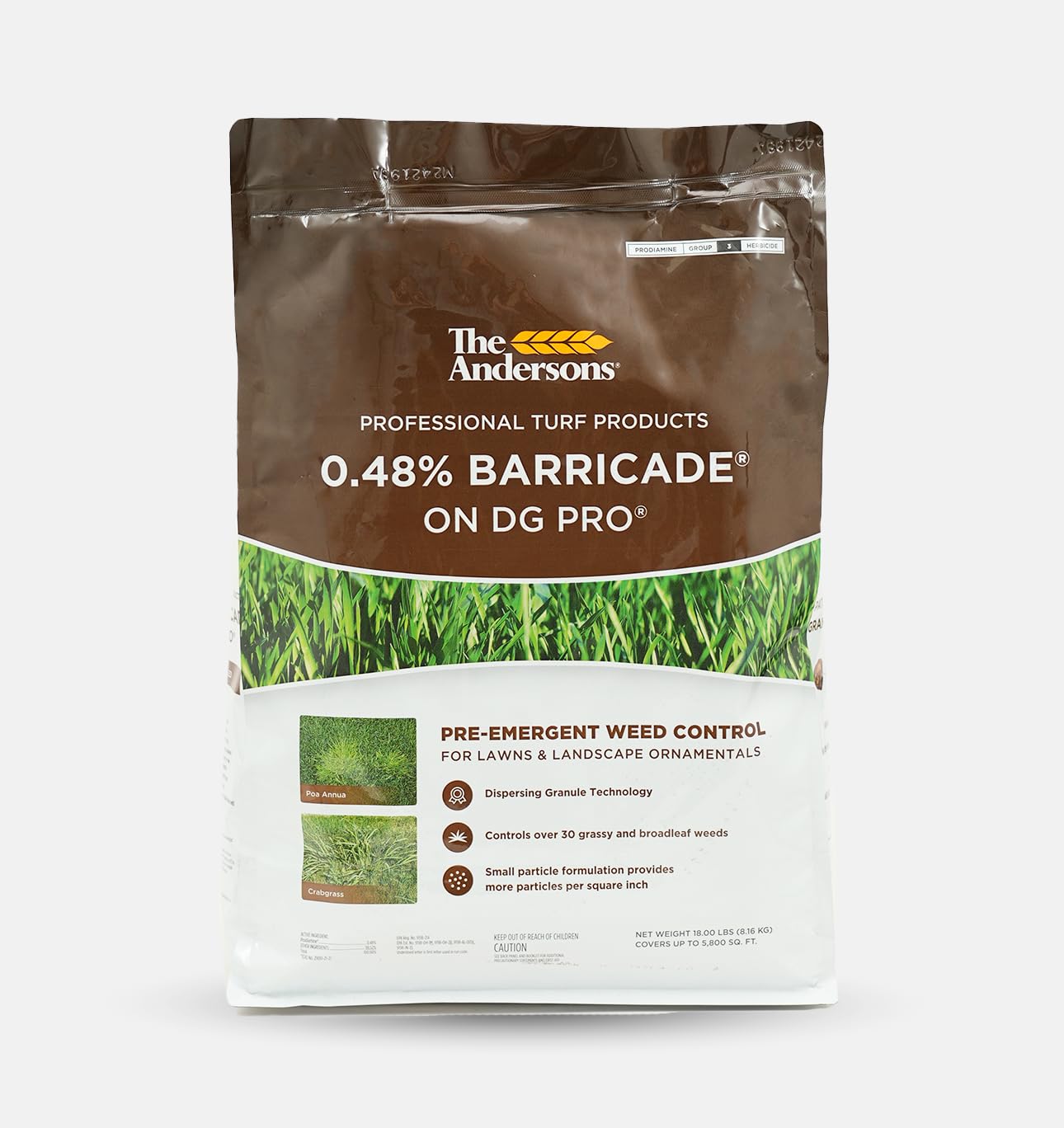
| Item Form | Granule |
|---|---|
| Coverage | 5800 square feet |
| Unit Count | 288 Ounce |
| Active Ingredients | Prodiamine 0.48% |
Barricade is a granular pre-emergent that stops common lawn weeds before they emerge, using 0.48% prodiamine in a dispersible granule formula. You apply it across the lawn in early spring or fall and water it in so the small DG Technology particles dissolve and move the active ingredient into the soil. That combination gives broader, more even coverage per square inch and is especially aimed at preventing crabgrass, poa annua and other annual grassy and broadleaf weeds across up to 5,800 square feet from a single 18 pound bag. The product is straightforward to use with a spreader and fits routine seasonal maintenance plans. Important limits are that it will not kill weeds already established and must be timed correctly for best effect. Also, because it is a professional-strength herbicide buyers should follow safety directions closely and keep pets and children off treated areas until safe.
Best for: Homeowners who plan seasonal lawn maintenance and want a single, high-coverage pre-emergent to prevent crabgrass and common annual weeds across medium to large yards.
Less Ideal for: People needing a post-emergent solution for existing weeds, or gardeners who prefer non-chemical weed control methods.
- Designed to prevent both grassy and broadleaf annual weeds including crabgrass and poa annua
- DG Technology dispersible granules dissolve quickly when watered for consistent soil incorporation
- Covers up to 5,800 square feet from a single 18 pound bag, suitable for typical residential lawns
- Contains professional-grade active ingredient prodiamine for season-long pre-emergent control
- Will not control weeds that are already established in the lawn
- Must be applied in the correct seasonal window (early spring or fall) to be effective
- Requires watering after application and careful safety handling around children and pets
Verdict: Pick Barricade when you want a professional-strength, high-coverage pre-emergent that reliably prevents crabgrass and other annual weeds across a typical residential lawn.
The Andersons Barricade DG Pro Pre-Emergent Granules (50 lb)

| Item Form | Granule |
|---|---|
| Coverage | 14,200 square feet |
| Active Ingredients | prodiamine |
Barricade DG Pro is a granular pre-emergent intended to prevent weed seed germination across established turf, landscape beds, and large turf installations. You apply it evenly over the target area in early spring or fall then water it in to activate the prodiamine, which forms a barrier at the soil surface to stop weed seedlings. The DG Pro granule formulation is designed to deliver more particles per square inch, improving coverage and consistency across the labeled 14,200 sq ft coverage. Practical benefits include long-lasting prevention of over 30 common grass and broadleaf weeds and a formulation trusted by turf professionals for large lawns, sports fields, and sod farms. Limitations are that it will not control weeds that are already established and it requires careful timing and follow-up watering to be effective; protective clothing is recommended during application because of the active ingredient. For homeowners focused on performance, it offers professional-level results when used as directed.
Best for: Buyers who prioritize turf performance and long-term weed prevention for large lawns, sports fields, or professional turf areas and who follow seasonal application schedules.
Less Ideal for: Not a good choice for gardeners seeking a quick fix for existing weed patches or for very small container or indoor plantings.
- Professional-grade active ingredient prodiamine for reliable pre-emergent control
- Granular DG formulation provides higher particle count for more uniform coverage
- Labeled coverage large enough for big lawns and turf areas (14,200 sq ft)
- Effective against over 30 common grassy and broadleaf weeds when applied correctly
- Does not kill existing weeds so requires pre-emptive timing and planning
- Requires watering after application to activate which adds a step to treatment
Verdict: Choose Barricade DG Pro when you want a professional-grade pre-emergent that delivers broad, long-lasting weed prevention across large turf areas.
Scotts WeedEx Prevent with Halts Pre-Emergent (10.06 lb)

| Coverage | 5000 square_feet |
|---|---|
| Item Form | Bag |
| Active Ingredients | Pendimethalin |
Scotts WeedEx Prevent with Halts is a granular pre-emergent designed to stop common lawn weeds before they emerge. You apply it in early spring to prevent crabgrass, foxtail, spurge and similar annual grasses for the season, or in late summer to fall to reduce moss and certain cool-season seedlings. The product is delivered in a single 10.06 lb bag that treats up to 5,000 square feet and is intended for most turf types except Dichondra and bentgrass. Practical benefits include seasonal, hands-off control once applied and compatibility with routine spreader use and normal weather events since rain or frost will not reduce effectiveness. Important limitations are that it will not kill established weeds and some targets, such as goosegrass, may require a repeat application in eight weeks; it can also stain hard surfaces so care during spreading is needed. For homeowners managing weed prevention across a modest lawn, this is a straightforward option that integrates with a spring or fall lawn-care plan.
Best for: Buyers who want an affordable, low-effort way to prevent annual lawn weeds across a small to medium yard and prefer a seasonal, preventative approach to lawn care.
Less Ideal for: Homeowners who need to eliminate existing weed infestations, or those with specialty lawns such as bentgrass or Dichondra who should use a product formulated for those turf types.
- Pre-emergent action prevents germination of listed annual grasses and several broadleaf weeds
- Covers up to 5,000 sq. ft. from a single 10.06 lb bag
- Resistant to rain, snow, or freezing weather after application
- Suitable for use on most lawn grass types (excludes Dichondra and bentgrass)
- Does not control established or mature weeds
- Some weeds like goosegrass may need a second application for control
- Can stain concrete, stone, metal, clothing, or shoes if spilled
Verdict: A budget-friendly, weather-tolerant pre-emergent that reliably prevents common annual lawn weeds across up to 5,000 sq ft when used as part of spring or fall lawn care.
LebanonTurf Prodiamine 0.58% Granular Pre-Emergent (covers 20,000 sq ft)

| Item Form | Granule |
|---|---|
| Coverage | 20,000 sq. ft. |
| Active Ingredients | Prodiamine |
This granular pre-emergent uses 0.58% prodiamine on a BIODAC carrier to stop crabgrass and many grassy weeds from germinating across lawns and landscaped areas. It is applied with a broadcast spreader in early spring, with a recommended follow-up in late May or early June; the manufacturer warns not to overseed for three to four months after application. The product covers a large area per unit, making it suitable for whole-yard preventive programs and for professional maintenance of turf, trees, shrubs, and flowers. Its granular form simplifies handling compared with liquids and reduces immediate runoff risk, while the prodiamine chemistry provides season-long residual control when applied correctly. Limitations include the planting restriction after application and that it prevents seed germination so it cannot be used where you plan to establish new lawn from seed shortly after treatment. Also availability is restricted in several states, so check local regulations before planning use.
Best for: Buyers who prioritize a dependable, season-long preventive approach to crabgrass control and want a product that fits routine lawn maintenance schedules used by homeowners or pros.
Less Ideal for: Gardeners planning to establish new lawns from seed shortly after treatment or those needing an option legal in excluded states should consider alternatives.
- Granular formula on BIODAC carrier for easy broadcast spreading
- Contains 0.58% prodiamine, a proven pre-emergent for crabgrass and grassy weeds
- Large coverage of 20,000 sq. ft. per unit reduces application frequency
- Suitable for use across lawns and landscaped beds to protect turf and plantings
- Prevents seed germination so you cannot overseed or plant grass seed for 3–4 months after application
- Not labeled for sale or use in a number of states, limiting availability and compliance
Verdict: Choose this granular 0.58% prodiamine product when you need a reliable, large‑area pre-emergent to prevent crabgrass and other grassy weeds.
Scotts Halts Crabgrass & Grassy Weed Preventer, 10.06 lb.
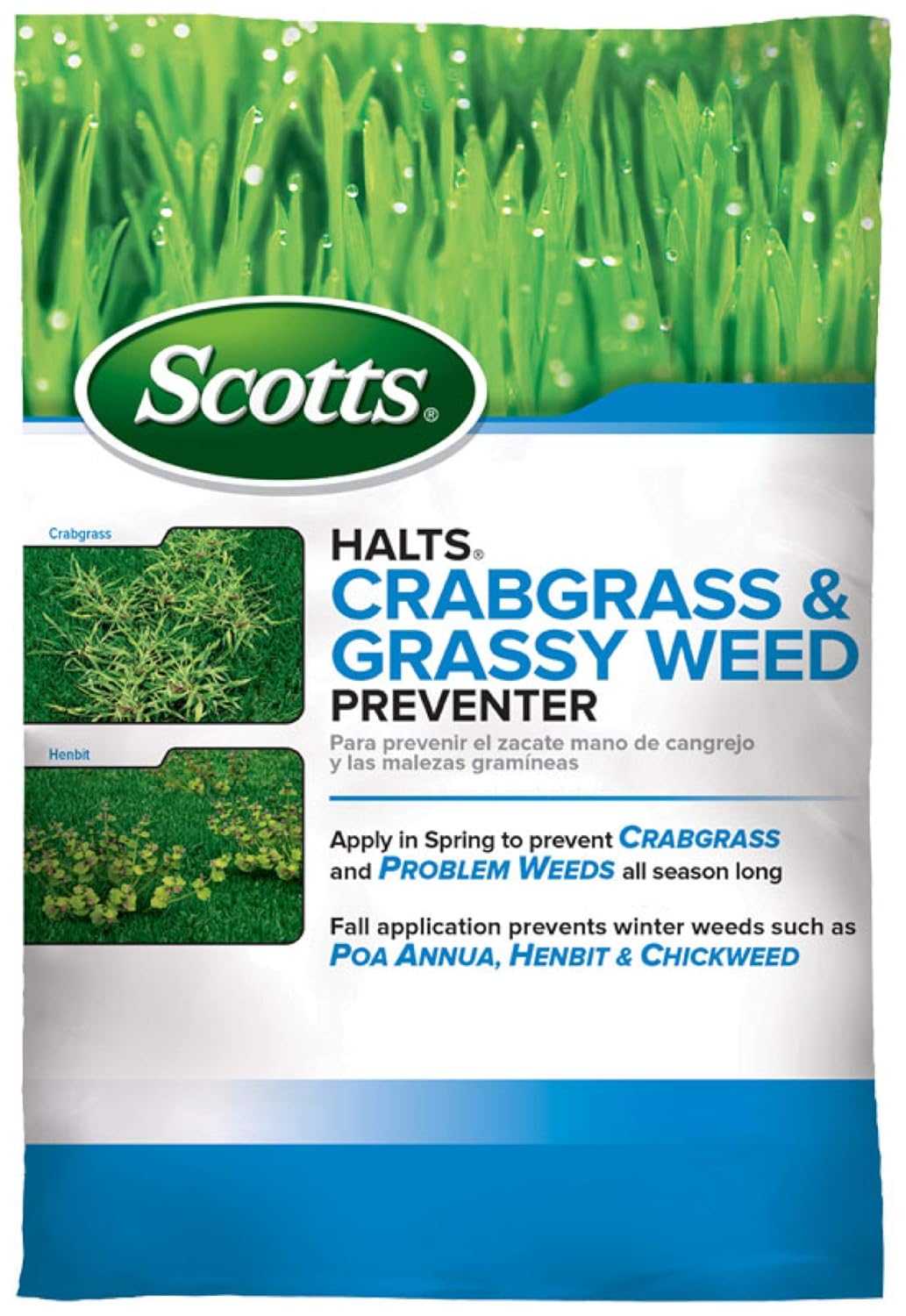
| Item Form | Granule |
|---|---|
| Coverage | 5000 square_feet |
| Active Ingredients | Pendimethalin 1.71% |
Scotts Halts is a granular pre-emergent formulated to stop crabgrass and seeded grassy weeds from germinating across established lawns. You apply it dry with a broadcast spreader in early spring or fall, then water it in as directed; the active ingredient pendimethalin forms a soil barrier that prevents weed seedlings from emerging and is advertised as resistant to rain, snow, or freezing after application. This bag treats up to 5,000 square feet and is intended for use on most turf types except Dichondra and Bentgrass. The practical benefits are straightforward: a single timed application protects turf from several common annual weeds without needing spot herbicide treatments, and the granule form makes even coverage with a spreader easy. Important limitations are that it does not kill existing mature weeds and cannot be used on newly seeded or sprigged areas until months later, so timing and measuring lawn area matter. Also repeat applications for certain weeds like goosegrass may be necessary according to label instructions.
Best for: Homeowners who plan lawn care around seasonal timing and want a preventive, low-effort way to stop annual grassy weeds before they emerge.
Less Ideal for: People needing to remove existing weed infestations, those reseeding or establishing new turf within months, or gardeners who require immediate weed knockdown.
- Pre-emergent action prevents crabgrass and listed grassy weeds before they germinate
- Covers up to 5,000 sq ft per bag for single-application protection
- Granule form designed for even spreader application and easy watering activation
- Rain, snow, or freezing after application will not reduce effectiveness
- Does not control existing mature weeds so not useful for established infestations
- Not safe for newly seeded or freshly sprigged lawns for several months
Verdict: Use this granular pre-emergent if you want a seasonal, preventative barrier against crabgrass and common grassy weeds on an established lawn up to 5,000 sq ft.
Roundup Dual Action 365 Weed & Grass Killer Plus 12 Month Preventer with Pump 'N Go 2 Sprayer

| Unit Count | 170 Fluid Ounces |
|---|---|
| Coverage | 400 sq.ft. |
| Item Form | Liquid |
This product combines an all-in-one herbicide and long‑term preventer in a 1.33 gallon ready-to-use formula with an integrated Pump 'N Go 2 sprayer. It is designed for non-lawn areas like driveways, patios, gravel and cracks where you want to both eliminate current weeds and stop new growth for up to a year. The concentrate-free container and extendable wand make spot and area spraying straightforward and reduce bending when treating edges and crevices. It claims visible results within hours and becomes rainproof in about 30 minutes, which helps when weather timing is tight. Practical benefits include broad-spectrum control of common tough weeds and a 400 sq ft coverage per container. Important limitations are that you must spray the entire target area—not just visible weeds—to get the preventer effect, and the product is intended for non-lawn surfaces only, so it is not for treating turf you want to keep. Follow the label for safety and reentry instructions since it is a strong herbicide.
Best for: Buyers who prioritize strong, long-lasting weed control for hardscape and non-lawn areas and want a ready-to-use product with a built-in sprayer for quick, targeted applications.
Less Ideal for: Gardeners who need a lawn-safe solution or who prefer spot-treatment of individual plants without treating whole areas should look for a turf-safe or selective product instead.
- Kills existing broadleaf and grassy weeds and prevents new growth for up to 12 months
- Ready-to-use formula with Pump 'N Go 2 sprayer for accurate, continuous spraying without mixing
- Rainproof in about 30 minutes for faster applications in variable weather
- Extendable wand improves reach and accuracy in cracks, edges, and under decks
- Must spray the entire area to activate the preventer effect, which can use more product
- Formulated for non-lawn areas only and will damage turf and desirable plants if applied there
Verdict: Choose this if you want a ready-to-use, long-lasting solution to both kill weeds now and prevent them from returning in non-lawn areas for up to a year.
Choosing the Right Pre Emergent Pre-Emergent Herbicide: Key Factors to Consider
Timing and Seasonal Window
When you apply a pre-emergent herbicide is the single most important factor in whether it works. Most products must be applied before soil temperatures trigger weed seed germination. That timing varies by region and weed species, so plan applications around local soil-temperature thresholds or traditional seasonal cues such as forsythia bloom or consistent daytime temps. Applying too early can reduce effectiveness as the active ingredient may dissipate before peak germination, while applying too late means established weeds will bypass the barrier.
If you are managing multiple beds and turf areas, stagger applications by microclimate. Shaded beds and north-facing slopes often warm later than full-sun lawns, so they may need a slightly delayed application to match germination timing.
Residual Length and Reapplication
Residual length tells you how many weeks or months the product will prevent seed germination. Longer residuals reduce the need for quick follow-up treatments but can restrict planting windows for desirable seedlings. Shorter residuals allow more flexible planting schedules but may require repeat applications to cover prolonged germination periods. Consider what you intend to plant after treatment: if you plan to sow new grass seed or transplant annuals, check label waiting periods carefully.
Also account for environmental factors that shorten residual activity. Heavy rainfall, soil type, and microbial activity in warm, moist soils can break down active ingredients faster. In sandy soils, some actives leach quicker than in clay or loam, so you may need more frequent reapplication or choose a formulation with greater staying power.
Active Ingredient and Weed Spectrum
Different active ingredients control different groups of weed seeds. Some are broad-spectrum against many annual grasses and broadleaf weeds, while others target specific problem species like crabgrass or foxtail. Match the chemistry to the weeds you see or expect in your region. Label lists of controlled weeds are the most reliable guide since formulations and allowed uses vary.
Understanding the active ingredient also helps you plan integrated control. For beds where you want to leave room for seeding ornamental plugs, select a product with a shorter plant-back interval or one labeled for transplanting compatible species sooner.
Application Method and Equipment
Pre-emergent herbicides come as granules, water-dispersible granules, or liquids for broadcast spraying. Granular products can be easier for small lawns with spreaders and reduce drift risk. Liquid formulations allow precise bands of protection and are often better for beds where you want to avoid overspray onto desirable plants. Choose the application form that matches your existing tools and comfort level.
Calibrating equipment matters. For even coverage and predictable results, check spreader or sprayer settings against product directions. Uneven application creates gaps where weeds can slip through, and overapplication increases risk to nearby plants and the environment.
Plant Safety and Compatibility
Label restrictions for turf species, established ornamentals, and edibles determine where you can use a product safely. Some pre-emergents are labeled for warm-season grasses but not cool-season grasses, or vice versa. Others advise against use near newly seeded lawns or recently transplanted ornamentals. Read and follow plant-back intervals and application rates to avoid injury.
If you have mixed plantings, consider targeted application techniques like banding along beds or spot treatments to reduce exposure to sensitive species. When in doubt, test a small area or consult local extension guidance for compatibility with common regional plants.
Environmental and Safety Considerations
Consider runoff potential, proximity to water features, and pollinator activity when choosing a pre-emergent. Some chemistries bind strongly to soil and pose lower runoff risk, while others may be more mobile. Avoid application before heavy rain and use buffer zones near streams, ponds, or storm drains.
Follow label instructions on personal protective equipment, re-entry intervals, and storage. Keep in mind that restrictions can differ for edible gardens; many pre-emergents are not labeled for use in vegetable beds or require long waiting periods before planting food crops.
When to Apply Pre-Emergent in Different Climates
Soil temperature is a better guide than calendar dates. In cool-season climates, aim for early spring applications before soil reaches the germination threshold for annual grassy weeds. In warm-season climates, late winter or early spring timing before warm-season weeds sprout is common. For fall-germinating weeds, a late-summer or early-fall application may be appropriate.
Use a soil thermometer or local extension resources to refine timing. Pay attention to microclimates in your property; shaded areas, sheltered corners, and slopes warm at different rates and may need slightly different scheduling.
- Measure soil at a 2-inch depth for the most relevant temperature readings.
- If you have a mix of cool- and warm-season turf, prioritize the timing that addresses the most problematic weeds first.
Application Techniques That Improve Coverage
Good application technique ensures an even protective barrier. For granular products, walk at a steady pace and overlap spreader swaths slightly. For liquids, use the recommended nozzle and maintain consistent spray pressure and speed to avoid streaks.
Water-in requirements vary. Some formulations need immediate light irrigation to move the active ingredient into the topsoil layer where seeds germinate, while others rely on natural rainfall. Follow label guidance on water-in depth and timing.
- Calibrate spreaders and sprayers before treating to match label rates.
- Avoid applying in high winds or before heavy rain to reduce drift and runoff.
Using Pre-Emergents Around New Plantings and Seed
Most pre-emergent products restrict seeding and transplanting for a period after application. If you plan to seed lawns or set out annuals and vegetable starts, check the plant-back interval and choose a product compatible with your schedule.
Where immediate planting is necessary, consider mechanical control or mulching until it is safe to use chemical pre-emergents. Alternatively, use targeted banding to protect beds while leaving planting rows untreated when label allowances permit.
- Mulch and landscape fabric are nonchemical options for immediate weed suppression in beds.
- For turf renovation, delay pre-emergent application until new grass is established or use products labeled safe for overseeding if available.
Integrating Pre-Emergents Into an Overall Weed Management Plan
Pre-emergents are one tool in a larger integrated strategy that includes good cultural practices. Healthy, dense turf and proper mulching reduce space for weeds to establish. Combine pre-emergent use with proper mowing height, fertilization timing, and irrigation practices to lower overall weed pressure.
For perennial or established weeds that bypass pre-emergents, plan spot treatments or mechanical removal as follow-up. Rotating control tactics and monitoring weed emergence each season helps maintain long-term effectiveness.
- Record application dates and conditions to refine timing in future seasons.
- Inspect treated areas regularly and address escapes early to prevent seed set.
Safety and Environmental Best Practices
Minimize non-target exposure by avoiding application near edible plantings unless the product is labeled for such use. Create buffer zones around water and use low-drift equipment settings. Store products in original containers and dispose of empty containers according to local regulations.
Protect pollinators by avoiding applications to blooming plants and considering timing when pollinator activity is high. Read label directions for personal protective equipment and re-entry intervals to ensure safe handling.
- Do not apply before expected heavy rainfall to reduce runoff risk.
- Follow any state or local restrictions related to restricted-use chemicals or buffer requirements.
How We Chose the Best Pre Emergent Pre-Emergent Herbicide
We focused on attributes that matter in real garden and lawn use, looking for products that provide reliable pre-emergent control without creating unnecessary risks for desirable plants. Core evaluation criteria included residual control duration to judge how long a product prevents germination, the breadth of weed species controlled to match regional weed pressures, and application flexibility covering spreader, sprayer, and granular options for different yard sizes. We also assessed safety and turf compatibility by checking label guidelines for common turfgrasses and ornamentals, along with ease of use such as mixing, calibration, and re-entry intervals. Environmental considerations like runoff risk and restrictions for edible gardens were included so gardeners can choose responsibly. Excluded from this list were post-emergent-only products, specialty chemistries that require licensed applicators, and items lacking clear label directions for home garden use. The final set balances performance, practical application methods, and everyday gardener safety.
FAQ
Can I use a pre-emergent herbicide and then plant grass seed right away?
Usually not. Most pre-emergent herbicides impose a waiting period before seeding or transplanting. The length of the plant-back interval depends on the chemistry and formulation. Check the label for exact timing and follow instructions to avoid poor germination of desired species.
Will a pre-emergent prevent all types of weeds?
Pre-emergents are effective against germinating annual weeds and some specific grass species but do not control established perennial weeds. They also vary in the spectrum of species they suppress. Expect gaps where targeted post-emergent or mechanical control is still necessary.
How often should I reapply a pre-emergent herbicide?
Reapplication frequency depends on the product residual length and local conditions such as rainfall and soil type. Many gardeners apply once per season for spring annuals, but extended seasons or products with shorter residuals may require follow-up applications. Follow label intervals for safe and effective timing.
Are pre-emergent herbicides safe around ornamentals and trees?
Safety depends on the product and the species involved. Some pre-emergents are labeled for use around established ornamentals and trees when applied as directed, while others restrict use near sensitive plants. Read label compatibility guidance and consider targeted application techniques to reduce exposure.
Can I water in a pre-emergent after applying it?
Many formulations require a light irrigation or rely on rainfall to move the active ingredient into the topsoil where seeds germinate. Label instructions specify water-in depth and timing. Avoid heavy irrigation that might wash the product away from the target zone.
Final Verdict
Choose a pre-emergent based on the weeds you need to prevent, the planting windows you must protect, and how you plan to apply the product. Prioritize correct timing, the appropriate residual length for your season, and compatibility with turf and ornamentals on your property. Balancing these factors helps you reduce hand-weeding and maintain a healthier landscape while limiting non-target impacts.
