

Note: This article contains affiliate links. If you click on these links and make a purchase, I may earn a small commission at no extra cost to you. This helps support my research and content. Read my full affiliate disclosure here.
A stubborn crabgrass or a patchy lawn draws every gardener's eye. Choosing the right weed and crabgrass killer matters because application method, active ingredients, and turf compatibility determine how quickly weeds die and how healthy the lawn recovers. This guide covers seven top-rated options suited to common yards and maintenance routines. We shortlisted products that perform reliably in real lawns and evaluated them on application practicality, speed of control, and safety for common turf types. Read on to understand the tradeoffs so you can pick the right treatment for your lawn and schedule.
Top Picks at a Glance
| Best Overall The best all-around choice for most situations | Scotts Liquid Turf Builder with Plus 2 Weed Control, 32 fl. oz. |  |
| Best Quality Built to a higher standard if you want something more solid | BASF Drive XLR8 Crabgrass Killer Concentrate, 64 oz |  |
| Best Value The sweet spot between price and what you get | Spectracide Weed Stop for Lawns Plus Crabgrass Killer Concentrate, 40 oz |  |
| Best Budget The cheapest option that still gets the job done reliably | Spectracide Weed Stop for Lawns Plus Crabgrass Killer, Ready‑to‑Use, 32 oz |  |
| Highest Rated A top-rated pick with lots of positive feedback | Monterey Crab-E-Rad Plus Weed Control, 16 oz (with Measuring Spoon) |  |
| Most Popular A crowd favorite that many people choose with confidence | Ortho GroundClear Weed & Grass Killer with Comfort Wand, 1 gal |  |
| Best Seller A high-volume bestseller chosen again and again | Roundup Weed & Grass Killer4 Refill, 1.25 gal |  |
Scotts Liquid Turf Builder with Plus 2 Weed Control, 32 fl. oz.

| Item Form | Spray |
|---|---|
| Coverage | 6000 square_feet |
| Liquid Volume | 32 fluid ounces |
| Active Ingredients | Nitrogen |
This ready-to-spray Scotts liquid lawn food combines a quick 25-0-2 nitrogen boost with broadleaf weed control in a hose-end applicator bottle. You attach the bottle to a garden hose, spray the lawn when weeds are actively growing and avoid watering for 48 hours so the herbicide can work. The formula targets common lawn weeds such as dandelions, clover, chickweed and ground ivy, and the product notes coverage up to 6,000 sq ft on warm-season lawns and 4,000 sq ft on cool-season lawns from a 32 fl. oz. bottle. Practical benefits include fast, even application with no mixing and visible weed curling in a few days, plus simultaneous feeding for greener turf. Limitations are that it only controls listed broadleaf weeds (not all weed types or crabgrass preemergence), it should not be used on garden beds or non-listed grasses, and repeat treatments may be needed for stubborn weeds; also avoid use above 85°F. For a buyer seeking convenience and combined fertilizing and weed control, this is an easy, single-step option for routine lawn care rather than a complete solution for every weed problem.
Best for: Homeowners who want a convenient, time-saving product that combines feeding and spot-to-whole-lawn broadleaf weed control for routine lawn maintenance.
Less Ideal for: People needing crabgrass preemergence, treatment for grassy weeds, or a professional-grade, comprehensive herbicide program should look at specialized products instead.
- Ready-to-spray hose-end applicator requires no mixing and gives even coverage
- Provides a fast nitrogen boost to green the lawn while treating listed weeds
- Covers up to 6,000 sq ft on warm-season lawns and 4,000 sq ft on cool-season lawns from one bottle
- Targets common broadleaf weeds such as dandelions, clover, chickweed and ground ivy
- Controls only listed broadleaf weeds and is not a crabgrass preemergent or broad-spectrum weed solution
- Must not be applied to garden beds or non-listed grass types and requires following temperature and watering restrictions
Verdict: A convenient ready-to-spray lawn food that quickly greens turf while killing common listed broadleaf weeds for easy, routine lawn maintenance.
BASF Drive XLR8 Crabgrass Killer Concentrate, 64 oz
| Unit Count | 64 Ounce |
|---|---|
| Item Form | Liquid |
| Coverage | Full |
| Active Ingredients | Quinclorac 18.92% |
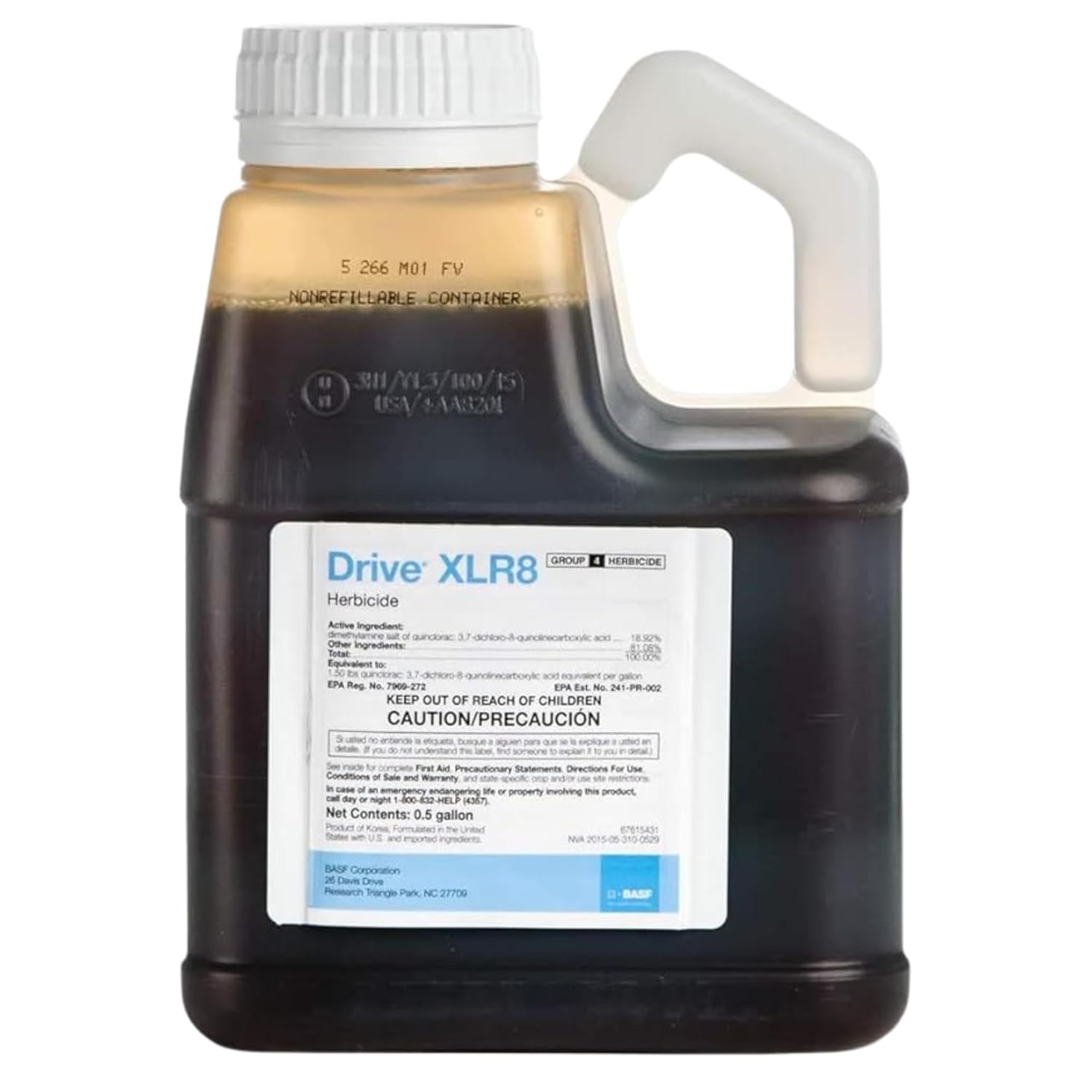
Drive XLR8 is a concentrated, water-based post-emergent herbicide that targets crabgrass and a wide spectrum of grassy and broadleaf weeds in turf. You mix the concentrate with water and a methylated seed oil surfactant and spray over the lawn to treat visible weeds; one recommended mix covers roughly 1,000 sq ft. The product’s active ingredient, quinclorac at 18.92%, provides rapid uptake and up to 30 days of residual control, which can reduce repeat applications. It is labeled for both warm- and cool-season turf and can be tank-mixed with other turf herbicides to broaden control. Practical benefits include a rainfast formula in under an hour and clear application directions that advise avoiding mowing two days before and after treatment to improve efficacy. Important limitations are the need for careful mixing and PPE when handling a concentrated herbicide and state or label restrictions for spot-only use in some areas. For users expecting a simple ready-to-use spray, this concentrated product requires measuring and correct stewardship.
Best for: Gardeners and turf managers who prioritize fast, robust post-emergent control and want a concentrated product they can mix and tank-match for maximum performance.
Less Ideal for: Casual homeowners who prefer plug-and-play ready-to-use products or those unwilling to follow pesticide safety procedures and label restrictions.
- Contains quinclorac 18.92% for effective post-emergent control of crabgrass and other grassy weeds
- Water-based concentrate that is rainfast in less than an hour and offers up to 30 days residual control
- Mixing instructions provide an approximate coverage rate (one mixture covers ~1,000 sq ft) for planned applications
- Works on both warm- and cool-season turf and can be tank-mixed with compatible herbicides to extend spectrum
- Concentrate requires accurate measuring and use of a surfactant which adds complexity compared with ready-to-use sprays
- Safety precautions and PPE are required during handling and application
Verdict: Choose Drive XLR8 when you need a concentrated, professional-strength post-emergent that delivers rapid crabgrass control and a month of residual protection.
Spectracide Weed Stop for Lawns Plus Crabgrass Killer Concentrate, 40 oz

| Unit Count | 40 Fluid Ounces |
|---|---|
| Coverage | 6250 square feet |
| Item Form | Spray |
| Kills | 470+ listed weeds |
Spectracide Weed Stop Plus Crabgrass is a ready-to-spray concentrate formulated to kill a wide range of broadleaf and grassy weeds, including crabgrass, with visible results in as little as five hours. You mix the concentrate and apply it over the lawn when temperatures are between 45 and 90 degrees, spraying until weeds are wet; the formula is rainproof about three hours after application. Notable features include claimed control of more than 470 weed types, contact action down to the root, and coverage sufficient for several thousand square feet from a single bottle. In practice this makes it useful for seasonal spot treatments or treating larger areas where quick knockdown is desired. Important limitations are following label directions carefully to avoid lawn injury in hot conditions and potential temporary discoloration on bermudagrass. The product is straightforward for homeowners who want a fast, broad-spectrum solution but requires attention to temperature windows and application rates for safe use.
Best for: Homeowners who want a practical, fast-acting solution to reduce common lawn weeds and crabgrass across medium to large lawns and who follow label directions carefully.
Less Ideal for: People seeking an organic or non-chemical method of weed control or those who need a product safe for application in very hot climates without risk to sensitive turf varieties.
- Controls over 470 listed broadleaf and grassy weeds including crabgrass
- Visible weed knockdown in about five hours
- Rainproof roughly three hours after application so it resists washing off
- Concentrate covers a large area from one bottle, suitable for several thousand square feet
- Can cause temporary yellowing or discoloration on bermudagrass
- Must not be applied when daytime temperatures exceed 90°F to avoid lawn injury
Verdict: A fast, broad-spectrum concentrate that delivers quick visible control of crabgrass and hundreds of common lawn weeds when you follow the label directions.
Spectracide Weed Stop for Lawns Plus Crabgrass Killer, Ready‑to‑Use, 32 oz

| Item Form | Spray |
|---|---|
| Coverage | up to 5,000 square feet |
| Liquid Volume | 32 fluid ounces |
| Kills listed weeds | 470+ types |
Spectracide Weed Stop for Lawns Plus Crabgrass Killer is a ready-to-use spray designed to kill more than 470 listed weeds, including crabgrass, by contact down to the root. You use it straight from the bottle with no mixing: walk your lawn, spray problem patches when daytime temperatures are between 45°F and 90°F, and expect visible wilting in as little as five hours. The formula treats both broadleaf and grassy weeds such as dandelion, chickweed and clover, and the 32-ounce bottle covers up to about 5,000 square feet. The practical benefits are ease of use, broad-spectrum control, and quick visible results for spot treatments or larger trouble spots. Important limitations are temperature restrictions and a caution on Bermudagrass, which can yellow or discolor if applied above recommended temperatures, so follow label directions carefully. This product is best for routine lawn weed control rather than selective or preventative weed management programs that require seasonal planning or turf-specific herbicides.
Best for: Buyers who want a low-effort, fast-acting weed killer to spot-treat lawns and regain control quickly without mixing chemicals or hiring help.
Less Ideal for: Gardeners seeking a turf-specific preemergent crabgrass prevention program or those with sensitive lawn varieties requiring specialized herbicides should consider other options.
- Ready-to-use spray so no mixing or calibration needed
- Kills a wide range of broadleaf and grassy weeds including crabgrass
- Produces visible results quickly, often within five hours
- Covers up to 5,000 square feet from a single 32 oz bottle
- Not safe to apply outside specified temperature range and may harm Bermudagrass if directions are not followed
- Contact-style action means repeat applications may be needed for established or deep-rooted weeds
Verdict: A convenient, ready-to-use spray that kills a very wide range of common lawn weeds and gives fast visible results for budget-minded homeowners.
Monterey Crab-E-Rad Plus Weed Control, 16 oz (with Measuring Spoon)

| Item Form | Granule |
|---|---|
| Coverage | 5000 square feet |
| Unit Count | 16 Ounce |
| Included Components | Measuring spoon |
Monterey Crab-E-Rad Plus is a granular selective weed control designed for use on residential and ornamental lawns to target crabgrass, dandelions, clover, wild onion and other listed weeds. You broadcast the granules across actively growing turf following label directions, then water or wait as instructed; the product becomes rainproof within hours so light rain shortly after application is unlikely to reduce effectiveness. Notable features include a measuring spoon for accurate dosing and a coverage claim of up to 5,000 square feet from the 16 ounce unit, which makes it practical for medium to large yards or for treating multiple spot areas. The formulation focuses on weeds while leaving most turfgrasses unharmed when used as directed, and visible control typically appears within a few weeks. Important limitations are that this is a targeted lawn weed killer rather than a nonselective herbicide, so areas with desirable broadleaf plants or mixed plantings will require care to avoid damage, and repeat spot treatments may be necessary for heavy infestations.
Best for: Buyers who prioritize predictable, turf-safe weed control for lawns and want a product that holds up to short-term wet weather after application.
Less Ideal for: Gardeners who need a broad-spectrum nonselective killer for beds, driveways, or areas with mixed plantings should choose a different product.
- Selective formula controls crabgrass and many common broadleaf lawn weeds
- Rainproof in hours so light rain soon after application should not wash it away
- Covers up to 5,000 square feet from a single 16 oz unit for broad coverage
- Includes a measuring spoon for accurate dosing and easier application
- Sold as a granular, so even spread requires a spreader or careful hand application
- Not a nonselective herbicide so it will not remove weeds from flower beds or non-turf areas
Verdict: A reliable, turf-safe granular formula that delivers targeted crabgrass and broadleaf weed control across large lawn areas and becomes rainproof within hours.
Ortho GroundClear Weed & Grass Killer with Comfort Wand, 1 gal

| Item Form | Spray |
|---|---|
| Coverage | 5120 square feet |
| Liquid Volume | 128 fluid ounces |
| Active Ingredients | Ammonium Nonanoate |
Ortho GroundClear is a one-gallon ready-to-use spray formulated to kill common landscape weeds and grasses on contact. It is typically used to spot-treat dandelions, chickweed, crabgrass, moss and similar vegetation on patios, driveways and beds where you do not want plants to regrow. The included Comfort Wand makes it easy to aim the spray at individual plants and reduce overspray to nearby desirable plants. The formula produces visible browning within minutes and becomes rainproof about two hours after drying, so timing applications around weather is straightforward. It is OMRI Listed, which may appeal to gardeners who prefer products acceptable for organic production. Limitations: it is for non-lawn areas and established perennial weeds may need repeat applications to reach the root system, and users must avoid contact with wanted plants and follow safety directions to keep children and pets away until the spray dries.
Best for: Buyers who want a reliable, easy-to-use spot treatment to remove weeds from hardscapes and landscape beds and who prioritize proven performance and safety information when choosing products.
Less Ideal for: Homeowners seeking a lawn-safe, broad broadcast solution or those who want a non-chemical mechanical option should consider other products or methods.
- Ready-to-use spray with included Comfort Wand for precise application
- Fast visible results reported within about 15 minutes
- Becomes rainproof roughly two hours after drying
- OMRI Listed for use in organic production contexts
- Not for use on lawns so cannot be used for broadcast lawn weed control
- May require multiple applications on perennial or well-established weeds
Verdict: A fast, OMRI Listed spot-treatment spray that gives precise, rainproof weed control for hardscapes and landscape beds.
Roundup Weed & Grass Killer4 Refill, 1.25 gal

| Unit Count | 160 Fluid Ounces |
|---|---|
| Coverage | 375 square feet |
| Item Form | Spray |
| Active Ingredients | Triclopyr, Fluazifop P-Butyl, Diquat Dibromide |
This 1.25 gallon Roundup Weed & Grass Killer4 refill is designed to be poured into an empty spray container to treat weeds and grassy weeds around beds, walkways, driveways, foundations, and other hardscape edges. It contains multiple active ingredients that attack broadleaf weeds and grasses to the root and promises visible wilting within hours and rainproofing in as fast as 30 minutes, which makes it convenient when weather windows are short. The refill covers about 375 square feet and is intended for use in and around established plantings when applied carefully to avoid drift onto desirable plants. Practical benefits include fast action, the ability to replant some areas within a specified wait period, and compatibility with the brand’s comfort wand refills so you avoid frequent repurchasing of small bottles. Important limitations are that it is a nonselective herbicide so it will damage desirable plants if misapplied and treated areas should be kept clear of people and pets until spray dries; follow label directions closely for safe use and replanting intervals.
Best for: Buyers who prioritize reliable, fast-acting weed control for routine maintenance of beds, edges, and hardscape areas and who follow label directions to minimize risk.
Less Ideal for: Gardeners who need selective control inside densely planted flower beds or who prefer organic or nonchemical weed management methods.
- Kills a broad range of weeds and grasses to the root, including dandelion and crabgrass
- Fast visible results in hours and becomes rainproof in about 30 minutes
- Large 1.25 gal refill reduces need for frequent repurchases and covers roughly 375 sq ft
- Formulated to refill compatible spray wand for easy application around beds and hardscapes
- Nonselective formula that will harm desirable plants if it drifts or is oversprayed
- Requires careful handling and adherence to label safety and replanting intervals
Verdict: Choose this refill if you want a fast, proven, large-format herbicide that quickly kills tough weeds and grasses and refills a compatible spray wand for area-wide maintenance.
Choosing the Right Weed and Crabgrass Killer: Key Factors to Consider
Active Ingredient and Mode of Action
Knowing the active ingredient tells you what types of weeds a product will affect and how fast it will work. Some actives target grassy weeds like crabgrass while others focus on broadleaf species. Choosing a product with the right mode of action reduces repeat treatments and helps avoid harming desirable lawn grass.
Active chemistry also affects restrictions on overseeding, the time before children and pets can reenter treated areas, and environmental precautions. Read label directions to match the active ingredient to your weed profile and to plan follow-up care.
Turfgrass Compatibility
Different turfgrasses tolerate herbicides differently. A treatment safe on one lawn type may scorch or stunt another if applied at the wrong rate or at the wrong growth stage. Assess your lawn species and look for products labeled safe for it, or choose broad-compatibility options when your lawn has mixed grasses.
Compatibility matters most during warm-season growth, newly seeded areas, and thin turf. If you plan overseeding or sod installation, note any waiting periods required after treatment to avoid damage.
Application Method and Equipment Needs
Herbicides come as concentrates for spray, ready-to-use bottles, granular formulations, and hose-end mixes. The chosen format determines equipment needs and how easily you can get even coverage. Spot-spray bottles suit small patches; hose-end or broadcast-friendly mixes work better for whole lawns.
Ease of measuring, mixing, and applying influences consistency. Products with clear, forgiving dilution instructions reduce the risk of overapplication that can harm turf or underapplication that leaves weeds alive.
Speed of Control and Visible Results
Some treatments show browning and collapse within days, while others work more slowly and require a couple of applications. Faster-acting products are useful when you need quick aesthetic improvement or when weeds threaten new seedlings. Slower systemic options may deliver longer-term suppression but demand patience.
Understand realistic timelines so you do not retreat too soon. Combining cultural controls, such as mowing and watering adjustments, with chemical treatment often improves results regardless of speed.
Residual Activity and Re-treatment Interval
Residual activity describes how long a product prevents new weed emergence after application. Longer residual control can reduce the number of applications in a season, but it may also constrain overseeding or planting. Shorter residuals allow more flexible lawn care scheduling but can require repeat treatments.
Follow label guidance on re-treatment intervals to avoid buildup and to maintain turf health. Consider whether you prefer fewer, longer-lasting applications or a program of frequent, targeted spot treatments.
Environmental and Safety Considerations
Proper handling, drip and runoff prevention, and awareness of nearby garden beds or waterways are essential. Some actives have strict buffer recommendations near water, and others advise against application before heavy rain. Personal protective equipment needs and re-entry intervals also vary.
Gardeners should weigh the environmental profile of a product, including restrictions on use around pollinator-attractive plants, and select options that align with their household and landscape priorities.
When to Treat Versus Cultural Corrections
Not every weed patch needs immediate chemical treatment. Improving turf density through proper mowing height, fertilization timing, and targeted overseeding often reduces future crabgrass pressure. Mechanical removal and hand-pulling are effective for small infestations in otherwise healthy turf.
- Treat when crabgrass covers multiple square feet or is spreading rapidly.
- Consider spot treatment while using cultural practices to prevent reinfestation.
- Delay chemical control if you plan immediate overseeding unless the product label allows it.
Safe Timing Around Seeding and Overseeding
Seeding windows are critical. Many herbicides carry specific waiting periods before you can seed or oversow without harming young grass. If you plan to renovate, pick a product with a short or no-seeding restriction, or schedule treatments after new grass has established based on label timelines.
- Confirm label-specified wait times for the turf species you are planting.
- If renovating a lawn, consider nonchemical controls first and time herbicide use to avoid damaging seedlings.
Application Best Practices for Spot and Whole-Lawn Use
For spot applications, use a targeted nozzle or pump sprayer to minimize contact with desirable plants. For whole-lawn treatments, calibrate your sprayer or follow hose-end instructions precisely to ensure uniform coverage. Avoid overlapping spray swaths to reduce risk of turf injury.
- Apply on calm, dry days to limit drift and maximize uptake.
- Mow before application but avoid scalping; allow time for clippings to settle before watering.
Handling Persistent or Resistant Patches
Repeated sightings of crabgrass in the same area may indicate poor turf health, soil compaction, or seed pockets. Address underlying issues like compaction or poor drainage alongside herbicide use. Rotate modes of action where label guidance allows to reduce resistance pressure.
- Improve soil with aeration and topdressing where needed.
- Use targeted follow-up treatments only as label directions permit.
How We Chose the Best Weed and Crabgrass Killer
We focused on practical, garden-tested criteria that matter when treating crabgrass and mixed weed populations in lawns. Selection began with products formulated for both grassy and broadleaf weeds or with clear instructions for safe use on common turfgrasses. We excluded treatments meant solely for garden beds, industrial herbicides without homeowner directions, and granular fertilizers that lack targeted weed control. Editorial filters prioritized documented speed of visible control, documented safety windows for overseeding and pets, and flexibility of application across spreader, spray bottle, or hose-end setups. We also evaluated label clarity, mixing and application ease, and the typical number of treatments needed. Performance under different lawn conditions, such as thin turf, patchy areas, and recent reseeding, was considered. Finally, we looked at environmental precautions and runoff guidance to align recommendations with responsible garden use.
FAQ
Can I treat crabgrass and broadleaf weeds at the same time?
Often you can, if the product is labeled for both grassy and broadleaf weeds and safe for your turf type. Read the label carefully for application rates and turf compatibility to avoid damaging desirable grass.
How long after application is the lawn safe for children and pets?
Re-entry intervals vary by product. Many homeowner formulations allow re-entry once spray has dried, while others recommend longer wait times. Check the product label for precise safety guidance.
Will a single application eliminate all crabgrass?
A single treatment may control visible plants, but persistent seed banks can produce new seedlings later. Some situations require multiple applications or combining chemical control with cultural practices for lasting results.
Is it okay to mow before or after applying a weed killer?
Mowing a day or two before treatment improves contact with weeds. Avoid mowing immediately after application; allow the herbicide to be absorbed for the time specified on the label to maximize effectiveness.
Can I use these products on newly seeded lawns?
Many products have specific waiting periods before seeding or after seeding. Some are safe for use on established turf only. Always follow label instructions to avoid harming seedlings.
How does rain affect treatment effectiveness?
Rain within a few hours of application can wash away some products and reduce effectiveness. Choose windows with several dry hours forecast and follow label rainfastness recommendations.
Final Verdict
Prioritize products that match your lawn species and the mix of weeds you face. Decide whether you need quick visible control or longer residual suppression, then select an application format that fits the size of the area and your equipment. Balance speed, turf safety, and environmental considerations when choosing a weed and crabgrass treatment. With the right match to your lawn and a plan for cultural follow-up, you can regain dense turf and reduce the chance of repeat infestations.
