

Note: This article contains affiliate links. If you click on these links and make a purchase, I may earn a small commission at no extra cost to you. This helps support my research and content. Read my full affiliate disclosure here.
Growing healthy, productive brinjal plants depends as much on proper fertilization as on watering and pest control. The right fertilizer for brinjal supplies the nutrient balance that supports vigorous foliage, steady flowering, and consistent fruit set without burning tender roots. In this guide we shortlisted six well-suited fertilizer options and evaluated them on garden-relevant criteria like nutrient profile and ease of application. Read on to understand how different formulations behave in pots, raised beds, and in-ground plantings, and which feeding approaches match common soil types and growing schedules.
Top Picks at a Glance
| Best Overall The best all-around choice for most situations | FoxFarm Happy Frog Tomato & Vegetable Fertilizer, 5-7-3 Blend, 4 lb |  |
| Best Quality Built to a higher standard if you want something more solid | Dr. Earth Organic Tomato, Vegetable & Herb Fertilizer (64 oz) |  |
| Best Value The sweet spot between price and what you get | Pendelton Triple 10 All-Purpose Liquid Fertilizer (32 oz) |  |
| Best Budget The cheapest option that still gets the job done reliably | Jobe's Tomato Fertilizer Spikes, 18 Count |  |
| Highest Rated A top-rated pick with lots of positive feedback | Miracle-Gro Water Soluble All Purpose Plant Food, 1.5 lb |  |
| Most Popular A crowd favorite that many people choose with confidence | Southern Ag All Purpose Granular Fertilizer 10-10-10 (5 lb) |  |
FoxFarm Happy Frog Tomato & Vegetable Fertilizer, 5-7-3 Blend, 4 lb

| Item Form | Granules |
|---|---|
| Specific Uses For Product | Vegetables, Tomatoes, Soft Fruits, and Berries |
| Unit Count | 64 Ounce |
| Mixing Ratio | 5:7:3 |
| Target Species | Vegetables |
This granular FoxFarm Happy Frog fertilizer supplies a balanced 5-7-3 N-P-K blend designed to support leafy growth and plentiful fruit set, plus added calcium and mycorrhizal fungi to improve root uptake and reduce blossom end rot. It is applied to in-ground beds and containers following the package directions and is suitable across vegetable plantings. The OMRI listing means it fits organic-minded plots, and the inclusion of mycorrhizae can help young roots access nutrients and moisture more efficiently. For root crops such as turnips the moderate nitrogen level encourages healthy foliage without overly stimulating excessive top growth that can reduce root development when used at recommended rates. Practical limits are that it is a general vegetable formula rather than a turnip-specific mix, so tight control of nitrogen and timing is still needed for optimal root size, and application rates must be followed to avoid uneven root formation. The dry granules are easy to store and apply but require incorporation or watering in to activate nutrients.
Best for: Gardeners focused on reliable, performance-oriented nutrition for a variety of vegetable crops who want an organic-certified, all-purpose fertilizer that supports both roots and fruiting.
Less Ideal for: Growers seeking a specialized low-nitrogen or root-maximizing formula specifically for large-scale root vegetable production should consider a product formulated expressly for root crops.
- Balanced 5-7-3 N-P-K suited to vegetables that need both foliage and root development
- Contains calcium to help prevent blossom end rot and related fruiting issues
- Includes mycorrhizal fungi to improve root nutrient and water uptake
- OMRI listed, making it acceptable for organic gardens
- Granular form is simple to store, measure, and apply to containers or beds
- Not tailored specifically to root crops so growers may need to adjust application timing or rates for turnips
- Sold in a single size that may require multiple purchases for larger plots
Verdict: Choose this OMRI-listed 5-7-3 granular if you want a performance-oriented, organic-friendly fertilizer that supports healthy roots and reliable vegetable yields.
Dr. Earth Organic Tomato, Vegetable & Herb Fertilizer (64 oz)

| Unit Count | 64 Ounce |
|---|---|
| Item Form | Granules |
| Specific Uses For Product | Organic |
| Target Species | Herb |
| Coverage | Medium |
This granular organic fertilizer is designed to boost vegetable and herb production by supplying balanced nutrients and soil biology support. It is typically broadcast into beds, mixed into potting mixes, or applied at planting and midseason for a nutritional lift; the manufacturer recommends reapplying every six weeks for containers. Notable features include a fully organic ingredient list, fast but sustained nutrient release, and a blend of probiotic microbes plus ecto and endo mycorrhizae intended to improve nutrient uptake and drought tolerance. In practice that means healthier root systems and potentially better yields and flavor in crops like cucumbers when used as part of an organic program. Limitations are that it is a medium coverage product in a 64 ounce bag so larger plots will need more frequent purchases, and it contains phosphorus so local runoff rules should be checked before use. Follow the directions for pH and application timing to avoid overapplication in small containers.
Best for: Gardeners who prioritize organic soil health and want a single, biology‑focused fertilizer to support vegetables like cucumbers in beds or containers.
Less Ideal for: Large‑scale growers seeking a bulk, high‑coverage fertilizer or those who must avoid phosphorus due to local regulations should consider other options.
- 100 percent organic formula suitable for certified organic gardens
- Contains beneficial microbes and eight strains of mycorrhizae to support root health and nutrient uptake
- Granular form releases nutrients quickly and continues feeding for several months
- Works for beds, raised planters and containers and can be used at planting, transplanting or midseason
- Bag is medium coverage so not economical for very large vegetable plots
- Includes phosphorus which may be restricted in some local jurisdictions
Verdict: Choose this product if you want an organic, microbe‑rich granular fertilizer that supports root health and steady feeding for cucumber and other vegetable plantings.
Pendelton Triple 10 All-Purpose Liquid Fertilizer (32 oz)

| Item Form | Liquid |
|---|---|
| Specific Uses For Product | Plant Growth |
| Target Species | Turf |
| Mixing Ratio | 128:1 |
| Liquid Volume | 0.94 liters |
This concentrated 10-10-10 liquid fertilizer is designed as an all-purpose feed for lawns, gardens, and food plots. It mixes at 128:1 and the 32 oz bottle can make a large volume of ready-to-use solution, so it is typically used diluted in a watering can, backpack sprayer, or boom sprayer to feed broad acre plantings or small plots between plantings. Notable features include added amino acids and seaweed extract that support plant vigor and a squeezable measure-and-pour bottle for accurate dosing. In practice the balanced N-P-K ratio supports both vegetative growth and general nutrient needs for grasses and annual forage, and the concentrate format keeps storage space small while stretching coverage. Limitations are that it is a generic balanced formula rather than a soil- or species-targeted mix, so heavier feeders or plots with documented deficiencies may need supplemental products or soil testing to optimize results. Also consistent reapplication every one to two weeks is recommended, which adds to ongoing maintenance for larger areas.
Best for: Buyers who want a simple, economical liquid concentrate to fertigate or spray food plots and forage areas without fuss and who prefer stretching a single product across multiple plant types.
Less Ideal for: Growers who need a targeted soil amendment based on lab results or those seeking slow-release granular feeding for low-maintenance plots should consider more specialized alternatives.
- Balanced 10-10-10 N-P-K suitable for general growth across many plant types
- Concentrated formula makes up to 32 gallons, reducing trips to refill and storage needs
- Includes amino acids and seaweed extract to support plant vigor and stress recovery
- Squeezable bottle with integrated measuring feature for easy, repeatable dosing
- Not tailored to specific soil nutrient deficiencies or crop-specific needs
- Requires frequent applications (every 1–2 weeks) to maintain effects on fast-growing plots
Verdict: A cost-effective concentrated 10-10-10 liquid that stretches far and simplifies feeding for mixed-species food plots.
Jobe's Tomato Fertilizer Spikes, 18 Count

| Unit Count | 18 Count |
|---|---|
| NPK | 6-18-6 |
| Application Method | Insert spikes around the plants |
| Target Species | Tomato |
Jobe's Tomato Fertilizer Spikes are simple root-feeding sticks designed to deliver balanced nutrients directly to tomato roots over several weeks. Use one or more spikes inserted into the soil around each plant at planting or early in the season and the slow-release formula releases phosphate-heavy nutrition aimed at supporting flowering and fruit set. The pre-measured spikes eliminate guesswork and reduce mess compared with granular or liquid feeds, and the waterproof pouch helps keep leftovers dry. Practical benefits include targeted feeding that is less likely to wash away and an easy schedule—reapply roughly every eight weeks during the growing season. Limitations are that spikes provide a fixed NPK (6-18-6) so you cannot fine-tune ratios mid-season, and the fixed dose may not match very large or very small plants exactly. Also phosphorus-containing fertilizers are regulated in some areas, so check local guidance before use.
Best for: Gardeners who want a low-effort, no-mess way to support tomato flowering and fruiting and who prefer simple, periodic feeding over frequent applications.
Less Ideal for: Growers who need precise control over nutrient ratios, those managing large-scale production, or gardeners in jurisdictions restricting phosphorus use.
- Slow-release spikes deliver nutrients directly to the root zone for up to eight weeks
- Pre-measured sticks remove mixing and measuring errors and reduce mess
- High phosphorus (18) supports flower development and fruit set
- Waterproof resealable packaging keeps unused spikes dry
- Fixed 6-18-6 formula does not allow adjusting nutrient ratios for specific plant needs
- Single-dose spikes may be too strong or too weak for unusually large or small plants
Verdict: An easy, budget-friendly root-feeding option that reliably boosts tomato flowering and fruit set with pre-measured slow-release spikes.
Miracle-Gro Water Soluble All Purpose Plant Food, 1.5 lb

| Item Form | Powder |
|---|---|
| Application Method | Watering Can |
| Target Species | For all flowers, vegetables, trees, shrubs and houseplants |
| Mixing Ratio | 24-8-16 |
Miracle-Gro Water Soluble All Purpose Plant Food is a powdered, water-soluble fertilizer formulated to deliver fast nutrition to a broad mix of plants. You mix the powder into a watering can or a garden feeder and apply every 1 to 2 weeks depending on whether plants are indoors or out. The 24-8-16 NPK ratio supplies a strong nitrogen boost for leafy growth along with phosphorus and potassium to support flowering and fruit set. For pepper growers this means it can help produce vigorous plants and encourage fruit development when used at the recommended strengths. Notable features include clear mixing guidance for both indoor and outdoor use and compatibility with container and in-ground plantings. Practical benefits are quick uptake by roots and flexible application options. Important limitations are the high nitrogen proportion, which can favor foliage over fruit if overused, and the need to follow dilution instructions to avoid nutrient burn. This product is best used as a regular boost within a balanced feeding plan rather than the only fertility source for long-term soil health.
Best for: Home gardeners looking for an affordable, easy-to-use boost to support vigorous pepper plant growth and quick results in both containers and garden beds.
Less Ideal for: Growers who want a low-nitrogen or slow-release fertility plan for long-term soil building should consider specialized or organic alternatives.
- Water-soluble powder that feeds plants quickly through the roots
- Clear mixing instructions for indoor and outdoor applications
- Broadly labeled for use on flowers, vegetables, trees, shrubs and houseplants
- Feeds approximately 600 sq. ft. from the 1.5 lb container
- High nitrogen ratio may encourage foliage more than fruit if used too frequently
Verdict: A budget-friendly, fast-acting soluble fertilizer that gives bell pepper plants a regular nitrogen-rich boost to promote vigorous growth and quicker results.
Southern Ag All Purpose Granular Fertilizer 10-10-10 (5 lb)
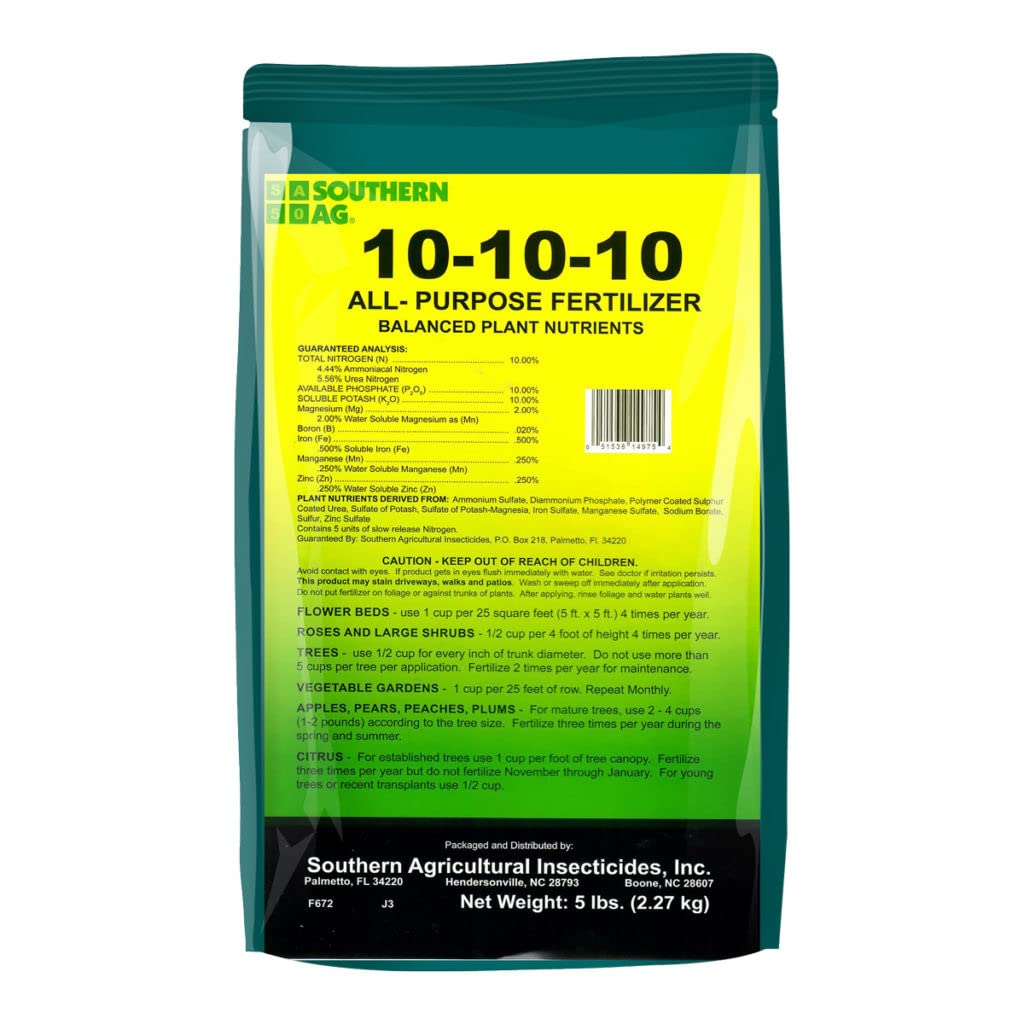
| Item Form | Granules |
|---|---|
| Specific Uses For Product | Citrus and Fruit Trees, Flowerbeds, Roses, and Large Shrubs, Vegetable Gardens |
| Application Method | Broadcast evenly over area and water in. |
| Mixing Ratio | 10:10:10 |
This 5 lb bag of Southern Ag 10-10-10 granular fertilizer is a straightforward, balanced all-purpose feed for vegetable beds, fruit trees, roses, and shrubs. You spread the granules uniformly over soil or beds and water them in; directions and recommended cup measurements are printed for common uses so dosing is easy. The formula supplies equal parts nitrogen, phosphorus, and potassium plus trace minerals like magnesium, iron, manganese, zinc, and boron, which supports steady vegetative growth and overall plant health. For asparagus specifically it can be used as a periodic maintenance feed during the growing season to support fern growth and energy storage in crowns. The product is simple to store and apply, and the small bag size is convenient for trialing on a single bed or patch. Limitations are that it is a general blend rather than a tailored asparagus formula, so heavy feeders or soils needing specific nutrient correction may require additional amendments, and granular broadcast feedings require careful placement to avoid contact with foliage or runoff risks described on the label.
Best for: Gardeners on a budget who want a simple, balanced fertilizer to maintain small asparagus patches and other mixed beds without buying specialty formulas.
Less Ideal for: Growers managing large asparagus plantings, or who need a targeted high-potassium or soil-specific amendment, should choose a crop-specific or soil-test-driven fertilizer.
- Balanced 10-10-10 N-P-K supports general growth and root development.
- Includes micronutrients (iron, manganese, zinc, boron) for broader plant nutrition.
- Clear application instructions and coverage rates for common garden uses.
- Small 5 lb size is convenient for testing on a single asparagus bed or small garden.
- Not formulated specifically for asparagus so may lack the higher potassium or phosphorus some heavy beds benefit from.
- Granular broadcast application can stain hard surfaces and requires watering after application to activate nutrients.
Verdict: A low-cost, easy-to-use balanced granular fertilizer that is a practical maintenance feed for small asparagus beds and mixed gardens.
Choosing the Right Fertilizer for Brinjal: Key Factors to Consider
Nutrient Ratio and Stage-Specific Needs
Brinjal plants shift their nutrient demands through the season. Early growth benefits from moderate nitrogen to build healthy leaves and stems. As plants begin to flower and set fruit, phosphorus and potassium become more important to support bloom formation, root strength, and fruit development.
Choosing a fertilizer whose ratio matches the current growth stage reduces the risk of excessive vegetative growth at the expense of fruiting. Look for clear N-P-K labeling and consider pairing a balanced base fertilizer with a bloom booster or potash-rich supplement when fruit set begins. Frequent light feedings with a balanced formula often work better than heavy single feedings.
Release Type and Feeding Frequency
Fast-release fertilizers deliver nutrients immediately and are useful when plants show a specific deficiency or during rapid growth spurts. However, they require more frequent applications and increase the risk of salt buildup in the root zone.
Slow-release or controlled-release fertilizers offer a steadier supply over weeks or months, reducing labor and the chance of root burn. For containers or well-draining beds, a controlled-release product helps maintain steady nutrition between scheduled feedings. Match release type to your maintenance routine and watering frequency.
Application Method and Garden Setup Compatibility
How you plant brinjal – in pots, raised beds, or in-ground rows – affects which fertilizer forms are most useful. Granular fertilizers are easy to apply to beds and topdress containers, while water-soluble formulas are convenient for foliar feeding and quick corrective feeds. Liquid concentrates can be diluted for frequent, gentle feeding but require accurate measuring.
Consider whether you need a product that works with drip irrigation or fertigation systems. Flexibility matters when you rotate crops or move containers seasonally.
Soil and Salt Considerations
Brinjal is sensitive to high soluble salts which can damage young roots and reduce water uptake. Fertilizers with a high salt index can cause tip burn, wilting, or reduced seedling vigor, particularly in containers where salts concentrate between waterings.
Assess your soil's baseline fertility and drainage. In heavy soils, lower-salt, slow-release options reduce the chance of accumulation. In containers, flush periodically and choose lower-salt formulations or organic sources that release nutrients more gently.
Micronutrients and Soil Biology
Beyond N-P-K, micronutrients such as magnesium, calcium, and boron play supporting roles in flower development and fruit quality. A fertilizer that includes or is compatible with micronutrient supplements helps avoid hidden deficiencies that limit yield.
Organic amendments and products containing beneficial microbes can enhance nutrient availability and soil structure over time. If you rely heavily on container production, incorporating a biological component helps maintain long-term root health.
Practical Handling and Safety for Home Gardens
Ease of measuring, storage stability, and clarity of instructions matter for home growers. Powdered or highly concentrated liquid formulas require careful dilution to avoid overfeeding. Pelletized or coated granules are user-friendly and reduce accidental overdosing.
Also factor in odor, dust, and child- or pet-safety when storing and applying fertilizers. Clear labeling and straightforward application rates make it easier to feed consistently through the season.
When to Start Feeding Brinjal
Begin light feeding once seedlings have two to four true leaves or when transplants are well established in the garden. Early applications should aim to support root establishment rather than forcing excessive foliage growth.
Increase phosphorus and potassium emphasis as flower buds form to encourage pollination and fruit set. Monitor plants weekly for signs of deficiency and adjust application intervals accordingly.
- Seedling stage: diluted, low-strength feed every 10-14 days
- Vegetative stage: balanced N-P-K at standard strength
- Flowering/fruiting: shift to higher P and K or supplemental potash
Feeding in Containers Versus In-Ground Beds
Containers dry and concentrate salts faster than in-ground beds, so choose lower-salt or slow-release formulations for pots. Regular flushes and lighter, more frequent feedings keep nutrient levels safe for roots.
In-ground beds benefit from a single incorporated application of a balanced granular fertilizer at planting, followed by side-dressings or liquid feeds during the season. Soil organic matter and microbial activity in beds often improve nutrient cycling compared with containers.
- Use controlled-release granules in pots for consistent supply
- Side-dress or foliar feed beds during peak flowering
Integrating Organic and Synthetic Options
Organic fertilizers release nutrients more slowly and improve soil structure, while synthetic formulas provide predictable nutrient ratios and quick correction of deficiencies. Many gardeners use a combined approach: an organic base to build soil health and targeted synthetic feeds to address immediate needs.
If you prefer organic growing, plan for longer-term soil building and increase frequency of lighter feeds during heavy-fruiting periods. For fast results, water-soluble synthetics deliver immediate availability but require careful dosage.
- Organic base plus targeted soluble feed for heavy fruiting
- Reserve synthetic quick-feeds for visible deficiency or rapid growth stages
Signs of Over- and Under-Fertilization
Yellowing lower leaves, weak bloom, and poor fruit development can indicate nutrient imbalance or deficiency. Excessive lush vegetative growth with few flowers often signals too much nitrogen. Burned leaf edges, wilting despite adequate moisture, or crusted soil surfaces suggest salt accumulation from overfeeding.
When you see these signs, pause feeding, flush the soil in containers with clean water, and re-evaluate the applied rates and product choice. Soil testing helps pinpoint persistent issues.
- Too much nitrogen: lush leaves, few flowers
- Salt burn: scorched leaf margins, wilting
- Deficiency: pale leaves, poor fruit set
Timing Fertilizer Around Watering and Weather
Apply granular fertilizers to dry soil and water in to activate them, or use a liquid feed on moist soil to minimize root stress. Avoid heavy feeding right before extreme heat periods when plants are transpiring heavily; nutrient uptake becomes erratic under heat stress.
After heavy rains, delay application until soil moisture stabilizes to prevent nutrient leaching. For container growers, feed more frequently in warm months and cut back during cooler, slower-growth periods.
- Water in granular feeds to activate nutrient release
- Avoid major feedings before heatwaves or heavy rain
How We Chose the Best Fertilizer for Brinjal
We focused on fertilizer attributes that directly affect brinjal performance in small-scale vegetable gardens and containers. Key evaluation criteria included nutrient ratio and bioavailability, because brinjal needs a balance of nitrogen for leaf growth, phosphorus for bloom and root development, and potassium for fruiting and stress resilience. We assessed release behavior and longevity to match common feeding schedules, comparing fast-release formulas that provide immediate uptake with slow-release and controlled-release options that reduce application frequency. Ease of application and flexibility was another filter: products had to be usable in both container and in-ground setups, compatible with foliar feeds and fertigation where applicable. We evaluated physical handling and safety for home gardens, favoring formulations that are easy to measure and unlikely to cause fertilizer burn. Environmental considerations such as soluble salt levels and the presence of beneficial microbes or organic matter influenced selection as well. Excluded items included general-purpose soil amendments with negligible nutrient analysis, hobbyist mixes without clear feeding instructions, and industrial or bulk agricultural fertilizers not intended for home or small-scale use. The final shortlist balances predictable nutrient delivery, gardener-friendly application, and suitability for brinjal growth stages.
FAQ
How often should I fertilize brinjal plants?
It depends on the fertilizer type. Fast-release liquid feeds are typically applied every one to two weeks, while controlled-release granules can last several weeks to months. Adjust frequency for container-grown plants, which often need more frequent, lighter feeds.
Can I use a general vegetable fertilizer on brinjal?
Yes, a balanced vegetable fertilizer will work, but tailor feeding as the plant shifts to flowering. Increasing phosphorus and potassium during bloom and fruit set helps support yield and fruit quality.
Are organic fertilizers effective for brinjal?
Organic fertilizers supply nutrients more slowly and improve soil structure over time. They are effective, especially when combined with periodic soluble feeds during heavy-fruiting periods to meet higher short-term nutrient demands.
What signs indicate my brinjal needs more potassium?
Signs of potassium deficiency include reduced fruit size, poor color development, and older leaf margins turning brown or scorched. A potassium-rich supplement or potash-containing feed during fruiting can correct this.
Should I foliar feed brinjal plants?
Foliar feeding can quickly correct certain micronutrient deficiencies or provide a short-term boost during flowering. Use dilute solutions and avoid foliar sprays during the hottest part of the day to reduce leaf scorch risk.
Final Verdict
Choosing the best fertilizer for brinjal comes down to matching nutrient release and ratio with your planting method and the crop stage. Prioritize a product that offers the right balance for flowering and fruiting, a safe salt index for your setup, and an application style you will maintain consistently. Balance tradeoffs between convenience and control: controlled-release formulas reduce labor but may not correct sudden deficiencies as quickly as soluble feeds. Use soil tests and plant observations to guide midseason adjustments and you will reliably improve fruit set and overall plant health.
