

Note: This article contains affiliate links. If you click on these links and make a purchase, I may earn a small commission at no extra cost to you. This helps support my research and content. Read my full affiliate disclosure here.
Ants can move from harmless yard visitors to persistent indoor pests before you notice a trail. Choosing an effective long term ant killer matters because some products only stop colonies briefly while others suppress nests for weeks or months. This guide covers seven top long term ant killers shortlisted for their ability to deliver extended residual action, compatible placement for indoor and outdoor areas, and manageable safety profiles. Below you'll find practical notes on how these products behave in real garden and home settings plus the criteria we used to evaluate them. Use the checklist that follows to match product traits to the places you need protection.
Top Picks at a Glance
| Best Overall The best all-around choice for most situations | Spectracide Terminate Termite & Carpenter Ant Killer with AccuShot Sprayer, 1.33 Gal |  |
| Best Quality Built to a higher standard if you want something more solid | Syngenta Advion Ant Gel Bait, 30 g |  |
| Best Value The sweet spot between price and what you get | Terro Outdoor Liquid Ant Bait Stakes, 12-Pack |  |
| Best Budget The cheapest option that still gets the job done reliably | Combat Max Ant Killing Gel, 27 g Syringe |  |
| Highest Rated A top-rated pick with lots of positive feedback | Envu Suspend SC Insecticide Concentrate, 16 oz |  |
| Most Popular A crowd favorite that many people choose with confidence | TERRO Liquid Ant Killer Bait Stations, 12-Pack (T300B) |  |
| Best Seller A high-volume bestseller chosen again and again | Ortho Home Defense Insect Killer for Indoor & Perimeter, 1.33 gal. with Comfort Wand |  |
Spectracide Terminate Termite & Carpenter Ant Killer with AccuShot Sprayer, 1.33 Gal

| Unit Count | 166.4 Fluid Ounces |
|---|---|
| Item Form | Spray |
| Target Species | Insects |
| Active Ingredients | Lambda-Cyhalothrin |
| Specification Met | EPA |
Spectracide Terminate combines a ready-to-use lambda-cyhalothrin formula with a battery-powered AccuShot sprayer to deliver targeted indoor and perimeter treatments. It is used by aiming the extendable wand at cracks, baseboards, foundations, decks or woodpiles and pressing the trigger for a continuous spray or twisting the nozzle for a stream. Notable features include a two-finger trigger to reduce hand fatigue, an extendable wand for improved reach and a clear, non-staining formula with minimal odor. In practical use it provides fast knockdown on contact for many common wood-infesting and nuisance insects and offers up to nine months of indoor control against carpenter ants. Important limitations are that it is not intended as the sole solution for active termite infestations and users must follow safety directions to keep people and pets away during application. The sprayer requires brief priming and uses batteries which are included, but occasional re-priming may be needed for overhead or angled spraying.
Best for: Homeowners who want a convenient, all-purpose indoor and perimeter treatment to manage termites, carpenter ants and other common pests without hiring a pro and who value ease of application.
Less Ideal for: People facing confirmed, active termite colonies or large structural infestations that need professional termite control or specialized products.
- Ready-to-use formula kills termites, carpenter ants and many listed insects on contact
- AccuShot battery-powered sprayer with extendable wand reduces hand fatigue and improves accuracy
- Clear, non-staining formula with minimal lingering odor
- Provides up to 9 months indoor control against carpenter ants
- Not recommended as the sole treatment for active termite infestations
- Requires batteries and occasional priming for reliable spray performance
Verdict: A convenient ready-to-use spray with a powered wand that makes targeted indoor and perimeter treatments against termites and carpenter ants easy for typical homeowners.
Syngenta Advion Ant Gel Bait, 30 g
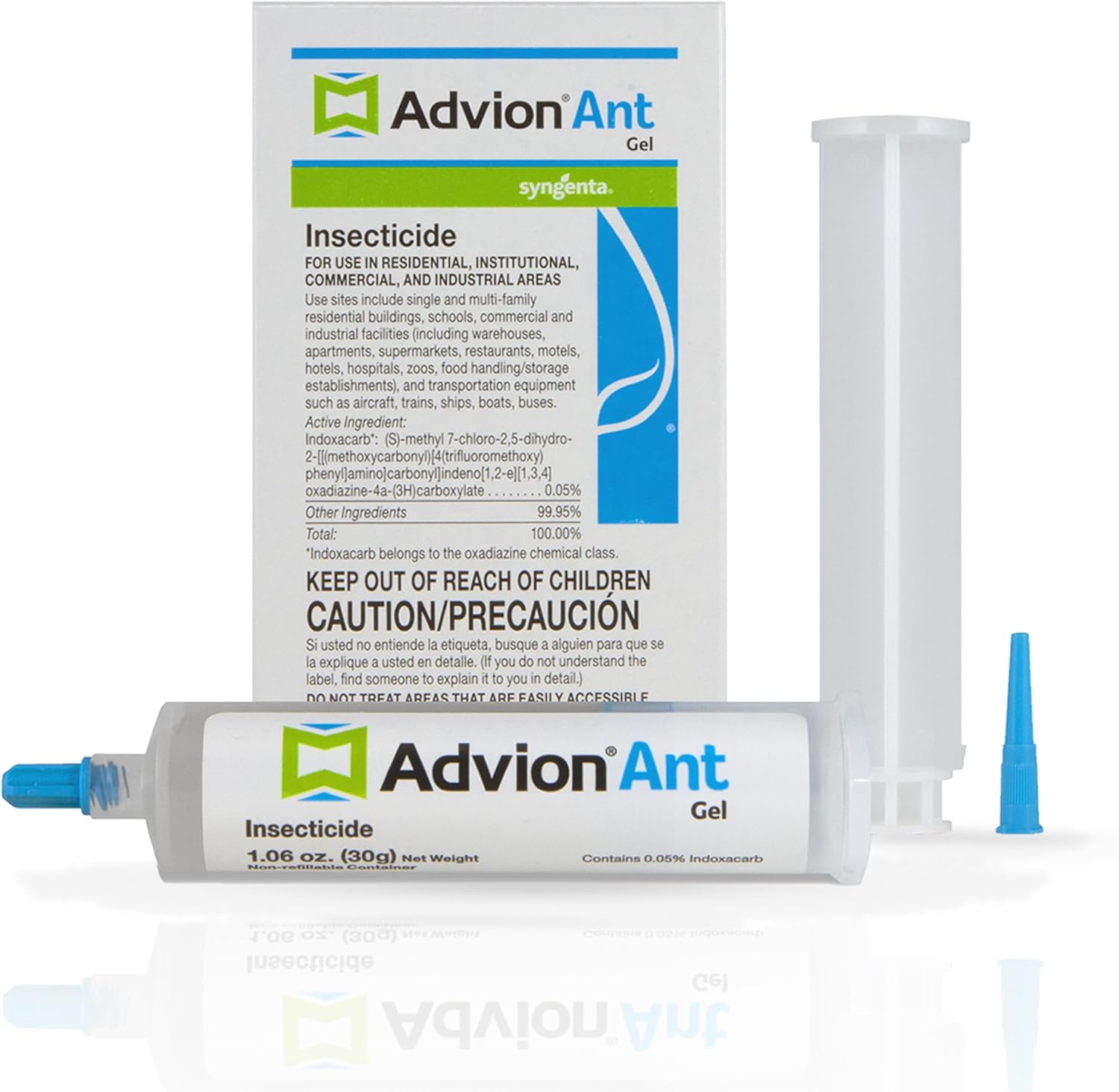
| Item Form | Gel |
|---|---|
| Target Species | Insects |
| Active Ingredients | Indoxacarb |
Advion Ant Gel is a concentrated, professional-style ant bait formulated around indoxacarb and a highly palatable gel matrix to lure foraging ants and carry toxicant back to the colony. You apply small dabs of the translucent, nonstaining gel in ant trails, near nesting sites, or in voids where ants forage; workers feed on the gel and transfer it through trophallaxis, which helps suppress entire colonies rather than just worker ants. The formulation is touted for lasting integrity with low odor and high attractiveness to sweet-feeding species, so you do not need frequent reapplication in protected spots. Because it is a targeted bait rather than a broadcast insecticide, it is practical for spot treatments in kitchens, pantries, and around baseboards as well as sheltered outdoor locations. Important limits are that it is a bait product requiring worker-mediated distribution so results are not instant and indoor use requires keeping it away from children and pets.
Best for: Buyers who prioritize effective colony-level control and want a concentrated, professional-style bait for spot treatments inside homes or in sheltered outdoor locations.
Less Ideal for: People needing immediate knockdown of visible ants or those who require a product for widespread outdoor perimeter treatments should consider different control methods.
- Contains indoxacarb, a potent active ingredient with a unique mode of action
- Highly palatable, translucent gel that attracts sweet-feeding ants
- Maintains formulation integrity for extended periods in sheltered application sites
- Suitable for indoor and sheltered outdoor spot treatments
- Relies on worker feeding and transfer so colony elimination can take several days to weeks
- Not intended for broad outdoor broadcast use or exposed wet areas
Verdict: Choose Advion Ant Gel when you want a high-performance, worker-transferred bait that targets colonies rather than just knocking down visible ants.
Terro Outdoor Liquid Ant Bait Stakes, 12-Pack

| Unit Count | 12 Count |
|---|---|
| Material Type | Plastic |
| Target Species | Ant |
| Power Source | manual |
These Terro Outdoor Liquid Ant Bait Stakes are simple, low-effort bait stations designed to intercept ant colonies outdoors before they reach the house. Each stake contains a sweet liquid bait with borax that worker ants feed on and carry back to the nest, which can eliminate the queen and much of the colony over a 2 to 4 week period. They are weather-resistant, see-through so you can monitor bait consumption, and install by cutting a tab and pushing the stake into soil or mulch near ant trails. For homeowners dealing with small common species such as little black, odorous house, pavement, and ghost ants, the stakes provide targeted perimeter protection without sprays or direct contact. Limitations are that baiting takes days to weeks to fully work and you may see increased ant activity at first as foragers discover the bait. Also they must be placed where children and pets cannot access them and replaced periodically to maintain protection.
Best for: Homeowners who want a low-effort, evidence-based way to stop small common outdoor ants at the source and prefer baiting over sprays, using visual confirmation of activity before replacing units.
Less Ideal for: People needing an immediate knockdown or single-visit solution for heavy indoor infestations or those who cannot place bait stations out of reach of children and pets.
- Colony-level control via borax bait that foraging ants share with the nest
- Ready-to-use stakes are easy to deploy by cutting the tab and inserting in soil
- See-through design lets you monitor bait consumption and know when to replace
- Weather-resistant stations suitable for yards, patios, and garden perimeters
- Works gradually and can take 2–4 weeks for complete colony control
- Not child- or pet-proof if placed in accessible areas and requires careful placement
Verdict: A practical, easy-to-use baiting solution that stops small outdoor ant colonies by getting worker ants to carry borax bait back to the nest.
Combat Max Ant Killing Gel, 27 g Syringe

| Active ingredient | Fipronil 0.001% |
|---|---|
| Net weight | 27 gram (0.95 oz) |
| Application | Indoor and outdoor use |
| Form | Ready-to-use gel in syringe |
Combat Max Ant Killing Gel is a syringe-applied bait that targets foraging ants and carries a fipronil-based formulation back to the nest to eliminate the queen, larvae, and workers. It is used by placing small dots of gel where ants travel or enter structures—along trails, in cracks, and near suspected nests—so foragers feed and transfer the bait to the colony. Notable features include a precise syringe applicator for tight spaces, an odorless, vapor-free gel suitable for kitchens and living areas, and a high water-content formula that encourages quick feeding and colony impact within three to five days. The product is effective on a range of common species including little black ants and odorous house ants. Important limitations are the small 27 gram syringe size, which may require reapplication or multiple tubes for larger infestations, and the need to avoid placement on areas that are routinely washed or where food contact can occur. Follow label directions to prevent contamination and do not use on electrical equipment.
Best for: Buyers who want a targeted, low-odor solution to control small black ants and other common household species by placing bait directly on trails and entry points and who prefer precise, spot treatments over broad sprays.
Less Ideal for: People facing large outdoor mound infestations or who need long-lasting perimeter protection should consider larger-capacity baits or complementary control methods.
- Syringe applicator allows precise placement in cracks, crevices, and other hard-to-reach ant pathways
- Fipronil-based formula begins working within hours and is designed to eliminate entire colonies via forager transfer
- Odorless and vapor-free gel suitable for use in kitchens, bedrooms, and living areas
- High water content encourages faster feeding by ants, speeding colony control
- Small 27 gram (0.95 oz) syringe may be insufficient for large or widespread infestations
- Must avoid areas that are routinely washed or where food is prepared, limiting placement options
Verdict: A precise, low-odor gel bait that quickly attracts and kills foraging small black ants and their colonies when applied directly to trails and entry points.
Envu Suspend SC Insecticide Concentrate, 16 oz

| Item Form | Spray |
|---|---|
| Target Species | Ants, Bed Bugs, Cockroaches, Fleas, Mosquitoes, Scorpions, Spiders, Ticks, Wasps, Yellow Jackets |
| Liquid Volume | 16 fluid ounces |
| Specification Met | EPA |
| Active Ingredients | Deltamethrin |
Suspend SC is a concentrated deltamethrin suspension concentrate designed for perimeter, crack-and-crevice and spot treatments to stop crawling pests before they enter structures. Mixed with water, the concentrate covers large areas around foundations, doors, windows, patios and landscaping and can also be used in garages, basements and crawl spaces. Its low-odor, water-based formulation and label flexibility allow indoor spot applications in tight areas and on some fabrics when used exactly as directed. The main practical benefit is the long residual control on treated surfaces, which reduces the need for frequent reapplication compared with short‑acting knockdown sprays. Because it targets a broad list of crawling pests, it fits into routine prevention programs aimed at cockroaches, ants, spiders and similar pests. Important limitations are that this is a professional‑strength insecticide that requires careful dilution and label-following for safe indoor use and that it does not provide immediate broad-area aerosol knockdown like ready-to-use sprays.
Best for: Buyers who prioritize reliable, long-lasting perimeter control and are willing to mix and apply a concentrated product correctly for ongoing cockroach prevention.
Less Ideal for: People who want simple ready-to-use aerosols or need instant knockdown across large indoor living spaces should consider alternative formulations.
- Concentrated formulation mixes with water to treat large perimeter and exterior areas
- Contains deltamethrin for long residual control on treated surfaces
- Low-odor, water-based formula suitable for indoor crack-and-crevice and spot use when label directions are followed
- Broad-spectrum efficacy against common crawling pests including cockroaches, ants and spiders
- Requires dilution and careful handling, so it is less convenient than ready-to-use sprays
- Not intended as an immediate aerosol knockdown product for open-area spraying
Verdict: Choose Suspend SC if you want a concentrated, long‑residual deltamethrin treatment to reliably protect perimeters and reduce repeat applications against cockroaches.
TERRO Liquid Ant Killer Bait Stations, 12-Pack (T300B)

| Unit Count | 12 Count |
|---|---|
| Item Form | Liquid |
| Target Species | Insects |
| Active Ingredients | Sodium Tetraborate Decahydrate (Borax), 5.40% |
Terro Liquid Ant Killer bait stations are prefilled, single-use traps designed for indoor control of common sugar-loving ants. You place the small stations along baseboards, in corners, under appliances, or on countertops where you see ant activity. Worker ants are drawn to the sweet liquid, feed on it, and take it back to the nest so the borax-based active ingredient can eliminate the colony over days to weeks. The product is easy to use with no mixing or setup and the 12-pack gives coverage for several rooms. Because the bait is contained inside a low-profile plastic station, it reduces incidental contact risk compared with loose sprays or powders and lasts for weeks while ants continue to visit. Limitations are that the formula targets sugar-preferring species so very protein- or grease-attracted ants may ignore it, and control can take 2 to 4 weeks for larger infestations. Also stations should be placed away from pets and children despite the contained design since the bait contains borax.
Best for: Homeowners who prioritize an easy, low-hassle indoor solution and want a bait that works at the colony level with minimal hands-on pest handling.
Less Ideal for: People who need immediate knockdown of ants or who have pets or children that frequently access treated areas and cannot reliably keep them away from placed stations.
- Ready-to-use stations require no mixing or setup
- Designed to be carried back to the nest for colony-level control
- Low-profile enclosed bait reduces messy exposure compared with loose liquids or sprays
- 12 stations provide coverage for multiple rooms or hotspots
- Formulation is sugar-based so less effective on ants that prefer protein or grease
- Control can take 2–4 weeks for large or established colonies
Verdict: A simple, low-contact indoor bait system that reliably reduces sugar-loving ant infestations by getting worker ants to carry borax back to the colony.
Ortho Home Defense Insect Killer for Indoor & Perimeter, 1.33 gal. with Comfort Wand

| Item Form | Spray |
|---|---|
| Target Species | Insects |
| Liquid Volume | 1.33 gallons |
| Active Ingredients | Bifenthrin 0.05%, Zeta-Cypermethrin 0.0125% |
This 1.33 gallon Ortho Home Defense spray is designed to treat both indoor problem spots and the outdoor perimeter of a home to reduce ants, roaches, spiders and many other crawling and flying insects. It comes with a battery-powered Comfort Wand that delivers a continuous spray so you can apply a uniform band around foundations, patios and entry points without bending or pumping. The formula with bifenthrin and zeta-cypermethrin is intended to kill on contact and establish a barrier that the manufacturer says lasts up to 12 months for ants, roaches and spiders on non-porous indoor surfaces. In real-world use that means fewer repeat treatments in busy yard perimeters and around doors and windows. The spray dries clear with minimal fumes which helps for indoor use near kitchens and living areas. Limitations are that this is a chemical insecticide so users should follow safety directions around children, pets and plants and it is not a specific solution for pests not listed on the label. For homeowners focused on strong, perimeter-level protection this product simplifies application and covers a large area per container.
Best for: Homeowners who want a performance-focused perimeter treatment to reduce recurring yard and entry-point insect problems and prefer a ready-to-use product that is easy to apply.
Less Ideal for: People seeking organic or non-chemical control methods or those who need a targeted solution for pests not listed on the label should consider alternative products.
- Includes battery-powered Comfort Wand for continuous, fatigue-free application
- Ready-to-use 1.33 gallon container covers large perimeters without mixing
- Formula creates a barrier claimed to provide up to 12 months protection against ants, roaches and spiders on non-porous indoor surfaces
- Dries clear and gives off minimal fumes, making indoor use more practical
- Contains synthetic insecticides so precautions are required around children, pets and ornamentals
- Protection claims are specific to certain species and surfaces so results vary by pest and conditions
Verdict: A powerful, ready-to-use perimeter and indoor spray for homeowners who want long-lasting, performance-oriented protection against common yard and household insects.
Choosing the Right Long Term Ant Killer: Key Factors to Consider
Residual Duration and Weather Resistance
How long a product continues to kill ants after application is the central consideration for long-term control. Products with longer residual activity reduce the need for repeat treatments, but their persistence can be affected by sun exposure, rain, and irrigation. For outdoor perimeter use, choose formulations rated to withstand light rainfall or that specify reapplication intervals after heavy precipitation. Indoor treatments benefit from residues that cling to baseboards and entry points without leaving excessive dust or residues on floors.
Understanding residual duration also helps you plan seasonal treatments. A product that reliably lasts several weeks can cover a single typical ant season, while shorter residuals require timed follow-ups to intercept new foraging. Always follow label guidance for reapplication timing to avoid overuse and to maintain both effectiveness and safety.
Mode of Action and Colony Control
Long-term control depends on reaching the colony or disrupting recruitment, not just killing foragers. Some products work as contact-kill agents that eliminate ants on contact but do not affect nestmates, while others include slow-acting baits or transfer agents that worker ants carry back to the nest. For sustained suppression, consider products with a mechanism that encourages feeding or transfer to brood and queens.
Know the ant species you are targeting where possible. Different species have distinct foraging behaviors and bait preferences; a formulation that attracts common house-infesting species will perform better at colony-level control. Combining perimeter barrier treatments with targeted baiting often gives the best long-term results because the barrier reduces new entry while baits reduce established nests.
Application Versatility and Placement
Where and how you can apply a product matters for both safety and effectiveness. Some long-term ant killers are formulated for perimeter sprays and foundation treatments, others are granular for lawns and landscape beds, and some are safe for indoor crack-and-crevice use. Choose a product whose application method fits the sites you need to protect: inside entryways, around window and door frames, along foundation lines, or in shrub and mulched areas.
Consider how application affects non-target plants and beneficial insects. Granules applied to turf are less likely to contact ornamental planting than a broadcast spray. If you plan to use treatments near pollinator-attractive plants, pick options and timings that minimize exposure, such as treating when flowers are not in bloom and following label buffers for shrubs and beds.
Human and Pet Safety
Safety information on the label determines where a product can be used safely and what precautions to take. Long-lasting formulations may present greater residual exposure risk to children and pets if placed in accessible locations. Look for products with clear setback distances, reentry intervals, and guidance on keeping treated areas off-limits until residues are set or dried.
When treating around edible gardens or play areas, follow label instructions about pre-harvest intervals and safe distances. Use application tools that reduce drift and avoid broadcast treatments during windy conditions. For households with pets, read directions on allowable outdoor placements and consider using bait stations or targeted perimeter applications to limit access.
Environmental Persistence and Runoff Risk
Long-living products can bind to soil or run into drainage during heavy rain, which creates potential risk for nearby waterways and non-target organisms. Choose formulations with label guidance on avoiding runoff and follow recommended buffer zones from storm drains and water bodies. Granules and certain micro-encapsulated sprays are often designed to reduce immediate runoff risk, but all products should be applied according to direction to limit environmental exposure.
If your property slopes toward a creek or storm system, plan applications on calm, dry days and avoid treating before forecast rain. Integrated approaches that rely on targeted baiting plus spot perimeter treatments typically reduce total active ingredient use and lower runoff potential.
Ease of Use and Label Instructions
Clear label directions are essential for achieving long-term control while staying safe. Products with straightforward mixing instructions, simple dosages for different treatment areas, and clear reapplication intervals make follow-through more likely and reduce user error. Specialized equipment can give professional-level results but may not be practical for casual gardeners.
Look for labels that spell out placement examples, such as distance from foundations, how to treat cracks and crevices, and whether treatments are suitable for mulch or turf. Good labels also describe what to expect after application, such as the timeframe for reduced ant activity and recommended follow-up actions.
Matching Treatment Type to the Site
Different formulations perform best in different settings. Use low-profile crack-and-crevice applications or baits for indoor kitchens and bathrooms, perimeter sprays or liquid barriers around foundations, and granules for lawns and wide landscape areas. Matching product type to the treatment site reduces exposure to people and plants while maximizing the product's intended residual effect.
When treating mixed-use yards with ornamental beds and vegetable patches, plan placements to minimize contact with edible plants. Focus barrier treatments along foundations and under eaves, while placing baits in covered stations away from children and pets.
- Indoor: crack-and-crevice products and enclosed bait stations
- Perimeter: low-drift sprays and liquid barriers
- Landscape: targeted granules in turf and under mulch
Timing Treatments for Peak Foraging
Apply long-term products when ants are actively foraging but before populations spike. Early spring or late summer can be effective windows depending on local climate and species. Weather also influences efficacy; avoid applying before heavy rain unless the label specifically allows for rainfast performance.
For bait-based colony control, place baits when competing food sources are limited. For barrier treatments, allow residues to set and then monitor high-traffic entry points for signs of renewed activity before repeating applications.
- Check local activity patterns to time applications
- Avoid treating during hot, rainy periods that reduce efficacy
Combining Baits and Barriers for Longer Suppression
A combined approach often gives the best long-term results. Use baits to target colonies directly and a perimeter barrier to block reinvasion. Baits reduce nest numbers while a barrier reduces new foragers entering the structure.
Keep bait stations replenished and placed where ants forage but away from non-target animals. Use barriers according to label spacing instructions to maintain consistent coverage around the property perimeter.
- Place baits along ant trails but out of reach of pets
- Apply barrier products in continuous lines around foundations for even protection
Safe Use Around Edible Gardens and Pollinators
If you have vegetables, fruit trees, or pollinator-friendly plantings, prioritize placement and timing to limit exposure. Many long-term ant products list specific guidance about distances from edible plants and when it is safe to reenter or harvest.
Avoid treating flowering plants or applying broadcast sprays during bloom. When in doubt, use bait stations or targeted treatments away from attractant plants and follow label instructions on harvest intervals and worker protections.
- Treat non-blooming times to reduce pollinator exposure
- Use targeted placements to keep active ingredients off produce
Monitoring and Knowing When to Reapply
After applying a long-term treatment, monitor treated zones weekly for fresh activity. Complete elimination can take days to weeks depending on the active mechanism. If ant activity returns in treated zones, consult label reapplication intervals rather than repeating treatments prematurely.
Keep records of application dates, weather conditions, and observed activity levels. This log helps determine whether a product's residual claims hold up under your local conditions and guides future seasonal planning.
- Inspect entry points and bait stations weekly
- Follow label-specified reapplication windows
How We Chose the Best Long Term Ant Killer
We prioritized products that deliver measurable, sustained control rather than quick-contact knockdown alone. Key evaluation criteria included residual lifespan under typical use, effectiveness against common ant species, and application types that suit indoor, perimeter, or landscape use. We also assessed human and pet safety information for recommended application rates, and how formulation type affects placement options and runoff risk. Ease of application and how clearly label instructions guide repeat treatments were considered to ensure safe, consistent results. We excluded products that are designed strictly for ephemeral spot treatments or that require specialized applicators not commonly available to home gardeners. Products that lacked clear label directions for long-term use or that presented disproportionate runoff risk in planted areas were not included. The final shortlist reflects a balance of extended efficacy, practical application methods, and safety guidance gardeners need for sustained ant control.
FAQ
How long should I expect a long-term ant treatment to last?
It depends on the formulation and conditions. Many long-term products advertise residual action measured in weeks to months, but sun, rain, and foot traffic can reduce effectiveness. Check the label for the specified residual window and monitor activity to decide on reapplication.
Can I use long-term ant products around vegetable gardens?
Some products have specific guidance allowing use near ornamentals but restrict application near edible parts or require waiting periods before harvest. Prefer targeted placements, bait stations, or perimeter treatments that keep active ingredients away from produce and follow label directions closely.
Are bait-based long-term solutions safer for pets and kids?
Baits in secure stations generally reduce direct exposure risk compared with broadcast sprays, but safety varies by formulation. Always use tamper-resistant stations and follow label precautions about placement and access to treated areas to limit accidental ingestion.
Will perimeter treatments stop ants coming from the yard?
Perimeter barriers reduce the number of ants crossing into structures but may not eliminate source colonies in the yard. Combining perimeter treatments with targeted baiting of nests provides better long-term suppression than either method alone.
How should I adjust treatments after heavy rain?
Many long-term products require reapplication after heavy rainfall if residues are washed away. Consult the product label for rainfast times and recommended reapplication intervals to maintain effective coverage without overusing active ingredients.
Final Verdict
Prioritize products whose residual duration and mode of action match the sites you need to protect. For buildings, favor options that combine perimeter barriers with colony-targeting baits; for broad landscape control, choose formulations rated for turf and mulch with low runoff risk. Balance persistence with safety: longer-lived residues reduce repeat work but demand careful placement to protect children, pets, and pollinators. Make decisions based on where ants forage, the ant species present, and local environmental conditions. Following label instructions for application and timing gives the best chance of sustained control while minimizing unintended exposure.
