

Note: This article contains affiliate links. If you click on these links and make a purchase, I may earn a small commission at no extra cost to you. This helps support my research and content. Read my full affiliate disclosure here.
When ants show up in kitchens, planter beds, or on patios you want control that actually works without introducing unnecessary toxins to the people, pets, and plants you care about. Choosing a least toxic ant killer matters because products in this category vary widely in how they kill colonies, how persistent residues are, and how safe they are for non-targets in a domestic garden or home. This guide shortlists seven top options across different application styles and situations. We evaluate each choice for safety around children and pets, real-world effectiveness against common ant species, and suitability for indoor or edible-plant areas. Read on to see which types perform best for the situations you face, and why those evaluation points matter for practical pest control.
Top Picks at a Glance
| Best Overall The best all-around choice for most situations | EcoVenger All Purpose Insect Spray, Plant-Based 16 oz |  |
| Best Quality Built to a higher standard if you want something more solid | STEM Plant-Based Bug Spray for Ants, Roaches and Flies, 12 fl oz |  |
| Best Value The sweet spot between price and what you get | EcoLogic Ant & Roach Killer Aerosol 14 oz |  |
| Best Budget The cheapest option that still gets the job done reliably | STEM Plant-Based Bug Spray — Ants, Roaches & Spiders, 10 oz |  |
| Highest Rated A top-rated pick with lots of positive feedback | NCSIFDD Ant Away Ant Repellent Gel, 6-Pack |  |
| Most Popular A crowd favorite that many people choose with confidence | EcoVenger Ant & Crawling Insect Killer Spray, 16 oz (Plant-Based) |  |
| Best Seller A high-volume bestseller chosen again and again | TERRO Liquid Ant Killer Bait Stations, 12-Pack (T300B) |  |
EcoVenger All Purpose Insect Spray, Plant-Based 16 oz

| Volume | 16 oz |
|---|---|
| Active ingredients | Geraniol, Cedarwood Oil, Citronella Oil, Sodium Lauryl Sulfate |
| Use | Indoor & outdoor ready-to-use spray |
| Kills on contact | Yes |
| Targets eggs | Yes |
EcoVenger All Purpose Insect Spray is a botanical, ready-to-use spray formulated to kill common household pests, including fruit flies, on contact while also disrupting eggs to reduce re-infestation. You use it the same way as any trigger-spray insecticide: shake, spray directly onto affected surfaces, entry points, and breeding areas, and let it dry. Key features are a plant-based active blend (geraniol, cedarwood, citronella) that gives a mild natural scent, non-staining formula safe for most surfaces, and claims of residual protection that lasts for days to weeks depending on conditions. For fruit fly control it is useful for treating countertops, drains, trash areas, and window frames where adults land and lay eggs, and the egg-targeting action helps break the life cycle. Limitations: as a non-synthetic formula it may act more slowly or require repeat applications versus stronger chemical insecticides for heavy infestations, and the nozzle is noted as delicate so treat it gently. Follow label directions and avoid eye contact.
Best for: Buyers who prioritize effective, plant-based pest control for kitchens and indoor spaces and want a product that targets adults and eggs without harsh chemical odors.
Less Ideal for: Those facing a large, established infestation who need the fastest-acting professional-strength chemical control should consider alternative options.
- Broad-spectrum list of target pests including fruit flies and their eggs
- Plant-based ingredients suitable for use around children and pets when used as directed
- Ready-to-use trigger spray for quick spot treatment
- Non-staining formula with a mild, natural scent
- Leaves a residual barrier to help prevent re-infestation for days to weeks
- May require repeated applications or longer to match the speed of stronger synthetic insecticides
- Nozzle described as delicate and can be damaged if handled roughly
Verdict: If you want a safer, plant-based spray that tackles fruit flies and their eggs while leaving a mild scent, this 16 oz ready-to-use formula is built for routine home use.
STEM Plant-Based Bug Spray for Ants, Roaches and Flies, 12 fl oz

| Active ingredients | Geraniol 6.2%, Lemongrass Oil 0.5% |
|---|---|
| Other ingredients | White Mineral Oil, Isopropyl Myristate, (+)-Ethyl Lactate 93.9% |
| Form | Trigger spray |
| Use | Indoor and outdoor spot treatments |
This STEM bug spray is a trigger-spray insecticide formulated with plant-derived actives such as geraniol and lemongrass oil to kill ants, roaches and flies on contact. It is intended for targeted indoor and outdoor spot treatments: shake, hold about a foot from the insect and spray directly on or where insects congregate. The product’s botanical formula and absence of added dyes or strong chemical fragrances make it a reasonable choice for homes where users prefer less synthetic-smelling options. The trigger bottle gives control for spot application and repeated short bursts, and the directions note it is oil-based so spills should be cleaned promptly. Important limitations are that it is not for spraying on people, pets or plants and requires direct hits for best effect rather than long-range fogging. For persistent infestations you may need supplemental measures because this is designed for surface and contact kills rather than residual baiting or area-wide control.
Best for: Buyers who want an affordable, low-odor botanical spray for quick spot control of common household pests and who prioritize a simple, easy-to-use trigger bottle for targeted treatments.
Less Ideal for: People facing large or hidden infestations who need long-lasting residual control or bait-style solutions should consider professional products or integrated pest control approaches.
- Plant-based active ingredients (geraniol and lemongrass oil) that reduce strong chemical odor
- Trigger-spray bottle for controlled, targeted application
- Labeled for both indoor and outdoor spot treatments when used as directed
- No added dye or fragrance listed, which minimizes residue and scent
- Oil-based formula can leave slippery residue if spilled
- Requires direct spraying of insects for effectiveness and offers limited residual control
- Not safe to spray on people, pets or plants
Verdict: A budget-friendly, low-odor plant-based trigger spray that provides quick, targeted kills of ants, roaches and flies for everyday spot treatments.
EcoLogic Ant & Roach Killer Aerosol 14 oz
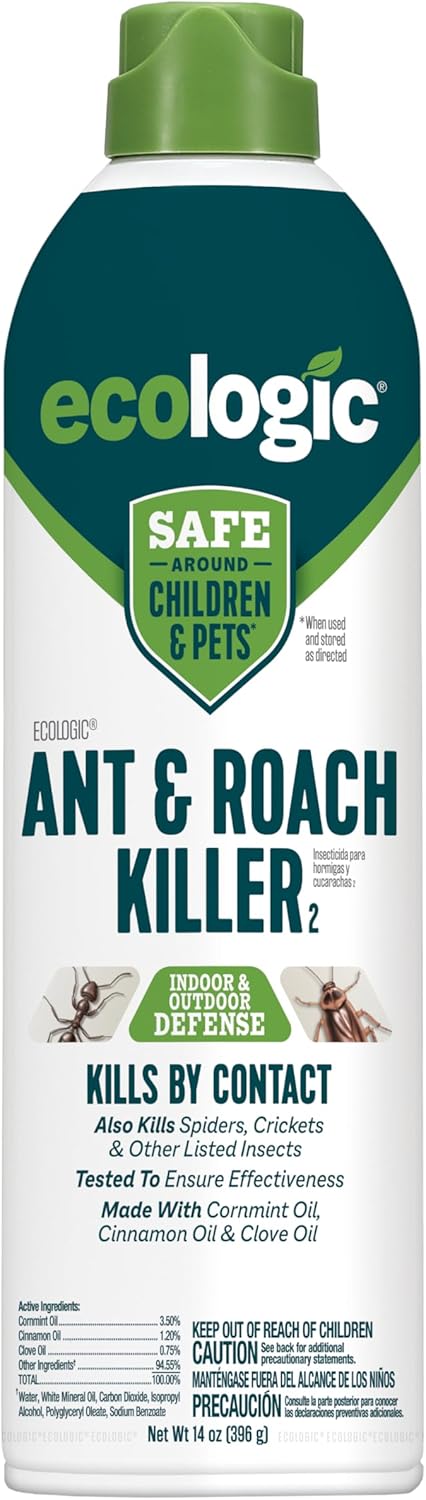
| Unit Count | 14 Ounce |
|---|---|
| Item Form | Spray |
| Target Species | Insects |
| Liquid Volume | 14 fluid ounces |
| Active Ingredients | carbon,sodium benzoate |
EcoLogic Ant & Roach Killer is an aerosol contact spray that uses cornmint, cinnamon and clove oils to kill ants, cockroaches, spiders and other listed insects. It is used like a conventional spray: direct into cracks, crevices and entry points until surfaces are visibly wet, repeating treatments as needed. The formula is positioned as a mindful, plant-oil alternative and is labeled safe around children and pets when used and stored according to directions. Practical benefits include fast knockdown on contact and flexibility for indoor or outdoor spot treatments around baseboards, sinks, doorways and patios. Because it is an aerosol, application is quick and reaches hard-to-access hiding spots. Important limitations are that it is a contact-only killer so it will not control hidden nests or provide long-term residual control, and users should avoid spraying food-preparation surfaces and test outdoor finishes for discoloration before use. For routine, targeted control where you prefer a plant-oil formulation, this works well; for heavy infestations a bait or professional treatment will be more effective.
Best for: Buyers who want a low-cost, plant-oil alternative for quick, targeted control of visible ants and roaches around the home and yard.
Less Ideal for: Those facing large or hidden infestations, or people who need long-lasting residual control should consider baits or professional services instead.
- Uses plant-derived oils (cornmint, cinnamon, clove) as active ingredients
- Designed for both indoor and outdoor spot treatments
- Aerosol format reaches cracks and crevices for quick contact kill
- Contact-only action provides little residual protection or colony control
- May discolor some outdoor surfaces if not tested first
Verdict: A budget-friendly, plant-oil aerosol that delivers fast contact kills for spot treatment of ants and roaches around home and outdoor entry points.
STEM Plant-Based Bug Spray — Ants, Roaches & Spiders, 10 oz

| Item Form | Aerosol |
|---|---|
| Target Species | Ants, Roaches, Spiders |
| Unit Count | 10 Ounce |
| Active Ingredients | Geraniol 6.0%, Lemongrass Oil 0.5% |
This STEM plant-based bug spray is an aerosol insecticide formulated with geraniol and lemongrass oil to kill ants, roaches, and spiders while avoiding strong chemical odors or added fragrances. It is used like a conventional spray: aim at visible insects, crevices, or likely harborages and apply short bursts for spot treatments inside or around entry points outdoors. The botanical active ingredients make it suitable for households looking to reduce synthetic pesticide exposure and the product is labeled for use around people and pets when directions are followed. Practical benefits include a fresh, low-odor application, entomologist testing noted by the brand, and a compact 10 oz size that is convenient to store in a utility closet. Limitations are that it is a spot-treatment aerosol rather than a long‑lasting residual solution and botanical actives can require more frequent reapplication than some conventional synthetic insecticides for ongoing control of heavy infestations.
Best for: Buyers who want an inexpensive, low-odor spray for quick indoor and perimeter spot treatments and prefer plant-based formulations over conventional chemicals.
Less Ideal for: Those facing a heavy or persistent infestation who need a long‑lasting professional‑strength residual treatment should consider alternative products or professional services.
- Plant-based active ingredients (geraniol and lemongrass oil) that reduce harsh chemical odors
- Suitable for indoor and outdoor spot treatments when used as directed
- Compact 10 oz aerosol is easy to store and handy for quick use
- Formulation is marketed as safe around people and pets when directions are followed
- Provides spot control rather than long-lasting residual protection
- May require more frequent applications than stronger synthetic insecticides
Verdict: A budget-friendly, low-odor plant-based aerosol for quick spot control of ants, roaches, and spiders around the home.
NCSIFDD Ant Away Ant Repellent Gel, 6-Pack

| Unit Count | 12 Count |
|---|---|
| Number of Pieces | 1 |
This ant repellent gel is a concentrated applicator product intended for targeted spot treatments around entry points, baseboards, window frames, and known ant trails. You remove the cap, attach the precision tip, and apply pea‑sized drops into crevices or along trails; the manufacturer notes it can take 3–5 days to work through a colony and helps keep ants away for up to 60 days in treated areas. Practical benefits include the narrow applicator for neat placement in tight gaps, suitability for both indoor and outdoor problem spots, and a formulation presented as family and pet safe when used as directed. Important limitations are that results are not instantaneous and multiple applications or placements may be needed to control larger or multiple colonies, and effectiveness depends on correctly locating trails and nest access points. For someone who wants a low‑mess, targeted solution rather than broad broadcast treatments, this gel is a convenient option.
Best for: Buyers who prioritize dependable, low‑mess spot treatment for recurring ant sightings and prefer a product they can place precisely where ants travel.
Less Ideal for: People needing rapid elimination of very large or widespread infestations or those who prefer broadcast sprays or professional colony eradication services.
- Precision applicator allows neat, pea‑sized placements in tight crevices and along ant trails
- Labeled for both indoor and outdoor use so the same product can treat kitchens, baseboards, and patios
- Formulation described as family and pet safe when used according to directions
- Single placements can provide protection in treated areas for up to 60 days
- Not an immediate knockdown—can take 3–5 days to affect a colony
- May require several placements and correct trail identification to fully control larger infestations
Verdict: Use this precision gel when you want a neat, family‑safe spot treatment that targets ant trails and entry points rather than a broad spray solution.
EcoVenger Ant & Crawling Insect Killer Spray, 16 oz (Plant-Based)

| Unit Count | 16 Fluid Ounces |
|---|---|
| Item Form | Spray |
| Target Species | Odorous House Ants, Fire Ants, Roaches, Fleas, Spiders |
| Active Ingredients | Citronella Oil, Geraniol, Cedarwood Oil, Sodium Lauryl Sulfate |
| Liquid Volume | 480 ml |
EcoVenger Ant & Crawling Insect Killer is a ready-to-use, botanical spray designed to eliminate ants and other crawling pests quickly while leaving a light citrus/woody scent. In practice you spray active ants and their trails for immediate knockdown and treat entry points, baseboards, and mounds to create a residual barrier that the manufacturer says lasts up to four weeks. The formula lists plant-derived actives such as geraniol, citronella and cedarwood oils rather than traditional neurotoxic insecticides, which makes it suitable for use around homes with pets when directions are followed. Notable features include fast kill times (claims of house ants in about a minute and fire ants in minutes), a non-staining finish safe for carpets and fabrics, and a fine spray nozzle for targeted treatment. Limitations: botanical products can require thorough application to reach nests and deep queen chambers, so severe infestations may need repeat or professional intervention; effectiveness versus every species and in every environment will vary compared with conventional synthetics. For pet-safe indoor control and perimeter work this provides a practical, lower-toxicity option with measurable residual effects.
Best for: Buyers who prioritize effective, lower-toxicity pest control for indoor use around pets and family and want a product that acts fast and leaves a short-lived pleasant scent.
Less Ideal for: People facing very large or established colonies who need a single heavy-duty chemical solution or those who prefer synthetic pesticides for guaranteed uniform efficacy across all pest species.
- Plant-based active ingredients suitable for homes with children and pets when used as directed
- Fast on-contact knockdown of ants and other crawling pests according to product claims
- Leaves no oily residue and is labelled non-staining for use on carpets and fabrics
- Provides residual repellency for up to four weeks when applied to trails and entry points
- May require thorough application into nest chambers for complete colony elimination, which can be labor-intensive
- Performance can vary by species and infestation severity compared with conventional chemical pesticides
Verdict: A fast-acting, plant-based spray that delivers pet-friendly indoor ant control with several weeks of residual protection.
TERRO Liquid Ant Killer Bait Stations, 12-Pack (T300B)

| Unit Count | 12 Count |
|---|---|
| Item Form | Liquid |
| Target Species | Insects |
| Active Ingredients | Sodium Tetraborate Decahydrate (Borax), 5.40% |
Terro Liquid Ant Killer bait stations are prefilled, single-use traps designed for indoor control of common sugar-loving ants. You place the small stations along baseboards, in corners, under appliances, or on countertops where you see ant activity. Worker ants are drawn to the sweet liquid, feed on it, and take it back to the nest so the borax-based active ingredient can eliminate the colony over days to weeks. The product is easy to use with no mixing or setup and the 12-pack gives coverage for several rooms. Because the bait is contained inside a low-profile plastic station, it reduces incidental contact risk compared with loose sprays or powders and lasts for weeks while ants continue to visit. Limitations are that the formula targets sugar-preferring species so very protein- or grease-attracted ants may ignore it, and control can take 2 to 4 weeks for larger infestations. Also stations should be placed away from pets and children despite the contained design since the bait contains borax.
Best for: Homeowners who prioritize an easy, low-hassle indoor solution and want a bait that works at the colony level with minimal hands-on pest handling.
Less Ideal for: People who need immediate knockdown of ants or who have pets or children that frequently access treated areas and cannot reliably keep them away from placed stations.
- Ready-to-use stations require no mixing or setup
- Designed to be carried back to the nest for colony-level control
- Low-profile enclosed bait reduces messy exposure compared with loose liquids or sprays
- 12 stations provide coverage for multiple rooms or hotspots
- Formulation is sugar-based so less effective on ants that prefer protein or grease
- Control can take 2–4 weeks for large or established colonies
Verdict: A simple, low-contact indoor bait system that reliably reduces sugar-loving ant infestations by getting worker ants to carry borax back to the colony.
Choosing the Right Least Toxic Ant Killer: Key Factors to Consider
Mode of Action and Colony Impact
How a product kills ants matters for real-world control. Contact killers may quickly remove visible workers but often leave the queen and brood untouched, allowing the colony to rebound. Baits and slow-acting toxicants that worker ants carry back to the nest can reduce the whole colony over time. Biological or physical options, such as diatomaceous earth or boiling water for specific outdoor nests, work by different mechanisms and have different timelines and limitations.
Understanding the mode of action helps you match a product to the infestation. For indoor kitchen trails a bait that ants feed to nestmates is usually more effective than a surface spray. For a single outdoor mound a targeted physical or botanical treatment can offer fast disruption with minimal spread into surrounding soil.
Toxicity Profile and Non-target Risk
Least toxic in this context means a lower risk of acute or chronic harm to humans, pets, and beneficial organisms when used as directed. Look for products with low mammalian toxicity, clear label instructions for sensitive settings, and minimal inhalation or dermal hazard. Even low-toxicity materials can be risky if applied heavily or in the wrong place, so product labeling and route of exposure matter.
Consider where you will apply the product. Indoor treatments near food prep surfaces, children's play areas, or where pets roam require stricter safety margins than a peripheral patio or garage. For edible gardens, prefer options labeled safe for use around edible plants or those with short pre-harvest intervals and minimal soil uptake.
Application Method and Ease
Application style affects both user safety and effectiveness. Gel and granular baits allow targeted placement and reduce drift. Ready-to-use sprays are convenient for surface treatments but can be less precise and create more residue. Dusts like silica-based products work for voids and wall cavities but require careful placement to avoid inhalation.
Practical ease includes whether the product requires special equipment, how often reapplication is needed, and whether the format is compatible with the infestation site. For many home gardeners, options that enable targeted baiting or spot treatments are preferable because they limit exposure and reduce impact on beneficial insects.
Residual Persistence and Environmental Behavior
How long a product persists after application affects both control longevity and exposure risk. Short-residual materials reduce long-term risks to beneficial insects and soil life but may require repeat applications. Longer-lasting products can give extended control but increase the chance of non-target exposure and soil contamination.
Assess persistence relative to the treatment area. Indoors, minimal residue is usually best. In landscaping or mulched beds, consider how rainfall, irrigation, and soil binding will move or dilute active ingredients. Choose options with predictable environmental behavior that match how long you need control.
Compatibility With Edible Plants and Soil
If treatment zones include vegetable beds, herb pots, or fruit trees, you need materials that will not translocate into edible tissues or disrupt soil biology. Some botanical extracts and physical controls are safe to use around edibles, while others carry label restrictions or require withholding harvest for a set time.
Think about root zone exposure and persistence. Granules applied to soil surfaces can wash into the root zone, so select formulations with low plant uptake for edible areas. When in doubt, use physical or baiting approaches placed away from crop root zones to reduce contamination risk.
Target Species and Infestation Size
Different ant species and infestation scales demand different responses. Tiny sugar-feeding pavement ants behave differently from large, protein-hunting carpenter-like species. Small, localized indoor trails often respond to confined baiting strategies. Large or satellite colonies in yards may need broader perimeter tactics or repeated treatments.
Identify the ant behavior first: Are they forming trails to sweets, nesting in wall voids, or building conspicuous mounds outdoors? Matching the product format-bait, dust, spray, or physical- to species behavior will improve odds of controlling the colony while keeping applications minimal and focused.
When to Choose Baits Versus Surface Treatments
Baits are typically the best first choice when workers are foraging inside structures or along defined trails because they use the ants' food preferences to deliver toxicants back to the nest. Successful baiting requires placement along active trails and occasional rotation of bait types if ants ignore a single formulation.
Surface sprays and barrier treatments can be useful for rapidly reducing visible numbers and creating temporary exclusion zones around doorways and foundations, but they rarely eliminate a nest alone. Use sprays selectively and in targeted spots to limit residue.
- Use baits for colony-level control and foraging trails.
- Reserve sprays for spot treatment or creating temporary barriers.
- Combine methods: bait to reduce colony, spot-spray for immediate reduction of workers when necessary.
Safe Application Practices Around Children and Pets
Even low-toxicity materials should be applied with caution in areas accessible to children and pets. Place baits in tamper-resistant stations or under cabinets, and avoid broadcasting dusts or sprays where pets walk, sleep, or groom. Read label directions for reentry times and cleanup guidance.
When treating outdoor play areas or vegetable beds, consider physical options or targeted bait placement at the perimeter rather than treating the ground where kids dig or pets roam. Store products securely and dispose of unused amounts per label instructions.
- Use bait stations to limit access by non-targets.
- Avoid treating high-traffic surfaces with broadcast sprays.
- Follow label cleanup and storage directions to reduce accidental exposure.
Nonchemical and Cultural Controls That Reduce Reinfestation
Sanitation and habitat modification reduce ant attractants. Clean up spills promptly, store food in sealed containers, and eliminate standing water and overmature mulch where ants forage or nest. Sealing entry points in foundations, windows, and door frames reduces indoor colonization.
Physical removal of mounds, pruning vegetation away from foundations, and limiting wood-to-soil contact are effective long-term strategies. These measures lower reliance on chemical options and make any least-toxic treatments you use more successful.
- Eliminate food and water sources to reduce foraging.
- Modify habitat to make your yard or home less attractive to ants.
- Use exclusion methods to limit indoor access.
Timing Treatments for Best Results
Ant activity varies by temperature, season, and species. Many baits work best when ants are actively foraging, often in warmer months or during dry spells when they seek concentrated food sources. Avoid baiting immediately after heavy rain that might wash away granular products.
Plan applications when pets and children are least likely to access treated zones, and choose times when you can monitor bait uptake for a few days. Repeat or follow-up treatments may be needed for large or persistent infestations.
- Apply baits during active foraging periods for faster uptake.
- Avoid application before heavy rain or irrigation when using surface granules.
- Monitor and reapply as needed based on ant activity.
Disposal and Long-Term Maintenance
Dispose of unused product and empty containers according to label instructions and local regulations. Leaving bait stations in place for several weeks can help intercept slow-acting colony treatments, but replace or clean them when they become contaminated with debris or moisture.
Maintain exclusion measures and sanitation after the infestation is reduced to prevent reinfestation. Periodic inspection of likely entry points and bait station refills during high-activity seasons can keep colonies from re-establishing.
- Follow label disposal instructions for containers.
- Keep bait stations clean and sheltered from weather.
- Inspect and maintain exclusion and sanitation measures seasonally.
How We Chose the Best Least Toxic Ant Killer
We focused on products and approaches that reduce chemical exposure while still targeting ant colonies effectively. Our selection filters included formulation safety, documented colony control methods, application flexibility, and compatibility with home and garden settings. We prioritized options with low acute toxicity to mammals, minimal lingering residues, and delivery formats suitable for sensitive zones like kitchens, play areas, and vegetable beds. Evaluation criteria emphasized efficacy against worker ants and colonies, safety profile for children and pets, persistence and residue behavior in soil or on surfaces, and ease of targeted application. We excluded products with high mammalian toxicity, broad-spectrum neurotoxic insecticides, or formulations that require heavy protective equipment for routine use. Products that rely solely on repellents without colony-reducing action were deprioritized. The final shortlist balances measurable ant suppression with minimized risk to people, pets, and beneficial insects when used according to label directions.
FAQ
Are least toxic ant killers safe to use around edible gardens?
It depends on the formulation. Many low-toxicity baits and physical controls have minimal soil uptake and are acceptable for use near edibles, but always follow label guidance and observe any pre-harvest intervals. When in doubt, place bait stations away from root zones or use nonchemical measures for immediate protection.
How long does it take for baits to eliminate a colony?
Baits that rely on worker foraging to transfer toxicants to the nest typically take days to weeks to significantly reduce a colony. The timeline depends on ant species, colony size, and how actively workers are feeding on the bait.
Can diatomaceous earth or similar physical products be used indoors?
Diatomaceous earth can be effective in cracks and wall voids, but take care to use food-grade material and avoid creating dust that could be inhaled. Apply sparingly in targeted locations and keep the area out of reach of children and pets until settled.
Will sealing entry points stop ants completely?
Sealing entry points reduces indoor incursions but may not eliminate a nearby colony or satellite nests. Combine exclusion with baiting or targeted outdoor treatments to address workers already inside and to reduce future foraging.
Are natural repellents a reliable long-term solution?
Many natural repellents, such as certain essential oil sprays, temporarily deter ants but often do not reduce the colony. They can be useful for short-term deterrence or as part of an integrated approach but are usually not sufficient alone for established infestations.
Final Verdict
Prioritize products and strategies that match how the ants are foraging and where they nest. For indoor trails and kitchens, targeted baits in secure stations often provide the best balance of safety and colony-level control. For outdoor mounds or landscape infestations, combine physical removal, habitat modification, and targeted least-toxic options to reduce exposure to children, pets, and beneficial organisms. Tradeoffs include speed versus safety and persistence versus non-target risk. Choose the treatment format that minimizes exposure in sensitive areas while giving a clear path to colony reduction. With thoughtful placement and follow-up sanitation, you can effectively manage ants while keeping toxicity low.
