

Note: This article contains affiliate links. If you click on these links and make a purchase, I may earn a small commission at no extra cost to you. This helps support my research and content. Read my full affiliate disclosure here.
When you treat St. Augustine turf in spring you need a product that greenes-up the lawn without stressing its warm-season growth pattern. Choosing the right spring weed-and-feed matters because St. Augustine is sensitive to certain herbicides and to excess fertilizer early in the season. This guide looks at six shortlisted spring weed-and-feed options chosen for safety on St. Augustine, effective broadleaf control, and balanced fertilization. We evaluated products on turf safety, weed control spectrum, nutrient ratio, and application ease so you can pick the product best suited to your yard and maintenance plan.
Top Picks at a Glance
| Best Overall The best all-around choice for most situations | Ferti-lome St. Augustine Weed & Feed 15-0-4 (25.6 lb) |  |
| Best Value The sweet spot between price and what you get | BioAdvanced 3-in-1 Weed & Feed Granules for Southern Lawns, 10 lb |  |
| Best Budget The cheapest option that still gets the job done reliably | Ferti-lome St. Augustine Weed and Feed 15-0-4 |  |
| Highest Rated A top-rated pick with lots of positive feedback | The Andersons Barricade 18-0-4 Granular Fertilizer with Pre-Emergent (18 lb, 5,000 sq ft) |  |
| Most Popular A crowd favorite that many people choose with confidence | Scotts Turf Builder Bonus S Southern Weed & Feed2, 27.59 lb |  |
| Best Seller A high-volume bestseller chosen again and again | Scotts Turf Builder Halts Crabgrass Preventer with Lawn Food (covers 5,000 sq. ft.) |  |
Ferti-lome St. Augustine Weed & Feed 15-0-4 (25.6 lb)

| NPK | 15-0-4 |
|---|---|
| Form | Granules |
| Coverage | 5,000 sq. ft. |
| Specific Uses For Product | Lawns (Centipede, Zoysia, St. Augustine) |
This weed-and-feed product combines a 15-0-4 fertilizer with an atrazine-containing herbicide to prevent and control common weeds in St. Augustine, Zoysia, and Centipede lawns while feeding turf. You spread the granules across the lawn according to label rates (one bag covers roughly 5,000 sq. ft.) typically in early spring, and the formulation offers season-long weed defense plus nutrient input in a single application. Practical benefits include targeted compatibility with warm-season grasses listed on the label and the convenience of a combined treatment instead of separate fertilizer and herbicide steps. Important limitations are that it is not labeled for use on Bermuda or northern grasses and contains a chemical active ingredient that some gardeners avoid, so read and follow the label closely and take standard safety precautions when applying. For homeowners wanting a straightforward, one-pass option to both feed and reduce weeds on listed turf types, this product simplifies maintenance but requires attention to proper timing and lawn type compatibility.
Best for: Homeowners with St. Augustine, Zoysia, or Centipede lawns who prefer a cautious, single-product approach to both fertilizing and weed control and prioritize following label directions.
Less Ideal for: Gardeners with Bermuda or cool-season lawns or those seeking organic or chemical-free solutions should choose a different fertilizer or weed control method.
- Combined pre-emergent and post-emergent weed control plus fertilizer in one product
- Formulated specifically for St. Augustine, Zoysia, and Centipede grasses
- Covers approximately 5,000 square feet per bag for yard-scale application
- Granular form is easy to apply with a broadcast spreader
- Contains atrazine which some users avoid for environmental or safety reasons
- Not safe for Bermuda or northern grass varieties so misuse can damage lawn
Verdict: If you have an eligible warm-season lawn and want a simple one-step product to feed turf and control weeds, this St. Augustine weed-and-feed delivers both in a single application.
BioAdvanced 3-in-1 Weed & Feed Granules for Southern Lawns, 10 lb

| Item Form | Granule |
|---|---|
| Coverage | 4,000 square feet |
| Active Ingredients | Dicamba acid, Indaziflam, Penoxsulam |
| Unit Count | 160 Fluid Ounces |
This 3-in-1 granule combines selective herbicides with a slow-release fertilizer for one-step care of St. Augustine and other southern warm-season lawns. Use it with a broadcast or drop spreader when temperatures are 50 to 90 degrees and weeds are actively growing; a single 10 lb bag covers about 4,000 sq ft at the recommended rate. The product kills common southern broadleaf weeds such as dandelion, dollarweed, and clover while feeding and greening turf for roughly three months, and it claims up to six months of prevention against listed grassy and broadleaf weeds. Practical benefits include easy application, targeted chemistry for southern species, and reduced need for separate weed control and fertilizing products. Limitations: it is formulated only for southern turfs (not for northern lawns or edible plants), is restricted from sale in many states, and requires attention to temperature and spreader calibration to avoid damage to sensitive turf or non-target plants.
Best for: Homeowners with St. Augustine or other southern warm-season lawns who want a single-product solution to kill listed weeds, green the turf, and reduce repeat applications during the growing season.
Less Ideal for: Gardeners with cool-season or mixed turf, vegetable gardens, or who need a product approved for use in states where this formulation is restricted should look elsewhere.
- Combined weed control and slow-release fertilizer simplifies seasonal maintenance
- Formulated specifically for southern warm-season grasses including St. Augustine
- Granular form works with broadcast or drop spreaders for even coverage
- Provides up to six months prevention of listed weeds and feeds the lawn for up to three months
- Not intended for northern turf or edible plants and is restricted for sale in many states
- Requires correct application timing and spreader calibration to be safe and effective
Verdict: Choose this product if you want a convenient, single-step granular treatment to kill common southern lawn weeds and feed St. Augustine turf through the season.
Ferti-lome St. Augustine Weed and Feed 15-0-4

| N-P-K | 15-0-4 |
|---|---|
| Intended use | Lawns |
| Target species | Lawn Grass |
This granular 15-0-4 weed-and-feed from Ferti-lome combines a lawn fertilizer with herbicide activity aimed at St. Augustine, Zoysia, and Centipede grasses. It is applied in early spring when lawns are moist and should be watered in after application; those directions help control both pre-emergent and post-emergent weeds while delivering nitrogen for green-up. Typical use is broadcast with a drop or rotary spreader over an established lawn. The product’s straightforward formulation and clear timing make it easy to fit into a seasonal lawn care routine. Practical benefits include a two-in-one treatment that saves an extra step compared with separate fertilizer and weed control products and suitability for warm-season grasses. Important limitations are that it is designed specifically for certain turf types so it is not appropriate for cool-season lawns, and timing and watering are important for effectiveness and to avoid turf injury. Also the listing gives limited detail on active ingredients and coverage rate, so you will need to follow label directions or consult the package for exact application rates.
Best for: Buyers who want a simple, cost-conscious seasonal solution to feed and reduce weeds in established warm-season lawns and prefer a single-step product to simplify spring lawn care.
Less Ideal for: Homeowners with cool-season grasses, newly seeded or sodded lawns, or those who need precise active-ingredient information for sensitive sites should look for alternative products.
- Two-in-one fertilizer and weed control tailored for St. Augustine, Zoysia, and Centipede lawns
- Simple spring application with directions to water in for better control
- Granular form works with standard spreaders for even coverage
- Label in listing lacks specific active ingredient and coverage rate information
- Not formulated for cool-season turf or non-lawn uses
Verdict: A straightforward, budget-friendly weed-and-feed for established St. Augustine, Zoysia, and Centipede lawns that simplifies spring lawn maintenance.
The Andersons Barricade 18-0-4 Granular Fertilizer with Pre-Emergent (18 lb, 5,000 sq ft)

| Item Form | Granule |
|---|---|
| Coverage | 5,000 sq ft |
| Active Ingredients | Prodiamine |
| Unit Count | 288 Ounce |
The Andersons Barricade is a combined pre-emergent weed controller and fertilizer intended for preventive lawn care over roughly 5,000 square feet. You apply it in early spring or fall to establish a chemical barrier that stops weed seeds such as crabgrass, poa annua, and goosegrass from germinating, while the 18-0-4 formulation supplies nitrogen and potassium to promote thicker turf. The product uses a dispersible granule technology so particles dissolve quickly with watering and move into the soil where prodiamine works most effectively. Practical users will appreciate that it is designed specifically for prevention rather than post-emergent weed removal, so it should be part of a seasonal maintenance plan rather than a quick fix for existing infestations. Directions limit application timing to early spring and fall, and it will not kill established weeds, so expect to combine this with spot treatments or mechanical removal if you already have visible weeds. Overall it simplifies routine turf care by pairing nutrition and preventive weed control in one product for landscape-scale yards.
Best for: Homeowners who plan seasonal lawn maintenance and want to prevent weed emergence while supplying nitrogen to encourage thicker turf; good for those who schedule spring and fall treatments into their yard care routine.
Less Ideal for: People needing an immediate solution for visible or mature weed problems or those who require year-round weed control without seasonal applications.
- Combines pre-emergent herbicide and fertilizer so one application both feeds turf and prevents seeded weeds
- Covers up to 5,000 sq ft per bag, suitable for medium to large lawns
- Dispersible granule (DG) technology dissolves quickly and moves active ingredient into the soil after watering
- Targets a broad range of common grassy and broadleaf weeds including crabgrass and poa annua
- Does not control or remove existing weeds because it is a preventive product
- Application is season-limited to early spring and fall for best efficacy
Verdict: A convenient single-bag solution for preventive lawn care that pairs prodiamine weed prevention with 18-0-4 feeding to keep lawns thicker and reduce new weed pressure.
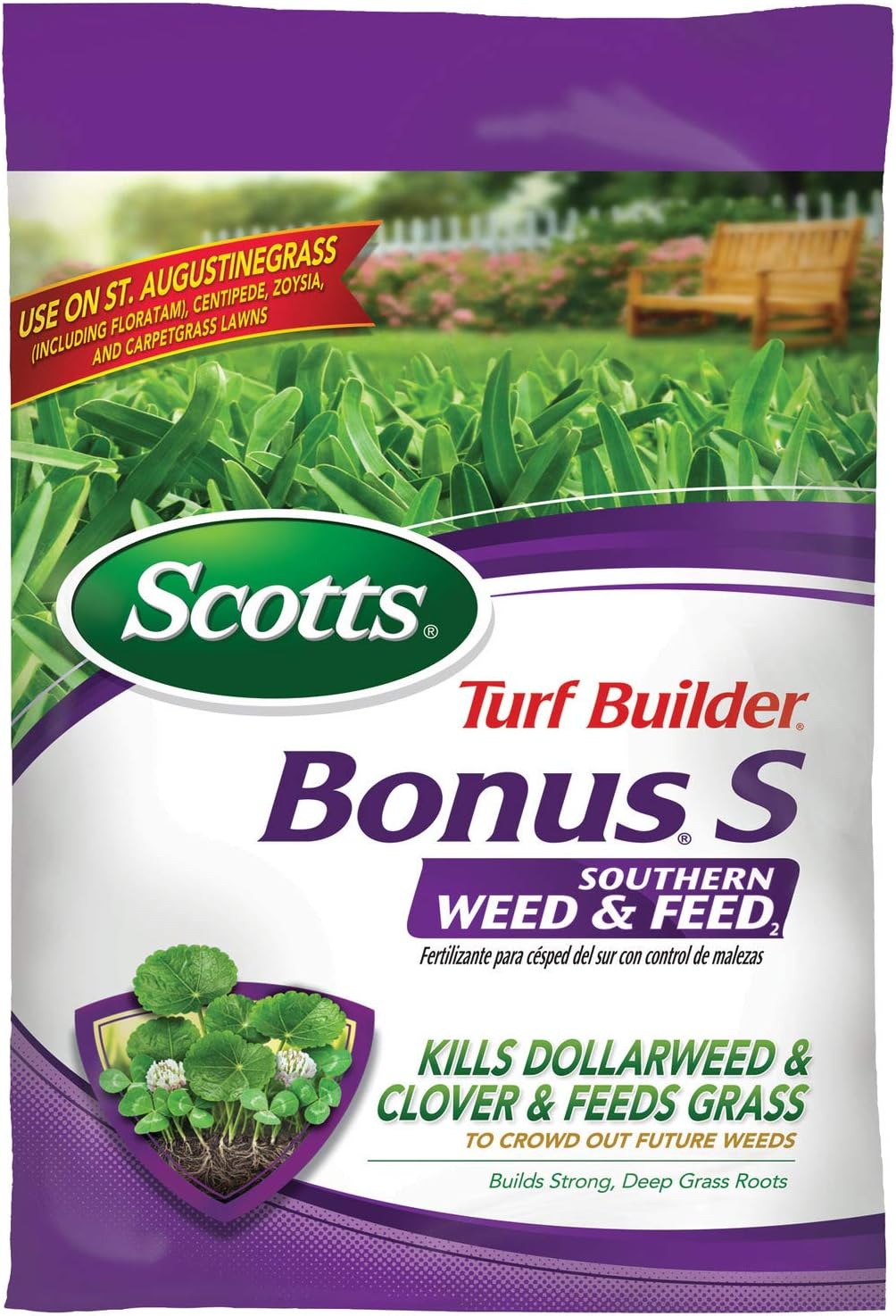
Scotts Turf Builder Bonus S Southern Weed & Feed2, 27.59 lb
| Item Form | Granule |
|---|---|
| Coverage | 8000 square feet |
| Item Highlight | Weed Killer Plus Lawn Fertilizer, Covers 8,000 sq. ft. |
This Scotts Turf Builder Bonus S Southern Weed & Feed2 is a granular weed-and-feed designed specifically for southern turf varieties. It combines a weedkiller that targets 25+ common southern lawn weeds with a fertilizer intended to feed grass and promote deeper roots. Typical use is a late-spring or active-growing-season application to St. Augustine, Centipede, Zoysia, or Carpetgrass on a dry lawn, applied with a broadcast or drop spreader and watered in immediately. Notable features include coverage for up to 8,000 sq ft per 27.59 lb bag and explicit spreader settings to help ensure even application. In practice it can simplify seasonal lawn care by treating weeds and feeding in one step, helping grass fill in as weeds die off. Important limitations are the narrow grass compatibility—do not use on Bermudagrass—and safety precautions due to the atrazine-containing herbicide, so follow label directions and keep people and pets off treated areas until safe. It is intended for twice-yearly use when soil temperatures are appropriate and grass is actively growing.
Best for: Buyers who prioritize a dependable, one-step seasonal treatment for southern lawns and want clear application guidance to get consistent results.
Less Ideal for: Homeowners with Bermudagrass, people seeking organic or non-chemical weed control, or those who need year-round treatment options.
- Targets 25+ common southern broadleaf weeds while supplying fertilizer in the same application
- Formulated for southern grasses including St. Augustine, Centipede, Zoysia, and Carpetgrass
- One bag covers up to 8,000 sq ft, reducing trips to buy multiple bags
- Provides clear application instructions and spreader settings for even coverage
- Contains atrazine so it has safety and environmental restrictions and requires careful handling and adherence to label
- Not safe for Bermudagrass or lawns in winter dormancy
Verdict: A reliable, single-bag weed-and-feed made for southern grasses that simplifies seasonal weed control and feeding for an 8,000 sq ft lawn.
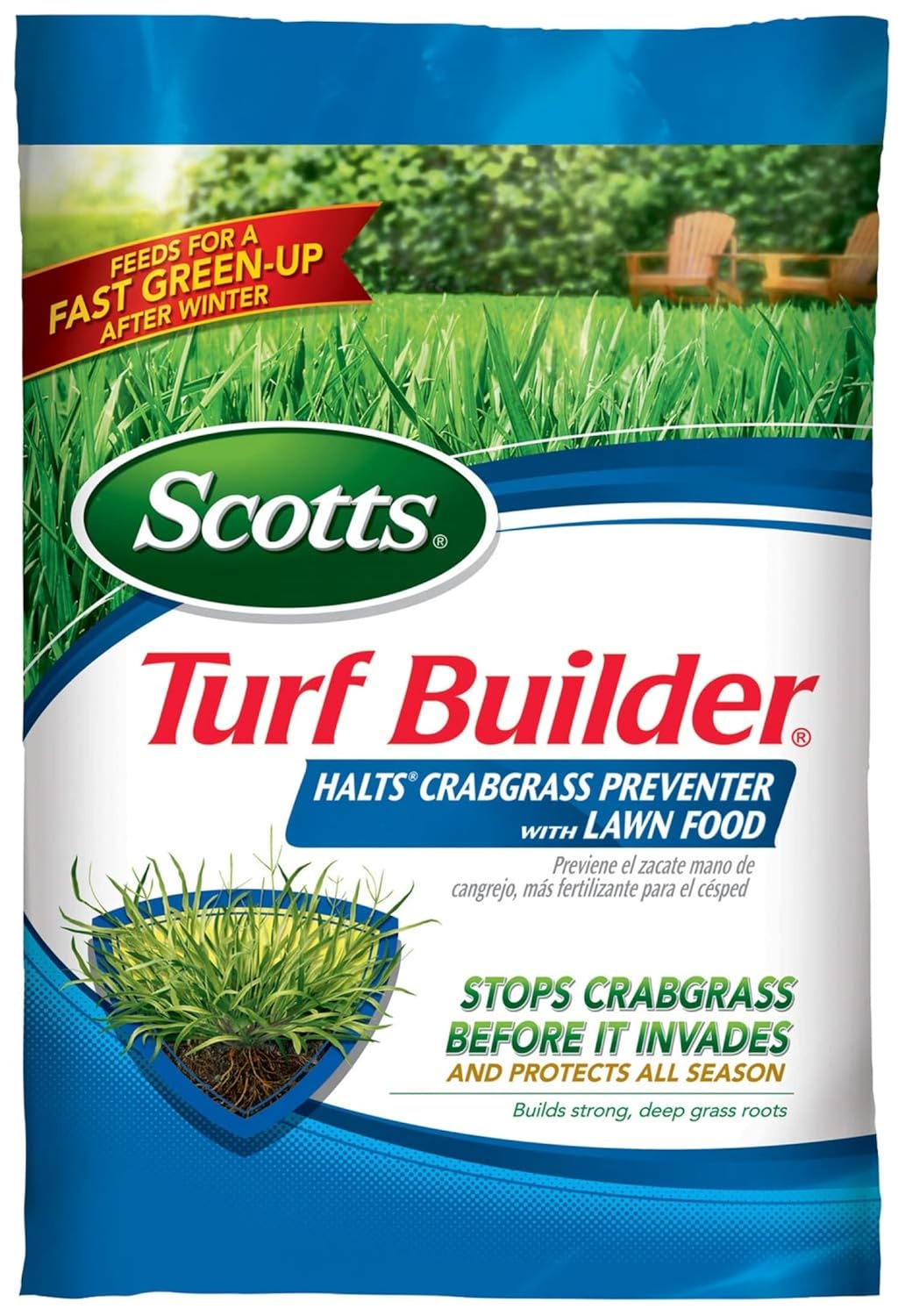
Scotts Turf Builder Halts Crabgrass Preventer with Lawn Food (covers 5,000 sq. ft.)
| Item Form | Granule |
|---|---|
| Coverage | 5000 square feet |
| Unit Count | 213.6 Ounce |
| Fertilizer analysis | 30-0-4 |
Scotts Turf Builder Halts combines a pre-emergent crabgrass preventer with a granular lawn fertilizer to protect and feed an established lawn through the spring. You apply it once in early spring to a dry lawn before regular hot weather, using a broadcast or drop spreader and then water the lawn lightly within 2 to 3 days so the active ingredient forms a barrier in the soil. The product covers 5,000 sq. ft. per bag and is formulated to prevent several grassy and broadleaf weeds while the 30-0-4 fertilizer helps grass green up quickly and build deeper roots. Practical benefits include season-long prevention of new crabgrass and simultaneous feeding, which reduces extra steps in spring lawn care. Limitations are that it will not kill mature crabgrass or existing weeds and it is not suitable for certain turf types like dichondra or bentgrass. Also, correct spreader settings and post-application watering are important for reliable performance, so casual or inexperienced applicators should follow directions closely.
Best for: Homeowners who prioritize reliable, season-long prevention and want a simple spring treatment that both blocks new crabgrass and feeds the lawn.
Less Ideal for: People needing a post-emergent weed killer for existing crabgrass or those managing dichondra or bentgrass turf should choose a different product.
- Pre-emergent formula prevents crabgrass and several other grassy weeds when applied correctly
- Includes fertilizer (30-0-4) for fast green-up and stronger root development
- Single-application coverage for 5,000 sq. ft. reduces repeat treatments in spring
- Granular form works with common broadcast and drop spreaders for even application
- Does not control established or mature crabgrass or existing weeds
- Not safe for use on dichondra and bentgrass lawns
Verdict: Choose this product if you want a dependable one-time early-spring treatment that prevents new crabgrass while feeding and strengthening your lawn.
Choosing the Right Spring Weed and Feed for St. Augustine Grass: Key Factors to Consider
Herbicide Compatibility With St. Augustine
St. Augustine is more sensitive than many warm-season grasses to certain broadleaf herbicides. Read and understand the active ingredients and whether the product label explicitly lists St. Augustine as a permissible turf. Using an incompatible herbicide can cause patchy discoloration, thinning, or long-term decline.
Labels will sometimes restrict use by season or by turf condition. Avoid products that advise waiting until after a certain growth stage or that require professional application for St. Augustine. When in doubt, choose a product that specifically names St. Augustine or that uses herbicides widely accepted for that grass type.
Fertilizer Analysis and Spring Timing
Spring is a time for gentle, targeted feeding rather than heavy nitrogen pushes that can force soft growth vulnerable to disease and heat later. Look at the fertilizer analysis for nitrogen, phosphorus, and potassium and prefer balanced or lower quick-release nitrogen blends intended for spring green-up.
The product should match your lawn's needs based on recent soil tests or typical regional fertility patterns. Too much early nitrogen can create excess top growth that makes weeds harder to manage and stresses the turf when summer heat arrives.
Weed Control Spectrum and Target Weeds
Different weed-and-feed products control different sets of broadleaf weeds and some grassy weeds. Check lists of labeled target weeds and prioritize products that treat the specific species you face in spring, such as clover, dollarweed, dandelion, and chickweed.
A product that covers the common spring broadleaf weeds in your region reduces the need for spot treatments later. If you have a particular persistent species, confirm that it is listed on the label and that the application timing matches the weed's growth stage.
Application Method and Spreader Calibration
Uniform application prevents streaks, overfeeding, and localized burn. Products should come with spreader settings or clear instructions for common broadcast and drop spreaders. Before treating, calibrate your spreader over a measured area so you apply the correct amount.
Also consider whether the product requires watering-in or a dry period after application. Application conditions such as windy days, recent rain, or newly sprigged turf change the risk profile and effectiveness.
Safety, Reentry, and Environmental Considerations
Observe label directions about keeping children and pets off treated turf and about irrigation after application. Some formulations have specific reentry times or require avoiding runoff into storm drains and garden beds.
Environmental concerns also include potential impact on desirable broadleaf plants at lawn edges and the risk of herbicide drift. Choose products with clear containment guidance and follow local regulations about application near water bodies.
Condition of Lawn and Recent Cultural Practices
The success and safety of a spring weed-and-feed depend on your lawn's current condition. Newly sodded or sprigged areas and lawns recovering from pests, disease, or recent scalping may be more vulnerable to both fertilizer burn and herbicide phytotoxicity.
Consider recent watering, mowing height, and any recent pest treatments before applying a combined product. In weakened lawns, a delayed or reduced-rate application or separate targeted treatments may be a safer choice.
When to Apply in Your Climate
Timing matters more than the label name. For St. Augustine, wait until the grass is actively growing and soil temperatures are consistently above the threshold recommended on the product label. Applying too early when turf is still dormant increases the risk of herbicide injury and reduces fertilizer uptake.
In mild climates where green-up starts early, aim for the window when new shoots are visible and nights are no longer near freezing. In transitional or cooler areas, hold off until active growth is underway to let the turf metabolize both herbicide and nutrients.
- Avoid application before a forecast of heavy rain that could cause runoff.
- Do not treat while the lawn is stressed from drought or recent insect damage.
- Mow a few days before application and set the mower to a higher height to reduce stress.
Preparing Your Lawn for Treatment
Perform a quick inspection for recent damage, thin spots, or visible injury from pests or disease. Repair or delay treatment for areas that are not healthy. Watering and mowing practices in the days before application affect how the turf responds.
Clear debris, rake lightly if excessive thatch is present, and avoid applying to wet grass unless the label allows. A proper pre-application routine reduces the chance of uneven results and turf stress.
- Calibrate your spreader using a test run on a measured area.
- Mark irrigation schedules to avoid watering immediately before or after unless directed.
- Spot-treat any small patches of persistent weeds rather than broad application when practical.
How to Read Product Labels for Safety
Labels contain the legal instructions and are the best source of truth for compatibility with St. Augustine. Look for explicit lists of permissible turf types, the active ingredients, and any seasonal or growth-stage restrictions.
Pay attention to the maximum application rates per 1,000 square feet and any repeated-application intervals. If a product lists replanting, overseeding, or sprigging cautions, follow those limits to avoid long-term damage.
- Confirm the label lists application rates for your spreader type.
- Check for any restrictions around pets, children, or water features.
- Note follow-up care instructions such as required watering windows.
Managing Expectations After Application
Weed control takes time. You may see visible decline in susceptible weeds over several days to a few weeks depending on species and weather. Nutrient-driven greening also depends on soil reserves and moisture.
Monitor treated areas for any signs of turf stress over the following two weeks and avoid additional treatments during this period. If localized discoloration appears, consult label troubleshooting steps rather than applying more product.
- Track weather for two weeks after treatment to ensure no heavy rains wash product into beds.
- Keep children and pets off treated areas for the interval listed on the label.
- Plan follow-up cultural actions such as proper mowing and watering to help the turf recover and use the added nutrients.
Alternatives to Combined Weed-and-Feed
In some situations it is safer or more effective to separate fertilization from weed control. Applying a low-dose fertilizer in early spring and reserving herbicide treatments for targeted spot control can reduce risk to sensitive turf.
This approach gives you more control over timing and reduces the chance of overfeeding or herbicide stress. It also makes it easier to tailor treatments to specific weed problems rather than relying on a one-size-fits-all product.
- Use a soil test to guide fertilizer timing and rates.
- Consider post-emergent herbicides timed to the growth stage of persistent weeds.
- Use mechanical control like hand-pulling for small infestations to limit chemical use.
How We Chose the Best Spring Weed and Feed for St. Augustine Grass
We prioritized options that balance weed control with turf safety for St. Augustine grass. Key evaluation criteria included the active herbicide ingredients and labeled compatibility with warm-season grasses, fertilizer analysis and timing for spring green-up, application rate clarity and spreader calibration, and the potential for turf burn under common spring conditions. We also considered the breadth of broadleaf weed control listed on product directions and whether the label restricts use over newly sprigged or sod areas. Ease of application and availability of clear instructions for homeowners were included because misapplication is a common source of turf damage. We excluded any product whose label explicitly warns against use on St. Augustine or that requires professional licensing for standard homeowner applications. In short, we filtered for St. Augustine-safe chemistries, measured nutrient balance appropriate for spring, practical application guidance for home gardeners, and documented efficacy against common spring broadleaf weeds.
FAQ
Can I apply a spring weed-and-feed as soon as temperatures warm up?
It often depends on soil temperature and whether St. Augustine is actively growing. Applying too early when turf is still dormant increases risk of herbicide injury. Wait until new shoots are visible and nights are reliably above the cold threshold listed on product labels.
Will a weed-and-feed harm newly sodded or sprigged St. Augustine?
Usually these products have restrictions for new sod or sprigs. Newly established turf is vulnerable to both herbicides and concentrated fertilizer. If the label cautions against use on new plantings, delay treatment until the lawn is well established.
How soon should I water after applying a granular weed-and-feed?
Follow the product label. Some granular formulations require light irrigation to activate the herbicide and move nutrients into the root zone, while others advise avoiding water for a period to prevent runoff. Use the label directions to determine timing based on your irrigation system and recent weather.
Can I spot-treat weeds and still use a weed-and-feed on the rest of the lawn?
Yes. Spot-treating persistent problem areas with a targeted herbicide can be a safer option for sensitive turf. After spot treatments have settled according to label directions, you can apply a general fertilizer or a compatible weed-and-feed to the remaining lawn if labels allow.
What should I do if I see turf discoloration after application?
Stop additional chemical applications and compare symptoms with the product label troubleshooting guidance. Minor temporary discoloration can occur, but widespread or progressive damage warrants ceasing treatments and seeking advice from a local extension agent or turf professional.
Final Verdict
Choosing a spring weed-and-feed for St. Augustine grass means balancing effective broadleaf control with minimal risk to a sensitive turf species. Prioritize products and timings that list St. Augustine compatibility, provide a moderate spring fertilizer analysis, and include clear application instructions. If your lawn is stressed or newly established, consider delaying application or separating fertilizer from herbicide use. Focus on calibration, label adherence, and post-application care so the turf gets the nutrients it needs without unnecessary stress.
