

Note: This article contains affiliate links. If you click on these links and make a purchase, I may earn a small commission at no extra cost to you. This helps support my research and content. Read my full affiliate disclosure here.
If spiders are turning your outdoor living spaces into a tangle of webs, choosing the right repellent makes yards easier to enjoy and maintain. The right product reduces webbing around patios, flower beds, and eaves without forcing constant reapplication or harming beneficial wildlife. This guide covers seven shortlisted spider repellents for yards, chosen for how they perform in real garden situations. We evaluated how long treatments last, how they affect different yard surfaces, ease of application, and safety for plants and pets. Read on to see which types of repellents fit your yard and maintenance habits.
Top Picks at a Glance
| Best Overall The best all-around choice for most situations | Mighty Mint Peppermint Oil Insect Repellent Spray, 1 Gallon |  |
| Best Quality Built to a higher standard if you want something more solid | Atticus Talak 7.9% Indoor/Outdoor Bifenthrin Insecticide Concentrate (1 gal) |  |
| Best Value The sweet spot between price and what you get | Mighty Mint Peppermint Oil Lawn & Yard Bug Control Spray, 32 oz |  |
| Best Budget The cheapest option that still gets the job done reliably | NatureStop Spider Repellent Spray for Patio (16 oz) |  |
| Highest Rated A top-rated pick with lots of positive feedback | Talstar One Insecticide Concentrate, 1 Gallon |  |
| Most Popular A crowd favorite that many people choose with confidence | Mighty Mint Peppermint Oil Insect Repellent Spray, 16 oz |  |
| Best Seller A high-volume bestseller chosen again and again | Atticus Talak 7.9% Bifenthrin Indoor/Outdoor Insecticide Concentrate, 32 oz |  |
Mighty Mint Peppermint Oil Insect Repellent Spray, 1 Gallon

| Volume | 128 oz |
|---|---|
| Ingredients | Water, Glycerin, Polyglycerol Oleate, Soap, Peppermint Oil |
| Use areas | Indoor / Outdoor |
| Scent | Peppermint |
Mighty Mint’s 1-gallon peppermint oil spray is a plant-based insect repellent intended for broad indoor and outdoor use. The product is supplied as a large ready-to-use bottle with a detachable nozzle for spraying around entryways, baseboards, patios, and gardens or for refilling smaller spray bottles. Its formula lists peppermint oil along with water, glycerin, and soap, so it works by delivering a strong peppermint scent that repels spiders, ants, roaches and similar pests without synthetic pesticides. Practical benefits include the large 128 oz volume for extended coverage and a scent that many households find more pleasant than chemical sprays. The label notes it is safe for use around people and pets when used as directed, and the concentrate-style packaging simplifies repeat applications. Limitations to keep in mind are that it is a deterrent rather than a lethal insecticide, so it may not eliminate established infestations, and effectiveness can vary by pest and environmental conditions. Users should follow safety directions and reapply after heavy rain or watering for outdoor use.
Best for: Buyers who prioritize safer, plant-based pest control and want a proven, widely used product with visible social proof for routine outdoor and perimeter pest prevention.
Less Ideal for: People facing severe infestations who need a fast-acting, residual insecticide or professional pest control should consider stronger, targeted treatments instead.
- Large 128 oz ready-to-use gallon provides long-lasting coverage and value
- Plant-based formula using peppermint oil rather than synthetic pesticides
- Versatile for indoor and outdoor application and can refill smaller bottles
- Pleasant mint scent that is less intrusive than chemical alternatives
- Designed as a repellent and deterrent so it may not eradicate heavy or established infestations
- Performance can be inconsistent depending on pest type and weather conditions
Verdict: Choose this gallon peppermint spray if you want a plant-based, widely adopted repellent for routine outdoor perimeter and home pest prevention.
Atticus Talak 7.9% Indoor/Outdoor Bifenthrin Insecticide Concentrate (1 gal)

| Active Ingredients | Bifenthrin |
|---|---|
| Formulation | Suspension Concentrate |
| Unit Count | 128 Fluid Ounces |
| Specification Met | EPA |
Talak 7.9% is a water-based bifenthrin concentrate meant as a flexible indoor and outdoor insect control product. You dilute the concentrate with water and apply it as a spray for perimeter barrier treatments, to turf, to ornamentals, or to interior baseboards and other problem areas. The label lists control of more than 75 pests including mosquitoes and ticks, and the formula is designed to kill on contact and provide residual control for up to three months. Practical benefits include a clear, odor-free spray that dries without staining and a bottle that allows easier small pours for accurate mixing. Important limitations are that mixed solutions should be used the same day and it is not approved for fogger use, so it is best for targeted spray applications rather than broadcast fogging. As with any bifenthrin product, users should follow label directions closely and consider nonchemical options for integrated mosquito management.
Best for: Buyers who want a single, versatile insecticide to treat both perimeter and landscape mosquito problems and prefer a product that delivers residual control without odors or visible residue.
Less Ideal for: People seeking a ready-to-use fogging or misting solution or those who need an insecticide they can pre-mix and store for later use.
- Broad-spectrum control listing more than 75 indoor and outdoor pests including mosquitoes and ticks.
- Water-based formula that dries clear, leaves no residue, and is odor-free for use around living areas.
- Long residual effect with label claim of up to three months of control per application.
- Mixes with water for adjustable application rates across lawns, landscapes, and surfaces.
- Bottle design supports easier small pours to reduce mess when measuring concentrate.
- Mixed spray cannot be stored and must be used the same day.
- Not approved for use in foggers, limiting application methods to direct sprays.
Verdict: A versatile, long-lasting bifenthrin concentrate that provides broad-spectrum mosquito and perimeter control for users who want one product for indoor and outdoor applications.
Mighty Mint Peppermint Oil Lawn & Yard Bug Control Spray, 32 oz

| Ingredients | Peppermint Oil, Rosemary Oil, Geraniol |
|---|---|
| Application method | Hose-attachable sprayer |
| Coverage per application | 32 fl. oz. to ~6,000 sq. ft. |
| Use areas | Outdoor lawns, landscapes, foliage, fences, patios |
This 32 oz Mighty Mint yard spray hooks to your garden hose and mixes automatically to treat lawns, fences, foliage, and patios for mosquitoes, ants, fleas, ticks, and other common pests. You apply it by attaching the included hose nozzle, turning the faucet on, and spraying evenly; the directions recommend 32 fl. oz. per roughly 6,000 sq. ft. and reapplying up to twice weekly as needed. The formula is plant-based, using concentrated peppermint oil, rosemary oil, and geraniol, so it leaves a minty scent rather than chemical fumes and is labelled safe for use around people and pets when used as directed. Practical benefits include fast contact knockdown of insects, broad outdoor coverage from a single bottle, and an easy hose connection that speeds repeat treatments. Limitations to expect are the need for regular reapplication for ongoing mosquito control and a performance ceiling compared with synthetic residual insecticides, so heavy infestations or long-term barrier protection may require more frequent treatments or supplementary methods.
Best for: Gardeners who want a straightforward, low-toxicity yard spray to reduce mosquitoes and other common pests without harsh chemicals and who prefer efficient hose-based applications over fiddly mixing.
Less Ideal for: People needing a one-time, season-long residual barrier against heavy mosquito infestations or commercial pest controllers seeking maximum long-term knockdown.
- Plant-based active ingredients (peppermint oil, rosemary oil, geraniol) that avoid harsh synthetic insecticide fumes
- Hose-attachable nozzle that automatically mixes spray for fast, even application over large areas
- Covers up to about 6,000 sq. ft. per 32 fl. oz. application for economical yard treatments
- Minty scent is pleasant and less irritating for scent-sensitive households and pets when used as directed
- Requires frequent reapplication (up to twice weekly) to maintain mosquito control
- Less residual long-term protection compared with conventional synthetic yard insecticides
Verdict: A practical, pet-friendly peppermint oil yard spray that lets you quickly treat large outdoor areas with a natural alternative to synthetic mosquito repellents.
NatureStop Spider Repellent Spray for Patio (16 oz)

| Volume | 16 oz |
|---|---|
| Intended use | Outdoor patios, decks, railings, furniture |
| Formulation | Ready-to-use spray |
| Manufacturer | NatureStop |
| Country of manufacture | Made in USA |
NatureStop Spider Repellent is a 16-ounce ready-to-use spray that applies around patios, decks, railings and outdoor furniture to help deter spider activity. Its plant-based active ingredients are designed for repeated spot applications to corners, entryways and other sheltered areas where spiders congregate, and the spray format makes it simple to treat problem zones without mixing or special equipment. The label emphasizes family- and pet-friendly ingredients when used as directed, which is useful for households that want a milder alternative to synthetic pesticides. In practice you should expect regular reapplication for sustained effect rather than a one-time solution, and coverage from a 16 oz bottle is best for small to medium outdoor areas. The product is straightforward and convenient for routine maintenance, though it will require follow-up treatments to keep spiders away over a season.
Best for: Best for budget-minded homeowners or renters who want a simple, family-friendly spray to manage spiders around small to medium outdoor living spaces.
Less Ideal for: Not ideal for people needing long-lasting, wide-area residual control or for treating large properties without buying multiple bottles.
- Plant-based formula suitable for households seeking an alternative to stronger chemical sprays
- Ready-to-use spray requires no mixing or equipment
- Designed for targeted application to patios, decks, railings and furniture
- Label indicates safe use around pets and families when directions are followed
- 16 oz bottle provides limited coverage so frequent reapplication or multiple bottles may be needed for larger areas
- Not a one-time residual treatment so effectiveness depends on regular use
Verdict: A convenient, plant-based ready-to-use spray that offers an affordable, family-friendly way to reduce spiders around small to medium outdoor spaces.
Talstar One Insecticide Concentrate, 1 Gallon

| Active ingredient | Bifenthrin 7.9% |
|---|---|
| Formulation | Concentrate, water-based |
| Coverage intent | Perimeter and structural applications |
| Pest range | Controls 75+ pests including ticks |
Talstar One is a professional-strength bifenthrin concentrate designed to provide broad-spectrum control of ants, spiders, roaches, fleas, ticks, mosquitoes, and many other pests. You mix the concentrate with water and apply it as a perimeter spray around foundations, doors, and windows or to targeted cracks and crevices indoors. Notable features include a water-based, low-odor formula that dries clear and a residual effect that reduces the need for frequent reapplications on lawns, ornamentals, shrubs, and structural surfaces. For yards with tick pressure, treating perimeters and vegetation provides a dependable barrier that helps reduce tick encounters when applied according to label directions. The product is concentrated so one gallon treats large areas, which makes it efficient for seasonal maintenance across multiple structures. Important limitations are that it is a pesticide that requires careful handling and strict adherence to label rates and application restrictions, and it is not a ready-to-use spray so you will need appropriate mixing and application equipment for safe, effective coverage.
Best for: Buyers who prioritize reliable, residual pest control for yards and perimeters and who are comfortable using concentrated pesticides with proper safety practices.
Less Ideal for: Casual users who want a ready-to-use product or those unwilling to follow pesticide label precautions and use appropriate application equipment.
- Broad-spectrum control that includes ticks and common yard pests
- Concentrated formula covers large areas and is cost-efficient for seasonal treatments
- Water-based, low-odor formula dries clear and is suitable for outdoor living spaces
- Suitable for both perimeter and targeted indoor/structural applications
- Concentrate requires proper mixing and application equipment for safe use
- Contains bifenthrin so users must follow label precautions to protect people, pets, and beneficial insects
Verdict: Choose Talstar One when you need a concentrated, long-lasting perimeter treatment that reliably reduces tick pressure across yards and structures.
Mighty Mint Peppermint Oil Insect Repellent Spray, 16 oz
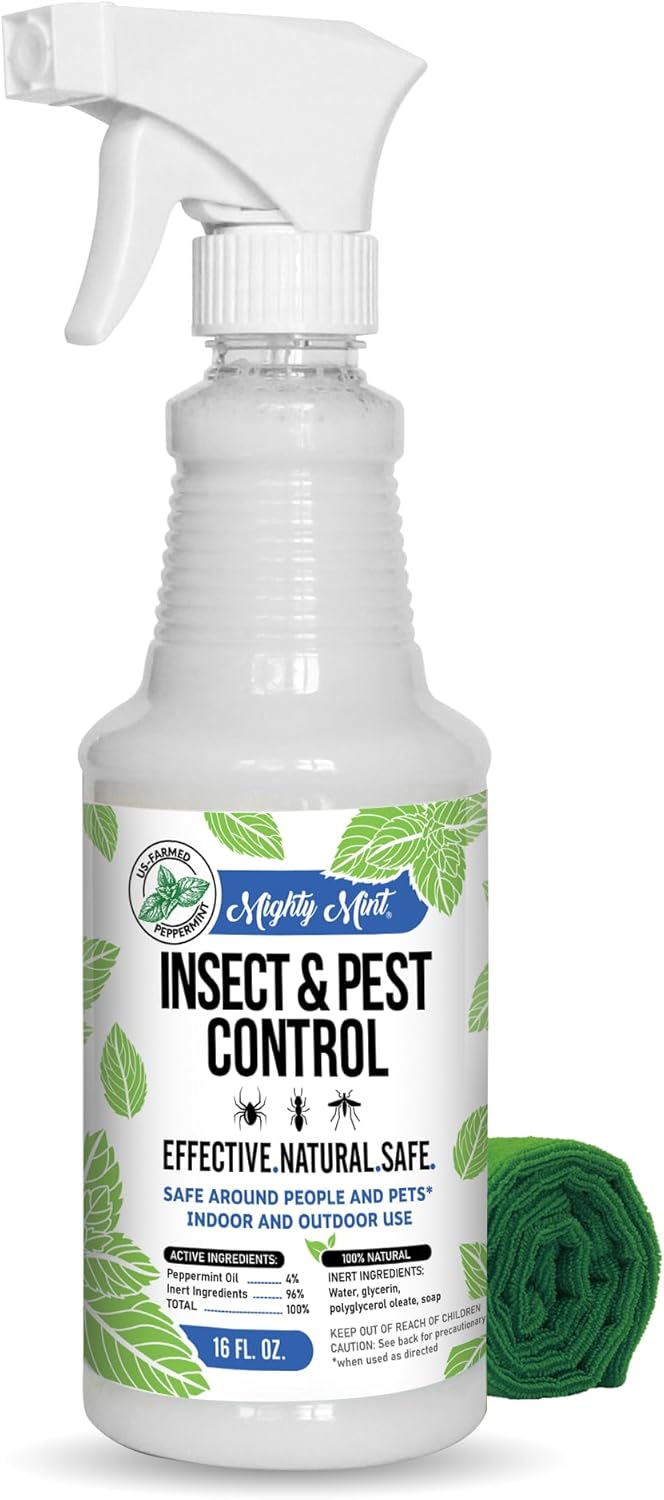
| Ingredients | Water, Glycerine, Polyglycerol oleate, Soap, Peppermint oil |
|---|---|
| Use Areas | Indoor / Outdoor |
| Size | 16 oz |
Mighty Mint is a plant-based, ready-to-use spray that uses concentrated peppermint oil to repel a broad range of household and patio pests. You apply it directly to problem areas such as baseboards, entryways, patios and around outdoor seating; the manufacturer recommends shaking and spraying until surfaces are covered and repeating applications two or more times per week for best results. Notable features include a peppermint-only scent profile, a formulation that avoids synthetic fragrances and the convenience of a 16 oz spray bottle for targeted spot treatments. Practical benefits are that it is safe to use around people and pets when dry and does not leave obvious stains on most surfaces, and the scent can make treated areas smell fresher than chemical alternatives. Important limitations are that it is a repellent rather than a pesticide so it works by discouraging pests rather than killing them, effectiveness depends on regular reapplication and it should not be applied when pollinators are present or to skin or food-contact surfaces.
Best for: Buyers who prioritize natural, low-toxicity solutions and want a targeted spray to reduce insects around patios and entryways while keeping family and pets in mind.
Less Ideal for: Anyone needing a one-time extermination or long-term residual pesticide for severe infestations should consider professional treatments or products formulated to kill pests rather than repel them.
- Plant-based peppermint formula that avoids synthetic fragrances
- Ready-to-use spray for quick, targeted indoor and outdoor applications
- Safe for people and pets when used as directed and allowed to dry
- Nonstaining on most surfaces and leaves a fresh mint scent
- Repels rather than kills insects so regular reapplication is needed to maintain protection
- Strong peppermint concentration may bother scent-sensitive individuals and requires keeping children and pets away until dry
Verdict: Choose Mighty Mint when you want a pet-friendly, plant-based spray to reduce patio and entryway insects with a fresh peppermint scent.
Atticus Talak 7.9% Bifenthrin Indoor/Outdoor Insecticide Concentrate, 32 oz

| Active Ingredient | Bifenthrin |
|---|---|
| Formulation | Suspension Concentrate |
| Liquid Volume | 32 fluid ounces |
| Length of Control | Up to three months |
| Target Species | Insects |
Talak 7.9% is a liquid concentrate for treating lawns, landscaping, outdoor living areas and indoor perimeter spots like baseboards and cabinets. You dilute the concentrate with water to create a spray for barrier treatments, spot applications or lawn mixes; label rates explain how much to mix per gallon depending on the use. The product uses bifenthrin, a proven broad-spectrum active ingredient, and the manufacturer states it controls over 75 species and can give residual control for as long as three months. Its water-based formula dries clear, leaves no odor or visible residue, and is not phytotoxic on plants when used per label. Practical benefits include flexible indoor and outdoor use, clear drying, and a bottle designed for easier pouring. Important limitations are that solutions should be mixed only for same-day use, it is not registered for sale in a few states, and it is not approved for fogger application, so professional-style misting methods are not appropriate.
Best for: Buyers who want a single, reliable product to protect yards, patios and building perimeters from a wide range of common pests and prefer conservative, label-driven application practices.
Less Ideal for: People seeking ready-to-use sprays or fogger-compatible products or those in states where this formulation is not registered should look at alternatives.
- Broad-spectrum control listed for 75+ indoor and outdoor pest species
- Water-based formula that dries clear and leaves no odor or residue
- Flexible label directions for lawns, landscapes, hardscapes and indoor perimeter treatments
- Long residual activity up to three months when applied at recommended rates
- Mixed spray solutions cannot be stored and must be used the same day
- Not approved for fogger application and not available for sale in some states
Verdict: A versatile, water-based bifenthrin concentrate that delivers long-lasting, broad-spectrum outdoor (and perimeter indoor) control when used according to the label.
Choosing the Right Spider Repellent for Yards: Key Factors to Consider
Effectiveness Against Common Yard Species
Different spider species behave differently around yards. Some build large, visible webs nightly, while others are stealth hunters that rarely show webs but still appear on walls and under eaves. A good repellent should reduce both web-building activity and visible spider presence across the typical species you encounter.
Effectiveness is often measured as reduced web counts and fewer sightings over days and weeks. Consider whether treatments target adults, juveniles, or both. Products that only deter adult spiders may not control developing populations fully, which influences how often you must retreat.
Duration And Weather Resistance
Yard treatments face sun, rain, irrigation, and dew. Longevity determines how frequently you need to reapply and how much maintenance time you invest. Some repellents offer multi-week protection while others wash off after heavy rain.
Weather resistance matters for specific yard zones. High-exposure areas like fences and patio edges need formulations that tolerate sun and rainfall. If you have drip lines, planters, or frequent overhead watering, choose options that remain effective after light irrigation or include guidance for reapplication after storms.
Application Method And Coverage Area
How you apply a repellent affects speed, uniformity, and labor. Ready-to-spray bottles and aerosols are quick for spot treatments and small yards. Concentrates and granular formulations suit larger properties because they allow wider coverage per container and often lower cost per treated square foot.
Consider whether the product needs specialized equipment like a pump sprayer or spreader. Also check label guidance on how much area a single container treats so you can compare products on equal footing and estimate how much product you will need for full-coverage applications.
Plant And Pet Safety
Yards are shared spaces with plants, pollinators, family members, and pets. Choose repellents that minimize risk to desirable insects and are safe around common garden plants. Some active ingredients are harsh and can damage foliage or harm beneficial arthropods when applied directly to blooms.
Look for clear instructions on buffer zones, re-entry intervals, and whether application is safe on edible plantings. If you have pets that roam freely, prioritize formulations with low toxicity or that dry quickly to reduce exposure during routine outdoor time.
Surface Compatibility And Residual Marking
Yard surfaces vary: vinyl siding, painted wood, brick, stone, turf, and mulch all react differently to treatments. Some repellents can stain or leave residues on light-colored siding or outdoor furniture. Others are designed to bind to porous materials like timber or masonry for extended protection.
Check label notes about staining risk and recommended test areas. If you plan to treat seating areas or decorative features, you may prefer non-staining or water-based options. Residual marking is also a consideration when treating patios or walkways where aesthetics matter.
Environmental Impact And Disposal
Think beyond immediate effectiveness to how a product fits into sustainable yard care. Some repellents use botanical active ingredients with shorter environmental persistence while others rely on longer-lasting synthetics. Residual persistence can affect soil microfauna and beneficial insects.
Also consider container disposal and whether concentrates allow mixing only what you need. Follow label directions for dilution and disposal. Choosing treatments with clear environmental guidance helps you protect nearby beds, pollinator plants, and water features.
Types Of Spider Repellents And When To Use Them
There are several practical repellent formats gardeners encounter: ready-to-spray liquids for quick spot treatments, concentrates for larger areas, granular products for perimeter barriers, and solid dispensers for localized protection. Each has strengths depending on yard size and the treatment goal.
Ready-to-spray options are convenient for patios, porch edges, and around outdoor seating. Concentrates let you treat fence lines, long borders, and whole lawns more economically. Granules are useful for creating perimeter barriers around foundations and under shrubs because they do not require as much mixing or equipment.
- Sprays: fast, good for targeted areas and quick maintenance
- Concentrates: cost-effective for big yards, require mixing and sprayer
- Granules: low-labor perimeter protection that resists light disturbance
- Dispenser devices: suited to entryways or localized hot spots
Preparing Your Yard For Treatment
Before applying any repellent, reduce clutter and remove existing webs and egg sacs. Physical removal increases the visible impact of treatments and prevents immediate recolonization. Trim back dense vegetation that shelters spiders and increases humidity, making treatments more effective.
Plan applications for dry weather when possible. If rain is forecast, wait until after a few clear days to maximize the initial bonding and coverage. For areas near pollinator plantings, avoid treating blooms during peak pollinator activity and focus on structural surfaces like eaves, fences, and under decking.
- Clear webs and detritus before treatment
- Trim dense groundcover and overhanging branches
- Check weather and avoid treating before heavy rain
- Target structural surfaces instead of flowering plants
Integrating Repellents With Cultural Controls
Repellents work best as part of a broader strategy. Cultural controls such as reducing outdoor lighting at night, sealing cracks in siding, and keeping outdoor storage tidy reduce ideal spider harborage and food sources. Combining these measures with periodic repellent applications lowers overall spider pressure and extends the time between treatments.
Encourage predator balance by avoiding broad-spectrum insecticides that kill beneficial predatory insects. Regular inspection and targeted spot treatments maintain low spider counts without resorting to widespread chemical use.
- Limit night lighting near seating and doors
- Seal gaps around windows, doors, and foundations
- Store wood and materials off the ground
- Use repellents in targeted zones rather than blanket applications
Seasonal Timing And Maintenance Schedules
Spider activity changes with season and local climate. In temperate regions, activity peaks in late summer and early fall when juvenile spiders disperse and visible webbing increases. Plan proactive treatments before peak seasons to reduce population buildup and maintain a lower baseline.
Follow label guidance for retreatment intervals and inspect treated zones every few weeks. Light touch-ups after heavy rain or irrigation help maintain protection. For perennial problem spots, scheduled seasonal applications combined with mechanical removal deliver the best long-term results.
- Treat proactively before peak webbing seasons
- Inspect and reapply after heavy rain if required
- Use spot treatments for new webs between scheduled applications
Safety Best Practices During Application
Read and follow all label instructions precisely. Use personal protective equipment recommended for the product, such as gloves and eye protection, especially when handling concentrates. Keep children and pets away from treated areas until products dry or according to label re-entry times.
Store unused product in original containers with labels intact and dispose of empty containers per local regulations. Avoid treating pollinator-rich flower clusters and water features directly to minimize unintended impact on beneficial species.
- Wear recommended PPE when mixing or spraying
- Keep pets and children out of treated zones until dry
- Store and dispose of containers according to label
How We Chose the Best Spider Repellent for Yards
We shortlisted products based on the practical requirements gardeners face when treating outdoor spaces. Effectiveness in reducing spider activity and visible webbing was a primary filter, with attention to how quickly results appear and how long they persist. We prioritized repellents that work across common yard settings such as lawns, flower beds, patio borders, fences, and eaves. Application method and coverage mattered because homeowners and gardeners vary in scale and equipment: granular, ready-to-spray, concentrate, and barrier treatments were considered separately. Material compatibility and safety for plants, pollinators, and pets were also required; any option with clear garden-harm risks was excluded. Ease of use and how often retreatment is needed influenced selection to reflect realistic maintenance schedules. Products were excluded if they lacked clear usage instructions for outdoor yards, if they were intended solely for indoor use, or if safety data raised concerns for typical garden settings. The final picks balance measurable spider reduction, longevity of protection, surface versatility, application convenience, and acceptable safety profiles.
FAQ
Are yard repellents safe to use around edible plants?
It depends on the formulation. Many repellents are safe for use on non-edible areas like fences and eaves but advise caution near edible plantings. Choose products with explicit guidance for use around food crops and follow buffer and re-entry instructions.
How often will I need to reapply treatments in a typical yard?
Frequency varies by product and weather. Some treatments last several weeks; others require monthly reapplication. Expect to check treated zones every few weeks and reapply after heavy rain if the product label advises.
Will repelling spiders attract more insects to my yard?
Repellents target spiders directly and do not typically increase insect populations. However, reducing spiders may slightly change predator-prey balances locally. Combining repellents with habitat management helps maintain natural predator populations without boosting pest insects.
Can I use a repellent on siding and outdoor furniture without staining?
Some formulations can leave residues or cause discoloration on light-colored or porous surfaces. Test a small, inconspicuous area first and follow label guidance about staining risks and recommended materials to avoid.
Are botanical or natural repellents effective compared with synthetic options?
Botanical repellents can be effective, especially for short-term or spot treatments, but they often require more frequent application. Synthetic options may offer longer residual protection. Effectiveness depends on formulation, application, and environmental conditions.
Should I treat my whole yard or only problem areas?
Targeted treatments of problem areas are usually more efficient and reduce overall environmental exposure. Focus on eaves, foundation lines, under decks, fence lines, and other harborage spots. Whole-yard treatments make sense for widespread infestations or preventive schedules on large properties.
Final Verdict
Prioritize repellents that match your yard size, surface types, and tolerance for maintenance. If you value low labor and longer intervals between treatments, choose formulations with proven residual coverage. For smaller patios and spot problems, ready-to-spray or botanical options deliver fast results with simpler application. Balance effectiveness with safety around plants and pets, and integrate repellents with cultural controls like sealing entry points and reducing clutter. Use treatment frequency and surface compatibility as your main decision factors to keep outdoor spaces comfortable and web-free.
