

Note: This article contains affiliate links. If you click on these links and make a purchase, I may earn a small commission at no extra cost to you. This helps support my research and content. Read my full affiliate disclosure here.
When you head into the woods or set up on a lakeshore, mosquitoes can turn a pleasant evening into a long, itchy fight. Choosing the right camping mosquito killer matters because effectiveness in the field depends on battery life, lure type, and how the unit disperses or traps insects without disturbing your campsite. This guide covers seven shortlisted camping mosquito killers that performed well across real-world criteria for outdoor use. We evaluated units for power delivery, quiet operation, portability, and how they handle the outdoor elements so you can pick an option that fits your typical trip length and camping style. Below we summarize what to expect from each shortlisted option and explain the key features that matter when selecting a camping mosquito killer.
Top Picks at a Glance
| Best Overall The best all-around choice for most situations | Thermacell Fuel-ZoneGuard Backpacker Mosquito Repeller (starter kit) |  |
| Best Quality Built to a higher standard if you want something more solid | PhatroyYee Solar Bug Zapper 4500V for Outdoor & Indoor |  |
| Best Value The sweet spot between price and what you get | otlotrte Cordless Rechargeable Bug Zapper & Camping Lantern |  |
| Best Budget The cheapest option that still gets the job done reliably | W4W Mosquito Repellent Coils — 3 Pack (12 Coils, 6 Stands) |  |
| Highest Rated A top-rated pick with lots of positive feedback | Sayneep Solar Rechargeable Outdoor Bug Zapper with 6000mAh Battery |  |
| Most Popular A crowd favorite that many people choose with confidence | Thermacell Fuel-ZoneGuard Extreme Fuel-Powered Portable Mosquito Repeller |  |
| Best Seller A high-volume bestseller chosen again and again | Cliganic Mosquito Repellent Bracelets, Pack of 10 (Citronella) |  |
Thermacell Fuel-ZoneGuard Backpacker Mosquito Repeller (starter kit)

| Target Species | Mosquito |
|---|---|
| Power Source | Fuel Canister |
| Maximum Range | 15 feet |
| Included Components | (4) repellent mats, backpack repeller, travel bag |
The Thermacell Fuel-ZoneGuard Backpacker is a compact, fuel-canister powered mosquito repeller designed for camping and other outdoor activities. It heats a small repellent mat to diffuse an unscented, DEET-free formula and establishes a roughly 15-foot zone of protection after about 15 minutes of warm-up. Typical use is simple: attach a pressurized camping fuel canister, insert a mat, turn it on and carry or set it near your campsite; the unit includes a water-resistant travel bag and four mats for initial use. Practical benefits include hands-off protection without applying sprays to skin, low weight for backpacking, and visible indicators (an orange glow and color-changing mats) to show operation and remaining mat life. Important limitations are that it requires a specific pressurized butane/propane fuel canister (not included), is intended for outdoor use only and should be kept dry, and its protection is localized so it works best when placed centrally relative to the group. For campers who want reliable, no-spray coverage at a campsite, this is an easy-to-use solution, but you will need to carry compatible fuel refills for extended trips.
Best for: Campers and backpackers who prioritize lightweight, hands-free mosquito protection at a small campsite and prefer not to use sprays on skin.
Less Ideal for: People who need whole-yard coverage, want an electric or rechargeable option, or who cannot carry fuel canisters should consider alternative repellents.
- Creates a tested 15-foot protection zone for nearby outdoor activities
- Lightweight and portable design with included water-resistant travel bag
- Hands-free, scent-free protection that avoids applying repellents to skin
- Visible operation indicators and color-changing mats to show remaining mat life
- Requires a specific pressurized butane/propane fuel canister that is sold separately
- Protection is localized and may not cover larger group areas or windy conditions
Verdict: For campers who want lightweight, no-spray mosquito protection at a small campsite, this starter kit delivers reliable hands-free coverage in a compact package.
PhatroyYee Solar Bug Zapper 4500V for Outdoor & Indoor

| Power Source | Solar Powered |
|---|---|
| Target Species | Mosquitoes, Flies, Moths, Gnats, Midges, Wasps, Hornets |
The PhatroyYee Solar Bug Zapper is a portable, no-chemical insect control unit designed for yards, patios and indoor spaces. It charges either by the built-in 10W solar panel or USB and runs on a 4000mAh battery for up to about 13 hours on a full charge, with an automatic day/night mode for hands-off operation. Twin blue-violet LEDs attract mosquitoes, gnats, moths and other flying pests toward a 15-inch safety grid that delivers up to 4500V to kill insects on contact. The unit includes stakes and a hanging chain for flexible placement and an IPX5 rating plus plastic and stainless steel construction for weather resistance. Practical benefits include cordless placement, multiple mounting options and chemical-free operation that is safe around people and pets. Limitations are that it performs best in dark conditions away from people, requires periodic cleaning of the grid for continued effectiveness and its solar charging can be slower than USB charging in cloudy weather.
Best for: Buyers who want a low-maintenance, chemical-free way to reduce flying insects around a patio, campsite or mixed indoor/outdoor spaces and prefer a safe, easy-to-use device that mostly runs automatically.
Less Ideal for: People who need instant, full-power operation in all weather conditions or who plan to use it primarily in very bright, well-lit areas where UV attraction is ineffective.
- Dual UV LED bulbs attract a wide range of flying pests including mosquitoes, flies and moths
- Solar plus USB charging with a 4000mAh battery gives cordless operation and up to 13 hours runtime
- IPX5 waterproof rating and stainless steel with ABS construction for outdoor durability
- Multiple mounting options included (ground stakes and hanging chain) for flexible placement
- Solar charging depends on sunlight and can be slow in cloudy conditions
- Works best in dark environments and should be placed away from gathering areas to avoid attracting bugs toward people
Verdict: A versatile, chemical-free solar and USB rechargeable zapper that offers hands-off, weather-resistant insect control for homeowners who prioritize safe, low-maintenance pest reduction.
otlotrte Cordless Rechargeable Bug Zapper & Camping Lantern

| Battery capacity | 4800mAh |
|---|---|
| Voltage | 4200V |
| Light wavelength | 365–395nm |
| Coverage | Up to 2100 sq. ft. |
| Waterproof rating | IP67 |
This cordless bug zapper combines a high-voltage grid with blue-purple LED attractor lights and a built-in rechargeable battery to control flying insects around yards, patios, and campsites. It is typically used hung or placed near seating areas and tents; set it to auto mode and the light sensor switches the unit on at dusk and off at dawn so it runs unattended. Notable features include a broad claimed coverage up to 2,100 sq ft, multiple light modes (blue, white, or combined) that let you choose between attraction and illumination, and IP67 waterproofing so it can stay out in wet conditions. The 4800mAh battery provides long runtimes—up to roughly 12 to 14 hours in single-light or auto modes—and the unit also supports plug-in operation for extended events. Practical benefits are easy portability for camping and cordless backyard use plus the convenience of automatic night operation. Limitations are that real-world coverage will vary with placement and local insect pressure, bright white light will reduce zap runtime, and high-voltage grids require basic care when cleaning and storing.
Best for: Buyers who want an affordable, portable insect control solution they can use at home or when camping and who value long battery life and automatic night operation.
Less Ideal for: People seeking a fixed, high-capacity commercial pest control unit for very large properties or those who need a completely silent non-electrical solution.
- Rechargeable 4800mAh battery with long runtimes and optional plug-in operation
- Auto light-sensing mode powers the unit at dusk and off at dawn for hands-free use
- IP67 waterproof rating makes it suitable for outdoor use in rain and damp conditions
- Dual-purpose design doubles as a camping lantern for illumination and insect control
- Actual effective coverage depends on placement and local insect density and may be less than the advertised 2,100 sq ft
- Combined blue and white light mode significantly shortens battery runtime compared with single-light modes
Verdict: A versatile, budget-friendly rechargeable bug zapper that also serves as a camping lantern and runs automatically from dusk to dawn.
W4W Mosquito Repellent Coils — 3 Pack (12 Coils, 6 Stands)

| Pack contents | 3 pack (12 coils, 6 stands) |
|---|---|
| Burn time | 5-7 hours per coil |
| Coverage | Up to 10 feet per coil |
| Ingredients | Rosemary Oil |
These W4W mosquito coils are a straightforward, low-tech way to reduce biting insects around patios, campsites, and backyards. Each spiral separates into two coils; the three-pack includes 12 coils and six metal stands. A single coil burns for roughly 5 to 7 hours and is rated to cover about a 10-foot radius, so you can run one or more depending on the size of your gathering. The active ingredient is rosemary oil, and the coils are labeled for outdoor use only and described as biodegradable. Practical benefits are long burn time per coil, included stands for easy use, and a simple setup that requires no batteries or electricity. Limitations are that performance depends on wind and open-air conditions, the coverage is localized rather than whole-yard, and coils produce smoke and scent that some people may find bothersome. For routine backyard evenings or camping trips where you want an inexpensive, disposable barrier against mosquitoes, these are an easy option.
Best for: Buyers who want a low-cost, disposable way to reduce mosquitoes at small outdoor gatherings, patios, or while camping and prioritize simplicity over whole-yard solutions.
Less Ideal for: People needing wind-resistant or whole-yard mosquito control or those who cannot tolerate smoke or strong scents should consider alternate repellent methods.
- Long burn time of about 5–7 hours per coil for extended outdoor use
- Included stands make the coils easy to position and keep off surfaces
- Biodegradable material and rosemary oil formulation rather than synthetic chemicals
- Large pack quantity provides multiple uses for several outings
- Smoke and scent may be unpleasant for some people or guests
- Effective coverage is limited and affected by wind so multiple coils are needed for larger areas
Verdict: A very affordable, easy-to-use option for short-term, localized outdoor mosquito protection.
Sayneep Solar Rechargeable Outdoor Bug Zapper with 6000mAh Battery

| Power Source | Battery Powered |
|---|---|
| Battery Capacity | 6000mAh |
| Electric Grid Voltage | 4200V |
| Coverage | Up to 2,400 sq. ft. |
| Ingress Protection | IP66 |
The Sayneep solar rechargeable bug zapper is built to deliver cordless, high-coverage insect control for outdoor use. It uses a 365–395nm attraction range and a 4200V electric grid to lure and kill mosquitoes, flies, gnats, and moths, and the unit claims coverage up to 2,400 square feet. Typical use is straightforward: set it in Auto Mode and the dusk-to-dawn sensor powers the unit on at night, or place it on a table or hang it at campsites and patios where there is no outlet. The integrated 6000mAh battery supports up to about 12 hours of runtime and can be recharged by the onboard solar panel or with USB when needed, which makes relocation simple for camping or backyard gatherings. The housing is IP66 weather resistant and the grid is enclosed for safer outdoor operation. Expect reliable cordless performance for evening use, though effectiveness will depend on local insect populations and placement; the unit is not a fumigation replacement but a targeted attract-and-kill solution.
Best for: Buyers who prioritize effective, portable insect control for outdoor evenings and want a durable cordless unit they can move between campsites, patios, and decks without relying on an outlet.
Less Ideal for: People who need immediate knockdown of very large infestations or who require chemical-based area treatment should consider professional or larger-scale solutions instead.
- Cordless operation with a 6000mAh rechargeable battery for up to about 12 hours of runtime
- Integrated solar panel plus USB charging for flexible recharging at campsites or patios
- 4200V electric grid with 365–395nm light to attract and kill a broad range of flying insects
- Dusk-to-dawn auto mode with light sensor for hands-off nightly operation
- IP66 weather-resistant housing suitable for outdoor exposure
- Performance depends on placement and local insect pressure so results can vary
- Not a substitute for area-wide pest control for heavy infestations
Verdict: A portable, weather-resistant solar-rechargeable zapper designed to deliver reliable cordless insect control for camping and outdoor evenings.
Thermacell Fuel-ZoneGuard Extreme Fuel-Powered Portable Mosquito Repeller
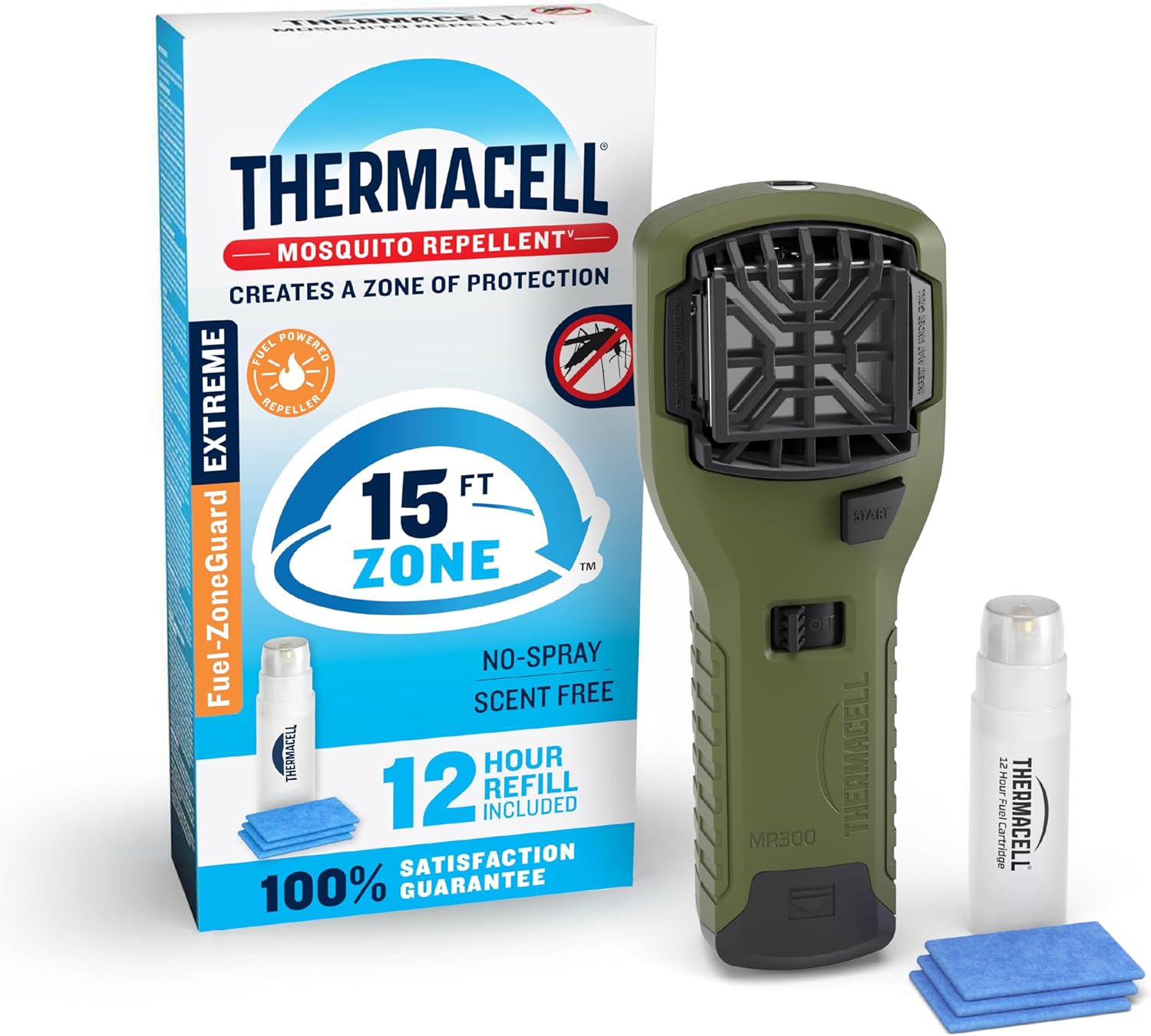
| Protection Zone | 15 Feet |
|---|---|
| Fuel Refill Duration | 12 Hours |
| Repellent Mats | Mats last up to 4 hours each |
| Formulation | Scent Free DEET-Free |
The Thermacell Fuel-ZoneGuard Extreme is a compact, heat-activated mosquito repeller designed for outdoor use where sprays and lotions are inconvenient. It runs on a 12-hour fuel cartridge and uses replaceable repellent mats to produce a scent-free protection zone of about 15 feet, making it suited to campsites, hunting blinds, and picnic spots. Because it requires no batteries or cords you can set it out and forget it while you set up camp or sit by a fire. Notable features include a 12-hour fuel source, mats that change color when spent, and a DEET-free, EPA-reviewed active ingredient. In practice it reduces mosquito presence quickly once warmed up, and the unscented output avoids masking natural smells that hunters care about. The main limitations are that coverage is localized (you need one per small gathering area) and it is for outdoor use only, so wind or open terrain can reduce effectiveness. For risk-conscious users the product provides a predictable, tested way to cut bites without applying chemicals to skin.
Best for: Campers, hunters, and outdoor hobbyists who want a proven, low-maintenance way to reduce mosquitoes around a small campsite or seating area without applying repellent to skin.
Less Ideal for: People needing broad property-wide protection or indoor use should consider other solutions that cover larger areas or are rated for enclosed spaces.
- Creates a scent-free protection zone up to 15 feet without sprays on skin
- Runs on a 12-hour fuel cartridge so no batteries or electrical power needed
- Mats change color to indicate when they need replacing for easy monitoring
- DEET-free, EPA-reviewed repellent formulation suited for outdoor use
- Effective coverage is localized so multiple units are needed for larger groups
- Performance can be diminished by wind or very open spaces
Verdict: A reliable, portable repeller that gives scent-free bite protection around a small campsite without batteries or skin-applied chemicals.
Cliganic Mosquito Repellent Bracelets, Pack of 10 (Citronella)

| Scent Name | Citronella |
|---|---|
| Item Form | Band |
| Indoor Outdoor Usage | Indoor, Outdoor |
| Target Species | Mosquito |
| Number of Items | 10 |
Cliganic Mosquito Repellent Bracelets are stretchy bands infused with plant-based essential oils (geranium, lemongrass, citronella) designed to be worn on a wrist or ankle for on-the-go mosquito deterrence. The package contains ten individually wrapped bands that are marketed for indoor and outdoor use such as parks, hiking, camping, and travel. Key practical benefits are ease of use and low chemical exposure since the product is DEET-free and labeled non-toxic, vegan, and cruelty free. Individual wrapping makes them convenient to carry and share, and the one-size-stretchy design fits most children and adults without fasteners. Important limitations are that these are a passive, localized repellent rather than a full-body treatment so coverage is limited to the immediate area around the band, and effectiveness can vary with wind, activity, and mosquito pressure. Users who need long-duration, whole-body protection or who are in high-risk areas should supplement with other proven measures. For cautious buyers wanting a simpler, low-chemical option for routine outdoor activities, these bands offer an easy extra layer of protection.
Best for: Buyers who prioritize low-chemical, easy-to-use mosquito protection for everyday outdoor activities and want a simple product they can hand to kids or tuck into a pack.
Less Ideal for: People who need robust, long-duration protection for high-risk mosquito areas or require full-body coverage should look at stronger topical repellents or treated clothing.
- DEET-free, plant-based ingredients reduce exposure to synthetic repellents
- Individually wrapped bands are portable and hygienic for travel or sharing
- One-size-stretchy design fits most wrists and ankles without adjustment
- Marketed for both indoor and outdoor use so they are versatile for casual activities
- Provides only localized protection around the band rather than full-body coverage
- Effectiveness can be inconsistent in windy conditions or heavy mosquito populations
Verdict: A convenient, DEET-free wearable that adds a low-chemical layer of mosquito protection for everyday outdoor use.
Choosing the Right Camping Mosquito Killer: Key Factors to Consider
Battery Life and Power
Battery life determines how long a device will protect your campsite between charges or fresh batteries. For multi-night trips you want a unit rated for many hours at typical settings rather than just peak output numbers. Consider whether the device uses replaceable batteries, a rechargeable internal pack, or supports USB recharging from a power bank. Power output matters because higher output can increase attractive range or zap effectiveness, but it often reduces runtime, so balance the two based on how long you need protection each night.
Also think about charging logistics. Rechargeable units that accept USB power are convenient when you have a solar panel or portable battery, whereas replaceable cell options make swapping quick without recharging gear. Look for clear runtime estimates at realistic settings rather than lab peak times.
Attractant Type and Effectiveness
Camping mosquito killers use different lures: light wavelengths, CO2 mimicry, heat, scent pads, or fan-based suction. Each method behaves differently in open-air conditions. For example, UV or blue light attracts many night-flying species but can be less effective in bright twilight or where competing light sources exist. Fan-and-trap systems can be better at physically capturing insects but need power to run the fan.
Consider the local mosquito species and typical campsite layout. Devices that combine multiple attractants tend to perform more consistently. Also check how frequently lure cartridges or pads need replacing and whether consumables are easy to pack and source for extended trips.
Portability and Mounting Options
Weight, shape, and mounting flexibility determine how a unit integrates with camping setups. Lightweight, compact units stow easily in a backpack and are preferable for backpacking trips. Larger models may offer greater coverage but are better suited to car camping where transport bulk is less of a concern. Look for units with hooks, stakes, or tripod mounts so you can position them above ground, near entranceways, or hung from a tree branch to improve lure dispersal.
Also consider how easily the unit can be cleaned and serviced in the field. Simple constructions with removable trays or screens are easier to maintain when you do not have full cleaning tools available.
Noise and Light Impact
Noise and visible light matter at camp because you want protection without disrupting conversation, sleep, or campsite ambiance. Some devices produce a low hum from fans or occasional zapping sounds when insects are neutralized. Others emit steady light that can interfere with night vision or attract unwanted attention. For sleeping areas choose units with quiet fans or passive trapping and dimmable or concealed light sources.
If you frequently camp with children or in quiet backcountry settings, prioritize units specifically tested for low decibel levels and minimal light spill. Conversely, if you place devices away from sleeping areas, a noisier but more powerful unit might be acceptable.
Weather Toughness and Durability
Outdoor gear faces rain, humidity, dust, and knocks during transport. A camping mosquito killer should have some measure of weather resistance so it continues working after a light shower or heavy dew. Look for splash-resistant housings, sealed battery compartments, and corrosion-resistant materials. Durable construction also matters if you are packing gear into tight spaces where it might be bumped or dropped.
Consider whether the unit needs to be sheltered during heavy weather and how easy it is to dry and clean after exposure. Devices that use disposable pads or sticky traps may become less effective when wet, so plan for storage and maintenance in damp environments.
Coverage Area and Placement Strategy
A unit's stated coverage area can help you decide how many devices you need for a campsite. Coverage is influenced by attractant strength, lure type, and placement height. For example, placing a device at head height near seating and sleeping areas increases personal protection but may reduce overall range. If you want whole-site coverage, expect to deploy multiple units or choose a more powerful device intended for larger spaces.
Think about campsite layout. Place units upwind of shelter and away from food prep areas if the device attracts non-target insects. Evaluate whether you want zoned protection for a sleeping area only or broader perimeter control.
Best Options by Camping Style
Different camping styles demand different mosquito control approaches. For backpacking you want the lightest, lowest-power unit that still offers effective short-term protection and minimal bulk. Car campers can accept heavier, higher-capacity devices that cover more area. Family or group campers may prefer units that support long runtimes or multiple units to create a protected zone around a tent or table.
Think about how you travel and pack. A small USB-rechargeable trap is ideal for day hikes and short overnight trips, while a larger fan-based unit suits longer stays at a single site. Mounting options and how you position units are as important as raw coverage numbers.
- Backpacking: prioritize weight, compact form, and USB charging
- Car camping: choose higher-capacity units with larger coverage
- Family camping: plan for multiple devices or a high-output unit to cover communal spaces
Placement Tips to Maximize Effectiveness
Placement makes a big difference. Hang or elevate the device slightly above ground level and upwind from your sleeping area so lures disperse toward mosquitoes before they reach people. Avoid placing units directly next to sleeping heads or inside tents unless the unit is rated for enclosed spaces and has very low light and noise output.
Position units away from competing light sources like campfires or lanterns, which can reduce the lure's relative attractiveness. If you have multiple devices, space them to create a protective perimeter around high-use areas rather than clustering them together.
- Mount devices 3 to 6 feet off the ground for typical mosquito flight paths
- Keep units 10 to 15 feet from tents or seating to reduce light and noise impact
- Use multiple low-power devices rather than one distant high-power unit for even coverage
Maintenance and Consumables in the Field
Regular maintenance keeps a unit effective on multi-day trips. Empty and clean collection chambers or sticky pads daily if insects accumulate. Replace or recharge consumables as recommended and carry spare pads or extra batteries when possible.
Plan for how consumables will be stored and packed. Scent pads or attractant cartridges can be sensitive to heat and humidity, so keep them sealed until use. Simple cleaning tools like a small brush and a cloth can prolong effective operation when you are away from base camp.
- Carry spare batteries or a power bank for longer trips
- Pack a small brush for removing debris from fan intakes
- Store attractant pads in airtight bags until needed
Safety and Non-Target Considerations
Consider how a device affects non-target insects and campsite safety. Sticky traps and light-based lures can catch beneficial insects like moths or pollinators if placed near natural habitat. Electric zapper grids may give off occasional arcs that startle campers or are unsuitable near flammable materials.
Follow safe placement rules and keep devices away from sleeping children and pets if they emit light, noise, or heat. If you are camping in an area with high biodiversity, place units away from water edges where beneficial insects congregate.
- Avoid placing traps directly over flowering plants
- Keep electric grids clear of flammable fabrics and paper
- Consider passive barriers and repellents as complementary measures
Combining Devices With Other Mosquito Controls
A camping mosquito killer is one tool among many. Use it together with netting, topical repellents, and campsite sanitation to reduce breeding sites. Empty standing water, store food securely, and use rigid barriers such as mesh screens for sleeping areas to limit bites while devices work on reducing local populations.
Layering strategies reduce the pressure on any single product and often yields better comfort. For example, use a trap to lower numbers around a communal area while treating immediate sleeping spaces with netting or treated fabrics.
- Use traps to reduce ambient numbers and nets for personal protection
- Pair devices with good campsite hygiene to prevent larval hotspots
- Rotate lure types across trips if a single method seems less effective
How We Chose the Best Camping Mosquito Killer
We focused on features that matter for use away from home and in variable outdoor conditions. Primary evaluation criteria included battery life and power output, because a unit must last through evening and provide consistent attractant or zap coverage. Portability and packability were assessed by weight, shape, and mounting options so units are easy to carry and install at a tent, hammock, or picnic table. Noise level was judged for real campsite conditions where quiet evenings matter. Weather resistance and durability were reviewed to make sure units can handle light rain, humidity, and dusty trails. Effectiveness of the attractant or trapping method was evaluated by how well a device draws in and neutralizes mosquitoes without excessive non-target captures. We excluded indoor-only products and units designed solely for standing-room use in controlled environments. We also filtered out devices that require permanent installation, mains-only power, or heavy, fragile components unsuited to travel. Our shortlist favors devices that balance field-proven features: long runtime, compact packing, robust construction, and clear user controls. The scoring labels reflect these dimensions so readers can weigh tradeoffs between runtime, noise, and portability.
FAQ
How long should a camping mosquito killer run each night?
It depends on mosquito activity and battery capacity. Many camp scenarios need 6 to 12 hours of runtime to cover evening through early morning. Choose a unit with a runtime that matches your typical night length or carry extra power for recharging.
Are light-based traps effective at campsites?
Light-based traps can work for many night-flying species but may be less effective when competing light sources exist. They perform best when placed away from campfires and positioned to guide insects into a trap rather than toward people.
Can I use an indoor mosquito trap at a campsite?
Indoor-only units are usually not weatherproof and may lack the mounting and power options useful for outdoor use. Look for devices rated for outdoor or portable use to ensure durability and safety at camp.
What maintenance does a trap require while camping?
Empty collection trays or replace sticky pads regularly, especially after heavy catches. Clean fan intakes and recharge or swap batteries as needed. Simple daily care keeps the unit operating efficiently on multi-night trips.
Will a single device protect a large campsite?
Coverage varies by attractant strength and placement. A single high-output unit may cover a central area, but multiple strategically placed low-power units usually provide more even protection across larger sites.
Are these devices safe around children and pets?
Many camping units are safe when used as directed, but devices that generate heat, light, or zapping sounds should be placed out of reach. Choose designs with recessed grids or sealed chambers if children and pets are present.
Final Verdict
When choosing a camping mosquito killer, prioritize the features that match how and where you camp. Balance battery life against attractant strength and portability so the unit lasts through the hours you need protection without adding excessive bulk. Consider noise, weather resistance, and maintenance needs to ensure dependable operation on multi-night trips. The right choice depends on tradeoffs: lightweight USB-rechargeable units fit backpacking, while larger fan-based traps suit car camping and group sites. Use placement and complementary measures like netting and site hygiene to get the best practical protection for your campsite.
