

Note: This article contains affiliate links. If you click on these links and make a purchase, I may earn a small commission at no extra cost to you. This helps support my research and content. Read my full affiliate disclosure here.
When rodents get into storage units they can damage boxes, fabrics, electronics, and insulation. Choosing the right rodent poison for storage units matters because these spaces often contain mixed goods, limited ventilation, and intermittent human access. You want products that reduce rodent activity quickly while minimizing risk to people, pets, and neighboring units. This guide shortlists the top seven rodent poisons chosen for storage settings and explains how each type performs on bait longevity, placement flexibility, and safety controls. We describe the evaluation criteria used so you can pick a solution that fits your facility and storage needs.
Top Picks at a Glance
| Best Overall The best all-around choice for most situations | Farnam Just One Bite II Rat & Mouse Bait Bars, 8-Pack |  |
| Best Quality Built to a higher standard if you want something more solid | Bell Laboratories Contrac All-Weather Blox 18 lb Pail |  |
| Best Value The sweet spot between price and what you get | Neogen Ramik Green Fish‑Flavored Weather‑Resistant Rodenticide Nuggets, 4 lb |  |
| Best Budget The cheapest option that still gets the job done reliably | Tomcat Mouse Killer Disposable Child & Dog Resistant Bait Stations (2-Pack) |  |
| Highest Rated A top-rated pick with lots of positive feedback | Bell Laboratories Final Blocks Rodenticide 18 lb |  |
| Most Popular A crowd favorite that many people choose with confidence | Tomcat Bromethalin Bait Chunx Pail, 4.25 lb |  |
| Best Seller A high-volume bestseller chosen again and again | d-Con Corner Fit Mouse Poison Bait Station Refills, 10 Count |  |
Farnam Just One Bite II Rat & Mouse Bait Bars, 8-Pack

| Item Form | Bar |
|---|---|
| Target Species | Rat,Mouse |
| Active Ingredients | Bromadiolone |
| Unit Count | 128 Ounce |
Farnam Just One Bite II are dense bait bars formulated with bromadiolone and shaped with nibble ridges to encourage chewing by Norway rats, roof rats, and house mice. They are typically placed in bait stations or along runways inside and around agricultural buildings where rodent activity is suspected. The bars are designed to deliver a lethal dose in one night and use a delayed 4 to 5 day mortality period to avoid bait shyness, which helps control populations including some warfarin-resistant rats. The product comes as individually wrapped 1-pound bars, which makes handling and placement neater and reduces mess compared with loose bait. Key limitations are that this is a professional-strength anticoagulant so it must be used carefully to avoid non-target exposure and it is labeled for use in and around agricultural buildings rather than general indoor household use. Users should follow safety instructions and local regulations when deploying the bars and keep them out of reach of children and pets.
Best for: Buyers who need an effective, fast-acting rodent bait for barns, outbuildings, or agricultural settings and who are comfortable following professional-use safety practices.
Less Ideal for: People looking for pet-safe, general residential indoor rodent control or those who cannot guarantee secure placement away from non-target animals should consider alternative methods.
- Designed to deliver a lethal dose in a single feeding for fast population reduction
- Nibble ridge shape encourages chewing for effective uptake
- Effective against warfarin-resistant Norway rats
- Individually wrapped 1 lb bars simplify handling and placement
- Contains the anticoagulant bromadiolone which poses secondary poisoning risks to non-target animals and requires careful placement and handling
- Labeled for use in and around agricultural buildings which limits household or broad residential use
Verdict: Choose these bait bars if you need a professional-strength, single-feeding rodent bait for fast control in agricultural buildings.
Bell Laboratories Contrac All-Weather Blox 18 lb Pail
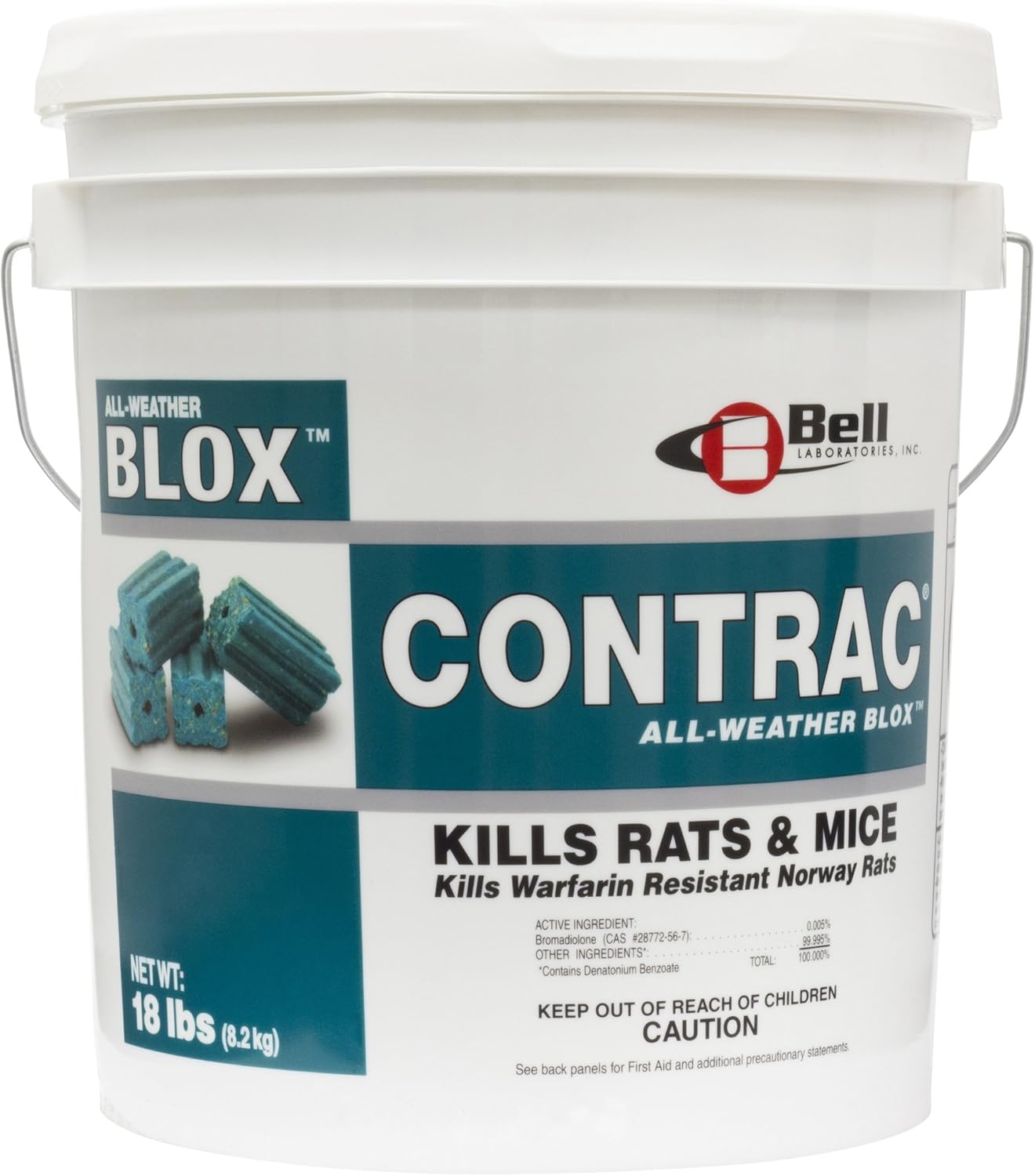
| Active ingredient | Bromadiolone |
|---|---|
| Form | All-Weather BLOX |
| Package weight | 18 lb pail |
Contrac All-Weather BLOX are hardened rodenticide bait blocks designed for professional-strength control of rats and mice in challenging environments like storage units. Each pail contains multiple center-holed blocks so technicians can mount them on bait rods or secure them in tamper-resistant stations; the formulation includes a small amount of paraffin for weather resistance and an extrusion process that creates multiple gnawable edges to encourage feeding. The active ingredient, bromadiolone, is a single-feeding anticoagulant effective against warfarin-resistant Norway rats, making it suitable for both clean-outs and ongoing maintenance. Practical benefits include excellent palatability, good performance in damp conditions, and ease of deployment in protected bait stations. Important limitations are that these are professional-use rodenticide blocks requiring careful placement away from non-targets and that legal or facility rules for rodenticide use and storage-unit policies must be followed. Not intended for open placement where pets or people can access the bait.
Best for: Facility managers, professional pest controllers, and storage-unit owners who prioritize reliable, single-feeding rodent control and need bait that holds up in damp or variable storage conditions.
Less Ideal for: Casual homeowners with small indoor infestations, households with pets or children where non-toxic or enclosed solutions are required.
- Formulated with bromadiolone for single-feeding control of resistant rats
- Center hole and rigid shape allow secure placement on bait rods or in tamper-resistant stations
- Paraffin-enhanced formula improves weather resistance for damp storage areas
- Highly palatable extrusion formulation encourages gnawing and bait acceptance
- Contains a potent anticoagulant that requires strict handling and secure placement to protect non-target animals and people
- Sold as a professional bulk pail which may be more than needed for small infestations
Verdict: Choose Contrac All-Weather BLOX when you need a professional-grade, weather-resistant bait that delivers strong single-feeding control in storage-unit environments.
Neogen Ramik Green Fish‑Flavored Weather‑Resistant Rodenticide Nuggets, 4 lb

| Item Form | Pellets |
|---|---|
| Target Species | Rats, Mice and Meadow Voles |
| Active Ingredients | Diphacinone |
Neogen Ramik Green nuggets are a fish‑flavored, weather‑resistant rodenticide formulated with diphacinone and sold in a 4 lb bag. You place the pellets where rodent activity is seen or inside approved bait stations; the palatable grain mix encourages feeding and the anticoagulant acts over several days after ingestion. The nuggets are designed for indoor and outdoor use and are marketed as especially suited to wet or damp areas because they resist softening in moisture better than wax baits. Practical users will appreciate the simple pellet form that is easy to distribute in stations or around structures and the familiar single‑ingredient formulation. Important limitations are that this is a first‑generation anticoagulant so multiple feedings are usually required and results can take several days, and it is a toxic pesticide that requires careful handling and secure placement to avoid exposure to children, pets, and non‑target wildlife. Follow label directions and local regulations when using this product.
Best for: Buyers who want a straightforward, proven pellet rodenticide for routine control around buildings and in damp outdoor sites and who prioritize ease of deployment and reliable palatability.
Less Ideal for: People who need an immediate‑action solution, those unwilling to follow pesticide safety rules, or those with uncontrolled access by pets or wildlife should choose different control methods.
- Weather‑resistant pellet form suitable for damp or wet areas
- Fish flavor and food‑quality grain mix increase palatability to rodents
- Simple pellet nuggets are easy to place in bait stations or along runways
- Contains diphacinone, a widely used first‑generation anticoagulant
- Requires multiple feedings and can take several days to produce mortality
- Toxic to non‑target animals and humans so strict placement and handling are necessary
Verdict: A practical, weather‑resistant pellet bait that reliably attracts rodents for routine indoor and outdoor control when used according to label instructions.
Tomcat Mouse Killer Disposable Child & Dog Resistant Bait Stations (2-Pack)

| Unit Count | 2 Count |
|---|---|
| Target Species | Mouse |
| Item Type Name | for Indoor/Outdoor Use |
| Included Components | Rodent Trap |
Tomcat Mouse Killer disposable stations come ready to use with a preloaded bait block inside a clear-lidded, tamper-resistant housing. You place the small stations where mice travel—along walls, in corners, behind appliances, or near burrows—and the bait attracts and kills mice that feed and leave the station. The clear lid makes it easy to check bait levels and the weather-resistant, child- and dog-resistant design lets you use them in garages, attics, and other semi-exposed spots without worrying about pets or kids accessing the poison. Because each unit is disposable and pre-baited there is no handling of loose bait, which simplifies setup and disposal. The package contains two stations, so this is best for spot treatment rather than an ongoing multi-station program. If you need broader or longer-term control you will want larger packs or a refillable system, but for quick targeted indoor use these stations are simple and effective.
Best for: Buyers who want a low-cost, low-effort spot treatment to quickly address a small indoor mouse problem and who prioritize safety and ease of use over long-term coverage.
Less Ideal for: Homes with heavy or widespread infestations or users who prefer reusable refillable systems for ongoing control should look at larger multi-station or refillable options.
- Ready-to-use pre-baited stations require no handling of loose poison
- Child- and dog-resistant housing reduces accidental access risk
- Clear lid lets you monitor bait without opening the station
- Weather-resistant design suitable for garage and attic placement
- Only two disposable stations in the box so coverage is limited for larger infestations
Verdict: A simple, safety-focused two-station kit that lets budget-minded buyers set and monitor pre-baited mouse poison with almost no setup.
Bell Laboratories Final Blocks Rodenticide 18 lb
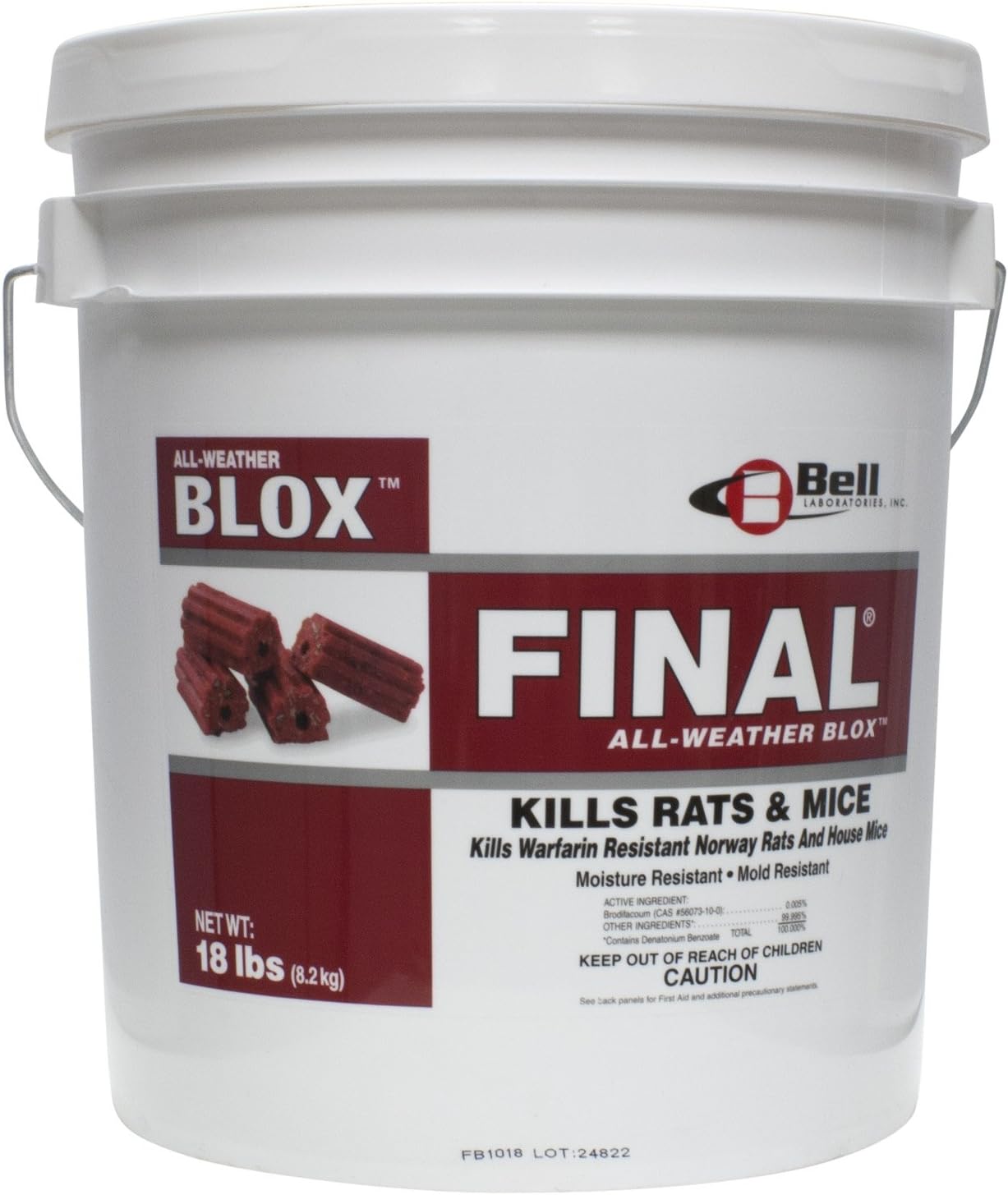
| Item Form | Spray |
|---|---|
| Target Species | Rodents |
| Item Weight | 19.9 pounds |
Final Blocks Rodenticide is a bulk block-style poison formulated for controlling rodents indoors and in outbuildings. It is presented as solid bait blocks designed to be placed in secure bait stations or locations rodents frequent; the block form helps keep bait in place and reduces scattering. Typical use is by distributing blocks around burrows, along runways, or inside tamper-resistant bait stations on a routine monitoring schedule. Practical benefits include a large 18 pound supply for sustained control programs and a concentrated formulation suited to professional or heavy residential infestations. Important limitations are that it is a toxic pesticide requiring careful placement in secured stations to keep pets and non-target wildlife away, and it assumes the user understands local regulations and safe handling. It does not include bait stations or measuring tools, so buyers should plan for storage and safe deployment accessories.
Best for: People managing moderate to heavy indoor or outbuilding rodent problems who prioritize an effective, long-lasting bait supply and will use tamper-resistant bait stations and proper safety practices.
Less Ideal for: Those with small, occasional mouse sightings, households with unsupervised pets or children, or anyone unwilling to follow pesticide safety rules should choose non-chemical or smaller packaged options.
- Large 18 lb supply suitable for multi-location or long-term control programs
- Block form resists scattering and stays in place along runways
- Designed for targeting rodents specifically, reducing wasted product
- Bulk pack is convenient for maintenance schedules without frequent repurchasing
- Contains toxic active ingredients and requires strict use in tamper-resistant bait stations
- No bait stations or placement accessories are included
- Not formulated or sold with child or pet-proof packaging integrated
Verdict: A bulk, block-style rodenticide that gives sustained, professional-strength bait supply for serious mouse control when used responsibly.
Tomcat Bromethalin Bait Chunx Pail, 4.25 lb

| Item Form | Bar |
|---|---|
| Target Species | Rodents |
| Net Weight | 4.25 lb |
This Tomcat pail contains preformed 1 oz. bromethalin bait blocks intended for tackling mice, Norway rats, roof rats, and meadow voles in and around buildings. It is packaged for professional or agricultural use and is typically deployed inside tamper-resistant bait stations placed in basements, garages, crawl spaces, and around foundations within 100 feet of structures. The bait is fast-acting so rodents often consume a lethal dose in a single night and mortality can occur within a few days. The large 4.25 lb. pail supplies many placements and makes regular monitoring and replenishment simple. Important practical points are that outdoor placements must be in weather- and tamper-resistant stations and the label restricts use against certain species in California. Because this contains an acute pesticide, care is needed to keep it inaccessible to children, pets, and non-target wildlife and to follow local regulations and label directions.
Best for: Buyers who want a professional-strength, ready-to-use rodent bait for systematic control around buildings and who plan to use tamper-resistant stations and follow label directions.
Less Ideal for: Casual homeowners who cannot commit to secure bait station use or who need a rodent solution safe for free outdoor placement around pets and wildlife.
- Preformed 1 oz. blocks are easy to place and monitor in bait stations
- Contains bromethalin which is effective against anticoagulant-resistant rodents
- Large 4.25 lb. pail supplies many bait placements for ongoing control
- Suitable for indoor and outdoor use when placed in tamper-resistant stations
- Requires tamper- and weather-resistant bait stations for safe outdoor use and to protect non-targets
- Not permitted for use on several listed species in California and must be used according to label restrictions
Verdict: Choose this product when you need a professional-grade, preformed bromethalin bait supply for effective, managed rodent control around structures.
d-Con Corner Fit Mouse Poison Bait Station Refills, 10 Count

| Unit Count | 10 Count |
|---|---|
| Target Species | Mouse |
| Active Ingredients | Cholecalciferol |
This 10-count refill pack supplies the bait that fits d-Con corner-fit refillable stations and is formulated with cholecalciferol rather than traditional anticoagulants. You load the bait into the low-profile, tamper-resistant station and place it where you see mouse activity such as corners, behind appliances, attics or garages. The active ingredient is designed to be attractive to mice and can stop visible activity within a few days once mice consume the bait. The refillable format makes it easy to swap in fresh bait without replacing the entire station, and the manufacturer notes the station is weather-resistant for limited outdoor use. Important limitations are that this is a lethal control intended for rodents and contains a vitamin D derivative as the active ingredient, so users must follow label directions carefully to avoid accidental exposure to pets or children and to comply with local disposal rules. Also, bait effectiveness depends on proper placement and mice feeding on it, so monitoring and moving stations may be necessary.
Best for: Buyers who want a proven, replaceable bait option for established mouse activity and who prioritize products with social proof and a more familiar active ingredient profile.
Less Ideal for: People who need nonlethal or catch-and-release rodent solutions or who cannot guarantee secure placement away from children and pets.
- Contains cholecalciferol formulation instead of anticoagulant neurotoxins
- Refill pack fits d-Con corner-fit refillable stations for easy replacement
- Low-profile, tamper-resistant bait station design reduces access by children and pets
- Weather-resistant formulation and station suitable for indoor and limited outdoor placement
- Lethal to rodents so requires careful handling and strict adherence to label safety directions
- Effectiveness depends on mice actually feeding on the bait and correct placement of the station
Verdict: If you want a refillable, tamper-resistant bait option with cholecalciferol for quickly reducing house mouse activity, these 10-count refills are a practical choice.
Choosing the Right Rodent Poison for Storage Units: Key Factors to Consider
Toxicity Profile and Label Restrictions
Understanding a product's toxicity is critical because storage units often host people and pets intermittently. Labels differ in active ingredients and required setbacks or containment measures. Read restrictions about use near food, fabrics, electronics, or in shared-access spaces.
Toxicity also influences cleanup and carcass handling. Higher-toxicity baits can be effective with fewer feedings but increase the importance of secure placement and staff training. Choose products whose labeled precautions match your facility's access patterns and the staff resources available to monitor placements.
Containerized Delivery and Tamper Resistance
A bait's delivery method matters as much as the formulation in storage units. Block baits, pellets, and soft baits are effective, but without a tamper-resistant station they can be disturbed by staff, customers, or other animals. Containerized delivery reduces accidental exposure and keeps bait dry in dusty or slightly humid unit interiors.
Opt for products that are compatible with lockable or permanently mounted bait stations designed for enclosed spaces. Stations that allow internal refills without full exposure are preferable because they reduce handling and the chance of misplacement in narrow shelving or behind stored items.
Bait Stability in Variable Conditions
Storage units can vary widely in temperature and humidity, from climate-controlled units to uninsulated spaces that get hot in summer and cold in winter. Baits that crumble, dry out, or melt under these conditions lose attractiveness and efficacy. Stability affects how often staff must inspect and replace bait.
Choose formulations that resist drying and mold, and that maintain palatability across a range of temperatures. Longer-lasting baits reduce maintenance labor and lower the chance of attracting scavengers to degraded attractants.
Efficacy Against Facility Rodent Species
Different facilities face different rodent pressures, often rats or mice with distinct feeding behaviors. Some baits work faster as acute toxicants, others require multiple feedings to be effective. Consider which species are present and whether you need rapid knockdown or a longer-term reduction strategy.
Efficacy also ties to bait preference and placement. In crowded storage areas with many food odors, more attractive formulations or pre-baiting strategies may be necessary. Understand that bait acceptance can vary seasonally and by local rodent populations.
Non-Target Exposure Mitigation
Minimizing accidental poisoning of pets, wildlife, or non-target people is essential in shared-access storage centers. Products that are easily accessible or leave residue on surfaces create risk. Look for baits and stations that reduce direct contact and have clear instructions for avoiding contamination of stored goods.
Training staff on where and how to place bait stations, signage for customers, and scheduled inspection routines are practical steps that work alongside product choice to keep non-target exposure low.
Regulatory Labeling and Disposal Instructions
Pesticide labels are legally binding; they determine where and how a rodent poison can be used. For storage units, ensure the product label allows indoor or structural use and provides guidance on carcass disposal and spill cleanup. Some formulations require specific disposal methods that affect how a facility manages waste.
Selecting products with clear, facility-appropriate labeling avoids regulatory issues and makes staff compliance easier. Keep records of placements and follow label timelines for rechecks and replacements.
Placement Strategies for Enclosed Storage Spaces
Effective placement minimizes discovery by people and maximizes rodent encounters. Put tamper-resistant bait stations along walls, at unit seams, and near likely travel corridors rather than open floor centers. In densely packed units, place stations where rodents can access them without contacting stored items directly.
For stacked boxes or shelving, mount stations at low levels behind items or inside shelving cavities. Avoid placing bait directly on shelving that holds textiles or food-related items to reduce contamination risk.
- Position stations where droppings or rub marks indicate rodent activity
- Keep bait off porous surfaces to prevent residue transfer
- Use wall-mounted or floor-level stations depending on unit layout
Monitoring and Refill Routines
Regular inspections are key to maintaining control and limiting exposure. Establish a schedule for checking bait stations, recording consumption, and replacing bait or station inserts. Frequency depends on bait stability and activity levels; high-activity situations may need weekly checks while low-traffic units can be monitored monthly.
Use a simple log to note station location, bait type, and last service date. Logs help spot patterns and prevent missed maintenance that could expose staff to older, degraded bait.
- Inspect stations at consistent intervals
- Record bait condition and evidence of feeding
- Replace bait when it shows signs of degradation
Carcass Discovery and Safe Cleanup
When a rodent dies inside a unit, immediate action reduces odor, secondary scavenger attraction, and contamination. Staff should wear gloves and use tools to recover carcasses while minimizing contact. Follow label guidance on handling and disposal to comply with safety instructions.
Disinfect the area after removal and check adjacent storage for contamination. If multiple carcasses appear rapidly, escalate to broader inspection or consult a pest professional to evaluate bait placement and strategy.
- Use disposable gloves and sealed bags for removal
- Disinfect surfaces following removal
- Document incidents and adjust baiting as needed
Working with Tenants and Facility Staff
Clear communication helps avoid accidental exposure and reduces complaints. Inform tenants of routine inspections, where stations are located, and who to contact about concerns. Provide simple guidance on keeping foodstuffs sealed and reducing clutter that can hide activity.
Train staff on basic safe handling, inspection checklists, and when to escalate findings to a pest management professional. Consistent procedures improve safety and maintain tenant confidence.
- Provide tenants with brief written notices about baiting schedules
- Train staff on station placement and monitoring protocols
- Keep a central record of all service visits and findings
When to Call a Professional
Persistent infestations, multiple access points, or concerns about non-target exposure often exceed routine product use. A pest professional can assess structural entry points, recommend integrated strategies, and implement exclusion or trapping where poisons are inappropriate.
Consider professional help if you find repeated carcasses, bait disappearing with no sign of feeding, or if a tenant reports pet exposure. Professionals also provide options for sensitive stored items and can advise on legal disposal practices.
- Call a professional for widespread or recurring activity
- Seek help when non-target exposure is suspected
- Use professionals for structural exclusion and complex sites
How We Chose the Best Rodent Poison for Storage Units
Our selection prioritized formulations and delivery options suited to storage-unit environments where goods are confined, access is irregular, and non-target exposure is a real concern. We focused on bait stability, how long a product remains attractive without spoiling, and whether the formulation resists moisture and dust common in storage facilities. Containment options were another filter: products that can be securely deployed inside tamper-resistant stations or sealed compartments scored higher. We assessed toxicity profile and labeled precautions to judge practical safety for staff, customers, and visiting pets. Application methods and the flexibility of placement in shelving, corners, and enclosed containers were evaluated. Finally, we looked at how straightforward the instructions are for commercial settings and whether products provide clear disposal guidance. Excluded from consideration were consumer poisons intended only for open-yard use, specialty agricultural products not labeled for confined storage, and items lacking clear labeling on non-target safety and containment. The chosen criteria reflect what matters for protecting stored goods while limiting collateral risk.
FAQ
Is rodent poison safe to use inside storage units?
It can be when products are used according to label directions and placed in tamper-resistant stations. Safety depends on following labeled restrictions, using appropriate containment, and training staff to avoid accidental exposure.
How often should bait stations in storage units be checked?
Inspection frequency depends on activity and bait stability. Many facilities start with weekly checks in high-activity areas, moving to biweekly or monthly for low-traffic units while maintaining records of consumption and condition.
What should staff do if they find a dead rodent in a unit?
Wear gloves, place the carcass in a sealed bag, and follow label disposal instructions. Disinfect the area afterward and log the incident. If multiple carcasses appear, consider contacting a pest professional for assessment.
Can bait attract pests other than rodents?
Some baits can attract non-target scavengers if left exposed or degraded. Using enclosed stations and choosing stable formulations reduces the chance of attracting birds, raccoons, or stray pets.
Are there alternatives to poison for storage units?
Yes. Integrated options include snap traps, live traps, exclusion work sealing entry points, and sanitation to remove attractants. These methods are often used with, or instead of, baits depending on sensitivity of stored items.
Do environmental conditions affect bait performance?
Yes. Heat, cold, and humidity can degrade some baits or change palatability. Selecting stable formulations and using sealed stations helps maintain effectiveness across variable storage conditions.
Final Verdict
For storage units the right rodent poison strategy balances effective rodent control with rigorous containment and regular monitoring. Prioritize products and delivery methods that remain stable in variable conditions, allow secure placement in tamper-resistant stations, and have clear label instructions for non-target safety and disposal. Match your choice to the species present, inspection capacity, and tenant access patterns. If you cannot safely contain bait or if infestations persist, escalate to professional pest management for exclusion and integrated control measures.
