

Note: This article contains affiliate links. If you click on these links and make a purchase, I may earn a small commission at no extra cost to you. This helps support my research and content. Read my full affiliate disclosure here.
Picking the right 300 Watt LED grow light shapes how well your indoor plants develop from vegetative growth into strong flowering. You want even canopy coverage, a spectrum that supports both veg and bloom, and a fixture that does not spike your electricity bill or overheat a small grow space. This guide shortlists the top choices for a range of indoor setups, from single-cabinet grows to small tents and hobby benches. Each pick was evaluated for spectrum quality, actual power draw, heat management, and ease of installation so you can match a fixture to your space and goals. Read on to see which options fit tight tents, small multi-plant racks, or compact hobby tables, and why those decision factors matter for results.
Top Picks at a Glance
| Best Overall The best all-around choice for most situations | MARS HYDRO FC-3000 300W Full-Spectrum LED Grow Light |  |
| Best Quality Built to a higher standard if you want something more solid | Spider Farmer SE3000 LED Grow Light, 300W, App Controlled |  |
| Best Value The sweet spot between price and what you get | Spider Farmer G3000 300W LED Grow Light (App Controlled) |  |
| Highest Rated A top-rated pick with lots of positive feedback | AC Infinity IONFRAME EVO4 300W Samsung EVO Bar LED Grow Light |  |
| Most Popular A crowd favorite that many people choose with confidence | MARS HYDRO TSW2000 300W LED Grow Light |  |
MARS HYDRO FC-3000 300W Full-Spectrum LED Grow Light

| Wattage | 300 watts |
|---|---|
| Light Source Type | Light Emitting Diode |
| Light Source Special Features | Dimmable, Daisy-chain compatible, Remote control App scheduling and programming |
| Number of Light Sources | 792 |
| Material Type | Aluminum, Metal |
The MARS HYDRO FC-3000 is a compact 300W LED fixture engineered for small indoor grows and 3×3 foot tents. It uses Bridgelux 3030 diodes and supplemental OSRAM red chips to deliver a high-efficiency full spectrum aimed at both veg and bloom stages. The light is built as a bar-style array with aluminum housing that helps dissipate heat during long runs. Setup requires manual assembly of the bars and driver, after which you can use on-unit controls or link it to the MARS HYDRO app or compatible controllers for dimming, scheduling, and daisy-chaining multiple units. In practice it provides even coverage for a single 3×3 footprint and the deep red output helps flowering and bud development. Expect lower energy draw compared with equivalent HID fixtures and straightforward integration into a small tent system. The main compromises are that it is not fully plug-and-play out of the box and larger gardens will need multiple units to get uniform canopy PPFD.
Best for: Growers who want a balanced, energy-efficient 300W fixture for a single 3×3 ft tent and value app control and a full spectrum that supports both vegetative growth and flowering.
Less Ideal for: Large-scale or commercial growers who need wide-area coverage or turnkey plug-and-play fixtures for multiple large rooms.
- High-efficiency 300W output using Bridgelux 3030 diodes for strong PAR delivery
- Full-spectrum design with OSRAM 660nm red chips to support both veg and flowering
- Dimmable and app-compatible for scheduling and remote control
- Aluminum bar structure that improves heat dissipation during extended runs
- Requires manual assembly of bars and driver before first use
- Coverage is optimized for a single 3×3 ft area so larger grows need multiple fixtures
Verdict: A well-rounded, energy-efficient 300W LED that reliably covers a 3×3 ft grow and offers app control and a bloom-friendly spectrum.
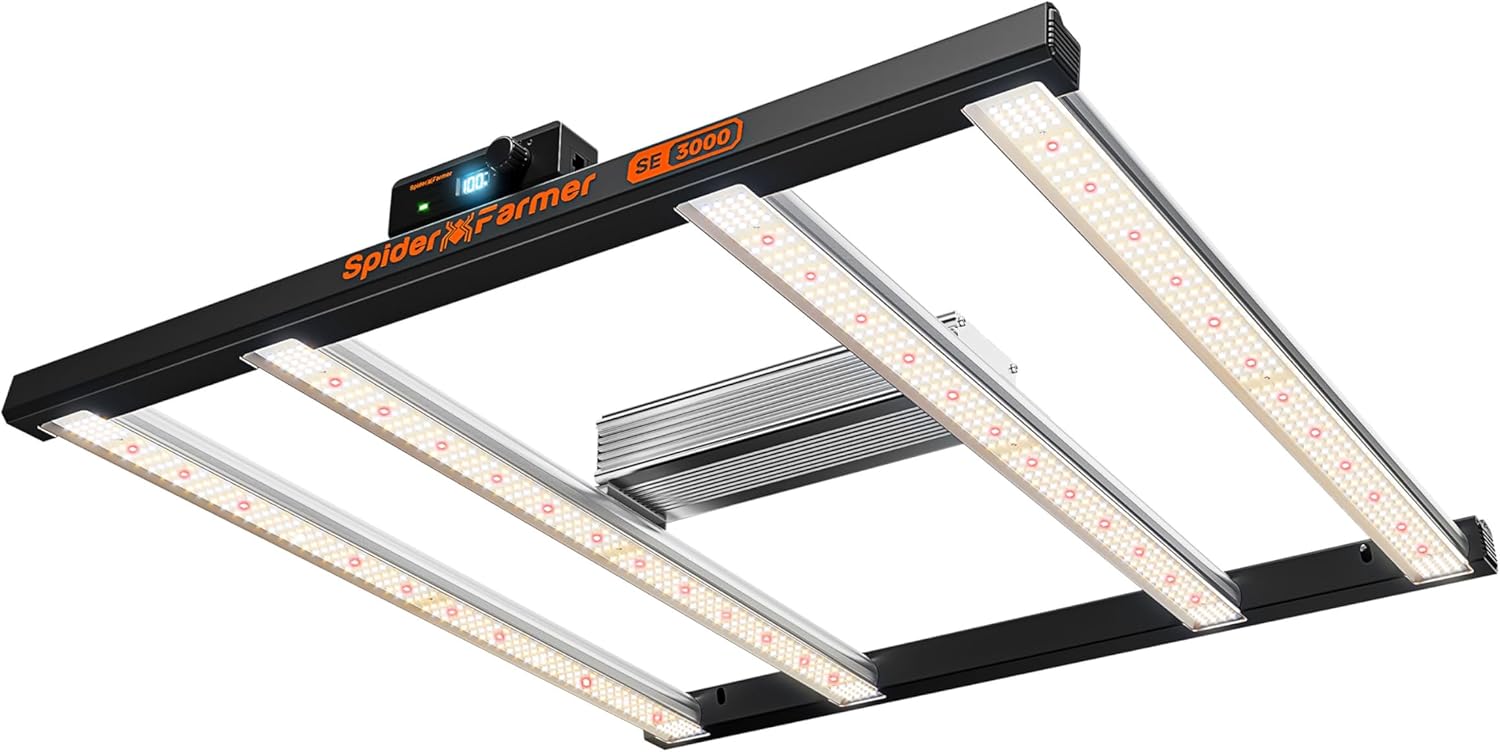
Spider Farmer SE3000 LED Grow Light, 300W, App Controlled
| Light Source Type | LED |
|---|---|
| Power Source | Corded Electric |
| Voltage | 120 volts_of_alternating_current |
| Light Source Wattage | 300 watts |
| Dimmable | dimmable |
The Spider Farmer SE3000 is a 300W full-spectrum LED bar-style grow light built to cover a roughly 3×3 foot grow area from seedling through flowering. It uses premium Bridgelux diodes and a plant-focused spectrum with strong deep red output to maximize photosynthesis while generating relatively low heat. App control and a digital dimming box let you set schedules, simulate sunrise and sunset, and fine-tune brightness for different stages, and the light supports daisy-chaining for multi-light setups. Aluminum construction helps dissipate heat and the design aims for even PPFD across the canopy, including edges. Practical benefits include lower energy draw compared with older HPS setups, precise light management via the app or manual dial, and a five-year repair coverage. Limitations are that the 300W draw may be more than necessary for very small micro-grows and you will still need to manage ventilation and hanging height to optimize uniformity; also advanced users seeking the absolute highest PPE numbers may prefer a larger commercial fixture.
Best for: Home growers who want a reliable, energy-efficient 3×3 light that handles the full growth cycle and prioritizes easy control and even canopy coverage.
Less Ideal for: Growers needing ultra-compact, low-wattage fixtures for tiny micro-grows or large commercial operators who need higher total output per fixture.
- Engineered full-spectrum with strong deep red output to support all growth stages
- App control plus digital dimming box allows schedules, sunrise/sunset simulation, and remote brightness adjustments
- Bar-style layout and premium Bridgelux diodes give even PPFD across a 3×3 ft canopy with reduced edge drop-off
- Aluminum construction improves heat dissipation for cooler operation compared with traditional HID lights
- Supports daisy-chaining for easier multi-light installations
- 300W power draw may be higher than needed for very small setups
- Requires external ventilation and proper hanging height to achieve optimal uniformity
Verdict: A user-friendly, energy-efficient 300W full-spectrum LED that reliably covers a 3×3 ft canopy with app-based scheduling and precise dimming.
Spider Farmer G3000 300W LED Grow Light (App Controlled)

| Power Source | Corded Electric |
|---|---|
| Voltage | 120 volts_of_alternating_current |
| Light Source Wattage | 300 watts |
| Light Source Type | LED |
| Number of Light Sources | 896 |
The Spider Farmer G3000 is a 300W full-spectrum LED grow light built to provide even, deep-canopy illumination for a 3×3 foot grow area. It uses a high-density array of 896 Bridgelux diodes arranged in extended light bars to reduce hotspots at the edges and deliver a stated 824 µmol/s output and about 2.75 µmol/J PPE. The unit is dimmable via an on-board digital display and can be controlled remotely with the Spider Farmer app for custom schedules, sunrise/sunset simulation, and remote brightness adjustments. You can daisy-chain multiple units and control up to 50 from one master, which simplifies scaling for larger tents or multiple rooms. The aluminum construction helps with heat dissipation and the fixture is ceiling-mountable out of the box. Limitations to note are the claimed PPE is midrange for modern LEDs and the G series targets value-oriented growers rather than commercial premium performance, so growers chasing the absolute highest efficiency or maximum commercial footprint per watt may prefer higher-end models. For hobbyists and small-scale growers who want reliable, app-driven control and uniform 3×3 coverage, the G3000 is a practical choice.
Best for: Gardeners who want a practical, easy-to-control 300W fixture for a single 3×3 grow tent and who prioritize uniform coverage and app-based scheduling over squeezing every bit of efficiency.
Less Ideal for: Large commercial operations or growers who need the absolute highest PPE and largest single-fixture coverage should consider higher-end models with greater efficiency and footprint.
- High-density 896 Bridgelux diodes for uniform canopy coverage
- Full-spectrum output suitable for all growth stages
- App control plus on-board dimming and digital display for easy scheduling
- Daisy-chainable control for scaling multiple fixtures
- Aluminum build that aids heat dissipation
- PPE (~2.75 umol/J) is solid but not class-leading for premium commercial LEDs
- Designed as an economy-line model so top-tier commercial performance is not the primary focus
Verdict: A practical, app-controlled 300W LED that delivers even 3×3 coverage and easy scaling for hobbyists and small-scale growers.
AC Infinity IONFRAME EVO4 300W Samsung EVO Bar LED Grow Light

| Light Source Type | Light Emitting Diode |
|---|---|
| Wattage | 300 watts |
| Number of Light Sources | 896 |
| Color Rendering Index | 90 |
| Light Source Special Features | Schedule controls, sunrise/sunset dimming, 10 brightness levels, WiFi app control compatibility, daisy-chaining, IP-65 |
The AC Infinity IONFRAME EVO4 is a performance-focused 300W bar-style grow light designed for small indoor spaces such as a 3×3 tent. It uses Samsung LM301H EVO diodes and 896 LEDs to deliver high efficacy (3.14 µmol/J) and strong PPFD for canopy penetration, while the algorithmic diode spacing reduces hotspots for more even coverage. Programmable features include 10 brightness levels, sunrise/sunset dimming, daily scheduling, and compatibility with AC Infinity's WiFi app and controllers for remote automation. The unit supports daisy-chaining and has a removable passive-cooled driver to help manage heat without noisy fans, plus an IP65 rating for humid environments. Practical benefits include precise light scheduling, deep canopy reach for flower stages, and easy installation with magnetic mounting options. Limitations to expect are the need to pair it with AC Infinity controller hardware to unlock advanced automation and that a 300W fixture may still require close height and intensity management for very small seedlings or very dense canopies.
Best for: Growers who prioritize light performance and controllable schedules for a 3×3 tent and want precise, commercial-grade LEDs and automation-ready features.
Less Ideal for: Casual hobbyists who want a plug-and-play, controller-free lamp or growers with only a few seedlings who need very low-intensity starter lighting.
- High-efficiency Samsung LM301H EVO diodes rated at 3.14 µmol/J for strong light output per watt
- Programmable controls with 10 brightness levels, schedule and sunrise/sunset dimming for automated cycles
- Algorithmic diode spacing and 896 LEDs provide even coverage and improved canopy penetration
- Passive-cooled removable driver and IP65 rating allow quieter operation and use in humid grow tents
- Daisy-chaining support simplifies expanding light arrays without extra drivers
- Advanced app-based automation requires AC Infinity controller hardware (sold separately)
- At 300W it still needs careful positioning in a densely planted or seedling-heavy 3×3 tent to avoid light stress
Verdict: If you want a high-efficiency, automation-ready fixture that delivers even, high-PPFD coverage for a 3×3 tent, the IONFRAME EVO4 is a top performance choice.
MARS HYDRO TSW2000 300W LED Grow Light

| Wattage | 300 watts |
|---|---|
| Light Source Type | LED |
| Dimmable | Yes |
| Color Temperature | 6000 Kelvin |
| Mounting Type | Inside Mount |
The Mars Hydro TSW2000 is a 300W full‑spectrum LED grow light intended for seedling through flowering in small indoor grows. It uses a dense central diode layout with 30 light sources and a 120° reflector design to spread light more evenly across a 3×3 to 4×4 foot area, while the aluminum fanless housing helps dissipate heat quietly. The light is dimmable via an external control so you can match intensity to growth stage, and it supports daisy‑chaining multiple fixtures for larger setups. Practical benefits include high PAR output for its wattage, broad spectrum that includes red and far‑red peaks for flowering, and compatibility with standard household voltages. Important limitations are that the product is optimized for small to medium footprints rather than large commercial rooms and the listed lumen figure is modest compared with PAR-focused metrics, so buyers should prioritize PAR/PPFD data for performance expectations. The fanless design reduces noise but requires attention to ambient ventilation in enclosed tents. For buyers who want an energy efficient, quiet 300W fixture with flexible control, the TSW2000 is a sensible choice.
Best for: Buyers who want a quiet, energy‑efficient 300W LED for a small to medium indoor grow and who rely on community feedback and established brand models when choosing gear.
Less Ideal for: Growers running large commercial rooms or those who require published PPFD maps and lab‑grade performance data for precise light planning.
- Dimmable external driver allows precise light intensity control for each growth stage
- Fanless aluminum design disperses heat quietly and increases light utilization
- Wide 120° reflector improves uniform coverage across small grow footprints
- Full spectrum including red and far‑red bands suitable from seedling to flowering
- Supports daisy chaining to expand a multi‑light setup
- Performance details emphasize lumens rather than PPFD numbers buyers often prefer
- Best suited to 3×3 to 4×4 foot areas and not optimized for large commercial rooms
Verdict: A quiet, energy‑efficient 300W full‑spectrum LED that delivers even coverage for small to medium indoor gardens and scales via daisy chaining.
Choosing the Right 300 Watt LED Grow Light: Key Factors to Consider
Spectrum and Plant Stage Support
Spectrum determines how photons are distributed across blue, red, and other wavelengths that plants use. A 300 watt LED should offer a spectrum suitable for both vegetative growth and flowering or provide switches or controls to tune the output. For mixed-stage grows, choose a fixture with broad full-spectrum output or a dimmable/red-boost mode so you can shift from a vegetative bias to a bloom-focused spectrum without moving fixtures.
Spectrum also affects plant morphology. More blue light keeps plants compact and sturdy, while more red and far-red encourage stretch and flowering. Understanding the spectrum helps you plan light schedules and distances to get the canopy architecture you want.
Real Power Draw and Energy Efficiency
Manufacturer wattage ratings do not always match real-world power draw. Check measured watts under normal operating conditions to estimate running costs and circuit load. Energy efficiency is best judged by PPF (photosynthetic photon flux) per watt. A higher PPF per watt means more usable light for each unit of electricity consumed, which matters for multi-month flower cycles and for growers watching their utility bills.
Consider the electrical capacity of your grow space. A compact setup might need fixtures that run cooler and draw slightly less than rated wattage so you can run other devices like fans and filters on the same circuit without tripping breakers.
Heat Output and Thermal Management
How a 300 watt LED manages heat affects canopy temperature and local ventilation needs. Fixtures that move heat away from the diodes efficiently keep the light output stable and lengthen diode lifespan. Passive cooling with large heatsinks is quieter but bulkier; active cooling with fans can be more compact but adds moving parts and occasional noise.
Heat also impacts humidity and transpiration. In small tents or confined cabinets, a fixture that runs hot can force you to increase ventilation, which changes airflow patterns and can stress plants if not balanced. Choose fixtures whose thermal profile fits your ventilation plan.
Light Distribution and Coverage Area
A 300 watt fixture can perform very differently depending on optics and lens design. Coverage area is about both intensity and uniformity. Look for fixtures that provide even photon distribution across the canopy at the hanging heights you intend to use. High center intensity with dark edges creates uneven growth and requires repositioning or more fixtures.
Consider the shape of your grow area. Narrow tents or long racks may prefer rectangular distribution patterns, while square tents benefit from wider, more even spreads. Some fixtures allow optional lenses or adjustable hang points to tune coverage for specific footprint shapes.
Build Quality and Installation Practicalities
Durable construction and easy installation reduce downtime and maintenance. Check whether the fixture has sturdy hanging points, a reliable power lead length, and accessible on-fixture controls or dimmers. Weatherproofing level matters if you plan to use the light in humid environments like greenhouses or enclosed tents with higher humidity.
Serviceability is also important. Fixtures with modular components or replaceable drivers allow longer service life. Consider how easy it is to clean dust from the heatsink and whether the fixture design prevents debris buildup that could trap heat.
Dimming, Controls, and Integration
Control options change how you manage intensity and spectrum across a crop cycle. Dimmable fixtures let you fine-tune PPFD as plants grow, delaying the need to move a fixture higher. Some lights include on-fixture dimmers, while others support external controllers or timers. Compatibility with standard dimmers or 0-10V controllers is useful for growers who rotate light schedules or run multiple fixtures together.
Networked control and programmable spectrums are convenient for multi-stage crops but add complexity. For straightforward grows, a simple, reliable dimmer may be the best choice.
How Hanging Height Changes Canopy Coverage
Hanging height is one of the simplest ways to change intensity and coverage. Lowering a 300 watt LED increases PPFD at the canopy center but reduces uniformity and risks light stress or heat buildup. Raising the fixture smooths the spread and reduces hot spots but lowers absolute intensity.
Start with the manufacturer suggested height as a baseline, then map PPFD across the canopy with a light meter if possible. For multi-plant trays, use slightly higher hang to maintain even growth. When transitioning from vegetative to flowering, reduce height gradually while watching for signs of light burn.
- Lower height raises intensity and center PPFD
- Higher height increases uniformity but lowers intensity
- Use a light meter to optimize for your canopy
Managing Heat in Small Tents and Cabinets
Heat management is more than fixture cooling. Think about airflow, intake and exhaust placement, and how the fixture affects ambient temperature. In very compact spaces, consider running lights during cooler hours or using supplemental ventilation timed with light cycles.
If you use active cooling on the fixture, plan for occasional fan maintenance. For passive-cooled fixtures, ensure dust does not build up on fins and reduce thermal performance.
- Coordinate fixture heat profile with tent ventilation
- Schedule ventilation to remove heat without stressing plants
- Clean heatsinks regularly to maintain cooling efficiency
Optimizing Spectrum for Bloom Vs Vegetative Phases
Balancing blue and red light is central to canopy architecture and flowering response. A balanced full spectrum supports a simple veg-to-flower transition. If you prefer stronger red during bloom, use a fixture or mode that increases red output while keeping some blue to maintain leaf quality.
Rather than dramatic spectrum shifts, incremental changes to intensity and a modest red boost often produce steadier results and minimize stretch. Pay attention to plant responses and adjust over several days rather than making abrupt moves.
- Use more blue early to control stretch
- Increase red gradually at bloom to support flower development
- Watch leaf color and internode spacing for signs of needed adjustment
Fixture Placement and Multiple-Light Layouts
When a single 300 watt light cannot cover your whole space evenly, plan for multiple fixtures. Stagger fixtures to reduce overlapping hotspots and use equal distances to maintain uniformity. Consider the effect of A-B switching where alternating lights on different schedules can reduce heat spikes.
Place fixtures so that valuable canopy real estate receives the most consistent PPFD. For rooms with reflective walls, minimal repositioning can significantly close coverage gaps.
- Stagger multiple fixtures to avoid hot center zones
- Use consistent hang heights across fixtures for uniform PPFD
- Reflective interiors help smooth coverage without extra lamps
Safety and Electrical Considerations
Check the rated input current and ensure your circuit can handle the combined load of lights, fans, and controllers. Use grounded outlets and quality power cords. Avoid daisy-chaining too many fixtures on a single extension lead.
Keep fixtures away from standing water and maintain clearance from combustible materials. If you run an external ballast or controller, mount it away from high-humidity areas to extend service life.
- Verify circuit amperage before adding fixtures
- Use proper mounting hardware and secure hanging points
- Protect power connections from moisture and dust
How We Chose the Best 300 Watt LED Grow Light
We focused on practical dimensions that affect performance in real indoor gardens. Key evaluation criteria included measured light spectrum and PAR output across the canopy to assess usable photons for both vegetative growth and flowering. Energy efficiency and actual power draw under operating conditions were used to judge running cost and heat generation. Thermal design and cooling determined how long the fixture can run without placing extra load on ventilation systems. Physical coverage patterns and hanging height flexibility were checked to ensure even light distribution for common tent and shelf sizes. We also examined build durability and ease of installation so fixtures are straightforward to set up and maintain in a busy grow space. We excluded fixtures that were underspecified, lacked clear electrical ratings, or did not provide spectrum information because those cannot be reasonably compared in this category. These filters produced the shortlist of dependable 300 watt LED fixtures suitable for hobby and small-scale indoor cultivation.
FAQ
What canopy size will a 300 watt LED cover effectively?
Coverage depends on optics and hanging height, but a typical 300 watt LED with good optics covers a roughly 2×2 to 3×3 foot canopy for flowering intensity. Start with manufacturer guidance and measure PAR to confirm useful footprint because coverage varies by lens and fixture design.
Can I run a 300 watt LED on a standard household circuit with fans?
Often yes, but it depends on total load. A single 300 watt LED plus fans and a controller is usually within a standard 15 amp circuit, but you should total the actual measured power draw of all devices and avoid overloading the circuit.
How high should I hang a 300 watt LED during bloom?
During bloom, many growers start with a moderate height that provides target PPFD without scorching top leaves. That often means lowering the fixture compared with veg, but exact heights vary with optics. Use a light meter to set PPFD rather than fixed distances.
Is dimming useful on a 300 watt LED?
Yes, dimming extends fixture flexibility and helps you tune intensity as plants develop. Dimming also reduces heat and power draw when full intensity is unnecessary. Check control compatibility so you can integrate the fixture with timers or external controllers.
How do I reduce hotspot issues with a single fixture?
Raise the fixture to increase uniformity or add reflective material to the grow area. Mapping PPFD across the canopy identifies hotspots so you can reposition plants or adjust hang height for a more even spread.
Final Verdict
When choosing a 300 watt LED grow light, prioritize measured light output, spectrum flexibility, and thermal behavior for your exact grow space. Balance energy efficiency against coverage needs so you get enough usable photons without excessive heat or electricity draw. Dimming and simple controls add practical flexibility across veg and bloom stages. Focus on how a fixture will integrate with your tent size, ventilation, and electrical capacity. With those tradeoffs considered, you can select a light that delivers predictable results and fits your routine.
