

Note: This article contains affiliate links. If you click on these links and make a purchase, I may earn a small commission at no extra cost to you. This helps support my research and content. Read my full affiliate disclosure here.
Garlic responds strongly to the physical and nutrient characteristics of the soil it grows in. Choosing a soil amendment for garlic matters because the wrong amendment can lock up nutrients, hold too much moisture, or fail to support proper bulb formation. This guide covers six carefully shortlisted amendments suited to garlic beds and explains how each supports drainage, nutrient availability, and long-term soil health. We evaluated options on the properties gardeners actually notice in the field, such as how an amendment changes texture and how quickly plants can access nutrients. Read on to see which types of amendments match your soil and growing goals.
Top Picks at a Glance
| Best Overall The best all-around choice for most situations | Farmer's Secret Soil Revitalizer Organic Liquid Compost (32 oz) |  |
| Best Quality Built to a higher standard if you want something more solid | Organic Mechanics Biochar Blend Soil Amendment, 1 cu ft |  |
| Best Value The sweet spot between price and what you get | Brut Organic Worm Castings, 5 lb |  |
| Best Budget The cheapest option that still gets the job done reliably | Farmer's Secret Soil Revitalizer – Organic Liquid Compost Soil Amendment (8 oz) |  |
| Highest Rated A top-rated pick with lots of positive feedback | Jobe's Organics Granular Bone Meal Fertilizer, 4 lb |  |
| Most Popular A crowd favorite that many people choose with confidence | Back to the Roots Organic Expanding Coco Coir Potting Soil Brick (10 lb) |  |
Farmer's Secret Soil Revitalizer Organic Liquid Compost (32 oz)

| Item Form | Liquid |
|---|---|
| Specific Uses For Product | Organic |
| Application Method | spray/pour |
| Coverage | 32,000 square feet |
| Mixing Ratio | 1:128 |
Farmer's Secret Soil Revitalizer is a concentrated liquid amendment that uses activated humics to improve soil structure, stimulate microbial activity, and make nutrients more available to plants. It is mixed at 1 ounce per gallon of water and can be applied with a watering can, sprayer, irrigation system, or as a foliar feed for houseplants. For clay soils the product's humic-rich formula helps loosen compacted particles over time and supports biological activity that improves drainage and root penetration. It is OMRI listed and made from organic sources, so it is suitable for edible gardens and safe around children and pets when used as directed. The effects are gradual rather than immediate because it works by rebuilding soil biology rather than supplying fast-release NPK, so gardeners should expect cumulative improvement after several applications every 2 to 4 weeks. Coverage claims are high for the bottle size, so plan dosing carefully if treating a large lawn or landscape.
Best for: Gardeners who want a low-risk, soil-first approach to improve compacted or nutrient-poor soils and are willing to use a repeat feeding schedule to build long-term soil health.
Less Ideal for: People seeking rapid green-up or instant high-amount nutrient feeds for heavy-feeding annuals or lawns should consider a supplemental synthetic fertilizer instead.
- OMRI listed organic formula safe for edible gardens when diluted as directed
- Activated humics increase microbial activity and long-term soil structure improvement
- Versatile application options: watering can, sprayer, hose-end or irrigation
- Concentrated mixing ratio (1:128) stretches one bottle over many applications
- Not a fast-acting synthetic fertilizer so visible results take multiple applications
- Coverage per bottle may be optimistic for large yards, requiring multiple bottles for whole-lawn use
Verdict: Use this organic, humic-rich liquid if you want to rebuild clay soil biology and structure over time rather than chase quick fertilizer results.
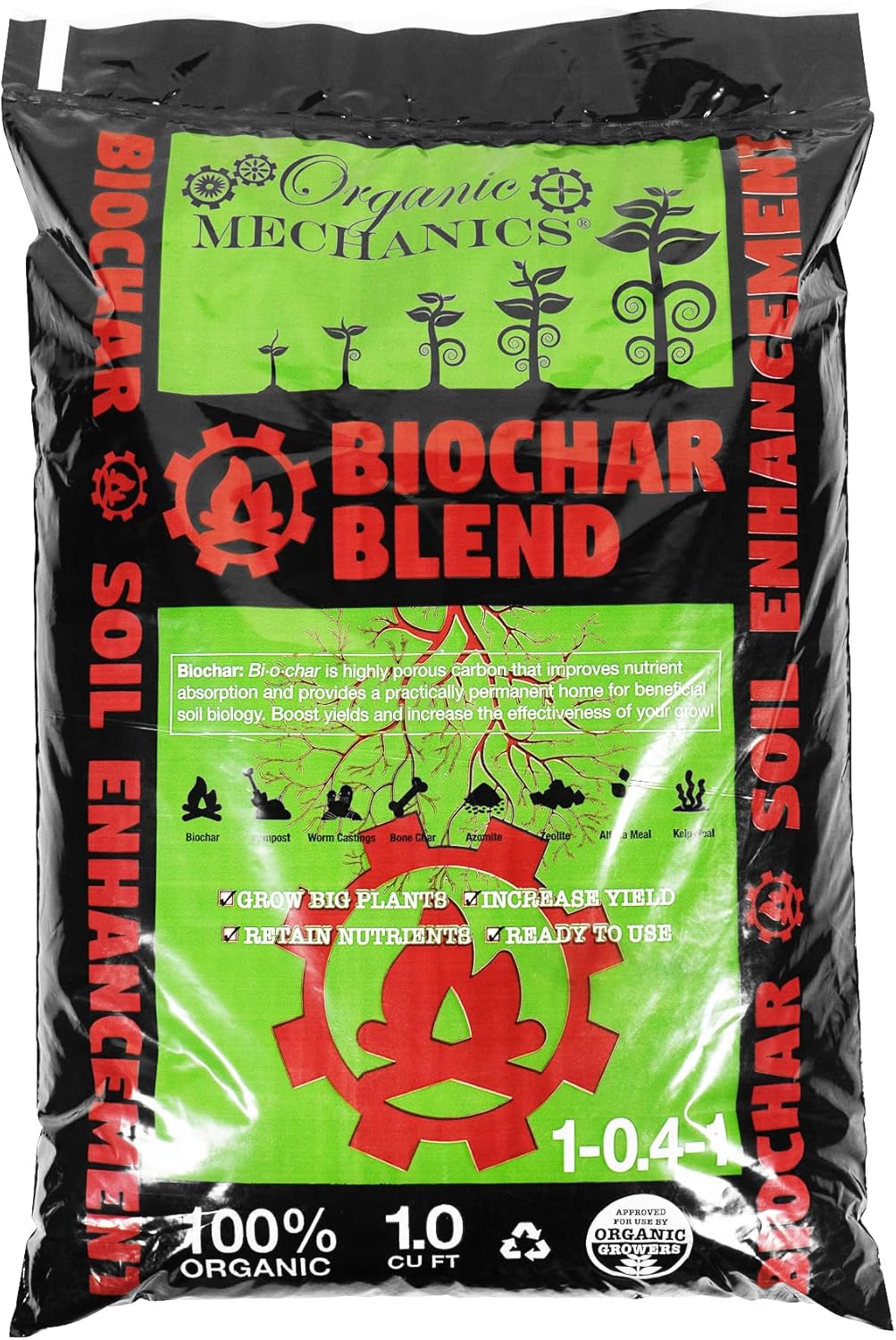
Organic Mechanics Biochar Blend Soil Amendment, 1 cu ft
| Unit Count | 1 Count |
|---|---|
| Item Type Name | Biochar Blend Soil Enhancement |
| Manufacturer | ORGANIC MECHANICS |
| Volume | 1 cubic feet |
| Item Weight | 20 pounds |
Organic Mechanics Biochar Blend is a one-bag soil amendment designed to boost plant growth and long-term soil health by adding biochar, compost, worm castings, bone char and mineral meals. You typically work it into raised beds, containers, or garden rows to increase water retention, microbial activity and available calcium and phosphorus. The biochar provides stable carbon that helps hold nutrients and moisture in sandy soils, while compost and worm castings seed beneficial microbes. Bone char and azomite supply phosphorus, calcium and trace minerals that can be scarce in washed-out sandy sites. Because it is a concentrated amendment rather than a complete bulk topsoil, gardeners will still want to mix it into existing soil rather than using it as a sole planting medium and may add a targeted fertilizer during active growth. The 1 cubic foot bag is convenient for spot treatments and bed top-dressing, but heavier applications over large areas require many bags or a bulk source. For performance-focused gardeners working to improve poor sandy soil, this blend delivers measured, science-backed ingredients that support bigger roots and higher yields.
Best for: Gardeners focused on improving soil performance in beds or containers who want a concentrated, biologically active amendment to build fertility and moisture retention over time.
Less Ideal for: People needing bulk topsoil or one-step potting mixes for filling large areas or for immediate transplanting without soil mixing.
- Contains biochar to increase nutrient and moisture retention in sandy soils
- Includes compost and worm castings to promote beneficial soil microbes
- Mineral-rich ingredients like bone char and azomite supply calcium, phosphorus and trace elements
- Ready-to-use 1 cu ft bag suitable for spot improvements, containers and raised beds
- Not formulated as a complete potting mix or standalone planting medium
- 1 cu ft bag size makes large-scale applications labor intensive and potentially costly
Verdict: A targeted biochar-plus-compost amendment that boosts nutrient retention and soil biology to improve yields in sandy beds and containers.
Brut Organic Worm Castings, 5 lb

| Item Form | Granules |
|---|---|
| Specific Uses For Product | Gardening,Organic |
| Target Species | All plants |
| Mixing Ratio | 1:5 |
Brut Organic Worm Castings function as a concentrated, natural soil amendment you mix into potting mixes or top-dress garden beds and raised beds. Typical use is mixing at the recommended 1:5 ratio for new indoor plants, sprinkling a cup around established houseplants, or working into outdoor planting holes and beds according to the brand directions. The product is OMRI/CDFA listed and produced in controlled conditions, which supports consistent nutrient content and beneficial microbial life that help roots establish, improve soil structure, and increase moisture retention without burning plants. Practical benefits for raised garden beds include improved aeration, slow-release nutrients, and a boost in microbial activity that supports long-term fertility. Limitations are that it is not a complete NPK fertilizer for immediate heavy feeding needs and larger beds require significant quantities to hit the suggested per-square-foot rates, so frequent applications or bulk purchases may be needed for big projects.
Best for: Gardeners who prioritize dependable, organic soil improvement for raised beds and container gardens and prefer predictable, low-risk amendments that support long-term soil health.
Less Ideal for: Those needing immediate, high-NPK feeding for heavy-feeding crops or gardeners who want to amend very large beds without buying supplemental bulk material.
- Certified organic and produced indoors for consistent purity
- Rich in beneficial microbes that improve soil structure and plant vigor
- Easy-to-use granular form suitable for mixing or top-dressing
- Not a standalone high-NPK fertilizer for rapid nutrient correction
- Five-pound bag may be small for large raised beds and repeated seasonal use
Verdict: Use this OMRI/CDFA-listed worm castings product to reliably build long-term fertility and microbial health in raised beds and containers.
Farmer's Secret Soil Revitalizer – Organic Liquid Compost Soil Amendment (8 oz)

| Form | Liquid concentrate |
|---|---|
| Application ratio | 1 oz per gallon |
| Certification | OMRI listed |
| Recommended timing | Apply monthly during growing season, especially fall and spring |
Farmer's Secret Soil Revitalizer is a concentrated organic liquid amendment meant to feed the soil by stimulating microbial activity rather than supplying direct synthetic nutrients to plants. You dilute one ounce per gallon and either pour or spray it onto the soil; the manufacturer recommends monthly use through the growing season and especially in spring and fall. Key features include OMRI-listed activated humics derived from organic sources and a concentrate format that stretches an 8 oz bottle across many applications. In practice it can help improve soil structure and support nutrient cycling when used alongside regular composting or fertilizing. Limitations are that it is not a complete fertilizer so you still need to supply macronutrients when plants show deficiencies, and results rely on consistent, repeated applications rather than a single quick fix. For gardeners watching their budget, the concentrated dosing gives good per-application value, but expect to pair it with other amendments for full fertility management.
Best for: Practical home gardeners who prioritize improving soil biology on a tight budget and want a concentrated, repeatable amendment to supplement composting and routine care.
Less Ideal for: Gardeners seeking an all-in-one fertilizer or immediate nutrient corrections for heavy-feeding crops should choose a product formulated for macronutrient delivery instead.
- OMRI-listed organic humics support soil microbial life.
- Concentrated formula dilutes 1 oz per gallon for many applications.
- Suitable for seasonal use in spring and fall to refresh soil biology.
- Not a complete fertilizer and will not replace needed N-P-K inputs.
- Small bottle size means repeated purchases for larger gardens.
Verdict: A concentrated OMRI-listed liquid humic amendment that stretches small bottles into many budget-friendly soil biology boost applications.
Jobe's Organics Granular Bone Meal Fertilizer, 4 lb

| Item Form | Granules |
|---|---|
| Application Method | Soil |
| Unit Count | 64 Ounce |
| Mixing Ratio | 2-14-0 |
Jobe's Organics Granular Bone Meal is a prilled, dust-reduced source of phosphorus and calcium aimed at strengthening root systems and improving blooms and tuber development. It is typically worked into the soil at planting for bulbs or applied around established plants every eight weeks during the growing season to support root- and flower-focused crops. The 2-14-0 NPK profile makes it especially useful where phosphorus is needed, and the granulated form is compatible with spreaders or hand application with minimal mess. Being OMRI-listed and made from 100 percent bone meal means it fits organic garden plans and is safe to use around children and pets when handled properly. Important limitations are that it supplies little to no nitrogen, so it should be paired with a balanced or nitrogen-rich amendment for leafy growth, and local regulations may restrict phosphorus use on lawns or near waterways. Also, results depend on existing soil phosphorus levels so a soil test is recommended before use.
Best for: Gardeners growing bulbs, tubers, flowering vegetables, or onions who want an organic phosphorus boost and prefer a low-dust granular product backed by positive user feedback.
Less Ideal for: Growers who need a complete all-purpose fertilizer for rapid leafy growth or those managing phosphorus-restricted turf or sites near sensitive waterways.
- High phosphorus and calcium content supports strong root development and better blooms
- Granulated prilled form reduces dust and works well with spreaders or hand application
- OMRI-listed and made from 100 percent organic bone meal suitable for organic gardens
- Directions recommend regular application every eight weeks for season-long support
- Contains little to no nitrogen so not sufficient alone for leafy growth
- Phosphorus fertilizers can be restricted in some areas because of runoff concerns
Verdict: A reliable organic bone meal to boost root development and bulb or onion bloom potential when soil phosphorus is needed.
Back to the Roots Organic Expanding Coco Coir Potting Soil Brick (10 lb)

| Item Highlight | 10 lb compressed coco coir brick; peat-free; OMRI Listed |
|---|---|
| Item Type Name | Coconut Coir |
| Volume | 2 cubic feet |
| Ingredients | Coconut Coir |
| Style Name | Expanding Potting Soil |
This compressed coco coir brick provides a lightweight, peat-free potting medium that expands when you add water to create loose, airy substrate for containers and seed flats. It is typically used by hydrating the 10 lb block to about 2 cubic feet of coir and then using it alone for potted plants, mixing it into garden soil to improve drainage and aeration, or blending with compost for starting seeds. Notable features include OMRI listing for organic use, a balanced pH suited to a wide range of plants, and compact storage before expansion which saves space. Practical benefits are improved root aeration and water retention compared with heavy garden loam, easier handling than bulky bags, and versatility across vegetables, herbs, and ornamentals. Important limitations are that coco coir is a soilless substrate and does not supply significant nutrients on its own so you will need to add fertilizer or compost for long-term potted herbs like rosemary, and the product requires time and a water source to expand before use.
Best for: Buyers who prioritize low-risk, easy-to-handle, organic potting media and want a versatile base for container herbs and seed starting without dealing with heavy bags.
Less Ideal for: Gardeners who want a ready-to-plant, nutrient-rich potting mix out of the box or those who prefer soil with built-in slow-release fertilizer.
- Peat-free OMRI listed organic coco coir suitable for organic growing
- Expands from a compact brick to about 2 cubic feet for easy storage and transport
- pH balanced and airy texture that improves drainage and root aeration
- Versatile use: can be used alone, for seed starting, or mixed into existing soil
- Provides little inherent fertility so supplemental feeding or compost is needed for nutrient-hungry plants
Verdict: A compact, peat-free coco coir brick that expands into an airy, pH-balanced base ideal for low-risk organic container gardening and seed starting when paired with fertilizer or compost.
Choosing the Right Soil Amendment for Garlic: Key Factors to Consider
Soil Texture and Drainage
Garlic prefers well-drained, loose soil so roots can expand and bulbs can dry before harvest. An amendment that improves texture will break up heavy clay, increase pore space, and allow excess water to move away from bulb crowns. In sandy soils, certain amendments help retain just enough moisture and organic matter to prevent bulbs from drying out between waterings.
Consider how quickly an amendment works: coarse materials change drainage immediately, while fine organic matter may take several seasons to restructure soil. Also take into account how the amendment affects compaction under foot traffic and during winter freeze-thaw cycles.
Nutrient Balance and Release Rate
Garlic needs a steady supply of nitrogen early in the season and balanced nutrients later to form large, healthy bulbs. Some amendments release nutrients quickly and can stimulate too much leafy growth at the expense of bulbs, while others release slowly and support steady development.
Match the amendment's nutrient profile and release pattern to your feeding plan. If your soil test shows specific deficiencies, choose an amendment that supplies the lacking elements without creating imbalances that invite pests or nutrient lockup.
Impact on Soil Biology
Healthy soil biology improves nutrient cycling, disease suppression, and soil structure-each important for garlic. Amendments that encourage beneficial microbes and earthworms help make nutrients more available and can reduce the severity of soil-borne diseases. Conversely, some high-salt or chemically treated materials can harm microbial life and leave garlic more vulnerable.
Think about whether you want to actively inoculate biology with compost or rely on materials that indirectly foster microbial growth, such as carbon-rich organics that feed resident populations.
Salt Content and Chemical Residues
Garlic is sensitive to high soluble salt levels, especially during bulb formation. An amendment with elevated salt content can cause leaf burn, stunted growth, or uneven bulb development. Similarly, residues from certain industrial byproducts or treated biosolids may introduce heavy metals or persistent chemicals that are undesirable in edible crops.
Always check for salt and contaminant risks when choosing amendments for food gardens. If you use reclaimed or unknown-source materials, perform a small test patch first and consider soil testing after application.
Persistence and Timing of Effect
Different amendments last for different spans. Some provide a single-season nutrient boost, while others improve structure and fertility for several years. Persistence influences when you apply something and whether it will affect future rotations in your planting area.
Plan amendments so the peak of their benefit aligns with garlic's critical growth stages. For long-lasting structural improvements, apply well before planting and allow time for integration. Quick-release options are best applied in fall or early spring when garlic can use an immediate nutrient uptick.
Practicality and Safety of Application
Ease of handling, whether you can mix the amendment into raised beds by hand, and any safety precautions matter for backyard gardeners. Bulky materials require more labor or equipment, while concentrated amendments may need careful measurement to avoid over-application.
Also consider storage, odor, and runoff risk. Choose materials that match the scale of your beds and the tools you have available, and follow basic safety practices such as wearing gloves when handling raw organics.
When to Amend Garlic Beds
Timing changes how an amendment affects garlic. For most gardens, fall incorporation gives coarse materials time to settle and allows slow-release nutrients to be present when shoots begin in spring. Light, fast-acting amendments can be applied in early spring to provide a quick nutrient lift before the period of rapid leaf development.
If you are planting into new raised beds or reclaiming compacted soil, begin amendments several weeks to months ahead of planting to let physical changes take effect. For minor topdressings, do the work shortly after planting and avoid burying shallow cloves too deeply.
- Fall applications for long-term structural improvement
- Early spring for quick nutrient boosts
- Reclaimed or compacted sites need earlier, heavier incorporation
How to Incorporate Amendments Into Garlic Beds
Proper incorporation ensures an amendment benefits the root zone without creating pockets of concentrated nutrients. For beds, spread materials evenly and work them into the top 6 to 8 inches where garlic roots develop. Coarse particles like gravel or coarse sand should be mixed thoroughly with existing soil to avoid layering that can impede roots.
When using organic amendments, mix and redistribute to break up clumps and encourage contact with mineral soil. Avoid piling high spots that settle unevenly and can expose cloves or create shallow planting zones.
- Mix evenly into the top 6 to 8 inches
- Break up clumps and avoid layered pockets
- Level beds after incorporation to maintain consistent planting depth
Balancing Amendments with Fertilizer Plans
Amendments are not always replacements for targeted fertilizer. If an amendment supplies low or slow nitrogen, plan supplemental feeding early in the season. Conversely, if an amendment provides a significant nitrogen pulse, reduce or delay additional nitrogen to prevent excessive foliage and reduced bulb set.
Use soil test results to coordinate amendment choice with any fertilizer program. This reduces the risk of over-application and helps you time feeding to garlic's needs for leaf development and subsequent bulb fill.
- Coordinate amendment nutrient profiles with planned fertilizer inputs
- Use soil tests to avoid duplicating nutrients
- Adjust timing to match garlic growth stages
Storing and Handling Amendments Safely
Some amendments arrive wet, odorous, or in heavy bags. Store organic materials in a dry, ventilated area off the ground to prevent nutrient loss and unwanted pests. Keep inorganic amendments covered to avoid moisture uptake and clumping.
Follow label guidance or supplier instructions for any material that requires curing, screening, or pre-mixing. Use gloves and dust protection for dusty powders and wash hands after handling materials that could contain microbes or contaminants.
- Dry, ventilated storage for organics
- Cover inorganic powders to prevent moisture pickup
- Use personal protective equipment for dusty or untreated materials
How We Chose the Best Soil Amendment for Garlic
We focused on amendments gardeners commonly use to prepare garlic beds and narrowed choices by attributes that change growing outcomes in practical ways. Key evaluation criteria included how an amendment alters soil texture and drainage, its nutrient contribution and release rate, the impact on soil biology and microbial life, ease and safety of application in small-scale beds, and persistence or longevity in a garlic crop rotation. We also considered sourcing and typical quality variation among supplied materials so recommendations are useful across different growing zones. We excluded products meant primarily as fertigations, instant chemical fertilizers, or treatments designed for potted houseplants because those behave differently in open garlic beds. Materials that carry a high risk of contaminant buildup or require complex processing before use were filtered out. The result is a set of amendments that demonstrably change the root environment in ways garlic growers will notice in bulb size, disease resistance, and harvest uniformity.
FAQ
Can I use compost as the sole amendment for garlic?
Often compost is an excellent baseline amendment because it improves biology and adds a broad mix of nutrients. However, depending on your soil test, compost alone may not correct drainage or specific mineral deficiencies, so you may still need coarse materials or targeted mineral amendments.
Will adding sand improve a heavy soil for garlic?
Adding coarse sand can improve drainage if mixed thoroughly and used in sufficient volume. Small amounts of fine sand or uneven mixing can create a concrete-like layer, so ensure you use coarse grit and blend it well with existing soil.
Is there a risk of overfeeding garlic with rich amendments?
Yes. Amendments high in readily available nitrogen can encourage leafy growth at the expense of bulb formation. Match amendment nutrient release to garlic's timeline and rely on soil tests to avoid excessive nitrogen.
How far in advance should I apply slow-release amendments?
Slow-release structural amendments are best applied in the fall or several weeks before planting to allow integration into the root zone. This timing reduces the chance of fresh materials interfering with planting depth or seed clove health.
Can I use manure-based products for garlic beds?
Manure can be beneficial if well composted to reduce pathogens and salt. Fresh or improperly composted manure can burn young roots or introduce weed seeds, so use only aged, stabilized manure and consider testing for salt levels if your source is uncertain.
Final Verdict
Select amendments based on how you need to change your soil: improve drainage, add steady nutrients, or boost biological activity. Prioritize amendments that match your existing soil texture and the nutrient profile shown by a soil test. Balance immediate needs against longer-term structure so your choice supports both this garlic crop and future rotations. Ultimately, the right amendment is the one that fits your garden's conditions and your management style. Focus on drainage and nutrient timing for the biggest impact on bulb size, and choose materials you can apply and manage safely and consistently.
