

Note: This article contains affiliate links. If you click on these links and make a purchase, I may earn a small commission at no extra cost to you. This helps support my research and content. Read my full affiliate disclosure here.
If you want clearer pond water without a large upfront cost, choosing the right budget pond filter matters. The wrong unit can underperform in circulation, clog fast, or be hard to maintain, negating any savings. This guide looks at seven shortlisted Budget Pond Filters that suit small to medium backyard ponds and lower-cost installations. We evaluate each option on measurable, garden-relevant criteria like flow capacity, filtration efficiency, ease of maintenance, and durability. Read on to see which features match your pond setup and operating habits before you pick a filter.
Top Picks at a Glance
| Best Overall The best all-around choice for most situations | POPOSOAP 660 GPH Pond Pump and Filter Kit with Fountain Attachments |  |
| Best Quality Built to a higher standard if you want something more solid | VIVOHOME 2110GPH Auto‑Cleaning Pressurized Bio Pond Filter with 13W Light |  |
| Best Value The sweet spot between price and what you get | Biling All‑in‑One Pond Filter and Fountain Pump Kit, 660 GPH |  |
| Best Budget The cheapest option that still gets the job done reliably | Fineday Pond Filter Basket (General Use) |  |
| Highest Rated A top-rated pick with lots of positive feedback | Augicy PF-3000 850GPH Submersible Pond Pump with 4-Layer Filter and 3 Fountain Nozzles |  |
| Most Popular A crowd favorite that many people choose with confidence | VIVOHOME VH556 530 GPH All-in-One Submersible Pond Filter Pump with Fountain |  |
| Best Seller A high-volume bestseller chosen again and again | Hecaty Pond Pump Filter Bag with Internal Frame |  |
POPOSOAP 660 GPH Pond Pump and Filter Kit with Fountain Attachments

| Power Source | Corded Electric |
|---|---|
| Flow Rate | 2500 liters per hour |
| Maximum Lifting Height | 8.2 feet |
| Voltage | 110 volts |
| Horsepower | 40 watts |
This POPOSOAP kit combines a 660 GPH corded pump with an integrated filter box and a small fountain kit to keep pond water circulating and clearer with minimal setup. It is typically used in backyard koi ponds, water gardens, or decorative courtyard waterfalls where a single unit that handles mechanical and biological filtration plus a fountain display is preferred. The kit includes two filter pads, filter balls, bio-ceramic rings and multiple nozzle heads with a diverter so you can run a fountain, a secondary outlet, or both while adjusting flow. Practical benefits include straightforward installation and easy maintenance thanks to the clip-access lid and replaceable media, plus the pump’s adjustable flow for matching different water features. Important limitations are that the unit is a compact, plastic-bodied system intended for ponds up to the stated capacity so larger or heavily stocked koi ponds may need a dedicated external filter and higher-capacity pump for heavy waste loads. The included components cover basic filtration and aeration but advanced multi-stage filtration or UV sterilization are not part of this single-unit kit.
Best for: Buyers who want a compact, easy-to-install solution that combines filtration, circulation, and a decorative fountain for small to medium backyard ponds and who prioritize convenience and low-maintenance operation.
Less Ideal for: Owners of large, heavily stocked koi ponds or hobbyists seeking advanced multi-stage filtration and professional-grade, long-term durability should consider separate high-capacity pumps and external filters.
- Integrated pump and filter simplifies installation and reduces plumbing work
- 660 GPH pump provides strong circulation suitable for small to mid-size ponds (manufacturer-rated up to 1,180 gallons)
- Includes multiple filter media (pads, balls, bio-ceramic rings) for mechanical and biological filtration
- Fountain kit with three nozzles and diverter enables different water displays and adjustable flow
- Easy-access lid and simple clips make routine cleaning and media replacement straightforward
- Plastic construction may be less durable than heavier-duty external filters over many years
- Not a substitute for large-capacity, multi-stage filtration in heavily stocked or very large koi ponds
Verdict: A convenient, all-in-one pump and filter kit that delivers strong circulation and basic mechanical and biological filtration plus fountain options for small to mid-size koi ponds.
VIVOHOME 2110GPH Auto‑Cleaning Pressurized Bio Pond Filter with 13W Light

| Max flow rate | 2110 GPH |
|---|---|
| Suitable pond volume | Up to 2113 Gallons (ornamental) / 1057 Gallons (koi) |
| Lamp power | 13W |
| Timer settings | 0 / 12 / 24 hours |
The VIVOHOME pressurized bio pond filter is built for owners who want strong, low‑effort filtration for decorative and koi ponds. It connects to an external pump (pump not included) and handles up to roughly 2,113 gallons with a maximum flow of 2,110 GPH while offering interchangeable hose adapters for common inlet/outlet sizes. The unit uses coarse and fine sponge pads plus a 13W lamp with a 0/12/24‑hour timer to improve clarity and reduce maintenance. When debris builds up a float triggers CLEAN mode and the internal motor spins the sponges while flushing out waste, then signals completion with a beep. The ABS housing and IP44 rating mean it tolerates outdoor conditions, and the spare bulb and modular lid make servicing straightforward. Limitations are that it is freshwater only and relies on you providing a compatible external pump sized to the pond and head height, so performance depends on pairing it with the right pump and correct hose sizing.
Best for: Buyers who prioritize reliable, hands‑off filtration performance and want a pressurized system that minimizes weekly maintenance for medium to large backyard freshwater ponds.
Less Ideal for: People who need an all‑in‑one kit with a pump included or those managing saltwater ponds should look elsewhere.
- Automatic cleaning cycle that spins and flushes filter sponges to reduce manual scrubbing
- Includes coarse and fine sponge pads plus a 13W lamp with timer to improve water clarity
- Multiple hose adapters for common inlet/outlet sizes make it compatible with many pump setups
- Durable ABS housing with IP44 rating and detachable lid for easier outdoor use and maintenance
- Requires an external pump sized correctly for your pond and head height since no pump is included
- Not suitable for saltwater ponds
Verdict: Choose this filter if you want a powerful, low‑maintenance pressurized system that keeps medium to large freshwater ponds clear with automated cleaning and timed UV‑style lamp control.
Biling All‑in‑One Pond Filter and Fountain Pump Kit, 660 GPH
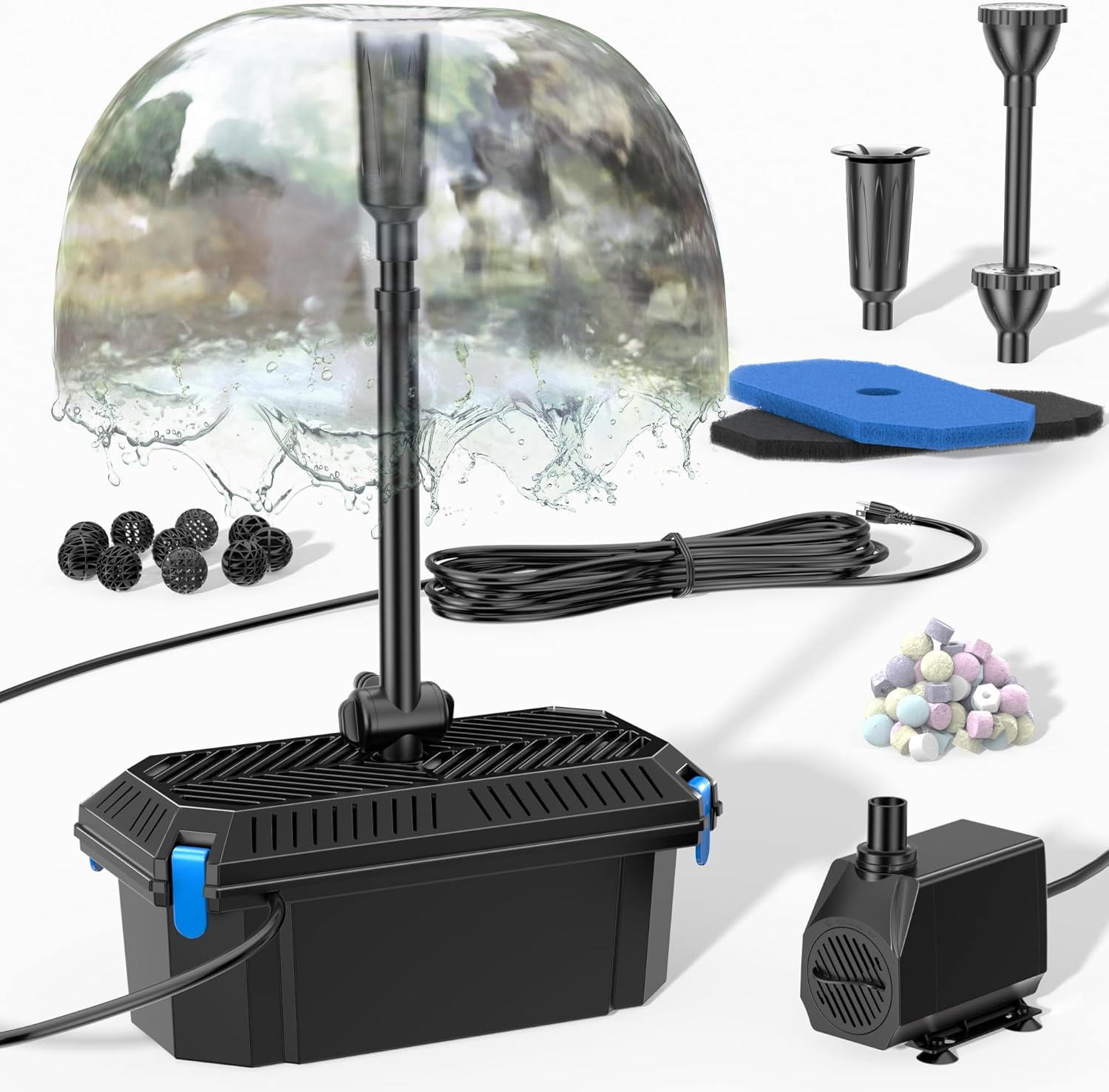
| Flow rate | 660 GPH |
|---|---|
| Power | 40W |
| Recommended pond size | up to 1500 gallons |
| Included accessories | 3 fountain heads, 2 filter pads, 20 bio balls |
This Biling kit pairs a 660 GPH, 40W submersible pump with an integrated multi-layer filter box so you get circulation, filtration, and a fountain in one package. It is typically installed submerged in small to medium garden ponds where the pump moves water through sponge pads and bio balls that trap debris and support biological cleaning while the included fountain heads add visual aeration. The unit is fish-safe by design since the filter box shields the impeller and the media avoid chemical treatment, which helps maintain healthy conditions for koi, goldfish, and plants. For a budget-conscious setup it reduces the need for separate pump and external filter components and simplifies maintenance; the manufacturer claims filter life between cleanings is extended compared with bare pumps. Limitations are its single power/pump size and reliance on the supplied filter media, so very large ponds, heavy debris loads, or users wanting modular external filtration may find the performance capped without upgrading to a larger or additional system.
Best for: Gardeners who want an affordable, space-saving way to add basic filtration and a fountain to a small or medium pond and prefer a simple all-in-one solution with minimal setup.
Less Ideal for: Owners of large ponds, heavy leaf/debris loads, or those who require a highly serviceable, modular filtration system should consider larger standalone pumps and external filters instead.
- Integrated pump and multi-layer filter box combines circulation and filtration in one compact unit
- 660 GPH, 40W pump sized for ponds up to 1500 gallons for steady turnover and fountain display
- Fish-safe design with sponge pads and bio balls that support mechanical and biological cleaning
- Includes multiple fountain heads and most installation components so it is ready to run out of the box
- Single fixed pump capacity limits performance in very large ponds or heavy debris conditions
- Filter media are built into the unit and offer less modularity than external filter systems
Verdict: A cost‑effective, ready‑to‑run all‑in‑one pump and filter kit that adds circulation, filtration, and a fountain to small and medium garden ponds.
Fineday Pond Filter Basket (General Use)

| Manufacturer | Fineday |
|---|---|
| Item model number | FD-PF-0205 |
| Available sizes | 5", 7", 10" |
The Fineday Pond Filter Basket is a low-cost cube-style intake strainer designed to sit over or around a small pond pump and keep leaves, gravel, and other debris out of the impeller. It is typically used on outdoor ponds, fountains, and small waterfalls where coarse to moderate debris is present. The boxy design draws water from multiple faces for a steady flow and the moderate mesh balances debris capture with throughput so pumps do not starve for water. It is available in multiple sizes to match different pump inlets and is made from a non-fiberglass material intended to be pond-safe and durable outdoors. Because it is a basic mechanical pre-filter, it reduces clogging of the pump but will need occasional cleaning and will not replace biological or media filtration for water clarity. For someone outfitting a small pond on a tight budget, it offers straightforward protection for pumps with minimal fuss.
Best for: Buyers who need an inexpensive, no-frills pump protector for small ponds, fountains, or waterfalls and prioritize protecting the pump over advanced water treatment.
Less Ideal for: People who want a complete filtration system or who maintain larger, heavily stocked ponds that need biological or fine mechanical filtration.
- Moderate mesh captures leaves and grit while maintaining reasonable flow
- Cube design draws water from multiple faces for steady intake
- Available in several sizes to fit different pump applications
- Made from non-fiberglass material suitable for outdoor pond use
- Requires regular manual cleaning to maintain flow and prevent clogging
- Does not provide biological filtration or fine polishing of pond water
Verdict: An affordable, effective pump pre-filter that protects small pond pumps from debris without adding complex filtration.
Augicy PF-3000 850GPH Submersible Pond Pump with 4-Layer Filter and 3 Fountain Nozzles

| Power Source | Corded Electric |
|---|---|
| Maximum Lifting Height | 6 feet |
| Item Highlight | High Flow Submersible Fountain Pump for Koi Ponds, Bird Baths & Water Features, 4-Layer Filters with 3 Spray Patterns- No LED |
The Augicy PF-3000 combines an 850 GPH submersible pump with a built-in 4-layer filtration chamber and three interchangeable fountain nozzles to handle circulation, mechanical and biological filtration, and decorative spray patterns in one unit. Typical use is straightforward: place the pump in the pond, assemble the sponges and ceramic rings, and choose a nozzle or connect the secondary outlet for a waterfall feature. The filter stack (coarse and fine sponges, ceramic rings and bio-balls) traps debris and supports beneficial bacteria so water clears without chemicals, while the 6 foot max head lets you feed a mid-height waterfall or fountain. Tool-free access and removable sponges make routine rinsing easy, and the lubricant-free impeller is simple to clean. Limitations are that the unit is sized for ponds up to about 750 gallons so it is oversized for tiny containers and the secondary outlet requires you to supply hose fittings separately. The pump is designed for continuous operation and favors buyers who prioritize a reliable, low-maintenance filtration and circulation solution for small to medium garden ponds.
Best for: Buyers who want a dependable, low-maintenance pump-and-filter combo for small to medium backyard ponds and who value continuous circulation and biological filtration over complex setups.
Less Ideal for: People with very small water bowls, tiny container ponds, or those who need integrated lighting or remote controls should look at simpler or more feature-focused alternatives.
- Integrated 4-layer filtration (coarse/fine sponges plus ceramic rings and bio-balls) supports mechanical and biological cleaning without chemicals
- High flow rate (850 GPH) with a 6 foot head suitable for circulating and powering mid-height waterfalls
- Tool-free design and removable sponges make routine cleaning quick and simple
- Includes three interchangeable fountain nozzles and a secondary outlet for an additional waterfall or feature
- Does not include hose or fittings for the secondary outlet so additional purchases may be needed
- Not ideal for very small ponds or containers because of its high flow rate
Verdict: A reliable, low-maintenance all-in-one pump and biological filter that clears and circulates water for small to medium ponds while also offering customizable fountain displays.
VIVOHOME VH556 530 GPH All-in-One Submersible Pond Filter Pump with Fountain

| Power Source | Corded Electric |
|---|---|
| Flow Rate | 2000 liters per hour |
| Maximum Lifting Height | 6.5 feet |
| Horsepower | 42 watts |
| Material Type | PP+ Copper |
The VIVOHOME VH556 is an all-in-one submersible filter pump designed to clean and circulate water while creating a decorative fountain. It houses a 42 W pump that moves up to 530 GPH (about 2000 L/h) through an internal sponge and bio-ball filter before returning water through one of three fountain nozzles. Typical use is simple: set the unit submerged in a backyard pond or water feature, choose a nozzle pattern, and plug in the long 33 ft cord. Notable features include multi-stage filtration to reduce debris and improve clarity, an integrated 9 W LED for nighttime display, and an IPX8 sealed design for weather resistance. Practical benefits are easy setup, reduced maintenance compared with separate pump and filter components, and added aeration from the fountain that helps pond health. Limitations are that it is sized for small to medium ponds and may need occasional cleaning of sponges and bio-balls; the unit is not intended for very large water gardens or heavily silted installations where a larger external filter would be better.
Best for: Buyers who want a low-hassle, single-unit solution to keep a small to medium garden pond clear and attractive with minimal installation and routine maintenance.
Less Ideal for: Gardeners with large water gardens, heavy fish loads, or ponds with substantial sediment buildup should consider a higher-capacity external filter and pump system instead.
- Integrated pump and multi-stage filtration simplifies setup and reduces equipment clutter
- 530 GPH (2000 L/h) flow rate suitable for aeration and circulation in small to medium ponds
- Three interchangeable nozzles let you change fountain patterns for decoration
- IPX8 sealed construction and a 33 ft UL-certified power cord for safe outdoor use
- Built-in LED light adds nighttime visual interest and shows when the light is functioning
- Not designed for very large ponds or heavy sediment where an external canister filter is preferable
- Requires periodic cleaning of sponge and bio-balls to maintain flow and filtration performance
Verdict: A convenient all-in-one pump and filter that adds aeration and a decorative fountain while keeping small to medium ponds cleaner with minimal fuss.
Hecaty Pond Pump Filter Bag with Internal Frame

| Material Type | Nylon |
|---|---|
| Power Source | No |
| Specific Uses For Product | Outdoor Ponds, Koi Fish Aquariums, Waterfalls, Swimming Pools, Fountains |
| Item Highlight | Anti-Clogging Cube Filter Box, Black Media Bag Pump Mesh Bag for Outdoor Water Fish Ponds |
The Hecaty Pond Pump Filter Bag is a simple inline mesh barrier that surrounds a pond pump to block leaves, gravel, and other debris before they reach the impeller. It is built from industrial-grade nylon with a sewn frame that helps the bag keep its shape around the pump and prevents large debris from collapsing the mesh. Installation is straightforward: place the pump inside, cinch the adjustable drawstring, and position the bag in the pond or waterfall box. The 1.7 mm fine mesh reduces clogging and extends pump life while allowing water flow, and the lightweight construction is easy to remove for rinsing or swapping. Limitations are its basic design and modest size, so very heavy debris or large ponds will need multiple bags or supplemental mechanical filtration, and the nylon mesh will require periodic cleaning to maintain flow. For budget-focused pond owners this provides a low-cost, practical way to protect pumps and reduce maintenance without complex setup.
Best for: Buyers looking for an affordable, no-frills way to protect a pond or waterfall pump and cut down on impeller clogs with minimal installation and upkeep.
Less Ideal for: People managing large filtration systems, ponds with heavy leaf or sludge loads, or those who want a fully enclosed multi-stage filter instead of a simple pump protector.
- Internal frame helps the bag hold shape and keeps debris away from the pump
- Thick industrial-grade nylon and triple stitching improve durability
- 1.7 mm fine mesh reduces clogging and protects impellers
- Adjustable drawstring secures the pump and simplifies installation
- Lightweight and easy to remove for cleaning
- Single small bag may be insufficient for large ponds or heavy debris loads
- Nylon mesh requires regular cleaning to avoid reduced flow
Verdict: An inexpensive, easy-to-use pump barrier that reliably reduces impeller clogs and extends pump life for small to medium backyard ponds.
Choosing the Right Budget Pond Filter: Key Factors to Consider
Pond Size and Required Flow
Matching a filter's flow capacity to pond volume is one of the most important decisions. Underpowered units will not circulate water sufficiently, creating dead zones where algae and sludge build up. Overly powerful setups can stress plants and small fish if flow is too strong, so consider adjustable outputs or use baffles.
To estimate needs, calculate pond volume and choose a filter rated to turn that volume over at least once every one to two hours for active fish ponds, or every four to six hours for garden ponds without fish. Remember that quoted flow rates are often measured without intake strain or filter media installed, so allow some headroom.
Mechanical and Biological Filtration Needs
A complete pond filter handles both visible debris and dissolved waste. Mechanical filtration traps leaves, hair, and suspended particles; if it is easy to access and clean, you will actually keep it working. Biological filtration provides surface area for beneficial bacteria that break down ammonia and nitrite; media selection and surface area determine how effectively it supports bacterial colonies.
For budget units, look for multi-stage designs that separate coarse debris from fine media so mechanical loads do not overwhelm biological sections. Consider the type of media used and whether replacements or additions are readily available.
Maintenance Frequency and Access
A low-cost filter only stays low-cost if it is easy to maintain. Filters that require tools, disassembly of many small parts, or frequent media replacement can quickly become a chore. Evaluate how often the unit needs cleaning based on pond conditions: heavily planted or fish-populated ponds require more frequent attention.
Good access features include removable lids, tool-free clamps, and clear pathways for rinsing sponges or pads. Also check whether the design allows partial cleanings so you do not destroy beneficial bacterial colonies by over-cleaning all media at once.
Energy Use and Pump Matching
Many budget filters depend on a separate pump. Matching pump head and flow to the filter keeps energy use reasonable and avoids cavitation or clogging. Higher flow means higher energy consumption, so balance desired turnover with electricity costs.
Look for filters that specify recommended pump ranges or include flow control. If the filter has an integrated pump, check inlet sizing and expected runtime. Consider whether the unit can operate continuously or is intended for intermittent use during warm months.
Resistance to Weather and Debris
Outdoor pond equipment faces sun, freezing temperatures, and organic debris. Materials that resist UV degradation, brittle cracking in cold weather, and corrosion extend useful life. A unit that sits at the waterline should have seals and connections that stay watertight through seasonal expansion and contraction.
Also think about how much leaf fall and sediment your site produces. Filters with pre-filters, skimmer attachments, or external settling chambers help reduce clogged media and extend maintenance intervals.
Installation Flexibility and Plumbing
How a filter connects to pumps, waterfalls, or pond returns affects where you can place it and how it integrates into landscape features. Look for multiple inlet and outlet sizes or adapters that fit common tubing, and for models that can be installed inline, external to the pond, or as a pressurized unit for waterfall lines.
Ease of mounting and footprint matter for small yards or mechanical housings. Budget filters that offer simple hose connections and clear orientation markings reduce installation errors and DIY frustration.
Sizing a Budget Filter for Different Pond Setups
Small decorative ponds, fish ponds, and pond systems with waterfalls have different circulation needs. For small decorative ponds under 200 gallons, a modest filter that offers both mechanical pads and a small biological chamber is often sufficient. Fish ponds generally need higher turnover and more biological media to manage waste.
When planning for a waterfall or fountain, account for the head loss created by elevation. You will need a higher-capacity pump and a filter that can handle the extra head without starving the return line. Measure distances and vertical lift so you can pick a unit and pump combination that maintains visible flow without excessive cycling.
- Estimate pond volume before choosing flow capacity
- Allow extra flow rating for head loss in waterfalls
- Choose a footprint that fits available space near the pond
Simple Maintenance Routines That Keep Filters Working
Establish a maintenance routine that fits your pond's loading. Check pre-filters and skimmers weekly during peak leaf-fall and algae season, and clean mechanical media when flow noticeably drops. For biological media, rinse gently on a schedule that preserves colonies-usually every 4 to 12 weeks depending on load.
Keep a log of cleaning activities, what you removed, and how quickly flow recovered. That record helps you dial in the right maintenance frequency and spot failing seals or wear before they become failures.
- Inspect inlet screens and pre-filters weekly in busy seasons
- Rinse biological media carefully to preserve bacteria
- Replace worn seals and clamps at first sign of damage
Integrating a Budget Filter with Plants and Wildlife
If your pond supports plants or wildlife, choose a filter that balances clarity with gentle currents. Strong flows can uproot marginal plants and stress small amphibians, while too little flow harms oxygenation. Position returns and diffusers to create gentle circulation without blasting the shallows.
Consider incorporating biological media and roots in planting sites to share filtration duties. Floating plants and marginal planting can reduce nutrient loads, reducing how hard the filter must work between cleanings.
- Direct outflows away from planted margins
- Use plants to absorb excess nutrients and lower maintenance
- Provide quiet, shallow areas away from strong currents for wildlife
Troubleshooting Common Filter Problems
If the pond becomes cloudy after installing a filter, check whether the mechanical media is clogged or bypassing debris. Cloudiness can also result from a sudden die-off of algae or plants, which increases biological load and calls for more biological media or a temporary increase in maintenance.
Loss of flow often traces to clogged intakes, collapsed hoses, or pump mismatch. Inspect connections, clean pre-filters, and verify the pump produces the expected flow without unusual noise. Regular visual inspections catch many problems early.
- Cloudy water: inspect mechanical media and recent pond changes
- Low flow: check intakes, hoses, and pump-range compatibility
- Leaks: tighten clamps and inspect seals during seasonal checks
Seasonal Care and Winterizing Budget Filters
How you treat a budget filter in winter depends on climate and whether the pond supports fish. In mild climates, the filter may run year-round but require less frequent maintenance. In freezing regions, drain and store above-ground units or follow manufacturer guidance to prevent ice damage. For biological filters, maintain some water circulation to preserve oxygen levels if fish are present.
Remove organic debris before freeze-up, and perform a thorough cleaning so decomposing matter does not build up under ice. Keep returns positioned to maintain an open hole in the ice if fish are present, using de-icers or low-flow returns if necessary.
- Clean thoroughly before cold season to reduce winter debris
- Store removable units in a frost-free place if recommended
- Maintain minimal circulation for fish-bearing ponds in cold climates
How We Chose the Best Budget Pond Filter
We selected Budget Pond Filters based on practical performance and gardener-focused durability rather than marketing claims. Our editorial filters prioritized flow capacity that matches pond volume, multi-stage filtration media and removal capability for both mechanical and biological waste, and practical maintenance needs such as access to media, frequency of backwashing, and parts that can be cleaned by hand. Durability and weather resistance were considered to ensure a unit lasts through changing seasons and outdoor exposure. We also assessed pump compatibility and plumbing flexibility so units work with common pump sizes and tubing. Exclusions included specialty decorative units and high-end commercial systems that exceed the intended budget scope. The resulting shortlist reflects units that meet minimum circulation needs, offer effective debris and ammonia reduction, are serviceable by home gardeners, and are designed to tolerate outdoor use.
FAQ
How do I size a Budget Pond Filter for my pond?
Size the filter to turn over your pond volume according to use. Aim for a full turnover every one to two hours for stocked fish ponds, or every four to six hours for plant-only or decorative ponds. Allow for head loss from waterfalls and friction in tubing when choosing flow capacity.
Can a budget filter handle heavy leaf fall?
Budget filters can handle leaf fall if they include a pre-filter or skimmer and you clean them frequently. Heavy leaf loads will shorten service intervals and may require external skimming or larger mechanical traps to keep media from clogging.
How often should I replace filtration media?
Replacement frequency depends on material and pond load. Mechanical pads and sponges are often reusable after rinsing, while some biological media lasts for years. Inspect media during routine maintenance and replace only when it is degraded or no longer holds shape, usually every one to three years for budget components.
Do I need a separate pump for a Budget Pond Filter?
Many budget filters require a separate pump. Choosing a pump in the recommended flow and head range ensures reliable circulation. Some integrated units exist, but separate pumps allow more flexibility and easier replacement if a pump fails.
Will a Budget Pond Filter clear green water caused by algae?
Filters help by removing nutrients and particles that fuel algae, but green water from free-floating algae may also need UV clarification or biological balancing through plants. A filter reduces the problem over time but is most effective alongside nutrient control and circulation.
Can I install a budget filter myself?
Yes, many budget pond filters are designed for DIY installation with common hose or PVC fittings. Read instructions about orientation and priming. If you plan a complex waterfall return or deep pond plumbing, you may want experienced help to size pump head and piping correctly.
Final Verdict
Picking the right Budget Pond Filter is about balancing circulation, filtration stages, and how much maintenance you are willing to do. Prioritize a unit sized for your pond volume and one that separates coarse debris from biological media so bacteria can do their work. Expect tradeoffs: cheaper units may require more frequent attention but can perform well if matched to the pond and maintained properly. Focus on flow capacity, ease of access for cleaning, and durable materials to get reliable clarity without overspending.
