

Note: This article contains affiliate links. If you click on these links and make a purchase, I may earn a small commission at no extra cost to you. This helps support my research and content. Read my full affiliate disclosure here.
Picking the right fish pond pump makes a major difference in water quality, oxygen levels, and how much maintenance you face. Whether you run a backyard koi pond, a small container water feature, or a larger naturalized pond, the pump is the heart of circulation and filtration. This guide covers six shortlisted Fish Pond Pumps that suit a range of pond sizes and setups, and it explains the practical tradeoffs gardeners should weigh. We evaluated each option for flow performance, energy draw, durability in outdoor conditions, and ease of installation and servicing. Read on to match a pump to your pond size, plumbing layout, and wildlife needs before you pick the model that fits your setup.
Top Picks at a Glance
| Best Overall The best all-around choice for most situations | VIVOHOME 100W 1600GPH Submersible Pond Pump |  |
| Best Quality Built to a higher standard if you want something more solid | Alpine Corporation Cyclone 2100 GPH Submersible Pond Pump (2100 GPH, 33 ft Cord) |  |
| Best Value The sweet spot between price and what you get | FREESEA 800GPH Submersible Pond Pump (45W) |  |
| Best Budget The cheapest option that still gets the job done reliably | PULACO 400GPH Submersible Aquarium and Pond Pump (25W) |  |
| Highest Rated A top-rated pick with lots of positive feedback | OYO WATER PSA2400 2400 GPH Adjustable Submersible Pond Pump |  |
| Most Popular A crowd favorite that many people choose with confidence | VIVOSUN Submersible Fountain Water Pump (800 GPH) |  |
VIVOHOME 100W 1600GPH Submersible Pond Pump

| Power | 100W |
|---|---|
| Output | 1600 GPH |
| Maximum Lifting Height | 15 feet |
| Power Source | ac |
| Material Type | PC+ABS |
The VIVOHOME 100W 1600GPH submersible pump is built for continuous pond circulation and small-to-medium water features. It moves a lot of water for its size and can lift water up to about 13.7 to 15 feet, so it suits koi ponds, waterfalls, fountains, and simple filtration setups. The unit includes two hose adapters and a five-position adjustable outlet so you can point flow where you need it, and the 20-foot power cord and four suction cups make placement flexible. Construction uses ABS with a ceramic shaft and silicon carbide drive ring for wear resistance, and the motor is epoxy sealed to IPX8 standards for reliable wet operation. It runs quietly and is relatively energy efficient for steady circulation, and the included filter bag helps keep large debris out. Limitations are typical of mid-range pumps: it is not intended for very large ponds or heavy pressurized filtration without pairing a larger unit, and the plastic housing requires basic seasonal maintenance to avoid clogging and premature wear.
Best for: Buyers who want a reliable, reasonably quiet pump to maintain circulation in a small-to-medium koi pond or run a modest waterfall while keeping energy use and setup fuss low.
Less Ideal for: Owners of large koi ponds, multi-stage pressurized filters, or installations requiring very high head and flow should choose a higher-capacity or purpose-built pump.
- High flow rate of 1600 GPH suitable for medium koi ponds, waterfalls, and fountains
- Adjustable 5-position outlet and two adapter sizes for versatile plumbing and flow direction
- Durable components including ceramic shaft and silicon carbide drive ring for extended service life
- IPX8 epoxy-sealed motor and included filter bag reduce water ingress and large debris entry
- Long 20.3 ft power cord and suction-cup base simplify placement and reduce vibration
- Not powerful enough for large ponds or heavy pressurized filter systems
- Plastic ABS housing may need regular cleaning to prevent clogging and wear
Verdict: A practical, energy-efficient choice for steady circulation in small-to-medium koi ponds and garden water features.
Alpine Corporation Cyclone 2100 GPH Submersible Pond Pump (2100 GPH, 33 ft Cord)

| Flow Rate | 35 gpm |
|---|---|
| Maximum Lifting Height | 20 feet |
| Power Source | Corded Electric |
| Voltage | 120 volts |
| Material Type | Acrylonitrile Butadiene Styrene (ABS) |
The Alpine Corporation Cyclone 2100 is a heavy-duty submersible pump built for continuous pond circulation, fountains, and waterfalls. It delivers up to 2100 gallons per hour and can lift water to about 20 feet, making it suitable for medium-sized fish ponds and moderate waterfalls. The unit uses a ceramic, oil-free shaft and a vortex impeller with a large pre-filter, which helps resist wear from debris and simplifies cleaning since the pump can be disassembled without tools. Its 33 foot cord and the ability to run vertically or horizontally give flexible installation options, while the ABS housing and magnetic-driven design aim to keep operation quiet and energy efficient. Expect solid performance for biological filtration and water features, but note the pump is relatively powerful and may need prefiltering or a skimmer in very dirty ponds to avoid frequent maintenance. The stated warranty and robust materials suggest good longevity when maintained properly.
Best for: Buyers who prioritize strong, reliable circulation for fish ponds and water features and want a durable, serviceable pump that supports filtration and moderate waterfalls.
Less Ideal for: People with very small container ponds, delicate fountain displays with low flow needs, or those who want an ultra-quiet, low-power hobby pump for tiny water features.
- High flow rate of 2100 GPH supports circulation, filtration, and moderate waterfalls
- Ceramic, oil-free shaft and vortex impeller resist wear and reduce risk of oil contamination
- Large pre-filter and tool-free disassembly simplify routine cleaning and maintenance
- 33 foot power cord and vertical or horizontal placement options allow flexible installation
- Can require frequent cleaning if used in heavily silted or debris-filled ponds
- Relatively high power draw compared with very small pumps
Verdict: Choose this pump if you need a robust, serviceable unit that delivers strong flow for filtration and medium waterfalls in performance-focused fish ponds.
FREESEA 800GPH Submersible Pond Pump (45W)

| Power Source | Corded Electric |
|---|---|
| Flow Rate | 13.33 gpm |
| Maximum Lifting Height | 10 feet |
| Voltage | 110 |
| Horsepower | 45 watts |
The FREESEA 800GPH submersible pond pump is built for small outdoor ponds, fountains, and garden waterfalls where steady circulation and quiet operation matter. It delivers up to 800 gallons per hour with an adjustable outlet and a 10 foot maximum lift, so you can use it for surface fountains, small waterfalls, or continuous pond turnover. The unit is compact and fully submersible, installs easily with included nozzles and suction cups, and is designed for 24/7 operation with dry-burn and overheat protection. Its 45 watt motor is rated for low power draw and the manufacturer highlights tool-free disassembly which simplifies cleaning and maintenance. Practical benefits include near-silent running that keeps backyard noise low and a small footprint that hides under rocks or in ponds without disrupting the landscape. Limitations are that it is a plastic-bodied, side-suction pump intended for small systems only and will not replace larger or heavy-debris-capable pond pumps for bigger koi ponds or high-head applications.
Best for: Buyers who want a quiet, easy-to-install circulation pump for a small backyard pond, fountain, or waterfall and prefer low-maintenance continuous operation.
Less Ideal for: Those managing larger ponds, systems with significant debris load, or who need heavy-duty, metal-bodied high-head pumps for larger koi setups should consider a more powerful commercial model.
- High flow for small ponds up to about 800 GPH suitable for fountains and waterfalls
- Adjustable flow and 10 foot max lift for flexible fountain or waterfall setups
- Quiet operation (advertised ~20 dB) lets it run 24/7 without disturbing outdoor spaces
- Includes multiple nozzle sizes and suction cups for easy installation and connection
- Built-in dry-burn and overheat protection plus tool-free disassembly for simpler maintenance
- Plastic construction may be less durable long term compared with metal-bodied pumps
- Not designed for heavy solids handling or large koi ponds
- Limited to 110V corded electric use without battery or DC options
Verdict: A compact, quiet 45W pump that reliably circulates and supplies fountains for small ponds while keeping maintenance and noise to a minimum.
PULACO 400GPH Submersible Aquarium and Pond Pump (25W)

| Flow Rate | 400 GPH (1500 L/H) |
|---|---|
| Power | 25 Watt |
| Maximum Lifting Height | 6.5 feet |
| Power Source | Corded Electric |
This PULACO 400GPH submersible pump is a straightforward, budget-friendly option for circulating water in small ponds, fountains, and medium aquariums. It runs on 120V with a 25W motor and claims a maximum flow of 400 GPH and a lift height around 6.5 feet, though actual flow will be lower once hose and elevation are added. The unit is fully submersible, includes three nozzle adapters and a length of tubing, and has an adjustable flow valve for dialing back output to match your pond or fountain. Practical benefits are its low power draw, simple tool-free disassembly for cleaning, and a stainless steel shaft for corrosion resistance. Important limitations are that performance drops under head pressure and debris can clog the impeller, so routine maintenance and a coarse pre-filter are recommended. The pump needs to be fully submerged before powering and is intended for basic circulation tasks rather than heavy-duty waterfall or large-pond use. For a tight budget it provides decent flow and useful accessories in a small footprint.
Best for: Buyers who need an inexpensive, energy-efficient pump to circulate water in small ponds, fountains, or medium aquariums and who prioritize value over heavy-duty performance.
Less Ideal for: Not a good fit for owners of large ponds, multi-tier waterfalls, or installations that require high head pressure or industrial-grade durability.
- High nominal flow for the size at up to 400 GPH for strong circulation in small features
- Low power consumption with a 25W motor for economical continuous running
- Includes multiple nozzle adapters and tubing so it is ready to install
- Tool-free disassembly makes impeller cleaning quick and simple
- Stainless steel shaft and rotor components improve corrosion resistance
- Stated flow is without hose or lift so real-world output will be notably lower
- Plastic construction and small size limit suitability for large ponds or heavy waterfalls
- Can clog with debris unless a pre-filter or regular cleaning is used
Verdict: A low-cost, energy-efficient submersible pump that delivers solid circulation for small ponds and fountains when routine cleaning is acceptable.
OYO WATER PSA2400 2400 GPH Adjustable Submersible Pond Pump
| Power Source | Corded Electric |
|---|---|
| Maximum Lifting Height | 16.5 feet |
| Horsepower | 180 watts |
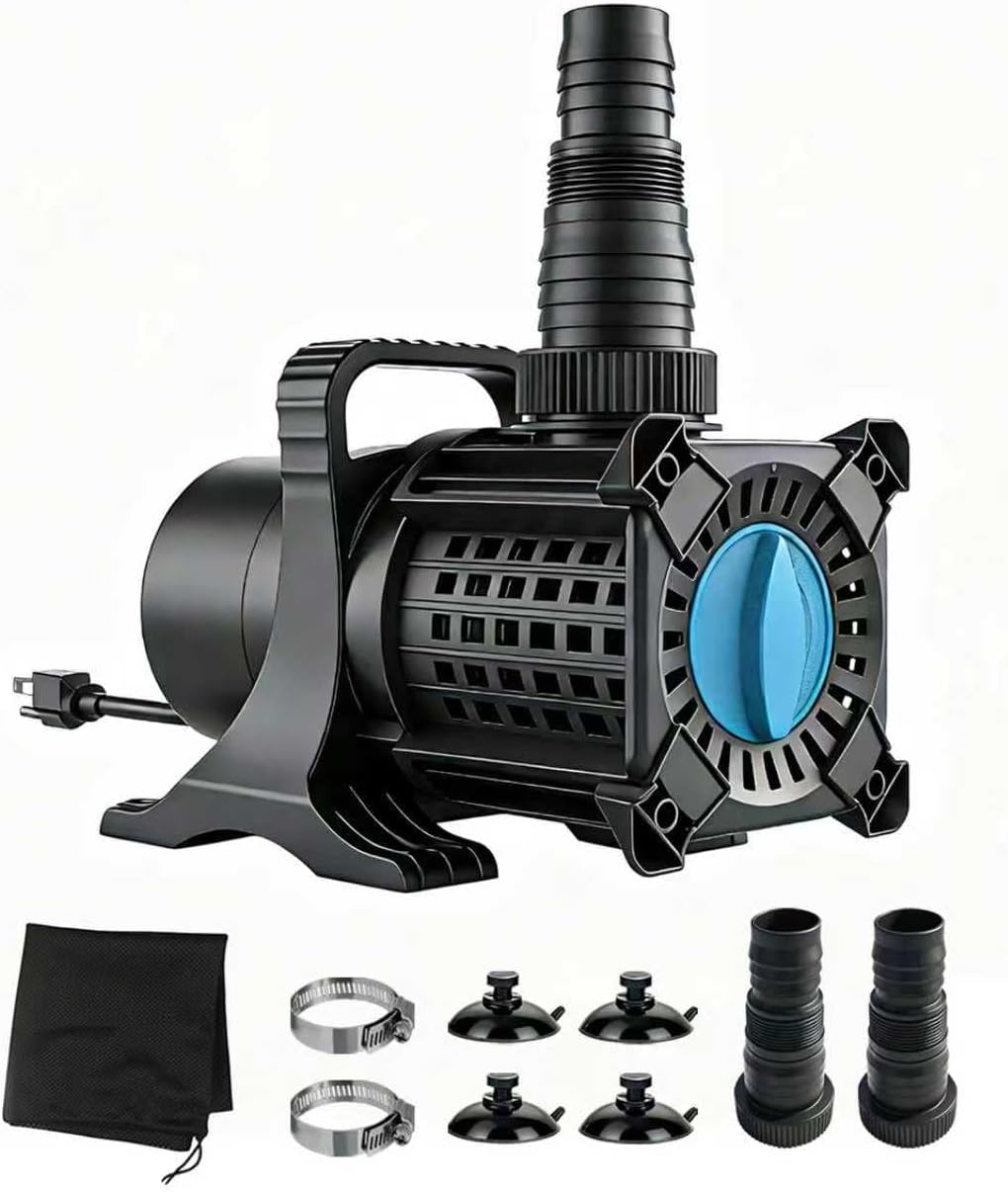
The OYO WATER PSA2400 is a 2400 GPH-class submersible pump built for continual outdoor use in ponds, waterfalls, fountains, and irrigation. It delivers adjustable flow from a light trickle up to a strong surge so you can fine-tune circulation for koi ponds or water features without swapping pumps. The unit is UL listed and uses a copper motor with dry-burn protection, which helps prevent motor damage if water levels fall. Practical touches include a 20.3 foot power cord that reduces the need for extension cables, a mesh barrier bag and filter shroud to block debris, and multiple threaded adapters for common hose sizes so you can install it vertically or horizontally. In real use it promises quiet operation thanks to a ceramic shaft and epoxy-potted motor, but like many high-flow submersibles it will require occasional cleaning of the mesh bag and intake when working in debris-heavy environments. This pump is aimed at owners who prioritize dependable, continuous circulation and straightforward installation rather than ultra-compact or decorative units.
Best for: Koi pond and water feature owners who need a reliable, continuously running pump with safety features and adjustable flow for steady circulation and waterfalls.
Less Ideal for: Buyers wanting a tiny, decorative fountain pump or a completely maintenance-free unit should consider smaller low-flow models or external filtration systems instead.
- UL listed and copper motor with dry-burn protection for safer, longer operation
- Wide adjustable flow control (10%–90%) to match pond, waterfall, or irrigation needs
- 20.3 ft power cord gives flexible placement without extension cords
- Includes mesh barrier bag, filter shroud, and multiple hose adapters for debris protection and easy hookups
- Capable of submersible or inline orientation for versatile installation
- Requires periodic cleaning of the mesh bag and intake in dirty ponds
- Relatively large physical footprint may be less convenient in very compact setups
Verdict: Choose this pump when you want a robust, safety-focused pond pump with precise flow control and built-in debris protection for dependable koi pond circulation.
VIVOSUN Submersible Fountain Water Pump (800 GPH)

| Flow Rate | 3000 liters per hour |
|---|---|
| Maximum Lifting Height | 10 feet |
| Voltage | 110 volts |
| Horsepower | 0.07 hp |
This VIVOSUN submersible pump delivers up to 800 GPH (3000 L/H) and is primarily used to circulate water for small ponds, fountains, and indoor water features. It has an adjustable flow knob and three interchangeable nozzles so you can tune spray height and pressure as lift height changes, and the unit supports a maximum lift of about 10 feet. The plastic housing keeps it lightweight and the internal design is serviceable — the pump disassembles without tools for routine cleaning. It runs on standard 110–120V and is relatively quiet in typical installations, making it suitable for backyard ponds where noise matters. Important limitations are its plastic construction and modest wattage, which make it best for small to medium water features rather than large ponds or heavy waterfall loads, and flow falls off as lift increases so output depends on placement. Overall, it is a practical, adjustable option if you need a compact, easy-to-clean pump for a small pond or fountain.
Best for: Buyers who want a compact, easy-to-maintain pump for a small pond or fountain and who prioritize reliable, proven performance backed by many user reviews.
Less Ideal for: Not a good fit for owners of larger ponds or those needing heavy waterfall or high-head pumping where a more powerful, metal-bodied pump is required.
- High maximum flow rate rated at 800 GPH (3000 L/H) suitable for small ponds and fountains
- Adjustable flow control and three nozzle options let you match spray pattern and pressure to the feature
- Tool-free disassembly for easy cleaning and maintenance
- Quiet operation appropriate for backyard or indoor water features
- Plastic construction may be less durable long term compared with metal-bodied pond pumps
- Performance decreases noticeably as lift height increases, reducing flow at higher heads
Verdict: A high-flow, adjustable and easy-to-service submersible pump that reliably handles small ponds and fountains.
Choosing the Right Fish Pond Pump: Key Factors to Consider
Flow Rate and Head Height
Flow rate determines how much water moves through your pond and filtration each hour. You need enough flow to turnover the entire pond volume in a time appropriate for your stocking level and filtration type. Head height is the vertical distance the pump must push water plus friction losses from plumbing. A pump that lists flow at zero head will deliver much less at real-world head heights, so match the pump curve to your actual plumbing run.
Undersizing a pump leads to poor circulation and oxygen exchange, while oversizing can create excessive current that stresses fish or causes erosion. Choose a pump with a usable operating range that fits your pond volume and the resistance created by filters, waterfalls, and pipe runs.
Energy Use and Running Cost
Pumps often run 24/7, so wattage and efficiency directly affect ongoing electricity costs. Look at flow delivered per watt rather than wattage alone. Variable-speed pumps can reduce runtime energy by throttling output during low-demand periods and may pay back their higher upfront cost over several seasons.
Consider seasonal operation too. In colder months you might reduce flow to protect fish and prevent freezing issues, but overall efficiency remains a key long-term expense driver for any pump used continuously.
Clog Resistance and Maintenance Access
Ponds collect leaves, algae, and debris that can foul the impeller and reduce flow. Pumps designed with pre-filters, larger intake screens, or easy-to-remove housings make maintenance faster and reduce downtime. A pump that requires tools or full disassembly every time it clogs will make upkeep harder.
Also evaluate how easy it is to reach the impeller for cleaning and whether replacement parts are simple to install. A more accessible design encourages proper maintenance, which preserves performance and extends service life.
Durability and Outdoor Suitability
Pumps must cope with moisture, sunlight, and temperature swings. Materials such as UV-stable plastics, stainless fittings, and corrosion-resistant motors help a pump last longer in an outdoor pond. Seals and cable entries should be rated for pond or submersible use to prevent water intrusion.
Think about winter conditions in your area. Pumps that tolerate intermittent freezing or are easy to remove for winter storage reduce the risk of damage. Robust construction also means fewer service interruptions during peak pond season.
Noise and Vibration
A pump that runs quietly preserves the tranquil feel of a garden and reduces stress on fish. Noise often comes from motor vibration, cavitation at the intake, or mounting surfaces. Look for pumps with rubber mounts, balanced impellers, and smooth intake designs to minimize noise.
Consider how the pump will be installed. Submerged pumps tend to be quieter than external units, but external pumps can be isolated in an enclosure. Ease of access for service should be weighed against potential noise mitigation strategies.
Plumbing Compatibility and Installation Flexibility
Pumps that accept a range of fitting sizes and allow both barbed and threaded connections adapt more easily to existing setups. Consider whether the pump supports inline installation, fountain heads, or waterfall returns, and whether it works with the filter type you plan to use.
Flexible installation options reduce the need for adapters and make it faster to swap a pump into a new or upgraded system. Also confirm electrical requirements and whether the cable length and plug type meet your site needs.
Matching Pump Size to Pond Volume
Estimate your pond volume accurately before choosing a pump. For heavily stocked fish ponds or systems with biological filters, aim for a higher turnover rate than for simple decorative ponds. Use the pump curve to find a pump that provides the needed flow at the actual head height of your installation.
If you plan water features like waterfalls or streams, factor in the additional head and desired visual flow. Small differences in head can reduce flow substantially, so err toward a pump with some extra capacity within its efficient operating range.
- Calculate pond gallons and desired turnover time.
- Account for elevation gain, filter resistance, and pipe length.
- Choose a pump whose curve matches real-world head conditions.
Submersible Versus External Pump Pros and Cons
Submersible pumps sit in the water, which often makes them quieter and simpler to hide. They are convenient for straightforward installations and smaller ponds. However, they put the motor in the pond, so cooling and debris exposure are design considerations.
External pumps mount outside the pond and are easier to service without draining water. They can be more energy efficient for larger systems and are often better for frost exposure when placed in a sheltered area. External models require careful priming and weatherproofing where they are installed.
- Submersible: quieter, compact, but more exposed to debris.
- External: easier service access, potentially more efficient for large flows.
Integrating Pumps with Filtration and Skimmers
Decide whether the pump will feed biological filters, mechanical filters, skimmers, or a combination. Each configuration places different demands on flow stability and pressure. A pump feeding a pressurized filter needs to maintain flow under the filter's backpressure, while a pump feeding a gravity filter must reliably deliver the desired flow to overflow points.
Consider using separate pumps for circulation and for fountain or waterfall features in larger systems. This separation keeps filtration running if a decorative feature clogs or needs service.
- Match pump output to the rated flow and head of your chosen filter.
- Think about redundancy for critical filtration in fish-heavy ponds.
Noise Reduction and Mounting Tips
Mount external pumps on solid, vibration-dampening pads and keep inlet lines straight and free of sudden constrictions. For submersible pumps, place them on a stable bed of gravel or paving to reduce vibration transfer and prevent suction of fine debris.
Regular maintenance like clearing intake screens and aligning fittings prevents cavitation noise and prolongs pump life. If noise is a priority, look for pumps with rubber mounts and balanced impellers.
- Use rubber pads or isolation mounts for external pumps.
- Stabilize submersible pumps on a firm, level base to reduce vibration.
Seasonal Care and Winterizing Guidance
In colder climates, plan how you will protect the pump from freezing. Some pumps are designed for continuous winter operation when submerged below the freeze line, while others should be removed and stored indoors. Disconnect electrical supplies before any winter servicing.
Clean and inspect the pump and impeller before storage to prevent seized parts. For pumps left in place, check that intakes are not blocked by ice and that the system maintains sufficient open water for gas exchange if fish remain in the pond.
- Remove and store pumps not rated for freeze exposure.
- Perform a full cleaning and inspection before winter storage.
How We Chose the Best Fish Pond Pump
We prioritized performance and real-garden durability when narrowing the list of six Fish Pond Pumps. Key evaluation criteria included steady flow delivery across realistic head heights, measured energy consumption at typical operating flows, and corrosion resistance for year-round outdoor exposure. We also assessed impeller and housing design for clog resistance and ease of routine cleaning, plus compatibility with common plumbing sizes and fittings. Noise level under normal load was checked because quiet operation matters around living spaces and for sensitive fish. Excluded from consideration were pumps designed only for decorative tabletop fountains or indoor aquariums, and units without clear waterproof and outdoor-use ratings. We focused on pumps that balance long-term reliability with straightforward maintenance, and that offer installation flexibility for different pond types and filtration systems.
FAQ
How do I calculate the right pump size for my pond?
Estimate your pond volume in gallons and decide how often you want full turnover. For fish ponds, faster turnover improves oxygen and filtration, so plan for higher flows. Use the pump curve to find a unit that delivers the needed flow at your actual head height, accounting for filters and pipe runs.
Can one pump handle circulation and a waterfall?
Often one pump can handle both if sized correctly and if plumbing is arranged to split flow. However, combining duties increases load and makes the system more vulnerable to a single point of failure. For larger ponds or important filtration, consider separate pumps for feature flow and filtration.
Should I choose a variable-speed pump?
Variable-speed pumps let you tune flow to seasonal needs and different features, which can save energy and reduce stress on fish. They are more expensive upfront but offer flexibility and quieter operation at reduced speeds.
How often should I clean the pump?
Inspect intake screens and impellers every few weeks during the growing season and after heavy leaf fall. Frequency depends on local debris load and algae growth. Regular cleaning prevents clogs and maintains steady flow.
Is a submersible pump better than an external pump for a backyard fish pond?
Submersible pumps are usually quieter and easier to hide, making them a good choice for many backyard ponds. External pumps offer easier access for maintenance and can be more appropriate for larger systems. The best choice depends on pond size, noise tolerance, and service access.
What electrical protections should I use with a pond pump?
Use outdoor-rated GFCI protection and ensure cables and connections are rated for pond use. Keep electrical components dry and mount controllers or timers in weatherproof enclosures. Follow local codes for outdoor wiring.
Final Verdict
Match pump capacity to the real-world head and pond volume, and prioritize durability and ease of maintenance for reliable, long-term operation. Energy efficiency and quiet running are important if the pump will run continuously near living spaces. Consider installation type, plumbing compatibility, and seasonal needs when deciding between submersible and external units. Focus on pumps whose operating curves and serviceability suit your filtration and feature requirements. That approach will give you the best balance of water quality, fish health, and manageable maintenance over time.
