

Note: This article contains affiliate links. If you click on these links and make a purchase, I may earn a small commission at no extra cost to you. This helps support my research and content. Read my full affiliate disclosure here.
A properly sized large pond pump keeps water moving, supports filtration, and maintains healthy oxygen levels for fish and plants. If your pond is bigger than a small backyard pond or runs heavier features like waterfalls or large filters, pump selection matters for performance and operating cost. This guide covers six shortlisted large pond pumps that fit a range of pond volumes and feature demands. Below we explain the evaluation criteria used and outline the factors that influence pump choice so you can match a pump to your pond, plumbing, and landscape features before checking model specifics.
Top Picks at a Glance
| Best Overall The best all-around choice for most situations | VIVOHOME 620W 9000 GPH Submersible Pond Pump |  |
| Best Quality Built to a higher standard if you want something more solid | HALF OFF PONDS Aqua Pulse AP-14800 Submersible Pond Pump (14,800 GPH) |  |
| Best Value The sweet spot between price and what you get | WaterRebirth PS-7000 350W Submersible Pond Pump (7000 GPH) |  |
| Best Budget The cheapest option that still gets the job done reliably | VIVOHOME 220W 4500GPH Submersible Pond Pump with Adjustable Nozzle and Barrier Bag |  |
| Highest Rated A top-rated pick with lots of positive feedback | WaterRebirth PSA5100 Submersible Pond Pump, 5500 GPH, 325W, Adjustable Flow |  |
| Most Popular A crowd favorite that many people choose with confidence | VIVOSUN 220W 4500GPH Submersible Pond Pump |  |
VIVOHOME 620W 9000 GPH Submersible Pond Pump
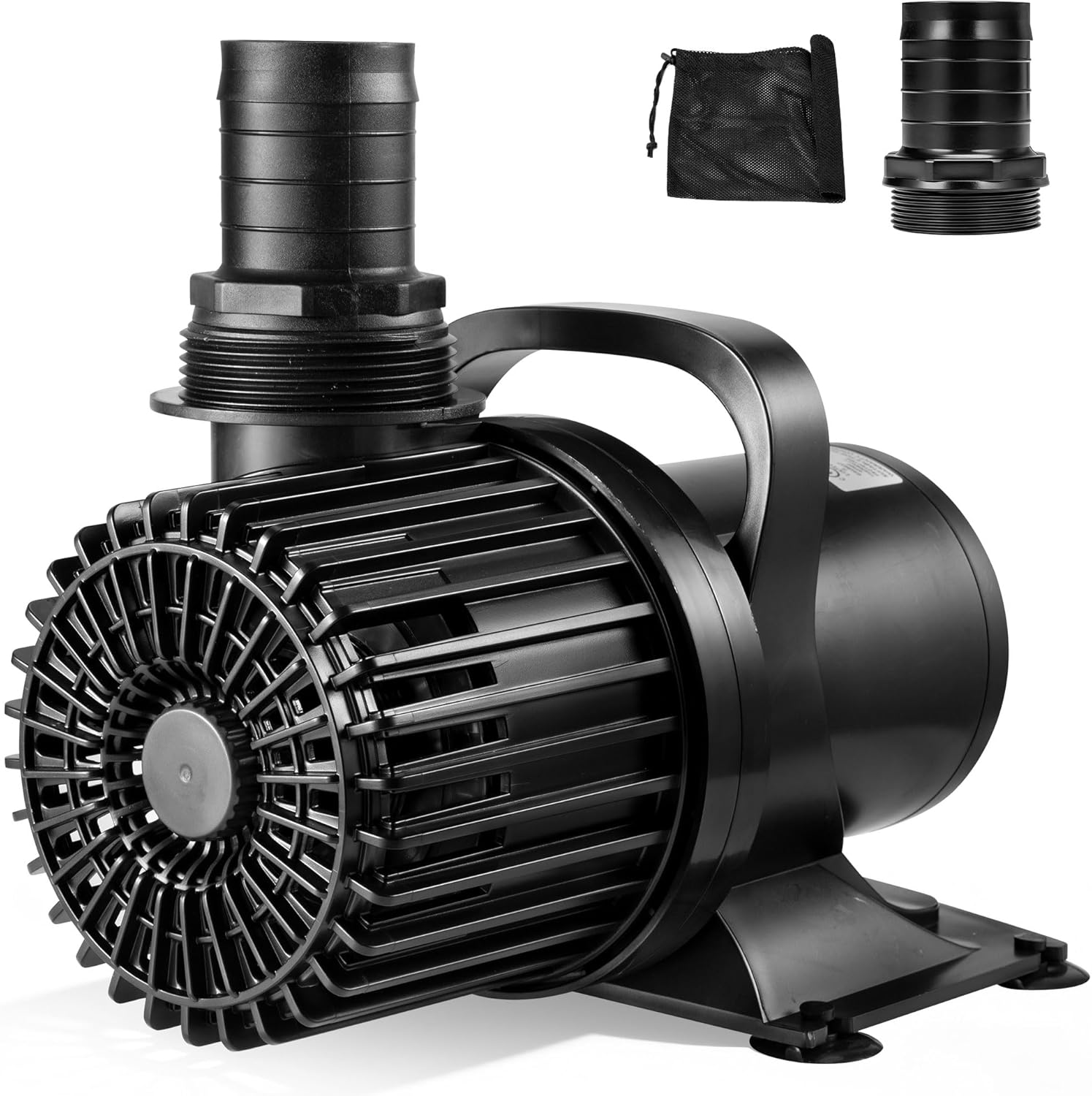
| Power | 620W |
|---|---|
| Output | 9000 GPH |
| Maximum Lifting Height | 27.6 feet |
| Flow Rate | 150 gpm |
| Power Source | ac |
The VIVOHOME 620W pump is built for large pond circulation and heavy water features, delivering up to 9000 gallons per hour and a maximum lift of 27.6 feet. It is typically used submerged at the bottom of ponds or inside filter housings to power waterfalls, fountains, and biological filters. Notable features include a 20-foot power cord, five-position adjustable nozzle for directing flow, two adapter fittings for 2-inch tubing, and a protective mesh barrier to keep out large debris. The motor uses magnetic drive technology with a ceramic shaft and silicon carbide seal for longer life and an IPX8 waterproof rating for reliable submerged operation. Practical benefits are strong flow capacity for better oxygenation and filtration, flexible plumbing options, quieter operation around 30 to 40 dB, and vibration-dampening suction feet. Important limitations are the unit's substantial size and weight which make handling and placement more effort, and its 620W power draw which may be higher than small-pond pumps and requires a properly rated outdoor circuit.
Best for: Buyers who need a robust, high-flow pump to circulate and oxygenate large ponds or drive substantial waterfalls and who prioritize reliability and adjustable plumbing over compactness.
Less Ideal for: Those with very small ponds, limited electrical capacity, or who need a lightweight, portable pump should consider lower-capacity models instead.
- Very high maximum flow rate suitable for large ponds and waterfalls
- 27.6 foot max lift lets it feed high waterfalls or remote filters
- Durable motor design with ceramic shaft and silicon carbide seal for extended life
- Adjustable outlet direction and included adapters simplify plumbing and nozzle placement
- Long 20.3 ft power cord and rubber suction feet reduce vibration and ease installation
- Relatively high power draw at 620W compared with smaller pond pumps
- Large and heavier unit which can be awkward to position or service
Verdict: Choose this pump when you need dependable, high-volume circulation for a large pond or sizable water feature.
HALF OFF PONDS Aqua Pulse AP-14800 Submersible Pond Pump (14,800 GPH)
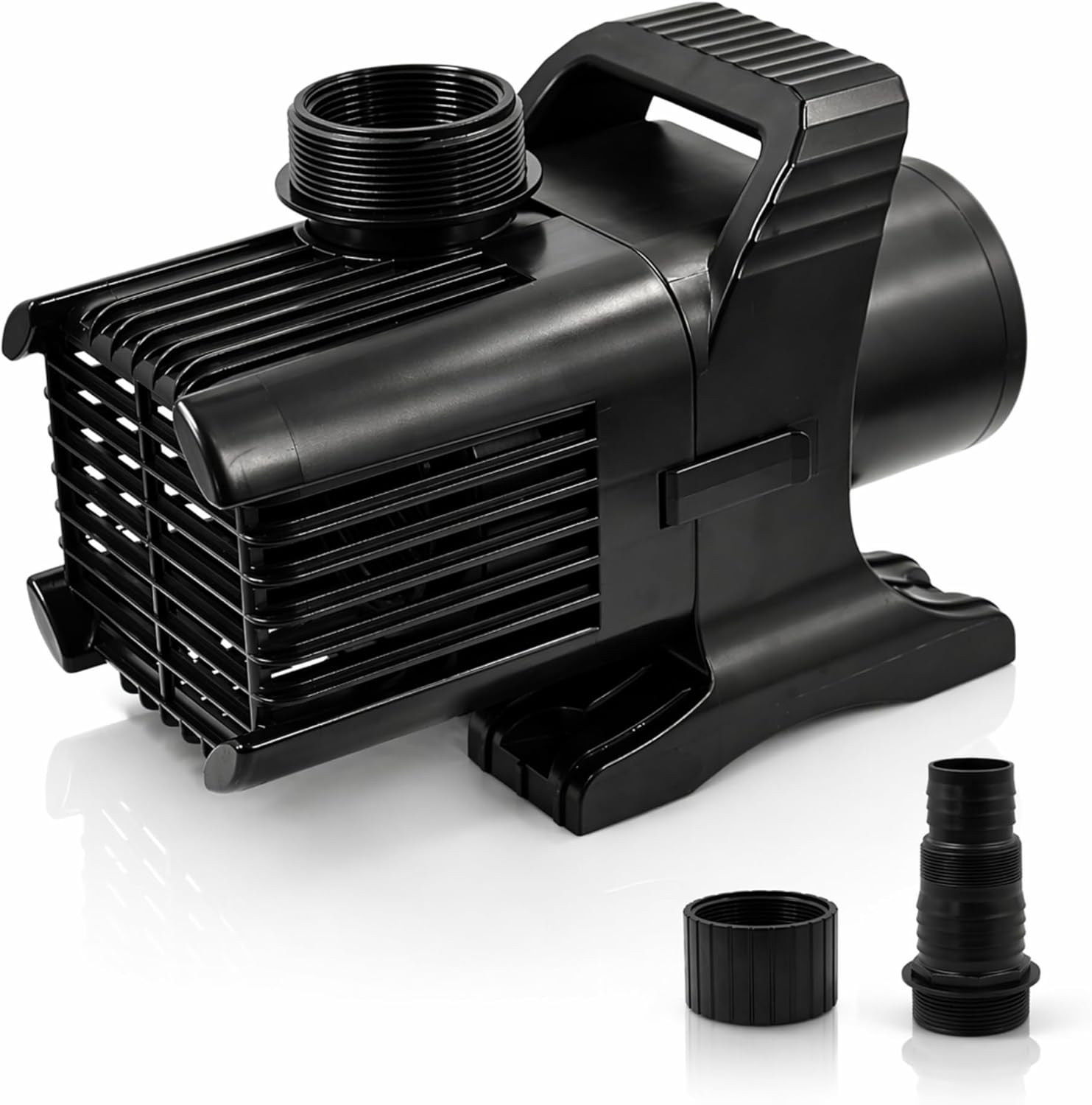
| Flow Rate | 247 gpm |
|---|---|
| Maximum Lifting Height | 35.5 feet |
| Power Source | Corded Electric |
| Horsepower | 1.75 hp |
| Voltage | 120 volts |
The Aqua Pulse AP-14800 is built to move a lot of water without eating power. It delivers up to 14,800 GPH while drawing about 1,100 watts from a 1.75 hp hybrid asynchronous motor that combines mag-drive efficiency with direct-drive strength. Install it submerged in a skimmer, waterfall box, or basin either vertically or horizontally; the pump accepts large fittings and passes solids up to 1/4 inch with a vortex-style impeller. Practical benefits include a 33 foot cord for flexible placement, an oil-free motor that is safe for fish and aquatic plants, and a removable impeller for straightforward maintenance. The unit is engineered for 24/7 operation and can produce a maximum lift near 35.5 feet, making it suitable for high-head waterfall runs or complex circulation needs. Expect a fairly compact footprint for the power delivered, but note it is a heavy-duty, high-power pump so it requires proper electrical supply and occasional debris cleaning to maintain peak flow and longevity.
Best for: Buyers who prioritize strong, reliable circulation for large ponds, pondless waterfalls, or multi-feature installations and want a pump that runs continuously with solid head capability.
Less Ideal for: Small pond owners or those needing a lightweight, low-power pump for tiny fountains should consider smaller, lower-wattage models instead.
- Very high flow rate suitable for large ponds and multiple features
- Hybrid asynchronous motor balances power and energy efficiency
- Oil-free design and removable impeller simplify maintenance and protect fish
- 33 ft power cord gives flexible placement options
- Can be installed vertically or horizontally to fit skimmers or waterfall boxes
- Requires a substantial electrical supply and appropriate wiring for continuous high-power use
- Plastic construction may be less durable than metal in very abrasive or exposed installations
Verdict: If you need continuous, high-volume circulation for a large pond or high-head waterfall, this pump delivers industry-grade flow with energy-conscious performance.
WaterRebirth PS-7000 350W Submersible Pond Pump (7000 GPH)

| Flow Rate | 116.6 gpm |
|---|---|
| Maximum Lifting Height | 20.2 feet |
| Voltage | 120 volts |
| Horsepower | 320 watts |
| Material Type | Silicon carbide |
The WaterRebirth PS-7000 is a heavy-duty submersible pump built to move large volumes of water while running quietly for long periods. It delivers up to roughly 7000 GPH (116.6 gpm) and can lift water to about 20.2 feet, so it is typically used to power waterfalls, large fountain heads, strong circulation in ponds, or high-flow filtration systems. Notable features include a silicon carbide shaft and drive ring for durability, a detachable inlet mesh to reduce debris intake, and an overheat protection sensor for continuous 24-hour operation. In practice the pump gives strong flow for large features and will save energy relative to lower-efficiency units because of its claimed high flow per watt. Maintenance is required if the pond is dirty since the rotor and mesh need monthly cleaning to prevent clogging. The pump is powerful and relatively quiet but will require a suitable electrical setup and occasional service to keep peak performance in heavily debris-laden water.
Best for: Buyers who want a reliable, high-flow pump to power large ponds, waterfalls, or heavy filtration and who plan routine maintenance to keep performance consistent.
Less Ideal for: Small pond owners or users who need quiet low-flow circulation without periodic cleaning or those who require integrated adjustable flow control.
- Very high flow rate suitable for large ponds and waterfalls (116.6 gpm / ~7000 GPH)
- Silicon carbide shaft and drive ring for increased durability and reduced wear
- Built-in overheat protection allows continuous 24-hour operation
- Detachable inlet mesh reduces large debris intake and simplifies cleaning
- Requires regular maintenance in dirty ponds to prevent clogging
- No built-in variable flow control included
Verdict: If you need a high-capacity, durable submersible pump to drive large ponds or waterfalls, this model delivers strong continuous flow with built-in protection and easy debris screening.
VIVOHOME 220W 4500GPH Submersible Pond Pump with Adjustable Nozzle and Barrier Bag

| Power | 220W |
|---|---|
| Flow Rate | 4500 GPH |
| Max Lift | 19.4 feet |
| Power Source | Corded Electric |
| Waterproof Rating | IPX8 |
The VIVOHOME 220W 4500GPH pump is built for moving large volumes of water in ponds, waterfalls, and water gardens. It runs as a submersible unit or inline and delivers up to 4500 gallons per hour with a 19.4 foot lift, so it can handle larger ponds or tall waterfalls. A 180 degree adjustable nozzle and included multi-size hose adapter make directing flow and connecting to common plumbing straightforward, while the 20 foot power cord gives flexible placement. The motor is copper-core with IPX8 waterproofing and thermal auto-shutoff for protection during overloads. Practical features include a removable barrier bag and mesh filter to reduce leaf and debris intake and four rubber suction feet to reduce vibration. The pump is relatively heavy and intended for continuous duty so expect some bulk when installing and occasional cleaning of the intake bag. For buyers prioritizing the lowest up-front cost there are cheaper, lower-capacity pumps, but this model balances strong flow and useful accessories for large pond setups.
Best for: Buyers who need strong continuous flow for large ponds or tall waterfalls and want a pump that includes useful installation accessories and basic debris protection.
Less Ideal for: Those with very small ponds, minimal flow requirements, or who want the absolute cheapest, lightweight portable option.
- High maximum flow of 4500 GPH suitable for large ponds and waterfalls
- 19.4 foot maximum lift lets it feed tall features or distant outlets
- Dual submersible and inline operation gives flexible installation options
- Includes adjustable 180° nozzle, multi-size hose adapter, stainless clamp, and barrier bag for easier setup and debris control
- Relatively heavy and bulky compared with smaller pond pumps
- Requires occasional cleaning of the intake bag to maintain peak flow
Verdict: A cost-conscious choice for large ponds that need high continuous flow and useful installation accessories packaged with the pump.
WaterRebirth PSA5100 Submersible Pond Pump, 5500 GPH, 325W, Adjustable Flow
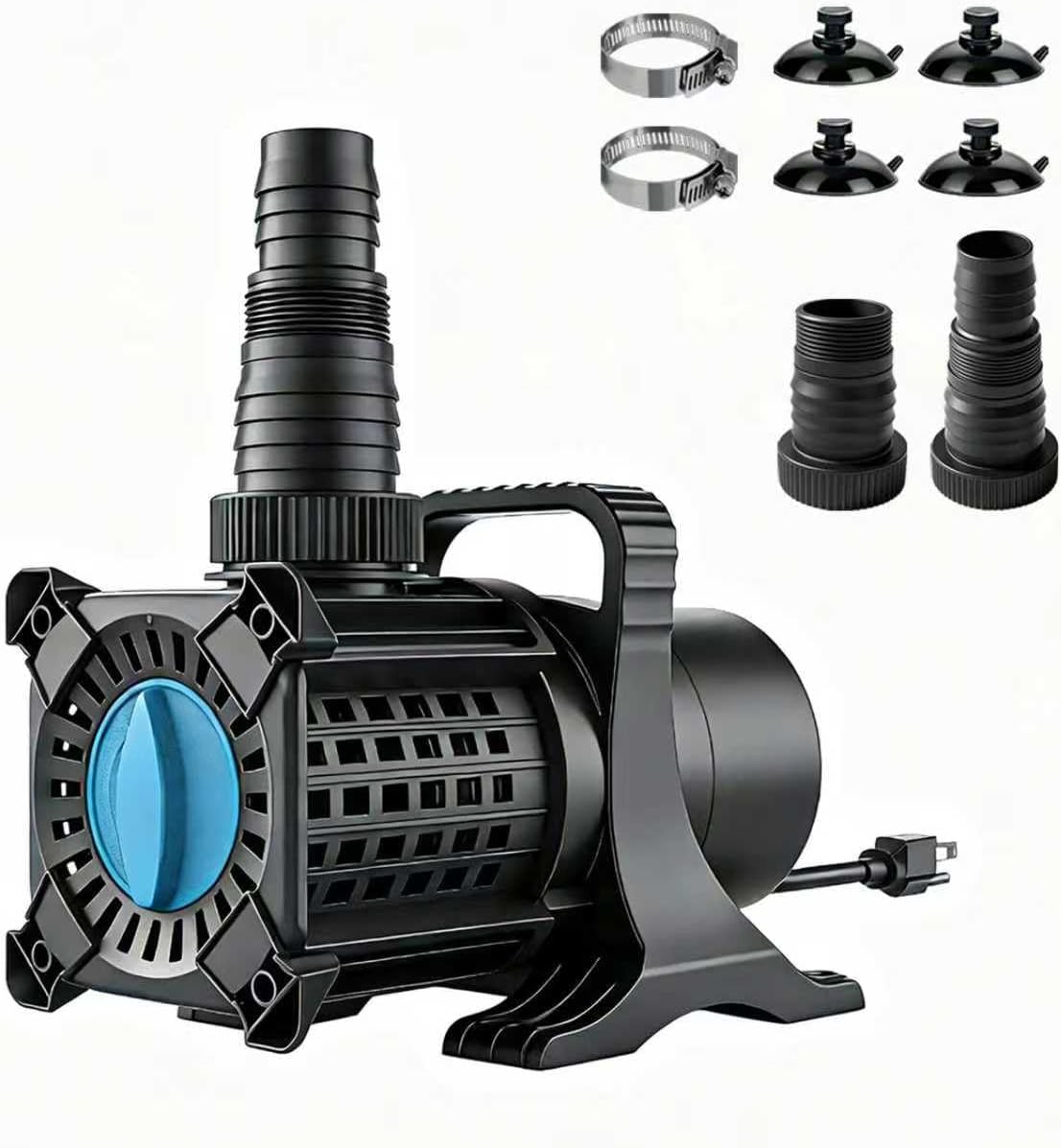
| Power Source | Corded Electric |
|---|---|
| Flow Rate | 91.67 gpm |
| Maximum Lifting Height | 18.7 feet |
| Voltage | 120 volts |
| Horsepower | 0.43 hp |
The WaterRebirth PSA5100 is a heavy-duty submersible pond pump built for large outdoor water features that need strong, continuous circulation. It houses a 325W copper motor and is rated for up to 5500 GPH at zero lift and an 18.7 ft maximum lift, so it can drive large waterfalls or keep substantial ponds well-turned-over. Installation is straightforward: the pump accepts 1-1/2" and 2" hoses with included adapters and a rotatable 5-position head eases alignment with plumbing. A front-mounted 90° flow control knob lets you precisely reduce output without adding external valves, and the removable filter cover makes debris cleaning simple. The oil-free design and ceramic shaft make it safe for koi and freshwater plants while minimizing wear for long runtime. Expect flow to drop as lift increases and plan plumbing accordingly. It is not rated for pools or hot tubs and the pump will draw more current under heavy lift, so confirm your electrical supply and intended head height before selecting this unit.
Best for: Buyers who prioritize dependable, continuous circulation for large ponds or waterfalls and want a pump built for biological safety and low maintenance.
Less Ideal for: People needing a pump for pools, hot tubs, or small indoor fountains should look for equipment rated for those environments or lower-flow models.
- High maximum flow rated up to 5500 GPH for strong circulation
- Adjustable 90° front flow control for precise output tuning without extra valves
- Rotatable 5-position head and included hose adapters for flexible plumbing alignment
- Oil-free design and ceramic shaft suitable for koi and freshwater ecosystems
- Removable front filter cover simplifies routine debris cleaning
- Flow rating is under zero lift so actual GPH falls with height and plumbing resistance
- Not certified for use in pools, hot tubs, or spa applications
Verdict: A robust, fish-safe submersible pump that delivers high flow and precise on-pump control, making it a practical choice for reliable large-pond circulation.
VIVOSUN 220W 4500GPH Submersible Pond Pump

| Flow Rate | 17000 liters per hour |
|---|---|
| Maximum Lifting Height | 19 feet |
| Power Source | Electric |
| Horsepower | 220 watts |
The VIVOSUN 220W 4500GPH submersible pump is built for large ponds, waterfalls, and heavy-duty water circulation where high flow and lift are required. In use it can circulate up to 4500 gallons per hour (about 17,000 LPH) and lift water as high as 19 feet, so it handles sizable pond volumes and tall waterfalls without needing multiple units. The pump is fully submersible with overload protection and a silicon carbide shaft and drive-ring for durability. A detachable prefilter and adjustable outlet direction make installation and routine cleaning straightforward, and the 20-foot power cord gives flexibility for placement. Noise is low for its size, and the unit is positioned as energy efficient relative to its output. Trade-offs to note are the plastic construction and the need to match hose fittings and filtration for debris-heavy ponds, and its 220W draw means it is not a low-power option for every situation. For large water gardens it provides dependable high flow and simple maintenance, but plan plumbing and screening accordingly.
Best for: Buyers who need a single, high-capacity pump to move large volumes of water for ponds and tall waterfalls and who value quiet, low-maintenance operation backed by many customer reviews.
Less Ideal for: Small pond owners looking for a low-power, compact pump or users who need a stainless steel commercial-grade unit for continuous heavy industrial use.
- Very high flow rate (4500 GPH / 17,000 LPH) suitable for large ponds and waterfalls
- High maximum lift up to 19 feet enables tall water features
- Silicon carbide shaft and overload protection for improved durability
- Detachable prefilter and adjustable outlet direction simplify cleaning and installation
- Relatively quiet operation for a pump of this capacity
- Plastic exterior may be less robust than metal-bodied commercial pumps
- 220W power draw requires appropriate electrical planning for outdoor use
Verdict: A powerful, quiet submersible pump that delivers the high flow and lift large ponds and waterfalls require.
Choosing the Right Large Pond Pump: Key Factors to Consider
Matching Flow Rate to Pond Volume and Features
Flow rate determines how quickly water circulates through your pond and is commonly expressed in gallons per hour. For large ponds, aim for a pump that can turn the entire pond volume over at least once every two to four hours, depending on stocking density and plant coverage. Features like waterfalls and large skimmers add head and flow demands, so use pump flow curves to see actual output at the expected lift.
Incorrectly sized flow can cause poor filtration, low oxygen, or excessive turbulence. Overpowered pumps can waste energy and create too-strong currents that stress fish or disturb plantings, while underpowered pumps fail to support filters and surface skimming.
Head Height and Real-World Flow Losses
Head height is how much vertical lift and friction the pump must overcome to move water from its location to features and return points. Measure total static head by adding vertical lift plus estimated friction from pipe length, fittings, and filter media. Pump flow drops as head increases, so always read manufacturer flow curves to pick a pump that still delivers required gallons per hour at your calculated head.
Failing to account for head leads to surprises where a pump that seems powerful on paper produces much lower flow once installed. Consider adding a margin of 10 to 20 percent to accommodate future additions like an extra waterfall or longer plumbing runs.
Energy Use and Long-Term Operating Cost
Large pond pumps often run many hours each day or continuously, so electrical consumption is a major lifetime cost. Compare wattage and flow output to get a sense of efficiency, typically expressed as gallons per watt or gallons per hour at a given watt draw. Variable-speed pumps let you match flow to seasonal needs and save energy during cooler months when biological demand is lower.
Also consider motor cooling method. Pumps that use pumped water to cool the motor may be more compact but can run hotter when flow is restricted. Good cooling design and low-wattage efficiency both extend motor life and reduce electricity bills.
Debris Handling and Pre-Filtration Needs
Large ponds collect leaves, pine needles, and organic debris that can clog impellers and reduce performance. Pumps with larger debris pass capability or with integral pre-filters reduce maintenance. However, larger debris pass designs can allow more solids through to downstream filters, so pairing with a properly sized mechanical or settling chamber is important.
Think about how easy it is to access and clean the pump's intake screen or pre-filter. Pumps intended for natural ponds should tolerate variable debris load and be straightforward to service without frequent disassembly.
Materials, Corrosion Resistance, and Weather Exposure
Outdoor pumps face wet-dry cycles, UV exposure, and temperature swings. Materials such as corrosion-resistant plastics, stainless steel fasteners, and durable seal designs help pumps last longer in garden settings. Avoid pumps that use materials prone to brittle failure in cold climates if your pond will experience freezing conditions.
Check for serviceable seals and availability of replacement parts. Pumps with easily replaceable shaft seals, impellers, and housings reduce long-term repair cost and downtime.
Installation Options and Plumbing Compatibility
Consider where the pump will sit: fully submerged in a pond sump, hidden in a skimmer, or mounted externally. Each placement has different plumbing and priming requirements. Large pond pumps should offer standard plumbing sizes and adapter options so you can connect to existing pipes without extensive rework.
Ease of access for winterization, ability to run dry for short periods without damage, and compatibility with automation or variable-speed controllers are additional installation considerations that affect long-term convenience.
Sizing Example and How to Calculate Pump Needs
To size a pump, start by estimating pond volume in gallons and decide desired turnover frequency. For large garden ponds, once every two to four hours is typical depending on fish load and surface area. Multiply pond volume by the desired number of turnovers per hour to get the target gallons per hour. Then determine the total dynamic head from vertical lift plus friction losses in pipes and fittings.
If the required head is significant, consult pump flow curves to find a unit that meets the target GPH at that head. Remember to build in a margin for seasonal changes and future additions like extra waterfalls.
- Measure pond volume and desired turnover interval.
- Calculate static head and estimate friction losses.
- Use pump curve data to match required GPH at calculated head.
Placement Options and Winter Care
Placement affects pump performance and maintenance. Submerged pumps in sumps or skimmers are common for aesthetic ponds because they are quiet and hidden. External pumps mounted in a protected equipment bay are easier to service and can run cooler, but they require priming and weatherproofing.
For cold climates, plan winter procedures such as removing pumps to a frost-free location or ensuring safe operation at low temperatures. Some large pumps are designed to handle occasional cold exposure, but long-term freeze-thaw cycles shorten service life.
- Submerged installs are quieter and simpler to hide.
- External mounts improve serviceability and cooling.
- Plan winterization steps based on local climate.
Plumbing Best Practices for Reliable Flow
Proper plumbing keeps the pump producing the rated flow. Use the largest practical pipe diameter to reduce friction losses, avoid sharp turns, and minimize fittings. Check that unions or quick-disconnects are rated for the pump's flow and pressure to simplify servicing without leaks.
Use flexible hose only where necessary; rigid pipe reduces the chance of crush or kinks and maintains flow efficiency. Include accessible isolation valves to allow servicing without draining the pond.
- Favor larger diameter pipe for long runs.
- Minimize elbows and unnecessary fittings.
- Install isolation valves and unions for maintenance.
Noise, Vibration, and Aesthetic Integration
Large pumps can transmit vibration to nearby structures or create audible noise near sitting areas. Submerged pumps are often quieter but can still cause vibration through mounting points. Use vibration-damping mounts and place pumps on solid, level bases to reduce noise.
Conceal pump plumbing with plantings or rockwork, but ensure that concealment does not block airflow to external units or access to inlets and service points. Thoughtful placement balances quiet operation and ease of maintenance.
- Use vibration isolation and level mounting.
- Keep service access clear when concealing equipment.
- Test noise levels at typical seating locations before finishing landscaping.
Control Options and Automation
Variable-speed controllers and timers let you dial in flow for seasonal and daily needs. Running at lower speeds overnight or in cooler months saves energy and reduces wear. If you plan waterfalls or timed features, a controller that can store schedules or integrate with pond controllers is useful.
Ensure control equipment is rated for outdoor use and installed with proper weather protection. Some pumps include built-in controls while others accept external controllers; choose the approach that matches your installation preferences.
- Consider variable-speed control for energy savings.
- Verify weatherproof ratings for external controllers.
- Match control type to installation complexity and automation goals.
How We Chose the Best Large Pond Pump
We focused on the practical qualities that determine whether a pump will perform reliably in larger ponds and under continuous outdoor use. Selection began by filtering for pumps with published flow rates appropriate for medium-to-large ponds and continuous-duty capability meant for prolonged operation. We prioritized energy efficiency and motor cooling design because run time drives operating cost and life span in large installations. Materials resistance to corrosion and debris-handling ability were essential to ensure pumps cope with leaves, string algae, and sediment common in outdoor ponds. We excluded submersible units intended only for small decorative bowls, and any pumps lacking clear performance data or continuous-duty ratings. Our evaluation emphasized measurable specs: flow rate at realistic head heights, wattage and resulting energy per 1,000 gallons circulated, debris pass size and pre-filtering options, and construction materials for wet/dry durability. These criteria align with the scoring metrics used throughout the guide.
FAQ
How do I calculate the flow rate needed for a large pond?
Estimate pond volume in gallons and decide how often you want full turnover. For large ponds, once every two to four hours is common. Multiply volume by turnover frequency to get the target gallons per hour, then pick a pump that provides that flow at your calculated head.
Can a pump be oversized for a pond?
Yes. Oversized pumps can waste energy and create excessive current that stresses fish and plants. They may also require throttling or control to avoid overpowering filters and waterfalls. Choose a pump that meets flow needs at the expected head rather than just the highest flow number.
How important is debris pass size for pond pumps?
Debris pass size matters for ponds with leaves and organic material. A larger debris pass reduces clogging risk, but you still need mechanical filtration or a settling chamber to protect downstream systems. Easy-to-clean pre-filters simplify maintenance.
Should I use a submerged or external pump for a large pond?
Both options work. Submerged pumps are quieter and hidden; external pumps are easier to service and often run cooler. Consider accessibility, noise, and plumbing layout when choosing placement.
How do variable-speed pumps help with seasonal changes?
Variable-speed pumps let you reduce flow and energy use during cooler months when biological demand is lower. They also allow fine control for waterfalls or show features while maintaining minimal circulation for filtration and oxygenation.
Final Verdict
Choosing the right large pond pump means balancing flow at real-world head heights, energy consumption, and the pump's ability to handle debris and outdoor conditions. Prioritize pumps that provide the required GPH at your calculated head, offer efficient motor designs or variable speed control, and are built from materials suited to outdoor, wet environments. Match installation style and control options to how you maintain the pond so servicing and winter care are straightforward. Prioritize the decision factors covered here to select a pump that meets current needs while leaving margin for future landscape changes.
