

Note: This article contains affiliate links. If you click on these links and make a purchase, I may earn a small commission at no extra cost to you. This helps support my research and content. Read my full affiliate disclosure here.
If you grow lime trees in a yard, patio container, or small orchard, the right fertilizer makes a noticeable difference in leaf color, flowering, and fruit set. Lime trees have specific needs for nitrogen, magnesium, iron, and other micronutrients that affect both vegetative growth and fruit quality. This guide covers our seven shortlisted fertilizers for lime tree and explains the practical tradeoffs between quick-release strength and long-term nutrient supply. We evaluated each option for nutrient balance, release type, and suitability for container versus in-ground planting. Read on to find a fertilizer that matches your tree size and growing rhythm.
Top Picks at a Glance
| Best Overall The best all-around choice for most situations | Farmer's Secret Citrus Tree Booster Liquid Fertilizer (8 oz) |  |
| Best Quality Built to a higher standard if you want something more solid | FoxFarm Happy Frog Citrus & Avocado Fertilizer, 4 lb |  |
| Best Value The sweet spot between price and what you get | Miracle-Gro Shake 'N Feed Citrus, Avocado, Mango Plant Food, 4.5 lb |  |
| Best Budget The cheapest option that still gets the job done reliably | Jobe's Organics Granular Fruit & Citrus Garden Fertilizer, 4 lb |  |
| Highest Rated A top-rated pick with lots of positive feedback | Gardenera Nutritional Plant Food Spray for Lime Trees, 8 oz |  |
| Most Popular A crowd favorite that many people choose with confidence | Down To Earth Organic Citrus Mix Fertilizer, 6-3-3, 1 lb |  |
| Best Seller A high-volume bestseller chosen again and again | TPS Nutrients Lemon Tree Fertilizer, Liquid Plant Food, 8 fl oz |  |
Farmer's Secret Citrus Tree Booster Liquid Fertilizer (8 oz)

| Item Form | Liquid |
|---|---|
| Specific Uses For Product | Tree Growth |
| Target Species | Citrus Trees (Lemons, Limes, Oranges) |
| Mixing Ratio | 1:128 (1 teaspoon per gallon) |
This concentrated liquid fertilizer is designed specifically for citrus trees and can be applied to outdoor or container specimens. It ships as an 8 ounce bottle that mixes at 1 teaspoon per gallon, so a little goes a long way; the product can be used weekly along the drip line or as a foliar feed. The label gives different dosing for young, mature, and container trees, which makes it easy to tailor feeding to tree age and pot culture. Because it is a professional-style formulation developed by agronomists and made in the United States, you can expect consistent nutrient strength and predictable results when used according to directions. Important practical points are safety handling and dilution—the concentrate requires accurate measuring and protective handling to avoid skin or eye contact. The bottle size is compact and cost-effective for small gardens, but if you manage many trees you will need larger volumes or repeat purchases. Overall it suits gardeners who want a targeted, easy-to-mix feed for healthier growth and better fruiting when applied as directed.
Best for: Home gardeners who grow a few citrus or similar fruit trees and want a targeted, easy-to-use weekly feed to improve growth and fruiting.
Less Ideal for: Large-scale citrus growers or landscapers managing many trees who need bulk volumes or ready-to-use formulations.
- Formulated specifically for citrus trees for targeted nutrition
- Super-concentrated mix stretches one bottle into many gallons
- Clear dosing guidance for young, mature, and container trees
- Suitable for both soil and foliar application for flexible use
- Small 8 oz bottle may require frequent repurchasing for larger orchards
- Concentrated liquid requires careful measuring and protective handling
Verdict: A concentrated, citrus-specific liquid feed that stretches a small bottle into many gallons for effective weekly feeding of home citrus trees.
FoxFarm Happy Frog Citrus & Avocado Fertilizer, 4 lb

| Item Form | Granules |
|---|---|
| Specific Uses For Product | Organic |
| Target Species | Citrus, Avocado |
| Mixing Ratio | 7:3:3 |
This granular fertilizer is designed specifically for citrus and avocado trees, combining slow-release nitrogen with calcium, sulfur and added mycorrhizal fungi to support root health and nutrient uptake. You apply it around the root zone—manufacturer directions suggest a measured scoop per foot of tree height three times a year—with watering after application to activate the nutrients. The inclusion of beneficial microbes can help newly planted and established trees absorb nutrients more efficiently, and the slow-release formulation reduces the need for frequent feedings. Because it is granular and OMRI-listed for organic use, it fits into organic gardening routines and is easy to store and spread by hand or with a spreader. Limitations include the fixed NPK-like formulation and the need to follow quantity guidelines carefully to avoid overfeeding; it is not a foliar spray or quick corrective for acute nutrient deficiencies. Expect gradual improvement in vigor and fruiting rather than immediate, dramatic changes.
Best for: Growers focused on reliable, performance-driven feeding for citrus or avocado trees who want an organic, low-maintenance fertilizer that supports root health and steady growth.
Less Ideal for: If you need an immediate fix for a visible deficiency, rapid green-up, or a foliar application route, choose a targeted liquid supplement or foliar spray instead.
- Formulated specifically for citrus and avocado, matching nutrient needs for these trees
- Slow-release nitrogen reduces frequency of applications and lowers risk of nutrient burn
- Contains mycorrhizal fungi to help improve root efficiency and nutrient uptake
- OMRI-listed granular formula suitable for organic gardening and easy to apply
- Granular form provides gradual feeding and is not suitable for rapid correction of deficiencies
- Single blend may not address specific micronutrient shortages without supplemental products
Verdict: A purpose-built organic granular fertilizer that delivers slow-release nutrients and root-friendly microbes to improve citrus and avocado tree performance with minimal fuss.
Miracle-Gro Shake 'N Feed Citrus, Avocado, Mango Plant Food, 4.5 lb
| Item Form | Granules |
|---|---|
| Application Method | Shake evenly onto soil |
| Target Species | citrus, avocado, mango |
| Mixing Ratio | 8-2-10 |
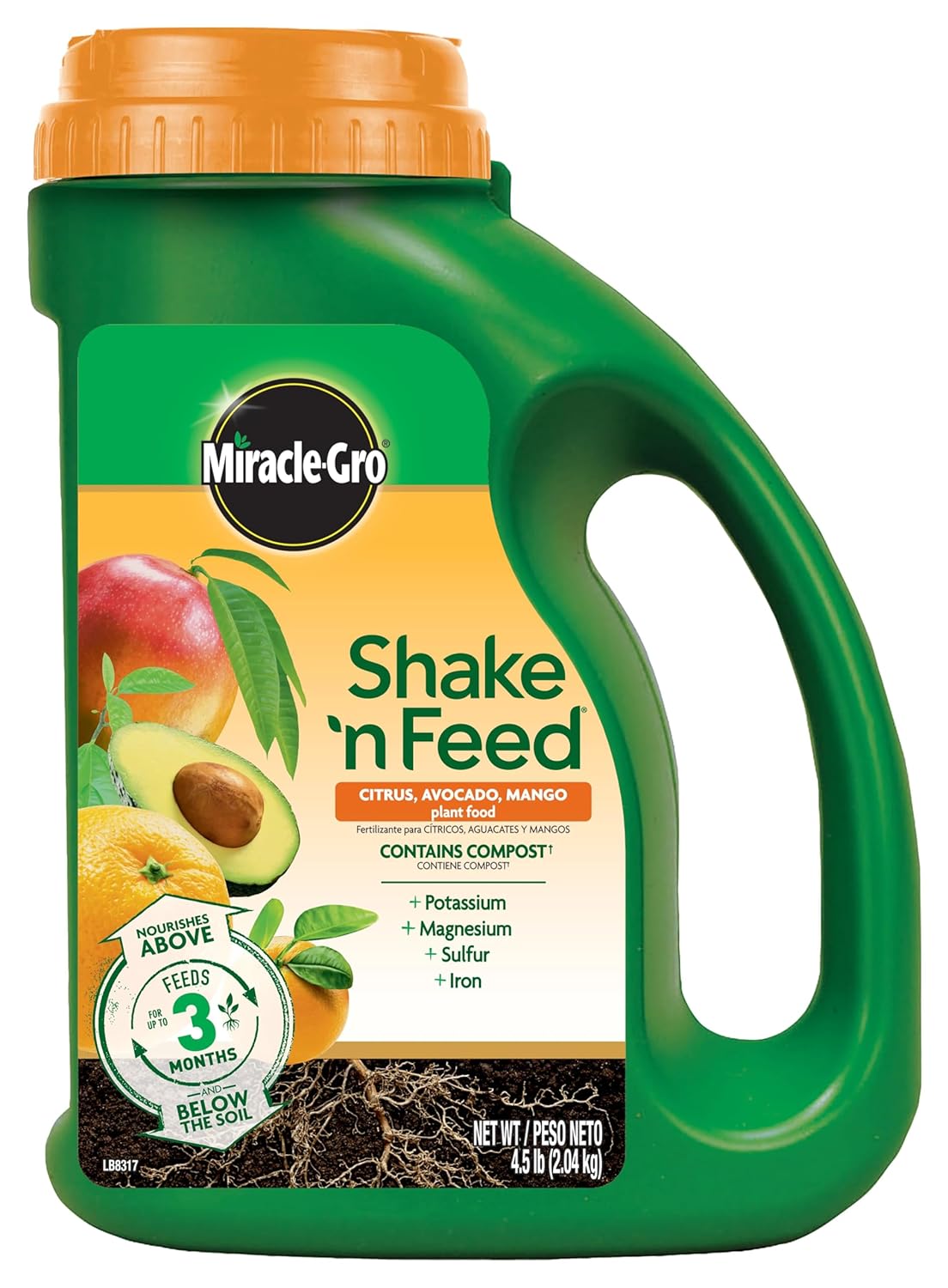
Miracle-Gro Shake 'N Feed Citrus, Avocado, Mango is a granular, slow-release plant food designed to feed citrus and similar fruit trees for up to three months with an 8-2-10 NPK profile. You apply it either at planting or by shaking it evenly onto the soil around established plants and lightly working it into the top inch or two of soil, then watering to activate the formula. The product includes micronutrients such as potassium, magnesium, sulfur, and iron and contains microbes to help break down compost and support root development, which can improve water efficiency and overall vigour. Its granular form and labeled coverage make it convenient for routine maintenance rather than daily feeding, and the three-month interval reduces how often you need to manage nutrition. The main limitations are the fixed NPK ratio, which may not suit plants needing different nutrient balances, and the need to follow label rates carefully to avoid overapplication near trunks and foliage. For gardeners wanting a straightforward, low-effort feeding schedule for citrus, avocado, or mango, this is a practical option.
Best for: Gardeners who want a low-maintenance, reliable feeding schedule for citrus, avocado, or mango in containers or beds and value simple, infrequent applications.
Less Ideal for: Growers who need a tailored nutrient program, fast-acting liquid feeds, or fertilizers formulated for different plant groups should consider other products.
- Slow-release formula feeds plants up to three months, reducing application frequency
- Contains micronutrients and microbes to support root health and correct common deficiencies
- Suitable for both container and in-ground use with straightforward shake-and-water application
- Granular form is easy to measure and apply across the root zone
- Fixed 8-2-10 NPK ratio may not be ideal for plants with different nutrient needs
- Requires careful application to avoid contact with trunk or foliage
Verdict: A convenient slow-release granular fertilizer that keeps citrus, avocado, and mango plants fed with minimal effort every three months.
Jobe's Organics Granular Fruit & Citrus Garden Fertilizer, 4 lb

| NPK | 3-5-5 |
|---|---|
| Form | Granules |
| Unit Count | 64 Ounce |
| Target Species | Fruit and citrus plants |
Jobe's Organics Granular Fruit & Citrus Fertilizer is a slow-release, granular formula designed to feed fruit and citrus trees and plants through the root zone. You apply measured handfuls around the base, water in, and repeat every 4 to 8 weeks during the growing season. The 3-5-5 NPK mix with calcium, magnesium, and sulfur comes from organic sources such as feather meal and bone meal, so it supports steady growth, flowering, and fruit development without synthetic chemicals. Practical benefits include easy application with little mess, OMRI listing for organic gardening, and a resealable bag that helps preserve granules between uses. Because it is granular and slower to release, it reduces the need for frequent feeding compared with soluble feeds, but results are gradual rather than immediate. The 4 lb bag is suitable for small gardens or a few trees, so larger plantings will require multiple bags or more frequent purchases.
Best for: Cost-conscious gardeners who grow a few fruit or citrus plants and prioritize organic feeding methods and simple, low-maintenance application.
Less Ideal for: Large-scale orchards or gardeners needing rapid correction of nutrient deficiencies should choose bulk or fast-acting fertilizers instead.
- OMRI listed for organic gardening and made from natural inputs
- Slow-release granules provide steady feeding to roots over several weeks
- Resealable bag reduces waste and keeps granules dry between uses
- Balanced 3-5-5 NPK with added calcium and micronutrients for fruit production
- 4 lb bag is small for larger orchards or multiple trees and will need frequent replacement
- Nutrient release is gradual so it will not correct acute deficiencies quickly
Verdict: A practical, OMRI-listed organic granular fertilizer that gives steady, low-maintenance feeding for a few fruit or citrus plants.
Gardenera Nutritional Plant Food Spray for Lime Trees, 8 oz

| Item Form | Liquid |
|---|---|
| Application Method | Spray |
| Coverage | Full |
| Target Species | trees |
| Unit Count | 8 Fluid Ounces |
The Gardenera Nutritional Plant Food Spray is a ready-to-use foliar feed designed for citrus and other fruit or ornamental trees. You apply it by shaking and spraying evenly over leaves and stems, typically once a week during the growing season, so nutrients are absorbed quickly through foliage. The formula lists micronutrients such as iron, zinc, manganese, magnesium, and sulfur that target common deficiencies causing yellowing or weak growth, which can translate to greener leaves and more vigorous branch development when used consistently. Its liquid spray format makes application fast and simple for potted or garden trees, and the 8 ounce bottle is convenient for small collections or spot treatments. Limitations are that the product description gives a single mixing ratio and general guidance but lacks detailed concentration numbers or safety timing around flowering, so users who need precise dosing for large-scale use or for sensitive bloom periods may want more specific instructions or to test on one tree first.
Best for: Gardeners who prioritize consistent, reliable correction of minor nutrient deficiencies in citrus and small fruit trees and want an easy weekly foliar treatment to maintain plant health.
Less Ideal for: Large-scale growers or those who require precise nutrient concentrations and tailored dosing schedules should consider concentrated fertilizers or lab-tested formulations instead.
- Targets micronutrient deficiencies with listed elements like iron and zinc
- Easy foliar spray application for direct leaf uptake
- Suitable for a wide range of citrus and tropical trees
- Convenient 8 fl oz size for small gardens or potted trees
- Label and listing do not give full concentration details or explicit flowering safety timing
Verdict: Use this easy foliar spray when you want a dependable weekly micronutrient boost to keep citrus and other trees visibly healthier.
Down To Earth Organic Citrus Mix Fertilizer, 6-3-3, 1 lb

| Item Form | Granules, Powder |
|---|---|
| Specific Uses For Product | Citrus tree care, fruit tree care, ornamental plant care |
| Coverage | Approximately 2,500 square feet per pound (based on a 50 lb bag covering 12,500 square feet) |
| Mixing Ratio | 6-3-3 |
Down To Earth Organic Citrus Mix is a small-package granular fertilizer designed to feed citrus trees and other fruiting or ornamental plants. It provides a 6-3-3 ratio of nitrogen, phosphorus, and potassium together with calcium, sulfur, iron, and zinc from natural sources such as feather meal, fish bone meal, alfalfa meal, kelp, and mineral supplements. Use it by broadcasting around the drip line, mixing into soil at planting, or working into potting mixes; the brand recommends three to four applications a year timed to late winter, late spring, and early fall. The product is OMRI-listed so it fits organic gardening systems, and the 1 lb mini box is convenient for containers, small trees, or trialing before buying larger sizes. Because it is a slow-release, natural blend, results are gradual rather than immediate and repeated seasonal applications are needed for sustained fertility. For larger landscapes a bigger bag will be more economical but this size keeps storage simple and limits waste for hobby growers testing an organic feeding program.
Best for: Gardeners who prioritize organic, certified inputs and want a small, low-commitment product to feed citrus in containers, patio trees, or small yards.
Less Ideal for: Large-scale growers or anyone needing fast, soluble nutrient boosts should choose larger bulk fertilizers or a water-soluble formula instead.
- OMRI-listed organic formula suitable for certified organic gardens
- Broad nutrient mix with micronutrients to support foliage, flowering, and fruit
- Convenient 1 lb mini box for containers, small trees, and trial applications
- Made from varied natural sources that release nutrients gradually
- Small 1 lb size is not cost-effective for large properties
- Slow-release natural nutrients produce gradual results rather than immediate greening
Verdict: A certified organic, micronutrient-rich 6-3-3 granular fertilizer in a handy 1 lb package ideal for organic gardeners trialing or feeding citrus in small spaces.
TPS Nutrients Lemon Tree Fertilizer, Liquid Plant Food, 8 fl oz

| Item Form | Liquid |
|---|---|
| Application Method | Watering can, hose end sprayer, or leaf misting |
| Target Species | Lemon Trees |
| Mixing Ratio | 1:200 |
TPS Nutrients Lemon Tree Fertilizer is a concentrated liquid plant food designed specifically for lemon and citrus trees and intended for use in both ground and container settings. It mixes at a 1:200 ratio and can be applied via watering can, hose-end sprayer, or as a foliar mist, which makes it easy to fit into routine watering or fertigation. The formula is promoted to build stronger roots, support new shoots and stems, and encourage fruit development, so you can expect steadier growth and potentially better yields when used according to directions. The 8-ounce bottle is compact and quick to store, and the liquid form allows for fast absorption compared with granular feeds. Limitations are the small container size for larger plantings and the need to follow dilution instructions precisely to avoid overfeeding; it is not a complete season-long supply for multiple trees. For cautious gardeners who prefer targeted, citrus-specific nutrition, this product offers a straightforward option that integrates easily into regular care.
Best for: Home gardeners who want a citrus-specific, easy-to-apply fertilizer and prefer cautious, measured feeding routines for single trees or a few container plants.
Less Ideal for: Large-scale orchards or gardeners seeking a bulk, season-long supply should consider larger-volume fertilizers or granular programs better suited to high-acreage needs.
- Formulated specifically for lemon and citrus to support fruiting and vegetative growth
- Multiple application methods: watering can, hose-end sprayer, or foliar mist
- Liquid concentrate mixes at 1:200 for quick absorption and precise dosing
- Suitable for both in-ground and container lemon trees
- Small 8 fl oz bottle may require frequent repurchasing for multiple trees or larger citrus plantings
- Requires careful dilution to prevent over-application
Verdict: A convenient, citrus-focused liquid fertilizer that gives cautious home gardeners an easy, targeted way to support healthier lemon trees and better fruit set.
Choosing the Right Fertilizer for Lime Tree: Key Factors to Consider
Nutrient Ratio and Timing
Lime trees need a steady supply of nitrogen during active growth to support leaf production and fruit development. The right N-P-K balance is critical: too much phosphorus can inhibit uptake of other nutrients, while insufficient nitrogen limits canopy growth and reduces yield. Look for fertilizers that specify both the N-P-K ratio and the timing recommendations for spring flushes, summer growth, and pre-winter maintenance.
Timing matters as much as ratio. Quick-release feeds help correct visible deficiencies fast, but heavy applications during peak heat can stress roots. Slow-release or timed-release options supply nutrients over weeks or months, reducing the risk of burn and smoothing out growth. For container-grown limes, shorter intervals with lighter doses are usually safer than a single large application.
Micronutrients and Trace Elements
Citrus species, including lime trees, commonly show deficiencies in iron, magnesium, zinc, and manganese, which affect leaf color and fruit set. A fertilizer formulated for citrus typically includes these trace elements in chelated or plant-available forms to correct chlorosis and support enzymatic processes that shape flavor and sugar development.
Because micronutrient needs are small but critical, opt for fertilizers that list micrograms or milligrams per kilogram of each trace element rather than vague 'contains micronutrients' claims. Foliar sprays can temporarily correct deficiencies, but a granular or soluble fertilizer with built-in trace elements helps maintain steady availability in the root zone.
Release Mechanism and Longevity
Fertilizer formulations vary from fast-acting soluble powders to coated slow-release granules and organic amendments that release nutrients as they break down. Fast-acting soluble feeds are useful for quick corrective treatments or stimulating flowering, but they require more frequent application and careful dosing. Slow-release granules and polymer-coated pellets reduce labor and moderate nutrient availability, lowering the chance of root burn when applied correctly.
Consider how often you want to feed and whether you prefer seasonal top-ups or a multi-month product. In containers, nutrients leach faster with frequent watering, so slow-release or a combination of base slow-release with occasional soluble feeds often works best.
Soil pH and Compatibility
Lime trees prefer slightly acidic to neutral soils where micronutrients are most available. The fertilizer you choose should not drastically alter soil pH or should include elements that remain available across a range of common garden soils. Some citrus fertilizers include sulfur or acidifying components to help with alkaline soils, while others are neutral.
If your soil test shows high pH, prioritize formulations that help maintain iron and zinc availability or plan to correct pH separately. For container growers using potting mixes, ensure the fertilizer is labeled safe for peat or coir-based media and will not cause nutrient lockup under repeated feedings.
Application Method and Ease
Different gardeners prefer different application routines. Water-soluble fertilizers dissolve quickly and are applied with a watering can or hose-end applicator, giving fast results. Granular fertilizers are broadcast or banded around the root zone and are low-effort when feeding several trees. Pelletized slow-release options can be sprinkled and left to work for months.
Choose a fertilizer with clear dosing instructions, especially for young versus mature trees. For container-grown limes, look for guidance on per-pot doses; for in-ground trees, products that recommend amounts by trunk diameter or canopy size reduce guesswork. Ease of measuring and mixing reduces the chance of over-application.
Environmental and Safety Considerations
Runoff and over-application can harm nearby plants and waterways, so fertilizers with targeted release profiles or reduced leaching tendencies are preferable near sensitive areas. Organic or mineral-bound formulations may present a gentler nutrient release and lower runoff risk, though they can require more frequent applications to maintain supply.
Also consider pet and child safety if the tree is in a heavily used yard. Look for clear labeling on reentry intervals, storage guidance, and whether the product leaves crystalline residues that could irritate skin or paws. Responsible application and correct dosing minimize environmental impact and keep the garden safe.
Feeding Schedule for Young Versus Established Trees
Young lime trees have smaller root systems and need lighter, more frequent feeds to avoid burn and encourage steady root growth. Apply a diluted soluble fertilizer or follow gentle, short-interval instructions on a balanced product to support the first few seasons of establishment.
Established trees tolerate larger, less frequent applications. Many gardeners apply a main feeding in early spring as buds form, then a midseason feed to support fruit development, and a light fall treatment to help reserves. Adjust timing for local climate and frost dates.
- Containers: feed every 4-6 weeks with dilute soluble fertilizer
- New in-ground trees: smaller doses every 6-8 weeks
- Mature trees: main spring feed, optional summer top-up, light fall maintenance
Correcting Common Deficiencies
Yellowing between leaf veins often indicates iron or magnesium deficiency in lime trees. A fertilizer with chelated iron or magnesium sulfate applications can correct these visibly and improve photosynthesis.
Slow leaf yellowing and poor fruit set can signal a broader micronutrient shortfall. In that case, use a fertilizer that lists the trace elements and consider a targeted foliar feed for quick correction before the next fruiting cycle.
- Interveinal chlorosis: check iron and manganese availability
- Pale overall leaves: consider nitrogen and magnesium levels
- Poor flowering: evaluate phosphorus and boron availability
Best Practices for Containers and Small Spaces
Containers lose nutrients faster due to frequent watering and limited soil volume. Use a fertilizer strategy that combines a small amount of slow-release material at potting time with routine soluble feeds. This gives a base level of nutrients while allowing quick adjustments during active growth or fruiting.
Ensure good drainage and repot when rootbound, because compacted roots cannot access fertilizer efficiently. Place fertilizer pellets or granules around the outer root zone and water in to move nutrients to active roots.
- Mix slow-release granules into potting mix at repotting
- Use liquid feeds midseason for flowering and fruit development
- Repot every 2-4 years or when roots fill the container
Organic Versus Synthetic Options
Organic fertilizers release nutrients through microbial activity, which benefits soil structure and long-term fertility. They are gentler and reduce the risk of overfeeding, but they may release nutrients more slowly and inconsistently depending on temperature and moisture.
Synthetic fertilizers offer predictable nutrient availability and clear N-P-K numbers, which helps correct deficiencies quickly. Many gardeners use a hybrid approach: organic amendments to build soil health and targeted synthetic feeds for specific corrections or during heavy fruiting.
- Organic: builds soil, lower burn risk, slower release
- Synthetic: predictable dosing, rapid correction, consistent N-P-K
- Hybrid approach balances soil health with targeted nutrient supply
Measuring Success and Adjusting Feedings
Track leaf color, canopy density, and fruit set as practical indicators of whether your fertilizer choice is working. A soil test every 2 to 3 years is the best way to measure nutrient levels and pH so you can fine-tune feeding plans.
If you see persistent deficiency signs after following label directions, reduce frequency or dose and re-evaluate. Overfertilizing can mimic deficiency symptoms and stress roots, so gradual adjustments are safer than large one-time changes.
- Use chopstick or soil probe to check root zone moisture before feeding
- Keep a simple garden log of feed dates and visible responses
- Adjust program seasonally based on growth and local climate
How We Chose the Best Fertilizer for Lime Tree
We focused on characteristics that matter in real garden use for lime trees rather than marketing claims. Selection prioritized nutrient formulations tailored to citrus needs, especially nitrogen levels and available micronutrients like magnesium, iron, and zinc. We considered release mechanism and feeding schedule because growers balance fast corrective feeds with convenience and root safety. Soil and container compatibility were checked so the picks work in typical potting mixes and garden soils. Ease of application and measurable dosing instructions were included to make routine fertilizing practical for busy gardeners. We excluded granular products or blends lacking clear nutrient labeling and any formulations intended only for ornamental plants without citrus-specific nutrient support. We also filtered out products that rely solely on very high nitrogen without micronutrients or those that require unusual application equipment. The final list emphasizes balanced nutrient ratios, clear directions, appropriate release profile, and adaptability to common lime-growing situations such as containers, raised beds, and in-ground yards.
FAQ
How often should I fertilize a lime tree?
It depends on age and container versus in-ground planting. Young trees usually need lighter, more frequent feedings every 6 to 8 weeks. Mature in-ground trees often benefit from a main spring application and a light midseason top-up. Containers typically need feeding every 4 to 6 weeks because nutrients leach faster.
What N-P-K ratio is best for lime trees?
Lime trees generally do well with a balanced fertilizer that is slightly higher in nitrogen relative to phosphorus and potassium, especially during vegetative growth. Look for formulations labeled for citrus or one with a moderate N value and included micronutrients. Adjust based on leaf symptoms and soil test results.
Can I use organic fertilizers on lime trees?
Yes. Organic fertilizers improve soil structure and provide a gentler, slower nutrient release. They can be very effective long term but may not correct severe deficiencies quickly. Many gardeners combine organic amendments with occasional soluble feeds for targeted corrections.
How do I fix iron chlorosis in lime trees?
Iron chlorosis shows as yellowing between leaf veins. Use a fertilizer that contains chelated iron or apply a foliar iron treatment for quicker correction. Also check soil pH, because high pH reduces iron availability and may require pH adjustment or ongoing chelated iron applications.
Should I feed more during fruiting?
A midseason feeding can support fruit development, but avoid heavy late-season nitrogen that promotes vegetative growth over fruit maturity. Use lighter, balanced feeds during fruiting and make most of the nitrogen applications earlier in the active growth period.
Final Verdict
Choosing the right fertilizer for lime tree comes down to matching nutrient balance, release profile, and application routine to your planting situation. Prioritize products that supply nitrogen with key micronutrients like iron and magnesium, and pick a release type that fits container or in-ground needs. Adjust feeding by tree age, observe leaf and fruit responses, and use soil tests to refine your plan. With a clear feeding schedule and attention to micronutrients, you can support healthy growth and reliable fruiting.
