

Note: This article contains affiliate links. If you click on these links and make a purchase, I may earn a small commission at no extra cost to you. This helps support my research and content. Read my full affiliate disclosure here.
Picking the right slow release fertilizer for perennials changes how your garden performs across the season. Perennial plants need steady, predictable nutrients to build roots, sustain foliage, and produce repeat blooms without the stress of leaching or sudden growth spurts. This guide shortlists the top slow release fertilizer options for perennials and explains why each made the cut based on nutrient profile, duration of release, and application ease. You will find practical evaluation criteria that matter in a working garden and clear explanations of tradeoffs so you can choose the feeding schedule and nutrient balance that suits your beds, borders, or containers. Read on for an overview of what to expect from slow release feeding and how the recommended picks align with common perennial needs.
Top Picks at a Glance
| Best Overall The best all-around choice for most situations | Osmocote Smart-Release Plant Food Flower & Vegetable, 1 lb. |  |
| Best Quality Built to a higher standard if you want something more solid | Proven Winners Premium Continuous Release Fertilizer, 2.5 lb |  |
| Best Value The sweet spot between price and what you get | Osmocote 4 Month Slow Release Plant Food for Vegetables & Flowers, 2 lb (pack of 2) |  |
| Best Budget The cheapest option that still gets the job done reliably | RAINFLOW Slow-Release 17-17-17 Granular Fertilizer, 11.28 oz |  |
| Highest Rated A top-rated pick with lots of positive feedback | Osmocote Smart-Release Plus Plant Food 15-9-12, 8 lb (2 Pack) |  |
| Most Popular A crowd favorite that many people choose with confidence | Scotts All Purpose Flower & Vegetable Continuous Release Plant Food, 3 lb |  |
| Best Seller A high-volume bestseller chosen again and again | Milorganite 6-4-0 Slow-Release Fertilizer, 32 lb (with Feeding Tips Brochure) |  |
Osmocote Smart-Release Plant Food Flower & Vegetable, 1 lb.

| Item Form | Granules |
|---|---|
| Specific Uses For Product | Root Development |
| Application Method | Mix into soil |
| Target Species | vegetables and perennials |
| Unit Count | 16 Ounce |
Osmocote Smart-Release Flower & Vegetable is a granular, slow-release fertilizer with a balanced 14-14-14 NPK designed to support both root development and vigorous top growth. Typical use is mixing the granules into the top 1–3 inches of soil or incorporating into raised-bed mix before planting; one pound covers about 40 sq ft and feeds for up to four months based on soil temperature. The included applicator and mistake-proof slow-release formulation make it easy to apply without frequent refeeding, and the product is intended for edible gardens, perennials, and ornamentals. For rhubarb specifically, the balanced nutrients support leafy growth and steady root development without sharp spikes of soluble fertilizer. Limitations are that this is a general-purpose, season-long feed rather than a rhubarb-specific formula and nutrient release depends on soil temperature, so uptake can be slower in cool conditions early in the season.
Best for: Gardeners who want a low-maintenance, season-long feed for vegetable beds and perennials and prefer a straightforward, mistake-resistant product that reduces repeat applications.
Less Ideal for: Growers seeking a specialty fertilizer formulated specifically for rhubarb or those who need quick-release nutrient boosts during cool weather should consider alternative products.
- Balanced 14-14-14 NPK supports both roots and leafy growth
- Slow-release formula feeds up to four months, reducing reapplications
- Granular form and included applicator make soil mixing straightforward
- Mistake-proof release that is unlikely to burn plants if slightly overapplied
- Release rate is temperature dependent and may be slow in cool soils
- Not tailored specifically to rhubarb or high-potassium needs that some growers prefer
Verdict: A simple, low-maintenance slow-release fertilizer that supplies balanced nutrients for a full season, ideal for gardeners wanting steady growth without frequent feeding.
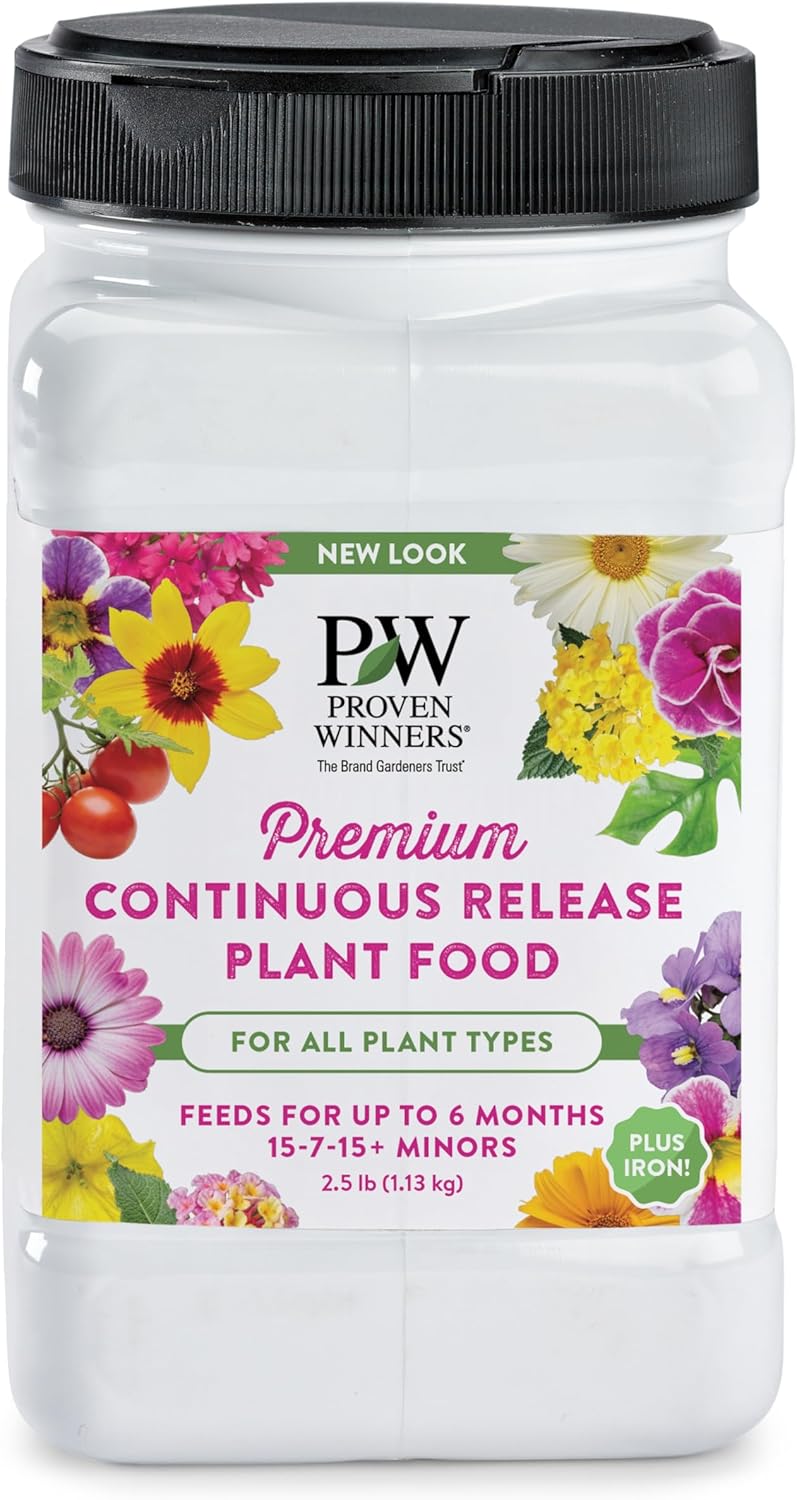
Proven Winners Premium Continuous Release Fertilizer, 2.5 lb
| Item Form | Granules |
|---|---|
| Mixing Ratio | 15-7-15 |
| Specific Uses For Product | Containers, Flowering Plants, Landscapes, Plant Growth |
| Application Method | Shake into soil |
This Proven Winners continuous release fertilizer is a granular 15-7-15 blend designed for easy use in containers, hanging baskets and landscape beds. You apply it by shaking the pellets into the soil at planting or sprinkling around established plants and then watering in; the temperature-sensitive coating times nutrient release so plants get more feed during peak growth. For perennial gardeners it delivers a steady supply of NPK plus iron and micronutrients without frequent feeding, which is convenient for seasonal spring application. The 2.5 lb shaker container is practical for several containers or small beds, and the medium coverage fits typical perennial borders. Limitations to expect are the fixed N-P-K ratio and set six-month release period, which means adjusting for specific nutrient needs or off-season feeding requires a different product. Also it is a dry granular format, so it is not suitable when a liquid or foliar feed is preferred.
Best for: Gardeners who prioritize steady, reliable seasonal performance and want to minimize repeat feedings for perennials and container plantings. Good for people who prefer a simple spring application and predictable, timed nutrient delivery.
Less Ideal for: Growers who need adjustable or high-phosphorus formulations for specific perennial problems or those managing large beds who require bulk fertilizer coverage.
- Temperature-sensitive coating times nutrient release to match peak growth periods
- Feeds plants for up to six months with a single application
- Includes multiple sources of N, P, K plus iron and micronutrients for balanced flowering and growth
- Shaker-top granular format is easy to apply to containers, hanging baskets and beds
- Fixed 15-7-15 ratio may not suit plants with different specific nutrient requirements
- 2.5 lb container covers medium area only and may be small for large perennial beds
- Granular only format is not ideal for gardeners who prefer liquid or foliar feeding
Verdict: Choose this product if you want a low-maintenance, single-application slow‑release fertilizer that supplies balanced nutrients to perennials and containers for an entire growing season.
Osmocote 4 Month Slow Release Plant Food for Vegetables & Flowers, 2 lb (pack of 2)

| Item Form | Granules |
|---|---|
| Target Species | Vegetables, Flowers |
| Mixing Ratio | 14:14:14 |
| Number of Packs | 2 |
| Unit Count | 64 Ounce |
This Osmocote product is a slow-release granular fertilizer designed to provide steady, balanced nutrition to vegetables and flowering plants for up to four months from a single application. Users sprinkle the granules around the root zone, water them in, and the encapsulated nutrients gradually become available, which reduces the need for frequent refeeding. The 14-14-14 NPK ratio supports both top growth and root development, making it suitable for annuals, perennials, and most edible garden crops. The package includes two 2 lb canisters so you can treat multiple beds or keep a spare container for follow-up plantings. Practical benefits include predictable, low-maintenance feeding and ease of application for gardeners who want consistent results without monthly dosing. Important limitations are that the product supplies a general-purpose, balanced feed rather than a target formula for specific needs like high-phosphorus bloom boosters or high-nitrogen leafy crops, and slow-release timing can vary with soil temperature and moisture so results may be slower in cool or very dry conditions.
Best for: Gardeners who prioritize predictable, low-maintenance feeding for mixed vegetable and flower beds and want consistent growth without frequent applications.
Less Ideal for: Growers seeking specialized fertilization programs for specific crops, aggressive bloom stimulation, or rapid correction of nutrient deficiencies should consider targeted fertilizers instead.
- Slow-release encapsulation provides up to four months of continuous feeding
- Balanced 14-14-14 NPK supports both foliage and root development
- Granular form is easy to apply around established plants and beds
- Two 2 lb canisters give enough product for multiple beds or follow-up plantings
- Not formulated for crop- or bloom-specific feeding needs such as high-phosphorus or high-nitrogen schedules
Verdict: Buy this if you want a reliable, set-and-forget balanced fertilizer that feeds vegetables and flowers for up to four months.
RAINFLOW Slow-Release 17-17-17 Granular Fertilizer, 11.28 oz

| Item Form | Granules |
|---|---|
| Mixing Ratio | 17:17:17 |
| Unit Count | 11.28 Ounce |
| Application Method | Spread and mix into the soil |
| Coverage | general-purpose, suitable for various plants and gardens |
This RAINFLOW granular fertilizer supplies a balanced 17-17-17 NPK blend in a slow-release form designed to feed plants for about 60 days. You apply it by spreading or lightly mixing the granules into potting soil or garden beds and watering as usual; the product gives straightforward, timed nutrition without frequent reapplication. Notable features include the even NPK ratio that supports foliage, roots, and blooms and clear dosing guidance for different pot sizes. For cannas, which benefit from steady nitrogen and potassium for vigorous foliage and flowering, this product can support healthy growth when used at the recommended rates. Practical benefits are convenience and reduced application frequency, making it suitable for busy gardeners on a budget. Important limitations are the small pack size—11.28 ounces limits coverage for larger beds—and the fixed 17-17-17 ratio that does not allow tailoring to soil tests that show specific nutrient deficiencies. Follow recommended rates to avoid overfeeding, especially in pots and newly established outdoor plantings.
Best for: Gardeners seeking an inexpensive, low-effort fertilizer to provide steady, general nutrition to cannas in pots or small garden plots and who prefer fewer feedings.
Less Ideal for: Large-scale plantings, intensive vegetable beds, or gardeners working from a soil test who need custom NPK ratios should choose a larger or specialist fertilizer.
- Balanced 17-17-17 NPK supports foliage, roots, and blooms
- Slow-release formula feeds up to about 60 days, reducing application frequency
- Granular form is easy to spread and mix into potting soil
- Clear dosing recommendations for different pot sizes
- Small 11.28 oz package gives limited coverage for garden beds or multiple rhizomes
- Single NPK ratio cannot be adjusted to specific soil nutrient needs
Verdict: A budget-friendly, easy-to-use slow-release 17-17-17 granular fertilizer that provides convenient, steady nutrition ideal for keeping cannas healthy with minimal reapplication.
Osmocote Smart-Release Plus Plant Food 15-9-12, 8 lb (2 Pack)

| Item Form | Granules |
|---|---|
| Specific Uses For Product | Plant Growth |
| Target Species | plants |
| Ingredients | 15-9-12 |
This Osmocote Smart-Release Plus plant food is a resin-coated granular fertilizer designed to deliver steady nutrition for up to six months from a single application. You spread the granules on beds, containers, or around perennials and work them into the soil or topdress according to label rates. The 15-9-12 NPK blend is fortified with secondary nutrients and is intended for use on flowers, vegetables, shrubs, trees and houseplants, so it fits mixed perennial borders as well as container plantings. The controlled-release coating paces nutrient delivery with plant demand, reducing the need for frequent feeding and lowering the chance of nutrient burn when used correctly. Practical benefits include broad applicability, long coverage from each application and a value pack that supplies about 600 sq ft. Limitations are typical for slow-release fertilizers: it cannot correct an immediate deficiency quickly and application rates must be followed for best results in soils with very different nutrient levels or pH.
Best for: Gardeners who prioritize a dependable, low-maintenance feeding schedule for perennial beds and mixed borders and who want a single application that reduces seasonal feeding chores.
Less Ideal for: Growers needing quick corrective fertilization or who manage small plots that require highly tailored, frequent nutrient adjustments.
- Resin-coated granules release nutrients gradually for up to six months
- Balanced 15-9-12 NPK formula with added secondary nutrients suitable for many perennial types
- Works indoors and outdoors across containers, beds, and landscape plantings
- Two 8 lb bags provide extended coverage for roughly 600 sq ft when applied per label
- Not designed to correct acute nutrient deficiencies or provide an immediate green-up
Verdict: A reliable slow-release fertilizer that supplies balanced, long-lasting nutrition to perennials with minimal repeat applications.
Scotts All Purpose Flower & Vegetable Continuous Release Plant Food, 3 lb

| Item Form | Granules |
|---|---|
| Application Method | Sprinkle on soil and rake into top 1-3 inches |
| Target Species | All Purpose Flower & Vegetable Continuous Release Plant Food |
| Unit Count | 48 Ounce |
Scotts All Purpose Flower & Vegetable Continuous Release Plant Food is a simple granular fertilizer intended for in-ground flower and vegetable gardens. You apply it by sprinkling the granules around plants, raking them into the top 1 to 3 inches of soil, and watering to start nutrient release. Formulated to feed for up to two months, it supplies steady nitrogen to support root growth and foliage and is recommended for common garden crops including peppers. The bag covers roughly 150 sq. ft., so a single 3 lb package is convenient for small beds or a few pepper plants. Key practical benefits are ease of use, predictable feeding intervals, and reduced need for frequent applications during the growing season. Limitations are that it is an all-purpose formula rather than a pepper-specific mix and its N-P-K profile is not listed on the label data here, so you may want to monitor fruiting and supplement with a bloom-boost fertilizer if you need higher phosphorus for heavy fruit set. Follow label rates to avoid overapplication near crowns.
Best for: Gardeners who want an inexpensive, low-effort fertilizer to maintain steady growth for a few jalapeno plants or a small vegetable bed without frequent feeding.
Less Ideal for: Growers who manage large vegetable plots or who need a nutrient program tailored specifically to maximize pepper fruit set and yield.
- Continuous-release granules feed plants for up to two months, reducing application frequency
- Easy application: sprinkle, rake into topsoil, and water
- Suitable for a wide range of garden plants including vegetables and peppers
- 3 lb bag covers about 150 sq. ft., practical for small gardens or container groups
- All-purpose formula may not provide the specific N-P-K balance jalapenos need for maximum fruiting
- Small bag size means frequent repurchases for larger gardens
Verdict: A budget-friendly, easy-to-use continuous-release fertilizer that keeps jalapeno plants fed for up to two months with minimal fuss.
Milorganite 6-4-0 Slow-Release Fertilizer, 32 lb (with Feeding Tips Brochure)

| Item Form | Pelletized |
|---|---|
| Application Method | Broadcast, Rotary or Manual |
| Coverage | 2,500 Square Feet |
| Specific Uses For Product | Lawns, Flowers and Gardens, Education |
Milorganite 6-4-0 is an organic, pelletized slow-release fertilizer intended for routine lawn and garden feeding. It is typically broadcast with a rotary or manual spreader and provides nitrogen slowly over 8 to 10 weeks, which reduces the need for frequent applications and lowers burn risk. The product contains organically complex iron for greening without the strong staining associated with iron salts and is low in soluble salts, so it performs well in warm or drier conditions. The 32 lb bag covers roughly 2,500 square feet and comes with a printed feeding and spreader tips brochure to simplify seasonal timing and application rates. Because it is made from heat-dried microbes, it also adds organic matter to improve soil structure in heavy clay or sandy soils. Limitations are that nutrient release is gradual so it is not suited to quick color fixes or rapid turf recovery, and users seeking tightly controlled N-P-K ratios or fast-acting synthetic performance may prefer a different product.
Best for: Buyers who want a low-maintenance, environmentally minded fertilizer that steadily feeds established lawns and mixed garden beds with minimal risk of burn and fewer repeat applications.
Less Ideal for: If you need rapid turf recovery, immediate color correction, or precise synthetic nutrient control for athletic fields or newly sodded lawns, choose a fast-release or specialty fertilizer instead.
- Slow-release nitrogen feeds lawns and plants for 8–10 weeks, reducing application frequency
- Low-salt formulation minimizes fertilizer burn and streaking in hot or dry conditions
- Organically complex iron promotes deep greening without heavy staining of concrete
- Pelletized form works with broadcast, rotary, or manual spreaders for easy application
- Adds organic matter that can improve drainage and soil structure in clay or sandy soils
- Not fast-acting, so it will not deliver an immediate green-up after application
- Contains biosolids which some buyers may prefer to avoid for personal or local reasons
Verdict: Pick this if you want a reliable, low-salt slow-release fertilizer that feeds lawns and gardens for weeks with minimal maintenance.
Choosing the Right Slow Release Fertilizer for Perennials: Key Factors to Consider
Nutrient Ratio and Suitability for Flowering
The balance of nitrogen, phosphorus, and potassium affects whether perennials focus on leaf growth, root development, or blooms. A fertilizer with a moderate nitrogen level and slightly higher phosphorus can support flowering without excessive leafy growth. Look at the guaranteed analysis to match fertilizer ratios to the stage of growth and the type of perennials you grow.
Overapplying an N-heavy formulation can produce lush foliage at the expense of blooms, while too little phosphorus may reduce flowering and root strength. Consider whether your soil test suggests deficiencies before choosing a product; slow release formulas are intended to top up a healthy soil profile rather than correct major nutrient imbalances.
Release Mechanism and Longevity
Slow release products use different mechanisms such as coated granules, polymer coatings, or organic matrices that break down over time. The release mechanism determines how temperature, moisture, and microbial activity influence nutrient availability. For perennials, steady delivery over several weeks to months reduces the need for repeated feeding and lowers the chance of flush growth.
Choose a release duration that matches your maintenance schedule and climate. In cooler climates, some coatings release more slowly, so a product rated for the appropriate number of weeks under your typical soil temperatures will provide the best results.
Application Method and Labor
Ease of application matters for beds, borders, and containers. Granular products that broadcast evenly are convenient for large flower beds, while spike or tablet formats may suit containers or isolated plants. Consider whether you need to work the product into the soil, apply it on the surface, or mix it into potting media.
Products that require minimal reapplication will save time, but ensure they allow for targeted placement near root zones. Also check whether the product is safe to apply around tender shoots or young plants without causing burn.
Compatibility With Soil Types and Plantings
Soil texture and organic matter influence how nutrients move and persist. Sandy soils may benefit from slow release formulas that reduce leaching, while clay soils may already hold nutrients but need careful timing to avoid waterlogging. If you grow mixed borders with shrubs and bulbs alongside perennials, choose a formulation that is broadly compatible rather than highly specialized for turf or vegetables.
Also consider whether you use containers, raised beds, or in-ground plantings. Containers dry and heat up faster, accelerating release; choose a product suited for container-grown perennials if that is a primary use.
Environmental Safety and Runoff Risk
Slow release fertilizers reduce the immediate availability of soluble nutrients and therefore lower the risk of runoff into waterways when used correctly. However, some formulations still pose a higher environmental loss risk if overapplied or if applied before heavy rain. Evaluate how a product minimizes soluble nutrient spikes and whether it includes measures to limit volatilization or leaching.
Good application practice, including following recommended rates and avoiding application before heavy irrigation or storms, is essential to protect nearby water bodies and beneficial soil life.
When Slow Release Feeding Makes Sense for Perennials
Slow release feeding is ideal when you want consistent, low-maintenance nutrient delivery across the growing season. For established perennials that benefit from steady root building and repeat blooms, a slow release approach reduces the need for frequent spot feeding and lowers fluctuation in vegetative growth.
Use slow release fertilizers for mixed beds, naturalized planting areas, and containers where unpredictable rains or watering schedules might otherwise cause nutrient swings. They are less useful when you need to correct a specific deficiency quickly; in those cases a targeted soluble feed combined with soil amendment is better.
- Good for established plants and low-maintenance beds
- Reduces peak nutrient availability after heavy watering
- Not a quick fix for acute nutrient deficiencies
Applying Slow Release Fertilizer to Different Planting Types
Application technique varies with planting type. For in-ground borders spread granules evenly over the root zone and gently rake or water them in. For newly planted perennials, follow label guidance on timing so young roots are not overwhelmed.
In containers use a measured amount mixed into potting media or applied as a surface topdressing, remembering that warmer, drier potting mixes accelerate release and may require smaller doses.
- Broadcast granules for beds, targeted placement for individual plants
- Reduce rates in containers and hot, dry locations
- Avoid placing granules directly against stems or crown tissue
Timing and Seasonal Strategies
Match release duration to your growing season. Early spring applications support spring flush and root growth. For long-blooming perennials, choose formulas that cover the active growth window so you do not need repeat applications midseason. Late-season feeding should be conservative to avoid stimulating tender late growth before winter dormancy.
Split applications can be useful when a single product does not cover your full season or when planting schedules vary across beds. Monitor plant response and adjust the timing in subsequent seasons based on observed vigor and flowering.
- Apply in early spring for spring growth and again only if needed for extended bloom
- Avoid heavy late-season feeding
- Adjust timing for climate and microclimates in your garden
Combining Slow Release With Organic Soil Building
Slow release fertilizers work well alongside organic practices. Adding compost and mulch improves soil structure and microbial activity, which can moderate nutrient release and retention. Organic matter also helps perennials access micronutrients that slow release macronutrient formulas may not supply.
If you follow an organic program, select slow release formulations that align with your certification or practice. Mixing organic amendments with a synthetic-coated product can still be effective, but be mindful of differing release behaviors.
- Compost increases nutrient retention and supports steady availability
- Mulch moderates soil temperature, influencing release rate
- Match product type to your organic gardening preferences
Common Mistakes to Avoid
Overapplication is the most frequent error and can lead to weak, floppy growth or unnecessary nutrient runoff. Follow label rates and adjust based on soil test results rather than applying more than recommended. Another mistake is using a formulation intended for lawns or high-nitrogen needs on flowering perennials.
Applying right before heavy rain or watering can reduce effectiveness. Also avoid placing granules against crowns or stems, which can cause burn or local nutrient concentration.
- Do not overapply; follow label and soil test guidance
- Avoid application immediately before heavy rain
- Do not place granules against plant crowns or stems
How We Chose the Best Slow Release Fertilizer for Perennials
We focused on real-world gardener priorities for perennials and applied concrete filters to build the shortlist. Key evaluation dimensions included nutrient ratio predictability, measured release longevity under typical soil temperatures, and the suitability of the formulation for common perennial types and planting situations. We also assessed ease of application, including spreadability for beds and safety for mixed borders or containers, plus compatibility with common soil types and organic gardening practices. Products were excluded if their release claims were vague, if they were formulated primarily for lawns or trees rather than perennials, or if they required complex pretreatment or specialized equipment to apply. We avoided items with insufficient labeling about nutrient sources or release mechanisms. The final picks balance steady-season nutrient availability, low maintenance feeding frequency, and practical application details gardeners can use without extra tools.
FAQ
How often should I apply slow release fertilizer to perennials?
It depends on the product's rated release duration and your climate. Many slow release formulas cover an entire season with a single application, while others require reapplication every 8 to 12 weeks. Check the product's release timing and adjust for warmer sites where release can be faster.
Can I use slow release fertilizer in containers with perennials?
Yes, but reduce the rate compared with in-ground beds because containers heat and dry out faster, which accelerates nutrient release. Measure carefully and monitor plant response, adjusting in subsequent seasons as needed.
Will slow release fertilizer prevent nutrient leaching in sandy soils?
Slow release formulations reduce the immediate soluble nutrient load and can lower leaching risk, but they do not eliminate it. Choose a product formulated to minimize loss in sandy conditions and combine feeding with organic matter to improve retention.
Are slow release fertilizers safe for newly planted perennials?
Many slow release products are safe for new transplants when applied at recommended rates, but avoid placing granules in direct contact with roots or stems. For very young seedlings, use caution and consider lower rates until the root system establishes.
Can slow release fertilizer replace compost and soil amendments?
No. Slow release fertilizer supplies macronutrients but does not replace the structure, microbial life, and micronutrient diversity provided by compost and organic amendments. Use fertilizers to complement soil building rather than as a sole solution.
Final Verdict
Choose a slow release fertilizer for perennials that matches the nutrient ratio and release duration to your garden's climate and planting type. Prioritize products with clear release mechanisms and appropriate rates for beds versus containers, and always adjust based on soil tests and plant response. Steady feeding reduces maintenance and helps perennials build stronger roots and more reliable blooms. Focus on matching release timing to your growing season and avoid overapplication to protect plant health and the surrounding environment.
