

Note: This article contains affiliate links. If you click on these links and make a purchase, I may earn a small commission at no extra cost to you. This helps support my research and content. Read my full affiliate disclosure here.
If mealybugs are weakening your houseplants, patio containers, or greenhouse stock, selecting the right insecticide matters. You want a product that controls mealybugs without stressing sensitive foliage or contaminating potting soil. This guide focuses on effective insecticide options for mealybugs and explains the practical tradeoffs you should expect in real garden and indoor growing situations. We shortlisted seven insecticide options that work well against mealybugs across common settings. Below we summarize how we assessed efficacy, plant safety, application methods, and residual effects so you can pick a solution that fits your space and routine.
Top Picks at a Glance
| Best Overall The best all-around choice for most situations | BioAdvanced Organics Houseplant Insect Killer, 24 oz |  |
| Best Quality Built to a higher standard if you want something more solid | Grandevo CG Bioinsecticide (1 lb) — OMRI-listed microbial insecticide |  |
| Best Value The sweet spot between price and what you get | Arber Organic Insecticide Concentrate for Indoor & Outdoor Plants, 16 oz |  |
| Best Budget The cheapest option that still gets the job done reliably | Garden Safe Insecticidal Soap Ready-to-Use Spray, 32 oz |  |
| Highest Rated A top-rated pick with lots of positive feedback | Bonide Systemic Houseplant Insect Control Granules, 3 Pack |  |
| Most Popular A crowd favorite that many people choose with confidence | Bonide Systemic Houseplant Insect Control Granules, 8 oz |  |
| Best Seller A high-volume bestseller chosen again and again | NatureStop Mealy Bug Killer (16 oz) |  |
BioAdvanced Organics Houseplant Insect Killer, 24 oz

| Unit Count | 24 Fluid Ounces |
|---|---|
| Item Form | Spray |
| Target Species | Insects |
| Active Ingredient | Potassium Salts of Fatty Acids 1% |
This ready-to-use spray combines a potassium salts of fatty acids insecticide with a fungicide action to quickly knock down aphids, mealybugs, whiteflies, scale, and spider mites while also helping control powdery mildew. You spray plants until wet, including undersides of leaves, then repeat weekly or biweekly as needed; the label allows use on edible crops up to harvest day, which makes it versatile for vegetable and fruit plantings as well as houseplants and ornamentals. Notable features are the 24 oz spray bottle that requires no mixing, OMRI listing for organic gardening, and specific directions for thorough coverage. In practice it is easy to apply, works quickly on contact, and is convenient for regular maintenance or spot treatments. Limitations are that it is a contact product so it requires direct spray on pests to be effective and repeated applications may be necessary for heavy infestations or hidden eggs.
Best for: Gardeners and houseplant owners who want a straightforward, organic-friendly spray to manage mealybugs and other common sap-sucking pests as part of regular plant care.
Less Ideal for: People facing a severe, widespread infestation that needs systemic control or long residual protection should consider a professional treatment or a systemic product instead.
- OMRI-listed formula suitable for organic gardening
- Ready-to-use spray requires no mixing and is easy to apply
- Kills common sap-sucking pests and acts on powdery mildew
- Label permits use on edible crops up to day of harvest
- Contact-only mode means it must hit pests directly and will not control established eggs or larvae hidden in crevices
- May require weekly or biweekly reapplication for heavy or recurrent infestations
Verdict: A convenient OMRI-listed, ready-to-use spray that delivers fast contact control of mealybugs and other common plant pests for everyday gardening use.
Grandevo CG Bioinsecticide (1 lb) — OMRI-listed microbial insecticide

| Target Species | Insects |
|---|---|
| Specification Met | OMRI |
Grandevo CG uses a microbial active formulation to repel, reduce feeding, cut reproduction and cause mortality in pests such as mites, aphids, thrips, whiteflies, spotted wing drosophila and mealybugs. It is applied as a foliar spray on a wide range of organic and conventional crops and works as part of resistance management programs because it employs multiple active compounds rather than a single synthetic ingredient. Practical benefits include approval for organic use, a zero-day pre-harvest interval for many crops, and a short re-entry interval that makes it usable in production settings. Users should expect slower knockdown compared with fast-acting synthetic insecticides and may need repeat applications and thorough coverage to manage heavy infestations. Grandevo is best used as part of an integrated pest management approach rather than as a standalone emergency treatment for severe outbreaks.
Best for: Growers who prioritize effective, production-ready biological control and want an OMRI-listed option they can integrate into a resistance management plan for fruit, vegetable and ornamental crops.
Less Ideal for: Gardeners who need immediate, rapid knockdown for a large, severe infestation or those seeking a single-application chemical quick fix should consider faster-acting alternatives.
- OMRI-listed and approved for organic use
- Broad-spectrum activity against sucking and chewing pests including mealybugs
- Suitable for resistance management with multiple active compounds
- Short re-entry interval and zero-day PHI for many crops
- Slower visible knockdown than many synthetic insecticides and may require repeat sprays
- Requires good spray coverage to reach pests hidden in foliage or crevices
Verdict: Choose Grandevo CG when you want an OMRI-listed, biologically based insecticide for production use that controls mealybugs and other sap-feeding pests while supporting resistance management.
Arber Organic Insecticide Concentrate for Indoor & Outdoor Plants, 16 oz

| Item model number | 1-341712-1 |
|---|---|
| Manufacturer | Arber |
| Date First Available | April 9, 2021 |
This 16 oz Arber concentrate is a biological insecticide and plant wellness product designed to be mixed with water and sprayed over foliage and soil to control pests such as mealybugs, aphids, spider mites, whiteflies and fungus gnats. You dilute it per the label to make up to about 16 gallons of finished spray and apply with a pump or trigger sprayer every 7–10 days or as needed. The formula is derived from fermented soil bacteria and is described as penetrating foliage and soil to disrupt pest life cycles while also supporting a balanced microbiome, so it can help stressed or repotted plants recover as pest pressure falls. Practical benefits include cost efficiency from a concentrate, suitability for both indoor and outdoor use, and an OMRI‑style organic approach that avoids harsh synthetics. Important limits are that it is not an instant knockdown product and requires repeated applications on a schedule to manage overlapping generations, and users must follow safety directions to avoid inhalation or contact. Best results come from integrating it with monitoring and preventive care.
Best for: Buyers who want an economical, organic‑minded solution to reduce mealybugs and other common pests while also supporting plant health and who plan to integrate regular treatments into their care routine.
Less Ideal for: People who need an instant, one‑time knockdown or who prefer ready‑to‑use sprays rather than mixing concentrates.
- Concentrated formula makes up to about 16 gallons of spray for economical coverage
- Biological active ingredients derived from fermented soil bacteria that support plant microbiome
- Formulated for both indoor and outdoor use including pots, raised beds and greenhouses
- Controls a range of pests commonly found on houseplants and garden plants including mealybugs
- Requires repeat applications on a schedule to control overlapping pest generations
- Not an immediate synthetic knockdown so slower visible results compared with chemical insecticides
Verdict: A cost‑efficient organic concentrate that treats mealybugs and other common plant pests while supporting plant microbiome for growers who use scheduled, repeat applications.
Garden Safe Insecticidal Soap Ready-to-Use Spray, 32 oz

| Item Form | Spray |
|---|---|
| Target Species | Insects |
| Liquid Volume | 32 fluid ounces |
| Active Ingredients | Potassium Salts Of Fatty Acids |
Garden Safe Insecticidal Soap is a ready-to-use contact spray designed to control aphids, mealybugs, mites, whiteflies and other soft-bodied pests by wetting all plant parts. You use it straight from the bottle — no mixing — and spray pests directly, including undersides of leaves, which makes it practical for spot treatments on houseplants, vegetables, fruit trees and ornamentals. The active ingredient is potassium salts of fatty acids, a soap-based formula that is permitted for use up to the day of harvest, so it fits into organic-minded vegetable gardens and greenhouse work. Its main benefits are simplicity and safety for edible crops when directions are followed, plus visible knockdown of mealybugs with repeated applications. Limitations are that it is a contact-only product so it will not provide residual systemic protection and thorough coverage is required for good control, which can be time consuming on large or dense plants. Also avoid spraying in full sun or near water bodies to reduce plant stress and environmental risk.
Best for: Gardeners looking for an affordable, low-toxicity spot treatment to quickly knock down mealybugs and other soft-bodied pests on edibles and ornamentals.
Less Ideal for: Growers who need long-term systemic control or who manage very large plantings where hand-spraying every leaf is impractical should consider alternative treatments.
- Ready-to-use formula requires no mixing for quick spot treatments
- Labeled for use on edibles up to the day of harvest
- Effective on contact against mealybugs and other soft-bodied pests
- Soap-based active ingredient is a low-toxicity option for organic gardens
- Contact-only action offers no systemic or long-lasting residual control
- Requires thorough coverage and repeated applications for heavy infestations
Verdict: A budget-friendly, ready-to-use soap spray that provides safe on-contact control of mealybugs and other soft-bodied pests for home and edible gardens.
Bonide Systemic Houseplant Insect Control Granules, 3 Pack

| Item Form | Granules |
|---|---|
| Target Species | Insects |
| Active Ingredients | Imidacloprid |
| Unit Count | 3 Count |
This Bonide product is a systemic granular insecticide designed for containerized indoor plants and is supplied as three ready-to-use packs. You work it into the potting mix and water it in so the active ingredient, imidacloprid, is taken up by the roots and distributed through the plant; insects that feed on the plant ingest the chemical and are controlled. It targets common pests such as mealybugs, aphids, and scale and advertises up to eight weeks of protection, which reduces the need for frequent spot treatments. The low-odor granules mean no spraying and minimal mess, making it convenient for use around houseplants. Important limitations are that it is for non-edible plants only and it will not affect pests that do not feed on plant tissue, so identification of the pest is important before use. Also systemic insecticides can have broader environmental effects, so use only on the labeled indoor plants and follow all safety directions.
Best for: Buyers seeking a dependable, low-maintenance solution for persistent sap-feeding houseplant pests who prioritize long-lasting protection and minimal application fuss.
Less Ideal for: People who grow edible container crops, organic-only gardeners, or anyone needing contact control for non-feeding pests should choose a different product.
- Systemic mode of action controls sap-feeding pests through ingestion rather than surface contact
- Ready-to-use granules are low odor and avoid spraying or messy mixes
- Advertised protection lasts up to eight weeks after application
- Pack of three provides multiple treatments or coverage for several plants
- Not labeled for use on edible plants such as herbs, vegetables, or fruiting species
- Will not control pests that do not feed on plant tissue
Verdict: A convenient, low-odor systemic granule treatment that reliably controls mealybugs and other sap-feeding houseplant insects with up to eight weeks of protection.
Bonide Systemic Houseplant Insect Control Granules, 8 oz

| Unit Count | 8 Ounce |
|---|---|
| Item Form | Granules |
| Target Species | Insects |
| Liquid Volume | 227.3 ml |
Bonide Systemic Houseplant Insect Control is a granular, ready-to-use systemic treatment designed for potted and container houseplants. You apply the granules to the soil surface, mix them into the potting mix, then water to activate the systemic uptake so the active ingredient moves through the plant and controls pests that feed on plant tissue. It is labeled to control mealybugs, aphids, scale and whiteflies and provides protection that persists for up to eight weeks between applications. Because it works systemically, it can reach insects that hide on stems and undersides of leaves where contact sprays miss. The product is low-odor and intended for ornamental, non-edible plants only. Important limitations are that it only affects insects that ingest plant sap and will not control nonfeeding pests, and it must be used according to label safety precautions to keep children and pets away; it is not for edible plants. For indoor growers dealing with recurring mealybug outbreaks this granule formula offers a hands-off, multi-week control option when used as directed.
Best for: Buyers who want a low-effort, multi-week control for mealybugs and similar sap-feeding pests on indoor ornamental and container plants and who prioritize proven product performance.
Less Ideal for: Gardeners seeking treatments for edible plants or for pests that do not ingest plant sap should choose a different product or control method.
- Systemic action controls sap-feeding pests that hide on stems and leaf undersides.
- Ready-to-use granules are simple to apply to potting soil without measuring concentrates.
- Provides up to eight weeks of protection per application.
- Low odor formulation suited to indoor use on ornamental plants.
- Not labeled for edible plants such as herbs or vegetables.
- Only effective against insects that feed on plant tissue and will not control nonfeeding pests.
Verdict: If you need a simple, low-odor, systemic option to reduce mealybug infestations on potted ornamentals, this ready-to-use granular treatment delivers multi-week protection.
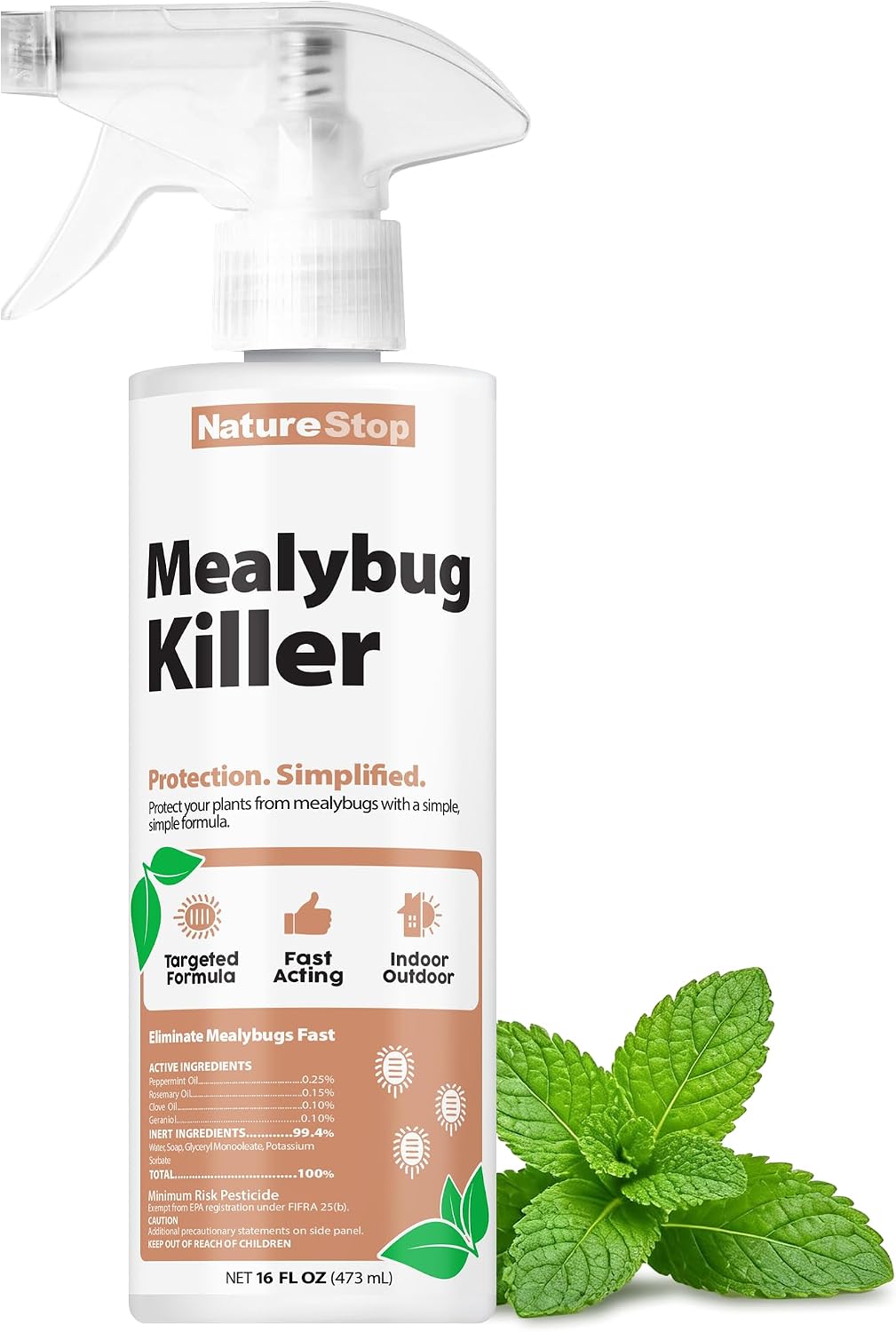
NatureStop Mealy Bug Killer (16 oz)
| Volume | 16 oz |
|---|---|
| Ingredients | Geraniol; Cedarwood Oil; Lemongrass Oil; Citronella Oil; Rosemary Oil |
| Manufacturer | NatureStop |
| Made in | USA |
NatureStop Mealy Bug Killer is an oil-based spray intended to control mealybugs on leaves, stems, and leaf nodes of houseplants and garden plants. The formula combines plant-derived oils such as geraniol, cedarwood, lemongrass, citronella, and rosemary to provide a non-chemical alternative to harsher insecticides. You use it by spraying affected areas directly, which makes it suitable for spot treatments and regular maintenance to reduce reinfestation. Practical benefits include a plant-friendly ingredient list that reduces risk of phytotoxicity when used as directed and simple spray application that fits into routine care. Limitations are that it is designed for targeted control rather than broad-spectrum pest management, and repeated applications may be needed for heavy infestations since natural oils often act by repelling or smothering rather than giving long residual control. Follow label directions and test on a small area before wide use on sensitive plants.
Best for: Buyers who prioritize low-toxicity, plant-friendly pest control and want a straightforward spray for routine spot treatments and prevention.
Less Ideal for: Gardeners facing a severe, widespread infestation or those who need a one-time, long-lasting chemical solution should consider stronger, long-residual options.
- Uses plant-derived oils rather than synthetic pesticides
- Simple spray application for spot treatment of affected leaves and nodes
- Formulated for indoor and outdoor plant use and intended to be plant-friendly
- Not formulated for long residual control so more frequent reapplication may be needed
- May be less effective on very heavy or widespread infestations compared with stronger chemical treatments
Verdict: A plant-friendly, oil-based spray that offers a low-toxicity, easy-to-use option for controlling mealybugs on indoor and outdoor plants.
Choosing the Right Insecticide for Mealybugs: Key Factors to Consider
Type of Active Ingredient
The active ingredient defines how the insecticide attacks mealybugs and how it behaves on plants. Contact actives must touch pests to work and are useful for localized infestations, but they may miss hidden nymphs in crevices. Systemic actives move through the plant's vascular system and can reach feeding mealybugs on new growth, which is helpful for heavy or recurring infestations.
Choosing between contact and systemic options affects timing and expected control. Systemics often take longer to act but provide longer protection, while contact sprays can give faster visible knockdown. Consider the biology of mealybugs and whether you need immediate reduction of visible insects or longer-term suppression.
Safety for Indoor and Container Plants
Many insecticides are formulated for outdoor beds and may be too harsh for tender indoor foliage or potted ornamentals. Check labeled plant tolerance and recommended dilutions for houseplants, seedlings, and flowering species. Some actives are more likely to cause leaf burn under high light or warm conditions, so factor in the growing environment when choosing concentration and application timing.
For indoor use also consider respiratory safety and ventilation needs. Products that produce fine mists or strong odors may require moving plants outdoors briefly or using targeted spot treatments to limit exposure. Always follow label safety guidance to protect people and pets sharing the space.
Application Method and Equipment
How you apply an insecticide affects coverage and effectiveness. Foliar sprays are convenient for small numbers of plants, while soil drenches or systemic treatments are better for treating root-feeding stages or when access to foliage is limited. Some formulations come as concentrates for dilution in sprayers; others are ready-to-use trigger sprays for quick spot work.
Consider the sprayer you have and whether the product's required nozzle, pressure, or particle size matches it. Good coverage of undersides of leaves and stem junctions is important because mealybugs often hide in joints and leaf axils. For heavy infestations, combining an initial contact treatment with a follow-up systemic application can improve results.
Residual Activity and Reapplication Schedule
Residual control determines how often you must reapply and how long treated plants remain protected. Contact insecticides typically have shorter residual life and may require repeated applications to catch emerging nymphs. Systemic options can provide weeks of control but may not protect newly potted plants if roots are disturbed.
Plan treatments around the life cycle of mealybugs and the cropping schedule of your plants. If you propagate or repot often, pick approaches that fit those practices. Also balance residual needs with safety – longer-lasting residues may require more caution with edible plants, even if mealybugs are mostly a problem on ornamentals.
Environmental Impact and Nontarget Safety
Consider effects on beneficial insects, pollinators, and soil organisms, especially if you use treatments outdoors or in greenhouses with open vents. Broad-spectrum insecticides can disrupt natural predators and lead to secondary pest outbreaks. For indoor and container use, the immediate concern is keeping people and pets safe, but outdoors you should weigh pollinator risk and possible runoff.
Look for products and application practices that minimize drift and nontarget exposure. Spot treatments, targeted application to infested plants, and using the lowest effective rate reduce environmental impact while still addressing mealybug pressure.
Plant Type and Growth Stage
Different ornamental species and growth stages tolerate insecticides differently. Seedlings, newly rooted cuttings, and recently repotted plants are more prone to phytotoxicity and transplant shock; they often need lower concentrations or gentler actives. Mature, woody ornamentals tolerate stronger treatments but may require pruning to expose hidden infestations.
Match the product choice and concentration to the plant's sensitivity. When treating mixed collections of plants, test a small area or lower concentration first and wait a few days to check for leaf responses before treating the whole collection.
When to Use Contact Sprays Versus Systemics
Contact sprays give fast results on visible mealybugs and are useful for small, contained outbreaks. If you see clusters on leaf undersides, stems, or in leaf axils, a targeted contact application can quickly reduce adult numbers and remove the sticky honeydew that encourages mold growth.
Systemic treatments are better when infestations are extensive, recurrent, or the insects are hidden. Because systemics move through the plant, they reach feeding nymphs on new growth. They are particularly helpful for plants in containers where root uptake is reliable.
- Use a contact spray for immediate knockdown and to clean heavily infested surfaces before applying a systemic
- Choose systemic treatments for long-term suppression or for plants that are difficult to spray thoroughly
- Combine methods when infestations are severe: contact for quick reduction, systemic for follow-up protection
Safe Application Practices for Indoor Plants
Treating houseplants requires extra caution to protect household members and pets. Work in a well-ventilated area or move plants to a covered outdoor spot while spray residues dry. Avoid fogging or aerosol methods in living spaces.
Apply lower concentrations to delicate foliage and wait for cooler parts of the day to spray. Wipe excess solution from hard surfaces and remove protective coverings from soil before using systemic drenches that require root uptake.
- Ventilate the area and keep pets away until residues dry
- Test a small branch or leaf on sensitive species before full application
- Follow label directions for reentry and drying times
Monitoring and Follow-Up Treatments
After an initial treatment, inspect plants weekly for at least a month. Mealybug nymphs hatch over time, so one application often will not be sufficient. Look for sticky honeydew, cottony masses, and distorted new growth as signs of ongoing activity.
Record treatment dates and products used so you can track what worked and when reapplication is allowable. Rotate modes of action if infestations persist to reduce the risk of resistance development.
- Use sticky traps and hand inspection to find early infestations
- Repeat treatments at labeled intervals until no new activity is observed
- Combine physical removal, pruning, and targeted insecticide use for best control
Integrating Cultural Controls
Cultural practices reduce mealybug pressure and improve insecticide effectiveness. Isolate newly acquired plants for several weeks, inspect stems and leaf axils during watering, and avoid overfertilizing with high nitrogen which can increase succulent growth favored by mealybugs.
Regular pruning to open canopy and improve air movement makes infestations easier to spot and treat. In greenhouse settings, control humidity and sanitize pots and tools to reduce spread between plants.
- Quarantine new plants for observation before adding them to collections
- Reduce excess nitrogen fertilization during high-risk periods
- Clean pots and tools between uses to avoid transferring mealybugs
Safe Disposal and Sanitation After Treatment
After treating infested plants, remove heavily infested material and dispose of it in sealed bags to prevent re-infestation. Clean sprayers and tools with soap and water according to label guidance to avoid cross-contamination.
Sanitize work surfaces and wash hands after handling treatments. For potted plants, consider repotting into fresh media if soil shows persistent infestation or if systemic drenches are not effective on root-resident stages.
- Bag and discard heavily infested plant material
- Rinse and decontaminate sprayers between products to prevent chemical interactions
- Consider repotting when soil appears infested or when repeat treatments fail
How We Chose the Best Insecticide for Mealybugs
We focused on attributes that matter most to gardeners battling mealybugs in containers, houseplants, and small greenhouse settings. Efficacy against mealybugs under typical home-gardening conditions was the primary filter. We prioritized products and active ingredients with documented contact or systemic activity against sap-sucking scale insects and mealybugs. Plant safety and phytotoxicity were evaluated next. Because many ornamental plants and young growth are sensitive, we checked for known risk to tender foliage, tolerance on common indoor species, and recommended dilution rates. Application versatility was considered: foliar sprays, soil drenches, and systemic options were included to match different infestation levels and gardener preferences. Residue and reapplication scheduling mattered for ongoing maintenance; we considered how long control lasts and whether repeat use is practical for indoor environments. Ease of use and equipment needs were weighed so gardeners could pick something compatible with spray bottles or hand sprayers they already own. We excluded broad-spectrum outdoor-only pesticides and products with labeled restrictions that make them impractical for container or indoor plant use. Excluded items included materials labeled only for agricultural use, products requiring specialized licensing, or formulations with high phytotoxic risk on common ornamentals. The final short list reflects a balance of fast knockdown, residual control options, and safety when used according to label directions.
FAQ
How long after treatment will I see mealybugs drop off plants?
Response time depends on the active ingredient and application method. Contact sprays often cause visible knockdown within hours, while systemic treatments may take several days to affect feeding mealybugs. Monitor plants and plan follow-up checks over multiple weeks.
Can I use the same insecticide on all my ornamentals and succulents?
It usually depends on plant sensitivity and the product label. Some succulents and newly rooted cuttings are prone to phytotoxicity and need lower rates or gentler actives. Always check labeled tolerances and test a small area first.
Are natural or botanical options effective against mealybugs?
Botanical and soap-based contact treatments can reduce populations when applied thoroughly, but they often need repeated applications and excellent coverage. They are useful for light infestations or as part of an integrated approach, especially where low toxicity is important.
Do systemic treatments prevent re-infestation?
Systemics can provide weeks of protection while the plant uptakes the active ingredient, which helps prevent new mealybugs from establishing. However, reinfestation from nearby plants or new acquisitions is still possible, so combine systemics with inspection and sanitation.
How often should I reapply an insecticide for mealybugs?
Follow the product label for intervals. In general, contact products may require reapplication every 7 to 14 days until no activity is seen, while some systemics may only need treatment every few weeks. Adjust timing based on infestation level and plant sensitivity.
Will treating one plant protect nearby plants?
Treating an infested plant reduces local pressure but does not reliably protect neighboring plants unless using a systemic with root uptake and the plants share soil. Best practice is to inspect and treat nearby plants as well to stop spread.
Final Verdict
When managing mealybugs, pick an approach that matches infestation severity and plant sensitivity. Use contact sprays for quick knockdown on visible pests and choose systemic options when you need longer protection or when pests are hidden in new growth. Prioritize plant safety, proper application technique, and sanitation to reduce reinfestation. Balance residual needs against nontarget and indoor safety, and combine chemical treatments with cultural controls and monitoring for the best long-term outcome. A methodical approach will help you regain plant health while minimizing risk to your other plants and living spaces.
