

Note: This article contains affiliate links. If you click on these links and make a purchase, I may earn a small commission at no extra cost to you. This helps support my research and content. Read my full affiliate disclosure here.
Choosing the right organic fertilizer matters because it affects more than immediate green-up. Organic lawn fertilizer works by feeding soil biology, improving structure, and releasing nutrients more slowly than synthetic options. That slower release means steadier growth, less risk of burn, and reduced nutrient runoff into storm drains. This guide shortlists seven top organic lawn fertilizers suitable for typical home lawns and explains how each option scored for nutrient content, ease of use, and environmental impact. We'll also cover application timing, rates, and practical tips to help you pick the best fit for your yard and maintenance style.
Top Picks at a Glance
| Best Overall The best all-around choice for most situations | Jonathan Green Organic Lawn Food 10-0-1 (5,000 sq ft) |  |
| Best Quality Built to a higher standard if you want something more solid | MicroLife Multi-Purpose 6-2-4 Granular Organic Fertilizer, 40 lb |  |
| Best Value The sweet spot between price and what you get | Purely Organic Products Lawn Food 10-0-2, 40 lb |  |
| Best Budget The cheapest option that still gets the job done reliably | O.M. Scott & Sons Natural Grass Food, 12.72 lb. |  |
| Highest Rated A top-rated pick with lots of positive feedback | Espoma Turf-Tone All Season Organic Lawn Food with Bio-Tone, 28 lb |  |
| Most Popular A crowd favorite that many people choose with confidence | Milorganite 6-4-0 Slow-Release Fertilizer, 32 lb (with Feeding Tips Brochure) |  |
| Best Seller A high-volume bestseller chosen again and again | Espoma Organic Weed Preventer Plus Lawn Food, 25 lb |  |
Jonathan Green Organic Lawn Food 10-0-1 (5,000 sq ft)

| Analysis | 10-0-1 |
|---|---|
| Form | Granules |
| Coverage | 5000 sq ft |
| Application method | Spread |
Jonathan Green Organic Lawn Food is a slow-release granular fertilizer designed to feed established and newly seeded lawns for eight to ten weeks. It is spread with a broadcast, drop, or hand-held spreader and supplies steady nitrogen plus iron to improve color without relying on fast-release synthetics. In practice the granules are easy to apply and the formula is gentle enough that it will not burn turf, which makes it suitable for homes with children and pets. The product covers about 5,000 square feet per bag and is described as containing natural ingredients and no sludge- or manure-based fillers. Important limitations are that its nutrient mix is low in phosphorus and potassium so it is mainly a green-up and maintenance fertilizer rather than a one-step solution for soil deficiencies, and feeding is gradual so results are not instant. For typical home lawns looking for an organic maintenance feed this is a practical, low-risk option.
Best for: Homeowners who want an easy, low-risk organic maintenance feed that improves color and sustains turf between major treatments.
Less Ideal for: Gardeners needing rapid greening, immediate repair of nutrient-poor soil, or a complete fertilizer with higher P and K for soil correction.
- Organic, natural ingredient formula that avoids fast-release synthetic nitrogen
- Slow-release feed provides 8–10 weeks of steady nutrition
- Contains iron to promote deeper green color
- Easy-to-spread homogeneous granules compatible with broadcast, drop, or handheld spreaders
- Low phosphorus and potassium content makes it unsuitable as a complete soil correction
- Gradual action means visible improvement can take multiple weeks
Verdict: A reliable organic slow-release lawn food that delivers steady green-up and maintenance for average home lawns.
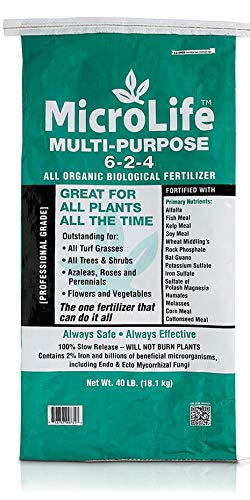
MicroLife Multi-Purpose 6-2-4 Granular Organic Fertilizer, 40 lb
| Item Form | Granules |
|---|---|
| Specific Uses For Product | Fertilizing |
| Coverage | Full |
| Target Species | all plants |
| Mixing Ratio | 6:2:4 |
MicroLife Multi-Purpose 6-2-4 is a slow-release, granular organic fertilizer designed to improve plant vigor and soil health across lawns, ornamentals, vegetables, trees, and shrubs. It is typically spread with a broadcast or drop spreader and worked into beds or turf where its blend of fish, kelp, humates, rock phosphate and protein meals releases nutrients over months. Notable features include a biological inoculant package claimed to contain beneficial microbes and a broad mix of minerals, amino acids, and trace elements that support strong root development and stress tolerance. For gardeners focused on performance, the formula promotes steady growth without synthetic salts so it will not burn when applied at recommended rates and repeats every 3 to 4 months. The trade-offs are that results are slower to appear than synthetic quick-release fertilizers and you must store and handle a large 40 pound bag. For someone prioritizing sustained, biologically driven lawn and landscape performance, this product offers a reliable organic route to bigger roots and improved soil structure.
Best for: Gardeners and lawn stewards who prioritize long-term performance and soil health and want an organic, slow-release fertilizer to support robust root systems and sustained growth.
Less Ideal for: People seeking immediate greening or rapid nutrient correction or those who prefer lightweight, small-quantity packaging for occasional use.
- All-organic, slow-release 6-2-4 formula that reduces burn risk
- Contains a range of natural inputs (fish, kelp, humates, meals) for broad nutrient and soil-building benefits
- Includes a biological inoculant package intended to boost beneficial soil microbes
- Long coverage interval with recommended reapplication every 3 to 4 months
- Slower visible nutrient response compared with synthetic quick-release fertilizers
- Large 40 lb bag can be heavy to handle and store for casual users
Verdict: Choose this product if you want a proven organic, slow-release fertilizer that builds soil biology and delivers sustained performance across lawns and landscapes.
Purely Organic Products Lawn Food 10-0-2, 40 lb

| Item Form | Granules |
|---|---|
| Specific Uses For Product | Lawns |
| Target Species | lawn grasses |
| Mixing Ratio | 10:0:2 |
This Purely Organic Lawn Food is a granular, plant-based fertilizer formulated to green up turf while avoiding phosphorus and synthetic chemicals. It is typically broadcast across established lawns using a spreader or by hand for smaller areas; the 10-0-2 N-P-K mix supplies nitrogen for color and a small amount of potassium for stress tolerance while meeting phosphorus-restriction rules. The formula emphasizes natural ingredients such as distillers grains and soybean meal, which release nutrients more slowly than soluble synthetic fertilizers and reduce the risk of burning. Practical benefits include a pet- and family-friendly profile with no re-entry restrictions and a lack of strong odors. Expect slower, steadier greening rather than immediate flushes of growth, and plan applications earlier in the season or repeated at intervals to maintain results. The product comes in a large 40 pound bag suitable for multiple applications on medium to large lawns but requires storage in a dry place to prevent caking and may feed more slowly in cool soil conditions.
Best for: Buyers who prioritize safer, natural lawn care and steady, maintenance-style greening for medium to large yards will like this product.
Less Ideal for: If you need rapid green-up or are treating nutrient-deficient new sod, a fast-acting synthetic fertilizer or a starter formula would be a better choice.
- Plant-based formula with distillers grains and soybean meal for slow nutrient release
- No phosphorus and no harsh chemicals, suitable where phosphate restrictions apply
- Family and pet friendly with no re-entry restrictions after application
- Large 40 lb bag covers multiple applications for medium to large lawns
- Slow-release action means results are gradual rather than immediate
- Requires dry storage to avoid caking and loss of effectiveness
Verdict: Choose this if you want a large-quantity, plant-based lawn fertilizer that safely greens turf over time while complying with phosphorus restrictions.
O.M. Scott & Sons Natural Grass Food, 12.72 lb.

| Feeds duration | Up to 10 weeks |
|---|---|
| Coverage | Up to 2,000 sq. ft. per bag |
| Usage frequency | Every 8 to 10 weeks, up to 4 times a year |
| Indoor Outdoor Usage | Outdoor |
This 12.72 lb. bag of O.M. Scott & Sons Natural Grass Food is a straightforward, natural-feeling fertilizer for homeowners who want regular, low-fuss feeding. It supplies nutrient sources from nature and begins working immediately if you water after application, with residual feeding that can last up to 10 weeks. Typical use is simple: load a Scotts spreader, set the dial per the bag, walk the lawn, then water lightly. The bag covers up to 2,000 sq. ft., making it convenient for small to medium yards and seasonal maintenance schedules of every 8 to 10 weeks. Notable features include recyclable paper packaging and a formula that contains no added artificial ingredients or pesticides, which supports a pet- and family-friendly reentry policy. Limitations are its modest bag size and coverage relative to larger lawns and the lack of specific N-P-K detail on the listing, so precise nutrient targets or problem-solution feeding (for example, high-nitrogen greening or slow-release specifics) may require pairing with soil testing or a supplemental product.
Best for: Homeowners who want a simple, family- and pet-friendly organic-style lawn food for routine seasonal maintenance on small to medium lawns and who prioritize natural ingredients and easy application.
Less Ideal for: Large properties or users needing precise nutrient formulas or targeted problem corrections should consider higher-coverage or lab-tailored fertilizers instead.
- Natural-sourced nutrients with no added artificial ingredients or pesticides
- Feeds up to 10 weeks after application when watered
- Safe for people and pets to reenter lawn immediately when used as directed
- Recyclable paper bag and easy application with a spreader
- Bag size (12.72 lb.) only covers about 2,000 sq. ft., so multiple bags are needed for larger yards
- Nutrient breakdown (N-P-K) is not specified in the listing, limiting targeted feeding decisions
Verdict: A simple, pet-friendly natural lawn food that delivers up to 10 weeks of feeding and works well for routine care on small to medium yards.
Espoma Turf-Tone All Season Organic Lawn Food with Bio-Tone, 28 lb

| Item Form | Granules |
|---|---|
| Application Method | spread evenly on a dry, mowed lawn |
| Target Species | Lawn Grass |
| Unit Count | 448 Ounce |
Espoma Turf-Tone is an organic granular lawn food designed for regular seasonal feeding of lawns. You spread it with a drop or broadcast spreader on a dry, mowed lawn to feed fescue, bluegrass, rye, St. Augustine, and zoysia; the product is formulated with slow-release nitrogen (9-0-1) and Espoma’s Bio-Tone formula to encourage gradual, sustained greening and healthier roots without burning. Because it uses natural ingredients such as feather meal and poultry manure, it reduces the risk of nutrient leaching and is suitable for gardeners who prefer organic inputs. The 28 pound bag covers up to about 5,000 sq. ft., which makes it practical for average to larger yards and helps cut mowing frequency by promoting steadier growth. Limitations are that nutrient analysis is focused on nitrogen with minimal phosphorus and potassium, so lawns needing balanced N-P-K correction will require supplemental products, and application requires a spreader for even results.
Best for: Homeowners who prioritize reliable, low-risk organic feeding and want a steady, long-lasting green-up for common turf types without synthetic chemicals.
Less Ideal for: Gardeners seeking a high-phosphorus starter fertilizer or those who need a precisely balanced N-P-K product for correcting soil test deficiencies.
- Organic, natural ingredient formula that reduces risk of burning and leaching
- Slow-release nitrogen (9-0-1) for steady, long-lasting greening
- Works across common turf types including fescue, bluegrass, rye, St. Augustine, and zoysia
- Large 28 lb bag covers up to roughly 5,000 sq. ft., suitable for typical home lawns
- Low phosphorus and potassium levels so may not correct all nutrient deficiencies
- Requires a spreader and even application for best results
Verdict: Choose this for dependable, slow-release organic lawn feeding that produces steady greening across common turf types.
Milorganite 6-4-0 Slow-Release Fertilizer, 32 lb (with Feeding Tips Brochure)

| Item Form | Pelletized |
|---|---|
| Application Method | Broadcast, Rotary or Manual |
| Coverage | 2,500 Square Feet |
| Specific Uses For Product | Lawns, Flowers and Gardens, Education |
Milorganite 6-4-0 is an organic, pelletized fertilizer designed for routine feeding of lawns and garden beds. It is typically applied with a broadcast or rotary spreader or by hand and delivers slow-release nitrogen that feeds plants for roughly eight to ten weeks. The product includes a feeding and spreader tips brochure that helps with seasonal timing and application rates, and a 32 lb bag covers about 2,500 sq ft. Because it is low in soluble salts and contains organically complexed iron, it greens turf without the spotting or burn risk associated with some synthetic fertilizers, and it can be used safely on flowers, shrubs, trees, and edibles. It has an earthy smell on application that fades after watering or rain, and it works well in both clay and sandy soils by adding organic matter and supporting microbial activity. The main limitations are the slower visible results compared with fast-release synthetic fertilizers and the need to follow spreader settings for even coverage on larger lawns.
Best for: Buyers who prioritize proven, environmentally minded organic options and want a low-risk, steady-feeding fertilizer for routine lawn and garden maintenance informed by community experience.
Less Ideal for: People who need rapid color correction or immediate growth response for repair jobs should consider fast-release products instead.
- Slow-release nitrogen feeds plants for about 8–10 weeks, reducing application frequency
- Low-salt formula lowers risk of fertilizer burn and striping on turf
- Organically complexed iron promotes deep greening without staining concrete
- Pelletized form works with broadcast, rotary, or manual application methods
- Slower to produce visible greening compared with quick-release synthetic fertilizers
- Has an earthy odor on application that can attract pets until watered in
Verdict: A dependable organic slow-release fertilizer that reduces burn risk and keeps lawns steadily fed with minimal fuss.
Espoma Organic Weed Preventer Plus Lawn Food, 25 lb

| Item Form | Granules |
|---|---|
| Specific Uses For Product | Lawns |
| Application Method | broadcast spreader |
| Target Species | Prevents dandelions, crabgrass and other common weeds |
Espoma Organic Weed Preventer Plus Lawn Food combines corn gluten meal with a slow-release organic nitrogen source to both discourage weed seedlings and feed established turf. It is applied with a broadcast or drop spreader in early spring and again in fall; the granulated form makes even coverage easy for typical lawn care chores. Notable features include a natural active ingredient and the dual-purpose claim of weed prevention plus greening without burning. Practically, a single 25 lb bag treats roughly 1,250 sq ft at the preventer rate or up to 2,500 sq ft at the feeding rate, so it suits small to mid-size yards and seasonal maintenance schedules. Limitations are that it prevents weed seed germination rather than killing existing weeds and its effectiveness depends on timing and proper spreader calibration. Homeowners seeking a low-toxicity, pet- and child-friendly option will appreciate the safety profile, but those needing quick knockdown of established weeds should plan to combine it with spot treatments or mechanical removal.
Best for: Homeowners who prioritize low-toxicity, organic lawn care and want a preventative, seasonal product to maintain a greener lawn without synthetic chemicals.
Less Ideal for: People who need immediate removal of existing broadleaf or grassy weeds or who manage very large lawns where repeated applications would be impractical.
- Contains 100% corn gluten meal, a natural ingredient that inhibits weed seed root development
- Provides slow-release organic nitrogen for gradual greening without burning
- Granular formula is compatible with broadcast or drop spreaders for straightforward application
- Child- and pet-friendly once applied according to directions
- Prevents new weed seedlings but does not control established weeds
- Requires correct timing and repeat applications for best results
Verdict: Choose this for a child- and pet-friendly, organic preventative lawn treatment that also feeds turf with slow-release nitrogen.
Choosing the Right Organic Lawn Fertilizer: Key Factors to Consider
Nutrient Composition and Release Profile
Understanding the guaranteed analysis matters because organic sources feed turf differently than synthetic formulations. Look for a clear N-P-K ratio and descriptions of nitrogen sources such as blood meal, feather meal, or composted plant material. Those sources generally release nitrogen more slowly as microbes break them down, which reduces the risk of leaf burn and produces steadier growth over weeks to months.
Release profile affects timing and frequency. Fast-acting organics can give a quicker green-up but still rely on microbial activity; slow-release ingredients support extended feeding. Consider your maintenance calendar and whether you prefer a single application per season or multiple lighter feeds.
Support for Soil Biology
A key advantage of organic fertilizers is their ability to nourish soil organisms that convert organic matter into plant-available nutrients. Products that include compost, seaweed, humic substances, or beneficial microbes help build structure, water-holding capacity, and nutrient cycling. Over several seasons this can reduce fertilizer needs and improve drought resilience.
Assess ingredient lists for terms like composted manure, kelp, or compost extracts. These additions are not just nutrient sources but act as food for microbes and root stimulants, so they matter if your goal is long-term lawn health.
Application Method and Practicality
Think about how the fertilizer will be applied. Granular formulas need compatible spreaders and even granule size for uniform coverage. Some organic products are formulated as liquids or water-soluble concentrates for easy foliar feeding or for use with hose-end applicators. Application practicality also includes clarity of rate instructions and safe re-entry times.
If you have a small lawn or limited storage, concentrated liquid or small-bag granules might be more convenient. Large properties benefit from bulk blends that spread evenly with standard broadcast or drop spreaders.
Salt Index and Burn Risk
Low salt index is important to prevent turf stress and root damage, especially when applying in warm weather or on newly established grass. Organic fertilizers generally have a lower salt index than synthetic counterparts, but concentrations vary by feedstock. Ingredients like blood meal and certain manures can be more concentrated, so following labeled rates reduces risk.
When renovating or seeding, choose gentle formulas with very low burn potential to protect new roots. For established lawns, match application rates to turf recovery capacity to avoid excess top growth that invites disease.
Environmental Impact and Runoff Potential
Consider how the fertilizer behaves after application. Slow-release organic inputs are less likely to wash into storm drains because they depend on microbial conversion and are often bound to organic matter. However, fine powders or improperly applied granules can still move offsite during heavy rain.
Selecting products with clear guidance on incorporation, watering-in, and buffer zones near water bodies reduces runoff risk. Many municipalities have ordinances restricting application timing; prioritize options that minimize soluble nutrient loss.
Cost Per Coverage and Longevity
Evaluate how much area a bag or container covers and how long the effects last. Organic fertilizers that supply both nutrients and soil-building materials may reduce the frequency of reapplication over seasons, which affects long-term cost-effectiveness.
Calculate coverage based on labeled rates rather than bag size alone. Higher up-front cost per unit weight can be offset by longer-lasting benefits to soil structure and reduced need for corrective treatments.
When to Apply Organic Lawn Fertilizer
Timing depends on your turfgrass type. For cool-season grasses, feed in early spring when shoots begin active growth and again in early fall for root development. For warm-season grasses, aim for late spring after full green-up and again in mid-summer when growth slows and recovery is needed.
Apply on dry turf and water lightly after spreading if the product instructions call for watering in. Avoid applications ahead of heavy rain to reduce the chance of runoff. Staggering smaller applications can produce steadier results than one heavy dose.
- Early spring for cool-season grass green-up
- Late spring for warm-season grass after active growth begins
- Avoid applying immediately before heavy rain
How to Read an Organic Fertilizer Label
Look beyond the N-P-K numbers. Ingredient lists reveal nutrient sources and amendments that benefit soil biology. Check for compost percentages, types of organic nitrogen, and any added humates or seaweed extracts.
Also note application rate per 1,000 square feet, any crop-specific instructions for turf, and safety guidance. Labels that specify spreader settings and include coverage math make uniform application much easier.
- Verify application rate per 1,000 sq ft
- Check ingredient sources for slow-release organics
- Prefer labels with spreader settings for common models
Integrating Fertilizer With Cultural Lawn Care
Fertilizer is one part of a healthy lawn system. Mowing height, watering schedule, and aeration frequency all influence how effectively turf uses nutrients. Raising mower height improves root depth and helps grass access nutrients over the long term.
Aeration opens compacted soil so organics can better reach the root zone. Combine organic feeding with annual or biennial aeration and overseeding to improve density and reduce weed pressure.
- Mow at recommended heights to promote deeper roots
- Aerate compacted lawns before a major organic feeding
- Match watering to season and product instructions
Managing Expectations: Results and Timeline
Organic fertilizers generally produce gradual, steady improvement rather than instant green-up. You can expect richer color and stronger turf over several weeks to months as soil microbes process organic matter into plant-available nutrients.
If immediate correction of a severe nitrogen deficiency is needed, plan for follow-up feedings or a complementary approach that still prioritizes low-burn sources. Track lawn response after each application to dial in timing and rates for your site.
- Visible change often appears within 2 to 6 weeks
- Soil health benefits accumulate over seasons
- Record application dates to evaluate results
Storage, Safety, and Application Best Practices
Store organic fertilizers in a cool, dry place and keep bags sealed to preserve microbial amendments. Protect containers from rodents and moisture that can cause caking or spoilage.
When spreading, use appropriate protective gear and follow label guidance for re-entry times on treated turf if specified. Sweep excess granules from hard surfaces to prevent runoff and accidental signage of nutrients into storm drains.
- Keep bags sealed and dry
- Use gloves and avoid inhaling dust
- Clean spreader after use to prevent cross-contamination
How We Chose the Best Organic Lawn Fertilizer
We evaluated candidates for soil-focused performance and user practicality. Primary evaluation criteria were nutrient composition and release profile, soil-microbe support, application practicality, and environmental safety. Nutrient composition assessed the balance of nitrogen, phosphorus, and potassium and whether sources favored slow release. Soil-microbe support reviewed inclusion of composted organics, humates, and beneficial microbes that help build long-term fertility. Application practicality considered product form, spreader compatibility, granule consistency, and clear rate guidance. Environmental safety measured runoff potential, solubility, and salt index to favor low-burn, low-leach options. We excluded fertilizer products that rely primarily on synthetic water-soluble nitrogen or that lacked clear organic feedstock information. Products unsuitable for cool- or warm-season turf based on labeled rates were filtered out. Final selections focus on items that demonstrate both immediate feeding and long-term soil improvement while remaining practical for typical lawn care routines.
FAQ
How often should I apply organic lawn fertilizer?
Frequency depends on the product and turf type. Many organic granular programs use two to four applications per year, while some slow-release options need only one or two feeds. Follow label rates and monitor turf response to adjust frequency.
Can I use organic fertilizer on newly seeded lawns?
Yes, but choose a gentle, low-burn formula designed for seedlings. Some organics can be applied at reduced rates at seeding or after germination to support early growth without stressing new roots.
Will organic fertilizer control weeds or thatch?
Organic fertilizers do not directly control weeds or thatch. Improving soil health and promoting dense turf through proper fertilization, mowing, and overseeding can reduce weed pressure over time. Thatch may require mechanical removal or aeration if it becomes excessive.
Is liquid organic fertilizer better than granular?
It depends on goals. Liquid organics can offer quicker uptake and easier foliar applications, while granular organics typically provide longer residual feeding and soil amendment. Choose based on application convenience, coverage needs, and product label guidance.
Can organic fertilizers prevent nutrient runoff completely?
No. Organic options reduce runoff risk because nutrients are often bound in organic matter and released slowly, but improper application or heavy rain can still cause movement. Follow buffer recommendations and avoid applying before storms to minimize runoff.
Final Verdict
Prioritize products that fit your turf type and maintenance rhythm. Emphasize nutrient sources that feed soil biology, clear application guidance, and a low salt index to reduce burn risk and runoff. Expect gradual but durable improvements: organics strengthen soil and turf over seasons rather than delivering instant results. Choose a formula that matches your desired application frequency and integrates with aeration, mowing, and watering practices to get the best long-term outcome.
