

Note: This article contains affiliate links. If you click on these links and make a purchase, I may earn a small commission at no extra cost to you. This helps support my research and content. Read my full affiliate disclosure here.
If you want to remove stubborn broadleaf weeds without harming the grass or soil life, choosing the right organic weed killer matters. Lawn care needs are specific: products must target common lawn invaders while leaving turf grasses, beneficial microbes, and nearby plants intact. This guide covers seven carefully shortlisted organic options for lawns and explains how they perform on effectiveness, turf safety, and ease of use. We'll walk through the evaluation criteria so you can match a product to your lawn type, weed pressure, and maintenance routine.
Top Picks at a Glance
| Best Quality Built to a higher standard if you want something more solid | Bonide Captain Jack's Lawnweed Brew Concentrate, 32 oz |  |
| Best Value The sweet spot between price and what you get | Spruce Weed & Grass Killer Refill, Ready-to-Use 64 fl oz |  |
| Best Budget The cheapest option that still gets the job done reliably | Bonide Captain Jack's Deadweed Brew Ready-to-Use Spray, 32 oz |  |
| Highest Rated A top-rated pick with lots of positive feedback | Espoma Organic Turf-Tone Weed Preventer Plus Lawn Food, 25 lb |  |
| Most Popular A crowd favorite that many people choose with confidence | Spruce Weed & Grass Killer Power Wand Kit with 64 oz Refill |  |
| Best Seller A high-volume bestseller chosen again and again | Spruce Snap & Spray Weed & Grass Killer Starter Kit, 64 oz |  |
Bonide Captain Jack's Lawnweed Brew Concentrate, 32 oz

| Item Form | Concentrate |
|---|---|
| Unit Count | 32 Ounce |
| Coverage | Controls dandelion, moss, algae, lichens, chickweed, oxalis, clover, ground ivy, and certain turf diseases |
| Liquid Volume | 32 fluid ounces |
Bonide Captain Jack's Lawnweed Brew is a concentrated iron-based treatment designed for professional-style spray application across lawns. Mix with water and apply with a backpack, compression, or knapsack sprayer to target dandelion, clover, chickweed, moss, algae, lichens and some turf diseases such as dollar spot and rust. The formula is fast-acting and visible browning of treated weeds or moss can appear within hours, which helps you confirm coverage. Because it is a concentrate, a single 32 oz bottle covers many spray tank refills and is convenient for treating large areas. Important limitations are that you must follow label directions for safe mixing and application and use sprayer equipment suitable for concentrates; it is not a ready-to-use hose-end product. Active ingredients are listed on the label rather than detailed on the packaging, so users should review the label for restrictions and safety precautions before applying.
Best for: Buyers who prioritize fast, visible weed and moss control across medium to large lawns and who are comfortable mixing concentrates and using a sprayer for precise application.
Less Ideal for: Homeowners who want a pump-spray or hose-end ready product or those unwilling to follow label mixing and safety procedures should look at simpler ready-to-use options.
- Selective control of broadleaf weeds plus moss, algae and lichens useful for improving turf appearance
- Fast visible results often within hours to confirm effective coverage
- Concentrated formulation stretches to multiple tank fills for treating larger lawns
- Designed for use with common spray equipment like backpack or compression sprayers
- Requires proper sprayer equipment and careful mixing rather than a ready-to-use applicator
- Label lists active ingredients on the package rather than printing them in product summary which requires checking the label for full details
Verdict: A fast-acting iron-based concentrate made for performance-minded lawn owners who want visible, selective control of weeds, moss and turf diseases using spray equipment.
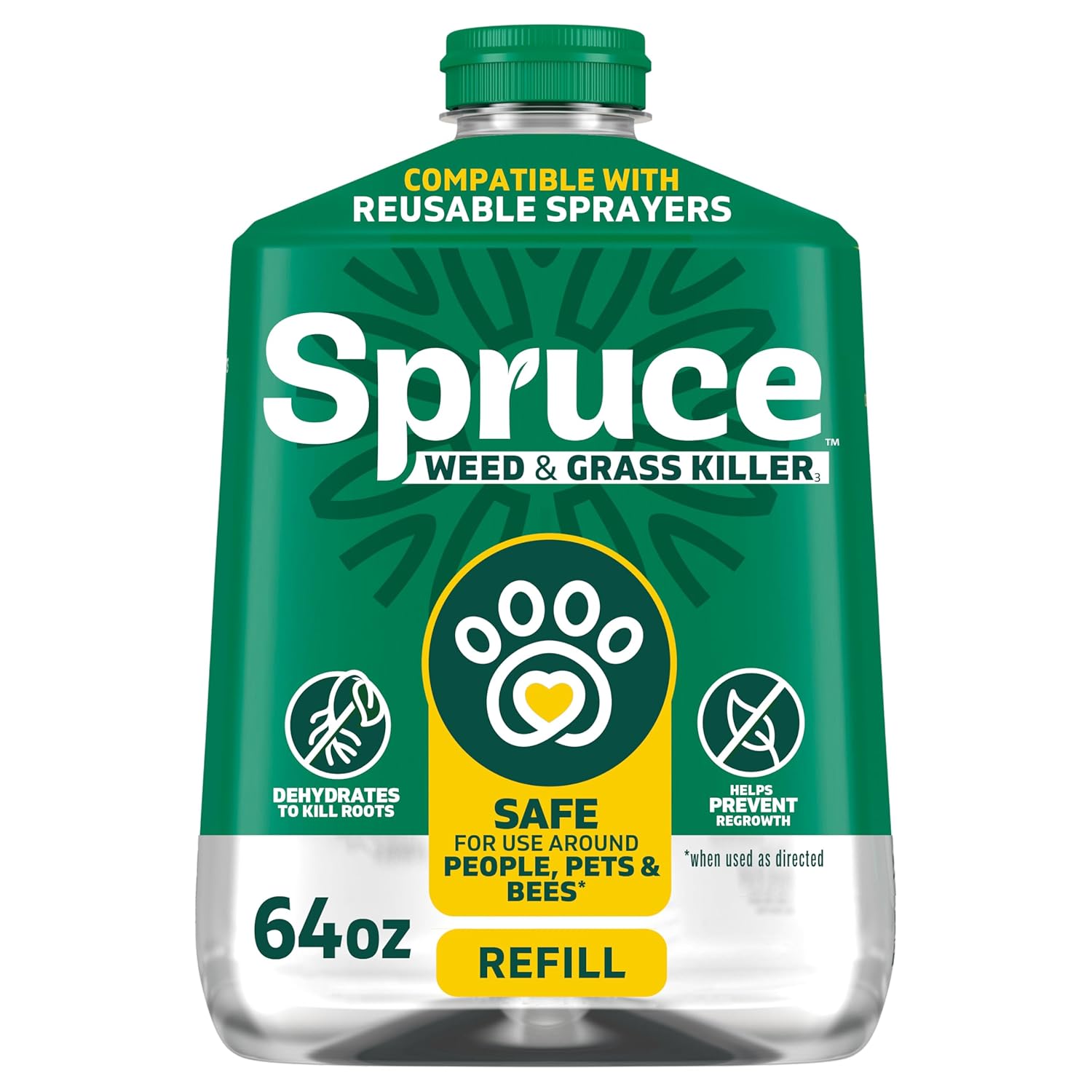
Spruce Weed & Grass Killer Refill, Ready-to-Use 64 fl oz
| Unit Count | 64 Fluid Ounces |
|---|---|
| Item Form | Spray |
| Coverage | 1 bottle treats up to 400 weeds |
| Active Ingredients | Sodium Lauryl Sulfate, Geraniol, Cornmint Oil |
This 64 fl oz Spruce refill is a no-mix replacement for the brand's Snap & Spray system that provides a convenient, ready-to-use weed and grass killer for spot treatments. It works on contact, dehydrating foliage with visible leaf darkening or wilting within an hour and complete plant death often by 24 hours. The formula relies on water, essential oils and sodium lauryl sulfate rather than synthetic herbicides, which makes it suitable for use around people and pets when directions are followed. One bottle is rated to treat up to about 400 weeds and is designed for hard surfaces, mulch beds, driveways and pavers rather than broadcast lawn application. Practical features include a snap-on refill top for the existing spray handle and a fast rainproof window of roughly 10 minutes. Be aware it is non-selective and must be applied carefully to avoid desirable plants, and it is most effective on young or small weeds rather than deep perennial roots where reapplication may be needed.
Best for: Buyers who want a low-fuss, pet-conscious spot weed killer for driveways, pavers and mulch beds and who prioritize convenience and visible speed of action.
Less Ideal for: Homeowners seeking a selective lawn treatment or long-term control of deeply rooted perennials should consider different systemic or professional options.
- Ready-to-use refill eliminates mixing and pouring
- Visible results in about one hour with full effect by 24 hours
- Formulated with water and essential oils for pet- and people-friendly use when directed
- Covers a high estimated count — one bottle treats up to 400 weeds
- Snap-on refill design fits the Spruce Snap & Spray handle for quick replacement
- Non-selective formula will damage desirable plants if oversprayed
- Less effective on large established perennial roots compared with systemic herbicides
Verdict: Choose this refill if you want a fast, ready-to-use, pet-conscious spot treatment that snaps into the Spruce spray handle for effortless weed control on hardscapes and beds.
Bonide Captain Jack's Deadweed Brew Ready-to-Use Spray, 32 oz

| Unit Count | 32 Ounce |
|---|---|
| Item Form | Spray |
| Coverage | Annual |
| Active Ingredients | Herbicide |
Bonide Captain Jack's Deadweed Brew is a ready-to-use spray formulated to quickly kill common broadleaf weeds and grasses in gardens and hardscape areas. The product is marketed for visible spot treatment around flower beds, vegetable gardens, driveways, sidewalks, patios, and gravel where you need fast weed control without mixing concentrates. Notable features include an easy trigger nozzle, organic-friendly formulation approved for organic gardening, and activity at temperatures down to about 40°F. In practice the spray delivers visible wilting within hours and becomes rainproof once dry, so treated areas hold results after light moisture. Because it is non-selective you must avoid spraying desirable plants and follow label safety instructions. The 32-ounce bottle is convenient for spot treatments but may be small for larger lawns or heavy infestations, so budget-minded users should plan quantities accordingly. For gardeners wanting quick, organic-compatible spot control with minimal setup, this is a practical option.
Best for: Gardeners looking for an affordable, no-mix spot treatment to quickly remove visible weeds around beds, paths, and hard surfaces while keeping to organic-friendly products.
Less Ideal for: Homeowners who need a selective lawn-only herbicide or who plan to treat large acreages where concentrated products would be more economical.
- Ready-to-use spray requires no mixing and is simple to apply for spot treatments
- Approved for organic gardening so it fits organic-maintenance plans
- Fast-acting formula shows results within hours and becomes rainproof after drying
- Works at temperatures as low as 40°F enabling early- and late-season use
- Non-selective formula can damage desirable plants if oversprayed
- 32 oz bottle may not cover large lawns or heavy weed infestations
Verdict: A handy, organic-approved ready-to-use spray for budget-conscious gardeners who want quick spot control of visible weeds without mixing chemicals.
Espoma Organic Turf-Tone Weed Preventer Plus Lawn Food, 25 lb

| Item Form | Granules |
|---|---|
| Application Method | broadcast spreader |
| Coverage | 1,250 sq. ft. |
| Target Species | Lawn Grass |
Espoma Organic Turf-Tone combines corn gluten meal fertilizer with a pre-emergent effect to both feed and help prevent common lawn weeds. It is applied with a broadcast or drop spreader in early spring and again in fall; at labeled rates it covers up to about 1,250 square feet per 25 lb bag when used as a weed preventer. The granulated formula provides roughly 8.23% slow-release nitrogen so you get a steadier green-up rather than a quick spike. Because it works by inhibiting root development in seedlings it is useful for preventing crabgrass and dandelions from establishing but will not control established weeds. The product is safe for families and pets to re-enter the lawn after application and fits into an organic maintenance plan. Expect to see preventive results only with proper timing and adequate lawn density, and plan to pair this with cultural practices like mowing and overseeding for best reliability.
Best for: Buyers looking for a reliable, organic preventive solution to keep lawns greener over the season and reduce new weed pressure without synthetic chemicals.
Less Ideal for: Homeowners needing a fast cure for existing weed infestations or those who want a one-time broad-spectrum weed killer.
- Made from 100% corn gluten meal providing organic slow-release nitrogen
- Granular form works with broadcast or drop spreaders for even application
- Labelled as safe for children and pets to use the lawn after application
- Dual function: helps prevent seedling weed establishment while feeding turf
- Only prevents weed seed germination and does not kill established weeds
- Requires correct timing and repeated seasonal applications for effectiveness
Verdict: Choose this product if you want a dependable organic preventive that feeds turf while reducing new weed establishment when applied on schedule.
Spruce Weed & Grass Killer Power Wand Kit with 64 oz Refill

| Unit Count | 64 Fluid Ounces |
|---|---|
| Coverage | 1 bottle treats up to 400 weeds |
| Item Form | Multiple |
| Liquid Volume | 64 fluid ounces |
This kit combines a 64 oz ready-to-use herbicide with a battery-powered Power Wand for fast, targeted spot treatments. The formula is non-mixing and designed to work on contact, dehydrating leaves so you can see darkening or wilting within an hour and complete die-off by about 24 hours when used as directed. The wand is reusable and comes with two AA batteries so you can spray cracks, edges, mulch beds, driveways, and walkways without pouring or measuring. Practical benefits include ease of use, rainproofing within 10 minutes, and a formula advertised as safe around people, pets, and bees when directions are followed. Limitations are that it is non-selective so it must be applied carefully to avoid desirable plants and grass, it is intended for spot treatment rather than broadcast lawn application, and best results require spraying in dry, warm conditions above 60°F with no immediate rain forecast.
Best for: Buyers who want a fast, easy-to-use spot weed killer for driveways, cracks, mulch beds, and edges and who prioritize quick visible results and minimal setup.
Less Ideal for: Those needing large-area lawn herbicide or selective weed control within turf should look for products made for broadcast lawn treatments or selective formulas.
- Ready-to-use 64 oz refill eliminates measuring or mixing
- Visible results in about one hour and full effect around 24 hours
- Includes battery-powered reusable wand for precision spot treatments
- Rainproof within 10 minutes so light showers are less likely to wash it off
- Formulated for use around people, pets, and bees when directions are followed
- Non-selective formula can damage desirable plants if oversprayed
- Designed for spot treatments not for broadcasting over large lawns
- Performance depends on spraying in recommended weather conditions
Verdict: A convenient, no-mix spot-treatment kit that delivers fast visible weed kill with a reusable powered wand for precise, low-fuss applications.
Spruce Snap & Spray Weed & Grass Killer Starter Kit, 64 oz

| Unit Count | 64 Fluid Ounces |
|---|---|
| Item Form | Spray |
| Coverage | 1 bottle treats up to 400 weeds |
| Active Ingredients | Sodium Lauryl Sulfate, Geraniol, Cornmint Oil |
This Spruce Snap & Spray starter kit pairs a 64 oz refill bottle with a reusable snap-on wand to deliver a no-mess, ready-to-use weed and grass killer for spot treatment. It works on contact, dehydrating plants so you can see darkening or wilting within an hour and complete dieback often by 24 hours. Use it on driveways, pavers, walkways, mulch beds and garden edges by holding the nozzle about a foot from the weed and thoroughly wetting leaves and stems. The formula is water-based and uses sodium lauryl sulfate, geraniol and cornmint oil instead of glyphosate, and the brand states it is safe around people and pets when used as directed. The powered wand and EZ-AIM options make precision spraying easier for cracks and tight spots, and one bottle claims coverage for up to 400 weeds. Limitations include the need to avoid desirable plants and lawns, follow temperature and dry-weather application guidance, and the spray may take extra priming on first use or between uses.
Best for: Buyers who prioritize a pet-conscious, practical approach to spot-treating weeds around yards and hardscapes and want an easy-to-use, ready-made spray system for targeted applications.
Less Ideal for: People looking for a lawn-wide systemic herbicide or a long-term preemergent solution should consider other products; those needing broadcast treatment of large turf areas will find this kit unsuitable.
- Ready-to-use kit with a reusable snap-on wand for no-mix, no-pour application
- Plant-based active ingredients reduce reliance on harsh synthetic herbicides
- Visible results often within one hour and full effect by 24 hours when used as directed
- Designed for precision spot treatments on hardscapes, mulch beds and garden edges
- One 64 oz bottle claims coverage up to about 400 weeds
- Not labeled for broadcast use on lawns so it is for spot treatment only
- Must be applied in dry, warm conditions and may require reapplication for persistent weeds
- Sprayer can take time to prime on first use or between applications
Verdict: A convenient, pet-conscious ready-to-use spray kit ideal for precise spot treatment of weeds on hardscapes and beds.
Choosing the Right Organic Weed Killer for Lawns: Key Factors to Consider
Target Weed Spectrum
Different organic actives work better on different weed types. Some treatments are most effective on young, soft seedlings while others can desiccate mature broadleaf weeds. Knowing whether your lawn problem is dandelions, clover, chickweed, or grassy weeds matters because many organic lawn-safe products are selective for broadleaves and will not control grassy weeds. Match the product to the likely weed species and life stage for the best outcome.
Failure to consider the weed spectrum can lead to repeated applications and wasted effort. Inspect affected areas and, if necessary, pull a sample plant to identify the species before choosing a treatment.
Turf Grass Compatibility
Lawn grasses react differently to organic herbicides and application stress. Cool-season and warm-season turf may differ in sensitivity at various times of year. Products that are safe for one grass type could scorch another if applied during heat stress or at high concentrations. Consider your grass species, its seasonal growth cycle, and recent stresses like drought or fertilization when timing treatments.
Application technique also affects turf safety. Spot treatments reduce exposure to desirable grass, while broadcast applications require careful calibration and timing to avoid damage.
Mode of Action and Residuals
Organic weed control often relies on contact desiccants, fatty acid salts, or naturally derived acids rather than systemic uptake. Contact products kill tissue they touch and typically offer no long-term residual control, which means follow-up treatments may be necessary. Understanding whether a product provides residual activity informs planning for reapplication and integrated lawn management.
Consider whether you need immediate top-growth control or longer suppression. If long-term seedbank management is a priority, combine targeted herbicide use with cultural practices like overseeding and mowing height adjustments.
Timing and Weather Sensitivity
Many organic treatments depend on environmental conditions for efficacy. Rain soon after application can wash away contact herbicides, and high temperatures can increase turf stress and the risk of scorch. Early morning or late afternoon applications on calm, dry days reduce drift and improve uptake for some products.
Plan applications when weeds are actively growing but not under severe stress. Avoid treating during heat waves or immediately before heavy rain to improve results and protect grass health.
Safety for People, Pets, and Wildlife
One main reason gardeners choose organic weed killers is reduced toxicity. However, reduced toxicity does not mean no precautions are necessary. Read label instructions about re-entry intervals for pets and children, recommended protective gear, and washing equipment after use. Some organic actives can still irritate skin or eyes, so handling and storage matter.
Also consider effects on pollinators and beneficial insects. Avoid applying flowering weeds that attract pollinators, and use targeted spot applications when possible to minimize non-target exposure.
Application Method and Equipment
Different lawn situations favor different application methods. Pump sprayers, hose-end applicators, and ready-to-use trigger bottles each offer tradeoffs in coverage control and convenience. Pump or hose-end sprayers allow mixing to match lawn size but require proper calibration to avoid overapplication. Ready-to-use bottles are simple for small patches but can be expensive for larger lawns.
Assess the scale of the infestation, your comfort with mixing concentrates, and whether you need a precision applicator for spot treatment versus a broad coverage tool.
When Organic Control Is the Right Choice
Organic weed killers are best when your priority is minimizing synthetic chemical residues and protecting soil organisms. They are particularly well suited to family yards, lawns near vegetable beds or pollinator patches, and situations where pets or children play on the grass frequently.
Expect tradeoffs: organic options often act more slowly or require multiple spot treatments compared with conventional systemic herbicides. Pair treatment with cultural practices such as proper mowing height, regular overseeding, and balanced fertility to reduce repeat outbreaks.
- Best for broadleaf weeds and visible patches
- Works well alongside mechanical removal and cultural care
- May need repeated applications for established plants
Integrating Treatments with Lawn Care Routine
Timing herbicide applications around your routine mowing, irrigation, and fertilization will reduce stress on turf and improve control. For most lawns, treat weeds when they are actively growing and leave turf uncut for a day or two before and after application when using contact products.
Avoid heavy fertilization immediately before treatment because lush, rapidly growing grass can be more sensitive. After treatment, maintain consistent watering and mowing practices to promote healthy turf recovery and reduce space for weeds to reestablish.
- Treat during active weed growth phases
- Coordinate with mowing and irrigation schedules
- Follow up with overseeding in thin areas
Spot Treatment Vs Area Treatment
Choose spot treatment for isolated weed patches. This minimizes non-target exposure and conserves product. For widespread infestations, area treatment may be appropriate, but use accurate application rates and consider the added risk to desirable grass.
When spot treating, use a precision nozzle or shield to avoid drift. For broadcast applications, calibrate sprayers carefully and avoid windy days to reduce off-target movement.
- Spot treatment reduces turf impact
- Area treatment requires careful calibration
- Use shields or low-drift nozzles in sensitive landscapes
Seasonal Considerations for Best Results
Spring and fall are often the best times to treat many broadleaf lawn weeds because plants are actively growing and the weather is moderate. Summer treatments can be riskier due to heat stress on turf and may require avoiding the hottest part of the day.
In colder climates, focus on a fall program that addresses perennial weeds before dormancy and pairs control with overseeding. In warmer regions, treat when weeds are flush with growth but avoid application during prolonged drought.
- Spring and fall usually give the best control
- Avoid treating during heat waves or drought
- Consider local climate and grass growth cycle
Combining Organic Control with Mechanical and Cultural Methods
Organic weed control is most effective when combined with hand-pulling, dethatching, aeration, and targeted overseeding. Mechanical removal reduces seed sources and makes chemical control more effective on remaining plants.
Address underlying lawn health issues such as compaction, poor drainage, and improper mowing height to reduce future weed pressure. Treat visible weeds while improving cultural practices to achieve lasting results.
- Hand-pull large taproot plants before treatment
- Aerate compacted soil to encourage dense turf
- Overseed thin areas to compete with weeds
How We Chose the Best Organic Weed Killer for Lawns
We shortlisted products based on metrics that matter in lawn-focused organic weed control. Primary filters included demonstrated effectiveness against common lawn weeds such as dandelion, clover, plantain, and chickweed, plus documented safety for typical turf species when used according to label directions. We prioritized formulations and application methods that minimize harm to lawn grass and soil biology, including contact versus systemic action and known residual effects. Ease of application and predictable timing were considered so gardeners can schedule treatments without risking burn to desirable plants. We also checked ingredient transparency and whether the active components are widely accepted in organic and low-toxicity gardening practices. Excluded from consideration were general garden herbicides not intended for turf, products with unclear ingredient lists, and any formulation known to cause irreversible grass damage when applied at standard rates. The evaluation focused on measurable turf outcomes, application practicality, and environmental compatibility for lawn settings.
FAQ
Will organic weed killers harm my grass?
Often they do not if used according to directions, but turf sensitivity depends on product type, grass species, and timing. Contact actives can scorch stressed grass, so avoid applying during heat stress and follow application rates.
How soon will I see results after applying an organic product?
Results vary by active ingredient and weed maturity. Many contact organic treatments show visible browning within days, while full plant decline may take one to three weeks. Repeated applications are sometimes necessary for complete control.
Can I overseed right after using an organic weed killer?
It depends on the product and its residual activity. Many organic contact products have little to no residual and allow overseeding soon after treatment, but check label guidance. When in doubt, wait a short recovery period and water and aerate to prepare a good seedbed.
Are organic weed killers safe for pets and children?
Organic options generally have lower toxicity, but some ingredients can irritate skin or eyes and may require brief re-entry intervals. Follow label safety instructions and keep pets off treated areas until the product has dried or the label indicates it is safe.
Do organic weed killers prevent new weeds from germinating?
Most organic lawn-safe herbicides are contact or short-lived and do not provide long-term pre-emergent control. Combine treatments with cultural practices like overseeding and mulching bare patches to reduce future weed emergence.
Can I mix organic weed killers with fertilizer or other lawn products?
Mixing depends on the product. Some concentrates are compatible with certain turf inputs while others are not. Always read the product label for compatibility and perform a small-area test before mixing any treatment.
Final Verdict
Choosing the right organic weed killer for lawns comes down to matching the product to the weed species, your turf type, and seasonal conditions. Prioritize turf safety and application timing, and expect that organic options often require follow-up and integrated cultural practices to achieve lasting control. By combining targeted treatments with mowing, overseeding, and soil care, you can manage weeds while protecting lawn health and soil life.
