

Note: This article contains affiliate links. If you click on these links and make a purchase, I may earn a small commission at no extra cost to you. This helps support my research and content. Read my full affiliate disclosure here.
If you manage a medium or large yard and need hands-free power on a budget, the right backpack leaf blower can save hours of raking and reduce strain. Budget backpack leaf blowers deliver higher airflow than handheld machines while keeping the operator mobile and less fatigued. This guide shortlists seven practical options that suit homeowners and small-property contractors looking for reliable clearing without premium pricing. We evaluated machines for airflow, ergonomics, and ease of maintenance so you can pick a blower that moves debris efficiently and stays comfortable during long jobs. Read on for the criteria we used and what to expect from each type of budget backpack blower.
Top Picks at a Glance
| Best Overall The best all-around choice for most situations | Thalorus 63cc Backpack Gas Leaf Blower, 665 CFM / 205 MPH |  |
| Best Quality Built to a higher standard if you want something more solid | PROYAMA 72cc Gas Backpack Leaf Blower |  |
| Best Value The sweet spot between price and what you get | Houltune 72cc Gas Backpack Leaf Blower, 760 CFM 235 MPH |  |
| Best Budget The cheapest option that still gets the job done reliably | Sarkoyar 63cc Backpack Gas Leaf Blower (665 CFM) |  |
| Highest Rated A top-rated pick with lots of positive feedback | AKSDSGA 63CC Gas Backpack Leaf Blower |  |
| Most Popular A crowd favorite that many people choose with confidence | NEO-TEC NTEB809A 52cc Gas Backpack Leaf Blower |  |
| Best Seller A high-volume bestseller chosen again and again | HASANEN 850CFM Backpack Gas-Powered Leaf Blower |  |
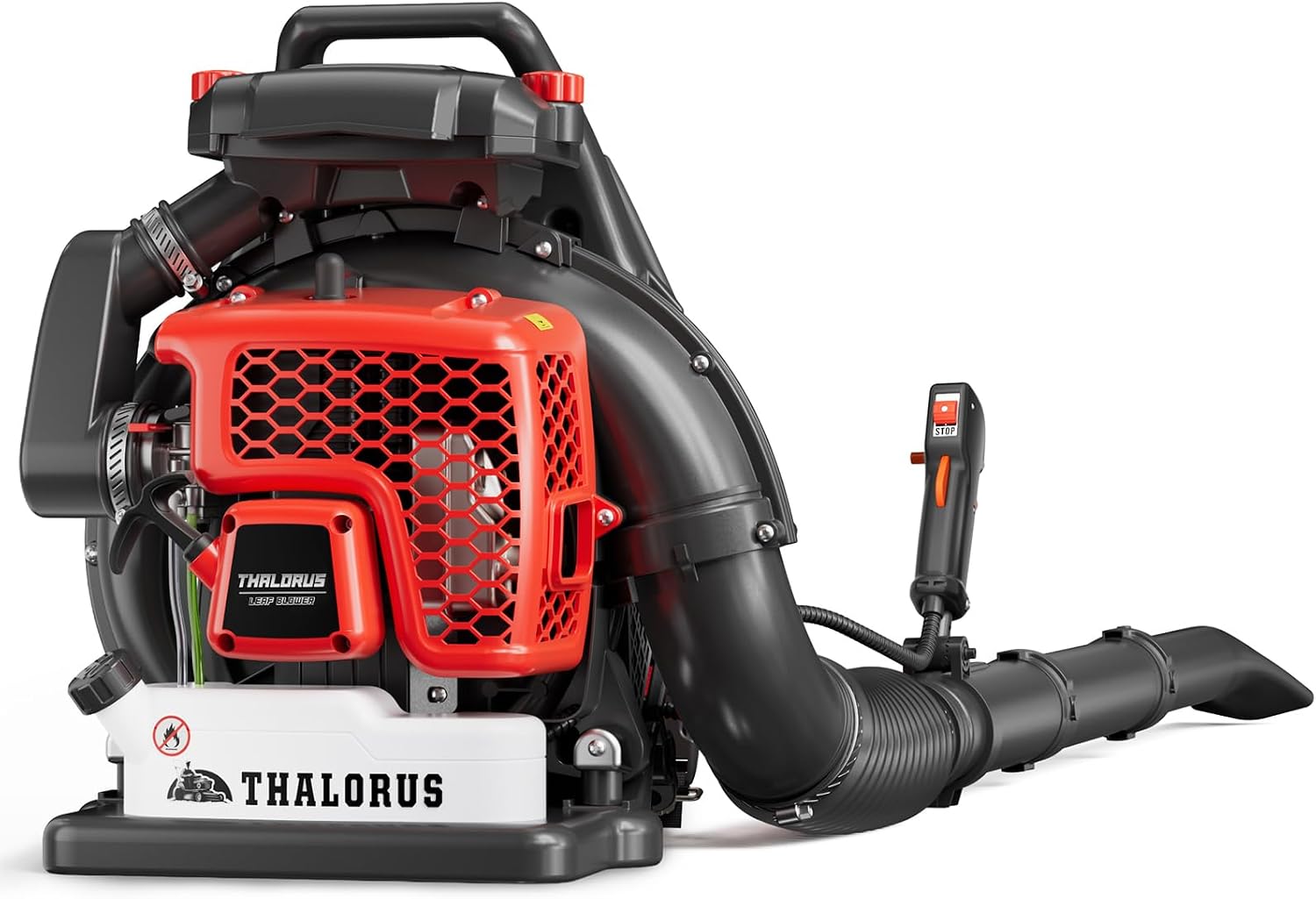
Thalorus 63cc Backpack Gas Leaf Blower, 665 CFM / 205 MPH
| Power Source | Gas Powered |
|---|---|
| Form Factor | Backpack |
| Air Flow Capacity | 665 cfm |
| Maximum Speed | 205 miles_per_hour |
| Additional Features | Adjustable Speed, Adjustable Tube Length, Anti-Vibration, Throttle Lock |
The Thalorus 63cc backpack blower combines a 3HP gas engine with a 665 CFM airflow and 205 MPH top speed to move heavy or wet leaves across large yards, driveways, and patios. It is designed for extended cleanup sessions: the padded ergonomic harness transfers weight to your back, the 1.7 L fuel tank reduces refueling stops, and adjustable speed plus cruise control let you switch between gentle work around beds and steady clearing on open lawn. Practical features include an anti-vibration system for comfort, an easy-start pull system that typically fires in a few pulls, and a commercial two-stage air filter with tool-free replacement for simpler maintenance. Because it is gas-powered, expect regular fuel mixing, engine maintenance, and typical two-cycle noise and exhaust; it is heavier than handheld blowers and requires storage and winterizing care. For homeowners with medium to large properties who need robust blowing power, it speeds up seasonal jobs but is more machine to maintain than electric options.
Best for: Homeowners with medium to large yards who want a powerful, time-saving blower for seasonal leaf and debris cleanup and who are comfortable with gas engine maintenance.
Less Ideal for: People with very small yards, those who prefer low-noise or zero-emission tools, or buyers who want minimal maintenance should consider lighter electric or cordless models.
- High airflow (665 CFM) and 205 MPH top speed for moving heavy or wet leaves
- Ergonomic padded backpack harness distributes weight to reduce fatigue during long jobs
- 1.7 L fuel tank reduces the number of refueling stops for large properties
- Adjustable speed and cruise control let you match power to the task and keep a steady output
- Commercial two-stage air filter with tool-free replacement simplifies maintenance
- Gas two-cycle engine requires fuel mixing, periodic engine maintenance, and produces noise and exhaust
- Heavier and bulkier than handheld electric blowers, which can be less convenient for small yards
Verdict: Choose this backpack blower if you need strong, sustained blowing power for large yards and are willing to handle routine gas-engine upkeep.
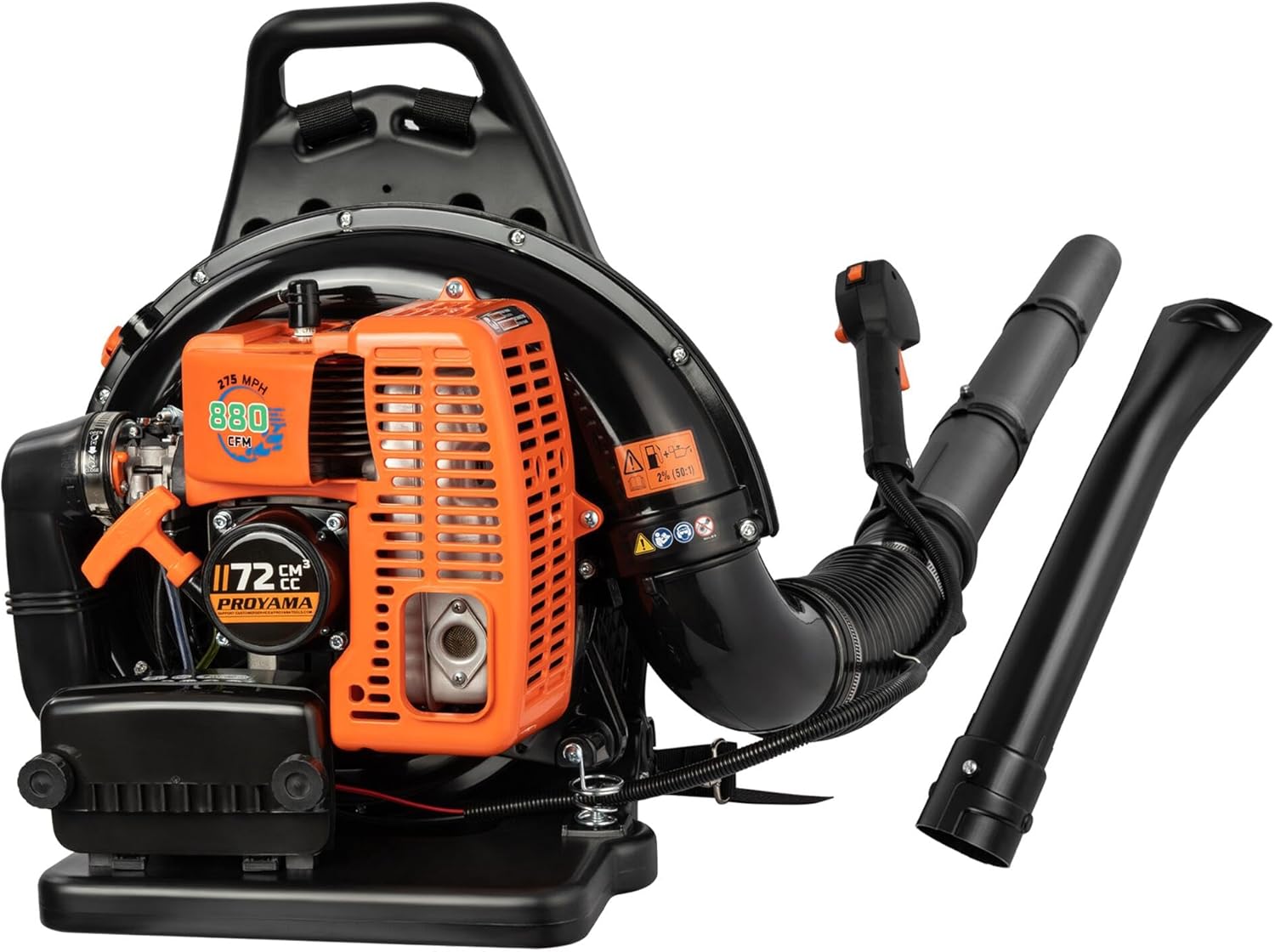
PROYAMA 72cc Gas Backpack Leaf Blower
| Power Source | Gas Powered |
|---|---|
| Form Factor | Backpack |
| Air Flow Capacity | 880 cfm |
| Speed | 275 miles_per_hour |
The PROYAMA 72cc backpack blower is built for high-performance yard work, using a 2-cycle gas engine to produce strong airflow and speed for moving large volumes of leaves, wet debris, and light snow. Worn like a backpack with padded straps, a hip belt, and a ventilated backrest, it is intended for extended use with less operator fatigue than single-handle blowers. Key features include a dual-tube nozzle system for switching between wide flat blasts and focused round streams, variable-speed throttle with cruise control for steady output, and an inline air filter to protect the engine. In practice the 880 CFM/275 MPH output and the self-throttle lock make long runs more efficient on large lawns, commercial properties, or seasonal cleanups where raw clearing power matters. Be prepared for the usual gas-engine maintenance, noise, and vibration despite the low-vibration design, and expect a learning curve to assemble, start, and tune the 2-cycle engine correctly. This blower favors performance and endurance over near-silent or ultra-light duty use.
Best for: Buyers who prioritize raw clearing power and long-duty operation, such as landscapers or homeowners with large properties and frequent heavy cleanups.
Less Ideal for: People who need a lightweight, near-silent tool for small yards or who prefer electric battery-powered equipment for low maintenance and lower noise.
- High airflow and speed (880 CFM and 275 MPH) suitable for heavy debris and light snow
- Backpack harness with padded straps and hip belt improves comfort for prolonged use
- Variable-speed throttle with cruise control allows consistent output without constant adjustments
- Dual nozzles (flat and round) provide versatility for wide areas and focused clearing
- Gas 2-cycle engine requires fuel mixing, maintenance, and produces notable noise and vibration
- Heavier and bulkier than handheld electric blowers, which may limit maneuverability in tight spaces
Verdict: Choose this blower when you need commercial-level, sustained clearing power for large properties or professional landscape work.
Houltune 72cc Gas Backpack Leaf Blower, 760 CFM 235 MPH

| Power Source | Gas Powered |
|---|---|
| Form Factor | Backpack |
| Air Flow Capacity | 760 cubic_centimeters_per_minute |
| Maximum Speed | 235 miles_per_hour |
| Noise Level | 70 db |
This Houltune 72cc gas backpack blower is built for demanding yard work where battery tools fall short. It produces up to 760 CFM and 235 MPH to move heavy, wet leaves, pine needles, and light snow while the padded dual back pads, adjustable harness, and anti-vibration mounts make long sessions more comfortable. Variable speed and cruise control let you dial airflow for delicate beds or stubborn debris, and an adjustable pivoting tube improves reach into corners without awkward body twisting. The blower uses a primer-assisted easy-start system and an upgraded air filter to simplify starting and extend engine life. Practical features include a 1.8L fuel tank for roughly 35 to 50 minutes of run time and interchangeable nozzles for concentrating or spreading airflow. Important limitations are that it is a gas two-stroke unit, so you need to mix fuel and perform routine engine maintenance, and it is louder and emits exhaust compared with electric options. For someone prioritizing reliable power and uptime across large properties, this is a capable, work-ready choice.
Best for: Buyers who need sustained, professional-strength blowing power for large yards, orchards, or commercial lots and who value runtime and uptime over the convenience of cordless tools.
Less Ideal for: Homeowners with small urban yards, strict noise or emission restrictions, or those who prefer low-maintenance electric tools should consider quieter electric models instead.
- High airflow and speed (760 CFM, 235 MPH) clears heavy, wet debris and light snow efficiently
- Ergonomic backpack harness with padded backrests and anti-vibration mounts reduces operator fatigue
- Variable speed plus cruise control for precise power control and consistent performance
- Easy-start primer-assisted recoil and upgraded air filter for more reliable starting and longer engine life
- Gas two-stroke engine requires fuel mixing, routine maintenance, and produces exhaust
- Noise level around 70 dB is higher than most cordless electric blowers
Verdict: Choose this blower when you need reliable, commercial-grade gas power and long runtime to clear large properties and heavy debris without battery downtime.
Sarkoyar 63cc Backpack Gas Leaf Blower (665 CFM)

| Power Source | air |
|---|---|
| Form Factor | Backpack |
| Air Flow Capacity | 665 cfm |
| Noise Level | 69 db |
| Speed | 2800 rpm |
This Sarkoyar 63cc backpack leaf blower is a gas-powered unit built for clearing leaves, debris, and light snow from yards, sidewalks, and small commercial sites. It pairs a two-stroke 63cc engine with a stated 665 CFM airflow, which makes moving heavy piles of wet leaves and loose debris faster than most handheld electric models. The backpack format and adjustable straps distribute weight across your shoulders, so longer jobs feel less fatiguing, and the adjustable outlet length helps reach tight areas. Construction is a mix of ABS and metal for durability, and the kit includes connecting tubes and basic tools for assembly. Expect typical gas-blower needs: you must mix fuel and oil, perform routine maintenance, and manage engine noise and exhaust. At 23 pounds the pack is not the lightest, and two-stroke engines require more upkeep and produce emissions compared with electric options. For a buyer focused on power on a budget, it offers strong blowing performance for tasks where corded or battery models fall short.
Best for: Buyers who need powerful, budget-friendly blowing performance for yards, sidewalks, or light commercial cleanup and who accept routine gas-engine maintenance to get more power than inexpensive electric options.
Less Ideal for: People who want a low-maintenance, emission-free, or very lightweight blower for small yards should consider cordless or electric handheld models instead.
- High claimed airflow of 665 CFM suitable for heavy leaf and debris clearing
- Backpack design with adjustable straps improves comfort for extended use
- Adjustable outlet length helps reach tight spots and vary airflow direction
- Includes basic accessories for assembly and fueling so you can start using it quickly
- Two-stroke gas engine requires fuel mixing, regular maintenance, and produces exhaust
- Heavier than handheld models which may be tiring for some users during long sessions
Verdict: If you need robust, low-cost blowing power for heavy yard cleanup and prefer performance over electric convenience, this 63cc backpack blower delivers strong airflow for the money.
AKSDSGA 63CC Gas Backpack Leaf Blower

| Power | 2.7 kW |
|---|---|
| Displacement | 63CC |
| Air Volume | 0.3 m³/s |
| Noise Level | 101 db |
| Fuel Tank | 1.8L |
The AKSDSGA 63CC backpack leaf blower is a gas-powered unit intended for large yards, driveways, and professional cleanup where run time and raw power matter. It pairs a 2-stroke 2.7 kW engine running at 6800 rpm with a 1.8L fuel tank to provide about an hour of continuous use, and the backpack harness transfers weight to the shoulders so you can work longer with less arm fatigue. Adjustable speed and a 120 degree adjustable tube let you match airflow to light debris or heavier, wet leaves and even light snow. Practical features include an easy pull-start, an external oil filling port for cleaner refills, and a polypropylene construction for weather resistance. Expect strong clearing performance and decent fuel economy for a 2-stroke, but note the unit is fairly noisy at 101 dB and requires regular two-stroke fuel mixing and basic engine maintenance. For reliability-focused buyers this is a straightforward, serviceable blower that favors uptime and power over quiet operation or emissions-free convenience.
Best for: Buyers who need a dependable, high‑power blower for large properties or frequent cleanup tasks and who prioritize uptime and straightforward gas-engine serviceability.
Less Ideal for: Casual users of small lawns, or anyone who prefers quieter, low‑maintenance electric or battery models or who wants to avoid dealing with gasoline and two-stroke maintenance.
- Powerful 63cc 2-stroke engine delivers strong airflow for clearing wet leaves and heavy debris
- Backpack harness shifts load to shoulders to reduce arm fatigue during long jobs
- 1.8L fuel tank provides around one hour of continuous runtime for longer sessions
- Adjustable speed and 120° tube let you tailor airflow for different tasks
- External oil filling port and manual start design simplify refueling and daily use
- High noise level at 101 dB makes hearing protection essential
- Requires two-stroke fuel mixing and routine engine maintenance
Verdict: If you need a dependable, high‑output blower for large or frequent jobs, this 63CC backpack unit delivers sustained power and practical features to keep you working longer.
NEO-TEC NTEB809A 52cc Gas Backpack Leaf Blower

| Power Source | Gas Powered |
|---|---|
| Form Factor | Backpack |
| Additional Features | Adjustable Speed, Anti-Vibration, Throttle Lock |
| Air Flow Capacity | 564 cfm |
The NEO-TEC 52cc backpack blower is built for clearing large yards and tougher tasks like wet or matted leaves and light snow. It produces up to 564 CFM and 216 MPH from a 2-cycle engine, and the backpack form factor moves the weight off your arms so you can work longer without arm fatigue. The unit includes an air purge for easier starting, a variable-speed throttle with cruise lock for sustained runs, and anti-vibration mounting to reduce fatigue on the harness. In practice this makes it effective for seasonal cleanups, commercial properties, and post-storm debris where handheld blowers struggle. Expect the usual gas-blower requirements: fuel mixing, routine maintenance, and more noise than electric models, and the backpack harness still requires some getting used to for comfortable fit and balance. For buyers who prioritize power and runtime over absolute quiet or zero emissions, this blower is a practical, well-featured choice that performs in demanding yard work.
Best for: Buyers who need sustained high-power leaf clearing for large lawns, rental or light commercial work, and want proven features that reduce operator fatigue during long jobs.
Less Ideal for: Casual homeowners with small yards or those who prefer low-noise, low-maintenance electric options should consider a handheld battery or corded blower instead.
- High airflow of 564 CFM and 216 MPH clears wet and matted leaves effectively
- Padded commercial-style harness distributes weight for longer use
- Air purge and easy-start features reduce fuss when starting the engine
- Variable-speed throttle with cruise lock allows consistent, hands-free operation
- Anti-vibration mounting improves comfort during extended runs
- Gas engine requires fuel mixing and routine maintenance
- Noisy compared with electric blowers and not suitable for noise-restricted areas
Verdict: If you need a powerful, durable blower for large or demanding cleanup jobs, this gas backpack model delivers sustained airflow and operator-focused features to get the work done.
HASANEN 850CFM Backpack Gas-Powered Leaf Blower

| Power Source | Gas Powered |
|---|---|
| Form Factor | Backpack |
| Additional Features | Adjustable Speed |
| Noise Level | 101 db |
| Maximum Speed | 6800 rpm |
This HASANEN backpack leaf blower is built around a 63cc two-stroke engine that produces strong airflow for moving leaves, gravel, light snow, and debris across large yards or commercial properties. It is worn on the back with adjustable, breathable straps and a padded backrest to distribute weight and keep engine heat away from the operator, which helps during long jobs. The blower includes adjustable nozzle angles and a long hose interface to broaden the cleaning reach, and a single-handle control that combines throttle and on/off for one-handed operation plus a cruise/constant speed switch to reduce fatigue. Practical benefits include a large 1.8L fuel tank for extended run time, PP housing that resists heat and impact, and multiple heat-dissipation features with a one-click shutdown for safety. Important limitations are typical of gas backpack blowers: it is loud at the listed noise level and requires fuel mixing and routine two-stroke maintenance, and the vibrating engine and overall weight can still be tiring over many hours despite the harness.
Best for: Buyers who prioritize reliable, high-power outdoor equipment and prefer proven gasoline engines for frequent or commercial clearing tasks and want a harnessed blower that reduces strain compared with handheld units.
Less Ideal for: Casual homeowners who need an occasional quiet, low-maintenance blower or users who cannot perform routine two-stroke maintenance should consider simpler electric or cordless models instead.
- High 63cc two-stroke engine delivers strong airflow suitable for commercial clearing
- Backpack design with padded backrest and adjustable breathable straps improves comfort for extended use
- Large 1.8L fuel tank supports longer run times between refills
- Adjustable nozzle angles and long hose interface expand reach and versatility
- Single-handle controls with a constant speed switch reduce operator fatigue
- Noise level is high at about 101 dB, so hearing protection is required
- Requires two-stroke fuel mixing and regular engine maintenance
- Backpack systems still transmit vibration and can be tiring during very long shifts
Verdict: Choose this backpack gas blower when you need powerful, continuous blowing performance for commercial or large-property work and want a harnessed design to ease long sessions.
Choosing the Right Budget Backpack Leaf Blower: Key Factors to Consider
Airflow and Thrust
Airflow measured in cubic feet per minute and nozzle velocity determine how well a backpack blower moves wet leaves, grass clippings, and heavier debris. Higher airflow helps clear large piles and damp material faster, while concentrated nozzle velocity is better for pushing debris out of tight corners or into beds. Consider the typical conditions in your yard: wide-open lawns benefit from higher CFM, while landscaped areas with dense plantings need better nozzle control.
Matching airflow to task reduces work time and limits repeated passes that cause operator fatigue. On budget models, look for specs that prioritize continuous airflow over sensational peak numbers that may be less sustainable in prolonged use.
Harness Fit and Weight Distribution
A backpack blower shifts most of the machine weight onto your hips and shoulders, so harness design is critical for comfort during long sessions. Padded shoulder straps, a supportive hip belt, and adjustable sternum straps keep the unit stable and prevent the blower from pulling on one side. Proper weight distribution reduces the risk of back strain and lets you work longer without stopping.
Test how easily straps adjust and whether the harness allows for airflow to your back on hot days. For shared use, look for designs that accommodate multiple torso sizes with simple adjustments.
Startability and Engine Reliability
Budget backpack blowers often use small two-stroke engines or compact electric motors. Engines that start consistently with minimal choke adjustments save time and frustration. Reliability also includes how the unit handles fuel mix, carburetor sensitivity, and whether it tolerates intermittent use without fouling.
Electric alternatives should be evaluated for motor durability under load and thermal protection. In both cases, look for simple startup procedures and components that are easy to access for routine checks to extend the machine's working life on a limited budget.
Maintenance and Serviceability
Ease of routine maintenance matters more on budget equipment since parts wear faster and small repairs may be needed sooner. Accessible air filters, simple spark plug access, and replaceable fuel lines cut service time. Clear, tool-free access to common service points reduces the need for professional repairs.
Also consider availability of aftermarket parts and whether the blower uses standard fasteners and components; common parts are cheaper and easier to source than proprietary pieces.
Noise Level and Vibration
Backpack blowers can be loud and generate vibration that contributes to operator fatigue and hearing exposure. Noise level affects when and where you can work, especially in residential areas with local noise ordinances. Vibration transmitted through handles and the harness increases fatigue and can make sustained use uncomfortable.
Look for budget options that include basic vibration damping in the handle and a muffler design that reduces low-frequency roar. While low-noise performance is easier to find in higher-end models, some budget options still manage reasonable noise reduction without sacrificing airflow.
Fuel Economy and Runtime
On gas models, fuel efficiency determines how long you can work before refueling and affects long-term operating cost. A more efficient engine or a slightly larger tank can make one tank clear a whole yard instead of splitting the job across refills. For electric or battery-assisted units, battery runtime and recharge time are the modern equivalent; check expected runtime at practical throttle settings rather than maximum output ratings.
Good fuel economy also correlates with lower emissions and reduced maintenance frequency. For frequent or commercial use, prioritize runtime characteristics that match your typical job size.
Gas Versus Electric Budget Backpack Options
Gas backpack blowers generally deliver higher continuous thrust for long work sessions, making them effective on large properties and for wet or compacted debris. They need regular fuel mixing and more maintenance but offer longer runtimes without recharging.
Electric backpack blowers are quieter and require less mechanical upkeep. Battery-powered models are improving quickly; choose packs with realistic runtime figures and swappable batteries if you need uninterrupted work.
- Gas: strong continuous power, longer single-session runtime, more maintenance.
- Electric: lower noise, less engine upkeep, limited by battery size and recharge time.
Ergonomics Tips for Longer Jobs
Adjust the harness so the weight rests on your hips rather than pulling your shoulders. Small tweaks to strap tension and hip belt placement can dramatically reduce back and shoulder strain. Take short, regular breaks and vary your stance to keep circulation and posture balanced.
Use the right nozzle attachment for the task to reduce wrist torque. A wider cone moves material faster but can create more handle vibration. A tapered nozzle increases velocity for targeted clearing with less overall effort.
- Set harness tightness to transfer weight to hips.
- Switch nozzles to match open lawns or tight beds.
- Use routine short breaks to avoid overuse fatigue.
Routine Maintenance Checklist
Keep a simple maintenance routine to extend the life of a budget backpack blower. Check and clean the air filter after dusty jobs, inspect fuel lines and clamps for cracks or leaks, and replace spark plugs on a seasonal basis. For electric units, ensure battery contacts are clean and store batteries at recommended charge levels.
Seasonal care includes stabilizing fuel for storage, fogging the engine if needed, and checking bolts and fasteners. Document small repairs so you can spot recurring issues that may indicate a deeper problem.
- Clean or replace air filter regularly.
- Inspect fuel lines and tighten clamps.
- Charge and store batteries correctly for electric models.
Reducing Noise Impact
If you work in noise-sensitive neighborhoods, plan jobs for allowable times, use ear protection, and favor models with mufflers or better acoustic design. Low-end models vary widely in noise output, so look for specifications or user reports that list decibel levels at typical operating distance.
Simple habits also cut perceived noise: run at the lowest effective throttle for each pass and avoid idling at high RPMs when not actively clearing.
- Wear hearing protection and follow local noise rules.
- Operate at the lowest throttle that gets the job done.
- Choose units with basic muffling features when possible.
Accessories That Improve Use
Several inexpensive accessories can improve comfort and performance. A thicker or aftermarket hip belt can relieve pressure on long jobs. Replacement nozzles and extension tubes help tailor airflow for different tasks. For electric packs, a spare battery dramatically increases usable time.
Consider simple maintenance kit items such as extra spark plugs, fuel filters, and air filters. Having these on hand reduces downtime and avoids trips to service centers for small fixes.
- Aftermarket hip belts and padded harness liners.
- Alternate nozzles for different clearing tasks.
- Spare battery or maintenance kit for uninterrupted work.
How We Chose the Best Budget Backpack Leaf Blower
We focused on real-world utility for homeowners and small-scale pros who need a backpack blower on a budget. Our selection criteria emphasized measurable performance attributes and user-focused features. Key evaluation points included steady airflow and peak CFM delivery for effective debris movement, harness comfort and adjustability to limit operator fatigue during extended use, engine or motor reliability and ease of starting for fewer work interruptions, and straightforward maintenance access for routine tasks like air filter cleaning and spark plug service. We also considered noise output and vibration levels because these factors affect fatigue and neighborhood impact, plus fuel or power efficiency for longer run times between refueling or recharging. Portability and tool-free adjustments were reviewed to ensure quick setup and fewer onsite hassles. We excluded units that lacked clear specifications, had consistently poor reliability reports, or were intended only for very light patio use. The final list prioritizes machines that strike the best balance between usable power, operator comfort, and low ongoing upkeep for budget-minded buyers.
FAQ
Are backpack blowers much more powerful than handheld models?
Often yes. Backpack blowers typically produce higher sustained airflow and are designed for longer runs, which makes them better for large yards and heavy debris. Handheld units are lighter and more maneuverable for small jobs.
Can a budget backpack blower handle wet leaves?
It depends on the airflow and nozzle design. Higher continuous CFM and a narrower nozzle for velocity are better at moving wet or compacted leaves. Budget units with modest specs may need more passes or higher throttle settings.
How loud are backpack blowers and do I need hearing protection?
Backpack blowers can be loud enough to require hearing protection, especially on gas models. Use ear protection for extended work and choose quieter models if noise restrictions apply in your area.
Is maintenance difficult on budget backpack blowers?
Maintenance is generally straightforward: air filter cleaning, spark plug checks, and fuel line inspections. Budget models may need attention more frequently, but many tasks are simple and can be done with basic tools.
Should I choose gas or electric for occasional homeowner use?
For occasional use on small to medium yards, electric models offer lower noise and less ongoing maintenance. If you have a large property or need longer continuous runtime, a gas model will usually provide more sustained power.
Final Verdict
When choosing a budget backpack leaf blower, prioritize the dimensions that match your yard and work style: choose higher continuous airflow for large or damp properties, and prioritize harness comfort if you plan long sessions. Balance startability and straightforward maintenance against noise and vibration tradeoffs. With clear priorities and simple accessories like a better hip belt or spare battery, you can get near-professional performance from a budget machine while keeping operating costs and upkeep manageable.
