

Note: This article contains affiliate links. If you click on these links and make a purchase, I may earn a small commission at no extra cost to you. This helps support my research and content. Read my full affiliate disclosure here.
When flies get into living spaces they become an immediate nuisance and a hygiene concern. The right indoor fly spray stops adult flies quickly, leaves minimal residue, and can be used safely around people and pets when label directions are followed. This guide covers seven shortlisted indoor fly sprays chosen for effectiveness in tight spaces, low odor, and practical safety features. Below you will find our top picks and the criteria we used to evaluate them, plus guidance on how to use sprays effectively and alternatives for persistent infestations.
Top Picks at a Glance
| Best Overall The best all-around choice for most situations | Raid Flying Insect Killer Spray, 18 oz |  |
| Best Value The sweet spot between price and what you get | Mighty Mint Peppermint Oil Insect Repellent Spray, 16 oz |  |
| Best Budget The cheapest option that still gets the job done reliably | STEM Plant-Based Bug Spray for Ants, Roaches and Flies, 12 fl oz |  |
| Highest Rated A top-rated pick with lots of positive feedback | Raid House & Garden Bug Spray, 11 oz (pack of 4) |  |
| Most Popular A crowd favorite that many people choose with confidence | ZEVO Flying Insect Aerosol Spray, 30 fl oz |  |
Raid Flying Insect Killer Spray, 18 oz

| Unit Count | 18 Ounce |
|---|---|
| Item Form | Spray |
| Target Species | Insects |
| Specification Met | EPA |
| Active Ingredients | d-Phenothrin 0.125%, prallethrin 0.100% |
Raid Flying Insect Killer is an 18 oz aerosol spray designed to kill mosquitoes, flies, gnats, small moths, wasps and similar flying pests on contact and by misting treated areas for short-term residual control. For indoor use you close doors and windows, spray with a sweeping motion into the air about three feet from walls and fabrics, then leave the room to allow the mist to work before ventilating after two hours. Notable features include a water-based formula that dries without a greasy residue and an "Outdoor Fresh" scent that reduces strong chemical odor. The product is EPA-specified and includes active pyrethroid ingredients for rapid knockdown. Practical benefits are quick results when insects are present and the ability to treat entry points like screens and around doors for continued control. Important limitations are the required safety precautions: the spray is harmful if inhaled or contacted, contains flammable ingredients, and rooms must be vacated and ventilated for a set time after use, which makes it less convenient for frequent or casual indoor use around children, pets, or food preparation areas.
Best for: Buyers who need a fast, reliable indoor solution to eliminate mosquitoes and other flying pests and who are comfortable following strict safety and ventilation steps after treatment.
Less Ideal for: Households that need frequent quick-turnaround sprays around children, pets, food areas, or where leaving rooms closed for extended ventilation is impractical.
- Kills a wide range of flying insects on contact including mosquitoes and flies
- Mist application allows room treatment without having to target each insect
- Water-based formula that dries without a greasy residue and has milder scent
- EPA-specified formulation with fast-acting pyrethroid active ingredients
- Requires vacating treated area and two hours of ventilation before re-entry
- Contains flammable ingredients and chemicals that require careful handling
Verdict: Use this aerosol when you want fast, on-contact elimination of mosquitoes and other flying insects and can follow the required safety and ventilation steps.
Mighty Mint Peppermint Oil Insect Repellent Spray, 16 oz
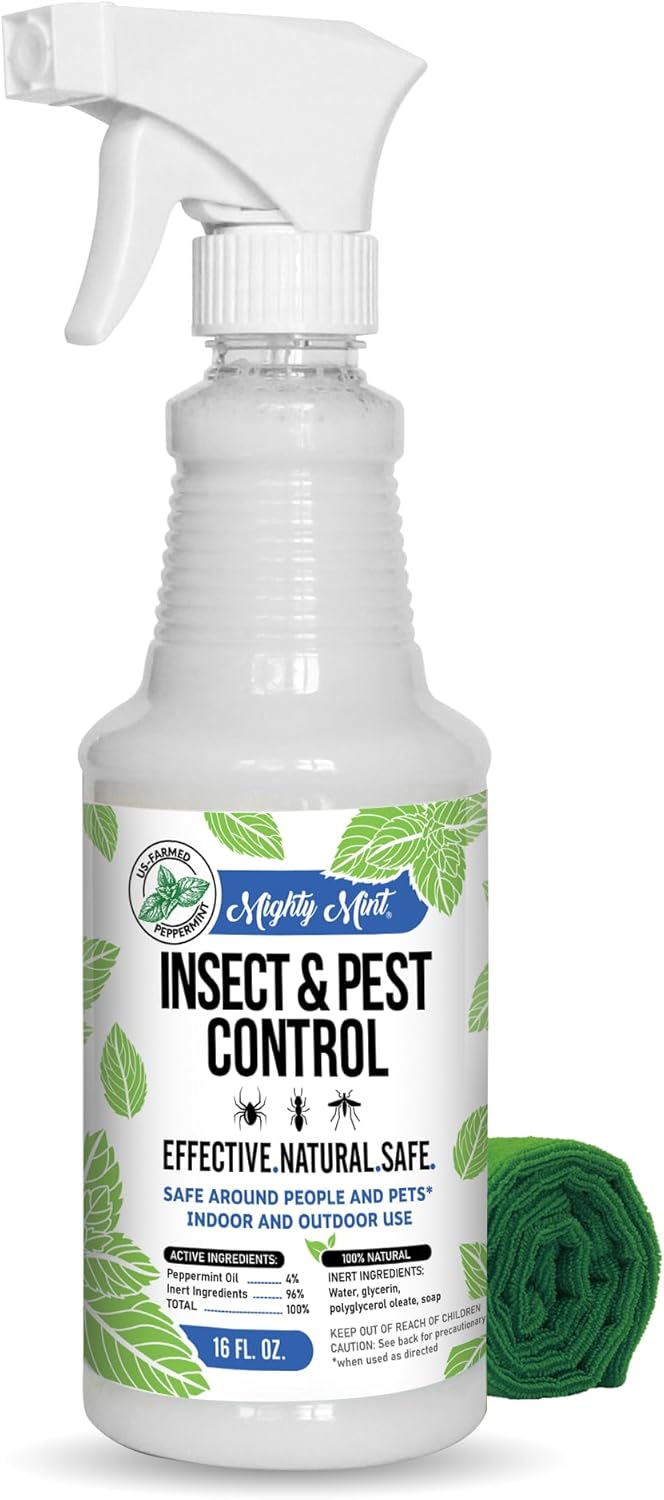
| Ingredients | Water, Glycerine, Polyglycerol oleate, Soap, Peppermint oil |
|---|---|
| Use Areas | Indoor / Outdoor |
| Size | 16 oz |
Mighty Mint is a plant-based, ready-to-use spray that uses concentrated peppermint oil to repel a broad range of household and patio pests. You apply it directly to problem areas such as baseboards, entryways, patios and around outdoor seating; the manufacturer recommends shaking and spraying until surfaces are covered and repeating applications two or more times per week for best results. Notable features include a peppermint-only scent profile, a formulation that avoids synthetic fragrances and the convenience of a 16 oz spray bottle for targeted spot treatments. Practical benefits are that it is safe to use around people and pets when dry and does not leave obvious stains on most surfaces, and the scent can make treated areas smell fresher than chemical alternatives. Important limitations are that it is a repellent rather than a pesticide so it works by discouraging pests rather than killing them, effectiveness depends on regular reapplication and it should not be applied when pollinators are present or to skin or food-contact surfaces.
Best for: Buyers who prioritize natural, low-toxicity solutions and want a targeted spray to reduce insects around patios and entryways while keeping family and pets in mind.
Less Ideal for: Anyone needing a one-time extermination or long-term residual pesticide for severe infestations should consider professional treatments or products formulated to kill pests rather than repel them.
- Plant-based peppermint formula that avoids synthetic fragrances
- Ready-to-use spray for quick, targeted indoor and outdoor applications
- Safe for people and pets when used as directed and allowed to dry
- Nonstaining on most surfaces and leaves a fresh mint scent
- Repels rather than kills insects so regular reapplication is needed to maintain protection
- Strong peppermint concentration may bother scent-sensitive individuals and requires keeping children and pets away until dry
Verdict: Choose Mighty Mint when you want a pet-friendly, plant-based spray to reduce patio and entryway insects with a fresh peppermint scent.
STEM Plant-Based Bug Spray for Ants, Roaches and Flies, 12 fl oz

| Active ingredients | Geraniol 6.2%, Lemongrass Oil 0.5% |
|---|---|
| Other ingredients | White Mineral Oil, Isopropyl Myristate, (+)-Ethyl Lactate 93.9% |
| Form | Trigger spray |
| Use | Indoor and outdoor spot treatments |
This STEM bug spray is a trigger-spray insecticide formulated with plant-derived actives such as geraniol and lemongrass oil to kill ants, roaches and flies on contact. It is intended for targeted indoor and outdoor spot treatments: shake, hold about a foot from the insect and spray directly on or where insects congregate. The product’s botanical formula and absence of added dyes or strong chemical fragrances make it a reasonable choice for homes where users prefer less synthetic-smelling options. The trigger bottle gives control for spot application and repeated short bursts, and the directions note it is oil-based so spills should be cleaned promptly. Important limitations are that it is not for spraying on people, pets or plants and requires direct hits for best effect rather than long-range fogging. For persistent infestations you may need supplemental measures because this is designed for surface and contact kills rather than residual baiting or area-wide control.
Best for: Buyers who want an affordable, low-odor botanical spray for quick spot control of common household pests and who prioritize a simple, easy-to-use trigger bottle for targeted treatments.
Less Ideal for: People facing large or hidden infestations who need long-lasting residual control or bait-style solutions should consider professional products or integrated pest control approaches.
- Plant-based active ingredients (geraniol and lemongrass oil) that reduce strong chemical odor
- Trigger-spray bottle for controlled, targeted application
- Labeled for both indoor and outdoor spot treatments when used as directed
- No added dye or fragrance listed, which minimizes residue and scent
- Oil-based formula can leave slippery residue if spilled
- Requires direct spraying of insects for effectiveness and offers limited residual control
- Not safe to spray on people, pets or plants
Verdict: A budget-friendly, low-odor plant-based trigger spray that provides quick, targeted kills of ants, roaches and flies for everyday spot treatments.
Raid House & Garden Bug Spray, 11 oz (pack of 4)

| Unit Count | 44 Ounce |
|---|---|
| Item Form | Spray |
| Target Species | Insects |
Raid House & Garden Bug Spray is an aerosol insecticide designed for quick spot control of common household and garden pests. You use it as a contact spray on visible ants, roaches, spiders, flies and many listed garden insects, indoors or on outdoor plants and surfaces. The formula advertises fast knockdown on contact with minimal lingering odor, and the aerosol delivery makes it easy to target nests, baseboards and plant foliage without mixing or specialized equipment. For reliability-focused buyers it delivers predictable, repeatable results when applied to active infestations and allows repeat applications as needed. Limitations include that it is not a residual perimeter treatment for long-term protection and repeated sprays may be needed for new arrivals; it also requires careful application around children, pets and edible plants according to label directions. Expect a straightforward, ready-to-use option for recurring spot treatments rather than a one-time cure for large infestations.
Best for: Someone who wants a dependable, easy-to-use spray for routine indoor spot control and occasional outdoor plant treatments and values predictable knockdown when pests appear.
Less Ideal for: People seeking long-lasting perimeter protection, large-scale professional pest control, or those who prefer non-chemical methods should consider other solutions.
- Ready-to-use aerosol for quick spot treatments without mixing
- Effective on both crawling and flying insects listed on the label
- Usable indoors and on garden plants for dual-purpose control
- Low lingering odor compared with many spray insecticides
- Provides contact knockdown but limited long-term residual protection
- Requires careful use around children, pets and edible gardens
Verdict: A reliable, ready-to-use aerosol for fast, repeatable indoor spot control of flies and common household insects.
ZEVO Flying Insect Aerosol Spray, 30 fl oz

| Item Volume | 30 fluid ounces |
|---|---|
| Target Species | Fly, Fruit Fly, Gnat, Mosquito |
| Included Components | Sprays |
| Brand Name | ZEVO |
ZEVO Flying Insect Aerosol is a ready-to-use spray designed to kill common flying pests on contact. You use it as a targeted aerosol: wait for the insect to land or spot it in flight, then spray directly until the insect is wet and wipe away any residue if needed. The formula uses rosemary and cornmint oils rather than a heavy synthetic odor, so it smells milder than many conventional aerosols while still delivering quick knockdown of flies, fruit flies, gnats, and mosquitoes. The product is intended for indoor and outdoor spot treatments around kitchens, bathrooms, living spaces, and patios and comes in a large 30 fl oz can that reduces the need for frequent repurchase. Important limitations are that it must be applied directly to visible insects to be effective and should not be used near food, electrical wiring, people, pets, or plants; surfaces may stain and ventilation is recommended. For someone who wants a fast, aromatic alternative to harsher sprays, this performs well when used as directed.
Best for: Buyers who prioritize quick, reliable knockdown of visible flying insects and prefer a less harsh-smelling aerosol for spot treatments in and around the home.
Less Ideal for: People seeking long-lasting residual protection, broad-area fogging, or a product they can safely apply around food prep surfaces or sensitive plants should consider other options.
- Fast-acting contact kill for flies, fruit flies, gnats, and mosquitoes
- Formula powered by rosemary and cornmint oils gives a milder scent than many conventional aerosols
- Suitable for indoor and outdoor spot treatments around living spaces
- Large 30 fl oz size reduces how often you need to replace the can
- Requires direct spray on visible insects to be effective rather than providing residual control
- Not safe for use on or around food, people, pets, or plants and can stain porous surfaces
Verdict: Choose this spray if you want fast, on‑contact elimination of indoor mosquitoes and other flying pests with a milder, plant‑oil based scent.
Choosing the Right Indoor Fly Spray: Key Factors to Consider
Knockdown Speed and Spectrum
How quickly a spray incapacitates and kills adult flies is the single most visible performance factor. Fast knockdown reduces further spreading of contaminants, limits fly movement to avoid landing on food or surfaces, and shortens the time you need to ventilate the space.
Some formulations work faster than others and may vary by fly species. Look for products that report quick knockdown for common house flies and that indicate whether they affect other nuisance flies as well.
Indoor Safety and Odor Management
Indoor sprays must strike a balance between potency and low impact on indoor air quality. Low-odor or low-VOC formulations are easier to tolerate in living spaces and reduce the need for long ventilation periods after application.
Check that the product label gives clear instructions for reentry time, surface contact guidance, and pet safety. Products designed specifically for indoor use typically include directions for minimizing inhalation and avoiding food-contact surfaces.
Application Type and Control
How you apply the spray affects both effectiveness and safety. Trigger sprays and pump-action bottles allow targeted application to specific resting sites such as window sills, light fixtures, and trash areas, reducing unnecessary aerosol in the air.
Aerosol foggers or broad-spray cans may produce faster room-wide coverage but can increase airborne particles and odor. Consider how much control you need for the room size and for avoiding sensitive areas like pet beds and open food.
Residual Activity and Re-treatment Frequency
Some indoor fly sprays leave a residual film that continues to kill or repel flies for hours or days, while others only provide immediate knockdown with no lasting effect. Residual products can reduce the frequency of reapplication but may leave visible residues on treated surfaces.
Decide whether you prefer occasional targeted treatments with residual effect or cleaner immediate-drop formulations that require more frequent application in high-pressure seasons.
Surface Residue and Cleanability
Indoor treatments will inevitably contact surfaces. Low-staining, non-greasy formulations are preferable for kitchens and visible living areas. If a product leaves a residue, the label should explain safe cleaning methods and recommended contact times before wiping.
Consider whether treated surfaces are food prep areas or where children and pets frequently touch; in those cases choose products that minimize residue or that are easy to clean after the recommended dwell time.
Label Instructions and Pet Compatibility
Carefully reading the label is essential for safe indoor use. Labels indicate legal use patterns, reentry times, ventilation requirements, and whether pets need to be removed during application or until surfaces dry.
Some formulations are explicitly labeled safe for households with pets when directions are followed. If a product lacks clear guidance for pet and child safety it is less suitable for occupied indoor spaces.
When to Use Spray Versus Nonchemical Control
Sprays are best for immediate control of visible adult flies and for spot treatments at likely resting locations. They are not a replacement for sanitation measures that reduce breeding sites such as exposed food, garbage, and pet waste.
If flies are persistent, integrate nonchemical steps: remove breeding material, use screens and traps, and maintain clean trash containers. In many cases, targeted sprays plus improved sanitation resolves infestations without repeated whole-room treatments.
- Use sprays for quick knockdown of active adult flies.
- Employ traps or sticky ribbons for monitoring and low-odor daytime control.
- Address breeding sources to reduce the need for repeated spraying.
Safe Application Tips for Indoor Use
Always read and follow the product label before use. Ventilate the room briefly after application if the label recommends it, and avoid spraying directly onto food, dishes, or cookware.
Target cracks, window sills, door frames, and other resting spots rather than broadcasting across the entire room. For trigger-spray products, use short bursts to cover surfaces lightly; for aerosols, keep a safe distance and use short bursts to avoid heavy deposition.
- Remove or cover pet bowls and fish tanks before spraying.
- Keep children and pets out of the treated area until the label-specified reentry time.
- Wipe or wash treated food-contact surfaces after the indicated dwell time.
Managing Odor and Ventilation
Low-odor formulas help when you do not want to air out living spaces for long periods. If an option has a stronger scent, ventilate by opening windows and doors for 10 to 30 minutes after application depending on label guidance.
Consider using targeted application to reduce the need for room-wide ventilation. If someone in the household is sensitive to smells or has respiratory issues, favor low-VOC products and consult label warnings.
- Open windows briefly after application unless the label advises otherwise.
- Use targeted sprays to limit airborne odor and particulates.
- Avoid spraying near HVAC intakes to prevent distribution through a home.
Combining Sprays with Traps and Exclusion
Sprays provide immediate reduction of adult flies, while traps and exclusion measures prevent re-entry and reduce the population over time. Use fly traps to capture survivors and to monitor whether further treatments are needed.
Seal gaps around doors and windows, repair screens, and keep trash tightly covered to make spray treatments more effective and longer lasting.
- Place traps near likely entry points and away from food prep areas.
- Check and replace trap cartridges or adhesive strips as recommended.
- Seal door gaps and repair window screens to block future entry.
How We Chose the Best Indoor Fly Spray
We selected products based on criteria that matter when treating flies inside homes, apartments, and small enclosed spaces. First, efficacy against adult flies was prioritized using reported knockdown speed and reported residual activity in indoor conditions. Second, indoor safety features were evaluated, including low-odor formulations, reduced aerosol drift, and availability of clear label instructions for use around people and pets. We also assessed formulation type and application control to favor options that minimize airborne particulates and surface residues. Ease of application and versatility for common indoor scenarios were considered, such as trigger-spray versus aerosol and suitability for use in kitchens, living rooms, and near pet areas. Packaging and nozzle control were checked for precision targeting to avoid over-application. Products that lacked adequate indoor use instructions or that were intended exclusively for outdoor, agricultural, or food-processing environments were excluded. Overall, the shortlist reflects options that balance quick fly knockdown with practical indoor safety and minimal lingering odor.
FAQ
Are indoor fly sprays safe to use around pets?
It depends on the formulation and label directions. Many sprays are safe when you remove pets during application and allow treated surfaces to dry before returning animals. Always follow label instructions for pet safety and any required reentry times.
How long should I ventilate the room after spraying?
Ventilation guidance varies by product. Low-odor indoor options may require only brief airing, while stronger aerosols could need longer ventilation. Follow the label, which states reentry and ventilation recommendations.
Will indoor fly spray get rid of fly larvae and breeding sites?
Most sprays target adult flies and do not affect larvae in breeding sites. To eliminate larvae you need to remove their food sources, clean soiled areas, and treat or discard infested material. Combining sanitation with sprays gives the best results.
Can I spray near food preparation areas?
Do not spray directly onto food or food-contact surfaces. If you must treat near food prep areas, cover surfaces and utensils, apply sparingly to adjacent nonfood surfaces, and clean treated areas as instructed on the label after the specified dwell time.
How often can I reapply indoor fly spray?
Reapplication intervals depend on the product's residual activity and label directions. Some products are designed for single-use spot treatments, while others have residual effects that allow less frequent applications. Follow the label for safe reapplication timing.
Are pump sprays better than aerosols for indoor use?
Pump or trigger sprays offer greater targeting and produce fewer airborne particulates, making them preferable in many indoor settings. Aerosols can cover larger areas more quickly but may increase odor and aerosol drift. Choose based on room size and sensitivity concerns.
Final Verdict
Pick a spray that matches how you plan to use it: fast knockdown for occasional incursions, residual control for repeated pressure, or low-odor formulations for occupied living spaces. Prioritize clear label directions for indoor safety, reentry times, and pet compatibility. Combine targeted spray use with sanitation, traps, and exclusion to reduce reliance on chemical treatments. That balanced approach delivers reliable fly control while minimizing exposure and residue in your home.
