

Note: This article contains affiliate links. If you click on these links and make a purchase, I may earn a small commission at no extra cost to you. This helps support my research and content. Read my full affiliate disclosure here.
When a tree shows signs of leaf spots, cankers, or powdery mildew, the right fungicide can stop disease spread and protect long-term vigor. You need a product that covers leaves and bark, persists through rain and sun, and fits how you apply treatments in your yard or landscape. This guide presents seven shortlisted fungicides for trees chosen for their application flexibility, active ingredients, and documented performance in common tree diseases. Below you will find practical notes on why each option made the list and the evaluation criteria used to judge them, so you can match a product to your tree species, timing window, and spray setup.
Top Picks at a Glance
| Best Overall The best all-around choice for most situations | Bonide Captain Jack Copper Fungicide 16 oz Concentrate |  |
| Best Quality Built to a higher standard if you want something more solid | VivaGrow Reliant Systemic Fungicide, 1 Gallon |  |
| Best Value The sweet spot between price and what you get | BioAdvanced 3-in-1 Fruit, Citrus & Nut Tree Spray, 32 oz |  |
| Best Budget The cheapest option that still gets the job done reliably | Southern Ag Liquid Copper Fungicide, 8 oz |  |
| Highest Rated A top-rated pick with lots of positive feedback | Monterey Fungi-Max Systemic Fungicide, 16 fl oz |  |
| Most Popular A crowd favorite that many people choose with confidence | Bonide Captain Jack's Neem Oil 128 oz Ready-to-Use Spray |  |
| Best Seller A high-volume bestseller chosen again and again | Bonide Captain Jack's Liquid Copper Fungicide Ready-to-Use, 32 oz |  |
Bonide Captain Jack Copper Fungicide 16 oz Concentrate

| Unit Count | 16 Ounce |
|---|---|
| Item Form | Liquid |
| Target Species | Fungus |
| Active Ingredients | Copper Octanoate (Copper Soap) |
Bonide Captain Jack Copper Fungicide is a liquid concentrate designed to prevent and treat a broad range of fungal diseases on vegetables, fruits, ornamentals, and turf. Mixed with water per label directions, it is sprayed onto plant surfaces, including tops and undersides of leaves, and can be applied up to the day of harvest, which makes it practical for food crops like tomatoes. The active ingredient copper octanoate provides contact protection against powdery mildew, blight, black spot, rust, peach leaf curl and similar diseases. Application is straightforward and repeatable every 7 to 10 days as needed, and the product is cleared for use in organic gardening. Limitations to consider are that copper is a contact fungicide so it does not systemically move through the plant and works best as a preventative or early-treatment tool rather than curing severe systemic infections. Users should follow safety directions and avoid overuse to reduce copper buildup in soil.
Best for: Gardeners looking for a performance-focused, organic-approved fungicide to include in a preventative disease program for tomatoes and other edibles.
Less Ideal for: Growers seeking a systemic treatment for already advanced internal infections or those who prefer non-copper chemistries to avoid soil accumulation.
- Approved for organic gardening and can be used up to the day of harvest
- Controls a wide range of common diseases affecting tomatoes such as blight and powdery mildew
- Concentrated liquid formula mixes with water for spray application
- Repeatable 7–10 day application schedule makes preventative programs easy to maintain
- Acts as a contact fungicide and does not move systemically within the plant
- Repeated use can contribute to copper accumulation in soil if not managed
Verdict: Use this organic-approved copper concentrate when you want an effective, easy-to-apply preventative spray to protect tomatoes from common fungal diseases.
VivaGrow Reliant Systemic Fungicide, 1 Gallon

| Item Form | Spray |
|---|---|
| Target Species | Fungus |
| Special Features | organic |
| Liquid Volume | 1 gallons |
Reliant is a concentrated systemic fungicide formulated for foliar spray or soil drench use that moves through the plant to provide both curative and preventive control of many common pathogens. It is quickly absorbed by leaves and roots and redistributed internally, which makes it useful on trees where surface sprays alone often fail to reach infected tissues. The product lists broad-spectrum activity against oomycetes and many fungal and bacterial diseases, and it is approved as a biorational product with relatively low environmental impact. In practice you mix the concentrate with water according to label directions and apply as a spray to foliage or as a drench to the root zone; systemic movement helps protect new growth and can treat existing infections. Limitations to consider are that proper dosing and timing are important for tree applications, and label directions must be followed for crop/site approvals and safety precautions. This is best used as part of an integrated disease management program rather than a standalone fix for severe or advanced infections.
Best for: Tree owners and landscapers seeking an effective, systemic option to manage and prevent common fungal and oomycete diseases while prioritizing performance and plant health integration.
Less Ideal for: Home gardeners wanting an immediate contact-only spray for superficial leaf spots or those unwilling to follow specific application labels and safety precautions should consider simpler contact fungicides or consulting a professional.
- Systemic action absorbed by foliage and roots for internal distribution
- Curative and protective activity that treats existing disease and shields new growth
- Concentrated formula that mixes with water for foliar spray or drench applications
- Broad-spectrum control including Phytophthora, Pythium, downy mildews and many leaf and root diseases
- Approved by EPA Biopesticide Division as a biorational fungicide with minimal environmental impact
- Requires careful adherence to label for rates, timing, and approved uses
- Not a quick surface contact fix for severe, established cankers or advanced structural infections
Verdict: Choose Reliant when you need a performance-oriented systemic fungicide for trees that provides both curative action on existing infections and ongoing protection for new growth.
BioAdvanced 3-in-1 Fruit, Citrus & Nut Tree Spray, 32 oz

| Item Form | Liquid |
|---|---|
| Target Species | Insects |
| Included Components | 32 Oz Fruit & Nut Tree Care |
This BioAdvanced 3-in-1 tree spray combines insecticide, miticide, and fungicide activity in a hose‑connected ready-to-spray bottle so you can treat trees quickly without mixing concentrates. It is applied by attaching the sprayer to a garden hose and thoroughly wetting foliage and new shoots until dripping, which delivers broad coverage for pests such as aphids and caterpillars plus disease control for black spot, powdery mildew, and rust. The ability to use it up to the day before harvest makes it practical for edible trees and vines, and the hose connection saves time on larger specimens compared with hand‑spraying. Limitations to expect are that it controls only listed pests and diseases on the label rather than every possible problem and that hose-end delivery can use more water and product than targeted spot treatments. Follow label directions closely for safe use and to avoid off-target spray.
Best for: Gardeners who prioritize efficient, time-saving disease and pest control for edible trees and vines and want a single product to handle common fungal and insect problems.
Less Ideal for: Growers who need highly targeted spot treatments, organic-certified products, or control of pests and diseases not listed on the label should consider alternatives.
- Three-in-one formula treats insects, mites, and fungal diseases in a single application
- Ready-to-spray hose attachment eliminates mixing and speeds up coverage for trees and vines
- Label allows use up to the day before harvest, suitable for edible fruit and nut trees
- Broad coverage when sprayed thoroughly, reaching new shoots where pests and diseases often start
- Only effective against pests and diseases specifically listed on the product label
- Hose-end application can be less precise and may use more water and product than spot treatments
Verdict: If you want a quick, one-step hose‑on solution to control common insects, mites, and fungal diseases on fruit and nut trees, this 3-in-1 spray is an efficient pick.
Southern Ag Liquid Copper Fungicide, 8 oz

| Unit Count | 8 Ounce |
|---|---|
| Item Form | Liquid |
| Target Species | Fungus |
| Special Features | organic |
Southern Ag Liquid Copper Fungicide is a concentrated 8 oz liquid designed to control a wide range of bacterial and fungal problems on trees and other plants. It is mixed by teaspoon-per-gallon rates and applied with standard garden sprayers or hose-end applicators to treat leaf spots, rusts, blights, algae on turf and moss on live oaks. The label lists many specific uses from apples and peaches to ornamentals and landscape palms, so it is versatile for general tree disease management. The active copper complex gives reliable preventive control and can be used on food-bearing plants when label directions are followed. Practical benefits include small-bottle convenience for occasional spot treatments and compatibility with common sprayers. Limitations are that it is a preventive/contact material rather than a systemic cure, so thorough coverage and repeat applications are required for effective control; users must also follow safety directions and label rates precisely to avoid plant injury or residue issues.
Best for: Home gardeners and property owners looking for an affordable, general-purpose fungicide to prevent and manage common tree and landscape diseases while treating occasional problem spots.
Less Ideal for: Large-acreage users, commercial arborists, or anyone needing systemic long-term disease control for many trees across a property.
- Broad-spectrum activity against many bacterial and fungal leaf spots, rusts and blights
- Rated for use on trees, ornamentals, vegetables and turf including algae and moss control
- Concentrated formula that mixes by teaspoon-per-gallon for flexible application rates
- Small 8 oz bottle is convenient for spot treatments and occasional use
- Acts as a contact/preventive fungicide so it requires good coverage and repeated applications
- Small bottle may not be economical for treating large properties or frequent use
Verdict: A compact, budget-friendly copper fungicide that reliably prevents common fungal and bacterial diseases on trees and landscape plants when used as directed.
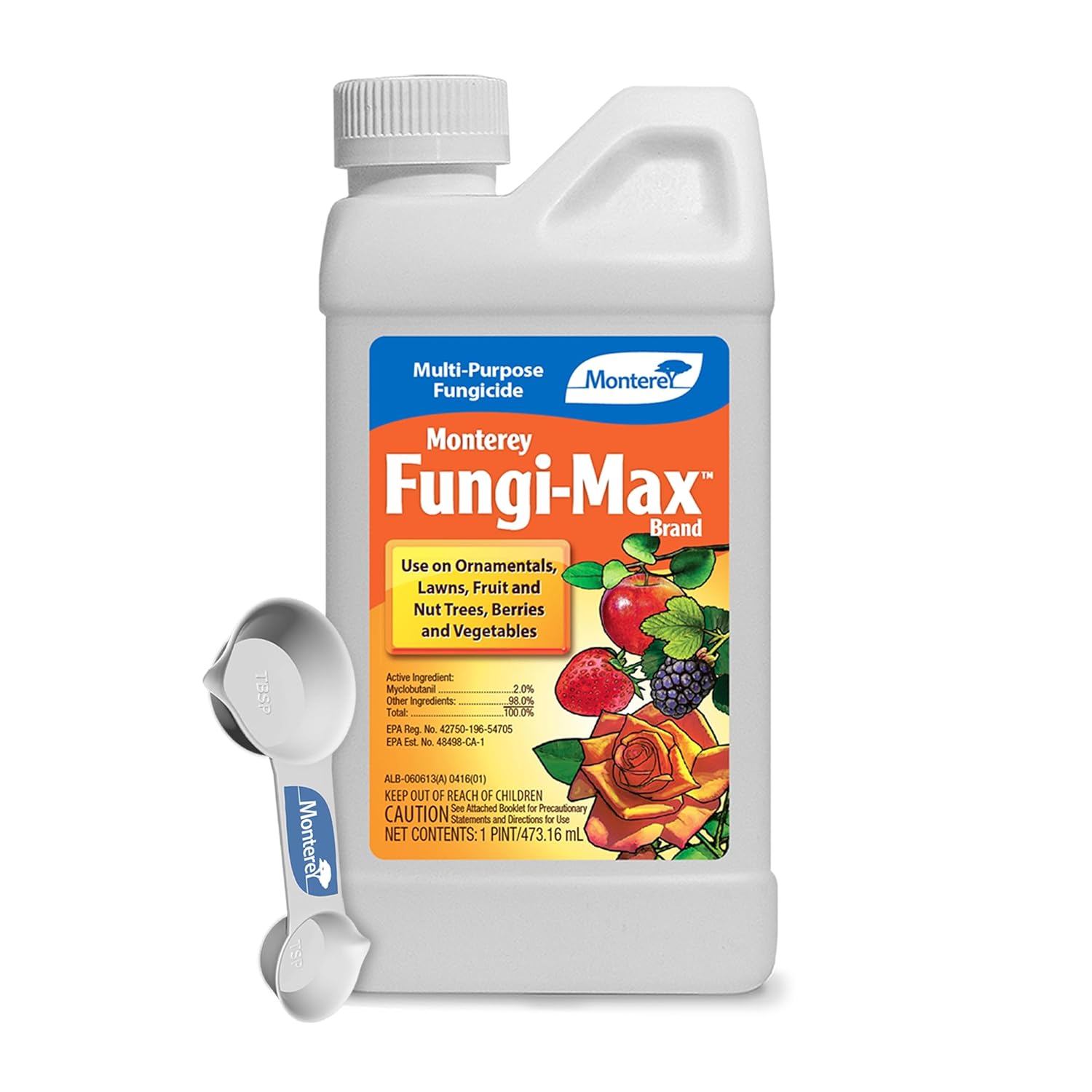
Monterey Fungi-Max Systemic Fungicide, 16 fl oz
| Item Form | Liquid |
|---|---|
| Application Method | Spray |
| Coverage | Wide range of plants and plant types |
| Target Species | Flowers, Vegetables, Trees, Lawn Grass |
| Liquid Volume | 16 fluid ounces |
Monterey Fungi-Max is a concentrated liquid fungicide formulated for home garden and landscape use to prevent and control common fungal diseases. You mix the product with water and apply it with a spray tank or pump sprayer; it works systemically so the active ingredient moves into plant tissue to protect leaves, stems, and roots. The label cites control for problems like powdery mildew, rust, leaf spots, crown rot, and several turf diseases, and the manufacturer says one application can protect plants for up to two weeks. Because it covers flowers, shrubs, fruit and nut trees, vegetables, and lawns, it is useful for mixed gardens where multiple plant types need disease management. Practical benefits include broad-spectrum disease coverage, systemic action that reaches new growth, and straightforward dilution and spray application. Important limitations are the need to follow label directions carefully for timing and mixing, potential incompatibility with certain sprayers or tank mixes, and the fact that repeat applications may be required for ongoing pressure or severe outbreaks.
Best for: Home gardeners and property owners who prioritize dependable, proactive disease control across mixed plantings and want a product that reaches plant tissue rather than only contact protection.
Less Ideal for: Organic gardeners or those seeking a contact-only, ready-to-use spray should consider alternatives designed for certified organic use or simpler ready-mix formulations.
- Systemic action that protects new growth after application
- Broad listed coverage for ornamentals, vegetables, fruit trees and turf
- Suitable for spray-tank or pump-sprayer application for yard-scale use
- One application offers up to two weeks of protection under normal conditions
- Not an organic or OMRI-listed product, so not suited for certified organic production
- Requires careful dilution and label reading to avoid misuse
Verdict: Choose Monterey Fungi-Max when you need a reliable, systemic fungicide that provides broad disease protection across a diverse home garden.
Bonide Captain Jack's Neem Oil 128 oz Ready-to-Use Spray

| Item Form | Ready-To-Use |
|---|---|
| Liquid Volume | 128 fluid ounces |
| Active Ingredients | Clarified Hydrophobic Extract Of Neem Oil |
| Target Species | Insects |
Bonide Captain Jack's Neem Oil is a large ready-to-use spray formulated to control fungal diseases, insect pests, and mites on trees, shrubs, and other garden plants. The product is applied by shaking and spraying to runoff, with directions to reapply every 7 to 14 days; the included nozzle makes treating branches and trunk collars straightforward. Active ingredient listed as a clarified hydrophobic extract of neem oil provides both preventive and curative activity against powdery mildew, rust, blight and common insects such as aphids, whiteflies, and spider mites, and it targets eggs through adults for fuller control. Practical benefits for tree care include suitability for organic gardening and labeled use up to the day of harvest for fruit trees. Limitations are the need for repeated applications for ongoing pressure and that heavy infestations or systemic diseases may require complementary cultural controls or different chemistries for complete control. Users should follow label directions for coverage and timing to avoid phytotoxicity in sensitive situations.
Best for: Gardeners who want a broadly effective, organic-friendly spray to manage fungal problems and common pests on landscape and fruit trees and who prefer a proven, widely used product backed by many user reviews.
Less Ideal for: Users seeking a one-time systemic treatment for deep or chronic tree diseases or severe infestations should consider professional or systemic products instead.
- Multi-purpose formula that controls fungal diseases, insects, and mites
- Ready-to-use with included spray nozzle for easy application to trees
- Approved for organic gardening and labeled for use up to harvest on edible trees
- Effective against multiple insect life stages including eggs, larvae, and adults
- Requires repeat applications every 7–14 days for sustained control
Verdict: Choose this ready-to-use neem oil spray when you want an organic-approved, multipurpose product to prevent and manage common fungal diseases and pests on trees.
Bonide Captain Jack's Liquid Copper Fungicide Ready-to-Use, 32 oz

| Unit Count | 32 Ounce |
|---|---|
| Item Form | Spray |
| Active Ingredients | copper |
Bonide Captain Jack’s Liquid Copper Fungicide is a trigger-spray, ready-to-use copper solution designed to prevent and treat common fungal diseases on fruits, vegetables, nuts, herbs and ornamentals. It is applied by shaking the bottle and thoroughly spraying tops and undersides of leaves, with repeat applications every 7 to 10 days or as needed. The product is labeled for organic gardening and can be used up to the day of harvest, making it practical for vegetable beds and fruit trees where residue concerns matter. Notable features include its broad-spectrum activity against powdery mildew, leaf spot, blight and peach leaf curl, and the convenience of a pre-mixed spray bottle that removes measuring or mixing. Limitations are inherent to copper products: it treats fungal problems but does not replace cultural controls like good airflow and sanitation, and overuse of copper can accumulate in soil so following label directions is important. As a ready-to-use option, it is best for gardeners who want a simple, approved solution for recurring fungal issues without handling concentrates.
Best for: Gardeners who prioritize proven, labeled products and want an easy-to-use organic-approved fungicide for edible beds and ornamentals based on real-world effectiveness and peer recommendations.
Less Ideal for: Gardeners seeking an all-in-one pest control product or those who prefer to avoid any copper-based treatments should look at non-copper alternatives or integrated disease-management approaches.
- Ready-to-use trigger spray requires no mixing or measuring
- Approved for organic gardening and can be applied up to day of harvest
- Effective against a broad range of common fungal diseases
- Convenient repeat-application interval (7–10 days) for ongoing control
- Contains copper which can build up in soil with excessive use
- Does not address non-fungal problems like insects or bacterial diseases
Verdict: A convenient, ready-to-use copper fungicide for gardeners who want an effective organic-approved spray to manage common fungal diseases.
Choosing the Right Fungicide for Trees: Key Factors to Consider
Active Ingredient and Mode of Action
Different active ingredients target fungi in distinct ways, and that affects how you use a fungicide on trees. Contact actives remain on the surface and kill spores on contact, so thorough coverage of leaves and bark is crucial. Systemic actives are absorbed and move through plant tissues, offering internal protection that can help control infections not reached by surface sprays.
Choosing a product with the correct mode of action also matters for resistance management. Rotating or tank-mixing products with different modes of action reduces the chance that pathogens become less sensitive over time. Consider the typical diseases in your area and pick an active ingredient known to be effective against those pathogens.
Residual Persistence and Rainfastness
Residual persistence describes how long the fungicide stays effective on foliage or bark after application. Longer residuals reduce the frequency of reapplication, which is useful for large or tall trees where spraying is labor-intensive. However, longer persistence can be affected by sunlight breakdown, heavy rainfall, and leaf growth.
Rainfastness is related but distinct. Some fungicides bind quickly and resist wash-off after a short drying period, while others lose efficacy with rain within hours. Match the product's residual claims to your local weather patterns and the likelihood of rainfall after application.
Coverage and Spray Technology
On trees, thorough coverage is often the single most important practical factor. Leaves on the inner canopy, undersides, and crotches can harbor spores and early infections. Choose formulations and droplet sizes that improve coverage and consider adjuvants when allowed by the label to help spread and stick on waxy leaves.
Spray equipment matters too. Backpack sprayers, hose-end sprayers, or professional boom and atomizer rigs deliver different droplet spectra and reach. The product should mix cleanly and be compatible with the equipment you plan to use.
Label Directions and Safety for Trees
Always match the product's labeled uses to the tree species and planting situation. Label directions specify allowed application rates, maximum seasonal uses, pre-harvest intervals for fruit trees, and personal protective equipment recommendations.
Proper adherence to label instructions protects tree health and ensures legal and safe use. Pay attention to restrictions on tank mixes, re-entry intervals, and environmental precautions such as proximity to water bodies or pollinator exposure.
Formulation Type and Mixing Convenience
Fungicides come as ready-to-use sprays, water-dispersible granules, soluble concentrates, or wettable powders. Ready-to-use options reduce mixing errors but may be less economical for large jobs. Concentrated formulations usually give a more flexible cost-per-area and are better for treating multiple trees.
Mixing convenience and clarity of directions reduce mistakes. Some formulations settle or require constant agitation, which matters if using a hand-pump sprayer or a tank without agitation. Check if the product requires an adjuvant for best performance and whether the label allows common spreader-stickers.
Timing and Disease Cycle Fit
Effective control often depends on timing relative to the disease cycle. Some pathogens require repeat protective sprays beginning at bud break or leaf expansion, while others are treated reactively after symptoms appear. Know whether the fungicide is better used as a preventive or curative product.
For perennial trees, plan multi-season strategies. Preventive sprays at vulnerable phenological stages can be more effective and less disruptive than late, heavy reactive treatments once a pathogen is well-established.
How Treatments Differ Between Shade Trees and Fruit Trees
Shade and ornamental trees are usually managed to preserve canopy appearance and longevity, with attention to leaf aesthetic and structural integrity. Fruit trees need extra consideration for pre-harvest intervals, pollinator safety during bloom, and residue limits on edible parts. The timing of sprays and allowed chemistries often differs between these two uses.
- Avoid applying fungicides during bloom on fruit trees unless the label explicitly permits it and pollinator risk is addressed.
- For large shade trees, focus on products and spray techniques that maximize canopy penetration and coverage.
Application Methods for Tall or Mature Trees
Treating tall trees requires planning. For trees beyond ladder reach, ground-based high-volume sprays, professional aerial or boom equipment, or systemic applications that require less frequent coverage become attractive. Always follow label limits on volume per acre and do not exceed maximum seasonal rates.
When using ground sprays, aim to reach the inner canopy where spores often originate; multiple angles and higher spray volumes improve penetration.
- Use droplet sizes that balance drift control with canopy penetration.
- Consider systemic products when canopy reach is limited.
Integrating Cultural Controls With Fungicide Use
Fungicides are most effective when paired with cultural practices that reduce disease pressure. Remove and destroy heavily infected leaves, prune to improve airflow and light penetration, and avoid overhead irrigation that extends leaf wetness duration.
A healthy tree is less susceptible to severe infections, so maintain proper fertilization and watering to reduce stress that predisposes trees to fungal attack.
- Prune during dry weather to reduce spread of spores.
- Sanitize pruning tools between trees with visible disease symptoms.
Resistance Management Strategies
Repeated use of the same active ingredient increases resistance risk. Alternate products from different chemical classes and follow labeled rotation intervals to preserve efficacy. When tank-mixing, ensure the label allows the combination and that you are not combining two products with the same mode of action.
Record applications including active ingredient used and dates to support informed rotations across seasons.
- Rotate modes of action across applications within a season when feasible.
- Avoid unnecessary preventive applications when disease pressure is low.
Safety, Environmental, and Pollinator Considerations
Follow label PPE requirements to protect yourself. Pay special attention to wind, temperature, and humidity to minimize drift and off-target exposure. For fruit trees, respect pre-harvest intervals to avoid residues on harvested produce.
Protect pollinators by avoiding applications during bloom and early morning or evening periods when bees are most active. Keep fungicides away from waterways and use buffer zones as specified on the label.
- Check label for aquatic warnings and buffer requirements.
- Delay irrigation until sprays have dried when label supports that practice.
How We Chose the Best Fungicide for Trees
We focused on fungicides that are appropriate for use on woody plants and tree species in ornamental, shade, and fruit-bearing contexts. Selection prioritized active ingredients with documented efficacy against common tree pathogens such as leaf spot, powdery mildew, anthracnose, rusts, and twig or trunk cankers, plus formulations suited to typical homeowner and small-scale professional applications. Our evaluation criteria emphasized coverage and spread on foliage and bark, residual activity after application, label directions and safety precautions for trees, and ease of mixing and application with common spray equipment. We also considered formulation versatility across spray, systemic uptake, and whether the product is labeled for foliar and trunk treatments when relevant. Excluded items included products labeled only for turf, agricultural row crops, or indoor houseplants that lack tree-specific directions. We also excluded materials requiring specialized commercial licenses where homeowner or landscape use is inconsistent with typical tree care. The final list reflects a balance between contact and systemic modes of action, practical application methods for homeowners and landscapers, and documented control of the pathogens most likely to threaten trees in residential and public landscapes.
FAQ
When should I start applying fungicide to a newly planted tree?
Timing depends on the disease risk and the pathogen life cycle. For diseases that overwinter on leaves or bark, preventive sprays beginning at bud break or first sign of green growth are often most effective. Newly planted trees also benefit from cultural care to reduce stress before considering chemical protection.
Can I use the same fungicide on both leaves and trunk infections?
Some products are labeled for both foliar and localized trunk or branch treatments, while others are foliar-only. Check the label to confirm allowed application sites and whether systemic uptake is needed for internal canker control.
How often should I reapply fungicide during a high-pressure season?
Reapplication intervals vary by product residual and disease pressure. Under heavy disease pressure, follow the shorter interval on the label and consider rotating modes of action. Do not exceed the maximum seasonal applications listed on the label.
Will fungicide harm beneficial insects or birds in my yard?
Most fungicides pose low direct acute risk to birds, but impacts on beneficial insects depend on product type and timing. Avoid spraying during bloom and follow label precautions to minimize pollinator exposure. Using targeted applications instead of broad-sweep sprays reduces non-target risk.
Can I tank-mix a fungicide with an insecticide or fertilizer?
Tank mixes are sometimes allowed but must be explicitly permitted by the labels of both products. Conduct a small jar test where labels allow to check compatibility and avoid mixes that cause phytotoxicity, especially on sensitive species or during hot weather.
What should I do if rain washes off a recent application?
If rain occurs within a short window after application and the label cites loss of efficacy, reapply according to label directions. For systemic products, rain shortly after application is less likely to reduce effectiveness once uptake has occurred.
Final Verdict
Choose a fungicide for trees based on the pathogen you need to control, the application method you can achieve, and the timing required by the disease cycle. Prioritize label scope for tree species, mode of action diversity for resistance management, and products whose persistence matches your local weather patterns. Balancing preventive timing, canopy coverage, and cultural practices will deliver the best long-term results. Use the evaluation criteria in this guide to match a product to the size and type of trees you care for and the resources you have for application and follow-up treatments.
