

Note: This article contains affiliate links. If you click on these links and make a purchase, I may earn a small commission at no extra cost to you. This helps support my research and content. Read my full affiliate disclosure here.
If deer are browsing your shrubs, vegetable beds, or ornamental borders, choosing the right solar deer repellent can save time and prevent repeated plant losses. Solar units offer hands-free operation and avoid wiring or frequent battery swaps, but they vary in detection range, coverage pattern, durability, and nuisance triggers. This guide covers seven top solar deer repellents shortlisted for common yard and garden situations so you can match a unit to your property size and planting layout. Below we summarize the evaluation criteria used and explain the practical differences that matter when selecting a device for a home landscape or small acreage. Read on to compare coverage, weather resistance, and runtime before the product list.
Top Picks at a Glance
| Best Quality Built to a higher standard if you want something more solid | G-Jyuncyou Solar Ultrasonic Animal Repeller (2-Pack) |  |
| Best Value The sweet spot between price and what you get | Grrwz Solar Ultrasonic Outdoor Animal Repellent, 2-Pack |  |
| Best Budget The cheapest option that still gets the job done reliably | CKCOEO Solar Ultrasonic Animal Repellent with Motion Sensor and Strobe Light |  |
| Highest Rated A top-rated pick with lots of positive feedback | JahyElec Solar Ultrasonic Animal Repellent (4-Pack) with PIR Motion Sensor and Strobe Light |  |
| Most Popular A crowd favorite that many people choose with confidence | CKCOEO Solar Ultrasonic Outdoor Animal Repellent, 2-Pack |  |
| Best Seller A high-volume bestseller chosen again and again | Broox RB-101 Solar Ultrasonic Animal Repellent |  |
G-Jyuncyou Solar Ultrasonic Animal Repeller (2-Pack)
| Power Source | Solar Powered |
|---|---|
| IP Rating | IP65 |
| Frequency Range | 18–45 kHz |
| Charging | Solar and USB charging option |
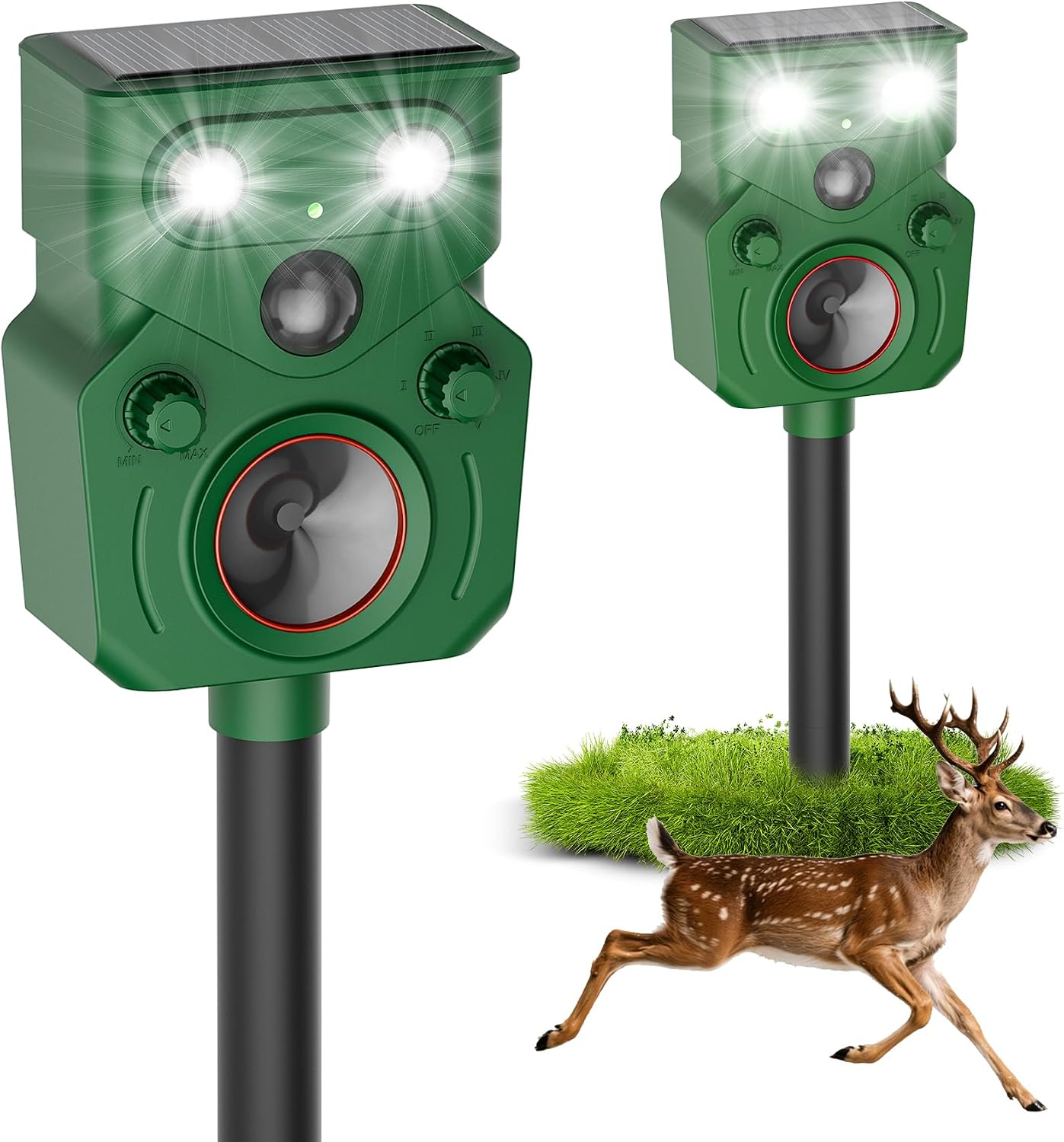
This two-pack of G-Jyuncyou solar ultrasonic repellers combines PIR motion detection, adjustable ultrasonic frequency and strobe lighting to protect yards, orchards, and gardens from deer, raccoons, coyotes and similar animals. Install by staking into the ground or hanging; the PIR sensor triggers ultrasonic pulses (18–45 kHz depending on mode) and flashing LEDs when animals enter the detection zone. There are five modes including sweep, high-frequency, full cycle and strobe-only, plus separate knobs for sensitivity and frequency so you can tune coverage for different animals and distances. Solar panels recharge during the day and a USB port lets you top up the internal battery when sunlight is limited. The unit is IP65 rated, built from ABS plastic, and intended for continuous outdoor use. Important limitations are that ultrasonic effectiveness varies by species and environment and requires correct placement and angle; sound does not physically harm animals and results are not instant in every situation. The device is best used as part of a layered approach to deer control rather than a guaranteed single solution.
Best for: Buyers who prioritize a low-maintenance, weatherproof deterrent they can rely on for continuous outdoor protection and who want the ability to fine-tune detection and frequency settings.
Less Ideal for: Those seeking an immediate, guaranteed elimination of large herd deer or users who prefer physical exclusion methods only should consider alternative or additional solutions.
- Adjustable frequency and sensitivity knobs let you target different animals and tune detection range.
- Dual charging via solar panel plus USB ensures power even in cloudy weather or winter.
- IP65 waterproof rating and ABS construction for outdoor durability.
- Multiple working modes including strobe-only and full-cycle provide flexible deterrent patterns.
- Ultrasonic effectiveness depends on species, landscape and placement so results can vary.
- No detailed coverage radius provided, so planning exact placement requires trial and error.
Verdict: A weatherproof, adjustable solar-powered repeller that provides reliable, low-maintenance deterrence when used as part of a broader deer-control strategy.
Grrwz Solar Ultrasonic Outdoor Animal Repellent, 2-Pack

| Unit Count | 2 Count |
|---|---|
| Detection range | Up to 30 ft |
| Coverage angle | 150° |
| Weather resistance | IP65 |
This Grrwz two-pack of solar ultrasonic repellers is designed to protect gardens and yards by pairing a PIR motion sensor with high-frequency sound and a bright strobe when animals enter a 150°/30 ft detection zone. Set up is simple: stake the unit about 9 to 10 inches into the ground or hang it on a fence, let the panel charge in sun for a short period, then leave it to run day and night using stored solar energy. The combination of sound plus flashing light gives a clear, nonlethal deterrent that requires no chemicals, baits, or maintenance beyond occasional cleaning. The ABS housing and IP65 rating mean the units tolerate rain and snow so you can leave them outside year-round. Practical limitations to note are that effectiveness depends on placement and line of sight, some wild animals can become habituated over time, and very cloudy locations will reduce daily solar charging and runtime. For a performance-focused solution that minimizes hands-on upkeep, these devices offer a scalable way to protect multiple problem areas around a yard.
Best for: Buyers who want a low-maintenance, performance-focused way to reduce cat and other animal activity around gardens or yards without chemicals or traps.
Less Ideal for: People who need guaranteed exclusion for heavily infested areas or who lack reliable sunlight for solar charging should consider wired or higher-powered alternatives.
- Motion-activated PIR sensor with up to 30 ft range and 150° coverage for wide detection
- Dual-action deterrent using ultrasonic sound and bright strobe light for stronger stimulus
- Solar-powered with battery backup for continuous day and night operation without wiring
- IP65 weatherproof ABS housing built to withstand rain, snow, and outdoor conditions
- Performance depends on correct placement and sufficient sunlight for charging
- Some wildlife may habituate to the stimulus over time, reducing long-term effectiveness
Verdict: A hands-off, solar-powered deterrent built for reliable, wide-coverage animal control around yards and gardens.
CKCOEO Solar Ultrasonic Animal Repellent with Motion Sensor and Strobe Light

| Power source | Solar |
|---|---|
| Detection angle | 150 degrees |
| Detection range | 25-30 ft |
| Waterproof rating | IP65 |
This solar ultrasonic repellent combines a PIR motion sensor, high-frequency sound pulses, and a flashing strobe to keep small mammals out of gardens and yards. Install it on a stake about 9 to 10 inches above the ground or hang it on a fence facing animal paths; when the sensor detects movement within about 25 to 30 feet and 150 degrees, the unit emits ultrasonic bursts and a bright LED flash for immediate deterrence and then returns to standby. The built-in solar panel charges the internal battery so the device runs after dark without wiring, and the IP65 ABS housing tolerates rain and sprinklers for year-round outdoor use. Practical benefits include easy, tool-free setup, chemical-free operation, and coverage that targets a wide range of species. Limitations to note are the need for good sun exposure to maintain charge, an advertised adjustment period of a few weeks for persistent animals, and the typical line-of-sight requirement of ultrasonic devices which reduces effectiveness around dense vegetation or obstructed approaches.
Best for: Gardeners and yard owners who want a low-maintenance, chemical-free deterrent that can be set-and-forgotten to reduce small mammal damage around beds and lawns.
Less Ideal for: People with shaded sites that get little direct sun or those who need immediate, guaranteed removal of persistent animals in heavily obstructed areas.
- Solar-powered with on-board charging so it runs at night without external power
- PIR motion sensor covers up to about 150 degrees and 25–30 feet for triggered activation
- IP65-rated ABS housing protects electronics from rain and outdoor conditions
- Dual-action deterrent using ultrasonic pulses plus flashing LED to startle animals
- Performance depends on direct sunlight for reliable charging and runtime
- Ultrasonic effectiveness is reduced by obstacles and may take weeks for animals to adapt or leave
Verdict: A hands-off, solar-powered ultrasonic repeller that gives practical, weatherproof protection against squirrels and other small pests for sun-exposed gardens.
JahyElec Solar Ultrasonic Animal Repellent (4-Pack) with PIR Motion Sensor and Strobe Light

| Power Source | solar_powered |
|---|---|
| Unit Count | 4 Count |
| Number of Pieces | 4 |
| Waterproof Rating | IP65 |
This 4-pack solar ultrasonic repellent is designed as a low-maintenance solution for keeping deer, rabbits, raccoons, squirrels, and stray cats away from gardens and lawns. Each unit mounts on a stake or can be hung, uses a top-mounted solar panel to recharge, and activates automatically when the PIR motion sensor detects movement within a wide angle. When triggered the device emits ultrasonic pulses and a flashing LED strobe to startle animals without causing harm. Practical benefits include fully wireless operation, IP65 waterproofing for year-round outdoor use, and simple installation that requires no wiring or battery changes. The multi-pack lets you space units to cover larger areas or create overlapping detection zones. Important limitations are the inherent variability of ultrasonic deterrents by species and landscape features; performance drops if panels stay shaded or if animals become habituated to repeated stimuli. For reliability-focused buyers, positioning in full sun and occasional repositioning will help maintain consistent effectiveness.
Best for: Buyers who want a low-maintenance, set-and-forget deterrent to protect gardens and yards from deer and small to medium wildlife and who prioritize weatherproof, solar-powered devices that do not need regular battery changes.
Less Ideal for: Those who need guaranteed removal of persistent or high-density wildlife problems or who cannot place the units in consistently sunny locations should consider alternative or supplemental control methods.
- Solar-powered with no external wiring or battery replacements required
- Built-in PIR motion sensor provides automatic activation only when animals approach
- IP65 waterproof housing suitable for year-round outdoor exposure
- Includes four units for broader coverage or staggered placement
- Combines ultrasonic pulses with flashing LED light for dual deterrent effect
- Effectiveness can vary by species and may decline if animals habituate
- Requires good sunlight to keep solar panels charged and operating reliably
Verdict: A dependable, low-maintenance solar kit to deter deer and common garden pests across larger outdoor areas without wiring or battery upkeep.
CKCOEO Solar Ultrasonic Outdoor Animal Repellent, 2-Pack

| Unit Count | 2 Count |
|---|---|
| Detection Angle | 150° |
| Detection Range | 25-30 ft |
| Waterproof Rating | IP65 |
This 2-pack of solar ultrasonic repellents uses a PIR motion sensor to trigger high-frequency sound pulses and a flashing strobe light to discourage animals from entering gardens and lawns. Install one where animals enter a bed or pathway about 9 to 10 inches above ground or hang it on a fence; when motion is detected within roughly 25 to 30 feet and 150 degrees, the unit emits ultrasonic bursts and a strobe for about 15 seconds before returning to standby. Practical benefits include solar charging for continuous day-to-night operation, IP65 waterproof ABS housing for outdoor durability, and simple tool-free setup that most users complete in minutes. For performance-minded buyers the sensor coverage and dual-action stimulus give a stronger active deterrent than passive methods like barriers. Limitations to expect are a required initial charge period in direct sun, a recommended adjustment period of a few weeks before animals consistently avoid the area, and the possibility that very determined or habituated animals may eventually become less responsive without repositioning or adding units to cover entry points.
Best for: Buyers who prioritize active, low-maintenance pest control and want a performance-focused, weatherproof solution to reduce cat and small wildlife activity in garden beds and yards without chemicals.
Less Ideal for: People who need immediate results overnight or who lack reliable sun exposure for charging should consider hardwired or battery-backed options instead.
- Solar-powered with built-in charging for continuous day-to-night operation
- Dual-action deterrent combining ultrasonic pulses and flashing strobe light
- Wide PIR detection angle up to 150 degrees and 25–30 foot range
- IP65 waterproof ABS construction suitable for outdoor exposure
- Tool-free installation with stake or hanging options for flexible placement
- Requires direct sun for initial charging and consistent solar performance
- May take 2–4 weeks to reach full effectiveness as animals learn to avoid it
- Ultrasonic stimulus may be less effective on habituated or determined animals
Verdict: A performance-focused, weatherproof solar repellent that delivers active ultrasonic plus strobe deterrence for long-term reduction of cats and small wildlife in outdoor gardens.
Broox RB-101 Solar Ultrasonic Animal Repellent

| Target Species | Cat, Dog, Rabbit, Raccoon, Skunk, Squirrel |
|---|---|
| Infrared sensor angle | 110 degrees |
| Detection range | 20-25 feet |
| Power supply | Solar plus 3 Ni-MH rechargeable batteries with USB charging |
The Broox RB-101 is a weatherproof, solar-powered ultrasonic animal repellent intended to keep gardens and yards clear of cats, squirrels, raccoons, deer and similar animals. It mounts in the ground or on a wall, uses an infrared motion sensor to trigger ultrasonic tones and a flashing LED, and offers five frequency modes and a sensitivity knob so you can match output to different species and detection distances. Practical benefits include solar charging with USB backup so it can run with minimal maintenance, a 110 degree sensor sweep and roughly 20–25 foot detection range for decent coverage of small to medium areas, and clearly labeled mode settings that make it easy to adjust. Limitations are that effectiveness depends on animals being sensitive to ultrasonic frequencies and on correct placement and orientation, and some users may not hear the device because the sound is above human hearing range. The unit is a straightforward, low-effort option for reducing nuisance wildlife where a humane, nonchemical approach is preferred.
Best for: Someone who wants a low-maintenance, humane way to discourage common garden pests and prefers configurable settings to tailor coverage to specific animals and areas.
Less Ideal for: People needing guaranteed removal of burrowing or hearing-insensitive animals or those who require a solution for very large acreage beyond the stated detection range.
- Solar panel with USB backup reduces need for frequent battery changes
- Adjustable frequency and sensitivity knobs let you target different species and distances
- Motion-activated ultrasonic sound plus flashing LED adds both audio and visual deterrence
- IP65 weatherproof construction suitable for outdoor exposure
- Relies on animals being able to hear ultrasonic frequencies so it will not affect all species
- Effectiveness depends on correct placement and periodic repositioning if animals habituate
Verdict: A simple, weatherproof solar ultrasonic repeller with adjustable frequency and motion detection that offers a low-effort, humane way to reduce common garden pests.
Choosing the Right Solar Deer Repellent: Key Factors to Consider
Detection Range and Coverage Pattern
How far and how widely a unit senses motion directly affects how much of your planting it will protect. Some solar deer repellents have narrow, long-range beams that suit paths and driveways, while others use a wide fan pattern for garden beds. Measure the area you need to protect and compare that to the advertised detection radius, remembering real-world range is affected by vegetation, slope, and placement.
A larger coverage angle can reduce the number of units required, but very wide sensors may increase false triggers from passing humans, pets, or moving branches. Consider adjustable sensors or multi-unit placement so you can shape the protected zone to avoid unnecessary activations.
False-Trigger Resistance and Activation Behavior
A repellent that activates constantly is frustrating and loses effectiveness; conversely, a device that fails to trigger when deer appear is useless. Look for units with sensitivity settings, pet-immune modes, or technology that differentiates large moving animals from small wildlife and wind-blown debris.
Also assess activation behavior: some devices emit a short burst when triggered, others run for a set interval, and a few escalate intensity with repeated activations. Think about your garden layout and nearby movement sources when deciding how tolerant you can be of occasional false alarms.
Solar Charging Performance and Battery Runtime
Solar panels and rechargeable batteries determine how long a device runs between sunlight cycles. For shady gardens or winter months with short days, panel efficiency and battery capacity become critical. Check whether the unit uses replaceable rechargeable cells and how long full charge runtimes last under typical conditions.
Also consider charging angle and whether mounting options let you orient the panel toward the sun. Units with larger panels or supplemental USB charging give more flexibility for low-sun sites.
Weather Resistance and Build Quality
Outdoor repellents face rain, sun, temperature swings, and sometimes being knocked over by animals or lawn equipment. IP ratings and construction materials indicate how well a unit will last in place. UV-resistant plastics, sealed electronics, and corrosion-resistant hardware extend service life.
Gardens in climates with heavy snow or extreme heat need sturdier housings and reliable seals. If you plan to leave devices out year-round, prioritize models designed for long-term outdoor exposure rather than seasonal use.
Sound, Light, and Motion Output Options
Different deterrent modes may be more or less appropriate for your situation. Ultrasonic pulses can be effective but are directional and affected by vegetation. Strobe lights can scare deer but may also disturb neighbors or pollinators at night. Motion-activated water or combined multi-modal outputs offer alternative approaches.
Choose a device with selectable modes if you want to tailor deterrent methods. Also check the intensity settings so you can step down output near human-traffic areas to reduce annoyance.
Mounting Flexibility and Ease of Use
A unit that is easy to install, aim, and relocate saves repeated headaches during seasonal planting changes. Ground stakes, pole mounts, and wall brackets each have tradeoffs: stakes are simple but can be dislodged, poles offer height and aiming control, and wall mounts keep units safe from lawn equipment.
Consider how often you will move the device, whether you need variable height for tall deer or shrubs, and how simple maintenance tasks like panel cleaning and battery replacement will be.
Placement Tips for Best Coverage
Positioning determines whether a solar deer repellent protects intended plants or repeatedly triggers on irrelevant motion. First, map the usual deer paths and concentrate devices where deer enter or cross lines of sight rather than scattering units randomly through beds.
- Mount sensors 2 to 3 feet above ground where deer bodies, not heads, pass through.
- Aim sensors slightly downwards to reduce sky clutter that causes false triggers.
- Avoid installing sensors pointing toward streets, busy walkways, or trees with heavy branch movement.
Using Multiple Units Effectively
Larger gardens often need two or more solar repellents to avoid coverage gaps. Overlapping detection zones help prevent deer from moving around an individual unit, but excessive overlap wastes equipment and can create louder or brighter areas that disturb neighbors.
- Stagger units so their detection cones meet at the most-used approach line.
- Use lower-intensity modes on units near paths to reduce nuisance to people and pets.
- Place extra units near high-value plantings rather than evenly across the property.
Seasonal Adjustments and Winter Care
Solar performance changes across seasons. In winter, shorter days and low sun angles reduce charging, so relocate panels to sunnier exposures or use supplemental charging if available. Snow and debris can cover panels, so clear them regularly to maintain runtime.
- Take units indoors for extreme storms if they are not rated for heavy snow loads.
- Store spare rechargeable cells and test them before the low-sun season.
- Trim nearby branches that cast shade on panels during key charging hours.
Minimizing Impact on Wildlife and Neighbors
Consider deterrent modes that are effective against deer but less disruptive to birds, pollinators, and nearby residents. Avoid bright strobe settings that flash all night in areas with heavy human activity or near bedroom windows.
- Choose sound frequencies and light intensities appropriate to the location.
- Test a unit for a few nights on lower settings before stepping up intensity.
- Aim devices inward toward the garden to limit outward spill of noise or light.
Troubleshooting Common Issues
If a device triggers too often, first check for false-trigger sources such as moving branches, reflective surfaces, or foot traffic. Reduce sensitivity or change the unit angle. If a unit fails to charge, clean the panel and inspect for water intrusion or corroded contacts.
- Replace rechargeable cells if runtime drops significantly between charges.
- Check mounting stability if the unit shifts after storms or animal bumps.
- Document activation patterns to identify times of day when adjustments will be most effective.
How We Chose the Best Solar Deer Repellent
We focused on factors that matter to gardeners who need dependable, low-maintenance animal control around plantings. Key evaluation criteria included detection and coverage because a device must sense deer reliably at practical distances and protect the intended planting area. We assessed activation responsiveness and false-trigger resistance to balance sensitivity with avoiding constant alarms from wind, birds, or neighborhood traffic. Durability and weatherproofing were essential since solar units sit outdoors year-round and must keep charging and firing through rain, sun, and temperature swings. Solar charging and battery runtime were checked to ensure devices operate through low-light stretches, and we looked at maintenance needs such as cleaning panels or replacing rechargeable cells. Finally, ease of installation and adjustability mattered for gardeners who need to aim sensors, change heights, or move a unit seasonally. We excluded wired mains-powered systems and solutions that require frequent manual reapplication. Units that relied on unverified scent cartridges or unsupported power systems were also set aside. The shortlist prioritizes self-contained solar units with clear specs for detection range, weather rating, and battery performance.
FAQ
How far will a typical solar deer repellent detect deer?
Detection distances vary, but many solar units advertise ranges between 20 and 50 feet. Real-world range depends on sensor type, height, and obstructions like shrubs and terrain. Measure your approach lines and allow some margin for reduced range in heavy vegetation.
Do ultrasonic or strobe modes bother pets or wildlife?
Ultrasonic pulses affect animals differently; dogs and cats may not react the same way deer do. Strobe lights can startle birds and nocturnal wildlife and may bother neighbors. Choose modes and intensities based on the species present and your proximity to homes or pollinator habitat.
Can solar repellents work in shady gardens or winter?
They can, but performance declines in low light. Look for larger panels, higher-capacity batteries, or units that support auxiliary charging. In heavily shaded sites you may need to relocate panels seasonally or choose a different deterrent approach.
How often do I need to maintain a solar deer repellent?
Maintenance is usually minimal: periodic cleaning of panels, checking seals, and replacing rechargeable cells every few years if runtime diminishes. Frequency depends on exposure and local weather; coastal or dusty environments may require more frequent checks.
Will deer get used to solar repellents over time?
Deer can habituate to a single, unchanging stimulus. To reduce habituation, vary deterrent modes, relocate units occasionally, or combine repellents with physical barriers and planting strategies. Changing activation patterns helps maintain effectiveness.
Final Verdict
For most gardeners the right solar deer repellent balances reliable detection, solid weatherproofing, and flexible mounting so it protects planted areas with minimal upkeep. Prioritize detection range and false-trigger resistance for garden beds, and favor larger panels or supplemental charging in shaded or low-sun settings. Consider multi-unit placement for larger yards and pick devices with adjustable outputs to limit disturbance to neighbors and non-target wildlife. Focus on the tradeoffs between coverage and nuisance triggers when deciding how many units to deploy. With the right placement and routine maintenance, a solar deer repellent can provide consistent, hands-off protection for ornamental and edible plantings.
