

Note: This article contains affiliate links. If you click on these links and make a purchase, I may earn a small commission at no extra cost to you. This helps support my research and content. Read my full affiliate disclosure here.
If you have a sensitive or injured back, mowing can quickly become an unpleasant chore that aggravates pain. A riding lawn mower built with ergonomic seating, low vibration, and easy controls can keep you mowing longer with less discomfort. This guide looks at seven shortlisted riding lawn mowers chosen specifically for gardeners who need back-friendly features. We focus on how seats, suspension, vibration damping, and operator ergonomics affect real-world comfort and long mowing sessions. Below you will find the top options and clear explanations of the criteria we used to evaluate them.
Top Picks at a Glance
| Best Overall The best all-around choice for most situations | EGO Power+ 52" Z6 Zero-Turn Riding Mower with Six 56V 12.0Ah Batteries |  |
| Best Quality Built to a higher standard if you want something more solid | Husqvarna TS 375XD Riding Lawn Mower, 54-inch Deck |  |
| Best Value The sweet spot between price and what you get | Husqvarna TS 140X 48" Riding Lawn Tractor with 24 HP Briggs V-Twin |  |
| Best Budget The cheapest option that still gets the job done reliably | GIYI Electric Riding Lawn Mower with 42" Deck and (6) 40V 6.0Ah Batteries |  |
| Highest Rated A top-rated pick with lots of positive feedback | Husqvarna TS 120 42" 19HP Briggs Lawn Tractor |  |
| Most Popular A crowd favorite that many people choose with confidence | EGO Power+ TR4204 42" Electric Riding Lawn Tractor |  |
| Best Seller A high-volume bestseller chosen again and again | Husqvarna Z254F 54 in. Zero-Turn Riding Mower, 23 HP Kawasaki |  |
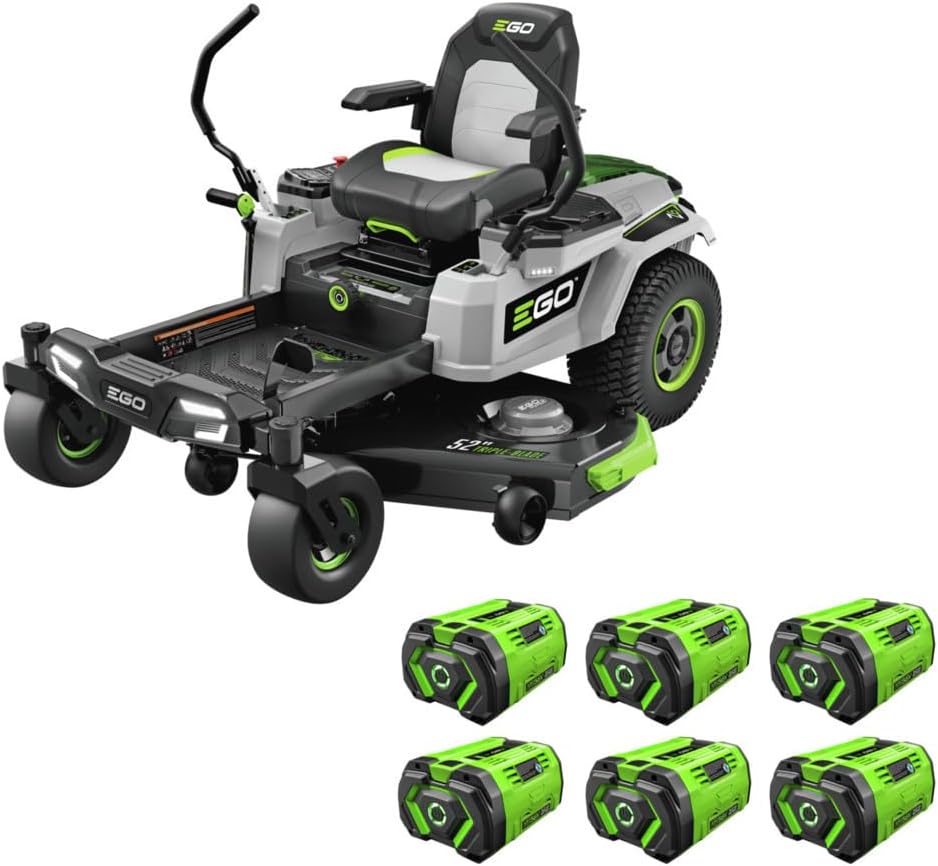
EGO Power+ 52" Z6 Zero-Turn Riding Mower with Six 56V 12.0Ah Batteries
| Power Source | Battery Powered |
|---|---|
| Cutting width | 52 inches |
| Maximum Adjustable Cutting Height | 4.5 inches |
| Minimum Adjustable Cutting Height | 1.5 inches |
| Number of Positions | 10 |
The EGO Power+ 52" Z6 is a full-size battery zero-turn mower designed to replace a gas ZTR for medium to large yards. It pairs a fabricated 52-inch steel deck with five brushless motors and Peak Power+ technology that can draw from up to six included 56V 12.0Ah batteries to deliver roughly 25 horsepower equivalent and a top speed around 8 MPH. Typical use is mowing open lawns and properties up to several acres where zero-turn maneuverability speeds the job. Notable features include an LCD with three drive modes, adjustable seat suspension, LED lights, USB port and a very fast 1600W charger that can refresh all six batteries in about four hours. Practical benefits are quiet operation, low vibration, strong hill and cutting performance comparable to gas, and the ability to cover up to about 4 acres on a single charge with the supplied batteries. Important limitations are the large battery system and charger footprint to store and maintain, the mower's substantial weight which affects storage and transport, and the reliance on the proprietary ARC battery platform if you want the claimed run times.
Best for: Buyers who want a low-noise, low-maintenance zero-turn mower that can handle roughly 2 to 4 acres with gas-comparable power and prefer a proven, safer-for-operators electric alternative.
Less Ideal for: People who need a lightweight, easily trailered machine or who expect the simplest possible ownership without managing multiple high-capacity batteries.
- Battery system (six 56V 12.0Ah batteries included) provides long run time—up to about 4 acres per charge
- Brushless motors and Peak Power+ deliver gas-like 25 HP equivalent performance for cutting and driving
- 52-inch fabricated steel deck gives wide, even cutting for medium-to-large lawns
- Fast 1600W charger can fully charge the six included batteries in roughly four hours
- Comfort and convenience extras such as adjustable seat suspension, LCD drive modes, LED lights and USB port
- Very heavy and bulky, which makes storage and towing more demanding
- Dependence on EGO ARC battery platform increases ongoing storage and maintenance needs
Verdict: For a risk-averse buyer who wants gas-level performance without fumes or constant engine maintenance, this 52" electric zero-turn delivers comparable power and multi-acre range on a single charge.
Husqvarna TS 375XD Riding Lawn Mower, 54-inch Deck

| Power Source | Gas Powered |
|---|---|
| Cutting width | 54 |
| Operation Mode | Manual |
The Husqvarna TS 375XD is a performance-focused riding mower designed to tackle large residential lawns and challenging terrain. It uses a 24 hp FR series Kawasaki V-twin engine and a fabricated 54-inch, three-blade deck to deliver fast, even cutting across wide swaths of grass. Notable features aimed at control and comfort include dial-adjustable seat suspension and a push-button locking differential, which help when mowing uneven ground or turning on slopes. The mower is manually operated and built on a rugged chassis that emphasizes durability for frequent heavy use. Practical benefits include faster job completion on medium to large properties and improved handling on rough sections, reducing operator fatigue. Important limitations are the machine's substantial weight and bulk, which make transport and storage more demanding, and the need for routine gas-engine maintenance. This model is best when you prioritize power, cut quality, and durability over compactness or easy storage.
Best for: Homeowners with medium to large properties who want a high-performance mower that reduces mowing time and handles rough or uneven terrain reliably.
Less Ideal for: People with very small yards, limited storage space, or those who prefer electric or low-maintenance equipment should consider smaller or alternative power options.
- Powerful 24 hp Kawasaki V-twin engine for strong performance and consistent cutting
- 54-inch fabricated three-blade deck covers large areas quickly
- Dial-adjustable seat suspension improves comfort during long mowing sessions
- Push-button locking differential enhances traction and maneuverability on rough terrain
- Heavy and large footprint makes storage and transport more difficult
- Gas engine requires regular maintenance and fuel handling
Verdict: Choose the Husqvarna TS 375XD if you need a powerful, durable riding mower that finishes large, rough residential lawns quickly and with confident handling.
Husqvarna TS 140X 48" Riding Lawn Tractor with 24 HP Briggs V-Twin

| Cutting width | 48 inches |
|---|---|
| Power Source | Gas Powered |
| Operation Mode | Manual |
The Husqvarna TS 140X is built for homeowners who need a robust, straightforward riding tractor for mowing roughly an acre, including moderate slopes. It pairs a 24 HP Briggs & Stratton V-twin engine with a 48-inch stamped steel deck and pedal-operated transmission so you can keep both hands on the wheel while changing speed. The reinforced deck and Air Induction technology aim to improve cut quality and reduce clumping, while an upgraded seat and ergonomic steering wheel increase comfort during longer jobs. Typical use will be regular property maintenance: striping driveways, cutting large open areas, and handling rolling terrain where a wider deck reduces passes. The tractor’s strengths are engine power, simple mechanical controls, and a roomy cutting width that shortens mowing time. Important limitations are its manual operation and gas power, which require fuel and routine engine maintenance, and the stamped deck is durable but less serviceable than heavier fabricated decks for extreme commercial use. For homeowners seeking a capable, no-frills machine, this balances performance and ease of use.
Best for: Homeowners with about an acre of lawn who want a powerful, easy-to-operate riding tractor that speeds up mowing and handles modest hills while prioritizing comfort during longer jobs.
Less Ideal for: Users who need a commercial-grade mower for daily heavy use or those seeking a zero-emission electric option should look elsewhere.
- Powerful 24 HP Briggs & Stratton V-twin engine provides strong performance on hills and larger lawns
- 48-inch stamped steel cutting deck reduces mowing time on an acre-sized property
- Pedal-operated transmission lets you keep both hands on the wheel for better control
- Ergonomic seat and steering wheel improve comfort for longer mowing sessions
- Gas engine requires regular fuel, oil changes, and tune-ups
- Stamped deck is less heavy-duty than fabricated commercial decks for extreme, frequent use
Verdict: A practical, comfortable gas tractor that cuts large yards quickly and handles modest hills for homeowners who want dependable performance and simple controls.
GIYI Electric Riding Lawn Mower with 42" Deck and (6) 40V 6.0Ah Batteries

| Power Source | Battery Powered |
|---|---|
| Cutting width | 42 inches |
| Number of Positions | 9 |
| Maximum Adjustable Cutting Height | 4.52 inches |
| Minimum Adjustable Cutting Height | 1.37 inches |
This GIYI electric riding mower is a cordless lawn tractor built to cover roughly an acre per charge using six 40V 6.0Ah lithium-ion batteries and a brushless, belt-free drive. It is typically used for medium to large residential yards where a 42-inch deck and nine cutting-height positions (about 1.5 to 4.5 inches) speed up mowing runs. Notable features include a stamped steel 42" deck, an ergonomically designed low-back seat, a brushless motor that lowers maintenance compared with gas models, and claimed run times of 60 to 80 minutes. In practice the combination of multiple batteries and a 6 mph top mowing speed makes it effective for rolling lawns and modest slopes up to about 15 degrees. Important limitations are its large footprint and weight that require storage space and may complicate transport, and the reliance on multiple battery packs means replacement cost and charging setup should be considered. For buyers prioritizing quiet, low-maintenance cordless operation, it delivers strong coverage; buyers needing commercial runtime or tight zero-turn maneuverability will want different platforms.
Best for: Homeowners with roughly one-acre lawns who want a quiet, low-maintenance cordless riding mower that covers ground quickly and tolerates mild slopes.
Less Ideal for: Commercial users, owners of very steep or tightly contoured properties, or buyers who need tight zero-turn maneuverability and extended continuous runtime.
- Large 42-inch stamped steel deck for faster passes across medium to large yards
- Includes six 40V 6.0Ah batteries providing 60–80 minutes of runtime on a full charge
- Brushless, belt-free motor design reduces routine maintenance and increases durability
- Nine adjustable cutting heights to handle different grass conditions and seasons
- Heavy and bulky unit that needs significant storage space and may be difficult to transport
- Dependence on multiple battery packs increases long-term replacement costs and charging logistics
Verdict: If you want a quiet, low-maintenance cordless riding mower that can cover about an acre per charge, this 42" GIYI model delivers strong residential performance.
Husqvarna TS 120 42" 19HP Briggs Lawn Tractor

| Cutting width | 42 inches |
|---|---|
| Power Source | Gas Powered |
| Operation Mode | Manual |
The Husqvarna TS 120 is a straightforward, homeowner-oriented riding tractor built around a 19 HP Briggs & Stratton engine and a 42-inch twin-blade stamped deck. It is used like a conventional lawn tractor: sit in the ergonomic seat, use the pedal-operated transmission for smooth speed control, and choose side ejection or add optional mulching or collection accessories. Notable features include the proven gas engine, pedal-operated hydrostatic transmission that keeps both hands free for steering, and a deck width that balances cut speed with maneuverability. In practice the TS 120 will make quick work of small to mid-size properties while offering a comfortable ride and simple controls that reduce operator fatigue. Limitations are its basic stamped deck and homeowner-focused equipment level, which mean it is not targeted at heavy commercial use or extremely large properties where wider decks and commercial-grade components would be preferable.
Best for: Buyers who prioritize a reliable, easy-to-operate gas riding mower for maintaining small to mid-size lawns and who value straightforward controls and proven engine performance.
Less Ideal for: Not a good fit for commercial operators or homeowners with very large properties who need wider decks and more heavy-duty, commercial-grade components.
- Proven 19 HP Briggs & Stratton gas engine for reliable power
- Pedal-operated hydrostatic transmission for easy, hands-on steering and smooth speed changes
- 42-inch twin-blade deck balances cutting efficiency and maneuverability
- Ergonomic seating and intuitive controls reduce operator fatigue during longer mows
- Designed for homeowner use rather than commercial or heavy-duty applications
- Stamped mower deck is less durable than heavier fabricated decks
Verdict: A reliable, easy-to-use gas riding tractor that delivers proven Briggs & Stratton power and simple hydrostatic controls for homeowners with small to mid-size lawns.
EGO Power+ TR4204 42" Electric Riding Lawn Tractor

| Power Source | Battery Powered |
|---|---|
| Cutting width | 42 inches |
| Battery Average Life | 60 minutes |
| Maximum Adjustable Cutting Height | 4 inches |
| Number of Positions | 12 |
The EGO Power+ TR4204 is a cordless riding lawn tractor built to replace small gas tractors for yards up to about 1.5 acres. It combines up to six 56V ARC Lithium batteries to produce the equivalent of a 21-horsepower gas engine and runs dual brushless, belt-free cutting motors under a 42-inch stamped steel deck. Typical use is straightforward: charge the included batteries, set one of three blade speeds and one of three drive speeds on the digital display, and mow with cruise control engaged for consistent passes. Notable features include LED lights, USB charging, Bluetooth, anti-scalp wheels, and a rear tow hitch for light hauling. Practical benefits are quiet operation, reduced maintenance from no belts or gas engine upkeep, and modular battery compatibility with other EGO tools. Important limitations are the runtime ceiling—advertised at up to 1.5 acres with six 6.0Ah batteries—which means larger properties will require additional batteries or more frequent charging, and the tractor’s heavier weight and battery system make it less suitable for tight, steep, or highly maneuvered lawn work compared with compact zero-turns.
Best for: Buyers who want to replace a small gas tractor with a low-maintenance, quiet electric riding mower for regular care of roughly one to one and a half acre lawns and who value battery ecosystem flexibility.
Less Ideal for: Those with larger properties well over 1.5 acres or who need high-speed, tight-turning commercial zero-turn capability should consider other options.
- Battery platform compatibility with all EGO 56V ARC Lithium batteries for flexibility and tool ecosystem sharing
- Dual brushless cutting motors and a stamped steel 42-inch deck for gas-like cutting performance with lower maintenance
- Customizable digital controls including three blade settings, three drive speeds, and cruise control for consistent results
- Premium conveniences such as LED lights, USB charging port, Bluetooth, and rear tow hitch for utility beyond mowing
- Advertised single-charge coverage tops out at about 1.5 acres with the included batteries, limiting use on larger properties without extra batteries
- Heavier battery package increases vehicle weight and may be less nimble in very tight or steep yards
Verdict: A practical electric alternative to small gas tractors that delivers gas-like power and low maintenance for lawns up to about 1.5 acres.
Husqvarna Z254F 54 in. Zero-Turn Riding Mower, 23 HP Kawasaki

| Power Source | gasoline |
|---|---|
| Engine Power | 23 HP |
| Cutting width | 54 inches |
| Operation Mode | Automatic |
| Number of Positions | 6 |
The Husqvarna Z254F is a purpose-built zero-turn mower for homeowners who need wide cutting coverage and reliable power. It uses a 23 HP Kawasaki engine and a hydrostatic, no-maintenance transmission to deliver smooth, variable speed control and a reported top speed around 6.5 MPH. The 54 inch ClearCut deck is designed for good airflow and a clean cut, and it supports discharge, mulching or bagging with optional attachments. Operator comfort and usability are addressed with an ergonomic control panel, comfortable seat and anti-slip foot area, while a simple deck lift and outward parking of the steering levers make daily use straightforward. Practical limitations include the mower's large footprint and weight, which make it best suited to medium to large lawns with clear access rather than tight, obstacle-dense yards, and optional mulching and bagging hardware must be bought separately. For buyers prioritizing proven components and ease of operation, the Z254F provides a dependable mowing platform.
Best for: Homeowners with medium to large lawns who value reliable components and efficient, fast mowing and who prefer a low-maintenance hydrostatic drive.
Less Ideal for: If your property is small, has many tight turns, steep slopes, or requires frequent trailer transport, a compact zero-turn or walk-behind mower will be a better fit.
- Powerful 23 HP Kawasaki gasoline engine for reliable starts and consistent turf performance
- Hydrostatic transmission requires no regular maintenance and provides smooth speed control
- 54 in. ClearCut deck covers large areas quickly and is designed for good airflow and cutting quality
- Comfort-focused operator station with ergonomic controls and anti-slip foot area for longer mowing sessions
- Large weight and footprint limit maneuverability in tight yards and make transport more difficult
- Mulching kit and bagger are sold separately rather than included
Verdict: Choose the Z254F if you want a dependable, wide-cut hydrostatic zero-turn that speeds up mowing on medium to large lawns with proven engine and transmission components.
Choosing the Right Riding Lawn Mower for Bad Backs: Key Factors to Consider
Seat Comfort and Adjustability
A supportive seat is the single most important comfort feature for anyone with back issues. Look for deep padding, contoured lumbar support, and multiple fore-aft and height adjustments so you can position the seat to maintain a neutral spine while reaching controls. A higher backrest and integrated lumbar shaping reduce muscle strain during longer mowing sessions. Breathable seat materials help reduce sweating and shifting, which can force frequent posture changes and increase fatigue.
Avoid flat, thin seats that offer little support. Test how easily the seat adjusts and whether locks hold firmly in place. Some seats include armrests or optional suspension seats; these can be valuable for riders who need added lateral stability or further shock isolation.
Vibration Dampening
Vibration travels from the deck and engine into the frame and through the seat, causing numbness, aches, and increased spinal stress over time. Effective vibration control can come from chassis isolation, rubber mounts between engine and frame, floating seat mounts, or well-tuned engine mounts. Fewer vibrations let you stay seated longer with less cumulative irritation to soft tissues and nerves.
Consider how the machine is engineered to isolate the operator from the engine and cutting deck. Look for manufacturer notes on vibration reduction, and when possible test a mower at low and higher throttle to feel differences. Remember that maintenance such as balancing blades and replacing worn engine mounts can influence real-world vibration performance.
Operator Ergonomics
Ergonomics covers control placement, steering effort, pedal layout, and platform space. Controls should be easy to reach without twisting or leaning. Low-effort steering and smooth transmission engagement reduce the need for sudden posture changes that stress the back. A spacious operator platform lets you shift position slightly while maintaining good support.
Evaluate how the steering wheel height aligns with your natural arm position and whether foot pedals are positioned to allow a relaxed knee angle. Simple, intuitive control layouts minimize the time spent hunched over the console and reduce awkward movements during operation.
Suspension and Terrain Handling
A mower that handles uneven ground smoothly will transmit fewer shocks to your spine. Suspension systems, whether on the front axle or built into the seat, help absorb bumps and reduce jarring. Wide, low-pressure tires also smooth the ride by rolling over ruts rather than jolting. Machines with a stable chassis and predictable handling let you mow confidently without bracing your core to compensate.
Consider your typical yard: if you have rolling terrain, exposed roots, or frequent gravel areas, prioritize models with better shock absorption and durable tires. Good deck float and a chassis that resists bouncing will also contribute to a less disruptive ride.
Ease of Entry and Exit
Getting on and off the mower repeatedly can strain the lower back if steps are high or platforms are awkward. Low step-in heights, wide footrests, and grab handles allow you to move without twisting or reaching. A stable, well-lit step area matters if you have limited mobility or perform frequent stops to clear debris or adjust settings.
Also consider whether seat swivels or folding armrests are available to ease lateral transfers. Simple handholds and a clear foot path reduce the need for bending or lifting that might aggravate a healing back.
Adjusting Your Riding Position
Small changes to how you sit and set up the controls can make a big difference in comfort. Start by raising or lowering the seat so your knees are slightly lower than your hips and your feet rest naturally on the pedals. Move the seat fore or aft until you can reach the steering wheel and controls without leaning forward.
Check steering wheel tilt if available and position mirrors or sightlines so you do not need to twist to view the mowing area. When operating, keep your shoulders relaxed and avoid locking your elbows. Take short pauses on long jobs to stand and gently stretch the lower back and hamstrings to reduce stiffness.
- Set the seat to maintain a neutral spine and slight lumbar curve
- Position controls within easy reach to avoid forward hunching
- Use pauses to stand and stretch during long mowing sessions
Simple Upgrades to Reduce Ride Shock
You do not always need a different machine to improve comfort. Replacing worn tires with wider, lower-pressure options can lower vibration and improve float over rough ground. Aftermarket seat cushions made for lumbar support or gel pads can help if the factory seat is firm but otherwise supportive.
Regularly balancing blades and maintaining engine mounts and belt tension also reduces vibration. Even tightening loose body panels and securing the deck can stop rattles that contribute to perceived harshness.
- Fit wider tires for better shock absorption
- Add a lumbar-support cushion or gel pad if seat lacks contouring
- Keep blades balanced and mounts tightened to minimize vibration
Mowing Technique for Less Back Stress
How you mow influences how your back feels after the job. Mow at a steady, comfortable pace and avoid sudden turns or abrupt stops. Try to use natural contours to guide your path and avoid repetitive twisting movements by changing direction periodically.
When crossing slopes, face uphill or downhill as recommended by the mower type to avoid compensatory leaning. Lower deck cuts on uneven ground to prevent excessive bouncing and consider shorter mowing sessions with breaks instead of a single long push.
- Keep a steady pace and avoid abrupt maneuvers
- Change mowing direction occasionally to vary posture
- Break long jobs into shorter intervals with rest and stretching
Maintenance Habits That Improve Comfort
Routine upkeep plays a big role in operator comfort. Balanced blades, correct tire pressure, and secure mounting points all reduce vibration and improve stability. Inspect seat mounts, rubber isolators, and engine mounts for wear and replace as needed to maintain the machine's designed isolation.
Grease pivot points and check steering components for play to keep steering effort low. Simple checks before each season can preserve a smoother ride and reduce the risk of shock-related discomfort during mowing.
- Balance blades and maintain recommended tire pressures
- Inspect and replace worn rubber isolators and mounts
- Keep steering and suspension pivots lubricated and tight
Accessories That Help Gardeners With Back Pain
Several accessories can reduce strain without altering how you mow. Armrests, swivel seats, and footrests can improve posture and make transfers easier. A cup or accessory holder positioned within easy reach prevents awkward reaching movements while seated.
Consider adding a small onboard tool tray so you do not need to dismount repeatedly. Sun shades and breathable seat covers also reduce fidgeting that leads to poor posture during hot weather.
- Install armrests or a swivel seat for easier lateral transfers
- Use an onboard tray to reduce frequent dismounting
- Choose breathable seat covers to minimize shifting and sweating
How We Chose the Best Riding Lawn Mower for Bad Backs
We prioritized features that directly reduce spinal stress and fatigue during mowing. Our selection emphasized ergonomic seating quality, including seat padding, contouring, and adjustability, because a supportive seat is the primary interface between rider and machine. Vibration control and chassis isolation were next, since lower vibration reduces muscle fatigue and nerve irritation. Operator ergonomics was judged by steering effort, control layout reachability, and platform space so riders can sit in a natural posture for extended periods. Suspension and terrain handling were evaluated to limit jolts over bumps and uneven ground that transmit shocks to the back. Finally we considered maintenance and ease of entry and exit to reduce awkward movements that strain the lower back. We excluded compact garden tractors and zero-turn machines that lack traditional seating ergonomics or are intended primarily for professional landscapers. Lightweight or toy-grade mowers were also filtered out. Choices presented are consumer riding lawn mowers that meet ergonomic and vibration-reduction thresholds. The resulting list reflects machines suitable for homeowners prioritizing back comfort rather than maximum speed or heavy commercial duty.
FAQ
Can a riding mower really reduce back pain compared with push mowing?
Often yes. Riding mowers remove the need to walk and push, taking weight off your legs and lower back. However, comfort gains depend on seat support, vibration control, and how you operate the mower. Proper seating and reduced vibration are key to realizing those benefits.
Is a suspension seat worth it for bumpy yards?
Usually. Suspension seats absorb shocks that would otherwise travel into your spine, reducing jarring on uneven ground. If your property has frequent bumps or ruts, a suspension seat can significantly improve comfort during longer mowing sessions.
How can I test vibration and comfort before buying?
If you can, sit in the mower and run the engine at idle and higher throttle to feel for vibration and engine harshness. Adjust seat settings and try steering and control reach. Pay attention to how the seat supports your lower back and whether you need to brace to reach controls.
Will wider tires always improve ride comfort?
Wider, low-pressure tires often smooth the ride by passing over bumps more gently, but they can affect handling and traction. They are a helpful upgrade for comfort on many residential lawns, though you should match tire choices to your mower's specifications.
Are there posture tips to follow while mowing that protect my back?
Yes. Keep your back straight, shoulders relaxed, and avoid twisting when reaching for controls. Take short breaks to stand and stretch, and change mowing direction periodically to avoid repetitive strain on the same muscles.
Final Verdict
When choosing a riding lawn mower for back support, prioritize seat quality, vibration reduction, and operator ergonomics over raw power. Tradeoffs often involve paying more attention to ride-smoothing features and ease of entry rather than top speed. Focus on models with adjustable, well-contoured seats, good vibration isolation, and user-friendly control layouts to minimize strain. Ultimately choose the machine that matches your yard conditions and mobility needs. If you have persistent or severe back issues, pair equipment choices with technique changes and simple upgrades to get the most comfortable mowing experience.
