

Note: This article contains affiliate links. If you click on these links and make a purchase, I may earn a small commission at no extra cost to you. This helps support my research and content. Read my full affiliate disclosure here.
If you share your yard with dogs, you know how concentrated urine can leave yellow or brown patches in the lawn. Choosing the right fertilizer for dog pee matters because it supplies nutrients that help stressed turf recover and encourages even color while the soil rebalances. This guide covers the top shortlisted options for recovering pet-damaged lawns and explains the practical differences gardeners should expect. We evaluate each product for nutrient formulation and how easy it is to apply in a lawn setting, plus how quickly it supports root and blade recovery. Read on to find a solution that fits your lawn type and weekly care routine.
Top Picks at a Glance
| Best Overall The best all-around choice for most situations | Turf Titan K9 Correcter Dog Urine Neutralizer (1 Gallon) |  |
| Best Quality Built to a higher standard if you want something more solid | Yellow Spot Green Dog Urine Neutralizer for Lawns, 32 oz |  |
| Best Value The sweet spot between price and what you get | Nature's Way Soil Dog Urine Neutralizer for Lawns, 32 oz |  |
| Highest Rated A top-rated pick with lots of positive feedback | The Andersons Pet Safe Lawn Fertilizer 28-0-6 (15 lb coverage) |  |
| Most Popular A crowd favorite that many people choose with confidence | See Spot Run Lawn Protection Dog Urine Grass Saver (32 fl oz) |  |
Turf Titan K9 Correcter Dog Urine Neutralizer (1 Gallon)

| Volume | 1 Gallon |
|---|
Turf Titan K9 Correcter is a gallon-sized, enzyme and surfactant lawn treatment designed to neutralize dog urine and encourage grass recovery when used consistently. You apply it to affected spots on the lawn, typically once a week, to reduce odor and help the turf recover from nitrogen burn caused by concentrated urine. The formula is described as all-natural and pesticide-free, which makes it safe to use around pets and children and suitable for routine maintenance rather than emergency repair. In practice this product is most useful for preventing new yellow spots and improving appearance over a few weeks; you may see partial improvements within about 10 days but fuller recovery requires repeated applications and patience. It does not replace spot reseeding for severely damaged patches, and results will depend on lawn type, watering, and how frequently pets urinate in the same area. For homeowners who want a low-toxicity, maintenance-focused solution, K9 Correcter offers a straightforward, easy-to-apply option.
Best for: Homeowners who want a low-toxicity, maintenance-first approach to control dog urine damage and odor and are willing to apply a treatment regularly to improve lawn appearance.
Less Ideal for: People needing immediate restoration of extensive dead patches or those who prefer a one-time, more aggressive chemical repair solution should look elsewhere.
- Enzyme-based, pet-safe formula suitable for use around dogs and children
- Targets odor and helps reduce visible yellowing with regular weekly applications
- Pesticide-free and made from natural ingredients for an environmentally friendlier option
- Available in a gallon size for treating multiple spots or larger lawns
- Requires repeated weekly use and patience; not an instant fix for severe damage
- Does not repair large dead patches on its own and may need combined lawn care steps
Verdict: A pet-safe, enzyme-based weekly treatment that reduces urine odor and helps lawns recover over time with consistent use.
Yellow Spot Green Dog Urine Neutralizer for Lawns, 32 oz

| Net weight | 32 Ounce |
|---|---|
| Coverage | Over 5,000 sq. ft. (concentrated) |
| Formulation type | Granular |
| Safety | Non-toxic, pet and people safe |
| Protection duration | Up to 12 months |
Yellow Spot Green is a granular, ready-to-use lawn treatment aimed at repairing and protecting grass from dog urine damage. You apply it directly to damaged soil or over yellow spots without mixing or a hose, and the concentrated granules claim to neutralize soil pH, reduce ammonia effects, and condition the root zone so grass can regrow when conditions allow. It is presented as non-toxic and safe for people and pets, and a single 32 ounce container covers a large area, which makes it practical for treating multiple spots or a big yard. For completely dead patches the product is intended to be used before reseeding or laying sod to improve soil conditions. Expect gradual improvement rather than instant greening since it prepares the soil for regrowth when the lawn is actively growing. The product also advertises long-lasting protection against repeat urine burns for up to a year, but recovery still depends on proper watering, timing in the growing season, and addressing any underlying lawn health issues.
Best for: Homeowners who need a performance-focused solution to repair and prevent dog urine burns and who plan treatments during the active growing season to maximize recovery.
Less Ideal for: People seeking an instant cosmetic fix during lawn dormancy or high heat, or those who want a single-step product that also includes seed or sod in the package.
- Granular, no-mix application makes spot treatment quick and simple
- Formulation targets soil pH and ammonia to create a better root environment
- Large coverage from a 32 oz container lets you treat many spots or a large area
- Non-toxic formula labeled safe for pets and people
- Does not force immediate greening during dormancy or extreme heat so results are seasonal
- Requires additional steps for completely dead patches such as removing dead grass and reseeding
Verdict: Use this concentrated granular treatment when you want a pet-safe, performance-minded product that conditions urine-damaged soil so your lawn can reliably recover during the growing season.
Nature's Way Soil Dog Urine Neutralizer for Lawns, 32 oz
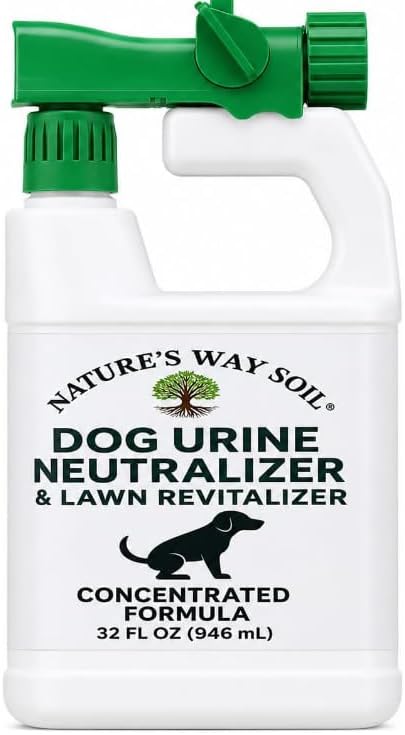
| Net volume | 32 oz |
|---|---|
| Coverage | Up to 5,000 sq ft |
| Application | Hose-end sprayer |
| Formulation | Enzymes, humic acids, nutrients |
This hose-end concentrate is formulated to treat dog urine at the soil level by breaking down urine residue with enzymes and supporting soil recovery with humic acids and nutrients. You connect the bottle to a standard garden hose and spray for spot or whole-lawn application; the sprayer mixes the concentrate automatically so there is no measuring. It is practical for regular use around runs, yards, and kennels because one 32-ounce bottle is advertised to cover up to 5,000 square feet. The formula is promoted as pet- and family-safe when used as directed and aims to improve moisture penetration and grass regrowth rather than just masking stains. Expect gradual improvement rather than instant green-up because the product works by improving soil biology over time. It is not a quick cosmetic fix for single fresh spots and requires follow-up applications and proper drying time before allowing children or pets back on treated areas.
Best for: Buyers who want a low-effort, maintenance-focused solution to treat recurring dog urine damage across a yard and prefer improving soil health rather than quick cosmetic fixes.
Less Ideal for: People who need an instant cosmetic repair for single fresh yellow spots or those who prefer granular fertilizers or DIY soil amendments instead of a ready-to-spray concentrate.
- Hose-end applicator mixes automatically for easy, no-measure spraying
- Enzyme and humic acid formula targets urine residue at the soil level
- Advertised coverage up to 5,000 sq ft from a 32 oz bottle for practical yard maintenance
- Formulated to be safe for pets and children when used as directed
- Works gradually by improving soil health so results are not immediate
- Effectiveness may vary with the severity of damage and lawn type
Verdict: A convenient hose-end concentrate for owners who want a practical, soil-focused way to reduce urine stains and improve lawn recovery over time.
The Andersons Pet Safe Lawn Fertilizer 28-0-6 (15 lb coverage)

| Item Form | Granules |
|---|---|
| Specific Uses For Product | Lawn Fertilizer |
| Coverage | 15 |
| Target Species | lawn grasses |
This granular lawn fertilizer from The Andersons is designed to give fast greening plus longer-term feed through a blend of quick- and slow-release nitrogen and added sulfur for turf health. It uses the brand's DG Technology so particles break down into micro-particles on contact with water, which helps move soluble nutrients into the root zone and reduces residue on the surface. Typical use is broadcast application with a spreader across up to about 5,000 square feet, and it is rated safe for yards with pets when applied according to directions. Practical benefits include noticeable color improvement, ease of application as a single-bag treatment, and year-round use where climate permits. Limitations are that the formula is focused on nitrogen and potassium only, so it is not an all-in-one product for soil amendment or micronutrient correction, and effectiveness depends on proper watering and spreader calibration. Buyers should follow label mixing and timing guidance for best results and pet safety.
Best for: Homeowners who prioritize fast, visible lawn performance and want a pet-safe fertilizer that combines quick greening with sustained feeding across a typical suburban lawn.
Less Ideal for: Gardeners seeking a complete soil amendment, phosphorus-rich starter formula, or products tailored to correcting micronutrient deficiencies should consider a different or supplementary fertilizer.
- DG Technology micro-particle delivery moves nutrients quickly to the root zone
- Combination of quick and slow-release nitrogen for immediate color and sustained feeding
- Formulated as pet-safe when used per label, suitable for yards with animals
- Covers a large area from one bag, simplifying single-application upkeep
- Limited nutrient profile with no listed micronutrients or phosphorus
- Requires correct spreader settings and post-application watering for best results
Verdict: Choose this product when you want a pet-safe granular fertilizer that delivers quick color improvement plus sustained nitrogen feeding for a large lawn.
See Spot Run Lawn Protection Dog Urine Grass Saver (32 fl oz)

| Item Form | Liquid |
|---|---|
| Liquid Volume | 32 |
| Manufacturer | See Spot Run |
See Spot Run is a concentrated, hose‑attachable microbial treatment designed to repair and prevent brown and yellow spots caused by dog urine by neutralizing excess nitrogen in the soil. You mix the concentrate with water, apply it across the yard or directly to problem spots with a hose applicator or sprayer, then lightly water to move the microbes into the soil. The formula is all‑natural and intended to complement regular lawn care rather than replace fertilizing or reseeding. Practical benefits include simple application, pet‑safe ingredients, and ongoing protection when used every eight weeks or weekly for spot treatment. It cannot revive grass that is already dead, so severely damaged areas still need to be removed and reseeded; the product is meant to condition the soil so new seed or sod can establish. Some users may need repeated applications before seeing full recovery and results depend on proper watering and follow‑up lawn care.
Best for: Homeowners who want a pet‑safe, soil‑focused solution to fix and prevent urine burn and are willing to follow a regular application and watering routine to help grass recover.
Less Ideal for: People looking for an instant aesthetic fix or a product that revives completely dead turf without reseeding should consider alternatives geared toward sod or immediate lawn replacement.
- All‑natural microbial formula targets soil chemistry rather than treating the pet
- Easy to apply with a hose applicator or tank sprayer for spot or full‑yard coverage
- Works alongside regular lawn maintenance and seasonal schedules
- Concentrate covers a large area when mixed (half‑gallon concentrate)
- Won't restore turf that is already dead and requires reseeding or sod in those areas
- Visible improvement can require multiple applications and consistent watering
Verdict: Choose this if you want a pet‑safe, soil‑based microbial treatment to prevent and repair dog urine spots as part of a regular lawn care routine.
Choosing the Right Fertilizer for Dog Pee: Key Factors to Consider
Nutrient Ratio and Formulation
The mix of nitrogen, phosphorus, and potassium directly affects how a lawn recovers from urine burns. High, concentrated nitrogen from urine causes foliage discoloration and can damage roots; a fertilizer intended to correct this problem will often offer a more balanced N-P-K ratio and include nutrients that promote root repair and lateral growth.
Formulation matters too. Water-soluble products act faster and are useful for treating small spots, while slow-release granular formulas provide longer-term feeding for larger areas. Consider which format suits your repair strategy and lawn size.
Application Method and Coverage
Ease of application determines how practical a product is for spot repairs versus whole-lawn treatments. Granular spreads are convenient for broadcast feeding but can be messy for precise spots unless you have a spreader with drop control. Water-soluble or liquid concentrates allow targeted application with a hose-end sprayer or watering can, which is helpful for treating individual burn patches.
Also check whether the product requires pre-wetting, rinsing, or reapplication after rain. Clear instructions reduce the risk of over-application that could worsen damage.
Speed of Visible Recovery
Gardeners often want to see regreening quickly, especially on high-visibility lawns. Fast-acting formulations that dissolve readily into the soil can encourage new leaf growth within days, while slow-release products improve long-term vigor but take longer to show color changes.
Balance your expectations: rapid greening might require more frequent follow-up treatments, whereas slower options strengthen the lawn over time and reduce the chance of repeated scorch.
Soil pH and Micro-nutrient Support
Dog urine can alter the soil pH in small concentrated areas and deplete or overload certain elements. Fertilizers that include chelated micro-nutrients such as iron, manganese, and zinc help correct localized deficiencies and promote even color recovery. Some formulations also contain soil conditioners or organic matter that improve soil structure and buffering capacity.
Testing soil pH in persistent burn spots is useful because it tells you whether you need pH amendments in addition to fertilizer. A product that supports soil health reduces repeat damage over time.
Safety Around Pets and Children
Because treatments are applied where pets frequent, safety guidance is critical. Look for products with clear instructions about re-entry intervals, how long to keep pets off treated areas, and whether the formula is labeled as pet-safe once dry. Some formulations require watering in to eliminate residues; others advise waiting periods.
Choosing a fertilizer with straightforward, conservative safety recommendations helps you treat damage without risking exposure to animals or family members.
Cost Per Application and Frequency
The cost of a fertilizer matters in terms of how often you need to apply it. Fast-acting, soluble formulas may require multiple applications in a season to maintain results on frequently used pet paths, while slow-release options can cut down on repeat treatments but might be more expensive per bag.
Think about the size of the areas you will treat. Buying a product that matches your intended application frequency will save time and reduce waste.
Treating Burn Spots Versus Whole-Lawn Feeding
Spot treatments and full-lawn applications have different goals. For isolated urine spots you want a product and method that corrects nutrient imbalance and encourages quick leaf flush without overloading the small area with fertilizer salts. For whole-lawn feeding the aim is to bolster overall turf resilience so the grass can better tolerate occasional pet urine.
If you are treating many small spots, water-soluble or liquid concentrates let you aim precisely and avoid excess buildup. For seasonal maintenance across the entire yard, a slow-release granular formula provides steady nutrition and reduces the need for repeated spot fixes.
- Use targeted liquid applications for isolated burns
- Choose slow-release granules for routine whole-lawn resilience
- Avoid applying high-nitrogen products directly to small burn patches
When to Reseed or Patch Sod
Fertilizer helps the surviving grass recover, but dead turf or bare soil may require reseeding or laying sod for full restoration. If roots are killed and soil remains bare after a few weeks of treatment, overseed with a compatible turfgrass mix or use small sod patches for instant coverage.
Prepare the spot by loosening compacted soil, adding a thin layer of good topsoil or compost, and keeping the area consistently moist until new seedlings establish. Match seed type to the existing lawn to avoid color and texture mismatches.
- Reseed if dead blades persist after fertilizer treatment
- Prep soil to improve seed-to-soil contact
- Keep newly seeded spots moist for best germination
Practical Pet Management to Prevent Recurrence
Fertilizer fixes symptoms, but preventing repeat damage reduces the need for constant retreatment. Train dogs to use a designated area with hardy groundcover or mulch, or rinse urine spots with water immediately after they occur to dilute salts. Rotating elimination zones and increasing watering frequency in high-use areas also helps.
Consider installing a small gravel or artificial turf area where pets are allowed off-leash to protect your main lawn. These behavioral and landscape changes will make fertilizer treatments more effective over time.
- Rinse recent urine spots with water to dilute salts
- Designate pet-friendly zones away from prime turf
- Rotate areas where dogs relieve themselves to allow recovery
Reading Labels and Application Rates
Always follow the label for application rates, timing, and safety. Over-application is a common cause of additional scorch, especially when treating small spots. Labels provide guidance on how much product to use per square foot and whether to water in after application.
If instructions differ between spot and broadcast use, err on the conservative side for spot treatment and consider diluting liquid concentrates to avoid concentrated salt deposits.
- Measure areas before applying to avoid over-application
- Water in granular products when recommended
- Follow re-entry and pet-safety intervals on the label
When to Test Soil and What to Look For
If burn spots reappear frequently in the same location, test the soil for pH and nutrient levels. A simple home kit can tell you if pH is outside the ideal range for your grass type; a lab test provides a fuller nutrient profile and recommendations.
Look for elevated soluble salts or extreme pH shifts in persistent spots. These issues sometimes require amendments beyond fertilizer, such as lime or gypsum, to restore a hospitable rooting environment.
- Test soil pH in persistent burn areas
- Consider lab analysis for repeated or severe damage
- Use amendments to correct pH or salt imbalances when needed
How We Chose the Best Fertilizer for Dog Pee
To build this shortlist we applied filters that reflect what gardeners need when repairing urine-burned turf. We prioritized nutrient formulations that correct the common imbalances caused by concentrated nitrogen, looking for balanced nitrogen, phosphorus, and potassium ratios and the presence of micro-nutrients that support root repair and foliar regreening. Application practicality was another key filter: products had to be suitable for spot treatment and safe for broadcast use on lawns with pets present. We also considered formulation type because granular and water-soluble fertilizers behave differently when you are treating small burn spots versus whole lawns. Speed of visible recovery and instructions for repeat applications were evaluated to identify options that reliably restore color without causing further scorch. Finally, we excluded products meant only for ornamental beds or specific non-turf crops, and we did not consider fertilizers that require specialist equipment to apply. The end result is a selection focused on real-world lawn recovery performance, ease of use, safety guidance for pet households, and soil-health support.
FAQ
How soon after a dog urinates should I apply fertilizer to a burn spot?
Often you should wait until the area shows signs of stress rather than applying immediately. In many cases rinsing the spot with water right away to dilute the urine is the best immediate action. Apply fertilizer once the soil is not saturated and follow label guidance for timing and rates.
Can I use the same fertilizer for spot treatment and whole-lawn feeding?
It depends on the formulation. Some products are versatile for both uses, but concentrated high-nitrogen mixes intended for broad feeding can harm small spots. Water-soluble or diluted liquid options are usually better for targeted repairs, while slow-release granules suit regular whole-lawn maintenance.
Will fertilizer alone fix recurring urine burn spots?
Usually fertilizer helps regrow grass but may not address underlying causes such as repeated exposure, soil pH shifts, or high salt buildup. Combining targeted fertilization with behavioral changes, rinsing, or soil amendments reduces recurrence more effectively.
Is it safe to apply fertilizer when pets use the yard daily?
Many lawn fertilizers are safe when applied according to label instructions and allowed to dry or be watered in as recommended. Look for clear re-entry intervals and pet-safety guidance on the product label, and keep pets off treated areas until the specified time has passed.
How long until I should expect to see green growth after applying a recovery fertilizer?
Visible regreening can appear within a few days with fast-acting soluble formulations, but full recovery of color and root strength may take several weeks. Slow-release products improve resilience over a longer timeframe and often show gradual improvement.
Should I test soil before treating a persistent burn?
Yes. Testing soil pH and nutrient levels is useful if spots keep returning in the same area. Test results help identify whether you need pH amendments, micro-nutrients, or adjustments to your fertilization approach rather than repeated blanket treatments.
Final Verdict
Prioritize a fertilizer that corrects the nutrient imbalance common to urine burns and choose a formulation that matches how you will apply it. For isolated spots, targetable liquid or soluble products provide quick greening, while slow-release granules support broader lawn resilience with fewer repeat treatments. Combine fertilizer use with simple pet-management habits and soil testing for persistent problems to reduce recurrence and restore a uniform, healthy lawn.
