

Note: This article contains affiliate links. If you click on these links and make a purchase, I may earn a small commission at no extra cost to you. This helps support my research and content. Read my full affiliate disclosure here.
A reliable soil moisture meter takes guesswork out of your watering routine so your plants stay healthy without wasted water. Whether you tend containers on a patio, raised beds, or an in-ground vegetable plot, the right meter helps you know when to water, not just how it feels at the surface. This guide looks at seven shortlisted soil moisture meters chosen for real garden performance and everyday durability. We evaluated meters for sensing accuracy, probe construction, readout clarity, and real-world durability so you can pick a tool that suits your planting style and growing conditions. Read on to find the options that best match the way you garden.
Top Picks at a Glance
| Best Overall The best all-around choice for most situations | apine Soil Moisture Meter for Indoor and Outdoor Plants |  |
| Best Quality Built to a higher standard if you want something more solid | Extech MO750 Soil Moisture Meter with 8" Stainless Steel Probe |  |
| Best Value The sweet spot between price and what you get | XLUX Long Probe Soil Moisture Meter (T9178) |  |
| Best Budget The cheapest option that still gets the job done reliably | Hathdia 3-in-1 Soil Moisture Meter (Single Probe) |  |
| Highest Rated A top-rated pick with lots of positive feedback | Aenncci 2-in-1 Soil Test Kit — Soil Moisture and pH Meter |  |
| Most Popular A crowd favorite that many people choose with confidence | XLUX T10 Plant Soil Moisture Meter (Battery-Free) |  |
| Best Seller A high-volume bestseller chosen again and again | XLUX T10 Soil Moisture Meter (2-Pack) |  |
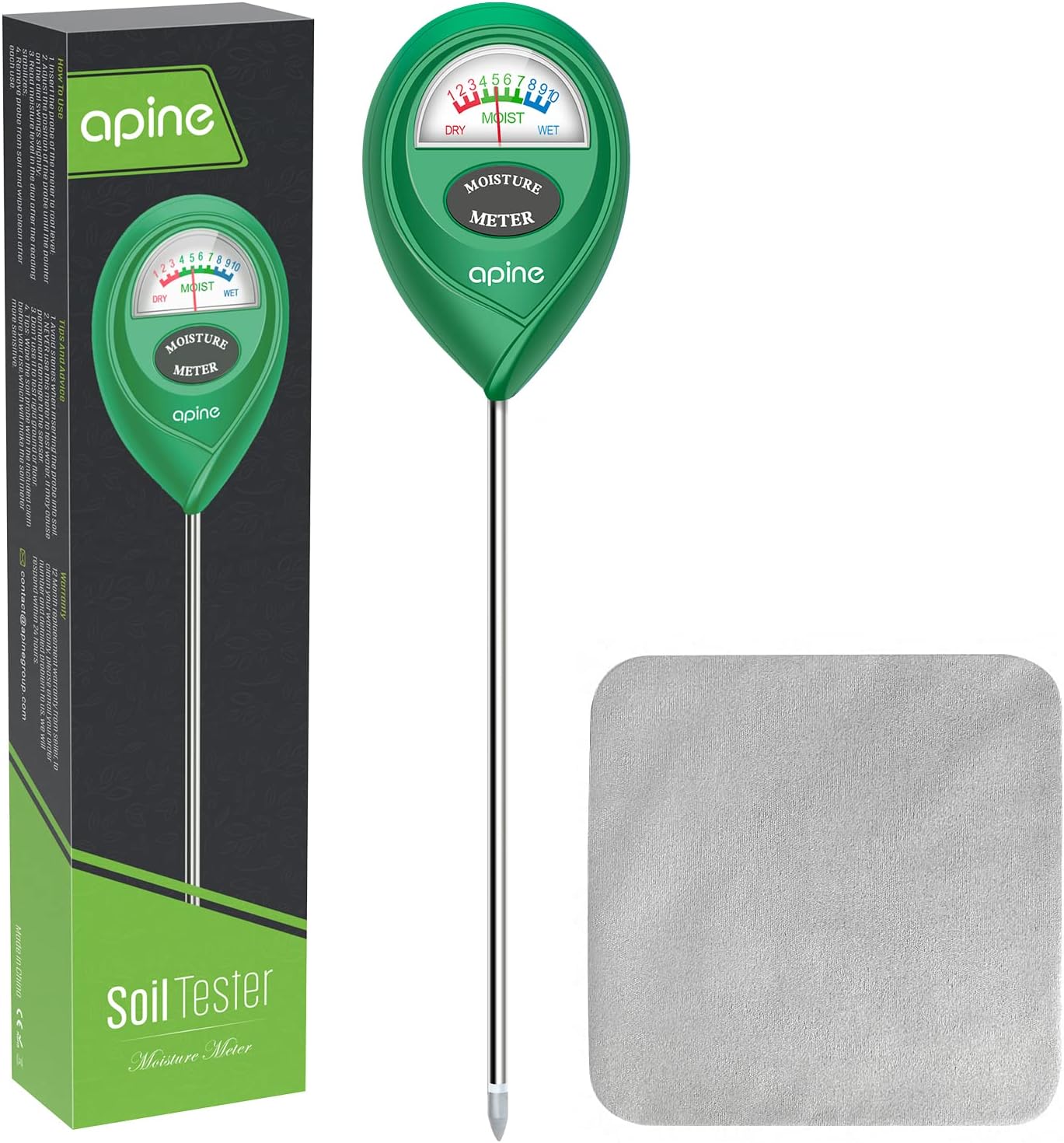
apine Soil Moisture Meter for Indoor and Outdoor Plants
| Manufacturer | apine |
|---|---|
| Model number | SMM-GR-A001 |
| Battery | No battery required |
| Probe insertion depth | 2-4 inches |
The apine Soil Moisture Meter is a basic analog probe meter for checking soil moisture in houseplants and garden pots. To use it you wipe the included cloth, insert the single metal probe 2 to 4 inches into the soil and read the colored dial within seconds. The battery-free design means no charging or replacements and the single-needle probe causes minimal root disturbance and stays relatively clean during testing. It is best used for routine spot checks to decide whether a plant needs water rather than for continuous monitoring. Notable features include its fast response, clear color-coded dial that is easy to interpret and a small included cloth for keeping the probe responsive. Limitations are that it is not designed for testing liquids or very compacted or extremely fluffy soils and it does not provide digital precision, pH, or long-term logging. For gardeners who want a low-friction, low-cost tool to check moisture before watering, this meter is a practical everyday accessory.
Best for: Gardeners who want a low-cost, no-fuss way to check if potted plants or garden containers need water and prefer quick visual guidance over digital detail.
Less Ideal for: Users who need lab-grade moisture or logging for research, growers using very loose soilless mixes, or those who require automated long-term monitoring solutions.
- Battery-free analog design requires no power or charging
- Fast readings in under 10 seconds from a simple probe insertion
- Clear color-coded dial that is easy for anyone to interpret
- Single slender probe minimizes root disturbance and stays cleaner
- Not suitable for very compacted or very fluffy soils
- Does not record data or provide precise digital measurements
- Not to be used for testing liquids or non-soil media
Verdict: A simple, battery-free probe meter that gives quick, easy-to-read moisture guidance for everyday potted plant and container use.
Extech MO750 Soil Moisture Meter with 8" Stainless Steel Probe

| Measurement Accuracy | ±(5% + 5d) |
|---|---|
| Output Type | Digital |
| Upper Temperature Rating | 50 °C |
| Included Components | Soil Moisture Meter |
| Probe | 8in stainless steel |
The Extech MO750 is a purpose-built handheld soil moisture meter that gives fast, repeatable moisture readings from 0 to 50 percent using an integrated 8-inch stainless steel probe. It is typically used by gardeners, landscapers, and field technicians to check moisture below the surface without digging up plants. The large digital LCD and data-hold function make it easy to read and record measurements, while min/max memory helps track changes during spot checks. The unit ships with AAA batteries and a protective sensor cap and the housing is water resistant for outdoor use. Practical benefits include a robust probe for probing deeper root zones, simple one-handed operation, and a clear numeric display that removes guesswork compared with analog meters. Limitations to note are the 0–50% measurement range, which is fine for most horticultural tasks but may not cover extremely wet conditions, and the probe length and sensor design mean it is a spot-check tool rather than something for continuous automated monitoring.
Best for: Buyers who need accurate, repeatable spot measurements in gardens, containers, or field plots and prioritize straightforward, professional-grade results over automated logging.
Less Ideal for: People who need continuous telemetry or multi-point monitoring across a large site or those who require moisture readings above the stated 50 percent range.
- 8-inch stainless steel probe reaches below surface for root-zone checks
- Clear digital LCD with data hold and min/max memory for easy readings
- Water resistant, lightweight handheld design for field use
- Operates on common AAA batteries included for immediate use
- Measurement range tops out at 50% moisture which may not capture saturation
- Designed for spot checks only and not for continuous or remote monitoring
Verdict: Choose the MO750 when you want a robust handheld meter that delivers quick, professional spot readings with an 8-inch probe for reliable root-zone moisture checks.
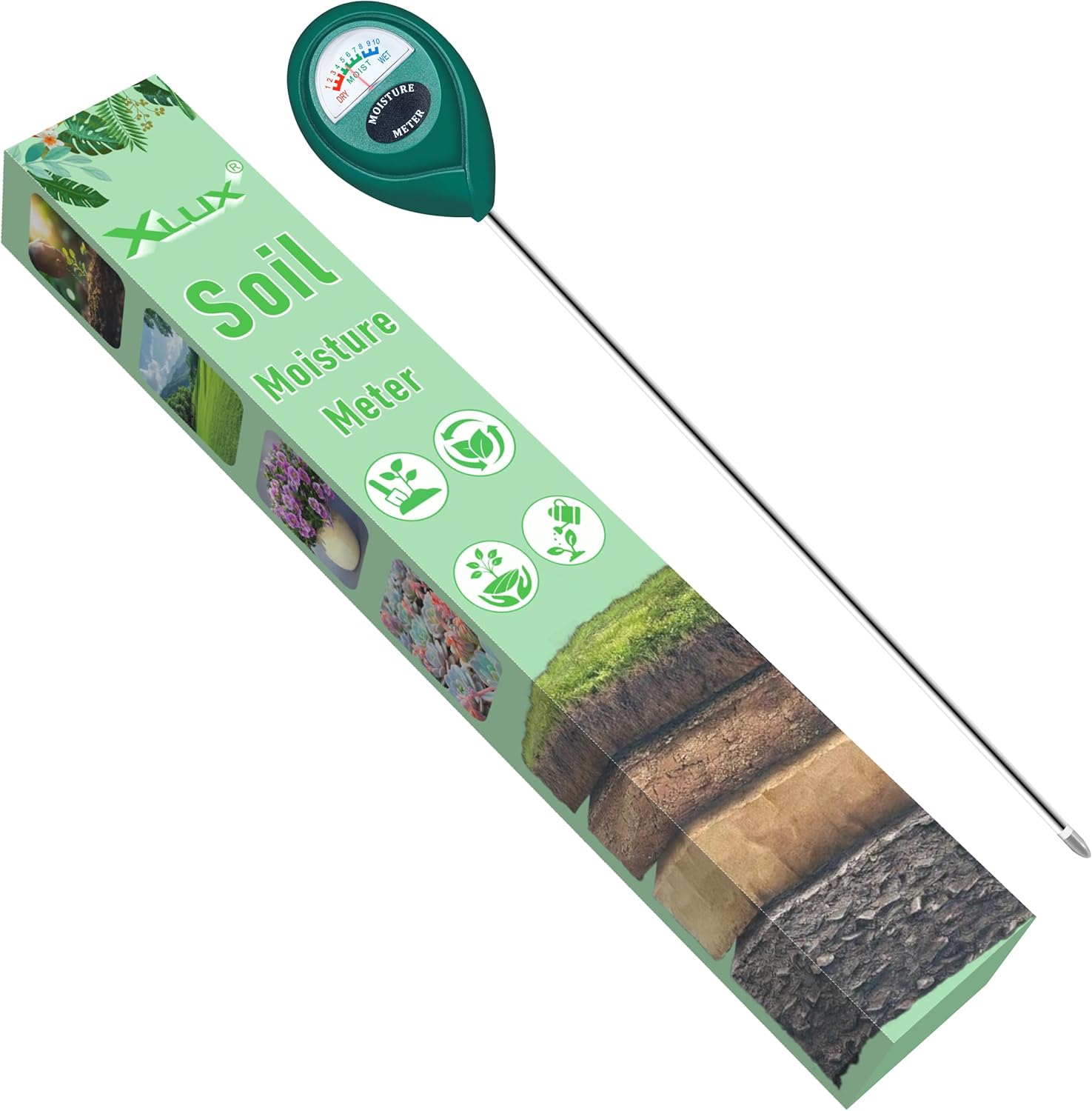
XLUX Long Probe Soil Moisture Meter (T9178)
| Brand | XLUX |
|---|---|
| Model | T9178 |
| Mounting Type | Tabletop |
| Upper Temperature Range | 50 °C |
The XLUX long probe soil moisture meter is a no-frills analog hygrometer designed to read moisture deeper in larger pots and containers. It works by inserting the single metal probe into potting mix and reading an immediate moisture indication on a large dial divided into dry, moist, and wet zones. The extended probe length makes it convenient for tall planters and hanging baskets where surface checks are misleading. Its simplicity means no batteries or calibration routines and the single-probe design reduces root disturbance when testing. Important practical notes are that the probe is intended for typical potting mixes and can give inconsistent readings in very airy media unless that media is compacted around the sensor, and the metal tip should not be left in soil for more than a few minutes to avoid corrosion. For routine watering decisions this meter is fast, easy to use, and durable enough for casual gardeners, but it is not suited to continuous monitoring or precise scientific moisture profiling.
Best for: Gardening buyers who want a simple, low-maintenance tool to make faster watering decisions for larger pots and container plants without fussing over electronics.
Less Ideal for: Users who need continuous logging, highly precise moisture percentages, or a meter engineered for coarse soilless mixes like pure perlite or orchid bark.
- Long 5.5-inch probe reaches lower soil levels in large pots and deep planters
- Large, easy-to-read dial with dry, moist, and wet zones for quick decisions
- Single-probe design minimizes root disturbance during testing
- Mechanical operation requires no batteries or electronics to maintain
- Not reliable in very airy substrates unless the media is compacted around the probe
- Metal probe can corrode if left in soil for extended periods
Verdict: Choose this meter if you need a fast, battery-free way to check moisture deep in large pots and make practical watering decisions.
Hathdia 3-in-1 Soil Moisture Meter (Single Probe)

| Brand Name | Hathdia |
|---|---|
| Function | Moisture |
| Probe Length | 7.6 inches |
| Applications | Indoor and outdoor |
| Number of Items | 1 |
This Hathdia single-probe soil moisture meter is a basic analog hygrometer designed to tell you when to water plants. You push the 7.6-inch probe into potting mix or garden soil to the root zone and the dial pointer shows a moisture level instantly, so it is useful for houseplants, larger pots, and quick spot checks outdoors. Its main selling points are its simplicity and no-battery operation, which make it very portable and always ready to use. The probe sensitivity gives fast feedback and the compact, lightweight body is easy to move between containers. Limitations are the single fixed probe and analog dial, which provide qualitative readings rather than precise numerical moisture percentages and are not suited for continuous monitoring. The meter is intended for soil only and should not be used submerged in water or pushed against stones. For gardeners who want a low-cost, no-friction way to avoid over- or under-watering, this is a convenient tool; users who need logged data, high precision, or multi-point sensing should look elsewhere.
Best for: Gardeners on a tight budget who need a straightforward, low-maintenance tool to check soil moisture for houseplants and container gardens. It fits buyers who prefer simple, immediate answers over technical features.
Less Ideal for: People who need precise, logged, or multi-point moisture data such as researchers, growers of sensitive crops, or those wanting smartphone connectivity should consider digital alternatives.
- No batteries required so it is always ready and low maintenance
- Long probe suitable for reaching root zones in larger pots and planters
- Lightweight and portable for quick spot checks indoor or outdoor
- Simple analog dial gives immediate, easy-to-read feedback
- Analog pointer gives qualitative rather than exact numeric moisture values
- Single probe cannot measure multiple depths or locations simultaneously
Verdict: A very affordable, no-battery moisture meter that gives immediate, easy-to-read soil moisture feedback for everyday houseplant and container gardening.
Aenncci 2-in-1 Soil Test Kit — Soil Moisture and pH Meter

| Battery | None required |
|---|---|
| Functions | Soil moisture and pH |
| Use | Indoor and outdoor |
This compact 2-in-1 soil tester combines a moisture meter and pH meter in a single battery-free probe, making it a simple tool for routine checks in pots, garden beds, lawns, and raised beds. You insert the probe into the soil (recommended deeper than 4 inches) and read both values on the large dual dial without switching modes, which is convenient for quick spot checks across multiple plants. The single sturdy probe and high-sensitivity sensors aim to minimize root disturbance while delivering fast readings, and the lack of batteries means no ongoing power maintenance. Practical strengths are its ease of use, portability for moving between indoor and outdoor areas, and clear visual dials that work for inexperienced users. Important limitations are that the device is a spot-check instrument rather than a laboratory-grade meter and it requires correct insertion depth and periodic cleaning of the probe for consistent results. Expect reliable everyday guidance for watering and basic pH awareness rather than precision soil analysis for professional testing.
Best for: Buyers who prioritize a dependable, low-maintenance tool for routine plant care and want quick, easy checks of soil moisture and pH across indoor and outdoor plants.
Less Ideal for: Users seeking highly precise, lab-level soil analysis or continuous monitoring solutions for research or commercial production.
- Two measurements in one probe for simultaneous moisture and pH checks
- Battery-free design eliminates the need for replacements or charging
- Large dual dial makes readings easy to see at a glance
- Single sturdy probe designed to reduce root damage during use
- Not a lab-grade instrument so values are best used for general guidance
- Requires insertion to the correct depth and regular probe cleaning for consistent readings
Verdict: A simple, maintenance-free two-in-one probe meter that delivers fast, reliable spot checks of soil moisture and pH for everyday plant care.
XLUX T10 Plant Soil Moisture Meter (Battery-Free)

| Battery Description | No batteries required |
|---|---|
| Mounting Type | Tabletop |
| Upper Temperature Range | 45 °C |
| Temperature Reading Accuracy | ±0.5 °C |
The XLUX T10 is a straightforward analog soil moisture meter designed to give instant moisture readings without batteries. You use it by inserting the slim 304 stainless steel probe into the potting mix or garden bed down to the root zone, then read the large color-coded dial that marks Dry, Moist, and Wet. Its single narrow probe minimizes root disturbance compared with thicker dual-prong meters, making it useful for potted houseplants and smaller garden beds. The tabletop mounting and protective sleeve help preserve the probe between uses, and the unit requires minimal maintenance beyond wiping the probe clean after each short test. Limitations to note are that it provides a general moisture level rather than precise soil moisture percentage and is intended for temporary tests only, so it is not a continuous-monitoring solution; accuracy can also vary by soil type and insertion depth. For gardeners who want a low-cost, low-effort way to remove guesswork from watering, the T10 offers reliable, easy-to-read results for everyday use.
Best for: Buyers who want a simple, low-maintenance tool to quickly check whether potted plants or small garden beds need water and who value easy-to-read, proven devices backed by many users.
Less Ideal for: If you need digital precision, continuous logging, or professional soil-moisture profiling for large-scale landscapes, this basic analog tester will be insufficient.
- Battery-free operation for instant readings without maintenance
- Slim single 304 stainless steel probe reduces root damage
- Large color-coded dial that is easy to read at a glance
- Protective sleeve included to prevent probe abrasion during storage
- Provides qualitative moisture ranges rather than numeric moisture percentage
- Designed for short, temporary tests only and not for continuous monitoring
Verdict: A no-fuss, battery-free moisture meter that gives quick, readable root-zone moisture guidance for everyday indoor and small garden plant care.
XLUX T10 Soil Moisture Meter (2-Pack)

| Battery Description | No batteries required |
|---|---|
| Number of Items | 2 |
| Item Highlight | Anti-rust 304 SST probe, single-probe immediate read |
The XLUX T10 is a straightforward analog soil moisture meter sold as a two-pack for spot-checking moisture in pots and garden soil. It uses a single stainless steel probe and a large dial marked in three zones plus ten scales so you can instantly tell if soil is dry, moist, or wet. Because it is battery-free and mechanical, there is nothing to charge or replace and it is easy to hand to less experienced gardeners. Typical use is pushing the probe into the root zone for a few seconds, reading the dial, then wiping the probe clean. The single-probe design limits root disturbance and the 304 stainless probe resists rust better than untreated metal. Important limitations are that it is not designed for continuous in-ground monitoring, should not be left in soil for more than a few minutes, and is less effective in very compacted or rocky soils. It reports relative moisture rather than precise volumetric measurements, so use it as a quick, practical guide rather than a scientific moisture profile.
Best for: Buyers who want a low-maintenance, easy-to-use tool to confirm whether houseplants or garden pots need water and prefer a simple reliable indicator over technical precision.
Less Ideal for: People who need continuous logging, laboratory-level moisture accuracy, or reliable readings in very compacted or rocky soil should choose a different sensor type.
- Battery-free operation requires no maintenance or replacements
- Large, easy-to-read dial with clear dry/moist/wet zones
- Single stainless steel probe reduces root disturbance and resists rust
- Sold as a two-pack for checking multiple pots or locations
- Not intended for continuous monitoring and should not be left in soil
- Gives relative moisture levels rather than precise numeric measurements
Verdict: A no-fuss, battery-free moisture meter that delivers quick, easy dry/moist/wet readings for cautious gardeners who want straightforward guidance.
Choosing the Right Soil Moisture Meter: Key Factors to Consider
Accuracy Across Soil Types
Soil composition changes how quickly moisture moves to a probe and how probes register readings. Sandy mixes drain rapidly and give quick, lower readings while heavy clay or peat retains water and can show higher values. A meter that reports consistently across loam, potting mix, and heavier soils makes it easier to interpret results for different plants.
Look for meters that have been tested or described as responsive in a range of media. If you grow both containers and in-ground beds, expect to cross-check readings at first until you learn each growing medium's baseline.
Probe Construction and Corrosion Resistance
Probes sit directly in the soil where moisture, fertilizer salts, and microbes can cause corrosion. Stainless or nickel-plated probes resist rust and last longer than bare metal. Thick, well-mounted probes are less likely to bend when pushed into compacted soil or around roots.
Replaceable probes are useful if you expect heavy long-term use. Also consider probe length: short probes are fine for small pots, while longer probes let you test deeper root zones in larger containers and garden beds.
Readout Type and Usability
Readouts range from simple color bands to analog needles and digital screens. Color or analog scales are fast for quick checks and often intuitive for beginners. Digital displays can offer exact percentages or moisture levels, which helps when managing plants with tight moisture windows.
Consider backlighting, font size, and whether the scale uses percentages or a dry/medium/wet banding. Clear, single-handed operation matters when you are juggling watering cans or moving among multiple pots.
Durability and Weather Resistance
Garden tools get knocked around and exposure to sun and rain is common. A meter with a sealed housing and minimal exposed electronics will stand up better to damp conditions. Water-resistant units reduce the risk of failure after accidental exposure during watering.
Durability also covers build quality of grips, housings, and any moving parts. A well-built meter tolerates drops, knocks, and frequent insertion into compacted soil without losing accuracy.
Calibration and Maintenance Needs
Some meters require periodic calibration to maintain accuracy, while others are effectively maintenance-free. Calibration can be as simple as adjusting a dial to a known reference or as complex as needing lab tools. If you prefer a low-fuss tool, choose a meter with minimal upkeep.
Maintenance also includes cleaning probes after use to prevent soil buildup and checking battery compartments for corrosion. Ease of cleaning can extend the device life and keep readings reliable.
Suitability For Plant Types
Different plants have different moisture preferences. Succulents and cacti need readings from the upper root zone and low-moisture sensitivity, while vegetables and ornamentals may require consistent mid-range moisture. A meter that can read at relevant depths and shows a scale that maps to plant needs will be more useful across your garden.
Think about whether you need to monitor surface moisture for seedlings, mid-root moisture for potted flowers, or deeper moisture for shrubs and trees when selecting meter features.
Using a Meter to Build Better Watering Habits
A soil moisture meter is a training tool for your watering routine. Instead of relying on surface dryness or a set schedule, use the meter to check the root zone where plants actually draw water. Over a few weeks you can learn the moisture ranges that indicate thirsty, satisfied, or waterlogged conditions for each plant type.
Check the same spot for a container or bed to track trends rather than single readings. Take measurements at consistent depths and times of day to reduce variability caused by evaporation or recent watering.
- Establish a baseline reading for each pot or bed when the plant is well irrigated and when it is nearing drought stress.
- Use the meter weekly for seedlings and newly transplanted plants, and less often for established specimens with deeper roots.
Interpreting Readings for Different Growing Media
Readings mean different things depending on potting mix, amended native soil, or heavy clay. A reading that is ideal in a free-draining mix might indicate overwatering in a peat-rich medium. Learn the typical readings for your mixes by testing after a known thorough watering and then when dry.
For mixed soils, take multiple readings at several spots to get an average picture. In media with lots of organic matter, expect moisture to linger and readings to stay higher for longer after irrigation.
- Compare readings between identical pots rather than between different soil types.
- When repotting or amending beds, recalibrate your expectations of what 'moist' looks like.
Common Mistakes and How to Avoid Them
Inserting a probe too shallowly gives a false impression of drought because the surface dries first. Push the probe to the appropriate depth for the root zone you want to monitor. Avoid hitting thick roots and ease the probe in to prevent damage.
Using a meter immediately after watering will always show a high reading. Wait a few hours for water to redistribute when assessing whether watering reduced drought stress. Also clean probes after use in fertilized soils to avoid salt buildup that can skew readings.
- Do not use the same reading to judge both surface-dwelling seedlings and deep-rooted shrubs.
- Avoid twisting or forcing probes into compacted soil; wiggle gently or water slightly to ease insertion.
Using Meters With Containers, Hanging Baskets, and Raised Beds
Containers and hanging baskets dry faster than in-ground beds, so meters help prevent sudden drought stress. Use shorter probes for shallow baskets and longer ones for deep pots to reach the active root zone without damaging roots near the surface.
For raised beds, take readings at multiple depths if you are managing heavy amendments or compost layers. The top few inches can behave very differently from the root zone a few inches below, especially after mulch or surface watering.
- For mixed container plantings, check the largest plant's root zone to guide watering for the whole pot.
- When winterizing containers, use the meter to leave potting mixes slightly drier to reduce freeze damage risk.
Maintaining and Storing Your Meter
After use, wipe probes clean of soil and dry before storage to reduce corrosion. For meters with removable probes, inspect and tighten fittings periodically. Store the unit indoors away from direct sunlight and extreme temperatures to preserve housing plastics and electronics.
If your meter is battery powered, remove batteries if you expect months of storage. Keep spare batteries handy for digital units used regularly so readings are not affected by weak power.
- Clean probes with fresh water and a mild brush; avoid harsh chemicals.
- Store in a dry toolbox or drawer to protect seals and buttons.
How We Chose the Best Soil Moisture Meter
We shortlisted soil moisture meters that deliver repeatable moisture readings and hold up to outdoor conditions gardeners put them through. Primary evaluation criteria included sensing accuracy across typical potting mixes and garden soils, probe construction and corrosion resistance, readout clarity and scale usefulness for plant types, and overall field durability against moisture and dirt. We also considered ergonomics and ease of use for quick checks in multiple pots or beds, battery or power requirements for digital units, and whether the meter needed calibration or regular maintenance. Devices that required specialized consumables or complicated setup were deprioritized. Excluded from the list were novelty testers with no credible sensing method, devices meant only for soil pH without moisture capability, and tools designed exclusively for deep agricultural research rather than home or small-scale garden use. The resulting picks emphasize dependable readings, straightforward operation, and durable construction appropriate for home gardeners.
FAQ
How deep should I insert a soil moisture meter probe?
Insert the probe to the depth of the plant's active root zone. For most container plants that is 2 to 6 inches; for larger pots or beds it may be 6 to 12 inches. Consistent depth gives comparable readings over time.
Can a soil moisture meter read through pots without insertion?
Most consumer meters require direct contact with soil via a probe and will not work through pot walls. Some electronic sensors exist for noninvasive monitoring but they are different devices and may not fit all containers.
How often should I check moisture with a meter?
Frequency depends on plant stage and weather. Seedlings and newly transplanted plants benefit from weekly checks or more. Established plants can be checked every week or two, with more frequent checks during heatwaves or drought.
Do soil additives or fertilizer affect meter readings?
Yes. High levels of soluble salts from fertilizers can influence some sensing methods and skew readings. Rinse probes after testing fertilized soil and be aware that readings in heavily amended mixes may need interpretation rather than exact thresholds.
Are digital meters better than analog ones?
Digital meters provide more precise numeric feedback which helps with plants that have tight moisture needs. Analog or color-coded meters offer quick, intuitive guidance and often have fewer electronic parts to fail. The best choice depends on whether you prefer precision or simplicity.
Final Verdict
A soil moisture meter should fit the way you garden: pick probe length, durability, and readout style that match your pots, beds, and plant types. Prioritize sensing accuracy and corrosion-resistant probes if you test many containers or frequently check garden beds. If you want low fuss, choose a straightforward meter with clear readouts and minimal maintenance. Balancing depth capability, weather resistance, and ease of use will help you water more confidently and reduce overwatering or drought stress. Use the tradeoffs outlined here to select a meter that keeps your plants consistently healthy without adding complexity.
