

Note: This article contains affiliate links. If you click on these links and make a purchase, I may earn a small commission at no extra cost to you. This helps support my research and content. Read my full affiliate disclosure here.
Indoor plants respond quickly to overwatering or drought, and a simple moisture meter can prevent wasted effort and stressed plants. You want a tool that reliably indicates whether the soil is genuinely dry or still holding moisture so you avoid root rot and uneven growth. This guide presents seven shortlisted indoor soil moisture meters chosen for typical houseplant situations – small pots, mixed potting mixes, and humidity-prone rooms. We evaluate meters by how accurately they read common indoor soils and how straightforward they are to use and maintain. Read on to see which types of meters fit your plant collection and care routine.
Top Picks at a Glance
| Best Overall The best all-around choice for most situations | SONKIR MS02 3-in-1 Soil Moisture, pH and Light Tester |  |
| Best Quality Built to a higher standard if you want something more solid | Buladeke 7-in-1 Digital Soil Tester — Moisture, pH, Temp, Light, EC/TDS |  |
| Best Value The sweet spot between price and what you get | XLUX Long Probe Soil Moisture Meter (T9178) |  |
| Best Budget The cheapest option that still gets the job done reliably | Censinda Soil Moisture Meter with Single Probe |  |
| Highest Rated A top-rated pick with lots of positive feedback | Jxikatx 7-in-1 Soil Test Kit with Dual Display (Moisture, pH, Fertility, Light, Temp, Humidity) |  |
| Most Popular A crowd favorite that many people choose with confidence | XLUX T10 Plant Soil Moisture Meter (Battery-Free) |  |
| Best Seller A high-volume bestseller chosen again and again | XLUX T10 Soil Moisture Meter (2-Pack) |  |
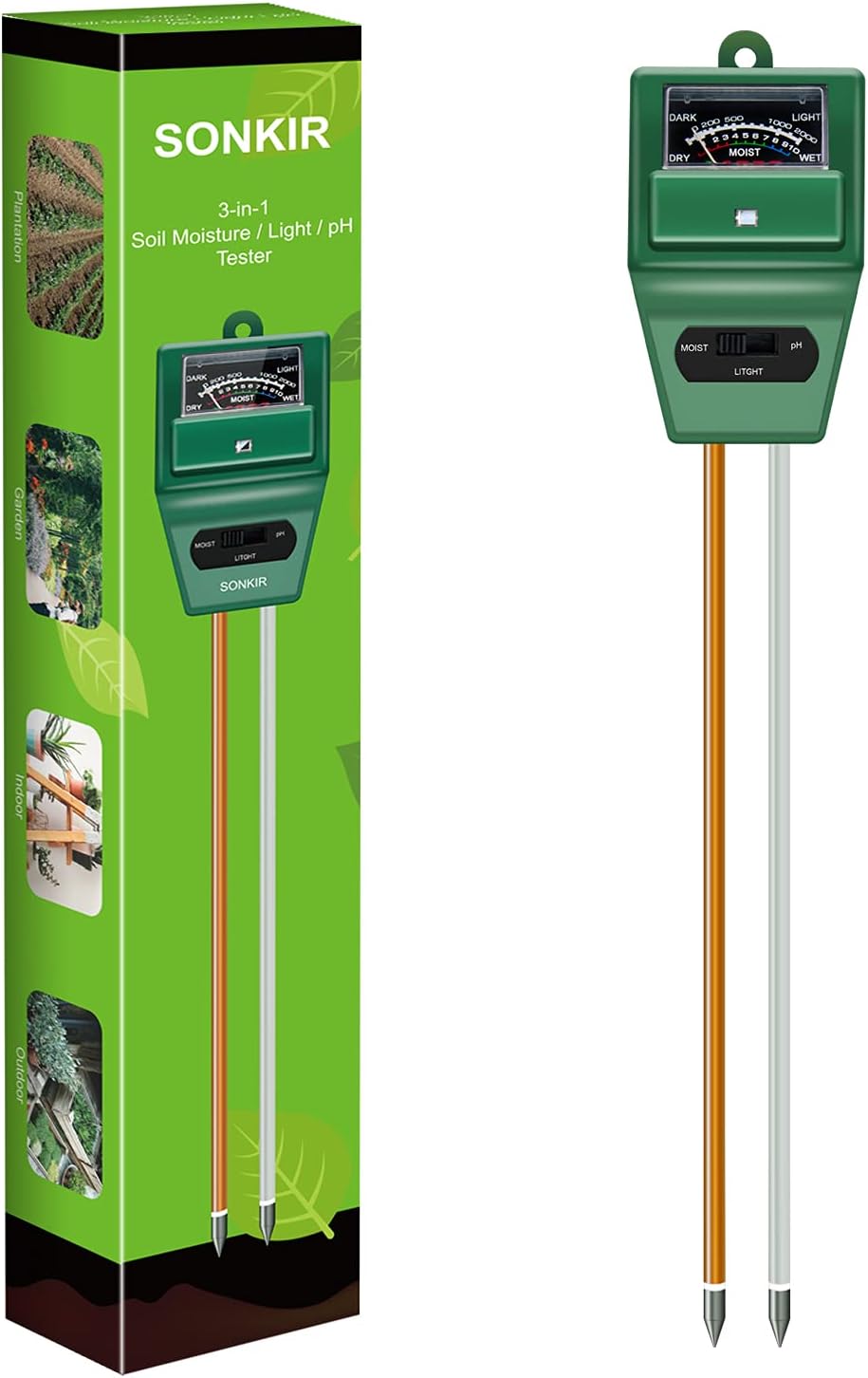
SONKIR MS02 3-in-1 Soil Moisture, pH and Light Tester
| pH range | 3.5-8 pH |
|---|---|
| Moisture range | 1-10 scale |
| Probe length | 7.9 inches |
| Power | No battery required |
The SONKIR MS02 is a handheld, no-battery soil meter that gives quick, visual readings of moisture, pH and sunlight to help you maintain healthier grass and garden plants. You switch the dial to the desired function, push the probe into the soil about 6 to 7 inches, wait roughly 10 minutes and read the needle on the analog display. The meter covers a practical pH range for lawns and gardens and shows moisture on a 1 to 10 scale so you can decide when to water. Its long probe and compact, lightweight body make it convenient for spot-checking multiple areas of a lawn or garden bed. Important limitations are that the pH probe is intended for soil only and the analog needle can be slow to move in very dry soils or close-to-neutral pH, so readings sometimes require rechecking after moistening the sample or testing several spots. The unit is best for gardeners who want an affordable, easy-to-use tool for routine soil checks rather than laboratory-accurate analysis.
Best for: Someone who wants an inexpensive, easy-to-use tool for routine soil checks across a lawn or garden and values practical, repeatable guidance over laboratory precision.
Less Ideal for: Users who need lab-grade pH or moisture measurements, continuous data logging, or digital readouts for precise record keeping should consider more advanced instruments.
- 3-in-1 functionality measures moisture, pH and sunlight without extra tools
- No battery required so it is always ready to use and low maintenance
- Long probe and compact form factor make spot checks across a lawn or garden quick
- Simple analog dial is straightforward for fast, at-a-glance decisions
- pH function is designed for soil only and cannot test water or other liquids
- Analog needle can be unresponsive in very dry soil or near-neutral pH, requiring repeated tests
Verdict: A straightforward, no-battery 3-in-1 tester that gives fast, practical soil moisture, pH and light checks for everyday lawn and garden care.
Buladeke 7-in-1 Digital Soil Tester — Moisture, pH, Temp, Light, EC/TDS

| Functions | Moisture, pH, Temperature, Light, EC, TDS, Fertility |
|---|---|
| Display | Large LCD with white backlight |
| Power | 4×1.5V AAA batteries (not included) |
This Buladeke 7-in-1 Digital Soil Tester is a multi-sensor handheld meter designed for routine checks of indoor and potted plants. You insert the probe into the potting mix and within about 10 seconds the large backlit LCD shows readings for soil moisture, pH, temperature, light intensity, electrical conductivity (EC) and TDS plus a fertility indicator. The big benefit is having multiple useful parameters in one compact tool so you can decide when to water, adjust pH, check light levels and evaluate nutrient solution strength without separate devices. The meter runs on four AAA batteries and warns when power is low. Practical limits are that it is intended for soil and not direct liquid measurement, the probe should not be forced into very dry or compacted media, and it does not include calibration solution or batteries. For growers focused on frequent, data-driven checks of houseplants and small pots this gives fast, readable multi-parameter feedback; for lab-grade precision or continuous logging you will want dedicated instruments or a data logger instead.
Best for: Indoor plant owners and performance-minded hobbyists who want fast, repeatable multi-parameter checks across many pots to optimize watering, light and basic nutrient decisions.
Less Ideal for: Users needing laboratory accuracy, continuous monitoring, or automatic data logging should consider dedicated probes or instruments with calibration kits and connectivity.
- Combines six soil and light measurements plus a fertility indicator in one handheld unit for quick diagnostics.
- Large backlit LCD makes readings easy to read in low light or at a glance.
- Fast results — probe-in reading in about 10 seconds speeds multiple checks across many pots.
- Battery low alert helps avoid misleading readings from weak power.
- Suitable for both indoor and outdoor potted plants and succulents.
- Not designed for direct liquid measurement and can be damaged if forced into very hard or dry soil.
- Does not include calibration solutions for pH or EC so accuracy may drift without periodic checks.
- No data logging or connectivity for tracking measurements over time.
Verdict: If you want a fast, all-in-one handheld meter to make data-driven watering and light decisions for indoor and potted plants, this 7-in-1 tester delivers clear, quick measurements.
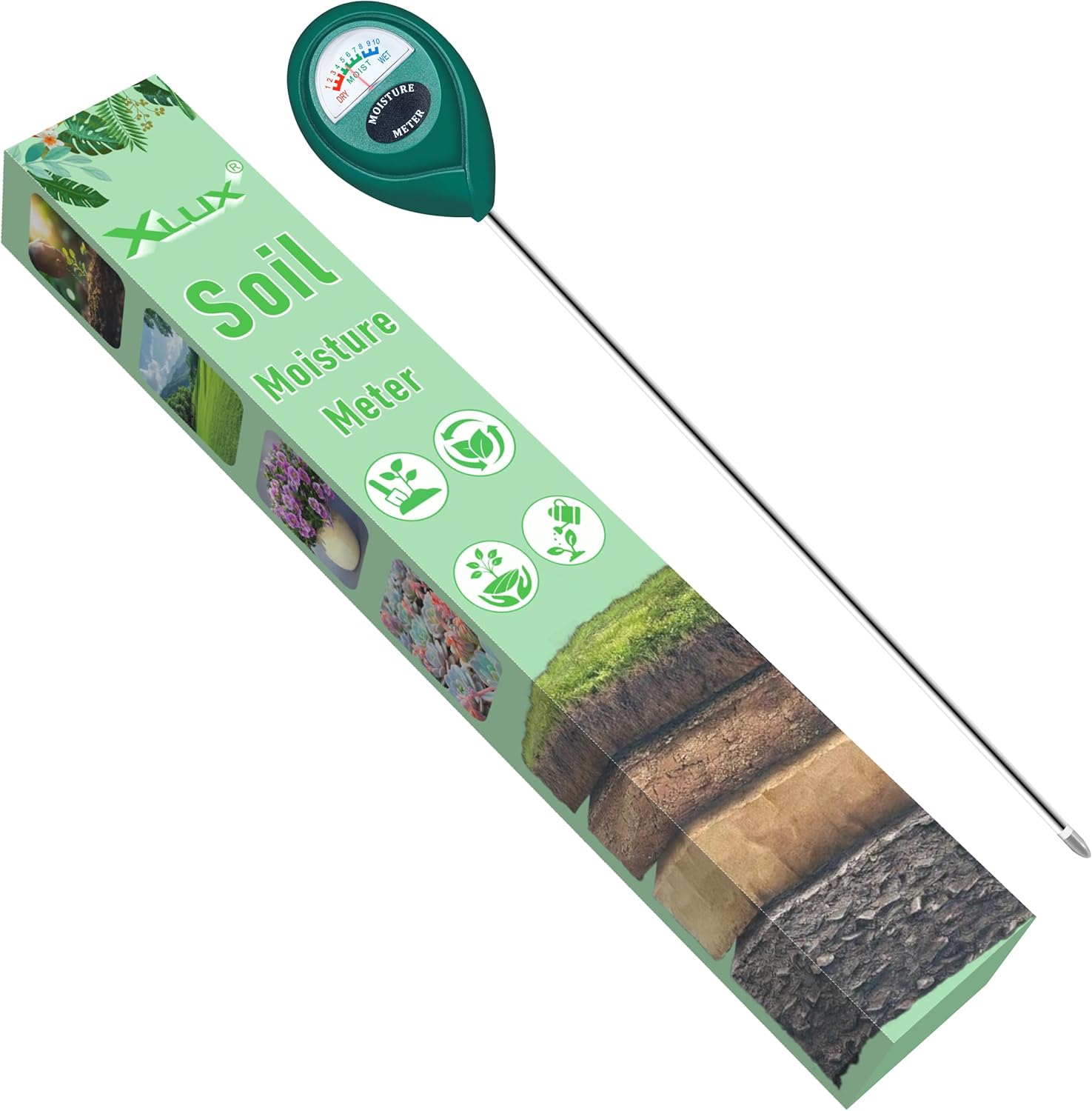
XLUX Long Probe Soil Moisture Meter (T9178)
| Brand | XLUX |
|---|---|
| Model | T9178 |
| Mounting Type | Tabletop |
| Upper Temperature Range | 50 °C |
The XLUX long probe soil moisture meter is a no-frills analog hygrometer designed to read moisture deeper in larger pots and containers. It works by inserting the single metal probe into potting mix and reading an immediate moisture indication on a large dial divided into dry, moist, and wet zones. The extended probe length makes it convenient for tall planters and hanging baskets where surface checks are misleading. Its simplicity means no batteries or calibration routines and the single-probe design reduces root disturbance when testing. Important practical notes are that the probe is intended for typical potting mixes and can give inconsistent readings in very airy media unless that media is compacted around the sensor, and the metal tip should not be left in soil for more than a few minutes to avoid corrosion. For routine watering decisions this meter is fast, easy to use, and durable enough for casual gardeners, but it is not suited to continuous monitoring or precise scientific moisture profiling.
Best for: Gardening buyers who want a simple, low-maintenance tool to make faster watering decisions for larger pots and container plants without fussing over electronics.
Less Ideal for: Users who need continuous logging, highly precise moisture percentages, or a meter engineered for coarse soilless mixes like pure perlite or orchid bark.
- Long 5.5-inch probe reaches lower soil levels in large pots and deep planters
- Large, easy-to-read dial with dry, moist, and wet zones for quick decisions
- Single-probe design minimizes root disturbance during testing
- Mechanical operation requires no batteries or electronics to maintain
- Not reliable in very airy substrates unless the media is compacted around the probe
- Metal probe can corrode if left in soil for extended periods
Verdict: Choose this meter if you need a fast, battery-free way to check moisture deep in large pots and make practical watering decisions.
Censinda Soil Moisture Meter with Single Probe

| Probe Length | 6.7inch |
|---|---|
| Moisture Range | 1-10 (1-3 Dry, 4-7 Nor, 8-10 Wet) |
| Battery | No batteries needed |
| Upper Temperature Range | 40 °C |
This basic soil moisture meter uses a single metal probe and an analog dial to show whether soil is dry, normal, or wet. You insert the 6.7-inch probe into the root zone and read the moisture scale immediately, so it is useful for routine checks on potted houseplants, hanging baskets, and garden containers. The unit needs no batteries and is lightweight and portable, making it convenient to move between plants and to keep in a small gardener's toolkit. Notable features include a printed moisture range (1–10) with marked dry, normal, and wet zones and clear usage tips on the package. Because it is mechanical, readings are instant but relative rather than scientific and can be affected by very rocky or compacted soils, which the manufacturer warns can bend the probes. The meter should not be left permanently in the soil and requires occasional cleaning of the probe after use. For straightforward, low-cost monitoring this meter does the job, but users wanting digital precision or multi-parameter sensing will need a different device.
Best for: For budget-minded indoor gardeners who want a quick, no-fuss way to check whether potted plants need water and prefer simple tools over digital gadgets.
Less Ideal for: Not a good choice for growers who need laboratory-level moisture accuracy, long-term soil logging, or multi-parameter sensors for advanced plant diagnostics.
- No batteries required so it is always ready to use
- Long probe reaches typical potted plant root zones
- Instant analog reading for quick watering decisions
- Lightweight and portable for moving between plants
- Analog, relative readings are less precise than digital meters
- Probe can be damaged in very hard or rocky soil and should not be left inserted
Verdict: A very affordable, battery-free meter that gives fast, practical moisture checks for everyday indoor plant care.
Jxikatx 7-in-1 Soil Test Kit with Dual Display (Moisture, pH, Fertility, Light, Temp, Humidity)

| Measurements | Moisture, pH, Fertility, Light, Soil temp, Air temp, Humidity |
|---|---|
| Display | Analog dial + LCD screen |
| Probe | Multi-metal single probe |
| Adjustable head | 90° rotating with 6 viewing angles |
The Jxikatx 7-in-1 Soil Test Kit is a compact handheld meter that gives you a quick snapshot of soil and microclimate conditions. It uses a single multi-metal probe with an analog dial for moisture, pH, fertility and light and an LCD for soil temperature plus air temperature and humidity. Typical use is simple: insert the probe into moist soil (about 5 inches recommended), angle the rotating head for easy viewing, and read the dial and screen to guide watering, fertilizing and siting decisions. Notable features are the dual-display layout that separates stable analog readings from digital temperature and humidity, the 90° adjustable head for ergonomic use, and a durable probe designed to minimize root disturbance. Practical benefits include faster, consolidated checks across multiple parameters and the ability to use it across houseplants, raised beds and lawns. Limitations to note are that it is designed for moist soil only, will not work accurately in very dry or waterlogged media or hydroponics, and some parameters are analog rather than precise numeric outputs which can reduce resolution for fine adjustments.
Best for: Gardeners who want a dependable, all-in-one meter for routine checks and practical decision-making on watering and fertilizing across houseplants, vegetable beds and lawns.
Less Ideal for: Users who need laboratory-grade numeric precision, continuous monitoring, or devices built for hydroponics and very dry or saturated media should look elsewhere.
- Measures seven relevant parameters in one compact tool for quick spot checks
- Dual display separates digital temperature/humidity from analog soil readings for clear viewing
- 90° adjustable head reduces bending and makes readings easier in beds and pots
- Single-probe design minimizes root disturbance during testing
- Not accurate in dry soil, waterlogged media, stones, or hydroponic setups
- Analog dial for pH, moisture and nutrients provides approximate ranges rather than exact numeric precision
- Probe should not be left in soil for extended periods to prevent damage
Verdict: Buy this if you want a reliable, easy-to-use multi-parameter soil tester for routine, practical gardening checks rather than lab-grade precision.
XLUX T10 Plant Soil Moisture Meter (Battery-Free)

| Battery Description | No batteries required |
|---|---|
| Mounting Type | Tabletop |
| Upper Temperature Range | 45 °C |
| Temperature Reading Accuracy | ±0.5 °C |
The XLUX T10 is a straightforward analog soil moisture meter designed to give instant moisture readings without batteries. You use it by inserting the slim 304 stainless steel probe into the potting mix or garden bed down to the root zone, then read the large color-coded dial that marks Dry, Moist, and Wet. Its single narrow probe minimizes root disturbance compared with thicker dual-prong meters, making it useful for potted houseplants and smaller garden beds. The tabletop mounting and protective sleeve help preserve the probe between uses, and the unit requires minimal maintenance beyond wiping the probe clean after each short test. Limitations to note are that it provides a general moisture level rather than precise soil moisture percentage and is intended for temporary tests only, so it is not a continuous-monitoring solution; accuracy can also vary by soil type and insertion depth. For gardeners who want a low-cost, low-effort way to remove guesswork from watering, the T10 offers reliable, easy-to-read results for everyday use.
Best for: Buyers who want a simple, low-maintenance tool to quickly check whether potted plants or small garden beds need water and who value easy-to-read, proven devices backed by many users.
Less Ideal for: If you need digital precision, continuous logging, or professional soil-moisture profiling for large-scale landscapes, this basic analog tester will be insufficient.
- Battery-free operation for instant readings without maintenance
- Slim single 304 stainless steel probe reduces root damage
- Large color-coded dial that is easy to read at a glance
- Protective sleeve included to prevent probe abrasion during storage
- Provides qualitative moisture ranges rather than numeric moisture percentage
- Designed for short, temporary tests only and not for continuous monitoring
Verdict: A no-fuss, battery-free moisture meter that gives quick, readable root-zone moisture guidance for everyday indoor and small garden plant care.
XLUX T10 Soil Moisture Meter (2-Pack)

| Battery Description | No batteries required |
|---|---|
| Number of Items | 2 |
| Item Highlight | Anti-rust 304 SST probe, single-probe immediate read |
The XLUX T10 is a straightforward analog soil moisture meter sold as a two-pack for spot-checking moisture in pots and garden soil. It uses a single stainless steel probe and a large dial marked in three zones plus ten scales so you can instantly tell if soil is dry, moist, or wet. Because it is battery-free and mechanical, there is nothing to charge or replace and it is easy to hand to less experienced gardeners. Typical use is pushing the probe into the root zone for a few seconds, reading the dial, then wiping the probe clean. The single-probe design limits root disturbance and the 304 stainless probe resists rust better than untreated metal. Important limitations are that it is not designed for continuous in-ground monitoring, should not be left in soil for more than a few minutes, and is less effective in very compacted or rocky soils. It reports relative moisture rather than precise volumetric measurements, so use it as a quick, practical guide rather than a scientific moisture profile.
Best for: Buyers who want a low-maintenance, easy-to-use tool to confirm whether houseplants or garden pots need water and prefer a simple reliable indicator over technical precision.
Less Ideal for: People who need continuous logging, laboratory-level moisture accuracy, or reliable readings in very compacted or rocky soil should choose a different sensor type.
- Battery-free operation requires no maintenance or replacements
- Large, easy-to-read dial with clear dry/moist/wet zones
- Single stainless steel probe reduces root disturbance and resists rust
- Sold as a two-pack for checking multiple pots or locations
- Not intended for continuous monitoring and should not be left in soil
- Gives relative moisture levels rather than precise numeric measurements
Verdict: A no-fuss, battery-free moisture meter that delivers quick, easy dry/moist/wet readings for cautious gardeners who want straightforward guidance.
Choosing the Right Indoor Soil Moisture Meter: Key Factors to Consider
Reading Accuracy
Accurate readings are essential because indoor potting mixes hold water differently than garden soil. A meter that consistently overstates moisture will cause you to under-water; one that understates moisture will encourage overwatering. Accuracy depends on probe design, internal sensing electronics, and how the device interprets conductivity or dielectric signals for loose, amended mixes.
When you evaluate accuracy, consider whether the meter reports simple wet/dry zones or gives a graduated scale. Graduated scales let you make finer decisions for plants that prefer evenly moist versus nearly dry conditions. Also note that readings can vary by soil type, so look for meters that perform consistently across peat-based, coco, and mixed potting soils.
Probe Length and Strength
Indoor pots are often shallow, so probe length matters to avoid hitting the bottom or roots. A probe that is too long will be awkward in small terracotta pots, while one that is too short may not reach the active root zone for larger containers. Sturdy construction prevents bending or breaking when inserting into dense or root-bound mixes.
Also assess the probe diameter and tip shape. Thinner probes displace less soil and reduce root disturbance, but they must still be rigid enough to insert smoothly. Corrosion-resistant materials extend service life, especially in regularly moist soils where metal probes can degrade over time.
Display Clarity and Readability
A clear display reduces guesswork during routine watering checks. Simple analog meters with color bands are easy to read at a glance, especially under indoor lighting. Digital displays can show exact percentages or icons but need to remain legible in low-light corners where many plants live.
Consider whether the display uses backlighting, large numerals, or color coding. Devices that combine a quick visual cue with a more precise readout give the best balance for busy gardeners who want both speed and detail.
Ease of Use and Maintenance
Indoor gardeners often prefer tools that are ready to use with minimal setup. Meters that need frequent calibration or special batteries add friction to routine checks. Look for models that are intuitive to operate, with clear instructions and straightforward sensor cleaning procedures.
Maintenance matters because potting mix can cling to probes and alter readings if not cleaned. Removable or wipe-clean probes and simple battery access reduce the chance you will stop using the meter because it becomes a chore to maintain.
Moisture Range Sensitivity
Different houseplants require different moisture windows. A meter with a broad sensitivity across very dry to saturated conditions helps you spot subtle changes before they stress plants. Sensitivity influences how well the device distinguishes surface wetness from deeper moisture.
Pay attention to how a meter reports near-saturation versus mildly damp conditions. Some meters compress most readings into a narrow band for indoor mixes, which reduces usefulness. Those that show a clear gradient let you fine-tune water frequency for species such as succulents, aroids, and ferns.
Types of Indoor Soil Moisture Meters
Indoor soil moisture meters fall into a few basic types: simple probe meters that measure electrical conductivity, capacitive sensors that avoid direct metal contact with soil, and digital units that convert sensor input to percentage or icon readouts. Each type behaves differently in potting mixes and in small pots.
Probe meters are the most common and affordable. Capacitive meters can be less prone to corrosion and give steadier readings in mixed soilless media. Digital units add precision but may require more careful placement and occasional battery replacement.
- Probe conductivity meters: quick and easy, perform well in most potting mixes.
- Capacitive sensors: resist corrosion, better for long-term monitoring in moist soils.
- Digital displays: provide exact numbers or icons but may need batteries and clearer placement.
Placement and Technique for Reliable Readings
How you insert the probe affects results. Aim to place the sensor into the active root zone rather than the surface layer. For small pots, insert the probe at a shallow angle if depth is limited; for larger pots, test several points to find a representative moisture level.
Avoid pushing the probe through drainage holes or into gaps where it will touch pot walls. Clean the probe between different plants to avoid transferring moisture or pathogens, and allow very waterlogged pots time to drain before testing to reduce saturation bias.
- Insert near the middle of the pot for even-rooted plants.
- Test multiple spots in large containers to average moisture.
- Wipe probes dry between uses and disinfect occasionally for sick plants.
Interpreting Readings for Different Houseplants
Not all plants need the same moisture. Use the meter reading in combination with knowledge of a plant's preference. For example, succulents and cacti tolerate lower readings before you water again, while ferns and some tropicals prefer a consistently higher zone on the meter.
When a meter gives a range rather than a binary wet/dry message, create plant-specific thresholds. Keep a simple chart or note for each species so you know whether a given reading means wait, water lightly, or water thoroughly.
- Succulents: look for lower-range readings before watering.
- Tropical foliage plants: aim for mid to upper-mid range readings.
- Seedlings and cuttings: prefer gentle, even moisture without saturation.
Common Pitfalls and How to Avoid Them
Relying on a single shallow test can be misleading because surface soil dries faster than the root zone. Conversely, always testing near the pot bottom might miss dry pockets near the surface. Combine probe placement with a visual check of the potting mix and plant turgor.
Another common issue is leaving a meter probe in place between checks. That can create channels or compact the soil. Only insert the meter for the reading and remove it afterwards to preserve natural soil structure.
- Do not leave probes in permanently.
- Avoid testing immediately after watering; wait for drainage.
- Use multiple readings to confirm unusual results.
Battery and Durability Considerations
If you choose a digital unit, consider battery type and replacement ease. Rechargeable units reduce ongoing battery purchases but add complexity. For simple analog meters, check for corrosion-prone parts and look for corrosion-resistant coatings or stainless components.
Durability is about more than materials. Check how probes are attached to the housing and whether seals protect the electronics from humidity. A well-built meter resists the indoor humidity cycles that can degrade inferior devices.
- Prefer accessible battery compartments for quick swaps.
- Look for corrosion-resistant probes for long service life.
- Consider a protective storage spot to avoid dropping or crushing the meter.
How We Chose the Best Indoor Soil Moisture Meter
We focused on the features that matter most for indoor plant care and excluded outdoor-only or agricultural meters that are bulky or built for deep soil probes. Primary evaluation criteria included reading accuracy in common potting mixes, probe design and length for small containers, ease of interpreting results under indoor lighting, responsiveness across moisture ranges, and durability with repeated indoor use. We tested editorially by comparing specification sheets, user-reported behavior in typical houseplant scenarios, and design features that influence real-world use. We excluded devices that require specialized soils, external calibration rigs, or are sized only for garden beds. We favored meters with probe lengths suitable for small to medium pots, clear readable outputs, low maintenance, and components that tolerate frequent insertions without breaking. Final selections balanced practical reliability for indoor potting mixes, simple operation for growers of all skill levels, and durable construction for repeated household use.
FAQ
How deep should I insert a moisture meter in a small pot?
Insert the probe until it reaches the active root zone without hitting the pot bottom, usually a few centimeters in small pots. Angle the probe slightly if needed to avoid the rim or drainage holes.
Can I leave a moisture meter in the soil between checks?
You should not leave the probe in continuously. Repeated insertion can compact soil and create channels that change moisture distribution. Insert only for readings and remove when finished.
Why do readings differ between two spots in the same pot?
Pots can develop dry pockets and wet spots due to root mass, uneven watering, or drainage. Test multiple locations to get a representative sense of overall moisture and adjust watering technique if readings vary widely.
Do capacitive meters work better in soilless mixes than conductivity probes?
Capacitive sensors are often less affected by the salts and soluble materials in soilless mixes and are less prone to corrosion. However, both types can work well if used and interpreted correctly for the specific potting media.
How often should I check moisture with a meter?
Frequency depends on the plant and season. Many houseplants need a check every 3 to 7 days when actively growing, and less often during dormancy. Use meter trends rather than single readings to guide schedule changes.
Final Verdict
Choose an indoor soil moisture meter that matches the depth and sensitivity needs of your pots and plant collection. Prioritize accurate readings in potting mixes, a probe length that suits your container sizes, and a display that you will actually use during routine checks. Expect tradeoffs between simplicity and precision: analog meters are quick at a glance, while digital units can give finer detail but need batteries and careful placement. Decide on the features that reduce friction for your care style. If you manage many small pots, favor short, durable probes and fast visual feedback. If you keep diverse species, a meter with a broad sensitivity and clear readout will help you tune water frequency with confidence.
