

Note: This article contains affiliate links. If you click on these links and make a purchase, I may earn a small commission at no extra cost to you. This helps support my research and content. Read my full affiliate disclosure here.
Getting watering right is one of the simplest ways to improve plant health and cut wasted water. A garden soil moisture meter gives you quick, on-the-spot readings so you can see whether soil is dry, moist, or saturated before you water. That matters for new transplants, container gardens that dry fast, and beds where different soil types change how long moisture lasts. This guide covers seven shortlisted meters that perform well across common garden situations. We evaluated each on accuracy, ease of use, durability, and suitability for different soils and containers. Read on to see which features matter most and which meter characteristics match your garden routine.
Top Picks at a Glance
| Best Overall The best all-around choice for most situations | Dr.meter S10 Soil Moisture Meter |  |
| Best Quality Built to a higher standard if you want something more solid | NexusLab Wireless 4‑in‑1 Soil Moisture Meter with LCD Receiver and 3‑Probe Sensors |  |
| Best Value The sweet spot between price and what you get | SONKIR MS02 3-in-1 Soil Moisture, pH and Light Tester |  |
| Best Budget The cheapest option that still gets the job done reliably | Censinda Soil Moisture Meter (single probe, no battery) |  |
| Highest Rated A top-rated pick with lots of positive feedback | Aenncci 2-in-1 Soil Test Kit — Soil Moisture and pH Meter |  |
| Most Popular A crowd favorite that many people choose with confidence | XLUX T10 Plant Soil Moisture Meter (Battery-Free) |  |
| Best Seller A high-volume bestseller chosen again and again | XLUX T10 Soil Moisture Meter (2-Pack) |  |
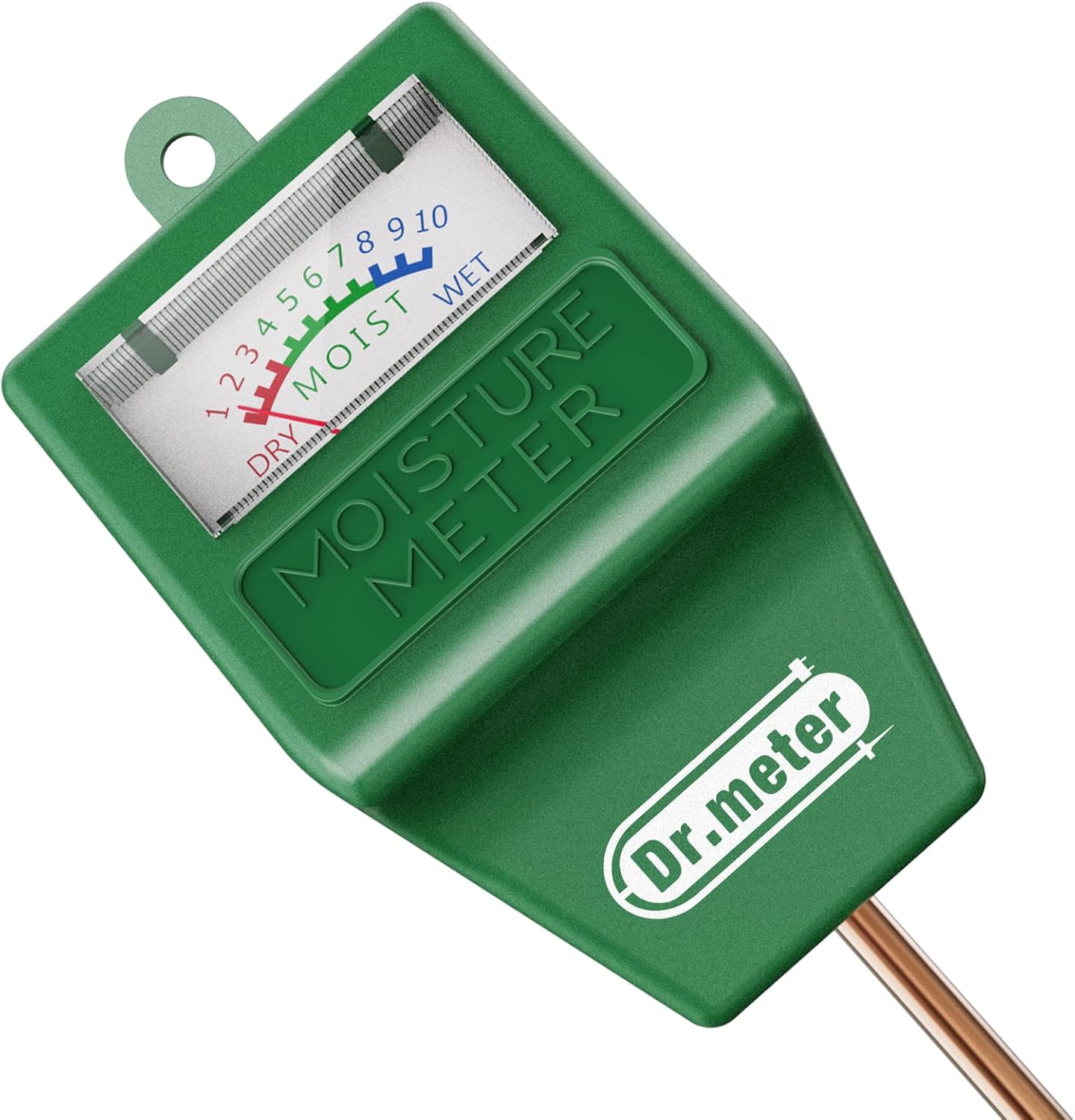
Dr.meter S10 Soil Moisture Meter
| Battery Description | No batteries required |
|---|---|
| Mounting Type | Tabletop |
| Upper Temperature Range | 40 °C |
| Included Components | 1x Dr.meter Moisture Sensor Meter |
The Dr.meter S10 is a compact, analog moisture meter designed to remove guesswork from watering houseplants and garden beds. You insert the single probe into potting mix or garden soil and read a 1–10 scale with color cues (dry to wet) on an easy-to-read display. Because it needs no batteries and has a slim probe it is ready to use immediately and is gentle on roots, making spot checks around stems quick and low-impact. Practical benefits include portability for checking multiple pots, straightforward color guidance for beginners, and a no-maintenance design that requires only occasional cleaning of the probe. Limitations: it provides relative moisture levels rather than precise volumetric water content, so results are best used as a watering guide rather than a scientific measurement. Avoid pushing the probe into very rocky or compacted soil to prevent damage, and expect fewer features than digital multi-function meters that add pH or light readings.
Best for: Gardeners who want a low-effort, reliable way to stop over- or under-watering and prefer simple, visual guidance for everyday plant care.
Less Ideal for: Users who need laboratory-grade moisture data, multi-parameter soil analysis, or frequent use in very compacted or rocky ground should consider a more advanced meter.
- No batteries required so it is always ready to use
- Simple 1–10 scale with color coding makes readings easy for beginners
- Slim single probe design minimizes root disturbance during testing
- Compact and portable for quick spot checks across multiple pots or garden areas
- Provides relative moisture readings rather than precise volumetric measurements
- Probe can be damaged if used in very rocky or extremely hard soil
Verdict: A fuss-free, batteryless moisture meter that gives clear color-coded readings to help everyday gardeners water more confidently.
NexusLab Wireless 4‑in‑1 Soil Moisture Meter with LCD Receiver and 3‑Probe Sensors

| Sensor water resistance | IPX5 |
|---|---|
| Soil moisture range | 0–100% (resolution 1%) |
| Moisture accuracy | ±3% (0–64%); ±5% (65–100%) |
| Soil temperature range | -20℃–80℃ |
| Wireless range | 60–150 m open area (approx. 60–230 ft) |
This NexusLab kit is a practical wireless soil monitor aimed at giving gardeners clear, hands‑off feedback about plant conditions. The system pairs an indoor LCD receiver with battery‑powered sensors that use TDR technology and triple stainless probes to deliver moisture, soil temperature, and light level readings. It ships with two sensors and can expand up to 12 zones, letting you track pots, raised beds, and garden rows from inside the house. The receiver displays clear high/normal/low status and can flash alerts when a sensor falls below a user set moisture threshold, which helps prevent under‑watering across multiple locations. Sensors are IPX5 rated so they tolerate rain and sprinklers, and the RF link reaches across long open distances so you do not need Wi‑Fi or apps. Expect periodic transmission intervals to preserve battery life so readings will not update instantly after watering. The unit is designed for soil use only, so it is not suitable for loose media such as pure perlite or gravel. For gardeners who want a reliable, expandable monitoring hub without app setup, this provides accurate, low‑maintenance oversight.
Best for: Gardeners who want an easy, no‑app solution to monitor moisture and basic plant conditions across multiple outdoor planting areas without visiting each site.
Less Ideal for: People who need real‑time continuous logging, mobile app integration, or monitoring in non‑soil substrates should look for specialized data‑logging or substrate‑specific probes instead.
- TDR sensor technology with stainless triple probes for stable, salt‑resistant moisture readings
- Expandable system supports up to 12 sensors so you can monitor multiple beds and pots from one receiver
- Long RF range (60–230 ft open area) and no app or Wi‑Fi required for simple indoor monitoring
- IPX5 waterproof sensors suitable for outdoor use in rain and sprinkler exposure
- Sensor updates are transmitted in intervals to save battery so readings may lag after watering
- Not suitable for use in non‑soil media like pure perlite, coco coir, or gravel
Verdict: A reliable, expandable wireless monitor that gives accurate, low‑maintenance moisture, temperature, and light readings across multiple outdoor planting zones without needing apps or Wi‑Fi.
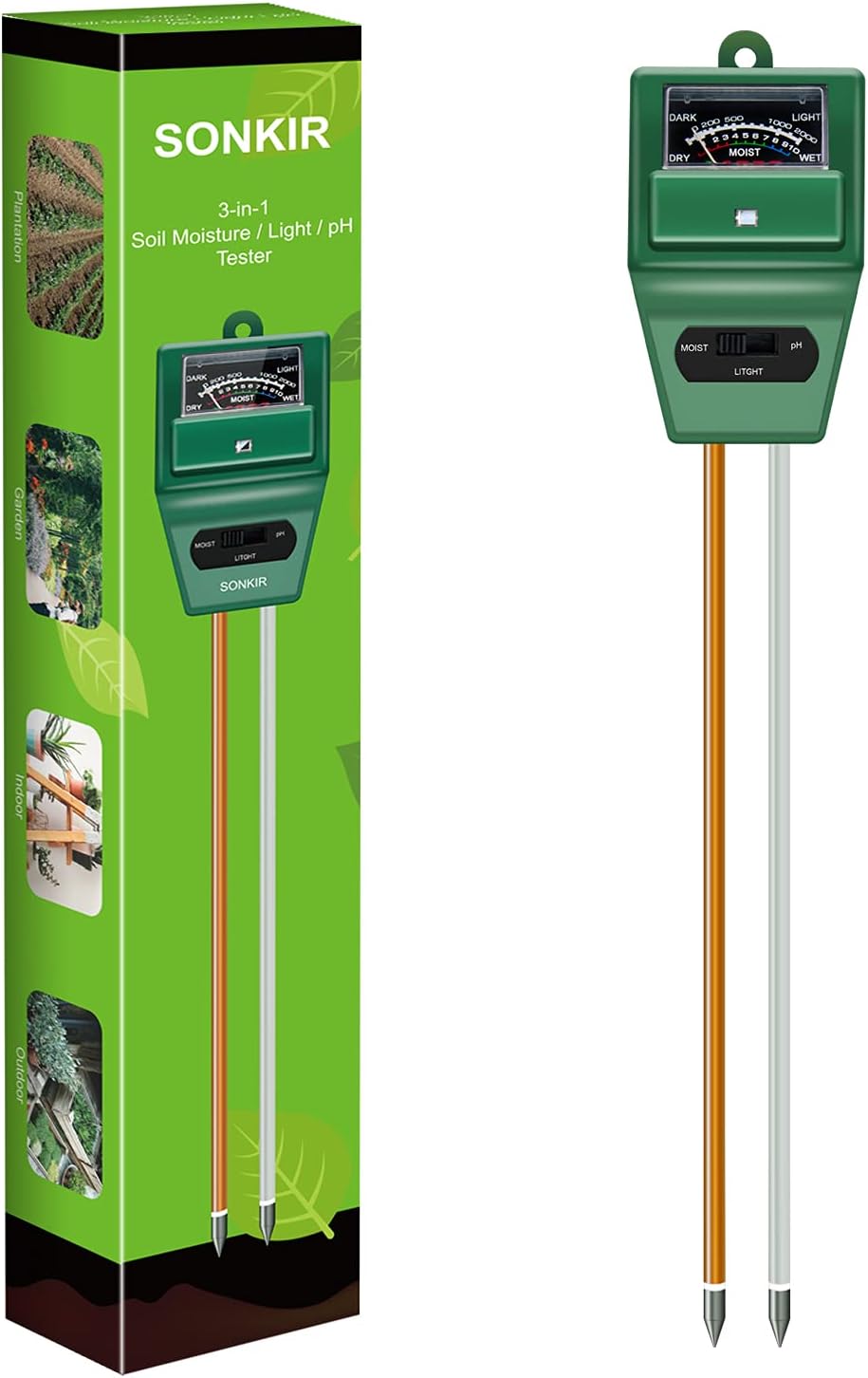
SONKIR MS02 3-in-1 Soil Moisture, pH and Light Tester
| pH range | 3.5-8 pH |
|---|---|
| Moisture range | 1-10 scale |
| Probe length | 7.9 inches |
| Power | No battery required |
The SONKIR MS02 is a handheld, no-battery soil meter that gives quick, visual readings of moisture, pH and sunlight to help you maintain healthier grass and garden plants. You switch the dial to the desired function, push the probe into the soil about 6 to 7 inches, wait roughly 10 minutes and read the needle on the analog display. The meter covers a practical pH range for lawns and gardens and shows moisture on a 1 to 10 scale so you can decide when to water. Its long probe and compact, lightweight body make it convenient for spot-checking multiple areas of a lawn or garden bed. Important limitations are that the pH probe is intended for soil only and the analog needle can be slow to move in very dry soils or close-to-neutral pH, so readings sometimes require rechecking after moistening the sample or testing several spots. The unit is best for gardeners who want an affordable, easy-to-use tool for routine soil checks rather than laboratory-accurate analysis.
Best for: Someone who wants an inexpensive, easy-to-use tool for routine soil checks across a lawn or garden and values practical, repeatable guidance over laboratory precision.
Less Ideal for: Users who need lab-grade pH or moisture measurements, continuous data logging, or digital readouts for precise record keeping should consider more advanced instruments.
- 3-in-1 functionality measures moisture, pH and sunlight without extra tools
- No battery required so it is always ready to use and low maintenance
- Long probe and compact form factor make spot checks across a lawn or garden quick
- Simple analog dial is straightforward for fast, at-a-glance decisions
- pH function is designed for soil only and cannot test water or other liquids
- Analog needle can be unresponsive in very dry soil or near-neutral pH, requiring repeated tests
Verdict: A straightforward, no-battery 3-in-1 tester that gives fast, practical soil moisture, pH and light checks for everyday lawn and garden care.
Censinda Soil Moisture Meter (single probe, no battery)

| Battery Description | No batteries needed |
|---|---|
| Probe Length | 6.7inch |
| Moisture Range | 1-10 (1-3 Dry, 4-7 Nor, 8-10 Wet) |
| Upper Temperature Range | 40 °C |
This Censinda soil moisture meter is a straightforward analog tester: push the single metal probe into potting mix near the roots and read the moisture scale (1–10 with ranges for dry, normal, and wet). It requires no batteries and gives an immediate indication so you can avoid overwatering common houseplants. The 6.7 inch probe reaches root-level soil in most pots and the printed scale simplifies watering decisions for beginners. Because it is mechanical, it is lightweight and portable and works anywhere without power. Limitations are its simplicity: it provides relative moisture only, no digital readout or temperature data, and the exposed metal probes can corrode if left in wet soil or used in very rocky or compacted mixes. The meter also needs cleaning after use and should not be forced into hard soils where the probe could bend. For casual plant owners on a tight budget who want a quick way to check pot moisture, this is a practical low-cost tool with easy, no-fuss operation.
Best for: Houseplant owners who prioritize a low-cost, easy-to-use tool to reduce overwatering and make watering decisions quickly without gadgets or batteries.
Less Ideal for: Collectors who need precise, repeatable digital measurements, multi-sensor monitoring, or a meter safe for frequent continuous in-soil deployment.
- No batteries required so it works immediately and costs nothing to operate
- Clear 1–10 moisture scale that maps to dry, normal, and wet for quick decisions
- 6.7 inch probe length reaches typical potting root zones for most houseplants
- Lightweight and portable for moving between pots and easy storage
- Analog readout gives relative moisture only, not precise numeric humidity or temperature
- Probes can corrode or be damaged if left in wet soil or used in very hard, rocky substrates
Verdict: A tiny, no-frills moisture meter that reliably prevents overwatering for budget-minded houseplant owners.
Aenncci 2-in-1 Soil Test Kit — Soil Moisture and pH Meter

| Battery | None required |
|---|---|
| Functions | Soil moisture and pH |
| Use | Indoor and outdoor |
This compact 2-in-1 soil tester combines a moisture meter and pH meter in a single battery-free probe, making it a simple tool for routine checks in pots, garden beds, lawns, and raised beds. You insert the probe into the soil (recommended deeper than 4 inches) and read both values on the large dual dial without switching modes, which is convenient for quick spot checks across multiple plants. The single sturdy probe and high-sensitivity sensors aim to minimize root disturbance while delivering fast readings, and the lack of batteries means no ongoing power maintenance. Practical strengths are its ease of use, portability for moving between indoor and outdoor areas, and clear visual dials that work for inexperienced users. Important limitations are that the device is a spot-check instrument rather than a laboratory-grade meter and it requires correct insertion depth and periodic cleaning of the probe for consistent results. Expect reliable everyday guidance for watering and basic pH awareness rather than precision soil analysis for professional testing.
Best for: Buyers who prioritize a dependable, low-maintenance tool for routine plant care and want quick, easy checks of soil moisture and pH across indoor and outdoor plants.
Less Ideal for: Users seeking highly precise, lab-level soil analysis or continuous monitoring solutions for research or commercial production.
- Two measurements in one probe for simultaneous moisture and pH checks
- Battery-free design eliminates the need for replacements or charging
- Large dual dial makes readings easy to see at a glance
- Single sturdy probe designed to reduce root damage during use
- Not a lab-grade instrument so values are best used for general guidance
- Requires insertion to the correct depth and regular probe cleaning for consistent readings
Verdict: A simple, maintenance-free two-in-one probe meter that delivers fast, reliable spot checks of soil moisture and pH for everyday plant care.
XLUX T10 Plant Soil Moisture Meter (Battery-Free)

| Battery Description | No batteries required |
|---|---|
| Mounting Type | Tabletop |
| Upper Temperature Range | 45 °C |
| Temperature Reading Accuracy | ±0.5 °C |
The XLUX T10 is a straightforward analog soil moisture meter designed to give instant moisture readings without batteries. You use it by inserting the slim 304 stainless steel probe into the potting mix or garden bed down to the root zone, then read the large color-coded dial that marks Dry, Moist, and Wet. Its single narrow probe minimizes root disturbance compared with thicker dual-prong meters, making it useful for potted houseplants and smaller garden beds. The tabletop mounting and protective sleeve help preserve the probe between uses, and the unit requires minimal maintenance beyond wiping the probe clean after each short test. Limitations to note are that it provides a general moisture level rather than precise soil moisture percentage and is intended for temporary tests only, so it is not a continuous-monitoring solution; accuracy can also vary by soil type and insertion depth. For gardeners who want a low-cost, low-effort way to remove guesswork from watering, the T10 offers reliable, easy-to-read results for everyday use.
Best for: Buyers who want a simple, low-maintenance tool to quickly check whether potted plants or small garden beds need water and who value easy-to-read, proven devices backed by many users.
Less Ideal for: If you need digital precision, continuous logging, or professional soil-moisture profiling for large-scale landscapes, this basic analog tester will be insufficient.
- Battery-free operation for instant readings without maintenance
- Slim single 304 stainless steel probe reduces root damage
- Large color-coded dial that is easy to read at a glance
- Protective sleeve included to prevent probe abrasion during storage
- Provides qualitative moisture ranges rather than numeric moisture percentage
- Designed for short, temporary tests only and not for continuous monitoring
Verdict: A no-fuss, battery-free moisture meter that gives quick, readable root-zone moisture guidance for everyday indoor and small garden plant care.
XLUX T10 Soil Moisture Meter (2-Pack)

| Battery Description | No batteries required |
|---|---|
| Number of Items | 2 |
| Item Highlight | Anti-rust 304 SST probe, single-probe immediate read |
The XLUX T10 is a straightforward analog soil moisture meter sold as a two-pack for spot-checking moisture in pots and garden soil. It uses a single stainless steel probe and a large dial marked in three zones plus ten scales so you can instantly tell if soil is dry, moist, or wet. Because it is battery-free and mechanical, there is nothing to charge or replace and it is easy to hand to less experienced gardeners. Typical use is pushing the probe into the root zone for a few seconds, reading the dial, then wiping the probe clean. The single-probe design limits root disturbance and the 304 stainless probe resists rust better than untreated metal. Important limitations are that it is not designed for continuous in-ground monitoring, should not be left in soil for more than a few minutes, and is less effective in very compacted or rocky soils. It reports relative moisture rather than precise volumetric measurements, so use it as a quick, practical guide rather than a scientific moisture profile.
Best for: Buyers who want a low-maintenance, easy-to-use tool to confirm whether houseplants or garden pots need water and prefer a simple reliable indicator over technical precision.
Less Ideal for: People who need continuous logging, laboratory-level moisture accuracy, or reliable readings in very compacted or rocky soil should choose a different sensor type.
- Battery-free operation requires no maintenance or replacements
- Large, easy-to-read dial with clear dry/moist/wet zones
- Single stainless steel probe reduces root disturbance and resists rust
- Sold as a two-pack for checking multiple pots or locations
- Not intended for continuous monitoring and should not be left in soil
- Gives relative moisture levels rather than precise numeric measurements
Verdict: A no-fuss, battery-free moisture meter that delivers quick, easy dry/moist/wet readings for cautious gardeners who want straightforward guidance.
Choosing the Right Garden Soil Moisture Meter: Key Factors to Consider
Moisture Reading Accuracy
Accurate readings are central to a soil moisture meter's usefulness. A meter that reports consistent values across repeated insertions in the same spot lets you build trust in its guidance. Accuracy matters more in fine-rooted plants and seedlings where small moisture differences affect survival.
Look for meters that perform consistently in both looser potting mixes and heavier garden soils. Expect some variation between devices; what matters is repeatability and sensible separation between dry, moist, and wet readings to guide watering actions.
Probe Design and Length
Probe geometry and length determine where and how well the meter senses moisture. Long probes reach deeper moisture zones in established beds and tree or shrub roots, while shorter probes are better for shallow containers and seed trays. Probe thickness and tip shape affect how easily the probe slides into compacted soil without causing excessive damage.
The number and spacing of sensing elements on the probe also influence readings; evenly spaced contacts provide a more representative sample of soil moisture. Consider the probe length you need for your typical plants and whether the design minimizes bending or breakage during use.
Durability and Corrosion Resistance
Soil moisture meters are used in wet, dirty conditions that can corrode metal parts and degrade plastics. Materials that resist rust and pitting extend service life and keep readings stable. Durable construction also means the probe and housing survive being pushed into rocky or root-filled soil without bending or cracking.
Maintenance matters too. Meters that tolerate routine cleaning without losing calibration or showing accelerated wear will perform better season after season. If you plan to use the meter frequently, prioritize corrosion-resistant probes and robust housings.
Ease of Reading and Interpretation
A meter is only useful if you can read and interpret its output quickly while working outdoors. Analog needle gauges with clear, labeled zones make snap decisions easy, and digital displays with backlight are helpful in low light. Consider how the scale maps to actionable zones like 'dry', 'moist', and 'wet' rather than abstract numbers.
Simple, intuitive displays reduce second-guessing and let you water on a schedule based on measured conditions rather than guesswork. Also evaluate how the display holds up when dirt gets on it and whether it is protected during storage.
Suitability for Containers and Raised Beds
Containers and raised beds dry out differently than in-ground soil because of height, soil volume, and drainage. A meter that works well in deep landscape beds may over-report dryness in small pots if the probe reaches a dry pocket near the rim. Conversely, a probe too short will miss moisture at root depth in deeper planters.
Choose a meter whose probe length and sensing design match the typical pot sizes and bed depths you use. For gardeners working across both containers and beds, a versatile probe length or a meter that provides guidance for multiple depths is ideal.
Maintenance and Long-Term Reliability
Routine maintenance affects how long a meter stays accurate. Probes should be easy to rinse and dry without disassembling fragile parts. Meters that require little calibration and have replaceable parts where wear is expected will save time down the line.
Consider how frequently you garden and whether the meter will see heavy seasonal use. Durable meters that resist soil buildup and allow simple cleaning preserve accuracy and reduce the need to replace the tool.
When a Moisture Meter Helps Most
Moisture meters are most helpful where visual or surface cues are misleading. Seedlings, recently transplanted perennials, mixed-container arrangements, and beds with uneven irrigation benefit from objective moisture checks. In these scenarios the meter removes guesswork and prevents inconsistent watering that can stress plants.
Even experienced gardeners use meters to confirm whether irrigation systems are delivering water to the root zone rather than just wetting the surface. They are also useful when changing soil mixes or amendments because those alter how water is retained and released.
- Confirming watering depth after planting or transplanting
- Monitoring fast-drying containers and hanging baskets
- Evaluating performance of drip or soaker irrigation lines
- Checking moisture after heavy rains to avoid overwatering
Using a Meter Properly
Insert the probe slowly and avoid forcing it through roots or rocks. Repeated readings at the same depth and location give more reliable information than single spot checks. For pots, take readings at multiple points around the root ball to account for uneven moisture.
Clean the probe after each use to prevent soil buildup that can alter readings. Allow the probe to dry before storing. If your meter has a removable probe or protective cap, use it to protect the sensing surfaces between uses.
- Take multiple readings at the same depth for consistency
- Record readings for overhead watering schedules to spot patterns
- Avoid taking readings immediately after watering unless you want to measure saturation
Interpreting Readings for Different Soil Types
Different soils hold and release water at different rates. Sandy soils drain quickly and need more frequent checks, while soils high in organic matter or clay retain moisture longer. A single numerical reading should be interpreted relative to the soil type and plant needs.
Develop a baseline by observing how your soil behaves after a full watering and comparing meter readings over several days. That baseline helps translate scale readings into practical watering intervals for each planting area.
- Sandy mixes: expect lower moisture retention and faster declines
- Loam and amended soils: moderate retention and steadier readings
- Clay soils: hold water longer but may show high variance between surface and deeper probes
Protecting Meters From Common Damage
Avoid leaving meters outside exposed to prolonged sun and rain. UV and moisture can degrade housings and seals. Store meters in a dry place and keep probes protected to prevent bending or corrosion.
When working in stony or root-filled ground, probe damage is a common failure mode. Use gentler insertion techniques and choose a meter with a thicker, reinforced probe if you garden in those conditions frequently.
- Rinse and dry probes after use to reduce corrosion
- Use protective caps or tubes when storing
- Avoid levering the probe against hard objects to prevent bending
Alternatives and Complementary Tools
Moisture meters are quick spot-check tools and work best alongside other irrigation management practices. Soil tensiometers measure soil water tension for a different kind of data and are useful where precise plant-available water readings are required.
Other complementary methods include simple probe sticks to check soil resistance, monitoring plant indicators like wilting patterns, and using rain gauges or soil moisture sensors integrated into irrigation controllers for automated systems.
- Use tensiometers for deep-rooted crops requiring precise irrigation control
- Combine meters with a rain gauge to adjust scheduled irrigation
- Observe plant signals and meter data together for the best judgment
How We Chose the Best Garden Soil Moisture Meter
We started by focusing on tools that deliver dependable moisture readings across the kinds of soils gardeners actually use. Key evaluation criteria were accuracy in different soil textures, probe design and placement consistency, resistance to corrosion and wear, response speed and ease of reading, and adaptability for both containers and in-ground beds. We also considered ergonomics for repeated use and how straightforward maintenance and cleaning are after contact with soil. Products were excluded if they lacked reliable moisture scales, used single-use or non-durable probes, or had poor placement repeatability in both loose potting mix and firmer garden soil. We prioritized meters with clear, repeatable readings and construction materials that withstand regular outdoor use. The final shortlist balances precision, user ergonomics, and longevity so gardeners can make consistent irrigation decisions without frequent replacement.
FAQ
How deep should I insert a moisture meter probe?
Depth depends on the plant and container size. For most pots insert the probe to the root zone without hitting the bottom. For established beds aim for several inches into the root area. Take multiple readings at different depths if roots vary.
Can a meter be used in both containers and in-ground beds?
Often yes, but probe length and sensing design matter. Some meters are optimized for shallow pots while others reach deeper beds. Choose a meter with probe length that matches your common planting situations or use different meters for different tasks.
Do meters need calibration?
Many simple meters do not require routine calibration, but their readings can drift if probes corrode or soil buildup occurs. Regular cleaning and occasional checks against known wet and dry reference samples help maintain confidence in readings.
Will a moisture meter work in very sandy soil?
Moisture meters work in sandy soils but readings can change rapidly because sand drains fast. Expect lower retention and take more frequent checks to capture moisture trends rather than relying on single readings.
How do I avoid damaging the probe?
Insert the probe slowly, avoid forcing it through roots or rocks, and store it with a protective cap. If you garden in rocky soil, select a meter with a reinforced probe or use gentler insertion angles to reduce bending risk.
Are digital displays better than analog for outdoor use?
Digital displays can be easier to read in low light, but they may be more sensitive to moisture ingress. Analog gauges are simple and robust. Choose based on whether you prioritize readability or ruggedness.
Final Verdict
Choose a Garden Soil Moisture Meter that matches the soil types, container sizes, and planting depths you work with most. Prioritize consistent, repeatable readings and a probe design that reaches the root zone without damaging plants. Also weigh durability and ease of cleaning so the meter stays reliable through seasons. A good meter makes watering decisions clearer and reduces guesswork. Focus on the tradeoffs between probe length, display type, and corrosion resistance to pick a tool that fits your routine and garden conditions with confidence.
