

Note: This article contains affiliate links. If you click on these links and make a purchase, I may earn a small commission at no extra cost to you. This helps support my research and content. Read my full affiliate disclosure here.
Managing weeds across acres, large lawns, or extensive roadside strips requires products that treat wide swaths efficiently and keep regrowth in check. You need solutions that save time on application, deliver consistent results over varied turf and soil, and fit the safety and timing constraints of big outdoor spaces. This guide covers six shortlisted weed killers for large areas, selected for coverage rate, persistence, and suitability for common large-scale scenarios. Below we summarize how each option performs and the evaluation criteria used so you can pick the product best suited to your landscape and workload.
Top Picks at a Glance
| Best Overall The best all-around choice for most situations | RM43 Total Vegetation Control 43% Glyphosate Plus Imazapyr, 2.5-Gallon |  |
| Best Quality Built to a higher standard if you want something more solid | Roundup Pro Concentrate Herbicide (2.5 gal) |  |
| Best Value The sweet spot between price and what you get | Spectracide Large Plot Weed Stop for Lawns Concentrate, 1 Gal |  |
| Best Budget The cheapest option that still gets the job done reliably | VIVIPOOOL 41% Glyphosate Super Concentrate Weed & Grass Killer (1 gal) |  |
| Highest Rated A top-rated pick with lots of positive feedback | Honcho K6 Glyphosate Herbicide, 2.5 Gallon |  |
| Most Popular A crowd favorite that many people choose with confidence | Compare-N-Save 75324 Glyphosate Herbicide, 1-gallon |  |
RM43 Total Vegetation Control 43% Glyphosate Plus Imazapyr, 2.5-Gallon
| Unit Count | 320 Fluid Ounces |
|---|---|
| Coverage | 43,243 square feet |
| Item Form | Liquid |
| Active Ingredients | Glyphosate isopropylamine salt, Imazapyr isopropylamine salt |
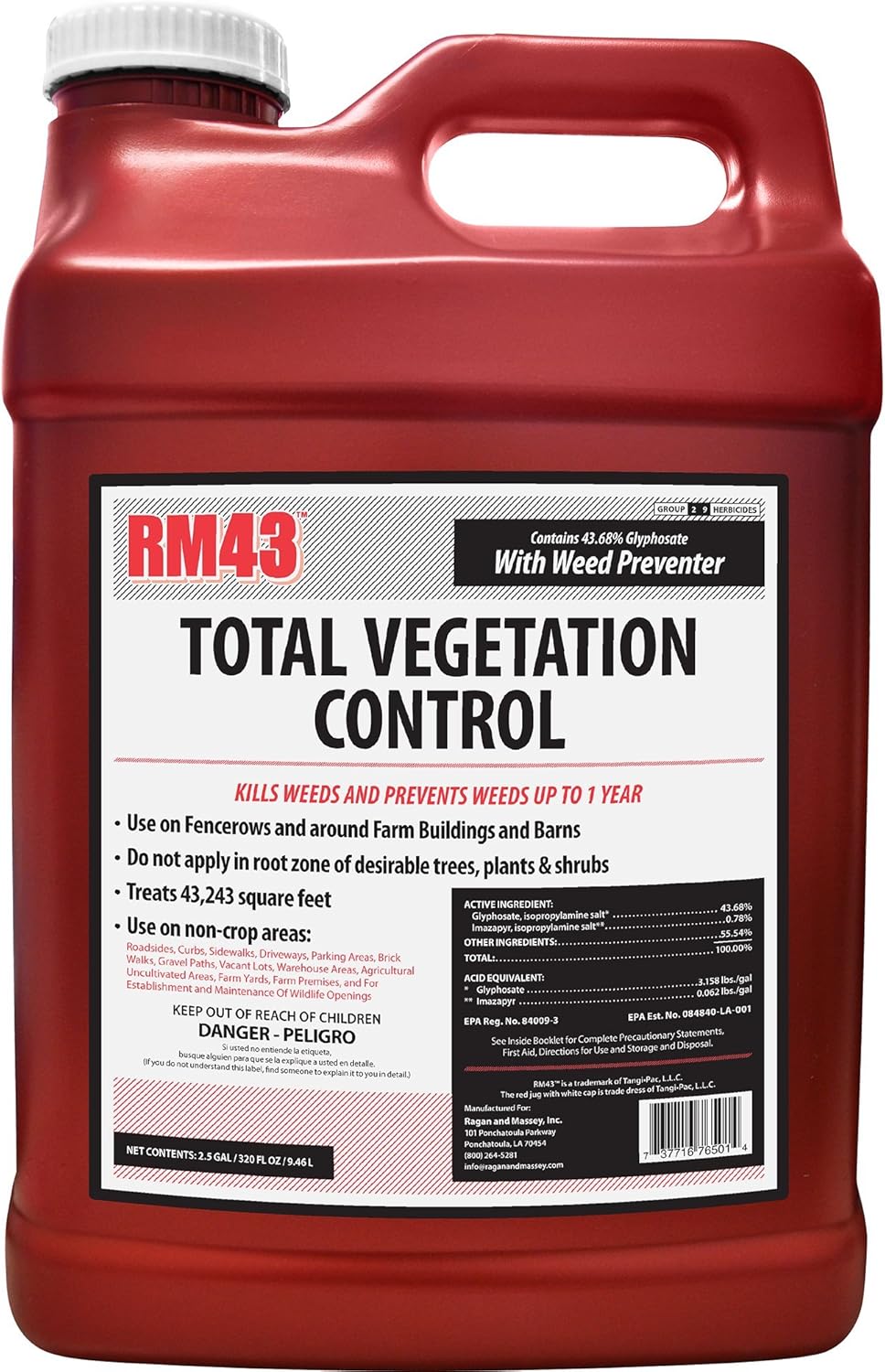
RM43 Total Vegetation Control combines glyphosate and imazapyr in a concentrated 2.5‑gallon formula intended for clearing and preventing unwanted growth over large non‑crop areas. It is applied as a spray to bare ground, fence rows, driveways, gravel paths and around outbuildings where vegetation is not desired. The product is rainfast in about two hours and claims residual control for up to a year, so a single application can protect large stretches of property. Notable features include the dual active ingredients for broad control of grasses, weeds, vines, brush and some trees, and a high coverage claim that makes it suitable for farm and large‑lot tasks. Practical benefits are reduced repeat treatments and straightforward spot or total‑kill application. Important limitations are that it must never be applied where desirable plants could be affected since imazapyr can persist in soil, and it is labeled only for non‑crop areas so it is not suitable for lawns or beds containing plants you want to keep.
Best for: Buyers who need a one‑and‑done solution for large non‑crop areas such as fence lines, driveways and farmyards and prioritize long residual control over selective treatment.
Less Ideal for: Homeowners wanting to maintain lawns, gardens or planted beds where desirable vegetation must be preserved should choose a selective or lawn‑safe product instead.
- Concentrated formula covers large areas from a single container
- Dual active ingredients broaden spectrum against grasses, brush and vines
- Rainfast in about two hours reduces loss from unexpected rain
- Suitable for both spot treatments and total vegetation control on bare ground
- Not labeled for use where desirable plants or crops are present due to soil persistence of active ingredients
- Requires careful, targeted spraying to avoid off‑target damage
Verdict: Choose RM43 when you need a single concentrated application to reliably clear and prevent vegetation across large non‑crop areas.
Roundup Pro Concentrate Herbicide (2.5 gal)

| Unit Count | 300 Fluid Ounces |
|---|---|
| Liquid Volume | 2.5 gallons |
| Coverage | Up to 435,600 sq. ft |
| Item Form | Liquid |
Roundup Pro Concentrate is a liquid herbicide intended for mixing in sprayers to treat large lawns, fields, and commercial areas. The 2.5 gallon jug is a concentrate that dilutes at rates from about 1 to 10.5 ounces per gallon of water, letting you cover up to the manufacturer-stated area without frequent refills. It is formulated to be rainfast in roughly an hour and is best applied when weeds are actively growing and temperatures are above 60°F. Practical benefits include high coverage per container and compatibility with stainless steel or plastic sprayers for standard application workflows. Important limitations are the need for careful dilution and protective handling, strict restrictions around water and runoff, and regulatory or local sale limitations in some states. Users should follow label directions for safety, keep people and pets away until spray dries, and expect that effective use requires proper equipment and basic pesticide handling practices.
Best for: Buyers who need a high‑coverage, performance-oriented herbicide for treating large yards, fields, or commercial properties and who are comfortable following pesticide mixing and safety instructions.
Less Ideal for: Casual gardeners with small beds or people unwilling to handle concentrated pesticides should choose ready-to-use alternatives or nonchemical methods.
- Concentrated formula covers very large areas from a single container
- Rainfast within about one hour which reduces loss from light rain
- Compatible with standard stainless steel or plastic sprayers for easy mixing and application
- Requires precise dilution and proper protective equipment during mixing and application
- Not for use near water or where runoff may occur and restricted in some jurisdictions
Verdict: Choose this concentrate when you need a professional-strength herbicide that treats very large areas with fewer refills.
Spectracide Large Plot Weed Stop for Lawns Concentrate, 1 Gal

| Item Form | Liquid |
|---|---|
| Coverage | 32000 square feet |
| Unit Count | 128 Fluid Ounces |
Spectracide Large Plot Weed Stop is a concentrated lawn herbicide meant for treating large areas by mixing with water and applying with a sprayer or hose-end applicator. It targets more than 200 listed broadleaf weeds, claims to kill roots for longer control, and shows visible results within hours while becoming rainproof in a few hours. Typical use is to mow first, mix the concentrate at the label rate for northern or southern grasses, and spray when daytime temps are between 60 and 85 degrees F for best safety and effectiveness. Practical benefits include very high coverage per bottle, compatibility with common sprayers, and instructions that suit seasonal timing for spring or fall applications. Important limitations are that it is a chemical control that requires careful handling and adherence to temperature and re-entry precautions, may need spot retreatment for very tough weeds, and should not be applied near water features or in excessively hot conditions to avoid turf damage.
Best for: Homeowners who need an efficient, high-coverage chemical solution for controlling broadleaf weeds across large lawns and who prioritize treating large areas economically.
Less Ideal for: People who prefer organic or non-chemical weed control, owners of small lawns where a concentrated large-plot product is unnecessary, or those who cannot follow label safety and temperature restrictions.
- Concentrate treats very large lawns—label lists up to 32,000 sq ft for northern grasses
- Kills over 200 listed broadleaf weeds and is formulated to kill roots
- Becomes rainproof within hours so light rain shortly after application is less likely to reduce effectiveness
- Works with standard tank or hose-end sprayers for straightforward application
- Requires careful temperature control and should not be applied above 85°F to avoid grass damage
- Chemical product requires safety precautions around people, pets, and water sources
- May need repeat spot treatments for persistent or particularly tough weeds
Verdict: A cost-effective concentrate for treating very large lawns with a fast-acting broadleaf weed killer that becomes rainproof in hours.
VIVIPOOOL 41% Glyphosate Super Concentrate Weed & Grass Killer (1 gal)
| Included Components | 41% Glyphosate |
|---|---|
| Unit Count | 128 Fluid Ounces |
| Item Form | Liquid |
| Coverage | 26000 square feet |
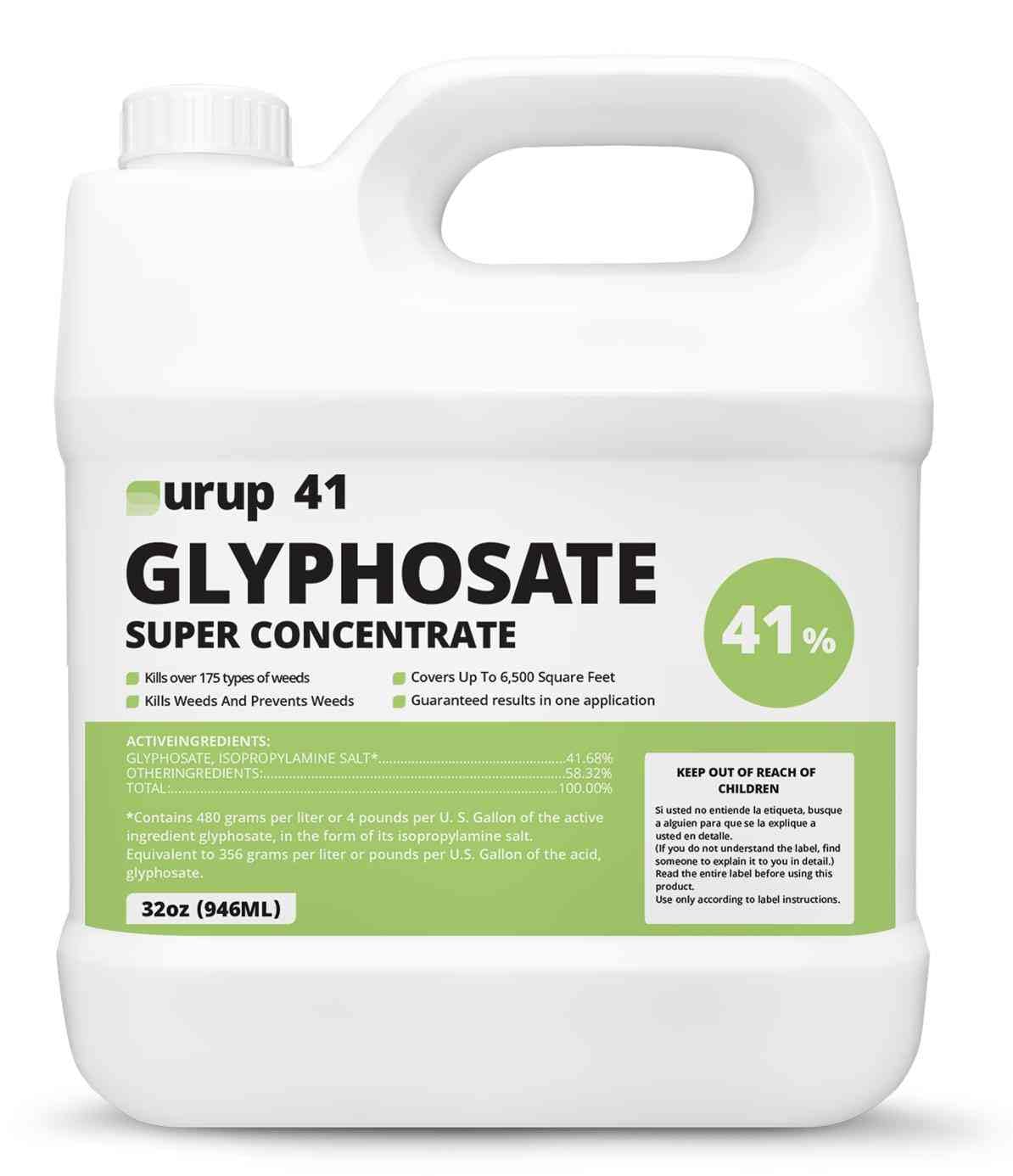
This 1 gallon VIVIPOOOL glyphosate concentrate is designed for large-area weed control and is useful when you need to treat driveways, sidewalks, fence lines, or expansive lawns. The 41% glyphosate formulation is a systemic herbicide that is applied as a spray and translocated to roots, so treated weeds start yellowing in about 5 to 8 days and die fully within one to two weeks. A single jug claims coverage up to 26,000 square feet when diluted per directions, which makes it economical for budget-minded buyers managing acres or multiple zones. Important practical features include liquid form for easy mixing with a pump sprayer, clear directional and safety guidance, and broad-spectrum activity against more than 130 weed species. Limitations are the usual ones for non-selective glyphosate products: it kills desirable plants on contact or through drift, requires careful handling and PPE, and is not suitable for spot-treatment needs where you want to preserve surrounding vegetation. For large-scale, cost-conscious weed clearance this product delivers concentrated, effective control when used exactly as directed.
Best for: Homeowners, landscapers, or property managers who need an economical concentrated herbicide to treat large areas and prioritize low cost per treated square foot.
Less Ideal for: People who need selective weed control near ornamental plants or those who prefer non-chemical or organic spot treatments should consider alternatives.
- High-concentration 41% glyphosate formula for systemic control of roots
- Large liquid volume (1 gallon) with claimed coverage up to 26,000 sq ft
- Effective on a broad spectrum of weeds and grasses with visible results in under two weeks
- Concentrate form mixes with standard pump sprayers for economical application
- Non-selective herbicide that can damage desirable plants if drift or overspray occurs
- Requires careful handling, personal protective equipment, and adherence to disposal rules
Verdict: A cost-effective, high-concentration glyphosate concentrate that stretches a single gallon across very large areas for budget-focused large-scale weed control.
Honcho K6 Glyphosate Herbicide, 2.5 Gallon

| Active Ingredients | Glyphosate potassium salt 48.7% |
|---|---|
| Item Form | Liquid |
| Unit Count | 320 Fluid Ounces |
| Included Components | (1) 2.5 Gallon Jug |
Honcho K6 is a high‑load potassium glyphosate liquid designed for large‑area weed control on farmsteads, fence rows, and landscape renovation. It is absorbed through foliage and moves systemically into roots, so a single properly timed application can kill both top growth and the root system of annual and perennial weeds. The built‑in surfactant improves leaf coverage and uptake, and the 2.5 gallon jug provides enough product to mix with water for multiple spray passes with a backpack, boom, or field sprayer. Because it has no soil residual activity, it will not persist in the ground after treated plants die, which is useful when you plan follow‑up planting according to label directions. Important limitations are that this is a nonselective herbicide that will damage desirable plants if contacted and that local regulations restrict use in some states, so following label safety directions and using protective equipment is essential.
Best for: Buyers who need a reliable, concentrated herbicide to clear large areas, fields, or fence lines and who prioritize consistent systemic control over speed or selectivity.
Less Ideal for: Home gardeners who need a selective product for lawns or around ornamentals or anyone unwilling to follow protective and regulatory label requirements.
- High concentration of glyphosate for effective systemic control of many annual and perennial weeds
- Built‑in surfactant improves leaf coverage and herbicide uptake without separate additives
- Large 2.5 gallon volume suitable for treating extensive areas or multiple applications
- Compatible with common application equipment including backpack, boom, and field sprayers
- Nonselective formula will kill or damage any plants it contacts
- Not permitted for use in certain states and requires strict adherence to label safety instructions
Verdict: Choose Honcho K6 when you need a concentrated, dependable systemic glyphosate for clearing large outdoor areas.
Compare-N-Save 75324 Glyphosate Herbicide, 1-gallon

| Active Ingredients | glyphosate |
|---|---|
| Liquid Volume | 1 gallons |
| Item Form | Spray |
| Coverage | 25000 square_feet |
This 1-gallon Compare-N-Save concentrate uses glyphosate for fast, non-residual control of annual and perennial weeds and unwanted grasses. It is mixed with water to make a ready-to-use spray and is typically applied with a pump sprayer to driveways, walkways, fence lines, landscape edges, garden prep areas, and for lawn renovation. The label advises 1.5 ounces per gallon for general weeds and 2.5 ounces per gallon for tougher perennials, with the bottle making many gallons of spray and covering large areas. Notable features include rainproofing in about two hours and visible browning in 2 to 4 days, plus clear safety and replanting guidance for ornamentals and some edibles. Practical benefits are strong foliage-to-root translocation that kills to the root and the economy of treating up to several thousand square feet from one container. Important limitations are that glyphosate will kill any green plant it contacts so careful spot application and protective gear are required, and it does not provide residual control so repeat treatments or follow-up management may be needed for persistent weed seedbanks.
Best for: Homeowners or groundskeepers who need a cost-effective, fast-acting solution to clear large areas of unwanted weeds and grasses and who prioritize proven performance backed by broad use guidance.
Less Ideal for: Gardeners seeking a selective herbicide to preserve surrounding plants or those who want a long-lasting pre-emergent barrier should consider other products or integrated weed management.
- High-concentration glyphosate formula effective on annuals, perennials, and grasses
- Mixes with water to produce large volumes of ready-to-use spray for treating big areas
- Rainproof in about two hours with visible results in 2 to 4 days
- Kills to the root by foliar uptake for longer-lasting aboveground control
- Non-selective and will kill any green plants it contacts, requiring careful application
- No residual activity so it will not prevent new weeds from emerging
Verdict: A concentrated, economical glyphosate concentrate designed to quickly knock down large expanses of weeds and grasses when used with proper safety precautions.
Choosing the Right Weed Killer for Large Areas: Key Factors to Consider
Coverage Rate and Economics
Coverage rate determines how much area a mixed tank will treat and therefore directly affects labor and material planning. For large areas, look for products that list treated area per volume at realistic field rates rather than idealized spray numbers. A product with a higher labeled coverage can reduce fill cycles and time spent refilling sprayers, which matters when treating acres or multiple large lawns.
Also consider how concentration changes with target weed pressure. Some formulations allow strength adjustments so you can use a lighter mix for maintenance and a heavier mix for heavy infestations. That flexibility improves economics across seasons and varied weed densities.
Residual Activity and Timing
Residual activity is how long a product prevents new weeds from emerging after application. For large areas, longer residual control reduces the frequency of whole-area re-treatments and can be especially valuable in early spring or fall when flushes of seedlings appear. However, longer persistence may limit when you can overseed or plant desirable vegetation, so check timing windows and turf compatibility.
Plan applications around major weed flushes and landscape operations. If you need to reseed or plant shortly after treatment, choose a shorter-residual option or schedule work outside the product's restricted window.
Application Method and Equipment Compatibility
Large-area application favors boom sprayers, ATV-mounted systems, or large-capacity backpack sprayers with wide swath capability. Confirm that the product label includes calibration rates for common equipment types and provides guidance on spray volume per acre. Products that mix readily with water and remain stable in tanks during multi-acre jobs reduce downtime.
Also consider nozzle recommendations and whether the formulation requires special filters or anti-foaming additives. Compatibility with existing equipment saves setup time and avoids the need for additional gear purchases.
Selectivity for Turf and Ornamentals
Selectivity refers to whether the herbicide targets weeds while leaving desired plants unharmed. In large areas that include valuable turf grass, ornamental beds, or mixed grass-and-planting zones, selectivity matters for preventing collateral damage. Some broad-spectrum options are nonselective and will harm any green plant, which can be useful for paths or gravel areas but unsuitable for lawns.
Read label guidance on turf species tolerance, timing restrictions, and buffer zones near ornamentals or water. When treating mixed landscapes, choosing a selective product or adjusting application zones can prevent costly plant loss.
Environmental Constraints and Buffer Requirements
Large-area applications increase the chance of off-target movement from drift or runoff. Look for products with clear buffer zone instructions, low volatility, and guidance on avoiding runoff into waterways. Consider how slope, recent rainfall, and soil type affect movement and whether extra precautions such as reduced spray pressure or droplet-size nozzles are advised.
Planning applications for calm, dry conditions and following label buffer requirements helps protect nearby habitat and reduces regulatory risk. Some formulations also list approved setbacks for irrigation and drainage areas, which is critical for large contiguous properties with mixed land uses.
Mixing, Storage, and Handling Practicalities
When treating large areas you will handle larger volumes of concentrated product. Choose formulations that are easy to measure and mix accurately, with clear dilution charts and minimal foaming. Stable mixes that can sit in a tank for the duration of a job without separation or loss of efficacy save time.
Also evaluate storage requirements and whether on-site bulk handling needs special secondary containment or temperature control. Practical labeling and straightforward PPE recommendations make large-scale operations safer and more efficient.
Timing Applications for Biggest Impact
Plan large-area treatments around weed life cycles. Preemergent products are most effective before seeds sprout, while postemergent products work best on actively growing weeds. Mapping out annual periods of seed germination, warm-season weed growth, and cool-season flushes will let you schedule whole-area applications to reduce repeat treatments.
For large lawns and landscapes, a combined approach often works best: apply a preemergent in early spring to limit seedlings, then spot-treat escapes with a postemergent in late spring or early summer. This strategy reduces overall material use while maintaining control.
- Apply preemergents before soil temperatures rise and seeds germinate
- Use postemergents when weeds are actively photosynthesizing and young
- Time applications to avoid heavy rain within 24 hours to reduce runoff risk
Application Techniques to Minimize Drift and Waste
On large properties, drift control matters for nearby plants and water. Use low-drift nozzles, increased droplet sizes, and lower boom heights to keep spray on target. Avoid treating on windy days and follow label-recommended buffer zones.
Calibrate sprayers before each season to ensure correct application rates. Even small calibration errors scale up over acres and can lead to under- or over-application, which affects efficacy and environmental safety.
- Select nozzles that produce coarser droplets for broadcast spraying
- Check pump pressure and travel speed to match labeled gallons per acre
- Use drift control agents only if compatible with the product label
Integrating Chemical Control With Cultural Practices
Chemical control is most effective when combined with cultural practices that reduce weed pressure. Improving turf density through proper mowing, fertilizing, and irrigation reduces open space for weeds to establish. Mechanical measures such as dethatching and overseeding thin weed populations over time.
For very large sites, zoning the landscape by use and vulnerability helps. Reserve broadcast herbicides for homogenous turf or unmowed areas and use targeted spot treatments in high-value planting zones.
- Strengthen turf health to outcompete weeds
- Use mechanical removal for perennial weeds before herbicide application
- Rotate modes of action seasonally to limit resistance buildup
Safety and Personal Protective Equipment for Large Jobs
Larger applications increase exposure risks for operators. Follow label PPE guidance strictly, plan rest breaks, and use tools that reduce direct handling like closed transfer systems. Keep clear records of where and when treatments occurred to help manage re-entry intervals and worker safety.
Also consider wash-down stations and secure storage for larger quantities. Training staff in mixing, calibration, and emergency procedures reduces the chance of spills and misuse on big jobs.
- Use chemical-resistant gloves, eye protection, and coveralls as labeled
- Establish decontamination procedures for equipment and clothing
- Log application details including tank mixes, rates, and weather conditions
Dealing With Resistant Weeds On Large Properties
Resistance can develop when the same mode of action is used repeatedly across whole properties. Monitor treated areas for persistent survivors the season after application and rotate active ingredients or combine mechanical methods when resistance is suspected.
For large sites, mapping problem zones and adjusting treatment approaches by area reduces selection pressure on the entire property and helps maintain long-term control options.
- Alternate chemistries with different modes of action year-to-year
- Increase application thoroughness on known problem patches
- Use integrated tactics such as spot removal plus broadcast preventive measures
How We Chose the Best Weed Killer for Large Areas
We prioritized products that make large-area weed control practical and predictable. Key evaluation criteria included coverage rate per gallon, measured as realistic treated area per unit of mixed product; residual activity or how long the product suppresses new weed emergence; label flexibility for spray equipment and application rates suitable for acres or large lawns; selectivity and safety constraints for use around desirable turf, ornamentals, and water features; and ease of mixing and compatibility with common boom and hose-end sprayers. We excluded products intended only for spot treatments, handheld bottle-only formulations, or those with label restrictions that prevent broadcast application on large turf or field settings. We also filtered out experimental or specialty formulations with narrow weed-spectrum claims. The resulting selections emphasize practical coverage, clear label instructions for large-area application, and predictable persistence, so gardeners and grounds crews can plan timing and follow-up treatments with confidence.
FAQ
What is the best time of year to treat large lawns for weeds?
It depends on the target weeds. Preemergent treatments usually go down in early spring before soil temperatures trigger seed germination, while postemergent sprays are most effective when weeds are actively growing. Mapping your site for typical flushes helps schedule whole-area work efficiently.
Can I use the same product across different turf species?
Some formulations are safe on multiple turfgrass types but others are labeled for specific species. Always check label tolerance information for your turf and test a small area when in doubt, since damage can be widespread when treating large contiguous zones.
How do I reduce spray drift when treating big areas?
Use low-drift nozzles, coarser droplet settings, lower boom heights, and avoid spraying on windy days. Calibrating speed and pressure also helps deliver the correct volume per acre and keeps spray on target.
How often will I need to reapply for season-long control?
Reapplication frequency depends on the product's residual activity and weed pressure. Some treatments provide months of suppression and reduce the need for repeat whole-area sprays, while high-pressure sites may require spot treatments between scheduled broadcasts.
Are there special environmental precautions for large-area applications?
Yes. Larger applications increase risks of runoff and off-target movement. Follow buffer zone instructions, avoid treating before heavy rain, and use products with low volatility when near waterbodies. Adjust practices for slope and soil type to reduce movement.
Can I combine herbicides in one tank to save time?
Tank-mixing can be efficient but only when allowed by the labels and when compatibility is confirmed. Some mixes can reduce effectiveness or increase crop injury, so check label mixing instructions and perform small compatibility tests when scaling up to large tanks.
Final Verdict
For large-area weed control prioritize products that offer high coverage rates, clear application guidance for boom or ATV sprayers, and a residual profile that matches your planting and overseeding plans. Balance selectivity needs against areas where nonselective control is acceptable, and choose formulations that minimize drift and runoff risks. Ultimately, schedule treatments to coincide with weed life cycles, integrate cultural and mechanical practices, and rotate modes of action to reduce resistance. Focusing on these tradeoffs will help you pick the most efficient, safe, and effective approach for your large landscape.
