

Note: This article contains affiliate links. If you click on these links and make a purchase, I may earn a small commission at no extra cost to you. This helps support my research and content. Read my full affiliate disclosure here.
Choosing the right fertilizer for grape vines changes how quickly young vines establish and how reliably mature vines produce fruit. Vine nutrition affects shoot vigor, cluster size, berry quality, and winter hardiness, so the wrong routine can limit yield or encourage excessive foliage instead of fruit. This guide covers six top picks for grape-vine fertilizer formulated for the specific needs of vineyard and backyard vines. We shortlisted options that suit common vine situations and evaluated them on nutrient composition, ease of application, and effects on vine growth and fruiting. Read on to understand the decision points that matter for planting, established vines, and annual maintenance.
Top Picks at a Glance
| Best Quality Built to a higher standard if you want something more solid | SOIL SEED & WATER Bacchus Blend Organic Fertilizer for Grapevines |  |
| Best Value The sweet spot between price and what you get | EB Stone Organics Fruit, Berry & Vine Food 7-3-3, 15 lb |  |
| Best Budget The cheapest option that still gets the job done reliably | Fairhaven Vitis-Max Grape Vine Fertilizer, 1 lb |  |
| Highest Rated A top-rated pick with lots of positive feedback | BRIRILINE EB Stone Organic Fruit, Berry & Vine Food 7-3-3, 4 lb (64 fl oz) |  |
| Most Popular A crowd favorite that many people choose with confidence | TPS Nutrients Grape Fertilizer Liquid Plant Food, 8 oz |  |
| Best Seller A high-volume bestseller chosen again and again | Growth Technology GT Fruit Focus Liquid Plant Food, 1 Quart |  |
SOIL SEED & WATER Bacchus Blend Organic Fertilizer for Grapevines

| Item Form | Granules |
|---|---|
| Specific Uses For Product | Vineyard Soil Enrichment |
| Application Method | Top-dress and mix into soil |
| Mixing Ratio | 1:4 |
| Target Species | grapevines |
Bacchus Blend is a granular, vineyard-specific organic amendment designed to strengthen vine growth and fruit quality by adding dairy compost, worm castings, and micronutrient sulfates to the root zone. It is typically used either mixed into soil for new plantings at a 1:4 ratio or top-dressed for established vines with a shallow application followed by watering. Notable features include an odorless, concentrated formula targeted to grapevines, clear commercial guidance for per-vine application, and organic ingredients that support soil biology and water retention. In practice this product improves soil organic matter and helps maintain nutrient availability through biological activity rather than quick-release salts, which suits producers focused on long-term vineyard health. Limitations are that results are gradual and seasonally dependent, and heavier-feeding vineyards may still need complementary nutrient programs or soil testing to address specific deficiencies. Also the coverage is listed as medium so multiple bags are required for larger blocks.
Best for: Growers and vineyard managers focused on improving long-term vine vigor and fruit quality through organic soil-building practices and predictable seasonal feeding.
Less Ideal for: Growers needing fast corrective feeding or precise, lab-driven nutrient programs for acute deficiencies should consider mineral fertilizers or targeted supplements instead.
- Formulated specifically for grapevines with recommendations for both new plantings and established vines
- Uses organic inputs like dairy compost and worm castings that build soil biology and organic matter
- Contains micronutrients (zinc and iron sulfates) to address common vineyard deficiencies
- Clear application guidance for per-vine rates in commercial settings
- Effects are gradual and not a quick source of immediately available nutrients
- Medium coverage means multiple bags needed for larger vineyards
Verdict: Choose Bacchus Blend if you want an organic, vineyard-focused soil amendment that builds long-term vine health and fruit quality through soil biology rather than quick-release nutrients.
EB Stone Organics Fruit, Berry & Vine Food 7-3-3, 15 lb

| Item Form | Granules |
|---|---|
| Target Species | fruit trees, berries and fruiting vines |
| Coverage | Medium |
| Mixing Ratio | 7:3:3 |
| Unit Count | 240 Ounce |
This EB Stone Organics 7-3-3 fruit, berry and vine fertilizer is a slow-release granular feed aimed at improving fruit set, flavor, and yield on grapevines and other fruiting plants. You spread it at the base of established vines or work it lightly into the soil according to package directions; the blend is designed to feed for about 6 to 8 weeks so you do not need to reapply constantly. The high potassium relative to nitrogen and phosphorus supports fruit development, while the 100% natural ingredients lower the risk of burn compared with synthetic quick-release formulas. Practical benefits include steady nutrient release, suitability for home vineyards and berry patches, and simple application for seasonal maintenance. Limitations are that it is a general-purpose orchard formula rather than a grapevine-specific program, so heavy-feeding situations or precise nutrient correction will still require soil testing and supplemental amendments. Also it ships as a bagged granular product so you will need to measure and store it properly to keep it dry and effective.
Best for: Home vineyard owners and gardeners who want a low-maintenance organic feed to improve fruit set and flavor without frequent applications.
Less Ideal for: Commercial growers or growers needing precise nutrient correction or high-rate fertilization should choose a vineyard-specific program guided by soil and tissue tests.
- 7-3-3 N-P-K ratio with higher potassium to support fruit development
- Slow-release granular formula feeds for about 6–8 weeks
- Made from 100% natural organic ingredients, reducing burn risk
- Easy to apply at the base of vines for routine seasonal feeding
- Not tailored specifically to grapevine micronutrient needs or corrective feeding
- Requires dry storage and measuring for repeated seasonal use
Verdict: A simple, organic slow‑release fertilizer that delivers higher potassium to help backyard grapevines produce sweeter, more abundant fruit with minimal fuss.
Fairhaven Vitis-Max Grape Vine Fertilizer, 1 lb

| Item Form | Granules |
|---|---|
| Specific Uses For Product | Organic |
| Application Method | top dress |
| Target Species | grape |
| Unit Count | 16 Fluid Ounces |
Fairhaven Vitis-Max is a resin-coated granular fertilizer made for grape culture that releases nutrients with moisture and claims a single-season effect without burning vines. It is applied as a top-dress at a small dose (manufacturer suggests about 2 oz per vine) and the 1 pound container is designed to treat roughly eight vines. The coated prills open when wet and slow-release between waterings, which reduces the need for repeated feedings and makes it easy to use during the growing season. Because it is labeled organic and targeted to grapes, the nutrient balance is tailored for fruiting vines rather than general garden use. Limitations to consider are the small package size for larger plantings and the fixed mixing ratio and application method, which offer less flexibility for growers who prefer custom NPK blends or higher-volume coverage. For a gardener managing a few vines who wants a simple, grape-specific, controlled-release option, this product keeps feeding straightforward and low-effort.
Best for: Home gardeners with a small number of grape vines who want a simple, low-effort, grape-specific fertilizer and prefer an organic controlled-release product.
Less Ideal for: Commercial growers or anyone managing many vines who need large-volume, customizable NPK formulations or more economical bulk coverage.
- Resin-coated granules provide controlled release with moisture, reducing frequency of applications
- Formulated specifically for grape vines to supply a full range of nutrients tailored to grape culture
- Small 1 lb size and low per-vine dose make it easy to try and use on a few vines
- Labeled organic, suitable for growers preferring organic-approved inputs
- Small package covers only about eight vines so multiple units are needed for larger plantings
- Fixed application method and mixing ratio limit flexibility for customizing nutrient strength
Verdict: A convenient, grape-specific controlled-release fertilizer that simplifies feeding for small home vineyards.
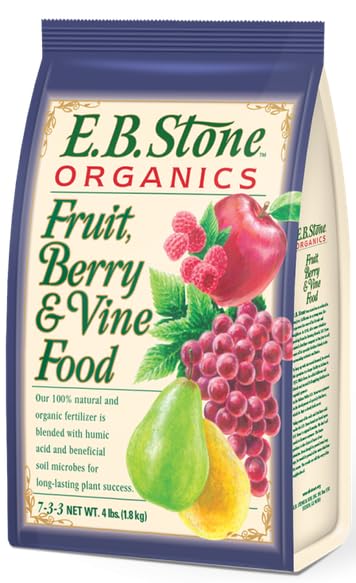
BRIRILINE EB Stone Organic Fruit, Berry & Vine Food 7-3-3, 4 lb (64 fl oz)
| Item Form | Granules |
|---|---|
| Specific Uses For Product | fruit trees, berries, and fruiting vines |
| Coverage | Organic |
| Liquid Volume | 64 fluid ounces |
| Mixing Ratio | 7:3:3 |
This organic granular fertilizer is formulated to support fruiting plants with a balanced 7-3-3 NPK blend keyed to encourage foliage and fruit set on grape vines. It is applied by evenly broadcasting around the base of the vine and watering in; the listing includes a mixing ratio and general directions so you can match application to plant size and season. Because it is organic and granular, nutrients release more slowly than synthetic concentrates, feeding vines steadily rather than delivering a quick spike. The product is presented as a 64 fluid ounce container and is intended specifically for fruit trees, berries and fruiting vines, so it focuses on the nutrient needs of grape production rather than general garden use. Important safety guidance such as keeping it away from children and pets and avoiding skin or eye contact is provided. If you want dependable, low‑risk feeding that supports consistent vine health and fruiting over the season, this fertilizer fits that role, though it will not produce the rapid flush that some high‑analysis synthetics can deliver.
Best for: Gardeners growing grape vines who prioritize steady, reliable nutrition from organic sources and want a product that integrates simply into seasonal feed schedules.
Less Ideal for: Growers seeking rapid, high‑intensity nutrient boosts for quick vegetative growth or commercial producers needing concentrated, fast‑acting fertilizers.
- Organic granular formula suited for fruiting plants
- Balanced 7-3-3 NPK tailored for foliage and fruit development
- Slow release behavior provides steady feeding over time
- Includes usage directions and a mixing ratio for measured application
- Lower nutrient concentration means slower visible results compared with synthetic high‑N fertilizers
- Container volume listed as fluid ounces which may require checking conversion for accurate mass-based dosing
Verdict: A dependable organic 7-3-3 granular fertilizer designed to give grape vines steady, season‑long nutrition for consistent fruiting.
TPS Nutrients Grape Fertilizer Liquid Plant Food, 8 oz

| Item Form | Liquid |
|---|---|
| Application Method | Soil drench |
| Target Species | Grapes |
| Liquid Volume | 8 fluid ounces |
This 8 oz liquid grape fertilizer from TPS Nutrients is formulated specifically for grapes and is applied as a soil drench to feed vines from the root zone. You mix it to the recommended ratio and apply around the base of established vines or newly planted stock to encourage root establishment, stronger vine growth, and better cluster set. Its grape-targeted formula and liquid form make it easy to apply and fast-acting compared with granular products, which is helpful when you want to correct a deficiency during the growing season. The product is sized for small gardens or trial use rather than long-term, multi-acre applications, so you may need multiple bottles for several vines or repeated feeding. The balanced mixing guidance and full coverage claim simplify routine maintenance for backyard growers and hobbyist vineyard plots, but heavy feeders or large plantings will require larger-volume fertilizer or a plan to reapply frequently.
Best for: Home gardeners and hobbyist vine growers who want a targeted, easy-to-use fertilizer to support healthy vines and better fruit set and who prefer a product designed specifically for grapes.
Less Ideal for: Commercial growers or anyone managing many vines who need bulk fertilizer or a long-term feeding program rather than a small trial-sized bottle.
- Liquid form for fast uptake and easy soil-drench application
- Formulated specifically for grapes to support vine vigor and fruit set
- Clear mixing guidance listed as a balanced ratio for routine use
- Suitable for both backyard vines and small vineyard plantings
- Small 8 oz volume means frequent repurchasing for multiple vines or repeated treatments
- Not intended for large-scale or commercial vineyard use without scaling supply
Verdict: A convenient grape-specific liquid feed that makes targeted root-zone feeding simple for backyard vines and small vineyard plots.
Growth Technology GT Fruit Focus Liquid Plant Food, 1 Quart

| Item Form | Liquid |
|---|---|
| Target Species | Fruits |
| Liquid Volume | 1 liters |
| Mixing Ratio | 3-5 ml per liter (soil), 5-7 ml per liter (hydroponic) |
GT Fruit Focus is a ready-to-mix liquid nutrient aimed at supporting fruiting plants from early growth through harvest. It is typically diluted with water and applied with each watering, using the manufacturer guidance of 3–5 ml per liter for soil or 5–7 ml per liter for hydroponics. The formula lists all 12 essential minerals including calcium, so it addresses common micronutrient needs that support root strength, foliage health, flower set, and fruit development. Its single-part liquid format makes measuring and mixing straightforward, which is convenient for container growers and small vineyard plots who want consistent feeding without blending multiple products. Important limitations are that it requires regular applications to be effective and careful dilution to avoid overfeeding, and safety precautions mean you must handle it with gloves and keep it away from children and pets. For risk-averse growers, following the recommended low-end dosage and observing vines after the first applications will help avoid nutrient burn while assessing responsiveness.
Best for: Gardeners growing grape vines who want an all-in-one, easy-to-mix liquid feed for steady fruit production and who prefer simple dosing and predictable results.
Less Ideal for: Large commercial vineyards that need bulk granular fertilizers or tailored nutrient programs for different growth stages should consider professional-grade or custom formulations instead.
- Complete blend of 12 essential minerals including calcium to support fruit set and development
- Single-part liquid formulation that mixes easily with water for each watering
- Suitable for soil, containers, and hydroponic or semi-hydroponic systems with clear dosing ranges
- Designed for a wide range of fruiting plants including grapes, making it versatile for small vineyards
- Requires frequent application and careful dilution to avoid overfeeding
- Safety precautions needed during handling and storage
Verdict: An easy-to-use single-part liquid fertilizer that supplies complete micronutrients, making it a safe, convenient choice for home grape growers seeking consistent feeding.
Choosing the Right Fertilizer for Grape Vines: Key Factors to Consider
Nutrient Ratio and Nitrogen Management
Grapevines need a balance of nitrogen, phosphorus, and potassium that shifts through the season. Early in the season a moderate amount of nitrogen supports shoot and root growth, but excessive nitrogen later can produce too much vegetative growth at the expense of fruiting. Choosing a fertilizer with the appropriate N-P-K ratio for the vine's growth stage helps control vigor while supporting cluster development.
Pay attention to slow-release versus readily available nitrogen. Slow-release nitrogen reduces the risk of sudden growth surges after application and lowers leaching loss, while soluble nitrogen can be useful for quick correction of deficiencies identified by tissue testing.
Soil Test and pH Interaction
A soil test tells you what the vines actually need and prevents unnecessary applications. Soil pH affects nutrient availability, especially phosphorus, iron, manganese, and zinc, which are important for grape health. Correcting pH issues or adding amendments based on test results is often more effective than blanket fertilizing.
Apply fertilizer decisions in the context of soil texture and organic matter. Sandy soils drain quickly and may need more frequent, smaller applications, while heavier soils retain nutrients longer and benefit from low-dose, slow-release options to avoid buildup.
Micronutrients and Deficiency Correction
Grapevines require micronutrients such as iron, manganese, boron, zinc, and magnesium in small amounts but missing these can reduce vigor and fruit set. Symptoms are often subtle early on and may mimic other problems, so targeted supplementation is preferable to indiscriminate micronutrient mixes.
Choose fertilizers that include micronutrients in plant-available forms when tests indicate deficiencies. Foliar applications can provide a fast correction for certain micronutrient shortages, while soil-applied chelated forms last longer in the root zone.
Formulation and Application Method
Fertilizers come as granules, water-soluble powders, liquids, or slow-release prills, and each behaves differently in the landscape. Granular formulations are easy to broadcast and work well with mulched vine rows, while liquids and water-soluble products are suited to fertigation or quick drench corrections. Slow-release products reduce application frequency and even out nutrient availability through the season.
Choose a form that fits your irrigation setup, labor capacity, and whether you need immediate correction versus steady feeding. Consider compatibility with common vineyard practices such as mulching, compost topdressings, and drip irrigation.
Timing and Frequency of Applications
When you apply fertilizer influences vine response. Many growers split nitrogen applications to support early spring growth and then limit nitrogen later to favor fruit ripening. Overfeeding after veraison can delay ripening and reduce sugar concentration. A regular schedule tied to growth stages, backed by tissue testing, delivers predictable results.
Frequency depends on the release profile and soil type. Fast-release products may be used multiple times in a season in small doses, whereas slow-release or stabilized formulations work well with one or two applications per year.
Environmental Impact and Leaching Risk
Nitrogen and other soluble nutrients can leach from the root zone and pollute groundwater, especially on sandy soils or with overirrigation. Choosing fertilizer with lower leaching potential, timing applications to avoid heavy rains, and using split applications all reduce environmental risk.
Incorporating organic matter and using cover crops in the vine rows can improve nutrient retention. Also consider products with controlled-release technology or nitrification inhibitors when leaching risk is a concern.
When to Feed Grapevines Through the Season
Feed vines in a way that matches their growth rhythm. In early spring apply nutrients that support root and shoot development, then reduce nitrogen inputs as shoots harden and clusters form. Many growers avoid heavy nitrogen after bloom to encourage fruit set and concentrate sugars during ripening.
Use tissue tests midseason to confirm micronutrient status and make targeted corrections. If a quick correction is needed, a foliar spray can supply micronutrients faster than soil-applied forms.
- Early season: focus on root and shoot support with moderate nitrogen
- Bloom to veraison: reduce nitrogen, monitor micronutrients
- Post-veraison: limit nitrogen to help ripening
Interpreting Soil and Tissue Tests
Soil tests show what is present in the root zone and guide long-term corrections like lime or phosphorus additions. Tissue tests reflect what the vine has actually taken up and are useful for diagnosing subtle deficiencies during the growing season.
Collect samples at recommended times and follow local extension guidance for interpretation. Use both results together to tailor fertilizer form, rate, and timing rather than relying on generic schedules.
- Soil tests: adjust pH and baseline nutrient levels
- Tissue tests: detect seasonal uptake issues and micronutrient shortages
Organic Versus Synthetic Options
Organic fertilizers release nutrients more slowly and add organic matter, which improves soil structure and microbial activity. They can be preferable for long-term soil health but may not correct acute deficiencies quickly.
Synthetic fertilizers give precise nutrient ratios and predictable release rates, useful for correcting known deficits or when exact N-P-K balance is needed. Many growers combine organic soil-building practices with occasional synthetic feeds for specific needs.
- Organics: build soil, slow nutrient release, lower burn risk
- Synthetics: targeted nutrient delivery, fast correction potential
Integrating Fertilizer with Vineyard Cultural Practices
Fertilizer choices should fit pruning, canopy management, and irrigation plans. For example, heavy pruning reduces immediate nutrient demand, while vigorous canopies may indicate a need to reduce nitrogen. Mulching and compost topdressings interact with applied fertilizer and affect how quickly nutrients become available.
Coordinate fertilization timing with irrigation to move nutrients into the root zone without causing runoff. In drip-irrigated rows, fertigation offers precise delivery and conserves product when set up correctly.
- Match feed timing to pruning and canopy goals
- Use irrigation to help incorporate soil-applied fertilizer
Common Nutrient Deficiency Symptoms
Recognizing deficiency signs helps you target corrections. Nitrogen deficiency shows as general chlorosis and reduced shoot growth. Iron deficiency produces interveinal chlorosis on young leaves, especially in high-pH soils. Magnesium and potassium shortages affect older leaves first and can reduce berry quality.
Symptoms can overlap with water stress or pest damage, so confirm with tissue tests when possible before changing fertilization programs.
- Nitrogen: pale leaves, low vigor
- Iron: interveinal yellowing on new leaves
- Magnesium and potassium: older leaf discoloration and reduced fruit quality
How We Chose the Best Fertilizer for Grape Vines
We focused on fertilizers that address the particular nutrient demands of grape vines across establishment and production phases. Selection prioritized products with clear nutrient ratios useful for different vine stages, practical application methods for backyard and small-scale vineyard use, and documented guidance for timing and rate. We also considered formulation type since granular, liquid, and slow-release forms behave differently in the root zone and influence labor and frequency of feeding. Our evaluation criteria included the balance of primary macronutrients with attention to nitrogen management, the presence and form of key secondary and micronutrients, clarity of label instructions and recommended timing, and compatibility with common soil amendment and mulching practices. We excluded general-purpose lawn blends and fertilizers lacking clear analysis or application guidance for woody fruiting vines. Final selections were those that best matched the needs of grape vines at various growth stages while being practical for typical garden or small-vineyard workflows.
FAQ
How often should I fertilize established grape vines?
Often a light application in early spring and a second, smaller dose after bloom is sufficient for many established vines. Frequency depends on soil type and release profile; sandy soils may require more frequent, smaller applications while slow-release products allow fewer feedings.
Can I use a general-purpose garden fertilizer on grape vines?
You can, but general-purpose formulas may not match the seasonal nutrient balance vines need. It is better to choose a formulation or adjust rates based on soil and tissue test results to avoid excess nitrogen late in the season.
Are foliar feeds effective for correcting deficiencies?
Foliar applications can quickly correct certain micronutrient shortages like iron or zinc and are useful midseason. They provide a fast uptake route but are a short-term fix; soil amendments are usually needed for lasting correction.
Should I change my fertilizer program after transplanting young vines?
Yes. Young transplants need nutrients that support root establishment without forcing excessive top growth. Use a balanced, lower-nitrogen starter approach and avoid heavy feeding until the root system is better established.
Does irrigation method affect fertilizer choice?
Yes. Drip and fertigation systems work well with water-soluble and liquid fertilizers, enabling precise placement. Broadcast granular or slow-release products are more appropriate for non-irrigated or mulched rows.
Final Verdict
Focus on matching fertilizer form and nutrient ratios to your vine age, soil test results, and the seasonal growth stage. Prioritize controlled nitrogen use so you do not push excess vegetative growth at the expense of clusters and ripening. Regular soil and tissue testing, combined with appropriate timing and a compatible formulation, will deliver the most consistent results. Balance practical concerns like application method and labor with the vine's nutritional needs. With those priorities in mind you can pick a feeding plan that promotes healthy canes, reliable fruit set, and better berry quality over the long term.
