

Note: This article contains affiliate links. If you click on these links and make a purchase, I may earn a small commission at no extra cost to you. This helps support my research and content. Read my full affiliate disclosure here.
When pests damage grass, the right insecticide for lawns can mean the difference between quick recovery and a season of thinning turf. You want a product that controls the common lawn pests you see in your region while minimizing harm to grass, beneficial insects, and soil life. This guide covers seven top-ranked insecticides for lawns and explains why each type made the shortlist. We evaluated persistence, turf safety, application flexibility, and ease of use so you can match a product to your lawn size, pest problem, and maintenance plan. Read on to understand the tradeoffs and pick the approach that fits your lawn care routine.
Top Picks at a Glance
| Best Overall The best all-around choice for most situations | Spectracide Triazicide Large Plot Insect Killer Concentrate, 1 Gallon |  |
| Best Quality Built to a higher standard if you want something more solid | The Andersons DuoCide Professional-Grade Lawn Insect Control (18 lb) |  |
| Best Value The sweet spot between price and what you get | Ortho BugClear Lawn Insect Killer, 20 lb. |  |
| Best Budget The cheapest option that still gets the job done reliably | Spectracide Triazicide Insect Killer for Lawns & Landscapes, 32 oz |  |
| Highest Rated A top-rated pick with lots of positive feedback | Quali-Pro Bifenthrin I/T 7.9F Insecticide, 1 Gallon |  |
| Most Popular A crowd favorite that many people choose with confidence | Atticus Talak 7.9% Bifenthrin Indoor/Outdoor Insecticide Concentrate (32 oz) |  |
| Best Seller A high-volume bestseller chosen again and again | Scotts GrubEx1 Season-Long Grub Killer (covers 5,000 sq. ft.) |  |
Spectracide Triazicide Large Plot Insect Killer Concentrate, 1 Gallon

| Unit Count | 128 Fluid Ounces |
|---|---|
| Item Form | Spray |
| Target Species | Insects |
| Liquid Volume | 1 gallons |
Spectracide Large Plot Triazicide is a one-gallon concentrate formulated to kill more than 180 listed insects on contact and provide residual control for up to two months when used as directed. You mix the concentrate with water and apply it with a tank sprayer to lawns, flower and vegetable gardens, around trees and shrubs to target ants, aphids, fleas, mosquitoes, ticks, Japanese beetles and other surface pests. Its concentrated format means a single jug covers large areas, which is handy for homeowners with medium to large yards who want a single-season treatment. The product is nonstaining when applied correctly and includes clear safety guidance to avoid contact with desirable plants and water sources. Important limitations are that it requires a separate sprayer, careful attention to label rates to avoid damaging plants, and safety precautions around people and pets during application and drying. For routine seasonal pest suppression across lawns and landscape beds this concentrate is practical and economical, but it demands proper mixing and protective gear to use responsibly.
Best for: Homeowners with medium to large lawns who want a single concentrated product to treat a wide range of common lawn and landscape pests and who are comfortable mixing and applying pesticide concentrates safely.
Less Ideal for: People who prefer ready-to-use sprays, those uncomfortable handling concentrated pesticides, or gardeners with small container or indoor plant collections.
- Concentrate covers large areas from a single gallon, making it economical for big yards
- Kills a broad list of over 180 surface and landscape pests on contact
- Provides up to two months of residual control when applied per label
- Nonstaining formula when used as directed
- Requires a separate tank sprayer and correct mixing for effective application
- Must be used with protective clothing and kept away from people, pets, and water sources
Verdict: Choose this concentrate if you need an economical, broad-spectrum insecticide to protect large lawns and landscapes for up to two months per application.
The Andersons DuoCide Professional-Grade Lawn Insect Control (18 lb)

| Item Form | Granule |
|---|---|
| Coverage | 9000 sq ft |
| Active Ingredients | bifenthrin |
| Active Ingredients | carbaryl |
The Andersons DuoCide is a granular lawn insect control designed for one-pass treatment of both surface and soil pests across large yards. You spread the granules evenly, water to activate, and the formula disperses into the turf to target grubs, ticks, fire ants, mole crickets, fleas and other common lawn pests. Its dual active ingredients, bifenthrin and carbaryl, provide a "double kill" effect that addresses pests above and below the turf surface, which is useful for homeowners wanting a broad-spectrum, performance-focused solution. The product covers up to 9,000 square feet per bag and the granule form makes application with a broadcast spreader straightforward. Important limitations are safety and local restrictions: it contains professional-grade insecticides, requires protective handling, and is not permitted for sale in certain states, so read and follow label directions and local rules before use. Reapplication timing depends on pest pressure and label guidance rather than a preset schedule.
Best for: Homeowners who prioritize strong, fast-acting control of a wide range of turf pests and who are comfortable following label safety precautions and local regulations.
Less Ideal for: Small-plot gardeners, organic lawn stewards, or anyone seeking pesticide-free or least-toxic options should look for alternative controls.
- Broad-spectrum control targeting 50+ lawn pests including grubs, ticks, fire ants and mole crickets.
- Dual active ingredients (bifenthrin and carbaryl) for above- and below-ground efficacy.
- Covers up to 9,000 sq ft so one bag treats large lawns.
- Granule formulation disperses quickly when watered, simplifying application with a spreader.
- Contains professional-grade insecticides requiring gloves and protective clothing during handling.
- Not available for sale in all states so regional restrictions may apply.
Verdict: Choose DuoCide when you need a single, professional-strength granular treatment that delivers broad, above- and below-ground control for large lawns.
Ortho BugClear Lawn Insect Killer, 20 lb.

| Item Form | Granules |
|---|---|
| Target Species | Insects |
| Unit Count | 1 Count |
Ortho BugClear Lawn Insect Killer is a ready-to-apply granular treatment designed for broad lawn and landscape use. You spread it with a compatible broadcast spreader, then water it in to activate fast contact kill for many common lawn pests; the product claims activity within minutes for most insects and longer residual control for ants and other listed species. It covers large areas—one 20 lb. bag treats up to 33,000 sq ft—so it is suited to whole-yard applications rather than spot treatments. Practical features include a granular form that is easy to apply with a Scotts or similar spreader and labeled use around ornamental plants, flower beds and listed vegetables. Limitations to note are the exclusions on certain ant species and fire ants where speed or effectiveness differs, and the need to water after application for activation which requires planning around weather. As with any insecticide, follow label directions for safe use around people, pets and edible plants.
Best for: Homeowners who want a single, easy-to-apply product to protect an entire lawn and surrounding landscape from a broad list of common insects and who prioritize long-area coverage and low-effort seasonal control.
Less Ideal for: People looking for a spot-treatment product for small areas or those who need a non-chemical or insecticide-free approach to pest management.
- Granular formula is straightforward to apply with common spreaders
- Large coverage per bag suitable for whole-yard treatments
- Fast-acting contact kill for many listed lawn pests
- Provides residual control up to 6 months for ants and 3 months for other listed insects
- Not equally effective on all ant species and slower against fire ants
- Requires watering-in after application to activate and set the barrier
Verdict: Choose this if you need an easy granular treatment that covers large lawns and delivers fast knockdown plus months-long residual control for common lawn pests.
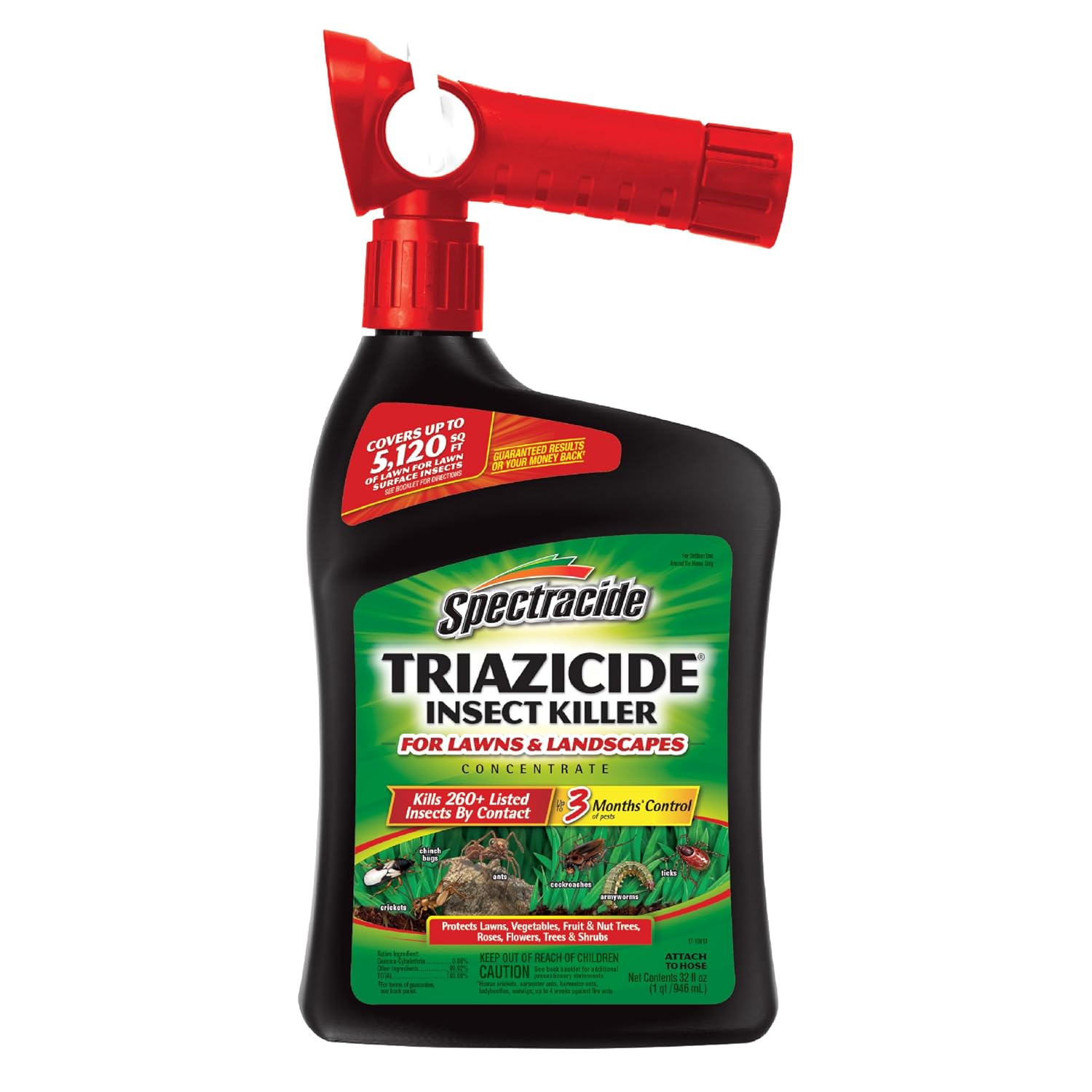
Spectracide Triazicide Insect Killer for Lawns & Landscapes, 32 oz
| Unit Count | 32 Ounce |
|---|---|
| Item Type Name | Lawn Insect Killer |
| Item Form | Spray |
| Active Ingredients | Gamma-Cyhalothrin (0.08%) |
| Specification Met | USDA |
Spectracide Triazicide is a concentrated insect killer intended for lawns, landscape beds, trees, shrubs and some vegetable and flower areas; you dilute it with water and apply with a tank sprayer or the hose-end QuickFlip fitting. The formula lists gamma-cyhalothrin as the active ingredient and claims contact kill for a wide range of pests including grubs, ants, fleas, deer ticks and Japanese beetles with residual protection lasting up to three months when used as directed. Typical use is spot treatments, full-lawn applications for surface insects, or targeted mound treatments for fire ants. Practical benefits include broad-spectrum control from a single concentrate, options for hose-end or tank-sprayer application, and non-staining labeling for most siding when applied correctly. Important limitations are safety and environmental cautions: it is highly toxic to fish and bees and requires careful application to avoid drift or runoff, and label directions on timing, dilution rates and reapplication limits must be followed. For buyers watching costs, the concentrate covers large areas so it can be economical per square foot compared with ready-to-spray bottles.
Best for: Practical homeowners who need broad, inexpensive control across lawns and landscapes and are comfortable following label directions for mixing and application.
Less Ideal for: People with ponds, ornamental water features, or pollinator-focused plantings should choose a product with lower aquatic and bee toxicity.
- Controls 260+ listed insects above and below ground, including grubs, ants, fleas and deer ticks
- Concentrate formula can be mixed for tank sprayers or used with hose-end QuickFlip for flexible application
- Long residual protection up to three months when used as directed
- Covers large areas from a single bottle which lowers cost per treated square foot
- Extremely toxic to fish and harmful to bees, requiring careful application to avoid environmental damage
- Requires precise dilution and adherence to label restrictions which can be intimidating for new users
Verdict: A cost-effective concentrate for homeowners who want broad-spectrum, long-lasting insect control across large lawns and landscapes.
Quali-Pro Bifenthrin I/T 7.9F Insecticide, 1 Gallon

| Item Form | Spray |
|---|---|
| Target Species | Termites, Carpenter Ants |
| Liquid Volume | 1 gallons |
| Active Ingredients | Bifenthrin |
Quali-Pro Bifenthrin I/T 7.9F is a flowable pyrethroid insecticide intended to provide long-lasting residual control of pests such as termites, carpenter ants, fleas, mites, and ticks in lawns and ornamentals. It is typically mixed and applied as a spray across turf, around perimeter zones, or in landscape beds where persistent control is needed. The formulation is described as non-irritating with no odor and leaves no visible residue, which makes it suitable for use in residential lawns, commercial properties, and athletic fields. It is also labeled as compatible with many common tank-mix partners including herbicides, fungicides, and liquid fertilizers, so it can be integrated into regular turf care programs. Important practical considerations are standard pesticide safety precautions and label directions for rates and target sites; this is a professional-strength product and requires careful handling to avoid non-target exposure. The product’s strength is its long residual activity, but users should plan applications according to label restrictions and local regulations.
Best for: Homeowners or groundskeepers who prioritize dependable, long-lasting pest control in lawns and landscaped areas and who follow label directions and safety practices.
Less Ideal for: Casual gardeners who prefer organic or non-chemical pest control methods or those unwilling to follow professional application and safety guidelines.
- Long-lasting residual control against a wide range of turf and structural pests
- Formulation reported to dry odorless with no visible residue, reducing immediate aesthetic impact
- Compatible with many common tank-mix partners for integration into existing turf programs
- Professional-strength insecticide that requires careful handling and strict adherence to label directions
Verdict: Choose this product when you need a dependable, long-lasting chemical control for persistent lawn and landscape pest problems.
Atticus Talak 7.9% Bifenthrin Indoor/Outdoor Insecticide Concentrate (32 oz)

| Item Form | Liquid |
|---|---|
| Target Species | Insects |
| Liquid Volume | 32 fluid ounces |
| Active Ingredients | Bifenthrin |
| Specification Met | EPA |
Talak 7.9% is a water-based bifenthrin concentrate intended for broad-spectrum insect control on lawns, landscapes, and around homes. You mix specified teaspoons into water to make spray solutions for turf, shrubs, trees, perimeter barrier treatments, or spot indoor applications such as baseboards and cabinets. The formula is clear, low-odor, and labeled to leave no residue and not harm plants when used as directed. Notable features include a high-strength active ingredient (7.9% bifenthrin), a dosing guidance that treats up to 1,000 sq ft per gallon mixed solution at common rates, and a bottle designed for easier pouring. For lawn use it can be applied at recommended dilution rates for persistent control against ants, grubs, caterpillars, and many turf pests, with residual activity reported up to three months. Important limitations are that solutions should be mixed only for same-day use and the product is not approved for foggers; follow the label for application rates and local restrictions since it is not registered in all states.
Best for: Gardeners and homeowners who want a single, strong concentrate to treat lawn and perimeter insect problems and who prioritize products with proven efficacy and widespread user acceptance.
Less Ideal for: People who need ready-to-use or long-term stored solutions, those operating in states where the product is not registered, or users who require fogger-compatible formulations.
- High concentration of bifenthrin (7.9%) for broad-spectrum knockdown and residual control
- Water-based formula that dilutes easily, dries clear, and is low odor
- Labeled for multiple uses: lawns, landscapes, perimeter barriers, and indoor spot treatments
- Effective residual control reported up to three months per application
- Mixed spray solutions cannot be stored and must be used the same day
- Not approved for application with foggers and not registered for sale in some states
Verdict: Choose Talak 7.9% when you want a concentrated, water-based bifenthrin product that delivers broad, long-lasting control for lawn and perimeter pest problems.
Scotts GrubEx1 Season-Long Grub Killer (covers 5,000 sq. ft.)

| Item Form | Granules |
|---|---|
| Target Species | Insects |
| Active Ingredients | Chlorantraniliprole |
| Unit Count | 229.6 Ounce |
Scotts GrubEx1 is a granular, season-long insecticide intended to protect turf by killing grubs and other soil-feeding larvae before they damage roots. It is applied to a dry lawn in spring or early summer using a broadcast or drop spreader and then watered in to carry the active ingredient into the root zone. The product lists chlorantraniliprole as the active ingredient and claims up to four months of control after one application, which makes it a low-maintenance option for routine lawn care. It also controls caterpillars, May/June beetle larvae, billbugs, and suppresses chinchbugs, so it addresses multiple common pests in one treatment. Practical benefits include one-year application limits and clear spreader settings recommended by the manufacturer, which simplify dosing. Limitations are that it must be watered in after application to activate, it is for an annual application only, and it targets soil-dwelling larvae rather than surface-feeding insects, so additional products may be needed for other pest problems.
Best for: Homeowners who prioritize predictable, low-effort grub prevention and want a reliable, season-long solution they can apply as part of routine lawn maintenance.
Less Ideal for: People needing immediate knockdown of active surface pests or those who prefer treatments that can be applied multiple times per season should consider alternate products.
- Single application provides up to four months of grub control
- Covers 5,000 sq. ft. per 14.35 lb. bag, suitable for typical residential lawns
- Targets multiple turf pests beyond grubs, including caterpillars and billbugs
- Manufacturer gives specific spreader settings to simplify correct application
- Requires watering in after application to activate protection
- Designed for one application per year so it is not a quick fix for active heavy infestations
Verdict: Choose this product if you want a straightforward, single-application granular treatment that prevents grubs and several other lawn larvae for an entire season.
Choosing the Right Insecticide for Lawns: Key Factors to Consider
Residual Control and Timing
How long an insecticide remains active in the turf affects how often you need to reapply and how well it prevents recurrent outbreaks. Longer residuals reduce the need for frequent treatments but can increase exposure risk to non-target insects. Consider the pest biology: soil-feeding pests such as grubs benefit from longer residual products applied before peak larval feeding, while surface feeders may require faster-acting contact materials applied when adults or larvae are present.
Timing also matters for seasonal life cycles. Match product persistence to the vulnerable stage of the pest to gain the most effective control while minimizing waste and non-target impact.
Turf Phytotoxicity and Grass Type
Different grass species react differently to active ingredients and formulations. Warm-season grasses can be more sensitive to certain sprays during heat stress, while cool-season turf may tolerate the same material if applied under milder conditions. Read label directions about application rates, water volumes, and temperature windows to avoid scorch or discoloration.
Phytotoxicity risk rises with higher concentrations, tank mixes, and late-afternoon or hot-weather applications. When in doubt, test a small area first and follow label guidance for irrigation or mowing after treatment.
Target Pest Spectrum
Insecticides vary from broad-spectrum materials that affect many insect types to narrow-spectrum options targeting specific pests. A broad-spectrum product might rapidly reduce visible damage but can also harm beneficial predators and pollinators. A narrow-spectrum or biorational approach may be less disruptive and more effective long-term if you have a single dominant pest.
Identify the primary pest-soil-dwelling grubs, surface-feeding larvae, or chewing adults-and choose a product with confirmed activity against that group. Correct identification reduces unnecessary applications and improves control outcomes.
Application Method and Lawn Size
Choose a formulation and delivery method that fit your lawn scale and your comfort level with equipment. Granules are easy to broadcast with a spreader for larger areas, while liquids and hose-end mixes allow more precise coverage and are useful for spot treatment. Professional-style spray equipment can give better coverage but requires calibration and personal protection.
Consider how much time you will spend applying the product and whether you need specialized gear. A product that matches your preferred method reduces the chance of uneven coverage and improves results.
Environmental and Non-target Risk
Insecticides can pose risks to pollinators, beneficial predators, earthworms, and aquatic life. Look for products with lower runoff potential and application restrictions near water. Timing treatments to avoid bloom periods and applying in the evening can reduce pollinator exposure. Some active ingredients break down quickly and have lower persistence in soil and thatch, which lowers long-term risk but may require repeat treatments.
Balance control needs with stewardship: use the least disruptive option that achieves satisfactory management to protect beneficial organisms and reduce environmental loading.
Label Restrictions and Re-entry Intervals
Labels specify safe use instructions, including re-entry intervals and restrictions for irrigation, mowing, and pet access. These directions are legally binding and reflect safety testing for turf and human contact. A product with long re-entry intervals may be impractical for high-traffic yards or areas used by pets and children.
Check restricted-entry times, whether irrigation is required to activate the product, and any limitations on overseeding or lawn renovations after application to avoid conflicts with other maintenance activities.
Identifying the Pest Before Treatment
Accurate identification is the first step. Inspect turf crown and root health, dig small sod sections to look for grubs, and examine damaged patches for signs of feeding patterns. Chewing damage, wilting, and yellowing have different causes that require different approaches.
Use traps and visual surveys to detect surface adults or larvae. Knowing whether the pest hides in the thatch, feeds on roots, or chews blades will direct you to a product with the right mode of action and persistence.
- Dig a 1-foot square and shake soil to reveal grubs and larvae.
- Look for grass pulling up easily when grubs are present.
- Note feeding times: many lawn pests are nocturnal and visible after dusk.
Granules Versus Liquids and Concentrates
Granular insecticides are convenient for large areas and spread evenly with a calibrated spreader. They often have lower drift risk and can be simpler for homeowners who do not own sprayers. However, granules may take longer to activate and can be less effective against pests in the canopy or thatch unless watered in.
Liquid concentrates and ready-to-use sprays provide faster contact activity and better coverage for broadcast or spot treatments. They require correct dilution and spraying technique to avoid over- or under-application. Choose the formulation that matches lawn size, target pest, and your comfort with equipment handling.
- Granules: easier for big lawns, less drift, needs watering in.
- Liquids: faster action, better coverage, needs careful calibration.
Seasonal Strategies and Integrated Lawn Care
Integrate insecticide use with cultural practices such as proper mowing height, balanced fertilization, and targeted irrigation. Healthy turf withstands pest pressure better and recovers faster after treatment. Timing insecticide applications to pest life stages reduces wasted product and improves control.
Plan seasonal treatments based on common local pest cycles. Preventive treatments work for some pests, while others respond best to curative timing when larvae are actively feeding. Combining monitoring, cultural care, and targeted applications forms a practical integrated strategy.
- Monitor weekly during pest season to detect early problems.
- Adjust irrigation and fertilizer to reduce stress that invites pests.
- Consider spot treatment to limit overall chemical use.
Minimizing Impact on Beneficials and Pollinators
Protect beneficial insects by avoiding broadcast applications during bloom and by selecting products with lower non-target toxicity. Evening applications often reduce pollinator exposure because many pollinators are inactive at night.
Use targeted spot treatments where practical and avoid overlapping applications that can amplify impacts. Maintaining healthy lawn diversity and reducing unnecessary pesticide use preserves predators that help keep pest populations in check.
- Avoid treating during flowering to protect pollinators.
- Prefer targeted sprays or baits when possible.
- Follow label instructions to reduce off-target harm.
Safety, Storage, and Post-application Care
Follow personal protective equipment guidance on the label during mixing and application. Store unused materials in their original containers out of reach of children and pets. Clean application equipment thoroughly after use to avoid contaminating future treatments.
After application, observe recommended re-entry intervals for people and pets, and water or mow only as directed to avoid reducing effectiveness or increasing risk of turf damage. Proper storage and disposal follow local regulations and label guidance.
- Wear recommended gloves and eye protection when handling concentrates.
- Keep products in a cool, dry place in original packaging.
- Rinse sprayers and spreaders to prevent residue build-up.
How We Chose the Best Insecticide for Lawns
We shortlisted insecticides for lawns that combine effective pest control with practical use in real turf situations. Our selection filtered for products and formulations suited to typical home lawns and common pests such as grubs, chinch bugs, armyworms, and annual billbugs. We prioritized options that offer measurable turf safety and a clear persistence profile so gardeners can time applications without risking grass burn or unnecessary re-treatment. Evaluation focused on concrete criteria: length of residual control, selectivity toward target pests versus beneficial insects, turf phytotoxicity and application safety, and ease of application across spreader, hose-end, and spot treatments. We also considered formulation versatility for different lawn sizes and whether established label instructions supported common seasonal use patterns. Products were excluded if they lacked clear label directions for home lawn use, targeted only agricultural crops, or presented unreasonable application complexity for noncommercial users. We did not include options without documented efficacy against common lawn pests or without turf-safe use instructions.
FAQ
How do I know if my lawn needs an insecticide?
Look for signs such as irregular dead patches, turf that pulls up easily, increased bird or animal activity, or visible larvae when you inspect soil. Conduct small digs to confirm root or grub damage before applying an insecticide.
Can I treat just the damaged areas instead of the whole lawn?
Often spot treatment is effective and reduces chemical use. Treating only affected zones is appropriate when damage is localized, but widespread infestations may require broadcast applications following label directions.
Will insecticide harm my grass or pets?
Risk depends on the active ingredient, application rate, and timing. Many lawn products are labeled for safe use around turf when applied correctly, but you should follow re-entry intervals and keep pets off treated areas until the label allows.
Is preventive treatment better than waiting for damage?
Preventive applications can protect against pests with predictable seasonal cycles, but they increase chemical use. If monitoring shows low pest pressure, targeted curative treatment may be more appropriate. Choose preventive use only when pest history justifies it.
How soon should I water after applying a granular insecticide?
Label instructions vary, but many granules require a light irrigation to move active ingredients into the thatch and soil. Follow the product directions for timing and water volume to activate the material without causing runoff.
Can I combine insecticide application with fertilizer or weed control?
Tank-mixing should only be done if the label explicitly allows it. Combining products can change phytotoxicity risk and reduce effectiveness, so follow label guidance and test compatibility before broad application.
Final Verdict
Selecting the right insecticide for lawns means balancing effective pest suppression with turf safety and environmental stewardship. Prioritize accurate pest identification, choose a formulation that suits your lawn size and application skills, and match residual duration to the pest life cycle. Consider targeted treatments and integrate cultural practices to reduce reliance on chemicals. Focus on products and timings that control the specific pests you face while minimizing non-target impacts. With the right approach you can restore and maintain healthy turf without unnecessary treatments.
