

Note: This article contains affiliate links. If you click on these links and make a purchase, I may earn a small commission at no extra cost to you. This helps support my research and content. Read my full affiliate disclosure here.
If you want robotic mowing without the fuss of buried boundary wire, models that navigate with GPS, sensors, or smart mapping let you automate lawn care with less installation. Picking the right wire-free robotic lawn mower matters because yard shape, grass type, obstacle density, and battery runtime all change how reliably the machine finishes the job. This guide covers seven top shortlisted options that work without a perimeter wire and explains the practical tradeoffs you should expect. We evaluated navigation systems, battery and runtime, cutting quality, and how each machine behaves in everyday yard conditions. Read on to see which features match your lawn and maintenance routine.
Top Picks at a Glance
| Best Overall The best all-around choice for most situations | Mammotion LUBA mini 2 AWD 1500H Robot Lawn Mower with LiDAR and Dual-Camera AI Vision |  |
| Best Quality Built to a higher standard if you want something more solid | Mammotion LUBA 2 AWD 3000HX Robot Lawn Mower (All-Wheel-Drive, RTK & UltraSense AI) |  |
| Best Value The sweet spot between price and what you get | ANTHBOT M5 Robotic Lawn Mower (Wire-Free, Dual Vision + RTK) |  |
| Best Budget The cheapest option that still gets the job done reliably | LEBOSBO V3 AI Vision Robotic Lawn Mower (up to 1,600 sq. ft.) |  |
| Highest Rated A top-rated pick with lots of positive feedback | HOOKII Neomow X SE Robotic Lawn Mower (3D LiDAR Navigation) |  |
| Most Popular A crowd favorite that many people choose with confidence | Segway Navimow i110N Robot Lawn Mower (Wire-free, RTK+Vision) |  |
| Best Seller A high-volume bestseller chosen again and again | Greenworks C30Z Wire‑Free Robotic Lawn Mower (RTKVision Navigation, up to 3/4 Acre) |  |
Mammotion LUBA mini 2 AWD 1500H Robot Lawn Mower with LiDAR and Dual-Camera AI Vision

| Mowing area | 0.37 Acres |
|---|---|
| Positioning & Navigation | 360° LiDAR + Dual-Camera AIVis |
| Climbing ability | 80% (38.6°) |
| Cutting height | 2.2–4.0 in |
| Power source | Battery Powered |
The Mammotion LUBA mini 2 AWD 1500H is a wire-free robotic mower designed for homeowners who want hands-off lawn care on small to mid-sized yards. It navigates using 360° LiDAR combined with dual-camera AI vision, which improves obstacle detection and reduces unnecessary stops compared with single-sensor units. The mower uses two cutting discs including a dedicated edge disc for cleaner borders and supports app-controlled automatic cutting-height adjustment so you can adapt to different grass types or seasons. AWD traction and an adaptive suspension let it handle steep slopes and step over small curbs or roots, while programmable battery management and off-peak charging help protect battery life and lower running costs. The unit is intended for multi-zone yards and offers drop-and-mow temporary mapping for quick jobs without saving a permanent map. Important limitations are its coverage cap of about 0.37 acres per mower and a relatively narrow cutting width, so larger properties or users expecting faster coverage may need a higher-capacity model or multiple machines.
Best for: Buyers who want a capable, wire-free robotic mower for a small to medium residential lawn and value smart navigation, reliable slope performance, and app control over raw coverage speed.
Less Ideal for: Not a good fit for large estates or users who need the fastest possible mowing of wide lawns in a single pass; those customers should look at higher-capacity commercial-grade robot mowers.
- Wire-free navigation with 360° LiDAR plus dual-camera AI for improved obstacle detection and smoother paths
- All-wheel drive and adaptive suspension for strong slope handling and ability to cross small curbs or roots
- Dual cutting discs including a dedicated edge blade for neater edges and automatic height adjustment via the app
- Smart battery features including charge limits and off-peak scheduling to extend battery life and reduce energy cost
- DropMow temporary mapping and multi-zone management for flexible use on complex yards
- Rated coverage is limited to about 0.37 acres which is small for larger properties
- Cutting width is relatively narrow, so mowing time per charge may be longer compared with wider mowers
Verdict: A compact, wire-free option that balances intelligent LiDAR+AI navigation and strong slope ability for small to medium lawns.
Mammotion LUBA 2 AWD 3000HX Robot Lawn Mower (All-Wheel-Drive, RTK & UltraSense AI)

| Cutting width | 15.7 inches |
|---|---|
| Cutting Height Range | 2.2–4.0 in. |
| Battery Capacity | 12 Ah |
| Charging Time | 120 min |
| Connectivity | Bluetooth, Wifi, 4G |
The Mammotion LUBA 2 AWD 3000HX is built for demanding lawns where traction, precision, and autonomous navigation matter. It combines a 165 W all-wheel-drive motor and omni-style wheels to tackle steep slopes up to 80 percent and rough terrain that would stop many consumer mowers. UltraSense AI vision with RTK positioning enables perimeter-wire-free operation, zero-distance edge cutting, and multi-zone mapping so the mower can manage up to 30 separate areas and resume after charging. Practical benefits include a 15.7 inch cutting width with dual cutting discs for efficient passes, several mowing patterns and remote control via 4G/Wi-Fi/Bluetooth, and built-in GPS anti-theft tracking. Limitations to note are the relatively short mowing area per charge (about 0.25 acre) and a 120 minute charge time, which means larger properties or very heavy grass will require multiple recharges and longer overall runtimes. Setup and fine-tuning of zones and no-go areas take some initial effort, but once configured the unit delivers reliable automated performance on challenging sites.
Best for: Buyers who prioritize mowing performance and reliable navigation on steep or uneven yards and want a perimeter-wire-free solution that can handle complex zones and obstacles.
Less Ideal for: Homeowners with continuously large lawns substantially over 0.25 acre who need one-pass coverage without interruptions should consider higher-capacity models or multiple units.
- All-wheel-drive with 165 W motors handles steep slopes and rough terrain up to 80% incline.
- UltraSense AI vision plus RTK enables perimeter-wire-free operation and precise edge cutting.
- Supports multi-zone management and several mowing patterns for tailored coverage.
- Connectivity via 4G/Wi‑Fi/Bluetooth and GPS anti-theft tracking for remote monitoring and security.
- Mowing area per charge is limited to about 0.25 acre, requiring recharges for larger lawns.
- Charging time of around 120 minutes can extend total mowing time on bigger properties.
Verdict: Choose the LUBA 2 AWD 3000HX if you need a perimeter-wire-free robotic mower built to handle steep, rough, and multi-zone lawns with high-precision navigation.
ANTHBOT M5 Robotic Lawn Mower (Wire-Free, Dual Vision + RTK)

| Power Source | Battery Powered |
|---|---|
| Operation Mode | Automatic |
| Maximum Adjustable Cutting Height | 2.7 inches |
| Minimum Adjustable Cutting Height | 1.2 inches |
| Cutting width | 7.9 inches |
The ANTHBOT M5 is a wire-free robotic lawn mower designed for small to medium yards that combines dual AI cameras with RTK positioning for centimeter-level navigation without a perimeter wire. It maps your lawn automatically via the app, supports up to 20 work zones, and returns to its charging base to recharge and resume mowing. The five free-rotating blade disc and adjustable cutting height (1.2 to 2.7 inches) deliver frequent, even mulching for a carpet-like finish, while AI vision detects many common obstacles so the mower avoids garden objects rather than bumping into them. Practical features include self-charging, OTA updates, emergency braking, and quiet operation around 58 dB. Expect straightforward setup for users who prefer an app-driven workflow, though advanced positioning (RTK/NRTK) adds system complexity and may require occasional calibration or a clear sky view for best accuracy. The M5 is best where reliable wire-free mapping and refined obstacle avoidance matter most in a compact yard.
Best for: Homeowners with small to medium lawns who want a low-maintenance, wire-free mower that reliably maps zones and avoids obstacles via app control.
Less Ideal for: Large properties significantly bigger than 0.15 acre or heavily enclosed yards with poor sky visibility where satellite-based positioning may be unreliable.
- Wire-free navigation using dual AI vision plus RTK for precise, perimeter-free mowing
- Automatic virtual mapping and multi-zone management through the app for hands-off scheduling
- Adjustable cutting height and 5-blade mulching system for consistent, fine clippings
- Quiet operation (≤58 dB) and built-in emergency braking for safer, neighbor-friendly use
- RTK/NRTK positioning can be sensitive to signal conditions and may need occasional recalibration
Verdict: Choose the M5 if you want a compact, wire-free robotic mower that maps and steers itself precisely with AI vision and RTK for tidy lawns with minimal hands-on setup.
LEBOSBO V3 AI Vision Robotic Lawn Mower (up to 1,600 sq. ft.)

| Cutting width | 6.3 inches |
|---|---|
| Power Source | Battery Powered |
| Operation Mode | Automatic |
| Minimum Adjustable Cutting Height | 0.8 inches |
| Maximum Adjustable Cutting Height | 2.4 inches |
The LEBOSBO V3 is a plug-and-play robotic lawn mower designed for small yards up to about 1,600 square feet that uses AI vision to find lawn edges and avoid obstacles rather than relying on buried perimeter wires. You control schedules and modes from the smartphone app and the unit handles regular trims at heights between 0.8 and 2.4 inches. Notable features include low-noise operation for daytime or evening runs, a 6.3-inch cutting width for narrow passes, and a 32 ft magnetic strip for quick no-go zones when you need to block flower beds or play areas. Setup is straightforward: charge, place the magnetic strip where needed, and start the mower without complex wiring. Expect a more random mowing pattern rather than systematic lanes, so full coverage takes longer, and very tall grass (above ~2.6 inches) should be mowed first by hand. The V3 is a practical, lower-cost option for homeowners who want hands-off maintenance on small lawns and prefer minimal installation work.
Best for: Homeowners with a small to medium lawn who want a low-effort, easy-to-install robotic mower and prefer saving on installation time and complexity.
Less Ideal for: Large properties, heavily sloped yards, or lawns with very tall, dense grass where a wider commercial mower or models with systematic navigation would be more efficient.
- AI vision navigation removes the need for buried perimeter wire for simpler setup
- Included 32 ft magnetic strip and no-go zone function for protecting beds and pathways
- Smartphone app lets you schedule and control mowing remotely
- Low-noise design suitable for residential neighborhoods
- Adjustable cutting height accommodates seasonal grass length changes
- 6.3 inch cutting width is narrow so mowing larger areas takes longer
Verdict: If you want a budget-friendly, wire-free robotic mower for a small yard that is easy to set up and controlled from your phone, the LEBOSBO V3 delivers.
HOOKII Neomow X SE Robotic Lawn Mower (3D LiDAR Navigation)

| Max. Mowing Area | 0.75 Acre / 32,670 sq.ft |
|---|---|
| Battery Capacity | 13,000 mAh |
| Mowing Time Per Charge | Approx. 120 minutes |
| Cutting Width | 11 in / 280 mm |
| Waterproof Rating | IPX5 |
The Neomow X SE is built for hands-off lawn care where reliability matters. It combines 360° 3D LiDAR SLAM with AI vision and bumper sensors to navigate complex yards without a buried perimeter wire or RTK antenna, and it can map multiple zones and no-go areas through the app. Typical use is simple: set up the base station, create maps with the app over Wi-Fi/Bluetooth/4G, schedule mowing, and let the mower run autonomously. Notable features include centimeter-level positioning, obstacle recognition for more than 200 object types, breakpoint resume after charging, and IPX5 splash resistance for wet conditions. Practical benefits are consistent coverage (claimed ≥95%), the ability to work at night or under trees, and the safety of avoiding small obstacles like toys or pets. Limits to expect are battery-run time of about two hours per charge which suits medium lawns but may require multiple charges on larger properties, and the system still needs occasional supervision and periodic cleaning despite its anti-clog deck and intuitive app controls. Setup is easier than perimeter-wire systems but you should plan initial mapping and occasional firmware updates.
Best for: Homeowners who prioritize dependable, low-touch lawn care and want a mower that navigates reliably without buried boundary wire, especially on medium-sized yards where consistent autonomous operation is the main priority.
Less Ideal for: People with very large properties beyond 0.75 acre or those who need continuous all-day mowing without any recharge interruptions should consider higher-capacity or commercial solutions.
- Wire-free navigation using 360° 3D LiDAR and AI vision eliminates the need to bury boundary wire
- Advanced obstacle avoidance that recognizes 200+ object types to reduce collisions
- App-based mapping and multi-zone management with Wi‑Fi, Bluetooth, and included 4G control
- Breakpoint resume and centimeter-level positioning for consistent coverage after charging
- IPX5 splash resistance and an anti-clog floating cutting deck for easier outdoor maintenance
- Approximately two hours of mowing per charge may require recharging cycles on larger yards
- Maximum supported area (0.75 acre) may be insufficient for very large properties
Verdict: Choose the Neomow X SE if you want a dependable, wire-free robotic mower that uses LiDAR and AI vision to navigate complex yards with minimal hands-on maintenance.
Segway Navimow i110N Robot Lawn Mower (Wire-free, RTK+Vision)

| Power Source | Battery Powered |
|---|---|
| Battery Average Life | 60 minutes |
| Maximum Adjustable Cutting Height | 2 inches |
| Cutting width | 25 centimeters |
The Navimow i110N is a perimeter-wire-free robotic mower designed for homeowners who want automated, hands-off lawn care on small to mid-size yards. Setup relies on AI-assisted mapping through the app so you can define virtual boundaries instead of running a boundary wire. The unit uses EFLS 2.0 (RTK enhanced with Visual SLAM) and a front-facing camera to build a centimetre-accurate map, plan efficient mowing routes, and avoid more than 150 object types. In practice it delivers quiet, scheduled mowing with adaptive edge modes for a cleaner perimeter and automatic recharging when the battery runs low. A 60-minute average battery life and three selectable cutting positions cover typical weekly maintenance, while IP66 protection helps in wet conditions. Important limits to note are the 0.25 acre capacity and the modest maximum cutting height, so very large properties or extremely tall grasses will need different equipment. Also some advanced features such as 4G anti-theft require optional accessories.
Best for: Homeowners who want a low-intervention, wire-free robotic mower for a small to mid-size lawn and who prioritize reliable obstacle avoidance and mapping over raw runtime.
Less Ideal for: Owners of large properties, commercial turf managers, or gardeners who need to cut very tall or heavy grass should consider higher-capacity mowers or traditional equipment.
- Wire-free AI-assisted mapping makes setup fast and avoids trenching for boundary wire
- RTK plus vision (EFLS 2.0) provides centimetre-level positioning for reliable navigation
- VisionFence camera identifies and avoids over 150 common obstacle types
- Quiet operation around 58 dB(A) and automatic recharge/scheduled mowing reduce yard disturbance
- Battery life around 60 minutes limits continuous mowing time and suits smaller lawns
- Designed for up to 0.25 acre so not appropriate for larger properties
Verdict: If you want a quiet, wire-free robotic mower with advanced RTK+vision mapping and strong obstacle avoidance for a quarter-acre or smaller yard, the Navimow i110N is a top choice.
Greenworks C30Z Wire‑Free Robotic Lawn Mower (RTKVision Navigation, up to 3/4 Acre)
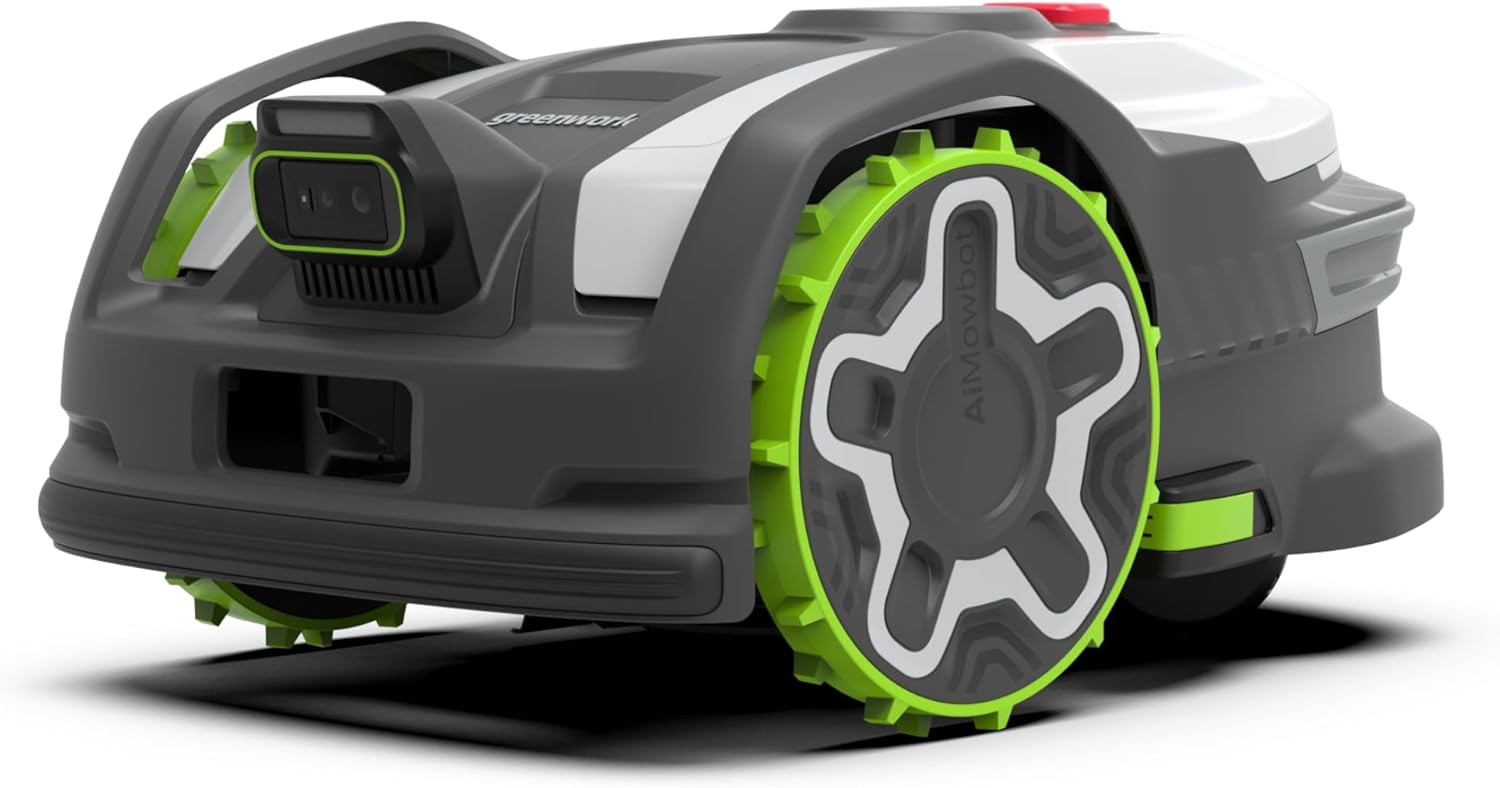
| Mowing area | up to 3/4 Acre |
|---|---|
| Navigation | RTKVision (RTK + vision fusion) |
| Slope capability | 24° climbing grade |
| Cutting height range | 0.75 to 3.5 inches |
| Operation mode | Automatic |
The Greenworks C30Z is a wire‑free robotic mower designed to replace perimeter‑wire systems by combining RTK satellite positioning with vision‑based AI for repeatable, systematic mowing. It is typically set up from the app to create virtual zones and schedules, then runs automatically to maintain lawns up to three quarters of an acre. Notable features include RTKVision fusion for precise navigation under trees and through narrow passages, AI-assisted obstacle detection that learns and avoids common objects, and electronic cutting‑height adjustment from 0.75 to 3.5 inches. Practical benefits are very low noise operation at about 54 dB, the ability to climb steep slopes up to 24 degrees, and IPX6 water resistance for use in wet conditions. Limitations to consider are that advanced navigation and obstacle avoidance depend on software and sensors so initial mapping and occasional troubleshooting may be required, and its narrow 7.87‑inch cutting width means longer run times on larger lawns. The mower is a good choice for homeowners who want a hands-off, wire‑free solution but expect some setup and periodic monitoring to keep maps and sensors performing optimally.
Best for: Homeowners who want a reliable, low‑noise robotic mower that avoids perimeter wires and delivers precise, scheduled mowing with minimal daily attention.
Less Ideal for: Large estates or users who expect very wide cutting swaths and minimal runtime; those who prefer a simpler plug‑and‑play push mower may look elsewhere.
- Wire‑free RTKVision navigation provides near‑inch GPS accuracy without perimeter wiring
- AI‑assisted obstacle detection reduces collisions with toys and garden objects
- App control with multi‑zone scheduling and built‑in weather forecast for hands‑off operation
- Electronic height adjustment lets you change cut height quickly across zones
- Quiet, IPX6 water‑resistant design allows flexible mowing times
- Narrow 7.87‑inch cutting width increases run time on larger properties
- Advanced sensor and software systems may require initial mapping and occasional troubleshooting
Verdict: Choose the C30Z if you want a wire‑free, RTK‑guided robotic mower that delivers precise, quiet, app‑managed mowing for yards up to 3/4 acre.
Choosing the Right Robotic Lawn Mower Without Perimeter Wire: Key Factors to Consider
Navigation System
How a mower locates itself and defines the lawn boundary is the single biggest factor for wire-free operation. GPS-based units use satellite positioning and often combine that with local sensors or inertial measurement to draw virtual boundaries. Vision or LiDAR systems map the lawn and detect obstacles in real time, while sensor-fusion approaches blend multiple inputs to reduce drift.
For gardeners this matters because navigation determines whether the mower reliably covers all the grass without escaping onto paths or nearby planting beds. A higher-end navigation system reduces the need for repeated human intervention, while simpler sensor setups may require more frequent corrections in complex yards.
Battery Capacity and Runtime
Battery size and how efficiently the mower uses power set the maximum area it can mow in one cycle. Runtime depends on battery chemistry, mower load from slope or tall grass, and how aggressively the machine maneuvers around obstacles. Recharge time is also important if the mower needs to make multiple trips to finish a larger lawn.
Gardeners should match expected runtime to lawn size and mowing frequency. A mower with shorter runtime can still work if it returns to the charging station and resumes automatically, but frequent mid-job returns increase total calendar time to finish and may reduce grass-cutting consistency.
Cut Quality and Deck Design
Cutting performance depends on blade type, deck width, and mulching capability. A well-designed deck produces uniform clippings, reduces scalping on uneven ground, and disperses clippings finely so they do not mat. Smaller decks can navigate tighter spaces but may take longer to cover large areas.
Consider your turf type and desired finish. Fine-textured grasses show uneven cutting more readily, while coarse lawns hide minor striping. Mulching helps return nutrients but requires sharp blades and adequate chopping action to avoid clumping.
Obstacle Detection and Safety
Wire-free mowers rely heavily on sensors to detect people, pets, and garden features. Good obstacle detection reduces collisions and minimizes damage to plants and furniture. Some systems slow down and reroute, others stop and wait, and a few use active mapping to remember fixed features.
Safety matters in active yards where children or pets play. Choose a mower whose detection behavior matches how busy your outdoor space is and how quickly it reacts to unexpected obstacles.
Weather Tolerance and Durability
Exposure to rain, humidity, dust, and UV affects how long a robotic mower will last and how consistent it performs. Weather-sealed electronics, corrosion-resistant materials, and drainage design keep systems functioning through typical seasonal changes. Some models can operate in light rain while others require dry conditions.
Gardeners should consider local climate and expected seasonal use. A more rugged build is worth the tradeoff if the mower will be left outdoors or used across wet seasons.
How Wire-Free Navigation Works
Wire-free robotic mowers use a mix of GPS, onboard sensors, cameras, or LiDAR to know where they are and where to cut. Some systems create an electronic map during a learning run, while others rely on satellite position combined with boundary waypoints set through an app.
Understanding the navigation approach helps set expectations about coverage accuracy, how much human correction is needed, and how the mower behaves near property lines or landscape features.
- GPS systems offer good coverage but can drift in areas with tree cover or close structures.
- Camera and LiDAR systems can handle complex layouts but may require clear sightlines and more processing.
- Hybrid approaches combine GPS and local sensing for improved reliability.
Mapping Your Yard for Better Results
Take time to map out lawn zones and note fixed obstacles such as trees, utility boxes, and garden beds. Many wire-free mowers allow you to set no-go zones and virtual boundaries via an app, which reduces run-time interruptions.
If your yard has narrow corridors or steep slopes, identify those areas first. Some units struggle in tight passages or on angled terrain, and pre-mapping lets you adjust mowing schedules or block off areas where the mower might get stuck.
- Measure lawn area roughly to match with recommended coverage for a chosen mower.
- Mark sections with heavy foot traffic separately to avoid over-mowing.
- Create virtual boundaries for delicate plantings if app-based geofencing is supported.
Maintenance Habits That Keep Automation Reliable
Regular upkeep preserves cut quality and keeps navigation systems working. That includes sharpening or replacing blades, cleaning sensors and camera lenses, and keeping charging contacts free of debris. Inspect the chassis for stuck grass and remove built-up material that can affect balance and traction.
Seasonal checks are also important. Before winter or extended storage, clean the unit thoroughly, remove batteries if recommended, and store the mower and docking station in a dry location to prevent corrosion.
- Wipe sensors and camera lenses weekly during heavy use season.
- Check blade condition every few weeks and replace or sharpen as needed.
- Keep docking station area clear so the mower can find and connect reliably.
Managing Complex Lawns and Multi-Zone Yards
If your property has multiple lawns separated by paths or landscaping, look for mowers that support multi-zone programming or manual transfer routines. Some systems let you assign different schedules to each zone so high-traffic areas can be mowed more often than ornamental sections.
For narrow connectors between zones, consider temporary adjustments like widening the passage or using scheduled manual moves if the mower cannot pass reliably on its own.
- Use app-based scheduling to stagger coverage across zones for efficient battery use.
- Temporarily remove obstacles like hoses or garden ornaments when the mower is running.
- Consider using separate mowing passes for steep or uneven patches if the mower struggles there.
Integrating with Smart Yard Systems
Many wire-free mowers offer app controls and may integrate with smart garden ecosystems for scheduling, status alerts, and firmware updates. Integration can reduce hands-on management and allow you to start or halt mowing remotely.
However, relying on cloud services or continuous connectivity means you should verify how the mower behaves offline and whether local controls exist in case of network outages.
- Set up geofencing and alerts for remote notifications about completed jobs or errors.
- Check if the mower offers local manual controls for basic operations without an app.
- Keep firmware up to date to benefit from navigation improvements and bug fixes.
How We Chose the Best Robotic Lawn Mower Without Perimeter Wire
We focused on robotic lawn mowers designed to operate without physical perimeter wire, then applied gardening-specific filters to find options that handle real-yard conditions. Key evaluation dimensions included navigation accuracy and boundary management because these determine whether a mower stays on your lawn and avoids obstacles. Battery capacity and runtime were critical for assessing how much continuous area a mower can cover before needing a recharge. Cutting performance and deck design were used to judge grass finish and mulching effectiveness across common turf types. Durability and weather tolerance were assessed to estimate lifespan and seasonal reliability in outdoor conditions. Ease of setup and ongoing control through apps or manual overrides rounded out the criteria since gardeners value simple installation and predictable behavior. We excluded units that require buried wire as a primary boundary method and machines marketed only for very small or experimental test plots. We also filtered out designs lacking clear navigation systems or insufficient battery information. The result is a list of wire-free robotic mowers that balance autonomous navigation, practical run times, and acceptable cutting quality for typical home lawns.
FAQ
Can a robotic mower really work without a perimeter wire?
Yes, modern wire-free robotic mowers use GPS, vision, LiDAR, or combined sensors to detect boundaries and obstacles. Effectiveness depends on yard complexity, tree cover, and how well the system is set up and calibrated.
How big a lawn can a wire-free unit handle in one run?
Maximum area per run depends on battery capacity and how efficiently the mower navigates. Some units can cover several thousand square feet per charge, while others are suited for smaller lawns or require multiple recharge cycles to finish larger yards.
Are wire-free mowers safe around children and pets?
Most wire-free models include obstacle detection and automatic stopping behaviors, but safety varies by system. They are generally safe when used as directed, but supervision and setting no-go zones are recommended in active play areas.
Do wire-free systems need regular recalibration?
Yes, occasional recalibration or remapping is often needed, especially after moving yard features, significant seasonal changes, or if the mower shows drift in coverage. Apps usually guide calibration steps.
Will tree cover or nearby buildings affect performance?
Tree canopy and tall structures can degrade GPS signals and interfere with vision sensors. Hybrid systems that use local sensors alongside GPS tend to be more robust in shaded or built-up yards.
How should I prepare my yard before running a wire-free mower?
Remove loose debris, hoses, and toys that could tangle the blades. Mark or temporarily block delicate planting areas and secure low branches that could obstruct sensors or cutting paths.
Final Verdict
Wire-free robotic mowers reduce installation hassle and can deliver consistent mowing if you match technology to yard conditions. Prioritize navigation accuracy and battery runtime for reliable coverage, and consider obstacle detection and weather tolerance for safety and durability. Smaller decks and simpler sensor sets may work well in tidy, open lawns, while complex or shaded properties benefit from hybrid navigation or vision-based systems. Decide which tradeoffs suit your routine: lower setup effort versus occasional manual fixes, or the higher cost of advanced navigation for hands-off mowing. With the right features aligned to your lawn size and layout, a wire-free robotic mower can be a practical tool for keeping turf maintained with minimal ongoing effort.
