

Note: This article contains affiliate links. If you click on these links and make a purchase, I may earn a small commission at no extra cost to you. This helps support my research and content. Read my full affiliate disclosure here.
If you have bumpy soil, slopes, or variable turf, a standard robotic mower can struggle or leave an uneven cut. Choosing a robotic lawn mower for rough ground means prioritizing traction, ground-following capability, and durable construction so the machine can finish jobs without getting stuck or damaged. This guide examines six top options suited to uneven yards, steep sections, and mixed surfaces, shortlisted for their terrain performance and battery endurance. We'll explain the practical tradeoffs to expect in real yard use and the evaluation criteria used to pick these models, then walk through features that matter when you compare machines.
Top Picks at a Glance
| Best Overall The best all-around choice for most situations | DREAME A3 AWD Pro 3500 LiDAR Robot Lawn Mower, 4WD, 15.8" Dual-Disc Cutting |  |
| Best Quality Built to a higher standard if you want something more solid | roborock RockMow X130H Robot Lawn Mower with 4WD and Quad-Vision Navigation |  |
| Best Value The sweet spot between price and what you get | roborock RockNeo Q110H Robot Lawn Mower |  |
| Highest Rated A top-rated pick with lots of positive feedback | MOVA LiDAX Ultra 3000 AWD Robot Lawn Mower (Wire-Free, 360° LiDAR + Dual Vision) |  |
| Most Popular A crowd favorite that many people choose with confidence | ECOVACS GOAT A2500 RTK Robotic Lawn Mower |  |
| Best Seller A high-volume bestseller chosen again and again | Husqvarna 410iQ Automower Robotic Lawn Mower (Wire-Free, App Controlled) |  |
DREAME A3 AWD Pro 3500 LiDAR Robot Lawn Mower, 4WD, 15.8" Dual-Disc Cutting

| Power Source | Battery Powered |
|---|---|
| Operation Mode | Automatic |
| Maximum Adjustable Cutting Height | 4 inches |
| Battery Average Life | 1 days |
The DREAME A3 AWD Pro 3500 is a high-capacity robotic mower built to handle complex, uneven yards without boundary wires. It uses 360-degree LiDAR plus binocular AI vision to map yards, avoid more than 300 obstacles, and navigate reliably around trees and tight corners while the Dreamehome app manages schedules, zones, and no-go areas. True 4WD hub motors and heavy-duty off-road wheels let it climb slopes up to 38.7 degrees and drive over small curbs and roots, while dual floating cutting discs deliver a 15.8-inch cutting width for faster coverage. Practical benefits include quiet day-or-night operation, one-tap height adjustment for different grasses, built-in GPS/4G tracking and theft alerts, and IPX6-level cleaning convenience. Important limitations are its weight and size compared with consumer push mowers, and reliance on the app and cellular tracking for advanced features. For large acreage use expect professional-level setup of zones and an understanding that maintenance of blades, battery health, and occasional firmware or connectivity checks are part of ownership.
Best for: Homeowners with larger, irregularly shaped or hilly lawns who want hands-off, high-precision mowing and are comfortable managing app-based mapping and zone setup.
Less Ideal for: People with very small, simple lawns or buyers who prefer minimal tech and plug-and-play devices without app or cellular dependence.
- LiDAR plus binocular AI vision for stable, wire-free mapping and obstacle avoidance
- True 4WD hub motors and off-road wheels that handle slopes up to 38.7 degrees
- Wide 15.8-inch dual-disc cutting for faster coverage and consistent edge trimming
- App control with multi-zone mapping, scheduling, and GPS/4G anti-theft tracking
- Large and relatively heavy unit that may be more complex to service than simpler mowers
- Advanced features depend on app connectivity and cellular services
Verdict: Choose this model if you need a wire-free, LiDAR-guided 4WD mower that can reliably handle steep, complex acreage with minimal daily attention.
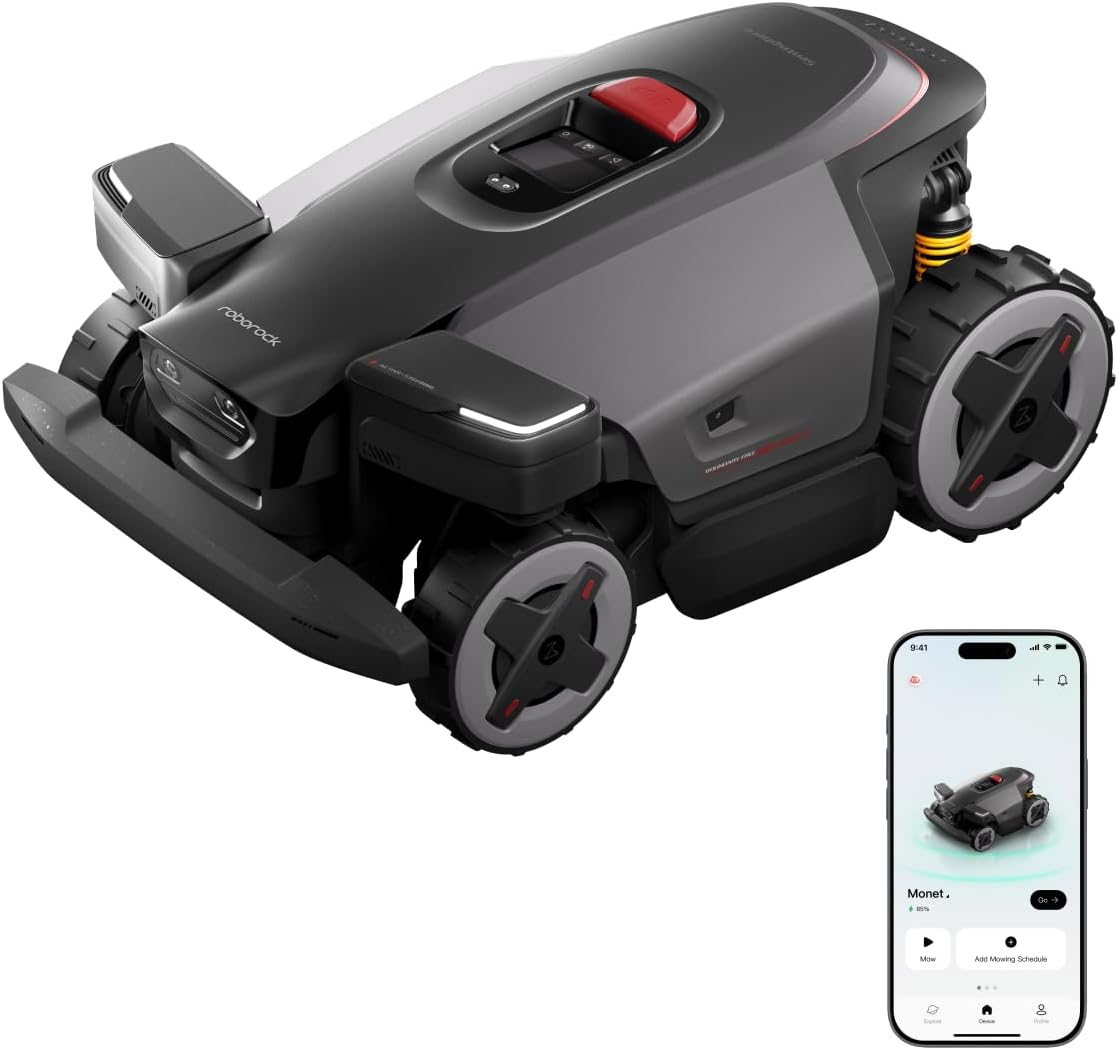
roborock RockMow X130H Robot Lawn Mower with 4WD and Quad-Vision Navigation
| Power Source | Battery Powered |
|---|---|
| Cutting width | 9.5 inches |
| Maximum Adjustable Cutting Height | 3.5 inches |
| Battery Average Life | 140 minutes |
The roborock RockMow X130H is a high-capability robot mower built to handle steep, uneven, and complex lawns without a buried perimeter wire. It uses Full-Band RTK plus a quad-camera AI vision system for precise positioning and dual mapping modes so you can either auto-map open areas or manually trace boundaries from the app. The pro-grade four-wheel drive, active steering, and dynamic suspension let it climb slopes up to 80% and roll over obstacles up to about 3.1 inches while keeping a floating cutting deck for consistent surface-following. Practical benefits include a relatively wide 9.5-inch cut to reduce runtime, multi-zone scheduling and a real-time app dashboard, plus anti-theft features and 4G connectivity. Important limitations are its weight and size for handling and storage, and the advanced navigation and connectivity mean a learning curve during setup and when customizing complex zones. For homeowners with steep or irregular yards who want largely hands-off mowing, this mower brings robust, reliable performance.
Best for: Homeowners with steep, irregular, or obstacle-filled lawns who want a durable, hands-off mower that prioritizes precise navigation and traction over simplicity.
Less Ideal for: Small, flat lawns or buyers who want a very lightweight, simple plug-and-play robot mower with minimal setup and fewer connectivity features.
- Four-wheel drive, active steering, and dynamic suspension that handle slopes up to 80% and 3.1-inch obstacles
- Full-Band RTK plus quad-camera AI vision for accurate positioning under trees and near fences
- Wire-free dual mapping options with app control and multi-zone scheduling for flexible setup
- 9.5-inch cutting width and floating deck for efficient, even mowing across contours
- Built-in anti-theft features including PIN lock, alarm, and GPS tracking
- Heavy and bulky compared with smaller robotic mowers, making manual transport and storage more cumbersome
- Advanced navigation and connectivity increase setup complexity and may require time to fine-tune for complex yards
Verdict: Choose the RockMow X130H if you need a wire-free, high-traction robot mower that can reliably conquer steep, uneven lawns with precise navigation.
roborock RockNeo Q110H Robot Lawn Mower

| Power Source | Battery Powered |
|---|---|
| Operation Mode | Automatic |
| Maximum Adjustable Cutting Height | 3.1 inches |
| Battery Average Life | 130 minutes |
| Minimum Adjustable Cutting Height | 1.6 inches |
The roborock RockNeo Q110H is a feature-rich robotic mower designed to handle complex, uneven yards without perimeter wires. It uses full-band RTK combined with VSLAM for stable positioning under trees and near fences, while dual-camera AI vision helps it detect and avoid people, pets, and garden obstacles so mowing runs with minimal human supervision. Setup relies on app-controlled mapping or an AI auto-mapping mode, letting you define multiple zones and custom schedules from the Roborock app. A floating cutting deck and large wheels let the mower follow ground contours, climb steep slopes up to 45 percent, and roll over low obstacles for continuous coverage. Battery life is rated around 130 minutes, which suits medium-sized properties up to roughly a quarter acre in a single session with efficient routing. Important trade-offs are the unit weight and complexity: heavier construction and advanced navigation add installation and learning curve compared with simpler models, and high-end sensors mean repairs or replacements could be costlier. This model targets yards with uneven terrain and many features, not buyers who want the simplest, lowest-cost solution.
Best for: Best for homeowners with uneven, complex lawns who want a hands-off, high-capability mower that handles slopes, narrow passages, and frequent obstacles while offering advanced mapping and scheduling.
Less Ideal for: Not a great fit for buyers prioritizing the lowest possible upfront cost or those with only a very small, simple lawn who prefer a basic plug-and-play robotic mower.
- Wire-free dual mapping with AI auto-mapping or manual app mapping for flexible boundary setup
- Full-band RTK plus VSLAM navigation for precise positioning in shaded or complex layouts
- Stereo AI vision obstacle avoidance that detects and steers clear of people, pets, and garden objects
- Floating cutting deck and large-diameter wheels for contour-following and slope capability up to 45%
- App control with multi-zone scheduling and a real-time progress dashboard
- Relatively heavy and feature-dense, which raises complexity for initial setup and maintenance
- Battery life of about 130 minutes may require return-to-base cycles on larger properties
Verdict: Pick the RockNeo Q110H if you need a heavy-duty, wire-free robot mower that reliably navigates complex, sloped lawns with advanced obstacle avoidance and multi-zone app control.
MOVA LiDAX Ultra 3000 AWD Robot Lawn Mower (Wire-Free, 360° LiDAR + Dual Vision)

| Cutting width | 15.8 in |
|---|---|
| Cutting height | 1.2-3.9 in, Electric |
| Positioning & Navigation | 360°3D LiDAR+Dual Vision(V3.0) |
| Max. slope performance | 80% (38°) |
| Battery average life | 165 minutes |
The MOVA LiDAX Ultra 3000 AWD is built to handle rough, uneven terrain while minimizing setup work. It navigates using 360° 3D LiDAR combined with AI dual-vision to create centimeter-level maps without perimeter wires or RTK base stations, then maintains dual maps and multiple zones from the app. AWD traction, four high-torque hub motors, and a floating-disc suspension let it climb steep slopes and cut over bumps and uneven ground without tipping. The dual cutting discs and electric height adjustment (1.2"–3.9") produce an even finish and precise edge trimming down to about 1.2" of uncut grass. Runtime and coverage are substantial for a mower in this class, and a 3-year manufacturer warranty plus a free 3-year 4G module add convenience and theft tracking. Expect a larger, heavier unit that requires occasional blade replacement and periodic software or mapping updates to keep obstacle recognition current. For very large properties you will need to plan charging and maps around runtime limits.
Best for: Homeowners who prioritize a dependable, low-touch mower for complex, steep or uneven yards and want secure, wire-free mapping with remote management.
Less Ideal for: Those with very large properties who need long continuous runtime or buyers who prefer a lightweight, ultra-simple robotic mower with minimal electronics.
- Wire-free mapping with 360° LiDAR and AI dual vision for fast, RTK-free setup
- All-wheel drive and floating suspension handle steep slopes and uneven terrain
- Dual cutting discs with electric height adjustment deliver precise, consistent cuts
- App control with dual maps and multi-zone scheduling simplifies lawn management
- Includes 3-year manufacturer warranty and 3 years of free 4G for tracking and alerts
- Heavier and larger footprint than simpler robot mowers which may be harder to move
- Effective coverage per charge is limited compared with commercial ride-on mowers
- Advanced sensors and software require occasional updates and maintenance for best obstacle detection
Verdict: Choose the LiDAX Ultra 3000 AWD when you need a reliable, wire-free robot mower that can tackle steep, uneven lawns while delivering precise edge trimming and remote multi-zone control.
ECOVACS GOAT A2500 RTK Robotic Lawn Mower

| Power Source | Battery Powered |
|---|---|
| Operation Mode | Automatic |
| Battery Average Life | 45 minutes |
| Cutting width | 0.39 inches |
| Number of Positions | 78 |
The ECOVACS GOAT A2500 RTK is a high-tech robotic mower built for largely hands-off lawn care on bigger properties. It uses RTK-enhanced positioning combined with 3D ToF LiDAR and an AI camera to map yards and navigate with centimeter-level accuracy, which reduces missed spots and keeps mowing paths consistent. The dual blade-disc and 32V motor offer strong cutting performance and an adjustable cutting height range to suit common grass types. A 5Ah battery provides roughly 45 minutes of runtime and the mower will automatically return to its charging base for top-ups, letting it maintain larger areas in multiple passes. Notable practical benefits include edge-to-edge trimming capability, obstacle detection for safer operation around common garden objects, and relatively quick 45-minute charging. Important limitations are the specialized navigation hardware and advanced setup that may require careful initial configuration, and the listed runtime may require multiple cycles for very large landscapes. This model is engineered more for reliable autonomous coverage than for budget-focused simplicity.
Best for: Homeowners who prioritize reliable, autonomous mowing for larger lawns and want precise navigation to minimize missed areas and manual oversight.
Less Ideal for: Buyers who prefer a simple plug-and-play mower with minimal setup or those who need continuous single-charge operation for extremely large estates without scheduling multiple runs.
- RTK plus LiDAR and AI camera deliver very precise navigation and consistent coverage
- Dual blade-disc and 32V motor provide strong cutting performance and adjustable heights
- Edge-to-edge mowing capability for close trimming along walls and fences
- Auto-return charging and 45-minute quick charge reduce manual intervention
- Advanced setup and calibration required to get full RTK/LiDAR performance
- Runtime may necessitate multiple sessions to fully cover very large properties
Verdict: Choose the GOAT A2500 RTK if you want RTK/LiDAR precision and autonomous edge-to-edge mowing for managing a large yard with minimal hands-on time.
Husqvarna 410iQ Automower Robotic Lawn Mower (Wire-Free, App Controlled)

| Power Source | Battery Powered |
|---|---|
| Maximum Adjustable Cutting Height | 4 inches |
| Minimum Adjustable Cutting Height | 1 inches |
| Operation Mode | Automatic |
| Item Type Name | Robotic Mower |
The Husqvarna 410iQ is a high-performance wire-free robotic mower built to automate regular lawn maintenance on medium-sized yards. It uses EPOS satellite positioning and cellular connectivity to create centimeter-accurate virtual maps and lets you set stay-out zones, change cut height, and schedule mowing from the Automower Connect app. The mower handles slopes up to 45 percent and offers a 1 to 4 inch adjustable cutting height across a 9.4 inch cutting width, so it can manage varied grass lengths and terrain transitions without perimeter wires. Larger wheels and a reinforced bumper improve traversal over driveways and uneven surfaces, and the unit is hose-washable for easy cleanup. Built-in anti-theft alarm and GPS tracking add security. Expect practical benefits like truly hands-off weekly trimming, predictable cut patterns, and multi-zone mapping for complex yards. The main compromises are the relatively narrow cutting width that makes jobs take longer on larger lawns and the upfront complexity of initial setup and mapping versus a simple perimeter-wire system.
Best for: A buyer who prioritizes precise, hands-off lawn performance and smart connectivity for a medium-sized yard and wants predictable, automated mowing with multi-zone control.
Less Ideal for: Large properties significantly over half an acre or buyers who need the fastest possible pass-to-pass mowing speed should consider larger commercial mowers or wider cutting options.
- Wire-free EPOS positioning enables centimeter-accurate virtual mapping and stay-out zones without perimeter wire
- Handles steep slopes up to 45 percent and negotiates surface transitions with larger wheels
- App control with Wi-Fi, Bluetooth and 4G for scheduling, cut-height changes, and remote tracking
- Built-in anti-theft alarm and GPS tracking for added security
- Hose-washable design and included charging station make maintenance straightforward
- Narrow 9.4 inch cutting width increases time needed to mow larger areas
- Initial setup and mapping can be more complex than perimeter-wire systems
Verdict: Choose the 410iQ if you want a wire-free, app-driven robotic mower that delivers precise mapping, slope capability, and secure hands-off mowing for up to a half acre.
Choosing the Right Robotic Lawn Mower for Rough Ground: Key Factors to Consider
Traction and Wheel Design
Grip is the first line of defense on rough ground. Deep-tread or high-traction tires help a robotic mower climb short slopes, pull itself out of soft patches, and resist slipping on wet grass. Wheel diameter and width matter too: larger wheels roll over bumps and small obstacles more smoothly, while wider wheels spread the machine's weight to reduce sinking on loose soil.
When you evaluate traction, think about the most common conditions in your yard. If you have frequent wet conditions or loose soil, prioritize aggressive tread patterns and replaceable tires that can tolerate abrasive surfaces.
Slope Capability and Climb Performance
Slope capability is usually expressed as a percentage gradient or maximum incline angle. A mower that manages steeper slopes without wheelspin or constant stalling reduces the chance of getting stuck and limits wear on the drive system. Climb performance also depends on weight distribution and traction control, not just motor torque.
Consider both the maximum gradient and how the mower behaves when transitioning from flat to steep zones. Models that can handle intermittent inclines and sustained slopes without frequent recovery cycles work better on heavily contoured sites.
Terrain-Following and Stability
Uneven ground produces variations in cut height if the mower cannot follow surface contours. Terrain-following can be passive, through flexible chassis and larger wheels, or active with suspension and articulated cutting heads. Better stability reduces scalping and delivers a more even finish across bumps and hollows.
Also assess how the machine handles sudden obstacles like exposed roots or small rocks. A design that tolerates impacts and resumes normal operation without manual intervention will save time and reduce maintenance.
Battery Capacity and Performance Under Load
Rough ground requires more energy because wheels slip more and motors work harder to climb and traverse uneven surfaces. Battery capacity and how power is managed under load determine actual runtime between charges and how often the mower needs recovery or recharge cycles.
Look for battery systems with consistent voltage delivery and good thermal management. For larger or very rough areas, prioritize units with longer run times or fast recharge cycles so the mower can finish complex mowing patterns without repeated interruptions.
Durability, Ingress Protection, and Serviceability
A mower working in rough conditions will encounter dirt, moisture, rocks, and impacts. Solid build quality, reinforced housings, and high ingress protection ratings help prevent breakdowns. Corrosion-resistant components and easily accessible service points make routine cleaning and blade changes straightforward, which is important when debris and mud accumulate quickly.
Consider how easy it is to clear the blades, replace worn tires, and inspect electronics. Machines designed with durable, replaceable parts reduce downtime and extend usable life in harsh yard environments.
Navigation, Obstacle Handling, and Boundary Options
Navigation systems influence how reliably a mower avoids trouble on irregular turf. GPS-assisted, magnetic guidance, or advanced onboard mapping reduces aimless wandering and repeated crossings of problematic patches. Good obstacle detection prevents repeated stalls against rocks, garden fixtures, or terraces.
Also consider how boundaries are defined. Wired perimeter systems can be precise on complex plots, while virtual or GPS solutions reduce installation work. Choose a boundary approach that fits your yard shape and how often you will reconfigure planting beds or paths.
Preparing Rough Lawns for Robotic Mowing
Before deploying a robotic mower on rough ground, do a quick site pass to remove larger debris, stakes, and garden tools that cause unexpected stalls. Fill deep holes and consider grading severe ruts to reduce repeated stress on the machine.
Trim tall edges and define clear transitions between lawn and beds so the mower's sensors do not misinterpret obstacles. Installing shallow guide cables or temporary markers along tricky transitions can help early runs map the area and learn problem zones.
- Clear branches, stones, and toys from the mowing area
- Fill holes and level dangerous ruts where possible
- Use temporary markers to help the mower learn tight transitions
Maintenance Tips for Machines Working on Tough Terrain
Expect more frequent cleaning when mowing rough ground. Mud, grass clippings, and grit build up around wheels, blades, and underside components. Regularly inspect and remove lodged debris to prevent overheating and reduced traction.
Check tires and drive mechanisms for wear after heavy seasons. Replace worn treads and keep axles and wheel bearings lubricated where specified by the manufacturer to preserve climbing ability and reduce strain on the motors.
- Clean underside and wheels after wet or muddy runs
- Inspect blade edges and replace when nicked or bent
- Service wheel bearings and drives per maintenance schedule
Adapting Mowing Patterns for Uneven Yards
On rough ground, slower passes and overlapping patterns produce a more consistent cut because the mower has more time to settle over bumps. If the mower software allows, reduce cruising speed in the most uneven areas to limit wheelspin and improve cut quality.
Use multiple shorter mowing cycles rather than one long run when battery life is limited on demanding terrain. Scheduling more frequent, shorter jobs can maintain turf health while keeping the mower operating within its best power band.
- Consider slower speed settings in bumpy zones
- Use overlapping passes for even coverage
- Split large jobs into shorter cycles if runtime is limited
Boundary Setup Options for Complex Plots
Wired perimeter boundaries remain the most precise option for yards with many beds, terraces, and drop-offs. They sharply define the mowing area and help prevent accidental descents into garden beds or steep edges.
Wireless or GPS-guided boundaries reduce installation effort and are useful if you plan to reconfigure planting areas frequently. However, they may require fine-tuning or temporary guides during initial runs on highly irregular terrain.
- Use wired boundaries for exact limits near slopes and drop-offs
- Choose GPS or virtual options for flexible layouts
- Test boundary behavior during the first few runs and adjust as needed
When to Use Manual or Assisted Mowing
Even the best robotic units can struggle with very steep slopes, extremely rocky areas, or dense thatch. For these problem spots, plan occasional manual mowing or trimming to avoid forcing the robot into conditions that cause frequent stalls.
Use a complementary handheld trimmer or a conventional mower for narrow passages, steep banks, and beaches of exposed roots. This hybrid approach preserves the robotic mower's strength on general turf while keeping risky zones safe and tidy.
- Reserve manual mowing for very steep or rocky sections
- Use hand tools to tidy edges and narrow gaps
- Integrate the robot into a broader maintenance plan rather than relying on it exclusively
How We Chose the Best Robotic Lawn Mower for Rough Ground
We focused on attributes that determine how well a robotic lawn mower manages rough ground and uneven terrain. Primary evaluation criteria included traction and wheel design, which affect grip on slopes and soft soil; terrain-following and suspension systems, which control cutting consistency on bumps and hollows; battery capacity and power delivery, which determine how long the unit can work on demanding surfaces; and durability and ingress protection to withstand mud, rocks, and moisture. We also considered navigation and obstacle handling because reliable path planning reduces the chance of bogging down, and maintenance ease since frequent cleaning is common with rough yards. Models were excluded if they were designed only for perfectly flat, small lawns or if they lacked specs showing slope capability and ruggedized components. The selection favors real-world operability over marketing claims, emphasizing measurable terrain specs and practical gardener features such as serviceability and wire-free boundary options.
FAQ
Can a robotic lawn mower handle steep slopes in a rough yard?
Often yes, but it depends on the model's slope rating and traction design. Check the mower's maximum gradient spec and consider weight distribution and tire tread. Very steep or loose slopes may still require manual attention.
How often will I need to clean a robot used on rough ground?
Usually more frequently than with flat, manicured lawns. Expect to clear mud and debris after wet runs and inspect blades and wheels weekly during heavy-use seasons. Frequency depends on soil type and weather.
Are wired boundaries better for irregularly shaped lawns?
Wired boundaries are generally more precise for complex or terraced plots because they define exact limits. Virtual or GPS solutions reduce installation but may need tuning in highly irregular terrains.
Will rough ground shorten the mower's battery life?
Yes, rough ground increases load on motors and causes more wheelspin, which drains the battery faster. Look for models with higher capacity batteries or efficient power management if your yard is demanding.
Can I use a robotic mower on mixed surfaces like turf and gravel?
Robotic mowers vary in tolerance for mixed surfaces. Some handle short gravel strips or compacted paths, but loose gravel and large stones can damage blades and drive components. Isolate non-lawn surfaces where possible.
What maintenance matters most when operating on rough terrain?
Regular cleaning of the underside and wheels, timely blade inspection and replacement, and checking tires and drive components for wear are most important. Addressing damage quickly prevents failures from worsening.
Final Verdict
For rough ground, prioritize traction, slope handling, and a chassis that can follow uneven contours. Expect tradeoffs between raw climbing power and battery runtime: more robust motors and traction systems use more energy, so balance runtime needs with terrain capability. Durability and easy serviceability are essential because rough yards increase wear and cleaning needs. Choose a mower that matches the toughest conditions you expect to face rather than one sized only for flat lawns. When you do, you will get more reliable mowing cycles, fewer recovery trips, and a better-looking lawn across slopes and bumps.
