

Note: This article contains affiliate links. If you click on these links and make a purchase, I may earn a small commission at no extra cost to you. This helps support my research and content. Read my full affiliate disclosure here.
If you care about a neat, finished lawn edge without spending hours with a trimmer, a mower tuned for edges can change how you maintain turf. Robotic lawn mowers built for edges focus on clean perimeter cuts, reliable boundary detection, and minimal cleanup along borders and hard edges. In this guide we narrow the field to six shortlisted options that are well suited to edge-focused lawns, testing them against real gardener priorities like edge-cut accuracy, boundary handling, and ease of setup. Read on to learn which performance and installation traits matter most for lawns with lots of edges and tight borders.
Top Picks at a Glance
| Best Overall The best all-around choice for most situations | ECOVACS GOAT A2000 LiDAR PRO Robotic Lawn Mower |  |
| Best Quality Built to a higher standard if you want something more solid | MOVA LiDAX Ultra 2000 Robot Lawn Mower with 3D LiDAR and AI Vision |  |
| Best Value The sweet spot between price and what you get | Segway Navimow i105N Robot Lawn Mower (wire-free, RTK+Vision) |  |
| Highest Rated A top-rated pick with lots of positive feedback | HOOKII Neomow X2 Air 3D LiDAR Robotic Lawn Mower (11" Cut, 13Ah) |  |
| Most Popular A crowd favorite that many people choose with confidence | ECOVACS GOAT O1000 LiDAR PRO Robot Lawn Mower with Built-in Edge Trimming |  |
| Best Seller A high-volume bestseller chosen again and again | Mammotion LUBA mini 2 AWD 1500H Robot Lawn Mower |  |
ECOVACS GOAT A2000 LiDAR PRO Robotic Lawn Mower

| Power Source | Battery Powered |
|---|---|
| Operation Mode | Automatic |
| Battery Average Life | 50 minutes |
| Cutting width | 3.6 inches |
| Maximum Adjustable Cutting Height | 3.6 inches |
The ECOVACS GOAT A2000 LiDAR PRO is a high-performance robotic mower built for homeowners who want automated, precise mowing with minimal manual work. It uses a HoloScope dual-LiDAR system to auto-map the yard and provide centimeter-level positioning so the mower reliably navigates around trees, fences, and shaded areas without perimeter wire. The integrated TruEdge trimmer handles borders and edges during the same pass, reducing the need for a separate trimmer. The 32V motor and dual-blade disc are designed to cut denser warm- and cool-season grasses, and the 3.0Ah battery plus fast 113.4W charging delivers about 50 minutes of runtime with short recharge cycles for frequent scheduled mowing. You control mowing zones, no-go areas, cutting height and schedules through the ECOVACS app, which makes the unit adaptable to complex yards. Important limitations to note are the relatively narrow 3.6-inch cutting width, which means multiple passes for wider swaths, and the roughly 1/2 acre target area so very large properties will need a different class of mower.
Best for: Homeowners who prioritize precise, automated performance and want a mower that handles obstacles, shaded areas, and clean edges with minimal manual intervention.
Less Ideal for: Owners of very large properties or those who need wide-cut productivity in a single pass should consider larger commercial or wider-cut models.
- Wire-free dual LiDAR mapping for accurate navigation without perimeter wire
- Built-in TruEdge trimmer for edge-to-edge cutting during the same mowing cycle
- High-torque 32V platform and dual-blade disc suited for dense or fast-growing lawns
- App control with custom zones, no-go areas, and scheduling for flexible automated mowing
- Fast-charge battery delivering about 50 minutes runtime and quick turnaround between cycles
- Narrow 3.6-inch cutting width increases time spent on larger lawns
- Designed for lawns up to about 1/2 acre so it is not ideal for much larger properties
Verdict: Choose the GOAT A2000 LiDAR PRO if you want a precision, wire-free robotic mower that auto-maps complex yards and trims edges for consistently neat results.
MOVA LiDAX Ultra 2000 Robot Lawn Mower with 3D LiDAR and AI Vision

| Power Source | Battery Powered |
|---|---|
| Operation Mode | Automatic |
| Maximum Adjustable Cutting Height | 3.9 inches |
| Battery Average Life | 60 minutes |
| Minimum Adjustable Cutting Height | 1.2 inches |
The MOVA LiDAX Ultra 2000 is a high-performance robotic mower built for detailed, hands-off lawn care and particularly strong at edge trimming. It uses 360° 3D LiDAR combined with AI vision to auto-map your yard without boundary wires or RTK setup, then plans U-shaped mowing routes and supports dual maps and up to 150 zones—handy for separate front and back lawns. The movable disc and UltraTrim system let it cut within about 2 inches of walls and ride flush against pavement for cleaner edges. Rear-wheel drive and off-road wheels handle slopes up to 45% and small obstacles, while the mower returns to its charging tower and resumes where it left off. Height adjustment is available through the app between 1.2 and 3.9 inches, and the system includes anti-theft features and continuous software updates. Limitations to note are a single-blade disc design, which is optimized for regular maintenance rather than tackling very overgrown grass, and a roughly 60-minute average runtime that may require multiple charges on larger jobs.
Best for: Buyers who prioritize precise, low-maintenance lawn care and want superior edge trimming and mapping without installing boundary wire; well suited to owners of medium, irregular, or multi-zone lawns who expect regular automated upkeep.
Less Ideal for: Not the best choice for someone needing to clear heavily overgrown turf regularly or for very large properties significantly above the stated coverage area.
- Boundary-free out-of-the-box setup using 3D LiDAR and AI vision for fast auto-mapping
- Precise edge trimming with movable disc that cuts within about 2 inches of edges
- Supports dual maps and up to 150 managed zones for complex yards
- Handles steep slopes up to 45% and small obstacles with off-road wheels
- App-controlled cutting height from 1.2" to 3.9" and automatic resume after charging
- Approximately 60-minute battery life which may require recharging during larger jobs
- Single-blade disc design is intended for upkeep and may struggle with very overgrown grass
Verdict: Choose the LiDAX Ultra 2000 if you want a boundary-free mower that delivers top-tier edge precision and intelligent auto-mapping for multi-zone lawns.
Segway Navimow i105N Robot Lawn Mower (wire-free, RTK+Vision)

| Power Source | Battery Powered |
|---|---|
| Operation Mode | Automatic |
| Cutting width | 7.1 inches |
| Maximum Adjustable Cutting Height | 2 inches |
| Number of Positions | 5 |
The Navimow i105N is a wire-free robotic mower designed for small lawns up to one eighth of an acre. It creates an AI-assisted map via a smartphone app, then autonomously follows planned mowing patterns and returns to its charging base when needed. Key features include EFLS 2.0 with RTK+Vision for centimeter-level positioning in low-satellite conditions, a 140° camera that recognizes many common obstacles, multi-zone scheduling for up to 12 areas, OTA software updates, and selectable edge-mowing modes for a cleaner border. In practice the no-wire setup cuts installation time and makes it easier to reconfigure zones, while the vision system reduces collisions with toys, garden furniture, and small features. It is relatively quiet at the reported 58 dB(A) and includes spare blades and an installation kit. Important limitations are the small 7.1-inch cutting width and the maximum cutting height range, so it works best for regular maintenance rather than heavy overgrown lawns, and advanced positioning features are most useful where GNSS signal is weak but add system complexity. Overall the i105N suits owners who want low-touch, reliable mowing for compact, regularly maintained yards.
Best for: Buyers who want a low-maintenance, fuss-free robot mower for a small, regularly maintained yard and prioritize reliable navigation and safety over aggressive cutting power.
Less Ideal for: Large properties, very overgrown lawns, or owners who need wide cutting swaths for faster work should consider larger commercial-style mowers instead.
- Wire-free, app-guided mapping simplifies setup and zone management
- RTK+Vision positioning improves navigation under trees and in narrow areas
- Camera-based obstacle detection identifies many common objects to reduce collisions
- Multiple-zone scheduling and OTA updates allow flexible remote control and improvements
- Includes charging station, GNSS antenna kit and spare blades for out-of-the-box use
- Designed for small lawns only with a narrow 7.1-inch cutting width
- Not optimized for heavy overgrowth or infrequent deep cuts due to limited cutting width and height range
Verdict: Choose the Navimow i105N if you want a simple wire-free robot mower with RTK-enhanced navigation and strong obstacle avoidance for a small, regularly maintained lawn.
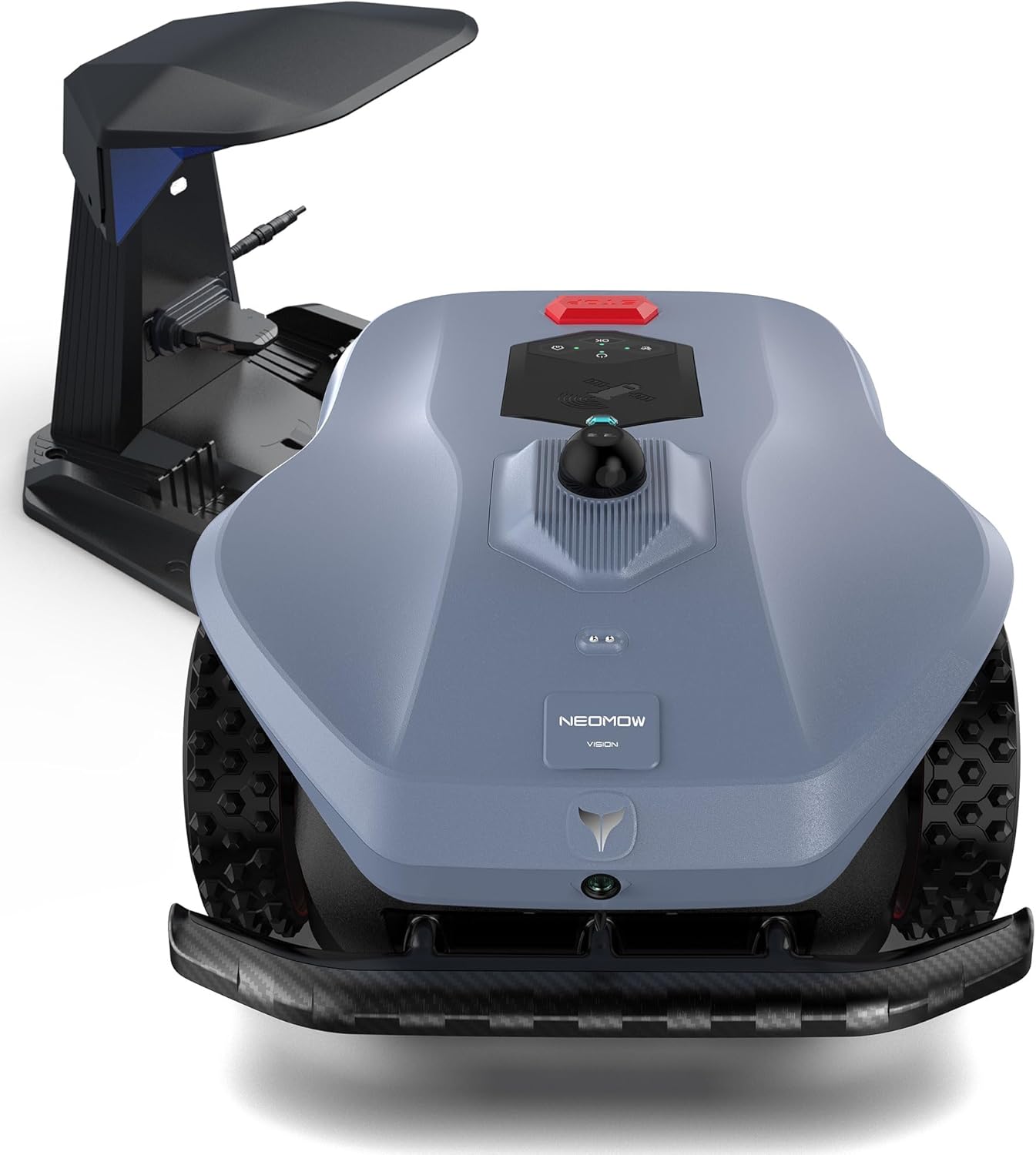
HOOKII Neomow X2 Air 3D LiDAR Robotic Lawn Mower (11" Cut, 13Ah)
| Cutting width | 11 in |
|---|---|
| Battery Capacity / Voltage | 13 Ah / 18 V |
| Mowing Area Per Charge | 0.17 Acre / 700 ㎡ |
| Max. Mowing Area | 0.37 Acre |
| Waterproof Level | IPX6 |
The HOOKII Neomow X2 Air is a compact robotic mower built around a 360° 3D LiDAR SLAM system and AI vision to map and mow small or fragmented lawns with minimal setup. It is typically used for daily or scheduled maintenance on yards up to 0.37 acre and can manage multiple zones and return paths. Notable features include inch-level positioning without an RTK antenna, a reserved port for an optional AI triple-vision camera, WiFi/4G/Bluetooth connectivity and an app for mapping, scheduling and remote monitoring. The electric cutting platform with an 11-inch deck and adjustable height (1.18 to 3.35 inches) handles common turf types and offers three preset mowing modes plus customization. Practical benefits are quiet operation, IPX6 water resistance for outdoor use, anti-theft alerts and GPS tracking, and about 120–150 minutes runtime per charge for roughly 0.17 acre per run. Limitations to consider are the modest cutting width and 0.37 acre maximum mapping area, which make this model best for smaller properties, and some advanced AI features require paid or optional hardware upgrades.
Best for: Buyers who prioritize reliable navigation and hands-off, precise mowing on small to medium fragmented lawns and want advanced sensing and app control over raw cutting capacity.
Less Ideal for: Homeowners with large continuous lawns who need faster coverage or a wider cutting deck should consider higher-capacity models.
- 360° 3D LiDAR SLAM plus AI vision for accurate mapping and obstacle detection
- Multiple wireless connections (WiFi, 4G, Bluetooth) and a mobile app for remote setup and monitoring
- IPX6 waterproof rating allows rinsing the unit after use
- Adjustable cutting height range and three preset mowing modes for turf flexibility
- Anti-theft alarm, GPS tracking and remote lock increase security
- Designed for small lawns only with an 0.37 acre mapping limit and ~0.17 acre per charge coverage
- 11-inch cutting width requires longer runtime to cover larger areas
Verdict: Choose the Neomow X2 Air if you want a budget-friendly, LiDAR-guided robot that delivers precise, low-intervention mowing for small, complex yards.
ECOVACS GOAT O1000 LiDAR PRO Robot Lawn Mower with Built-in Edge Trimming

| Cutting width | 8.66 inches |
|---|---|
| Power Source | Battery Powered |
| Operation Mode | Automatic |
The ECOVACS GOAT O1000 LiDAR PRO is a self-contained robotic lawn mower designed to map and mow irregular yards without perimeter wires. It automatically creates a map with dual 360° LiDAR and AI vision, then follows scheduled or on-demand mowing routines via the app. The standout is the built-in TruEdge border trimmer that lets the robot cut close to driveways, sidewalks, and flower beds so you need fewer manual touchups. The unit claims robust obstacle avoidance using 3D ToF LiDAR plus camera-based AI to detect toys, furniture, and pets. Practical benefits include wire-free setup for quicker deployment, compact slim-body routing through narrow passages, and customizable mowing zones and no-go areas from the app. Important limitations to note are its relatively small cutting width and the likely need to plan trimming schedules during daytime because trimming is louder than mowing. Expect the best results on lawns with defined borders and where owners want to reduce edging work rather than eliminate all manual maintenance.
Best for: Homeowners who want a mostly hands-off solution that minimizes manual edging and can handle irregular or narrow lawns with reliable navigation and app-based controls.
Less Ideal for: Large-acreage properties where a wider cutting path and faster coverage are the priority or users who need a completely silent trimming solution for nighttime operation.
- Wire-free dual LiDAR mapping for automatic, accurate lawn mapping without perimeter wire
- Built-in edge trimming reduces manual edging along driveways, sidewalks, and beds
- AI vision plus 3D ToF LiDAR to detect and avoid common outdoor obstacles
- App control for scheduling, zone setup, and creating no-go areas
- Narrow 8.66-inch cutting width means longer run times on larger lawns
- Trimming mode is louder than mowing and may be disruptive if scheduled at night
Verdict: Choose the GOAT O1000 LiDAR PRO if you want a wire-free robot that reliably trims right up to borders to cut down on manual edging.
Mammotion LUBA mini 2 AWD 1500H Robot Lawn Mower

| Power Source | Battery Powered |
|---|---|
| Operation Mode | Automatic |
| Cutting Height | 2.2-4.0 inches |
| Number of Positions | 7 |
| Cutting width | 7.9 inches |
The Mammotion LUBA mini 2 AWD 1500H is a purpose-built robotic mower for small residential yards with steep or complex terrain. It uses 360° LiDAR and dual‑camera AI vision to detect obstacles early and plan smoother routes, and its AWD drivetrain with two independent motors can climb slopes up to 80 percent while negotiating curbs and roots. Dual cutting discs including a dedicated edge blade deliver closer trimming along borders, and the main disc height can be adjusted from the app for seasonal or turf changes. The mower supports up to 20 independent mowing zones and a DropMow mode for quick one‑off jobs without mapping. Battery features such as custom charge limits and off‑peak charging help preserve battery life and cut energy costs. Practical limitations to expect are modest coverage per model (about 0.37 acre) so larger properties will need a bigger unit, and being a sophisticated autonomous machine it requires initial setup and occasional app management and blade replacements. For homeowners prioritizing safe, hands‑free mowing on slopes, this model balances power and smart navigation.
Best for: Homeowners who need a reliable, autonomous mower that can handle steep, uneven lawns and prefer safety‑focused features and simpler hands‑off operation.
Less Ideal for: Owners of large lawns significantly bigger than 0.37 acre or those who want a purely plug‑and‑play pushbutton mower with no app or setup work.
- 360° LiDAR plus dual‑camera AI vision for improved obstacle detection and navigation.
- All‑wheel drive with independent motors and adaptive suspension for climbs up to 80% and better traction on uneven terrain.
- Dual cutting discs including a dedicated edge blade for cleaner margins and automatic height adjustment via app.
- Multi‑zone support and DropMow mode handle complex lawns and quick temporary jobs without permanent mapping.
- Battery management options (custom charge limit and off‑peak charging) to extend battery life and reduce running costs.
- Rated for about 0.37 acre coverage per charge, so not suited for larger properties.
- Advanced features require initial setup and occasional app interaction and maintenance.
Verdict: Choose the LUBA mini 2 AWD 1500H when you want a compact, safety‑oriented robot mower that confidently handles very steep slopes and complex residential lawns.
Choosing the Right Robotic Lawn Mower for Edges: Key Factors to Consider
Edge-Cut Accuracy And Cutting Pattern
How closely a mower cuts to the border determines how much manual trimming you must still do. Mowers that use side-discharge decks or specialized edge-cutting blades can reach closer to curbs and garden beds, leaving a crisper line. Cutting pattern matters too; spiral or targeted edge passes reduce missed strips while random patterns often leave gaps that need attention.
Edge accuracy also depends on blade height adjustability and how the deck protects plants from accidental overcutting. Consider how the mower approaches corners and narrow junctions, since some units struggle to turn tightly and leave scalloped edges rather than straight lines.
Perimeter Detection And Boundary Control
Perimeter systems-whether physical boundary wire, virtual GPS geofencing, or perimeter sensors-are central to reliable edge trimming. A consistent boundary stops the mower from drifting into flower beds or hardscapes and allows it to focus cuts right up to the limit. GPS-based systems reduce installation work but can be less precise near walls or under heavy tree cover.
Think about the configuration needed for your yard: buried wire is precise but takes time to install; virtual systems are faster but may need calibration. Also check whether the mower supports perimeter offsets so you can set exactly how close to hard edges the blades should run.
Navigation Intelligence And Obstacle Handling
Good navigation keeps the mower on the intended path along edges and prevents repeated misses. Look for units with multiple navigation modes that include edge-following or perimeter-skimming routines. Obstacle detection matters for edges: bumps against low walls, edging stones, or garden ornaments can push a mower off course unless it senses and corrects quickly.
Also consider how the mower handles narrow passages and cornering. Machines that can perform targeted edge passes or follow a wire closely will finish borders with fewer uncut patches and less human intervention.
Setup Complexity And Ongoing Calibration
Precise edge performance often depends on careful initial setup and occasional recalibration. Installing a boundary wire involves planning line placement, securing the wire properly, and testing the perimeter signal. Virtual boundary systems require mapping and verification under real conditions.
You should consider how comfortable you are with that kind of work and whether the mower offers helpful setup guides, app-based calibration tools, or professional installation options. Also factor in how easy it is to update boundaries if you add new beds or change hardscapes.
Battery Life Relative To Edge Workload
Edge-focused mowing can be more stop-and-start than open-lawn passes, which can affect battery usage. Longer runtime lets the mower complete more of the perimeter in one session and reduces repeated docking cycles that interrupt edge continuity. Fast-charging capabilities and reliable return-to-base behavior are important so the mower resumes where it left off and finishes edge runs without leaving gaps.
Consider typical daily runtime in relation to the total length of your lawn edges and whether the mower supports scheduling to prioritize perimeter passes during optimal conditions.
Durability And Protection For Border Conditions
Edges bring more contact with obstacles, mulch, and moisture from beds, so durable build quality and protective bumpers matter. Look for sealed electronics, corrosion-resistant components, and robust wheel treads that maintain traction along slopes and tight borders. Deck protection and blade guards reduce the risk of damage when the mower brushes against stones or concrete.
Regular maintenance access to blades and easy-to-replace wear parts will extend useful life when the mower works frequently around abrasive boundaries.
Preparing Your Yard For Edge-Focused Robotic Mowing
A tidy edge starts before the robot runs. Trim low-hanging branches, remove loose stones and garden ornaments, and check that edging stones are seated firmly. For buried boundary wires, inspect the line for kinks or exposed sections and repair them to avoid signal dropouts.
- Clear a 12-inch work corridor along critical edges to reduce collisions.
- Secure border plants so the mower does not pull shallow-rooted specimens.
- Mark narrow passages and measure widths to confirm the mower fits through comfortably.
Boundary Options: Wire Versus GPS Versus Virtual Beacons
Each boundary type has tradeoffs for precision and ease. Buried wire gives the most consistent physical limit and precise edge proximity. GPS and virtual systems reduce installation time but may be less exact near structures or under dense canopy. Some mowers support hybrid setups so you can combine a wire for critical bed edges and GPS for large open areas.
- Wire: best precision for tight borders.
- GPS: faster setup, variable precision near obstructions.
- Hybrid: mix precision and convenience where needed.
Edge Maintenance Schedule And Best Conditions
Edges usually look best when trimmed on a consistent schedule rather than ad hoc. Light, frequent passes prevent long grass from flopping over hard edges and producing ragged results. Run perimeter passes when grass and soil are dry to avoid clumping and slipping, and avoid mowing immediately after fertilizing or heavy pesticide application so electronics stay protected.
- Schedule shorter, more frequent perimeter passes in high-growth seasons.
- Avoid edge mowing in heavy rain or when soil is saturated.
- Check wheel treads and clean clippings from the deck weekly.
Dealing With Narrow Passages And Corners
Measure gates and tight corridors before choosing a mower; some units are narrower or have specialized corner algorithms. If your lawn has many tight spots, choose a mower with explicit edge-following routines or the ability to perform multiple short passes along a border. For sharp corners, consider combining a perimeter wire offset so the mower can approach and turn without clipping plants.
- Measure minimum passage width to ensure clearance.
- Use perimeter offsets to protect plants at corners.
- Plan mowing sequences to allow the robot to reorient in confined areas.
Seasonal Considerations For Edge Performance
Leaves, mulch, and seasonal debris can interfere with boundary signals and the mower's sensors. Rake or blow leaves away from crucial perimeters and avoid heavy mulching right against the edge line. In winter or early spring, inspect the perimeter and wheels for packed soil or frost that reduces traction and edge-following accuracy.
- Clear seasonal debris before perimeter runs.
- Inspect and clean sensors after stormy weather.
- Adjust schedules during slow growth months to reduce unnecessary runs.
How We Chose the Best Robotic Lawn Mower for Edges
We selected the six robotic lawn mowers on this list by applying practical, garden-focused filters that reflect how these machines perform around borders and hard edges. Core evaluation criteria included edge-cut accuracy, which measures how close and cleanly the mower trims along curbs, walls, and planting beds; boundary and perimeter handling, which looks at how reliably the mower follows perimeter wires, virtual boundaries, or GPS-defined edges without missing strips or crossing into beds; and navigation intelligence, which assesses path planning, obstacle avoidance, and the ability to work in narrow corridors. We also prioritized installation and setup complexity because precise edge performance often depends on correct boundary configuration. Battery runtime and charging behavior were considered in relation to typical lawn sizes and edge lengths. Finally, durability in outdoor conditions and mower deck protection for accidental knocks were included to reflect long-term edge-use wear. Exclusions: we excluded models clearly intended only for very large agricultural turf or industrial applications and any unit lacking perimeter-control features. We did not include mowers without explicit edge or boundary control capabilities. These filters ensured the shortlist focuses on units realistic for residential and smaller commercial edge-focused lawns.
FAQ
Will a robotic mower cut right up to a stone or concrete edge?
Often it depends on the boundary method and deck design. Mowers with precise buried wire and narrow side discharge can cut very close to stones and concrete, while GPS-only systems may leave a small buffer. Expect some models to leave a small strip that needs occasional hand trimming.
How hard is it to install a boundary wire for edge-focused mowing?
Installation takes planning and some physical work but is straightforward for most gardeners. Wire must be routed around beds and fixed to the soil; time to complete depends on yard complexity. Many systems include clear guides and testing modes to verify correct placement.
Will the robot damage plants along the edge?
Damage is usually avoidable with correct boundary placement and appropriate offsets. Setting the perimeter a few inches from delicate plants and using a mower with responsive obstacle detection reduces the chance of contact. Regular inspection after the first few runs helps fine-tune limits.
Can a robotic mower handle edges on sloped lawns or terraces?
It depends on the slope and the mower's traction capabilities. Many robots manage moderate slopes well, but steep or uneven edges may reduce edge accuracy and increase slippage. Look for units rated for the incline of your site and test on a small section before relying on them for all edges.
How often should I check and maintain the mower for edge work?
Inspect the mower weekly during high-use seasons for blade sharpness, wheel wear, and deck cleanliness. Pay extra attention to sensors and bumpers because frequent contact with borders accelerates wear. Replace worn blades promptly to preserve clean edge cuts.
Final Verdict
Prioritize perimeter detection, edge-cut accuracy, and navigation intelligence when choosing a robotic lawn mower for edges. Tradeoffs are common: the most precise boundary systems often require more installation work, while virtual systems save time but may need calibration to achieve the same edge crispness. Focus on how your yard is laid out-narrow passages, corners, slope, and the length of hard edges-then match those realities to a mower's boundary options and runtime. When you weigh these factors and maintain the perimeter and mower regularly, a robot configured for edges will save trimming time and deliver a consistently tidy lawn border.
