

Note: This article contains affiliate links. If you click on these links and make a purchase, I may earn a small commission at no extra cost to you. This helps support my research and content. Read my full affiliate disclosure here.
A rock driveway needs a weed control solution that kills established plants, slows regrowth, and does not harm gravel, pavers, or nearby ornamentals. You want something that works in dusty, compacted surfaces where weeds hide in crevices and between stones. This guide presents seven shortlisted weed killers suited to rock driveways, selected for their effectiveness, residual control, and applicability to loose or bound stone. Below we explain what we measured and why those factors matter in a real driveway. Read on to find options that match the time you want to spend on follow-up treatments and the level of caution you need around planting beds or lawn edges.
Top Picks at a Glance
| Best Overall The best all-around choice for most situations | Roundup Dual Action 365 Weed & Grass Killer Plus 12 Month Preventer with Pump 'N Go 2 Sprayer, 1.33 gal |  |
| Best Quality Built to a higher standard if you want something more solid | RM43 43% Glyphosate Plus Weed Preventer Total Vegetation Control, 2.5-Gallon |  |
| Best Value The sweet spot between price and what you get | Spectracide Weed & Grass Killer Concentrate, 32 oz with AccuMeasure Cap |  |
| Best Budget The cheapest option that still gets the job done reliably | Spectracide Weed & Grass Foaming Edger Aerosol, 17 oz |  |
| Highest Rated A top-rated pick with lots of positive feedback | Spectracide Weed & Grass Killer Concentrate, 1 Gal |  |
| Most Popular A crowd favorite that many people choose with confidence | Ortho GroundClear Weed & Grass Killer with Comfort Wand, 1 gal. |  |
| Best Seller A high-volume bestseller chosen again and again | Roundup Weed & Grass Killer4 Refill, 1.25 gal. |  |
Roundup Dual Action 365 Weed & Grass Killer Plus 12 Month Preventer with Pump 'N Go 2 Sprayer, 1.33 gal

| Unit Count | 170 Fluid Ounces |
|---|---|
| Coverage | 400 sq.ft. |
| Item Form | Liquid |
| Liquid Volume | 1.33 gallons |
This all-in-one product is formulated to kill existing weeds and provide up to 12 months of prevention in non-lawn areas like rock driveways, patios, cracks, and under decks. It comes ready to use in a 1.33 gallon container with an integrated Pump 'N Go 2 sprayer and extendable wand, so you do not need to mix concentrates and can spray continuously for short intervals with better reach and accuracy. The formula claims visible results in hours and becomes rainproof in about 30 minutes, which is practical for unpredictable outdoor conditions. One container covers up to 400 sq. ft., so it is suitable for small to medium hardscape areas; application requires treating the entire target area to establish the preventive barrier. Important limitations are that it is meant for non-lawn surfaces only and requires careful handling per the safety instructions to avoid contact with skin or accidental exposure of desirable plants. Expect easy, efficient spot and area treatment but follow label directions for best results and safety.
Best for: Homeowners who need a straightforward, no-mix solution to remove weeds and keep rock driveways and other hardscape areas clear for up to a year, and who value convenience and fast-acting results.
Less Ideal for: Landscapers or users managing large acreages who need broader coverage per container or a product intended for lawn-safe applications should consider alternatives.
- Ready-to-use formula with no mixing required for quick application
- Built-in Pump 'N Go 2 sprayer and extendable wand for accurate, ergonomic spraying
- Kills existing weeds and provides up to 12 months of prevention when applied to the whole area
- Rainproof in about 30 minutes and shows visible results within hours
- Covers up to 400 sq. ft. per container, suitable for small to medium hardscape areas
- Intended for non-lawn surfaces only and not formulated for use on turf or ornamental beds
- Requires spraying the entire area to achieve the preventive barrier, which can be labor intensive for larger surfaces
Verdict: A convenient ready-to-use spray that removes weeds and creates a year-long preventive barrier ideal for keeping rock driveways and other hardscapes weed-free.
RM43 43% Glyphosate Plus Weed Preventer Total Vegetation Control, 2.5-Gallon
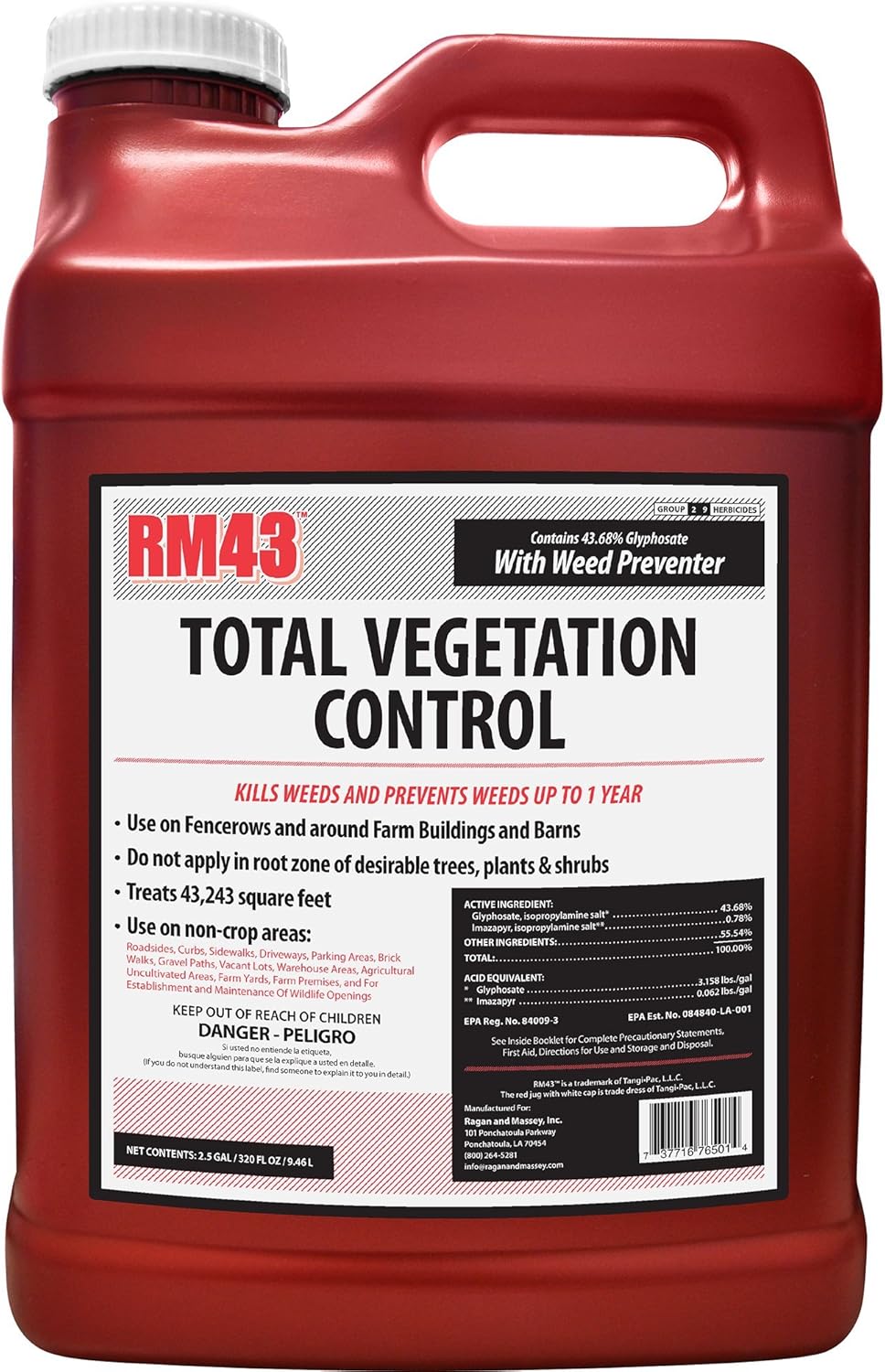
| Active Ingredients | Glyphosate isopropylamine salt, Imazapyr isopropylamine salt |
|---|---|
| Liquid Volume | 320 fluid ounces |
| Item Form | Liquid |
| Coverage | 243 243 square feet |
This 2.5‑gallon RM43 formulation pairs glyphosate with imazapyr to deliver heavy‑duty, long‑lasting control of weeds, grasses, vines, brush and small woody growth on areas where you want no vegetation. It is intended for noncrop uses such as rock driveways, gravel paths, fence rows and around outbuildings and is sold as a concentrated liquid that makes multiple gallons of spray solution for spot or total vegetation control. Notable features include a fast rainfast time of about two hours and a claim of prevention for up to 12 months when used on bare ground. In practice the product is effective for killing roots and preventing regrowth over large areas, so you can treat an entire rock driveway in one application and expect reduced maintenance for months. Important limitations are that it is nonselective and will damage desirable plants if sprayed over roots or drift occurs, and it is intended only for areas where no plants are wanted. Users must follow label directions for mixing, application and safety precautions to avoid unintended damage.
Best for: Buyers who need a high‑performance, long‑lasting herbicide to clear and keep rock driveways and other noncrop areas vegetation‑free with minimal repeat treatments.
Less Ideal for: Gardeners who want selective control around ornamental beds or anyone who needs a product safe to use near desirable plants or turf.
- Concentrated formulation covers large areas—manufacturer lists treatment up to 43,243 sq ft
- Combination of glyphosate and imazapyr kills roots and helps prevent regrowth for up to 12 months
- Rainfast in about two hours so treated areas are less likely to wash off shortly after application
- Suitable for both spot treatments and total vegetation control on noncrop surfaces
- Nonselective chemistry will damage or kill desirable plants if contacted or applied over roots
- Not appropriate for use in areas where vegetation is wanted or near sensitive plantings
Verdict: Choose RM43 when you want a professional‑strength, long‑lasting solution to keep a rock driveway and similar noncrop areas clear of weeds with infrequent reapplications.
Spectracide Weed & Grass Killer Concentrate, 32 oz with AccuMeasure Cap

| Liquid Volume | 32 fluid ounces |
|---|---|
| Coverage | 1,350 sq ft |
| Active Ingredients | Diquat Dibromide |
| Item Form | Spray |
Spectracide Weed & Grass Killer Concentrate is a concentrated nonselective herbicide intended for spot treatment on driveways, walkways, rock beds and around foundations. You mix the concentrate in a tank sprayer using the AccuMeasure cap, spray to fully wet the leaves, and visible browning can appear in as little as three hours with rainproof performance after about 15 minutes. The formula kills down to the root so treated vegetation can be removed and replaced within a day, which is useful when clearing persistent weeds from gravel or rock driveways. Practical features include a measured-cap dosing system that reduces spills and clear label directions for coverage rates. Important limitations are that it is nonselective so it will damage desirable plants if contacted and it must be applied when temperatures are above 60°F for best results. Users should also protect nearby plantings and avoid use on edible crops.
Best for: Homeowners who want a fast, powerful solution to clear weeds and grass from hardscape areas like rock driveways and pathways and who value easy, measured mixing and quick visible results.
Less Ideal for: People who need a selective treatment for lawns, ornamental beds, or edible gardens where nearby plants must be preserved.
- Concentrate formula covers large areas when mixed correctly, with stated coverage up to 1,350 sq ft
- AccuMeasure cap simplifies measuring and reduces mixing mess
- Visible results in as fast as 3 hours and rainproof after 15 minutes
- Kills down to the root, allowing quick removal and replanting after one day
- Nonselective formula will damage any desirable plants it contacts
- Requires tank sprayer and careful masking of nearby plants to avoid drift
Verdict: A practical, fast-acting concentrate with an easy-measure cap that makes short work of weeds and grasses on driveways and other hardscape areas.
Spectracide Weed & Grass Foaming Edger Aerosol, 17 oz

| Item Form | Spray |
|---|---|
| Coverage | 200 linear feet |
| Liquid Volume | 17 fluid ounces |
| Active Ingredients | Diquat Dibromide 0.18%, Fluazifop-p-butyl 0.06%, Dicamba 0.04% |
This foaming edger from Spectracide is a ready-to-use aerosol designed for quick spot treatment of weeds and grasses along rock driveways, walkways and other hardscape edges. The foam clings to foliage for accurate coverage, beginning to yellow and wilt treated plants in about three hours and killing roots within one to two weeks. It is rainproof in 15 minutes so you do not need to wait long for a short window of dry weather. Typical use is to shake the can, apply directly to the leaves until thoroughly covered, and protect nearby desirable plants from drift. The formula is non-selective so it will kill turf and ornamentals if contacted, and the aerosol canister contains a finite amount of spray so large areas may require multiple cans. Follow label safety directions closely because the product is toxic to aquatic life and can irritate eyes and skin.
Best for: Buyers who need an affordable, easy-to-use spot treatment to clear weeds from rock driveways and hardscape edges without mixing concentrates or heavy equipment.
Less Ideal for: People who want to treat large areas frequently or who need a selective lawn-safe product should consider concentrated or selective herbicides instead.
- Foaming spray clings to foliage for targeted application along edges
- Visible wilting in as fast as 3 hours with complete root kill in 1–2 weeks
- Rainproof in 15 minutes so light rain shortly after application will not reduce effectiveness
- Covers up to 200 linear feet per 17 oz can, suitable for multiple driveway edges
- Non-selective herbicide that will damage desirable plants and lawn grasses on contact
- Aerosol canister limits total treated area compared with concentrated liquids
Verdict: A simple, fast-acting foaming aerosol that gives budget-minded gardeners a convenient way to clear weeds from rock driveways and edges quickly.
Spectracide Weed & Grass Killer Concentrate, 1 Gal

| Unit Count | 128 Fluid Ounces |
|---|---|
| Item Form | Liquid |
| Coverage | Non-selective broad spectrum coverage |
| Liquid Volume | 128 fluid ounces |
Spectracide Weed & Grass Killer Concentrate is a liquid concentrate you mix with water and apply with a tank sprayer to remove unwanted weeds and grasses on driveways, walkways and around hardscapes. It is formulated to be fast acting with visible results in as little as three hours and becomes rainproof after 15 minutes, so treatments on a rock driveway are practical even with brief weather changes. The label rate covers about 300 sq ft per gallon of mixed solution when using 7 fl oz per gallon of water, letting one bottle make multiple spray treatments. Because it is non-selective, you need to avoid drift onto desirable plants and use physical barriers when spraying near borders. It kills to the root and allows replanting in treated areas after one day, but effectiveness is best above 60°F and on actively growing weeds. For long runs of heavy infestation you will need repeat applications or mechanical removal for bulk debris before spraying.
Best for: Buyers who prioritize dependable, fast-acting weed control for hard surfaces and need a product that holds up to changing weather so they can quickly reclaim rock driveways and walkways.
Less Ideal for: People who need a selective lawn herbicide or who want an organic, non-chemical option should consider alternatives better suited for turf or sensitive plantings.
- Concentrated formula stretches to multiple treatments for large areas
- Rainproof in 15 minutes so treatments stick through brief wet weather
- Kills down to the root for longer-lasting control versus contact-only sprays
- Fast visible results in as little as three hours allowing quick follow-up work
- Non-selective formula can damage desirable plants if sprayed or drift occurs
Verdict: A reliable, fast-acting concentrate that kills weeds to the root and becomes rainproof in 15 minutes, making it a strong choice for clearing rock driveways.
Ortho GroundClear Weed & Grass Killer with Comfort Wand, 1 gal.

| Item Form | Spray |
|---|---|
| Coverage | 5120 square feet |
| Liquid Volume | 128 fluid ounces |
| Active Ingredients | Ammonium Nonanoate |
Ortho GroundClear is a one-gallon, ready-to-use spray formulated to kill common weeds and grasses on hardscapes and landscaped areas. It is applied with the included Comfort Wand for targeted spot treatments on rock driveways, between pavers, and along edges where you do not want vegetation to regrow. The formula uses ammonium nonanoate and delivers visible browning in about 15 minutes and becomes rainproof two hours after drying, so treated areas are protected from brief weather shifts. Because it is OMRI Listed, it is an option for gardeners seeking an organic-aligned contact herbicide for hard surfaces. Practical benefits include the wand for precise application, broad control of weeds like dandelions and crabgrass, and a large one-gallon supply that covers wide areas. Limitations are that this is a contact killer, so deep-rooted or perennial weeds may need repeat applications and you must avoid drift onto desirable plants. You also must keep children and pets away until spray has dried and follow safety directions carefully.
Best for: Homeowners who need a targeted, fast-acting herbicide for rock driveways, patios, and walkways and who prefer an OMRI-listed contact product for hardscape weed control.
Less Ideal for: Those looking to permanently eliminate deep-rooted perennial weeds in soil beds or who need a systemic long-term lawn herbicide should consider other solutions.
- Ready-to-use formula with an ergonomic comfort wand for precise spot treatment
- Fast visible results in about 15 minutes and becomes rainproof two hours after drying
- OMRI Listed, suitable for use in organic production settings on hardscapes
- Large 1-gallon volume covers up to the stated coverage area for multiple applications
- Contact-only action means established perennial roots may require repeat treatments
- Must avoid contact with desirable plants due to potential damage from drift
Verdict: A large ready-to-use, fast-acting wand spray that makes precise, rainproof spot control of weeds on rock driveways simple and reliable.
Roundup Weed & Grass Killer4 Refill, 1.25 gal.

| Unit Count | 160 Fluid Ounces |
|---|---|
| Coverage | 375 square feet |
| Item Form | Spray |
| Active Ingredients | Triclopyr; Fluazifop P-Butyl; Diquat Dibromide |
This 1.25 gallon Roundup refill is designed to be poured into an existing sprayer and used to remove weeds and grass on hardscape areas such as rock driveways, patios, and walkways. It contains multiple active ingredients and claims visible results in hours and rainproof performance in about 30 minutes, so treated weeds brown quickly and treatments are less likely to wash away. Typical use is to apply on calm, warm days to actively growing weeds, avoid drift onto desirable plants, and keep people and pets off the treated area until the spray dries. The refill covers roughly 375 square feet and is convenient for repeat spot treatments across a driveway. Important limitations are that it is a nonselective herbicide so care is required near ornamentals, and label directions about replanting windows and safety must be followed. You will also need a compatible sprayer to apply it and to handle the concentrate cautiously when refilling.
Best for: Homeowners who want a reliable, fast-acting solution to eliminate weeds and grass growing in rock driveways and other hardscape areas and who prefer a proven, mainstream product backed by clear label instructions.
Less Ideal for: People who need a selective product for use among closely spaced ornamental plants or those who do not want to handle concentrated refill products should consider alternatives.
- Fast visible results in hours with rainproofing in about 30 minutes
- Formulated to kill both broadleaf weeds and grasses down to the root
- Large 1.25 gallon refill covers about 375 square feet for multiple spot treatments
- Designed for use on hard surfaces like driveways, walkways, gravel, and mulch beds
- Nonselective herbicide requires careful application to avoid damaging nearby desirable plants
- Must be poured into a sprayer and handled as a concentrated refill, which may be inconvenient for some users
Verdict: A fast, broad-spectrum refill that reliably clears weeds and grasses from rock driveways when applied carefully with a sprayer.
Choosing the Right Weed Killer for Rock Driveway: Key Factors to Consider
Mode of Action
Different weed killers work in different ways. Contact herbicides scorch aboveground parts quickly but often leave roots intact, which means tough perennial weeds can resprout from crowns or rhizomes. Systemic herbicides move through plant tissue to reach roots, which improves control of deep-rooted perennials common in driveways.
Choosing a product with the appropriate mode of action affects how many follow-up treatments you will need and whether you can expect long-term suppression. For mixed populations of annuals and perennials, consider combining a fast contact effect for visible knockdown with a systemic component to reduce regrowth.
Residual Control Duration
Residual or preemergent activity determines how long treated areas stay weed-free after application. On rock driveways, residual control reduces the frequency of repeat treatments and keeps seeds from sprouting in gaps between stones. Products vary from no residual (purely contact) to several months of soil activity.
Longer residuals can be helpful for low-maintenance driveways but increase the need for careful placement to avoid affecting nearby planting areas. Think about the tradeoff between fewer treatments and potential impact on desirable plants near the driveway.
Surface Compatibility
Driveways come in many surface types: loose gravel, compacted crushed stone, pea gravel, flagstone, or pavers with sand joints. Some formulations can discolor certain stones, strip protective coatings, or leave sticky residues. Others are labeled specifically for use on gravel and hardscapes.
Always consider how the product interacts with the specific material in your driveway. Compatibility affects both aesthetics and the need for post-application cleanup, and it can determine whether the product is safe to apply near drive edges or steps.
Runoff and Nearby Plant Safety
Driveway treatments are often adjacent to lawns, ornamental beds, and water runoff pathways. Products with high runoff potential can carry active ingredients into soil that supports desirable plants or into stormwater. Label instructions and precautionary statements matter for protecting nearby vegetation and water quality.
Select products with clear guidance on buffer distances, weather conditions to avoid, and application rates that minimize drift and runoff. Consider timing applications when no heavy rain is forecast and use targeted application techniques to limit exposure to non-target areas.
Application Method and Equipment
How you apply a product affects its effectiveness and safety. Ready-to-use sprays are simple for spot treatment, while concentrated liquids used with a pump sprayer or hose-end applicator are better for larger areas. Granules and gels offer alternative delivery but behave differently on loose stone versus compacted surfaces.
Choose a method that fits the scale of your driveway and your comfort with mixing and calibrating equipment. Proper nozzle selection, swath overlap, and walking speed influence coverage and reduce the risk of missing spots or overapplying.
Persistence and Residual Cleanup
Persistence refers to how long residues remain active on the surface or in shallow soil. For rock driveways, residues can adhere to stones or settle into sand joints. Some products break down quickly in sunlight, while others remain active for months.
Consider how persistence affects cleanup, the possibility of staining, and when it is safe to plant or allow runoff into nearby beds. If you plan to plant close to the driveway after treatment, choose options with short persistence or that have clear instructions for flushing or neutralizing residues.
When to Use Spot Treatments Versus Broadcast Applications
Spot treatments are best for isolated weeds in cracks, between stones, or along the edge of a driveway. They minimize chemical use and reduce risk to adjacent plants. For patchy growth, treat visible plants directly and revisit regrowth after a few weeks.
Broadcast applications cover the whole driveway and are useful when germination is widespread or when you want to suppress seedlings across the surface. Broadcast treatments require more product and greater attention to weather and runoff precautions.
- Spot treatment: lower chemical use, precise application, good for sparse infestations
- Broadcast: broad suppression, better for heavy seedbeds, needs runoff management
- Always avoid application before heavy rain to reduce movement off the driveway
Timing and Weather Considerations
Apply when weeds are actively growing and leaves are not stressed by drought or heat. Early morning or late afternoon on a mild day reduces evaporation and improves uptake for systemic products. Avoid windy days to prevent drift onto nearby plants.
Do not apply if heavy rain is expected within 24 hours unless the label specifies rainfast timings. Residual treatments perform best when applied to dry surfaces without standing water in joints.
- Active-growth timing increases effectiveness
- Wind and rain can undermine treatment and risk off-target exposure
- Cooler temperatures often improve uptake for many herbicides
Application Techniques for Gravel and Stone
On loose gravel, apply carefully to avoid displacing stones and to ensure the product reaches weed foliage and the top of the root zone. For paver joints, use a targeted stream or a brush-on method where appropriate. Granular products may settle into joints but can be less effective on foliage than liquid contact sprays.
Adjust sprayer pressure and nozzle type to produce larger droplets that are less likely to drift. When using hose-end applicators, test coverage in a small area first to confirm dilution and flow rate.
- Use low-pressure, coarse-spray nozzles for targeted applications
- Consider a wand for spot treating in tight joints
- Avoid excessive runoff by applying in smaller swaths and watching surface runoff
Managing Regrowth and Follow-Up Treatments
Perennials and deep-rooted species will commonly resprout after a single contact treatment. Monitor treated areas for new shoots and schedule follow-ups based on observed regrowth. Combining a contact product for quick knockdown with a systemic follow-up can reduce the total number of treatments.
Keep a treatment log noting dates, weather, and visible results to refine timing. Re-treat small patches promptly to prevent seed set and further spread across the driveway.
- Expect multiple visits for established perennials
- Prompt retreatment stops seed production
- Use physical removal for large taprooted weeds before herbicide for better control
Protecting Nearby Plants and Waterways
Always create buffer zones between treated driveway areas and planting beds. Use physical barriers or apply carefully along the edge to prevent drift. If the driveway slopes toward planted areas or storm drains, reduce application rate or consider non-chemical control in those sections.
Rinse equipment away from garden beds and collect rinse water for disposal on turf or areas labeled safe on the product directions. When in doubt, choose the least persistent option to reduce the risk to nearby desirable plants.
- Establish buffer zones when possible
- Avoid applying on steep slopes that shed runoff
- Dispose of rinse water in a safe, labeled area
How We Chose the Best Weed Killer for Rock Driveway
We focused on products and formulations that perform reliably on loose or compacted rock surfaces. Key editorial filters included mode of action, residual control duration, surface compatibility, and ease of application for driveway settings. We prioritized options with clear directions for use on gravel, paved, or chip-drive surfaces and that offer guidance on avoiding overspray to adjacent planting areas. We also evaluated safety and runoff risk based on labeled precautions, because driveway treatments sit near lawn, beds, and storm drains. Ease of use and available application methods were considered so gardeners can choose a handheld sprayer, hose-end applicator, or ready-to-use bottle that matches their comfort level. We excluded products whose labels did not explicitly address use on stone, gravel, or hardscape, and we did not include treatments intended only for lawns or indoor use. The resulting list represents products that balance fast contact control, measurable residual activity, and practical application for rock driveway situations.
FAQ
Can I use the same weed killer on my lawn and rock driveway?
Often products are formulated for specific surfaces. Lawn-specific formulations may be unsafe on rock or hardscape and vice versa. Check the label to confirm approved surfaces and follow mixing and application instructions for each area.
How soon after treatment can I walk on the driveway?
Walking time varies by formulation. Many contact sprays dry in a few hours, while some concentrates leave residues until they break down or are washed away. Follow the product label for safe re-entry times and avoid disturbing wet spray until it dries.
Will a residual product stain or discolor my stones?
Some formulations can temporarily darken or leave residues on certain stones. Test a small, inconspicuous area first and rinse if the label allows. For decorative or porous stone, choose products labeled for hardscape use to reduce risk of staining.
What is the best approach for persistent perennial weeds in gravel?
For persistent perennials, a systemic herbicide applied to actively growing foliage gives the best chance of reaching roots. Combine targeted application with physical removal of large crowns when practical and follow up after a few weeks to catch resprouts.
How do I prevent weed seeds from returning between treatments?
Reduce seed sources by removing flowering weeds before seed set and using residual products with preemergent activity where appropriate. Regular sweeping, topping with fresh gravel, or installing a weed barrier under new stone can also lower seed establishment.
Final Verdict
Choose based on how much persistence you need, how close desirable plants and water pathways are, and the type of stone in your driveway. Fast-acting contact options give quick visual control, while systemic or residual treatments reduce regrowth but require more careful placement. Prioritize surface compatibility and runoff precautions. For most gardeners, a targeted approach that pairs spot contact treatments with occasional residual applications provides a balance between effectiveness and safety, letting you keep a tidy rock driveway with minimal repeat effort.
