

Note: This article contains affiliate links. If you click on these links and make a purchase, I may earn a small commission at no extra cost to you. This helps support my research and content. Read my full affiliate disclosure here.
If spurge has popped up across your lawn, garden beds, or patio cracks, selecting the right treatment changes how fast you regain a tidy outdoor space. This guide focuses on spurge weed killer options suited for spot control, lawn-safe treatments, and hardscape edges. We shortlisted seven top-rated choices based on how well they remove spurge, their safety for desirable plants and turf, and how easy they are to use. Below you will find the best products for common spurge problems along with clear evaluation criteria so you can match a treatment to your yard, timing, and maintenance plan.
Top Picks at a Glance
| Best Overall The best all-around choice for most situations | Roundup Dual Action 365 Weed & Grass Killer Plus 12 Month Preventer with Pump 'N Go 2 Sprayer, 1.33 gal |  |
| Best Quality Built to a higher standard if you want something more solid | Select Source Triad TZ 4-Way Post-Emergent Broadleaf Herbicide (1 qt) |  |
| Best Value The sweet spot between price and what you get | Ortho GroundClear Year-Long Vegetation Killer with Comfort Wand, 1 gal. |  |
| Best Budget The cheapest option that still gets the job done reliably | BioAdvanced All‑In‑One Lawn Weed and Crabgrass Killer, Concentrate, 40 oz |  |
| Highest Rated A top-rated pick with lots of positive feedback | Quali-Pro Prodiamine Pre-Emergent Herbicide, 5 lb Granules |  |
| Most Popular A crowd favorite that many people choose with confidence | Roundup Weed & Grass Killer with Comfort Wand, 1.33 gal |  |
| Best Seller A high-volume bestseller chosen again and again | Roundup Weed & Grass Killer4 with Pump 'N Go 2 Sprayer, 1.33 gal. |  |
Roundup Dual Action 365 Weed & Grass Killer Plus 12 Month Preventer with Pump 'N Go 2 Sprayer, 1.33 gal

| Unit Count | 170 Fluid Ounces |
|---|---|
| Coverage | 400 sq.ft. |
| Item Form | Liquid |
This product combines a fast-acting herbicide with a built-in preventive barrier to both kill existing weeds and reduce regrowth for up to 12 months in non-lawn areas. It comes as a 1.33 gallon ready-to-use liquid and includes the Pump 'N Go 2 sprayer with an extendable wand for targeted application and up to 10 minutes of continuous spray without mixing. It is formulated to handle a broad range of broadleaf and grassy weeds such as clover, dandelion, crabgrass, and poison ivy and becomes rainproof in as little as 30 minutes, with visible results in hours. Practical benefits include easy spot treatment of driveways, sidewalks, patios, gravel and under decks, reduced need for repeat visits, and a sprayer that reduces bending. Important limitations are that you must coat the entire area you want protected rather than just visible plants and coverage is limited to about 400 sq ft per container, so larger infestations will need multiple containers or repeat treatments for full-area protection.
Best for: Gardeners who want a practical, low-effort solution for killing and preventing weeds in cracks, patios, paths, and other non-lawn areas and who value a built-in sprayer and long-lasting control.
Less Ideal for: People seeking selective lawn treatments or those managing very large landscapes where bulk or a granular program would be more cost-effective.
- Kills existing broadleaf and grassy weeds and grasses while also providing up to 12 months of prevention
- Ready-to-use liquid with Pump 'N Go 2 sprayer eliminates mixing and offers an extendable wand for accurate application
- Becomes rainproof in about 30 minutes and shows visible results within hours
- Designed for non-lawn hardscape and gravel areas where you want long-term control
- One container treats roughly 400 sq ft, so not economical for large areas
- Requires spraying the entire target area to establish the preventive barrier rather than spot-spraying only visible weeds
Verdict: Use this ready-to-spray product when you need a simple, one-step solution to kill existing spurge and other weeds and keep them from returning for up to a year in non-lawn areas.
Select Source Triad TZ 4-Way Post-Emergent Broadleaf Herbicide (1 qt)
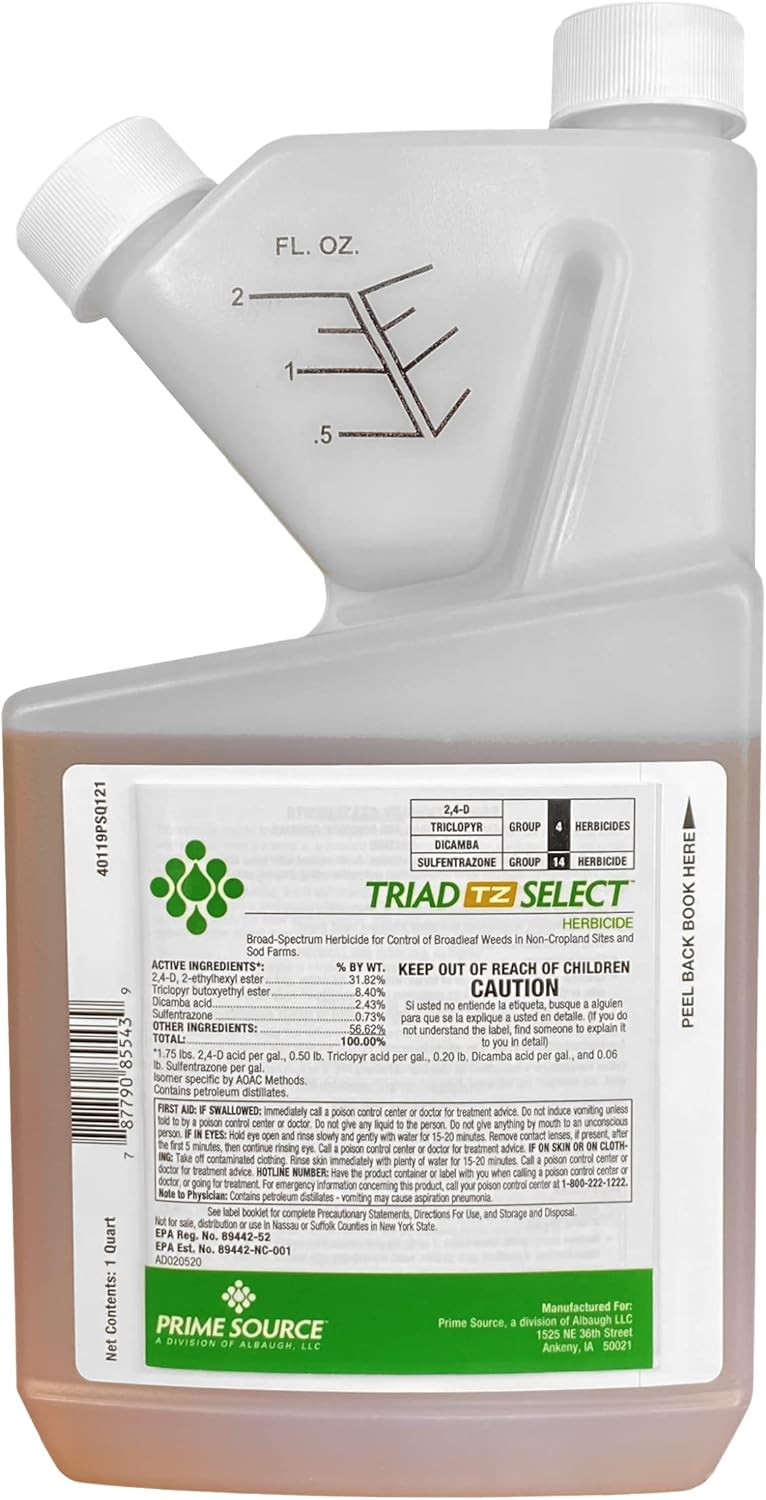
| Unit Count | 32 Fluid Ounces |
|---|---|
| Item Form | Liquid |
| Coverage | 48 to 96 fluid_ounces per acre |
| Active Ingredients | triclopyr, 2,4-D, Dicamba, Sulfentrazone |
Triad TZ is a concentrated post-emergent herbicide designed to stop and kill broadleaf weeds in lawns and other turf sites. It combines four active ingredients including triclopyr and is absorbed through leaves and stems, with weed growth typically halting within hours and visible decline within days to weeks. You use it with a properly calibrated sprayer at rates recommended on the label, applying when weeds are actively growing and avoiding mowing for two to three days around treatment. Notable features include multi-mode action for tougher species such as spurge, dandelion, ground ivy, and wild violet, plus labeled use on lawns, athletic fields, and utility rights-of-way. Practical benefits are rapid knockdown on susceptible broadleaves and flexibility across common turf settings. Important limitations are that it must be mixed and applied carefully with protective gear, it is not for food crop areas, and results depend on correct rate, timing, and environmental conditions so sensitive species may take up to four weeks to die.
Best for: Gardeners and turf managers who prioritize fast, reliable control of stubborn broadleaf weeds and are comfortable following label rates and using a sprayer for targeted applications.
Less Ideal for: Casual users who want a ready-to-use, no-mixing product or anyone needing an herbicide safe for food crops or untreated adjacent ornamentals.
- Four active ingredients with two modes of action for robust control of many broadleaf weeds
- Works quickly to stop weed growth and delivers visible control within days to weeks
- Labeled for a wide range of turf sites including residential lawns and athletic fields
- Concentrated liquid formula suitable for calibrated sprayer applications
- Requires careful mixing, protective clothing, and calibrated equipment to be effective and safe
- Not labeled for use where food crops are grown or near combustible materials
Verdict: Choose Triad TZ when you need a concentrated, multi-active post-emergent product that delivers fast, dependable control of tough broadleaf weeds like spurge in turf.
Ortho GroundClear Year-Long Vegetation Killer with Comfort Wand, 1 gal.

| Unit Count | 128 Fluid Ounces |
|---|---|
| Item Form | Liquid |
| Coverage | 1 gallon |
| Active Ingredients | Imazapyr; Pelargonic Acid |
Ortho GroundClear is a one-gallon, ready-to-use vegetation killer designed for clearing and preventing weeds on hardscapes and unplanted areas. The included Comfort Wand lets you apply a continuous targeted spray without bending or pumping, which is useful for treating cracks in driveways, patios, gravel and fence lines. The formula is fast-acting with visible results within an hour and is labeled rainproof after one hour, so treated areas do not need long dry windows. It contains imazapyr and pelargonic acid as active ingredients and is intended only where you want no plant growth for up to a year. Practical benefits include long-term prevention that reduces repeat treatments and simple application right out of the bottle. Important limitations are that it is non-selective so it will kill desirable plants on contact or through soil activity, and it should only be used on hardscapes or truly bare areas and applied on warm sunny days for best results. Follow safety directions to keep people and pets off treated areas until dry.
Best for: Buyers who want a low-effort, long-lasting solution to eliminate spurge and other unwanted plants from driveways, patios, gravel and other unplanted hardscape areas without frequent reapplication.
Less Ideal for: Gardeners who need to control weeds selectively among desirable plants or for treating lawns and planted garden beds should choose a selective herbicide or spot-treating methods instead.
- Ready-to-use one-gallon formula for immediate application
- Comfort Wand provides continuous targeted spray for cracks and edges
- Fast-acting with visible results in about an hour
- Rainproof after one hour so brief drying time is needed
- Prevents new vegetation for up to one year, reducing reapplication frequency
- Non-selective formula will damage or kill desirable plants if contacted
- Not suitable for use in planted beds or areas where regrowth is wanted
Verdict: Use this ready-to-spray, year-long formula when you want a straightforward, long-lasting way to remove and prevent spurge and other vegetation from driveways, patios, and other hardscape areas.
BioAdvanced All‑In‑One Lawn Weed and Crabgrass Killer, Concentrate, 40 oz
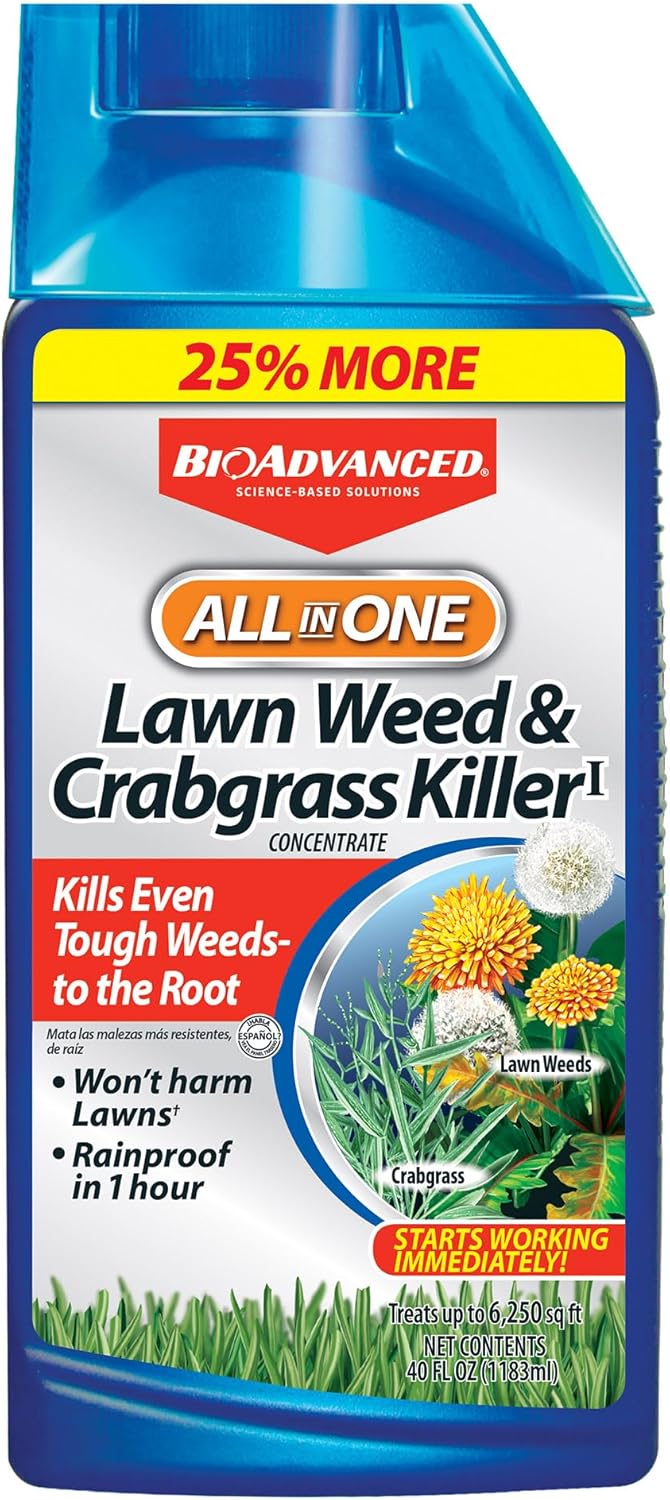
| Unit Count | 40 Fluid Ounces |
|---|---|
| Item Form | Spray |
| Coverage | 6250 square_feet |
| Active Ingredients | Herbicide (Quinclorac, 2,4-D, Dicamba salts listed in description) |
This BioAdvanced concentrate is a one‑step lawn herbicide meant to control a wide range of broadleaf weeds and crabgrass by spraying a hose‑connected applicator across the lawn. It is designed to penetrate and kill weeds down to the root and the label lists more than 200 targeted species, making it suitable for persistent problems such as spurge when applied as directed. The product is rainproof in about an hour, which reduces the risk of wash‑off after treatment, and the concentrate format lets you mix only what you need for the area you treat. Practical benefits include coverage for roughly 6,250 square feet from the 40 oz bottle at recommended rates and compatibility with many common turf types when used per label instructions. Important limitations: it should not be used on certain grasses like St. Augustine or centipede, and timing matters because weeds should be small and actively growing for best control. As with all herbicides, careful handling, exact mixing rates, and following safety directions are required.
Best for: Homeowners looking for a cost‑effective, broad‑spectrum weed control that treats whole‑lawn infestations and reduces repeat spot treatments.
Less Ideal for: People who need a spot treatment for a few isolated spurge plants or who maintain lawns with sensitive grass varieties listed on the label.
- Targets over 200 listed broadleaf weeds including common lawn spurge
- Concentrate formula allows mixing to treat large areas economically
- Rainproof in one hour, reducing loss from unexpected showers
- Penetrates to the root for longer lasting control
- Not safe for use on several turf types such as St. Augustine and centipedegrass
- Requires precise mixing and hose‑end application which may be fiddly for small patches
Verdict: A budget‑friendly concentrated herbicide that provides economical, wide‑area control of spurge and many other lawn weeds when used according to label directions.
Quali-Pro Prodiamine Pre-Emergent Herbicide, 5 lb Granules

| Item Form | Granule |
|---|---|
| Active Ingredient | Prodiamine 65% |
| Coverage | Pre-emergent grass and broadleaf weed control, season long crabgrass control |
| Unit Count | 80 Ounce |
Quali-Pro Prodiamine is a 5 lb granular pre-emergent herbicide designed to prevent germination of annual grasses and broadleaf weeds such as spurge. Applied to turf and landscape beds in spring or fall, it forms a protective barrier in the soil that stops weed seedlings before they emerge, giving season-long control of crabgrass and other common annuals. The 65% prodiamine formulation is compatible with common tank mixes such as fertilizers and iron products, which makes it convenient to combine with regular lawn treatments. It is intended for use on turf, landscape areas, nurseries, and golf courses where preventive control is preferred over post-emergent spot treatment. Limitations are that it will not kill established weeds so it must be applied before seed germination, and treated areas may require careful timing around seeding desirable grasses. For gardeners prioritizing dependable, preventative spurge control across a season, this product provides a straightforward, turf-compatible solution.
Best for: Homeowners and groundskeepers who want a reliable preventive product to keep spurge and other annual weeds from germinating across a growing season.
Less Ideal for: People needing an immediate knockdown of existing spurge or who plan to overseed lawns right after application should choose a post-emergent product or delay application.
- Contains 65% prodiamine for effective pre-emergent control of annual grasses and broadleaf weeds
- Granular form that can be applied with standard spreaders for even coverage
- Season-long control when applied at the correct timing
- Compatible with many fertilizers and iron mixes for combined lawn treatments
- Does not control established weeds and must be applied before seed germination
- Requires correct timing and care around seeding desirable turf
Verdict: Use this prodiamine granular pre-emergent when you want dependable, season-long prevention of spurge and other annual weeds before they emerge.
Roundup Weed & Grass Killer with Comfort Wand, 1.33 gal

| Item Form | Liquid |
|---|---|
| Coverage | 400 sq. ft. |
| Liquid Volume | 1.33 gallons |
This Roundup product is a one-gallon-plus liquid herbicide packaged with a built-in Comfort Wand for continuous spray, making spot and edge applications straightforward. It is formulated to kill broadleaf weeds and grasses, including spurge, dandelion, crabgrass, clover, and poison ivy, and the label promises visible results in as fast as six hours and rainproofing in about 30 minutes. Typical use is direct spraying on actively growing weeds in areas like flower bed edges, walkways, driveways, mulch and gravel beds, and around foundations where you need quick control. The Comfort Wand reduces hand fatigue and helps deliver a steady spray for targeted application. Practical benefits include a large coverage area up to 400 sq. ft. per container and guidance on replanting windows after application. Important limitations are that it is a nonselective herbicide so it will damage desirable plants if drift or overspray occurs, and treated areas should remain off-limits to people and pets until dry. Follow label directions for timing, temperature recommendations, and replanting intervals to avoid unintended damage.
Best for: Homeowners who want fast, reliable spot control of persistent spurge and other common broadleaf weeds and who prefer a ready-to-use solution with an easy-to-hold wand for precise application.
Less Ideal for: Gardeners who need a selective treatment near delicate perennials or lawns or who prefer organic or nonchemical weed-management methods should consider alternatives.
- Built-in Comfort Wand with one-touch continuous spray for easier, targeted application
- Kills broadleaf weeds and grasses to the root, including spotted spurge
- Visible results in hours and rainproof in about 30 minutes
- Covers up to 400 sq. ft. per 1.33 gallon container
- Nonselective formula can damage desirable plants if sprayed or drifted onto them
- Treated areas must remain off-limits until spray dries, which requires planning around pet and family activity
Verdict: A convenient, ready-to-use herbicide with a comfort wand that quickly controls spurge and other broadleaf weeds for homeowners wanting fast spot treatment.
Roundup Weed & Grass Killer4 with Pump 'N Go 2 Sprayer, 1.33 gal.

| Unit Count | 170 Fluid Ounces |
|---|---|
| Item Form | Spray |
| Coverage | 300 Square_Feet |
| Active Ingredients | Triclopyr, Fluazifop-P-Butyl, Diquat Dibromide |
This kit pairs a concentrated Roundup Weed & Grass Killer4 formula with a built-in Pump 'N Go 2 sprayer so you can treat patches of spurge, dandelions, crabgrass, and other broadleaf weeds without mixing chemicals. The sprayer attaches directly to the container and the extendable wand gives more accurate targeting while letting you stand upright. It produces visible browning in hours, becomes rainproof in about 30 minutes, and the manufacturer says treated areas can be replanted within 1 to 30 days depending on the situation. Practical benefits include up to roughly 10 minutes of continuous spray per pump cycle and enough product to cover several hundred square feet. Important limitations to consider are standard herbicide safety precautions you must follow, including keeping people and pets away until treated surfaces dry, and that active ingredients mean it will kill desirable plants if oversprayed. For homeowners who want a straightforward ready-to-use option for persistent spurge patches, this simplifies application compared with measuring and mixing concentrates.
Best for: Homeowners who want a low-hassle, ready-to-use solution to remove spurge and other broadleaf weeds quickly and with accurate spot applications.
Less Ideal for: Gardners seeking an organic or non-chemical approach or those who need selective control in dense mixed plantings where overspray risk is unacceptable.
- Prefilled Pump 'N Go 2 sprayer for immediate use without measuring or mixing
- Extendable wand improves targeting and reduces bending over
- Produces visible results in hours and becomes rainproof in about 30 minutes
- Covers several hundred square feet from a single 1.33 gallon unit
- Contains active herbicide ingredients that will damage or kill desirable plants if misapplied
- Requires standard personal protective measures and keeping people and pets away until dry
Verdict: A ready-to-use, pump-on bottle with an extendable wand that makes fast, accurate spurge and broadleaf weed control simple for risk-conscious homeowners.
Choosing the Right Spurge Weed Killer: Key Factors to Consider
Control Speed and Visible Results
How quickly a treatment shows visible suppression of spurge affects when you can resume regular lawn care and how confident you feel about progress. Some chemistries wilt and discolor broadleaf weeds within days while others require multiple applications over weeks. Faster-acting products are useful for spot treatments where you want immediate improvement, such as near patios or walkways. Slower products can still provide durable control but may require planning for repeated applications and monitoring.
Consider the growth stage of the spurge when treating. Younger plants often respond faster than well-established patches with deep roots. Knowing approximate control speed helps set expectations for follow-up weeding and reduces unnecessary repeat applications.
Turf and Ornamental Plant Selectivity
Selectivity is about killing spurge while leaving lawn grasses and nearby ornamentals unharmed. Some formulations are broad-spectrum and can damage desirable plants if oversprayed, while others target only certain broadleaf weeds. Choose a product labeled for the grass species and ornamentals in your landscape. Follow label directions for spot treatment around sensitive plants and learn whether the product requires shielding or a brush-on application to avoid drift.
If you have mixed plantings, err on the side of more selective application methods. Techniques like shielded sprays, spot applicators, or applicator wicks can reduce contact with non-target foliage and protect plantings you want to keep.
Application Method and Practicality
How a product is applied affects whether it fits into your routine. Liquid concentrates require mixing and a spray rig, pre-mixed sprayers are convenient for small jobs, and granular products are easy to broadcast but less precise. Pump sprayers, hose-end applicators, and bottle wands each have advantages and drawbacks for reaching tight areas or treating wide swaths.
Consider how much area you need to treat, whether you prefer spot treatment or broadcast application, and storage needs. Practical features like clear measuring marks, leak-free nozzles, and instructions for tank-cleaning reduce user error and accidental damage to desirable plants.
Rainfastness and Reapplication Interval
Rainfastness is the time required after application before rainfall will wash the treatment away and reduce effectiveness. A product with a short rainfast window can be applied on days with uncertain weather but may require retreatment if rain occurs too soon. Reapplication intervals tell you how often repeat treatments are allowed or recommended to achieve control without harming turf.
Match labeled rainfast and reapplication guidance to local weather patterns and your tolerance for follow-up work. In regions with frequent rain during the growing season, choose options with quicker uptake or plan applications during dry windows.
Safety Guidance for People and Pets
Safety instructions govern when family members and pets can re-enter treated areas and how to store and handle products. Even lawn-approved formulations have specified re-entry intervals, personal protective equipment recommendations, and mixing precautions. Read labels for first-aid statements and for instructions on washing equipment and clothing after use.
If you have children, pets, or edible gardens nearby, prioritize products with clear, conservative safety directions and packaging that minimizes accidental spills. Consider non-chemical control methods as part of an integrated approach when safety constraints are primary.
Long-Term Control and Cultural Practices
Chemical control is often one part of a broader strategy to keep spurge from returning. Improving lawn density through proper mowing, fertilizing, and overseeding reduces open space where spurge can establish. Regular hand-pulling of small patches, using mulches in beds, and correcting irrigation practices can reduce recurring outbreaks.
Evaluate a weed control plan in the context of long-term maintenance. A program that combines timely spot treatments with cultural improvements will typically reduce total chemical use and provide more durable results than repeated blanket applications.
When You Need Spot Treatment Versus Broadcast Control
Spot treatment is the preferred approach when spurge appears in isolated patches, along cracks, or under shrubs where broad spraying could harm desirable plants. Use a targeted applicator to apply a small volume directly to weed foliage and avoid drift. This minimizes chemical exposure and reduces impact on turf health.
Broadcast control is appropriate for widespread infestations across large lawns. When choosing broadcast treatments, confirm the label lists your turfgrass type and follow application rates closely. Consider timing applications during active weed growth for best uptake.
- Spot treatment: precise, lower total chemical use, ideal for mixed plantings
- Broadcast control: covers large areas, requires correct rate and turf compatibility
Timing Treatments for Best Effect
Spurge is often more vulnerable to treatment during active growth periods, which typically occur in warm seasons. Apply products when plants are actively taking up nutrients rather than during drought or dormancy. Avoid spraying stressed plants; results may be inconsistent.
Early-season control can reduce seeding and spread later in the year. For persistent patches, plan follow-up visits according to the product label to remove new seedlings and regrowth.
- Treat during active growth for better uptake
- Avoid applications when plants are drought-stressed
- Plan follow-up within labeled intervals for durable control
Non-Chemical Options to Complement Treatments
Mechanical control methods such as pulling or hoeing are effective on small patches and young plants. Because spurge often roots shallowly, removing plants before seeding can limit future outbreaks. Use gloves and dispose of pulled plants where seeds cannot spread.
Cultural tactics like improving turf density, adjusting mowing height, and using mulch in beds will reduce open ground where spurge establishes. These measures reduce reliance on chemical controls and support a healthier landscape overall.
- Hand-pulling early reduces seed production
- Mulch blocks light to seedlings in beds
- Stronger turf crowds out small weed seedlings
Application Tools and Safety Best Practices
Select an applicator that matches the job. For narrow cracks and edges, a bottle with a wand or a brush applicator gives control. For larger areas, a pump or pump-up sprayer allows even coverage. Clean equipment thoroughly after use and label stored containers clearly.
Always follow label PPE recommendations and keep children and pets off treated areas for the recommended re-entry interval. Store products in a locked, dry place away from food and animal feed.
- Use shielded or brush applicators near desirable plants
- Rinse and drain sprayer tanks to avoid cross-contamination
- Wear recommended gloves and eye protection during mixing and application
Managing Recurrent Outbreaks
Recurring spurge often signals a cultural or environmental condition that favors the weed. Inspect the area for compacted soil, thin turf, poor drainage, or repeated disturbance that creates bare ground. Addressing these underlying issues reduces the likelihood of repeated treatments.
Rotate control tactics between seasons when possible. Combining cultural repairs, timely spot treatments, and targeted broadcast applications will reduce reliance on any single method and improve long-term control.
- Identify and correct bare spots and soil problems
- Use a combination of cultural and chemical methods
- Monitor treated areas and remove new seedlings promptly
How We Chose the Best Spurge Weed Killer
We reviewed options that are commonly used to control spurge and evaluated them against criteria that matter to gardeners dealing with this fast-spreading weed. Key filters included documented efficacy against broadleaf spurges, compatibility with common lawn grasses and ornamental plants, and evidence of consistent results in typical home-garden situations. We also prioritized products offering clear application instructions, reasonable re-entry and rainfast times, and formulations that reduce risk to nearby non-target plants when used as directed. Excluded from consideration were treatments intended only for agricultural or industrial use, products lacking clear labeling for home lawn or garden use, and unproven home remedies without repeatable evidence. We focused on measurable dimensions: how quickly spurge control occurs, how selectively the product targets weeds versus turf, the practicality of applying the formulation, and safety guidance for pets and people. Those same dimensions informed our scoring and the selections included in the shortlist.
FAQ
Can I use general broadleaf weed killers on spurge?
Often broadleaf weed killers will work on spurge, but effectiveness and safety depend on the active ingredient and labeled uses. Always check the label to confirm the product lists spurge or similar broadleaf weeds and that it is safe for your turfgrass or nearby ornamentals.
How long after treatment is it safe for pets to return to the treated area?
Re-entry times vary by product and formulation. Many home-use products specify waiting until spray residues dry or a set number of hours. Follow the label instructions exactly and restrict pet access for the recommended interval to minimize exposure.
Is repeat application often necessary to control spurge?
Repeat applications are sometimes necessary because spurge can regenerate or new seedlings can emerge. The need for follow-up depends on treatment speed, product label guidance, and how well cultural practices limit reseeding.
Will spot-treating spurge damage nearby shrubs or flowers?
Spot treatments reduce risk but can still cause damage if spray contacts non-target foliage. Use shielded or brush applicators and apply when wind is calm. For sensitive plantings, consider physical removal or very targeted applications.
When is the best time of year to treat spurge?
Treat during periods of active growth, usually in warm seasons when plants are not drought-stressed. Early treatment of young seedlings gives better control and reduces seed production later in the season.
Can improving lawn care reduce spurge problems?
Yes. Thicker, healthier turf reduces open areas where spurge establishes. Proper mowing, fertilization, overseeding, and irrigation practices make it harder for spurge seedlings to get established and spread.
Final Verdict
Choose a spurge control approach that balances speed, selectivity, and safety for your landscape. For isolated patches, targeted spot treatments and hand-pulling minimize non-target exposure. For larger outbreaks, confirm turf compatibility and follow label rates closely. Prioritize products and practices that fit your timing and safety needs, then combine chemical control with cultural improvements to reduce recurrence. With the right method and follow-up, you can regain control of spurge while protecting desirable plants and turf.
