

Note: This article contains affiliate links. If you click on these links and make a purchase, I may earn a small commission at no extra cost to you. This helps support my research and content. Read my full affiliate disclosure here.
A lawn mower with bagger changes how you maintain a yard by combining cutting and collection in a single pass. For homeowners who want fewer trips raking and better curb appearance, the right bagger setup speeds chores and reduces clumping of damp grass. This guide covers six top options suited to typical suburban lawns and smaller properties, shortlisted for reliable cut quality and efficient bagging. We evaluated each mower on cut performance, how well the bagger handles fresh and damp clippings, ease of emptying, deck durability, and maneuverability. Read on for the practical tradeoffs and the features that matter most when you need a mower that also keeps your lawn tidy.
Top Picks at a Glance
| Best Overall The best all-around choice for most situations | SENIX 201cc 22" Self-Propelled 3-in-1 Gas Lawn Mower |  |
| Best Quality Built to a higher standard if you want something more solid | Greenworks 80V 21" Self-Propelled Lawn Mower with 4.0Ah Battery and Charger |  |
| Best Value The sweet spot between price and what you get | Greenworks 48V (2×24V) 17in Push Lawn Mower with Two 4.0Ah Batteries |  |
| Best Budget The cheapest option that still gets the job done reliably | Rodiuiu 131cc Self-Propelled 18" Gas Lawn Mower with 50L Bag (3-in-1) |  |
| Highest Rated A top-rated pick with lots of positive feedback | SENIX 21-Inch 144cc Gas Push Lawn Mower with 3-in-1 Deck and 1.7‑Bushel Bag |  |
| Most Popular A crowd favorite that many people choose with confidence | Greenworks 40V 16" Push Lawn Mower with 4.0 Ah Battery and Charger |  |
SENIX 201cc 22" Self-Propelled 3-in-1 Gas Lawn Mower

| Power Source | Gas Powered |
|---|---|
| Cutting width | 22 inches |
| Operation Mode | Automatic |
| Number of Positions | 6 |
| Material Type | Stainless Steel |
This SENIX mower pairs a 201cc OHV engine with a 22-inch steel deck and rear-wheel self-propulsion to make medium to large lawns quicker to mow. In everyday use you engage the self-propelled drive and push a single-lever height adjuster to choose one of six cutting positions from 1.25 to 4 inches, then pick bagging, mulching, or side discharge for the clippings. Notable features include large 11-inch rear wheels for better traction on slopes, a durable steel blade and deck, and a roomy bagging option for cleaner finishes. Practical benefits are faster coverage than a 20-inch mower, easier handling on uneven terrain, and flexibility to mulch or collect clippings depending on season and lawn health. Expect routine gas and basic maintenance for the engine and periodic blade care. The mower is fairly heavy and built for owners comfortable with gas equipment rather than those wanting ultra-light or electric alternatives.
Best for: Homeowners who want a robust, gas-powered mower that balances power, coverage, and clipping-options for medium to large yards and who prefer a bagging option for a tidy finish.
Less Ideal for: People seeking a lightweight, battery-powered, or low-maintenance electric mower for small urban lawns should consider alternative models.
- Powerful 201cc OHV engine provides consistent performance for medium to large lawns
- 22-inch cutting deck covers more ground than 20-inch mowers for faster mowing
- 3-in-1 cutting system (bag, mulch, side discharge) offers seasonal flexibility
- Rear-wheel drive with 11-inch wheels improves traction and maneuverability on slopes
- Relatively heavy which can make transport and storage more cumbersome
- Requires regular fuel and engine maintenance typical of gas mowers
Verdict: Choose this mower if you want a powerful, self-propelled gas machine with a 22-inch deck and bagging option for faster, cleaner mowing of medium to large lawns.
Greenworks 80V 21" Self-Propelled Lawn Mower with 4.0Ah Battery and Charger

| Power Source | Battery Powered |
|---|---|
| Battery Average Life | 2 hours |
| Number of Positions | 7 |
| Material Type | Plastic, Stainless Steel |
This Greenworks 80V self-propelled mower delivers gas-like cutting power without fumes or the noise. It uses a brushless motor and a 21-inch steel deck to tackle thick grass and leaves, while rear-wheel drive and variable-speed self-propulsion make it easier to move across slopes and larger yards. The included 4.0Ah battery claims up to about a half acre per charge depending on conditions and the rapid charger reduces downtime between jobs. Notable features for practical use include a 7-position height adjustment for quick deck changes, LED headlights for early or late mowing, and compatibility with Greenworks' 80V battery ecosystem so you can share batteries across other tools. The mower is quieter than gas models and avoids routine gas maintenance. Important limitations are that runtime will vary with grass density and terrain, and larger properties may need spare batteries for continuous work. Also the unit is relatively heavy compared with smaller push mowers, which matters for storage and lifting into trailers.
Best for: Buyers who prioritize strong, gas-comparable performance and want a cordless, low-maintenance mower that can handle thicker grass and modestly sized yards while integrating with a broader battery tool system.
Less Ideal for: Those with very small, flat lawns who prefer the lightest possible mower or users who need uninterrupted all-day runtime without purchasing extra batteries.
- Brushless motor offers stronger torque and longer motor life with quieter operation than gas
- Self-propelled rear-wheel drive and variable speed improve traction and maneuverability on slopes
- Compatible with 80V battery ecosystem so the same batteries work with 75+ Greenworks tools
- 7-position height adjustment and 21-inch steel deck for versatile cutting and durability
- LED headlight and rapid charger extend usable mowing hours and reduce downtime
- Battery runtime depends heavily on grass conditions and may require a spare battery for larger yards
- Heavier than many push mowers which makes lifting and storage less convenient
Verdict: Choose this mower if you want near-gas performance from a quieter, cordless 80V system that pairs with other Greenworks tools for flexible yard work.
Greenworks 48V (2×24V) 17in Push Lawn Mower with Two 4.0Ah Batteries

| Power Source | Battery Powered |
|---|---|
| Battery Average Life | 45 minutes |
| Cutting width | 16.14 inches |
| Number of Positions | 5 |
| Operation Mode | Manual |
This Greenworks 48V 17-inch push mower is designed for homeowners who want a tidy, low-maintenance bagging solution without gas. It runs on two 24V batteries (included) for a combined 48V output and is rated for up to 45 minutes of run time under typical conditions, which is usually enough for small to medium yards. The poly deck is rust resistant and noticeably lighter than steel, so the mower is easier to push and maneuver around beds and obstacles. Height is adjusted with a single lever across five positions and the 2-in-1 system lets you switch between mulching and using the rear bag for clipping collection, which keeps lawns clean after each pass. The unit starts with a push-button and operates quietly compared with gas mowers. Key trade-offs are the 17-inch cutting width and run time variability with heavy or tall grass, so larger yards will take longer and may require a recharge or extra battery. The simple design minimizes upkeep and storage space, making it practical for buyers focused on reliable bagging performance in smaller yards.
Best for: Homeowners who prioritize an easy-to-use, low-maintenance mower with good bagging options for small to medium yards and who prefer cordless convenience over gas upkeep.
Less Ideal for: Those with large properties or thick, overgrown turf that require wider decks and extended continuous runtime should consider larger battery platforms or gas mowers instead.
- Two 24V batteries combine for strong 48V power and up to 45 minutes runtime
- Lightweight 17-inch poly deck is rust resistant and easy to maneuver
- 2-in-1 mulching and rear-bagging keeps clippings contained or returns nutrients to the lawn
- Single-lever, multi-position height adjustment for quick cutting changes
- Push-button start and quiet operation reduce maintenance and neighborhood disruption
- 17-inch cutting width means longer mowing time on larger lawns
- Runtime will vary with grass height and will be shorter under heavy load
Verdict: Choose this mower if you want a lightweight cordless unit that reliably bags clippings and minimizes maintenance for small to medium yards.
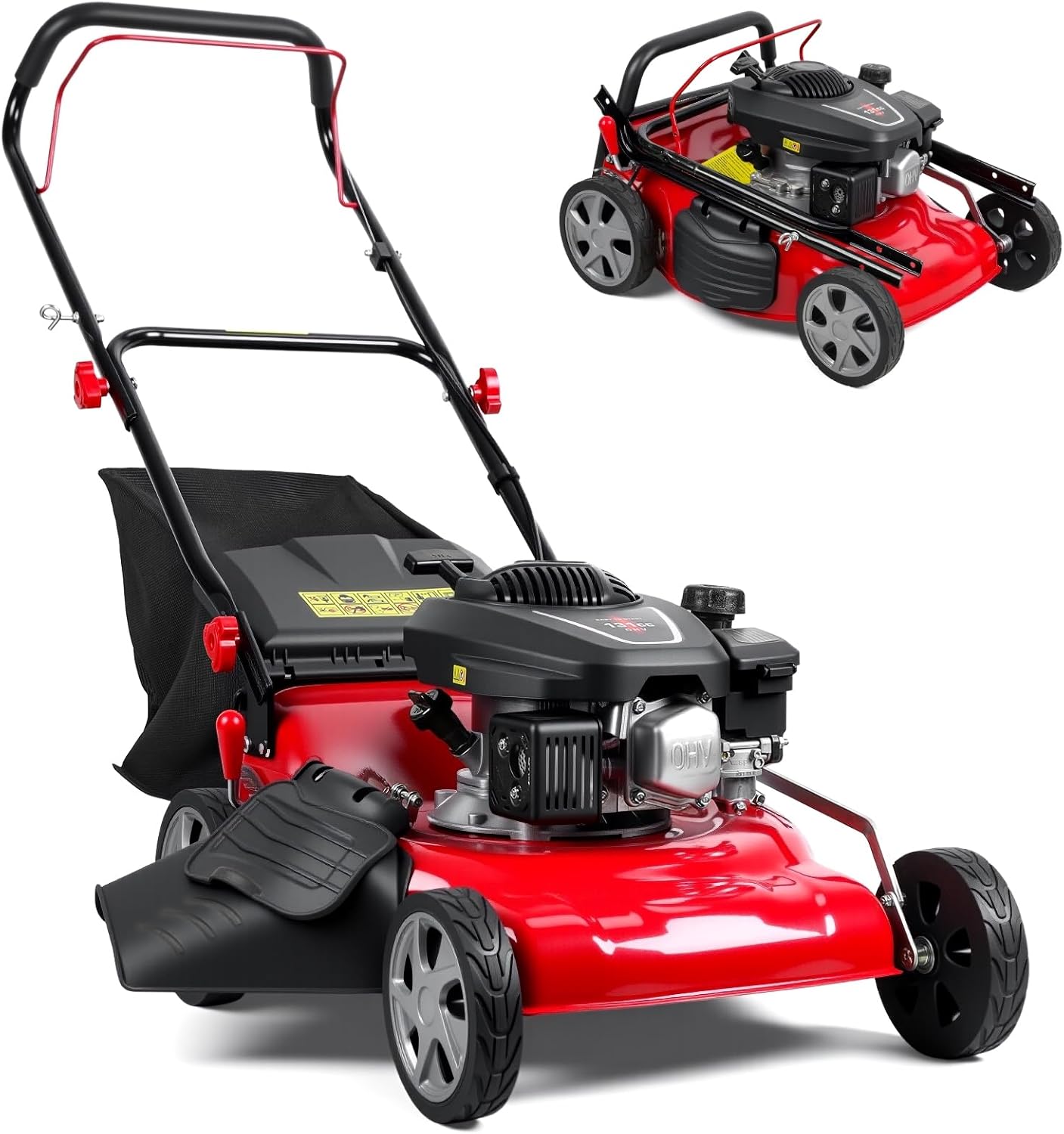
Rodiuiu 131cc Self-Propelled 18" Gas Lawn Mower with 50L Bag (3-in-1)
| Power Source | Gas Powered |
|---|---|
| Cutting width | 18 inches |
| Number of Positions | 8 |
| Maximum Adjustable Cutting Height | 7.5 centimeters |
| Operation Mode | Automatic |
This Rodiuiu mower is a practical, no-frills option for homeowners who need a reliable gas-powered machine with bagging capability. It uses a 131cc OHV 4-stroke engine and an 18-inch steel 3-in-1 deck so you can bag, mulch, or side-discharge clippings depending on the job. The unit is self-propelled with rear-wheel drive, which reduces effort on moderate slopes and larger yards, and the single-height lever offers eight positions to tune cut height quickly. A 50L collection bag and widened mouth make emptying faster when bagging. The foldable, lightweight design helps store the mower in a garage or trunk when space is tight. Expect straightforward starting without a choke or primer and the usual maintenance of a small gas engine. Limitations include a relatively narrow 18-inch cutting width for very large properties and modest engine torque compared with higher-end commercial mowers, so it is best for yards up to a few acres rather than heavy professional use.
Best for: Homeowners looking for an affordable gas mower with a proper bagger who value simple, hands-on ownership and need a machine that is easy to store and operate.
Less Ideal for: Landscape professionals or owners of very large properties who need a wider cutting deck, heavier-duty engine power, or commercial-grade durability.
- Self-propelled rear-wheel drive reduces user effort on slopes and longer runs
- 131cc OHV 4-stroke engine provides consistent gas-powered performance
- 3-in-1 steel deck (mulch/side discharge/rear bag) adds versatility for different lawn cleanup needs
- 50L grass collection bag with wide opening speeds up bagging and emptying
- Foldable, lightweight design saves storage space and eases transport
- 18-inch cutting width is narrower than commercial or large-residential mowers so it takes longer on very large lawns
- Manufacturer specifications include imperial and metric values that may require conversion for some buyers
Verdict: A budget-conscious, self-propelled gas mower with a 50L bag that delivers practical bagging and mulching performance for average residential lawns.
SENIX 21-Inch 144cc Gas Push Lawn Mower with 3-in-1 Deck and 1.7‑Bushel Bag

| Power Source | Gas Powered |
|---|---|
| Engine | 144cc 4-stroke OHV |
| Cutting width | 21 inches |
| Number of Positions | 6 |
The SENIX 21-inch gas push mower is a straightforward, reliability-focused machine for homeowners who need consistent bagging performance. Its 144cc OHV 4-stroke engine delivers steady power and relatively low vibration for routine mowing, and the 3-in-1 steel deck lets you choose bagging, mulching, or side discharge depending on lawn conditions. Dual-lever height adjustment gives six positions between 1.25 and 3.75 inches so you can dial in the cut, and the included 1.7-bushel bagger makes weekly bagging simple. The steel deck and vortex tunnel design help reduce grass buildup, and the larger rear wheels improve maneuverability over uneven yards. Because this is a manual push mower, it is best suited to small-to-medium lots where self-propulsion is not required; expect a bit more physical effort than a self-propelled model. Assembly and maintenance are typical for a gas mower, including occasional oil checks and spark plug care. If you prioritize a durable engine and reliable bagging over cordless convenience, this mower is a practical choice.
Best for: Homeowners who want a dependable, gas-powered mower that reliably bags clippings and handles routine weekly mowing on small to medium yards without the complexity of advanced drive systems.
Less Ideal for: People who need a self-propelled mower for steep or large properties or those who prefer battery-electric convenience and low maintenance.
- 144cc OHV 4-stroke engine designed for steady power and lower vibration
- 3-in-1 steel deck supports bagging, mulching, and side discharge for flexible use
- Six-position height adjustment from 1.25 to 3.75 inches for precise cutting
- Includes a 1.7-bushel grass bag for immediate bagging capability
- Alloy steel deck and vortex tunnel design reduce grass buildup and increase durability
- Manual push operation requires more physical effort compared with self-propelled models
- No explicit mention of a self-propelled option or variable drive for larger yards
Verdict: Choose this mower if you want a sturdy, gas-powered 21-inch model that reliably bags clippings and delivers simple, durable performance for routine yard care.
Greenworks 40V 16" Push Lawn Mower with 4.0 Ah Battery and Charger

| Power Source | Battery Powered |
|---|---|
| Battery Average Life | 35 minutes |
| Number of Positions | 5 |
| Maximum Adjustable Cutting Height | 3.75 inches |
The Greenworks 40V 16" push mower is a battery-powered walk-behind designed for homeowners who want a quieter, gas-free alternative with a bagging option. It arrives with a 4.0 Ah battery and charger and uses a push-button start for simple operation. The mower’s 2-in-1 system lets you switch between rear bagging and mulching, and a single-lever five-position height adjuster moves the cut height between 1.25 and 3.75 inches to suit different turf conditions. Lightweight construction and included battery runtime of roughly 35 minutes make it easy to maneuver around landscaping and modest slopes, and the Greenworks 40V ecosystem means the battery can be used with other 40V tools. Practical downsides are the 16-inch deck, which slows mowing on larger properties, and the plastic deck construction that is less durable than steel under heavy-duty use. Expect solid performance for up to roughly one-third acre per charge under typical conditions, with the convenience of bagging for a tidier finish.
Best for: Buyers who prioritize quiet, low-maintenance mowing with the option to bag clippings and who maintain small to mid-size lawns and value interoperability with other 40V tools.
Less Ideal for: Not a good choice for owners of large properties who need a wide deck and longer continuous runtime or for users who need a heavy-duty steel-deck mower for commercial-style durability.
- Includes 4.0 Ah battery and charger so it is ready to use out of the box
- 2-in-1 mulch and rear-bag system gives a clean finish with bagging or nutrient return with mulching
- Single-lever five-position height adjustment lets you change cutting height quickly
- Lightweight design and push-button start make it easy to maneuver and operate
- Battery is compatible with Greenworks 40V tool lineup for shared power across tools
- 16-inch cutting deck limits productivity on larger lawns
- Plastic deck construction is less rugged than steel for heavy use
Verdict: A convenient, ready-to-use cordless mower with a bagging option that suits small to mid-size lawns and homeowners who want quiet, gas-free operation.
Choosing the Right Lawn Mower with Bagger: Key Factors to Consider
Cut Quality and Deck Design
How a mower cuts influences both lawn health and how well clippings enter the bagger. A consistent, even cut reduces scalping and helps prevent disease by leaving appropriate leaf surface area. Deck design-whether stamped steel or fabricated-affects airflow and how clippings are lifted into the blade stream and toward the bagger. Deck width determines coverage per pass and therefore how long you spend mowing.
For bagging, decks with controlled airflow and well-shaped discharge chutes reduce clumping and blowing back. Consider the relationship between blade speed, deck height adjustments, and mower balance so the unit cuts cleanly at the heights you keep your lawn.
Bagging Efficiency and Airflow
Efficient bagging depends on good airflow from the deck to the bagger so clippings move without packing. Too little airflow leaves clumps in the chute and forces more frequent stops to clear blockages. The shape and seal of the chute and the bagger inlet determine whether clippings make it fully into the bag or spill onto the turf.
Bagger systems designed with baffles or a blower assist move grass into larger-capacity bags more reliably. Also note how the system handles damp clippings; some designs resist packing better, while others are prone to clogging in heavy or wet grass.
Bag Capacity and Emptying
Bag capacity affects how often you stop to empty and how long projects take. Larger bags mean fewer interruptions on medium to large yards, but very large bags can increase wind resistance and add weight that changes handling. The method for emptying the bagger matters as well: top-release or quick-release mechanisms are faster and less messy than designs that require detaching multiple fasteners.
Consider ergonomics for lifting and dumping, how the bag attaches to the frame, and whether the bag compresses clippings during use. Durable, weather-resistant bag materials and clear sight windows help you judge when to empty without opening the bag.
Power Source and Torque
Engine or motor power determines how well a mower maintains blade speed when cutting thick or tall grass, which in turn influences both cut quality and bagging reliability. Higher torque reduces bogging down on dense areas and helps sustain the airflow needed to move clippings into the bagger. For battery models, battery capacity and discharge curves matter for consistent performance over the mowing session.
Assess the mower's ability to handle the longest grass you expect to encounter and whether the powertrain recovers quickly after encountering heavy loads. For slopes or uneven terrain, extra torque helps maintain cut quality and bagging function.
Maneuverability and Handling
A mower that is easy to steer and position reduces time spent trimming and prevents missed areas that require rework. Wheel size, drive system, and weight distribution-especially once the bagger fills-change how the mower turns and climbs curbs or slopes. Self-propelled drives ease work on larger lots, while lighter push mowers can be preferable for tight yards and frequent directional changes.
Test how the bagger affects balance when full. Some systems add rear weight that makes front-lift cuts harder. Look for adjustable handle height and a compact footprint for storage.
Durability and Maintenance
Durability affects long-term costs and how often you must service the machine. Materials used in the deck, chute, and bagger frame influence resistance to rust, dents, and UV damage. Ease of accessing blades and belts, availability of common replacement parts like filters and bags, and the design for routine tasks such as blade sharpening make upkeep simpler.
Maintenance-friendly features include tool-free access panels, clear instructions for bag cleaning, and replaceable bag liners. Consider typical seasonal storage needs and how the bagger system fares when detached for winter.
When a Bagger Makes a Big Difference
A bagger is most valuable when you want a tidy finish without additional raking. It is especially helpful if you cut infrequently and generate heavy volumes of clippings, or if your yard has visible curb appeal where stray clippings matter. When mulching is not desired because of disease concerns or leaf litter, a bagger simplifies removal.
Baggers also reduce the risk of thatch buildup in lawns where clippings do not break down quickly. However, baggers add a step of emptying and occasionally clearing chutes, so they are a tradeoff between immediate tidiness and continuous ground feeding.
- Best for homeowners who prefer an immediate clean look after mowing
- Useful for yards with thin lawns where clippings could smother grass
- Less effective if you prefer mulching for soil health and moisture retention
Battery Versus Gas Mowers With Baggers
Battery-powered mowers have improved in torque and runtime, and many now support baggers with dedicated airflow designs. They offer quieter operation, lower routine maintenance, and instant torque that can help with bagging when batteries are fresh.
Gas mowers generally provide longer run times and stronger continuous power on large or dense lawns. That makes them reliable for heavy bagging work but at the cost of more maintenance, noise, and fumes. Choose based on yard size, proximity to neighbors, and preference for emissions and upkeep.
- Battery options: quieter, lower maintenance, limited runtime depending on battery count
- Gas options: longer runtime and sustained power, more maintenance and emissions
Maintaining the Bagger System
Regular checks prevent clogs and extend the life of the bagging system. Clear the chute after mowing if you notice reduced collection performance. Inspect the bag material for holes or fraying, and clean out trapped damp clippings to prevent mold and odors.
Lubricate hinge points and inspect fasteners on the bag frame each season. Store bags dry and off the ground during winter to preserve fabric and attachment points.
- Empty before wet conditions to prevent compaction and mold
- Inspect seals and gaskets to keep airflow directed into the bag
- Clean the chute after heavy use to avoid buildup
Adapting Mowing Habits for Better Bagging
Short, frequent mowing reduces clipping volume per pass and helps bags fill evenly. Avoid cutting more than a third of the leaf blade height in a single pass; excessive height removal produces larger clumps that may clog the chute. When grass is long, raise the deck and take a two-pass approach-one high pass to reduce bulk and a second cut to bag cleanly.
Mow at consistent speeds that keep blades at design RPM for effective airflow. Slow walking pace can increase bagging efficiency on heavy loads, but overly slow speeds may reduce airflow and encourage clumping.
- Prefer frequent mowing to heavy scalping
- Use higher deck settings on the first pass for overgrown areas
- Maintain a steady walk speed to preserve airflow
Storage and Winter Considerations
Proper off-season storage protects both mower and bagger. Detach fabric bags, empty and dry them thoroughly, and store them indoors to prevent mildew. If the bagger frame is removable, store it in a dry spot to avoid rust on metal components.
Before the first mow of spring, inspect the bagger for rodents or stored debris, check fasteners, and verify that the chute and inlet seals are intact. Replace any brittle or damaged straps to ensure safe attachment during the season.
- Dry and store bags indoors to prevent moisture damage
- Inspect and tighten frame hardware before the season
- Replace weathered straps and seals to maintain performance
How We Chose the Best Lawn Mower with Bagger
We focused on features that directly affect mowing and bagging performance in everyday yard work. Key evaluation criteria included cut quality across grass heights, bagger capacity and sealing to limit dust and clumping, ease of attaching and removing the bagger, deck construction and rust resistance for long life, engine or motor reliability and power for consistent cutting, and maneuverability for trimming around obstacles. To narrow the field we excluded models without an integrated or purpose-built collection system and units that required extensive aftermarket modification to add a bagger. We also filtered out machines poorly suited to typical residential lot sizes, such as heavy-duty commercial mowers or tiny battery units with impractically small bags. Final selections balance cutting performance with practical bagging features so gardeners get a usable, maintainable tool that reduces post-mow cleanup.
FAQ
Do baggers work well with damp grass?
Baggers can struggle with damp grass because moisture causes clippings to stick and pack. Some bagger designs and chute shapes resist packing better, but the best practice is to wait for drier conditions or mow at a higher deck setting and make a follow-up pass when clippings are less wet.
How often will I need to empty the bagger?
Emptying frequency depends on bag capacity and grass volume. Smaller residential bags may need emptying every 10 to 20 minutes on dense turf, while larger-capacity systems last significantly longer. Expect to pause more often on high-growth or wet conditions.
Can I mulch with the bagger attached?
Most bagger systems require removal to mulch effectively because the bagger redirects clippings away from the deck. Some mowers offer a plug or mulching plate that closes the chute so you can switch modes, but check compatibility and ease of switching for the model you choose.
Will a bagger reduce thatch buildup?
Removing clippings with a bagger can slow the rate of thatch accumulation by reducing surface organic matter returning to the turf. However, thatch is also influenced by lawn care practices like overwatering and excessive fertilization, so bagging is one of several steps to manage thatch.
Is a self-propelled mower better when using a bagger?
Self-propelled drives ease handling, especially when a bagger is full and adds weight. They reduce operator fatigue and make mowing slopes or larger yards simpler. For very small or tight yards, a lightweight push mower with a compact bagger might still be preferable.
Final Verdict
Choosing a lawn mower with bagger comes down to how much you value a clean finish against the extra steps of emptying and occasional chute maintenance. Prioritize cut quality, bagging efficiency, and bag capacity for productive sessions on your typical lawn size. Balance power source and maneuverability so the mower performs reliably across the grass conditions you encounter. If you want a tidy lawn with minimal raking, focus on units with proven airflow and user-friendly emptying. For quieter, lower-maintenance options, consider battery models that still deliver sufficient torque for bagging. Match the system to your yard and mowing habits to get the best results.
