

Note: This article contains affiliate links. If you click on these links and make a purchase, I may earn a small commission at no extra cost to you. This helps support my research and content. Read my full affiliate disclosure here.
Granular weed killer is a practical option when you need targeted spot control or broad treatment without mixing liquids. In lawns, garden beds, and around pathways the wrong choice can harm desirable turf or ornamentals, so picking the right formulation and application method matters. This guide looks at seven top granular weed killers shortlisted for common garden situations. We evaluate how easy each product is to apply, how long it keeps weeds from returning, and how well it limits harm to nearby plants. Read on to understand the tradeoffs and find the product profile that fits your yard or beds.
Top Picks at a Glance
| Best Overall The best all-around choice for most situations | Scotts Turf Builder Weed & Feed 3 Granular Lawn Fertilizer (14.29 lb) |  |
| Best Value The sweet spot between price and what you get | The Andersons Barricade Granular Pre-Emergent Weed Control (18 lb) |  |
| Best Budget The cheapest option that still gets the job done reliably | Preen Garden Weed Preventer Plus Plant Food, 5.625 lb (covers 900 sq. ft.) |  |
| Highest Rated A top-rated pick with lots of positive feedback | LebanonTurf Prodiamine 0.58% Granular Pre-Emergent Crabgrass Preventer (covers 20,000 sq. ft.) |  |
| Most Popular A crowd favorite that many people choose with confidence | The Andersons Barricade Granular Pre-Emergent Weed Control (40 lb) |  |
| Best Seller A high-volume bestseller chosen again and again | Preen Extended Control Weed Preventer, 13.75 lb Drum |  |
Scotts Turf Builder Weed & Feed 3 Granular Lawn Fertilizer (14.29 lb)

| Item Form | Granule |
|---|---|
| Coverage | 5000 square_feet |
| Active Ingredients | 2,4-D 1.220%, Mecoprop 0.081% |
Scotts Turf Builder Weed & Feed 3 combines a granular fertilizer with selective broadleaf weed control so you can feed your lawn while reducing common weeds like dandelion and clover. It is applied with a broadcast or drop spreader when weeds are actively growing and daytime temperatures are between 60 and 90°F, and it works best when applied to a wet lawn so the granules stick to leaves. The formulation includes WeedGrip Technology and active herbicides to control more than 50 listed weeds while delivering nutrients that promote thicker turf to crowd out future weeds. Practical benefits include a single-step application for homeowners who want to cut down on separate fertilizer and weed-killer tasks and clear dosing guidance for use with Scotts spreaders. Limitations are that it must not be used on certain turf varieties such as St. Augustine and bentgrass, you should avoid watering for 24 hours after application, and it requires precautions around children and pets until dust settles. This product is best treated as a seasonal maintenance tool rather than a cure-all for every lawn problem.
Best for: Homeowners who want a straightforward, single-step granular product to both feed their lawn and reduce common broadleaf weeds during regular seasonal maintenance.
Less Ideal for: Specialty turf managers, lawns planted with excluded grass species, or users seeking an organic or spot-only weed control approach should consider alternatives.
- Combines fertilizer and broadleaf weed control in one granular application
- WeedGrip Technology improves granule adhesion for better weed contact
- Covers up to 5,000 sq. ft. from a single 14.29 lb bag
- Clear application instructions and recommended spreader settings
- Not safe for use on several turf types including St. Augustine and bentgrass
- Requires dry window of 24 hours after application and careful timing with temperature
- Contains synthetic herbicides that require keeping people and pets off treated lawn until dust settles
Verdict: Choose this if you want a reliable, one-step granular treatment that simultaneously feeds turf and controls common broadleaf weeds across a medium-sized lawn.
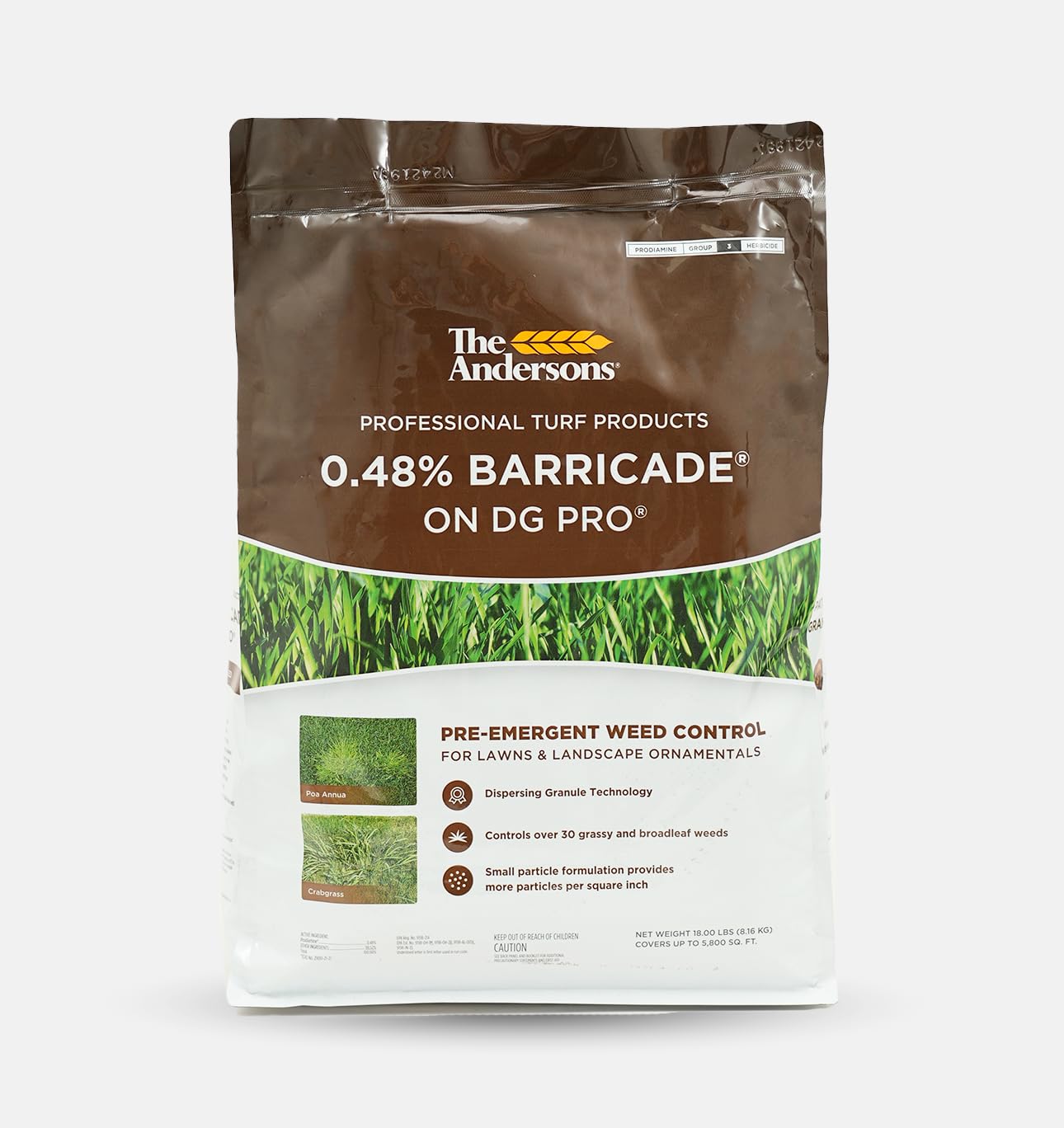
The Andersons Barricade Granular Pre-Emergent Weed Control (18 lb)
| Item Form | Granule |
|---|---|
| Coverage | 5800 square feet |
| Unit Count | 288 Ounce |
| Active Ingredients | Herbicide (prodiamine 0.48%) |
Barricade granular pre-emergent applies as a preventative barrier to stop weeds such as crabgrass, poa annua, goosegrass and henbit before they emerge. You spread the granules across a lawn in early spring or fall, water them in so the dispersible granules dissolve, and the active ingredient moves into the soil to block weed germination. Notable features include a professional 0.48% prodiamine formulation, DG dispersible granule technology for fast dissolution, and a coverage claim of about 5,800 sq ft from the 18 pound bag. In practice this product is useful when you want a season‑long reduction in weed pressure across a medium to large yard and when you apply at the recommended timing. It will not control weeds that are already growing, and correct timing and even application are essential for best results. For maintenance-minded gardeners who plan applications in spring and fall, Barricade offers reliable prevention and straightforward application; it is less helpful if you need post-emergent control or immediate weed removal.
Best for: Gardeners who prioritize preventing weeds across a medium to large lawn and who plan seasonal, maintenance‑style treatments to reduce future weed pressure.
Less Ideal for: People who need to remove active weed growth right away or those looking for an all‑in‑one post‑emergent solution for small, spotty infestations.
- Professional-grade active ingredient (0.48% prodiamine) formulated to prevent a wide range of grassy and broadleaf weeds
- Dispersible granule (DG) technology that dissolves quickly when watered to move the product into the soil
- Large coverage from an 18 lb bag suitable for medium to large lawns
- Designed specifically for early spring and fall applications when pre-emergent control is most effective
- Does not kill existing weeds so it must be combined with post-emergent measures for established infestations
- Effective timing and even application are required, which can be less forgiving for casual users
Verdict: Choose Barricade if you want a proven, professional‑grade pre-emergent to prevent common lawn weeds across a larger yard with seasonal applications.
Preen Garden Weed Preventer Plus Plant Food, 5.625 lb (covers 900 sq. ft.)

| Item Form | Granules |
|---|---|
| Application Method | spreader or by hand |
| Coverage | 900 square feet |
| Target Species | Flowers, Vegetables, Trees, Shrubs |
Preen Garden Weed Preventer Plus Plant Food is a ready-to-use granular product that combines a preemergent weed barrier with a balanced fertilizer so you can both stop many weed seeds from germinating and feed established plants in one application. It is applied by hand or with a spreader over mulch or bare soil, then watered to activate the invisible barrier; one 5.625 pound bottle treats about 900 square feet and claims protection for up to three months. Practical benefits include time saved by reducing repeat spot-weeding, and the convenience of feeding flowers, vegetables, trees, and shrubs at the same time. The flip-top applicator makes targeted distribution simple for smaller beds or around delicate plants. Limitations are that it will not kill existing weeds so beds must be cleared first, and it is a preemergent so timing matters for best results; it also contains common fertilizer salts, so avoid overapplication near seedlings or sensitive species. For gardeners wanting straightforward, combined weed prevention and feeding across landscape beds, this is an easy low-effort option.
Best for: Home gardeners who want a low-effort way to reduce weed emergence while feeding established flowers, vegetables, trees, and shrubs across beds and landscape areas.
Less Ideal for: Gardeners needing a post-emergent weed killer or those trying to rescue beds with heavy existing weed infestations should choose a different targeted solution.
- Combines preemergent weed prevention with balanced fertilizer in one step
- Covers approximately 900 square feet per bottle for broad area treatment
- Ready-to-use granules can be applied by hand or with a spreader for flexible use
- Flip-top applicator enables more precise application around plants
- Does not kill existing weeds so beds must be weeded before use
- Effectiveness depends on correct timing and watering to activate the barrier
Verdict: A convenient combined weed-preventer and plant food that treats large beds in a single application, ideal for gardeners wanting simple, low-maintenance weed control.
LebanonTurf Prodiamine 0.58% Granular Pre-Emergent Crabgrass Preventer (covers 20,000 sq. ft.)

| Item Form | Granule |
|---|---|
| Coverage | 20,000 sq. ft. |
| Unit Count | 640 Ounce |
| Active Ingredients | Prodiamine |
This is a professional-style granular pre-emergent that uses 0.58% prodiamine on a BIODAC carrier to prevent crabgrass and listed grassy weeds before they germinate. It is applied across lawns and landscaped areas in early spring, with a recommended follow-up in late May or June, and the label cautions against overseeding for 3 to 4 months after application. The product is concentrated for broad coverage, marketed to treat up to 20,000 square feet from the 640 ounce unit, which makes it convenient for large yards or regular maintenance by landscapers. The granular format is easy to spread with a broadcast or drop spreader and provides season-long preventive control when used as directed. Limitations include the pre-emergent nature: it will not control existing weeds, and timing is critical for effectiveness; it is also restricted in availability in several states, and the safety directions require care around children and sensitive planting. For someone seeking dependable, large-area prevention of grassy weeds, this delivers a straightforward, professional-grade option.
Best for: Buyers who prioritize predictable, season-long prevention for large lawns or commercial sites and who follow labeled application schedules and safety directions.
Less Ideal for: Gardeners needing a post-emergent solution for existing weeds, or those who plan to overseed or establish new turf within months of treatment.
- Professional-grade active ingredient (0.58% prodiamine) formulated specifically for pre-emergent grassy weed control
- Large coverage per unit designed to treat up to 20,000 sq. ft., reducing the need for multiple packages
- Granular BIODAC carrier works with common spreaders for even application across lawns
- Clear application timing guidance for spring and follow-up treatments to maintain prevention
- Does not kill established weeds because it is a pre-emergent product
- Label restrictions prevent use or sale in several states and territories
- Requires careful timing and following planting restrictions (no grass seed for 3–4 months)
Verdict: A reliable, professional-grade granular pre-emergent to prevent crabgrass and other grassy weeds across large lawns when applied on schedule.
The Andersons Barricade Granular Pre-Emergent Weed Control (40 lb)

| Item Form | Granule |
|---|---|
| Coverage | 12880 square_feet |
| Active Ingredient | Prodiamine 0.48% |
The Andersons Barricade is a pre-emergent granular weed control product formulated to prevent weeds like crabgrass, poa annua, goosegrass, and henbit across large lawns. It is applied to established turf and ornamental beds before weed seeds germinate and requires watering in so the dispersible granules dissolve and move the active ingredient into the soil. Notable features include 0.48% prodiamine active ingredient and patented dispersible granule technology for faster dissolution and more even soil penetration. The 40 pound bag covers a substantial area, which reduces how often you need to buy product for seasonal blanket treatments. Important limitations are that it will not kill existing weeds and it must be applied according to label timing and rates to avoid damage to desirable plants; personal protective measures are also necessary because the product is harmful if swallowed, inhaled, or absorbed through skin. For planned seasonal prevention on established turf, it delivers professional-style coverage and reliable residual control when used as directed.
Best for: Homeowners and landscapers who prioritize reliable, season-long weed prevention across medium to large lawns and want a product with professional credentials and widespread use.
Less Ideal for: People seeking a solution to remove existing weeds, or gardeners who prefer non-chemical or spot-treatment approaches for small areas.
- Formulated with prodiamine for proven pre-emergent control of common grassy and broadleaf weeds
- Dispersible granule technology speeds dissolution and helps move active ingredient into the soil
- Large 40 lb bag provides wide coverage suitable for whole-yard treatments
- Designed for use on established turf and ornamental beds following label directions
- Not effective on existing weeds since it is only a pre-emergent product
- Contains herbicide and requires careful handling and PPE during application
Verdict: Choose this product if you need a proven, large-coverage pre-emergent that delivers professional-style seasonal weed prevention when applied correctly.
Preen Extended Control Weed Preventer, 13.75 lb Drum

| Item Form | Granule |
|---|---|
| Coverage | 2,245 sq. ft |
| Active Ingredients | Isoxaben, trifluralin |
| Item Highlight | Pre-emergent herbicide prevents weeds up to 6 months |
Preen Extended Control is a ready-to-use granular pre-emergent formulated to prevent more than 125 broadleaf and grassy weeds for up to six months with a single application. It is applied on top of mulch or bare soil, then activated by watering to form an invisible barrier that blocks weed seedlings. Typical use is in established landscape beds, around shrubs, trees, and perennial plantings rather than on lawns, vegetable plots, or areas where you plan to sow seeds. The product includes a flip-top applicator for spot distribution and is designed for large coverage so one drum handles medium to large gardens. Practical benefits include long protection between applications and compatibility with many mature ornamentals when used as directed, which reduces recurring hand weeding. Limitations to note are that it does not kill existing weeds, it must be applied before seeds germinate, and it is not for use around food-producing plants or flower seeds, so timing and placement matter to avoid damage.
Best for: Home gardeners who prioritize low-risk, long-lasting weed prevention for established ornamental beds and want fewer seasonal applications and less hand weeding.
Less Ideal for: Gardeners who need a post-emergent solution to remove existing weeds, those planting seeds or maintaining vegetable beds, or people who require a product safe for lawns and edible gardens.
- Provides up to six months of pre-emergent weed prevention with one application
- Covers approximately 2,245 square feet per 13.75 lb drum, suitable for medium to large beds
- Granular formula is easy to apply with included applicator and is activated by watering
- Safe for use around many established perennials, shrubs, and trees when label directions are followed
- Does not kill existing weeds so beds must be cleared before application
- Not safe for vegetable gardens, flower seeds, lawns, or food-producing plants
Verdict: Choose this granular pre-emergent if you want a proven, low-effort way to keep established ornamental beds largely weed-free for months with a single application.
Choosing the Right Granular Weed Killer: Key Factors to Consider
Formulation and Active Ingredient Type
Different active ingredients work in different ways and target different weed groups. Some granules release herbicides that translocate through leaves and roots, while others act on seedlings in the soil. Knowing whether a product targets grassy weeds, broadleaf weeds, or both helps match the granule to the problem.
The formulation also affects safety around desirable plants. Soil-active residuals can protect beds from new weed seedlings but may also prevent desirable seedlings from establishing. Conversely, contact actives kill emerged weeds faster but offer little lasting prevention.
Residual Activity and Persistence
Residual activity determines how long treated areas resist new weed growth. Longer persistence can reduce repeat treatments, especially in beds where weed seeds are constant, but persistent residues can interfere with planting and harm sensitive species.
Consider the typical planting schedule for the area you treat. If you expect to sow seeds or transplant within weeks, choose a shorter-residual option. For established lawns or mulched beds where reseeding is rare, a longer-residual granule may be more efficient.
Selectivity and Impact on Desirable Plants
Selectivity describes whether the granule targets weeds without damaging turf or ornamentals. Some granular herbicides are labeled for use in established lawns but will injure garden flowers. Others are safe in ornamental beds but not in vegetable patches.
Read label directions for broadcast vs spot treatments and for restrictions around specific plant types. When treating near mixed plantings, opt for products with narrow contact zones or that allow spot application to reduce drift and root uptake by nearby desirable plants.
Application Method and Spreader Compatibility
Granules must be applied evenly to work effectively. Some products are designed for handheld spreaders, others for larger broadcast units. Spread pattern, granule size, and recommended spreader settings affect how uniform the coverage will be.
Uneven application creates patches where weeds survive or where excess causes injury. Choose a product that matches the spreader you already own or be prepared to adjust settings and test on a small area before full application.
Timing and Weather Sensitivity
When you apply granules affects uptake and efficacy. Many soil-active granules need rainfall or irrigation to move the herbicide into the root zone, while contact granules work best when weeds are actively growing and not stressed by drought.
Avoid application immediately before heavy rain that could wash granules into non-target areas. Also consider seasonal growth patterns: spring and fall are often prime times for weed control in temperate lawns, while warm-season weeds may require mid-summer timing.
Safety, Handling, and Storage
Granular herbicides are concentrated products that require careful handling to avoid accidental exposure or off-target damage. Look for formulations with clear packaging instructions about gloves, protective clothing, and equipment cleaning.
Storage stability matters because caked or damp granules are harder to apply and may lose efficacy. Keep granules in a dry, cool place and in their original container to preserve labeling and safety information.
Best Uses for Granular Applications
Granular weed killers are well suited to large turf areas, walkway edges, and preemergent bed treatments where uniform coverage is needed. They reduce the need to mix liquids and can be easier to apply across broad swaths when using a matched spreader.
Use spot treatments with handheld spreaders for isolated patches, and broadcast application for whole lawns or large beds. For preemergent control, apply evenly before weed seeds germinate and follow label directions about irrigation timing to activate the material.
- Broadcast granules for whole-lawns and larger beds
- Handheld spreaders for targeted patches and borders
- Preemergent timing is critical for seedling suppression
Applying Granules Safely Near Plantings
To protect desirable plants, avoid broadcasting granular herbicide directly over mixed plantings. Instead use shielded or drop spreaders, and consider creating buffer zones around sensitive species. Take care when applying on slopes to prevent runoff into flower beds or water features.
Clean spreaders thoroughly after use to prevent cross-contamination with other lawn or garden inputs. Sweep any overspread granules off plant foliage to avoid localized phytotoxicity.
- Use buffer zones around ornamentals and vegetables
- Prefer drop-style spreaders near mixed plantings
- Rinse equipment and avoid applying before heavy rain
Preemergent Vs Postemergent Granules
Preemergent granules form a barrier in the soil to prevent weed seedlings from establishing. They are best used before weeds germinate and are valuable in annual problem spots. Postemergent granules act on actively growing weeds and provide visible knockdown of existing plants.
Decide whether you need prevention or control. In many situations a two-step plan works best: apply preemergent in early spring to reduce seedling pressure, then spot-treat any escapes with a postemergent granule or manual removal.
- Preemergent prevents seedlings, does not control established weeds
- Postemergent targets visible weeds but may have less residual
- Combine strategies seasonally for best results
Integrating Granular Herbicides Into an Overall Weed Plan
Granular herbicides are one tool among cultural controls such as mowing height, mulching, and overseeding. Healthy, dense turf and well-mulched beds reduce light reaching weed seeds and make chemical control more effective and less frequent.
Use granules strategically rather than as the only tactic. For perennial weeds, combine targeted applications with manual removal of roots when practical, and adjust cultural practices to reduce future weed pressure.
- Combine granules with cultural practices for long-term control
- Target problem spots rather than relying solely on broad applications
- Monitor treated areas and follow up at appropriate intervals
Common Application Mistakes to Avoid
Applying too much product in one spot causes plant injury and wasted material. Always calibrate your spreader and test on a small swath to confirm coverage. Uneven application is a frequent cause of patchy results.
Another common error is ignoring label intervals and replanting restrictions. Many granular herbicides restrict sowing or transplanting for a set period after application to avoid damage to tender seedlings.
- Calibrate spreader and test on a small area
- Respect replanting intervals on the label
- Do not apply before heavy rainfall or in windy conditions
How We Chose the Best Granular Weed Killer
We selected products that represent the range of granular weed-killer solutions gardeners typically buy for lawns, flower beds, and edges. Our filters prioritized formulations designed for common weed types and application patterns, plus packaging and spreader compatibility for accurate coverage. Evaluation criteria focused on application control, residual activity in soil, selectivity toward turf and ornamentals, ease of cleanup and handling, and spreader compatibility. We also considered formulation stability so granules do not cake or break down in storage. Products that required specialized equipment beyond a hand spreader or that are intended only for industrial use were excluded. Excluded items include liquid concentrates and ready-to-spray hose-end products because they behave differently during application and carry distinct drift risks. The resulting shortlist emphasizes granular options that gardeners can apply with standard broadcast or handheld spreaders, use safely around planted areas, and expect predictable residual control.
FAQ
How soon after applying granular weed killer can I water or irrigate?
It often depends on the product. Many soil-active granules need light irrigation or rainfall within a few days to move the active ingredient into the root zone. Conversely, some contact granules work without watering but may benefit from a short rinse to reduce residue on foliage.
Will granular weed killer harm newly seeded lawns or recently transplanted plants?
Usually it can. Residual granules that prevent seed germination will interfere with newly seeded lawns and young transplants. Check the label for replanting windows and avoid applying residual products where you plan to seed or transplant soon.
Can I use the same granules on both lawns and garden beds?
Some formulations are labeled for both, but many are restricted to either turf or ornamentals. Using a lawn-specific granule in beds can injure flowers and vegetables. Always follow label directions for the planting type you intend to treat.
How often should I reapply granular preemergent products?
Frequency depends on the product's persistence and seasonal weed pressures. Some preemergents provide control for several months and need just one or two applications per year, while others may require more frequent reapplication. Follow label guidance and monitor weed emergence.
What is the best way to apply granules to avoid drift and off-target damage?
Use a drop spreader or shielded broadcast spreader near sensitive plants and avoid windy conditions. Keep a clear buffer from non-target vegetation and clean up stray granules on foliage promptly to reduce localized damage.
Final Verdict
When choosing a granular weed killer, match the formulation to the weed types and planting areas you need to protect. Prioritize products that offer the right balance of residual control and selectivity so you can treat problem spots without harming turf or ornamentals. Plan timing around planting and weather, calibrate your spreader, and integrate chemical control with cultural practices for the best long-term results. With careful selection and application, granular herbicides can be an effective part of a gardener's weed-management toolbox.
