

Note: This article contains affiliate links. If you click on these links and make a purchase, I may earn a small commission at no extra cost to you. This helps support my research and content. Read my full affiliate disclosure here.
A compact handheld broadcast spreader makes fast work of fertilizing, overseeding, and applying amendments on small lawns, raised beds, and tight garden spaces. The right model helps you lay down an even application without overworking a small area or leaving skips and heavy spots. This guide covers seven shortlisted handheld broadcast spreaders suited to small properties and container gardens. We evaluated how each tool performs in real garden conditions, focusing on spread pattern, ease of adjustment, and durability so you can match a spreader to the size and tasks in your yard.
Top Picks at a Glance
| Best Overall The best all-around choice for most situations | WORX 20V Cordless Handheld Broadcast Spreader WG869 |  |
| Best Quality Built to a higher standard if you want something more solid | EarthWay 2750 25 lb Nylon Bag Seeder/Spreader |  |
| Best Value The sweet spot between price and what you get | PERSZEN Handheld 3-in-1 Spreader for Seed, Fertilizer and Ice Melt (84 oz) |  |
| Best Budget The cheapest option that still gets the job done reliably | CHAPIN 8740A 64 oz Hand Shaker Spreader |  |
| Highest Rated A top-rated pick with lots of positive feedback | Scotts Whirl Hand-Powered Spreader |  |
| Most Popular A crowd favorite that many people choose with confidence | Scotts Whirl Hand-Powered Handheld Spreader |  |
| Best Seller A high-volume bestseller chosen again and again | Snow Joe SJSPD1 Handheld Multipurpose Spreader (5 lb Capacity) |  |
WORX 20V Cordless Handheld Broadcast Spreader WG869

| Power source | 20V Lithium Ion battery (PowerShare) |
|---|---|
| Coverage per load | Up to 4600 sq. ft. |
| Max spread distance | Up to 5 ft. |
| Settings | 6 speed controls, 8 flow-rate settings |
The WORX 20V Cordless Broadcast Spreader is a one-handed electric spreader designed to replace slow manual broadcast tools for small to mid-size yards. It uses a PowerShare 20V battery to drive a motor that throws material up to about 5 feet and can cover roughly 4,600 sq ft per fill, making it suitable for lawns from quarter to half acre. The unit offers an anti-clog agitator, an edge-control deflector to limit overspill, six speed settings to vary spread distance, and eight flow-rate settings to handle fine seed through pearled fertilizer and ice-melt. In practice it is fast and easy to use: fill the tub, set flow and speed, then walk while squeezing the trigger for consistent coverage without cranking. Its very light weight and one-handed ergonomics reduce fatigue during longer runs. Limitations include modest hopper capacity that requires more refills on larger properties and dependence on a compatible 20V battery rather than built-in power, so expect to plan around battery charge for extended jobs.
Best for: Buyers who want a faster, low-effort alternative to manual spreaders for small to medium yards and value adjustable control and portability for seasonal tasks.
Less Ideal for: Property owners with large acreage or professional contractors who need high-capacity or continuous runtime should consider larger tow-behind or cart-style spreaders.
- Cordless motorized spread up to 5 ft. for faster coverage than manual spreaders
- Anti-clog agitator promotes even flow and reduces downtime from blockages
- Six speed and eight flow-rate settings let you match spread distance and material size
- Edge-control deflector reduces overspill onto driveways, patios, and flower beds
- Lightweight one-handed design minimizes user fatigue during use
- Small hopper means more frequent refills on larger lawns
- Requires a 20V PowerShare battery so runtime depends on battery charge and availability
Verdict: A lightweight, easy-to-use cordless spreader that speeds up seeding and seasonal spreading for small to mid-size yards while giving precise control over distance and flow.
EarthWay 2750 25 lb Nylon Bag Seeder/Spreader

| Item Type Name | Nyl Bag Spreader |
|---|---|
| Brand Name | EarthWay |
| Item Weight | 2 pounds |
| Indoor Outdoor Usage | Outdoor |
| Unit Count | 1 Count |
The EarthWay 2750 is a professional-style 25 lb nylon bag seeder and spreader for broadcast applications like reseeding, food plots, and spot fertilizer work. It uses a 600-denier nylon hopper with a zipper top and built-in stand so the bag stays upright during filling and storage. A sloped floor and integrated rocking agitator promote complete emptying and steady flow of fine seeds, while the spring-close shutoff and adjustable flow let you meter material for 8 to 12 foot spread widths by changing crank speed. The fully lubricated, sealed gearbox avoids the common seizure problems of cheaper cast gears and helps the unit run smoothly under repeated use. The adjustable shoulder strap makes it easier to carry across larger areas, but because it is a handheld bag system it is best for small to medium plots rather than continuous, high-acreage work. Expect strong durability and precise metering but plan on manual cranking effort for long sessions and occasional cleaning to keep the agitator free of debris.
Best for: Buyers who prioritize precise, reliable spreading on small to medium plots and want a rugged handheld tool built to professional standards.
Less Ideal for: Not a good choice for landscapers or landowners who need to cover many acres continuously or who prefer motorized walk-behind spreaders for minimal physical effort.
- Durable 600-denier nylon hopper keeps seed dry and resists tears in outdoor conditions.
- Sealed, lubricated gearbox reduces risk of gear seizure and delivers smoother, reliable operation.
- Integrated rocking agitator and sloped floor promote complete emptying and steady flow of fine seeds.
- Adjustable flow control and spring-close shutoff enable precise metering for different seed sizes and spread widths.
- Built-in stand and shoulder strap improve ease of filling, transporting, and using the bag in the field.
- Hand-crank operation becomes tiring for very large areas compared with wheeled or tow-behind spreaders.
- 25 lb capacity limits continuous coverage area before refilling for larger properties.
Verdict: Choose the EarthWay 2750 when you want a tough, professional handheld spreader that delivers accurate, clog-resistant seeds and fertilizer distribution for small to medium jobs.
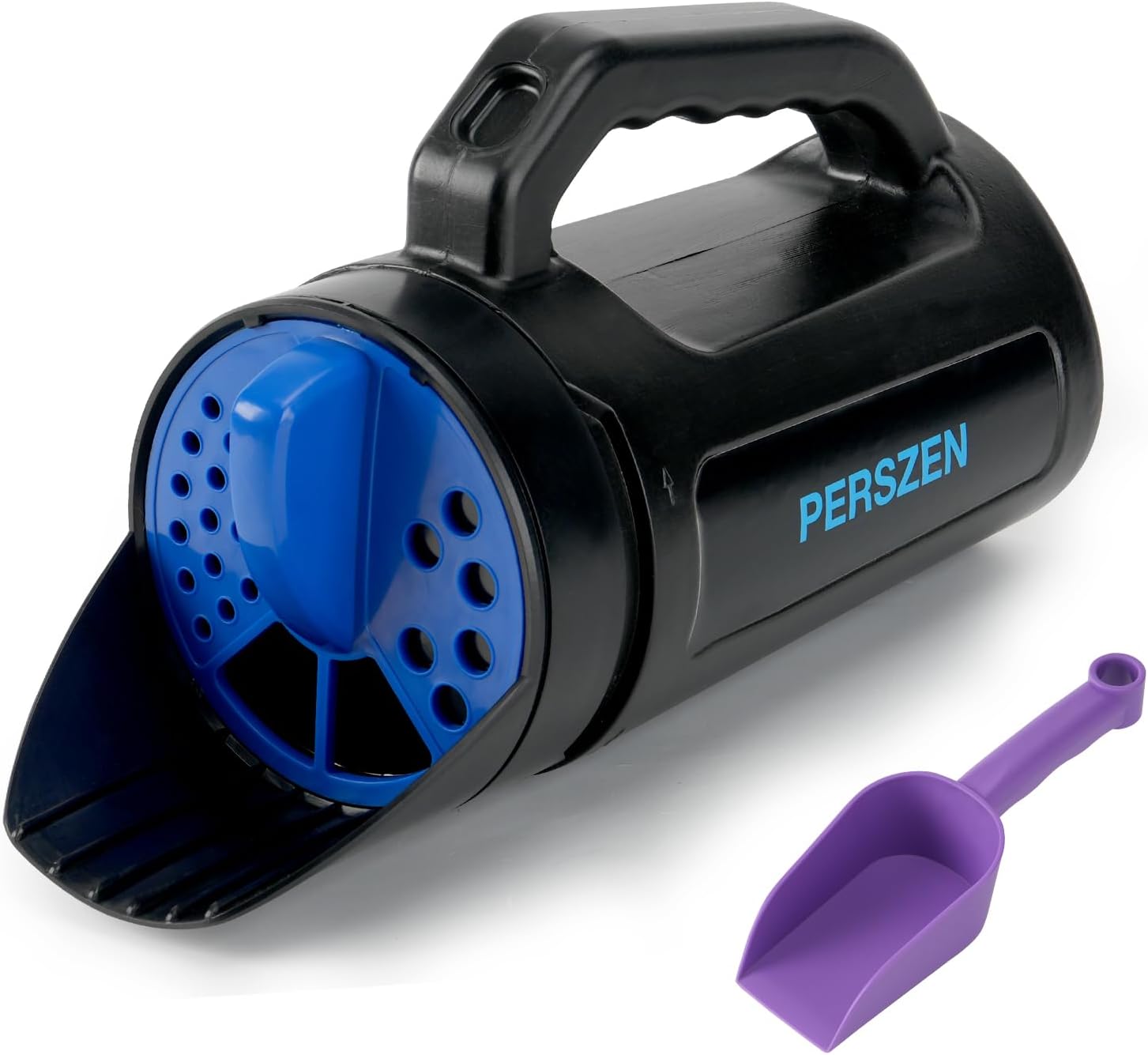
PERSZEN Handheld 3-in-1 Spreader for Seed, Fertilizer and Ice Melt (84 oz)
| Capacity | 84 oz (2.5 L) |
|---|---|
| Flow settings | 3 (small, medium, large) |
| Material | Plastic |
The PERSZEN handheld spreader is a simple, multi-use tool for small to medium lawns and driveways. It holds about 84 ounces of material and offers three flow settings so you can switch between fine seed, granular fertilizer, and ice-melt salt without swapping tools. The plastic construction keeps it light and corrosion-resistant against fertilizers and salt, and the ergonomic non-slip handle plus included scoop make filling and carrying straightforward. In practice it delivers even coverage when set correctly, and the larger hopper reduces refill frequency compared with very small hand spreaders. The main compromises are that plastic parts are less impact-resistant than metal and the manual control can require a steady walk and occasional calibration for very coarse or very fine materials. For routine seasonal tasks where portability and minimal storage are priorities, this spreader is an efficient, no-frills choice.
Best for: Buyers who want a compact, easy-to-store spreader that handles seasonal tasks efficiently and values portability and straightforward operation over heavy-duty construction.
Less Ideal for: People who need a heavy-duty, long-lasting metal spreader for very large properties or commercial use should look at larger tow-behind or metal broadcast models.
- Three adjustable flow settings for matching different material sizes
- Large 84 oz hopper reduces the need for frequent refills
- Lightweight, rust-resistant plastic construction for easy handling
- Ergonomic non-slip handle and included scoop improve usability
- Plastic construction is less durable against impacts than metal alternatives
- Manual flow control needs careful walking speed to ensure perfectly even coverage
Verdict: A practical, lightweight 3-in-1 handheld spreader that makes seasonal seed, fertilizer, and ice-melt tasks quicker with minimal storage and fuss.
CHAPIN 8740A 64 oz Hand Shaker Spreader

| Capacity | 1.8 kg |
|---|---|
| Bottle Type | Shaker Bottle |
| Reusability | Reusable |
| Material Type | Plastic |
The CHAPIN 8740A is a straightforward 64-ounce hand shaker designed for year-round spot spreading of seed, fertilizer, salt and ice melt. It works by filling the wide-mouth bottle, selecting one of three twist-to-open lid settings and shaking the desired amount onto sidewalks, patches of lawn or garden beds where a larger spreader cannot go. Notable features include a large grip-friendly handle for use with gloves, a reusable plastic body that stores upright on a shelf and three adjustable openings to match pellet sizes. In practice it is quick to fill, easy to operate with one hand and portable enough to keep in a car or shed for occasional jobs. Important limitations are its manual operation and limited capacity compared with wheeled broadcast spreaders, so it is best for small jobs rather than treating large lawns. The plastic construction is lightweight and economical but may show wear over many seasons if used very frequently.
Best for: Buyers who need an affordable, no-frills handheld spreader for spot applications and small yards and who prioritize portability and simple operation over speed.
Less Ideal for: Homeowners treating medium to large lawns or professional users who need wide, uniform coverage and faster application should choose a wheeled broadcast or push spreader instead.
- Large 64-ounce capacity reduces refill frequency for small tasks
- Three twist-adjust openings let you control flow for seed, fertilizer or salt
- Large handle designed for easy one-handed use, even with gloves
- Reusable plastic body stores upright and is easy to clean by hand
- Manual shaking limits speed and uniformity compared with wheeled spreaders
- Plastic parts may wear faster with heavy frequent use
Verdict: A budget-friendly, portable hand shaker that makes quick spot spreading of seed, fertilizer or salt easy for small jobs.
Scotts Whirl Hand-Powered Spreader

| Material Type | Metal, Plastic |
|---|---|
| Handle Material | Rubber |
| Capacity | Up to 1,500 sq. ft. coverage |
| Additional Features | Adjustable Arm Support, Smooth Even Coverage |
The Scotts Whirl is a lightweight, hand-powered broadcast spreader built for small lawns and walkways. You hold it by the handle while rotating the crank to distribute granules; the unit comes fully assembled and is ready to use. Notable features include an adjustable arm support for comfort during use and engineering intended to deliver smooth, even coverage across treated areas up to 1,500 sq. ft. Its small, ergonomic design makes it easy to maneuver around beds, sidewalks, and tight spots where a wheeled spreader would be clumsy. Because it is manually operated it requires no power and is simple to maintain. The main limitations are capacity and throughput: the hopper is sized for small areas only, so larger yards will need many refills or a larger spreader, and application rate control is less precise than on some larger, calibrated models. For someone prioritizing a reliable, no-frills tool for routine spot treatments and seasonal ice melt, the Whirl delivers consistent performance without complexity.
Best for: Buyers who want a dependable, low-maintenance spreader for routine seeding, fertilizing, or winter salt in small yards and around hardscapes and who prefer simple manual tools over powered options.
Less Ideal for: Not a good choice for owners of medium to large lawns who need to cover many square feet quickly or who require fine-grain control over application rates.
- Ready to use out of the box with simple hand‑powered operation
- Adjustable arm support improves comfort for extended use
- Engineered for smooth, even coverage on small areas
- Lightweight and easy to maneuver in tight spaces
- Small hopper capacity limits coverage per fill to about 1,500 sq. ft.
- Less precise application rate control than larger calibrated spreaders
Verdict: A reliable, no‑frills handheld spreader that delivers consistent, comfortable performance for routine treatments and small lawns.
Scotts Whirl Hand-Powered Handheld Spreader

| Capacity coverage | Up to 1,500 sq. ft. |
|---|---|
| Material type | Poly |
| Suitable for | Grass seed, fertilizer, salt, ice melt |
| Includes | Fully assembled |
The Scotts Whirl is a simple handheld broadcast spreader built for small yards and quick spot work. It dispenses seed, fertilizer, salt, or ice melt through a rotating spinner to give reasonably even coverage over areas up to 1,500 square feet. You hold the unit and walk a short swath while the spinner distributes product; an adjustable arm support improves comfort during use and the spreader comes fully assembled so you can start immediately. Its poly construction keeps it lightweight and portable for carrying to tight beds, stairs, and sidewalks where a tow-behind would be impractical. The mechanism is straightforward to operate but lacks the capacity and speed of wheeled broadcast spreaders, so it is best for smaller lawns or targeted jobs rather than treating large properties. Expect manual effort and a slower pace if you need to cover more ground, but for routine seasonal tasks this is an easy, low-maintenance tool.
Best for: Buyers who want a compact, no-fuss tool for treating small lawns, walkways, or spot areas and who value ease of use and comfort over high capacity.
Less Ideal for: Homeowners with large yards who need faster, higher-capacity spreading or contractors who must cover extensive areas regularly should choose a wheeled or tow-behind model instead.
- Easy to use right out of the box with fully assembled design
- Lightweight poly construction makes it highly portable for tight areas
- Adjustable arm support increases comfort during hand-held operation
- Suitable for multiple materials: grass seed, fertilizer, salt, and ice melt
- Limited capacity and slower coverage compared with wheeled or tow-behind spreaders
- Manual operation can be tiring for larger or uneven lawns
Verdict: A lightweight, easy-to-use handheld spreader that delivers even coverage for small lawns and targeted seasonal jobs.
Snow Joe SJSPD1 Handheld Multipurpose Spreader (5 lb Capacity)

| Capacity | 84.5 oz (approx. 5 lb) |
|---|---|
| Adjustable settings | Coarse to fine dial |
| Use cases | Ice melt, grass seed, fertilizer, pool chemicals, pesticides |
| Handle | Ridged grip with twist-lock lid scoop |
The Snow Joe SJSPD1 is a lightweight handheld broadcast spreader designed for year-round use on driveways, walkways, and small lawn areas. It dispenses ice melt, grass seed, fertilizer, pool chemicals and similar granules from its 84.5 oz (about 5 lb) hopper using an adjustable dial that changes the opening from coarse to fine for more precise application. The twist-and-lock cap serves as a built-in scoop for faster, cleaner refills and the ridged grip handle keeps it comfortable to hold during short jobs. Practical benefits include fewer trips to refill thanks to the larger-than-average capacity for a handheld unit and better control of flow to reduce product waste and over-application. Limitations are inherent to handheld designs: it is best for small areas and spot treatments rather than large yards, and the plastic construction means it is less durable than heavy-duty broadcast spreaders designed for frequent commercial use. For routine home tasks it offers a simple, low-effort way to get even coverage without complex setup.
Best for: Homeowners who want a simple, low-risk tool to handle seasonal tasks like applying ice melt, patching grass seed, or spot-fertilizing small areas without complex equipment.
Less Ideal for: People who need to cover large properties frequently or professional users who require a heavy-duty wheeled spreader for continuous, high-volume work.
- Adjustable dial with coarse-to-fine settings for controlled, even spreading
- Built-in twist-lock lid that doubles as a scoop for quick, clean refills
- Generous 84.5 oz (approx. 5 lb) hopper reduces the number of refills
- Lightweight and ergonomic ridged handle for comfortable short-session use
- Plastic construction is less robust than metal commercial spreaders
- Not suitable for large lawns or continuous use where a wheeled spreader is faster
Verdict: A lightweight, easy-to-use handheld spreader that gives risk-averse homeowners precise control for small seasonal spreading tasks.
Choosing the Right Handheld Broadcast Spreader: Key Factors to Consider
Spread Pattern Consistency
How uniformly material lands across a swath governs whether you get even nutrient or seed distribution. Broadcast spreaders that throw an inconsistent fan or produce clumping leave sections that are over- or under-treated, which can stress turf and plants.
Assess pattern at a realistic walking speed and with the specific granule sizes you plan to use. Wind and walking pace change where particles land, so a spreader that shows a predictable pattern in light wind and a steady pace will save you time correcting mistakes.
Adjustment Range and Calibration
A useful handheld spreader offers fine, repeatable adjustment settings so you can dial in application rates for fertilizers, seed, or soil amendments. Wide but precise ranges let one tool handle multiple materials without guessing.
Calibration matters because published setting numbers vary by material density and particle size. Look for spreaders with easily readable markings, simple feeder controls, and the ability to test and tweak settings on a short trial pass before treating the whole area.
Hopper Capacity and Feeder Design
Hopper size affects how often you stop to refill and how heavy the tool feels when full. For small lawns and beds, a compact hopper reduces weight while still holding enough for multiple passes. The feeder design determines if material flows consistently or clogs, especially with damp or irregular granules.
A sloped hopper bottom and a well-sized feeder opening reduce bridging and make metering more reliable. Consider how materials you commonly use behave in the hopper and whether the feeder can accommodate coarser seeds or lightweight fertilizers without modification.
Build Materials and Corrosion Resistance
Components that sit outside will face moisture, fertilizer salts, and occasional knocks. Plastics with UV resistance, stainless-steel hardware, and corrosion-resistant paint or coatings extend usable life. Brittle plastics and exposed untreated metal fasteners tend to fail first.
Inspect how moving parts are constructed and whether seals, bushings, or bearings are used where friction matters. Replaceable wear parts and straightforward fasteners make repairs easier and keep the tool functional over multiple seasons.
Handling, Balance, and Ergonomics
Because you operate these spreaders while walking, comfort affects accuracy. Good balance keeps the hopper from pulling the tool off line, and comfortable handles reduce fatigue during longer passes. Adjustable straps or handle positions help accommodate different user heights.
Weight distribution when the hopper is full is as important as empty weight. A spreader that feels stable at working weight will produce a more uniform throw because you can maintain a steady pace and line of travel.
Maintenance and Ease of Cleaning
Fertilizers and seed residues can cake or corrode parts if not cleaned after use. Designs that allow quick rinsing, removable feeder plates, and full access to the hopper interior simplify post-use maintenance and reduce long-term wear.
Consider whether the spreader requires tools for basic maintenance and whether replacement parts are easy to source. Simpler designs often mean fewer failure points and easier seasonal storage.
When a Handheld Spreader Is the Right Choice
Handheld broadcast spreaders excel in small lawns, narrow strips, raised beds, and around trees where a push or tow spreader would be overkill. They let you apply seed and amendments without moving heavy equipment and give more control in tight spaces.
If your property is under about a quarter acre, or you have many short runs and garden plots, a handheld unit saves setup time and storage space. Use them for spot treatments, overseeding patches, and when you need finer control near sensitive plantings.
- Best for small areas, walkways, and raised beds
- Easy to store and quick to deploy
- Good for spot treatments and patch repair
Preparing Materials and Testing Settings
Different fertilizers, seed mixes, and amendments flow differently. Before covering a whole lawn, test the spreader on a driveway or a grid of collection trays to see how far and how evenly material is thrown. Adjust feed settings and walking speed until the pattern looks uniform.
Pay attention to humidity and wind. Slight moisture in seeds or fertilizer can increase clumping, which changes the effective spread width and may require a coarser setting or occasional shaking during use.
- Perform a 20-foot test pass with the intended material
- Use slower, steady walks for heavier granules
- Calibrate against package application rates
Using a Steady Technique for Even Results
Consistent walking speed and a smooth arc of motion deliver the best coverage. Avoid sudden stops or changes in direction while broadcasting, and overlap passes slightly to eliminate thin strips. If the spreader has a scatter control or deflector, use it to protect edges and ornamental beds.
Keep the hopper level and avoid sudden jerks that can alter the feed rate. For narrow areas, walk parallel to the strip and make shorter, controlled passes rather than trying to cover too wide a swath in one go.
- Maintain even pace and overlap passes by about 10 to 20 percent
- Walk at a speed appropriate to the material weight
- Use a deflector to avoid drifting onto plant beds
Storing and Winterizing Your Spreader
After each use, empty the hopper and rinse any residual material to prevent corrosion and blockages. Let the spreader dry fully before storing to reduce the chance of rust or mold growth. For long-term storage, disassemble accessible feed parts to keep them clean and protected.
Store in a dry, sheltered spot away from direct sunlight when possible. For models with removable batteries or electronics, remove power sources and store them indoors to prolong life.
- Empty and brush out the hopper after every use
- Rinse and dry moving parts before storage
- Keep replacements and spare parts on hand for wear items
Common Mistakes to Avoid
Using the wrong setting for a given material is a frequent cause of inconsistent applications. Relying purely on the printed number without a quick field calibration can lead to over- or under-application. Always test and adjust in a small area first.
Another common mistake is treating in windy conditions. Even a light breeze redistributes fines and can create uneven bands. Finally, neglecting maintenance accelerates wear; clogs and corroded fasteners often trace back to skipping a basic cleaning routine.
- Do not broadcast into moderate to strong winds
- Avoid mixing incompatible materials in the hopper
- Perform a quick calibration pass before full application
How We Chose the Best Handheld Broadcast Spreader
We focused on attributes that matter when you actually use a handheld broadcast spreader in a garden or small lawn. Key evaluation criteria were spread pattern consistency, hopper and feeder durability, adjustment range and calibration, ergonomic handling and weight, and cleanup or maintenance needs. We tested how easily settings translate into even applications across different granule sizes and how resistant components are to corrosion, clogging, and impact. We excluded large tow-behind and tow-behind-style broadcast spreaders as well as handheld drop-style seeders that do not broadcast. We also filtered out units with poor adjustment ranges or flimsy feeder controls that make precise application difficult. The final picks emphasize real-world handling, calibration accuracy, and construction quality that extend service life in outdoor conditions.
FAQ
Can a handheld broadcast spreader handle both seed and fertilizer?
Often yes. Many handheld models have adjustable feed openings and calibration ranges that work for both seed and granular fertilizer. Very fine or very coarse particles may require specific setting changes and a test pass to ensure even flow.
How wide a swath can I expect from a handheld spreader?
A handheld spreader typically throws a narrower swath than walk-behind units. Swath width depends on feed rate, particle size, and walking speed, but expect shorter ranges suitable for narrow beds and small lawns rather than wide open fields.
How do I calibrate a handheld spreader for accuracy?
Calibrate by measuring material applied over a known area. Do a short test pass, collect or weigh material, and adjust the setting until the measured application matches the recommended rate. Repeat with the actual product you will use because densities vary.
Are handheld spreaders easy to clean after use?
Many are straightforward to clean if designed with removable parts or wide hopper access. Rinsing and drying immediately after use prevents caking and corrosion. Models with sealed or hard-to-reach mechanisms are harder to maintain over time.
Will a handheld spreader work well in wet conditions?
Wet or damp granules are prone to clumping and can clog the feeder. It usually depends on the specific product design. When materials are damp, use larger feed openings, shake the hopper occasionally, or postpone application until conditions are drier.
Final Verdict
For small lawns, narrow strips, and garden beds, a handheld broadcast spreader offers a compact, agile solution for seed and granular amendments. Prioritize spread pattern consistency, a reliable adjustment range, and durable hopper and feeder parts when selecting a unit. Balance ergonomics and maintenance needs against hopper capacity to match your typical jobs. With a brief calibration and steady technique, a handheld spreader will give even coverage and simplify seasonal tasks without the footprint of larger equipment.
