

Note: This article contains affiliate links. If you click on these links and make a purchase, I may earn a small commission at no extra cost to you. This helps support my research and content. Read my full affiliate disclosure here.
Indoor pest control should keep your household safe without introducing harsh chemicals or persistent odors. You want a natural bug spray that actually deters common indoor pests while being safe to use around family, pets, and food-prep areas. This guide looks at a concise shortlist of top natural options built for home use, focusing on real-world performance in living rooms, kitchens, bedrooms, and entryways. We evaluated candidates for how well they repel or deter insects, how safe and low-odor they are for indoor environments, and how convenient they are to apply and reapply. Below you will find our top picks and the practical criteria we used to assess them before the product list.
Top Picks at a Glance
| Best Overall The best all-around choice for most situations | Wondercide Indoor Pest Control Spray, Cedarwood, 16 oz |  |
| Best Quality Built to a higher standard if you want something more solid | EcoVenger All Purpose Insect Spray, Plant-Based, 16 oz |  |
| Best Value The sweet spot between price and what you get | Natural Armor Natural Bug, Insect & Pest Killer Spray (128 oz) |  |
| Best Budget The cheapest option that still gets the job done reliably | STEM Plant-Based Bug Spray for Ants, Roaches and Flies, 12 fl oz |  |
| Most Popular A crowd favorite that many people choose with confidence | Mighty Mint Peppermint Oil Insect Repellent Spray, 16 oz |  |
| Best Seller A high-volume bestseller chosen again and again | Mighty Mint Peppermint Oil Insect Repellent Spray, 1 Gallon |  |
Wondercide Indoor Pest Control Spray, Cedarwood, 16 oz

| Unit Count | 16 Fluid Ounces |
|---|---|
| Item Form | Spray |
| Target Species | Ants, Roaches, Spiders, Flies, Fleas, Ticks, Mosquitoes, Silverfish, Moths, Gnats |
| Active Ingredients | 5.7% Cedar Oil; 2.2% Sodium Lauryl Sulfate; 0.1% Sesame Oil |
Wondercide Indoor Pest Control is a ready-to-use spray that uses cedarwood oil and other plant-derived ingredients to kill and repel a wide range of indoor pests. You spray it around baseboards, windows, doors, under sinks, in cabinets and directly on visible insects; the nozzle offers mist or targeted spray for spot treatment. Its active formula lists cedar oil as the main ingredient, so expect a natural scent and fewer synthetic pesticides compared with conventional aerosols. Practical benefits include multi-surface use, safe-for-pets labeling when directions are followed, and suitability for routine preventative spraying in kitchens, bathrooms and living areas. Important limitations are that it must contact flying insects to be effective, surfaces can be slippery when wet, and the label warns of possible eye or skin irritation in sensitive people. For persistent infestations you may need repeated applications and integrated measures like sealing entry points and cleaning attractants to get durable control.
Best for: Buyers who want an effective, plant‑powered indoor pest spray for routine use around the house and who prioritize reduced synthetic chemicals and pet safety when used as directed.
Less Ideal for: People facing heavy or structural infestations who need professional-strength residual products or rapid elimination without repeated applications.
- Plant-based active (cedarwood oil) provides a natural alternative to synthetic pesticides
- Ready-to-use spray with adjustable nozzle for mist or targeted application
- Labeled safe for use around people and pets when directions are followed
- Versatile for use on multiple indoor surfaces including carpets, furniture and cabinets
- Requires direct contact to kill flying insects which limits efficacy against some flying pests
- May cause eye or skin irritation for sensitive individuals and can make floors slippery when wet
Verdict: A pet‑friendly, plant‑based indoor spray that provides versatile, routine protection against common household pests.
EcoVenger All Purpose Insect Spray, Plant-Based, 16 oz

| Net volume | 16 oz |
|---|---|
| Active ingredients | Geraniol, Cedarwood Oil, Citronella Oil, Sodium Lauryl Sulfate |
| Use | Indoor and outdoor |
EcoVenger All Purpose Insect Spray is a plant-based, ready-to-use aerosol designed to eliminate common household pests quickly while being safe for use around people and pets. You use it like any trigger spray: shake, target visible insects, cracks, crevices or perimeter surfaces, wet the area and let it dry. The formula lists botanical actives such as geraniol, cedarwood and citronella oils and claims both contact kill and residual protection that can deter pests for days to weeks. Practical benefits include a nonstaining, mild scent instead of harsh chemical odors, suitability for kitchens and patios, and the ability to target eggs as well as adults to interrupt infestations. Important limitations are that efficacy and residual duration will vary by pest and environment and heavier or recurring infestations may need additional treatments or professional control. The spray nozzle has delicate parts that can be damaged if handled roughly, but the brand offers replacement support.
Best for: Buyers who prioritize effective, fast pest control without synthetic pesticides and want a safer option for family areas and mixed indoor/outdoor use.
Less Ideal for: People facing large, established infestations or who need guaranteed, long-term commercial-grade control should consider stronger or professional solutions.
- Plant-based formula with botanical actives (geraniol, cedarwood, citronella) for reduced harsh-chemical exposure
- Kills on contact and is reported to leave a residual barrier that deters pests for days to weeks
- Labeled safe for use around children and pets and on many indoor and outdoor surfaces
- Ready-to-use trigger spray requires no mixing and targets cracks, crevices, and perimeter areas
- Residual effectiveness and speed of kill vary by species and conditions, so results are not uniform
- Nozzle contains delicate parts that can break with rough handling
Verdict: A ready-to-use, plant-based spray that delivers fast contact kills and short-term residual protection for homeowners who want effective pest control without harsh chemicals.
Natural Armor Natural Bug, Insect & Pest Killer Spray (128 oz)

| Unit Count | 128 Fluid Ounces |
|---|---|
| Item Form | Spray |
| Target Species | Insects |
| Manufacturer | Natural Armor |
This 128-ounce Natural Armor spray is a concentrated, plant-based insect and pest control designed for both indoor and outdoor use. It comes in a gallon jug with a heavy-duty trigger sprayer and is intended to knock down insects like ants, spiders, fleas, ticks and roaches while also repelling nuisance critters around foundations, garbage areas and patios. The active formulation of peppermint, clove and vinegar means it avoids synthetic pesticides, so it is a reasonable choice for homes with pets and kids when directions are followed. The product claims long-lasting repellency and water resistance that can protect treated areas for weeks to months, and the included trigger sprayer is described as clog-resistant for repeated use across roughly 1,000 square feet per fill. Trade-offs to consider are the large volume and liquid weight that make handling and storage less convenient than smaller cans, and natural formulations can require more frequent reapplication on heavily infested sites compared with strong synthetic insecticides. For someone wanting a low-toxicity, multipurpose spray to manage everyday household pests, this delivers a practical, easy-to-use option.
Best for: Buyers who prioritize lower-toxicity, multipurpose pest control and want a large refillable spray to treat yards, foundations and household entry points without synthetic pesticides.
Less Ideal for: Users who need a compact, ready-to-use aerosol for spot treatments or who require the faster knockdown and longer residual of professional synthetic insecticides.
- All-natural concentrated formula using peppermint, clove and vinegar
- Designed for indoor and outdoor use across multiple pest types
- Large 128 oz volume covers roughly 1,000 square feet per fill
- Comes with a heavy-duty, clog-resistant trigger sprayer
- Gallon size is bulky and heavy to handle and store
- Natural ingredients may need more frequent reapplication on heavy infestations
Verdict: A practical, low-toxicity gallon spray for homeowners who want a refillable, multipurpose natural solution to manage common indoor and outdoor pests.
STEM Plant-Based Bug Spray for Ants, Roaches and Flies, 12 fl oz

| Active ingredients | Geraniol 6.2%, Lemongrass Oil 0.5% |
|---|---|
| Other ingredients | White Mineral Oil, Isopropyl Myristate, (+)-Ethyl Lactate 93.9% |
| Form | Trigger spray |
| Use | Indoor and outdoor spot treatments |
This STEM bug spray is a trigger-spray insecticide formulated with plant-derived actives such as geraniol and lemongrass oil to kill ants, roaches and flies on contact. It is intended for targeted indoor and outdoor spot treatments: shake, hold about a foot from the insect and spray directly on or where insects congregate. The product’s botanical formula and absence of added dyes or strong chemical fragrances make it a reasonable choice for homes where users prefer less synthetic-smelling options. The trigger bottle gives control for spot application and repeated short bursts, and the directions note it is oil-based so spills should be cleaned promptly. Important limitations are that it is not for spraying on people, pets or plants and requires direct hits for best effect rather than long-range fogging. For persistent infestations you may need supplemental measures because this is designed for surface and contact kills rather than residual baiting or area-wide control.
Best for: Buyers who want an affordable, low-odor botanical spray for quick spot control of common household pests and who prioritize a simple, easy-to-use trigger bottle for targeted treatments.
Less Ideal for: People facing large or hidden infestations who need long-lasting residual control or bait-style solutions should consider professional products or integrated pest control approaches.
- Plant-based active ingredients (geraniol and lemongrass oil) that reduce strong chemical odor
- Trigger-spray bottle for controlled, targeted application
- Labeled for both indoor and outdoor spot treatments when used as directed
- No added dye or fragrance listed, which minimizes residue and scent
- Oil-based formula can leave slippery residue if spilled
- Requires direct spraying of insects for effectiveness and offers limited residual control
- Not safe to spray on people, pets or plants
Verdict: A budget-friendly, low-odor plant-based trigger spray that provides quick, targeted kills of ants, roaches and flies for everyday spot treatments.
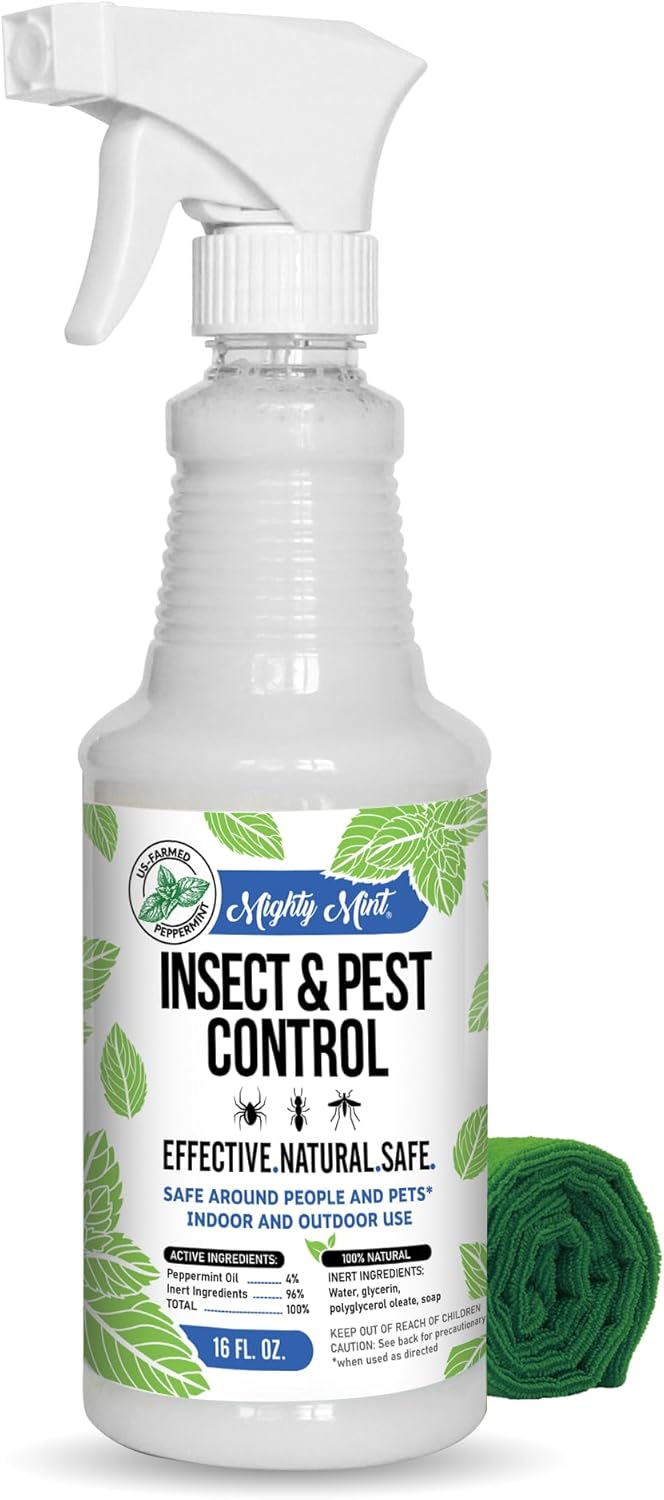
Mighty Mint Peppermint Oil Insect Repellent Spray, 16 oz
| Item model number | 860000087537 |
|---|---|
| Manufacturer | Pure Origin |
| Package Dimensions | 9.29 x 3.54 x 2.87 inches; 1.23 pounds |
| Date First Available | October 11, 2018 |
Mighty Mint Peppermint Oil Spray is a plant-based ready-to-use repellent for indoor and outdoor spot treatments around entryways, baseboards, patios, and vehicle engine bays. It uses a concentrated peppermint oil formula mixed with water and mild surfactants so you spray affected areas until wet and reapply a few times per week for ongoing deterrence. The spray is practical where you want a nonchemical alternative: it leaves a fresh mint scent rather than harsh fumes, dries without staining most surfaces, and is safe to use around people and pets when directions are followed. Important features include a trigger sprayer for targeted application and instructions that list common use locations and species it deters, including mice, rats, spiders, ants, and roaches. Limitations are that it is not for direct skin application and must be kept away from pollinators while applying; effectiveness depends on regular reapplication and results vary with infestation severity. For someone seeking a milder, scent-forward option, it works well as part of a broader pest-prevention routine rather than a one-time extermination fix.
Best for: Buyers who prioritize a natural, low-fume pest control option and want a product with broad user endorsement for routine spot treatments around the home.
Less Ideal for: Not the best choice for people facing large or established infestations who need professional-strength contact killers or long-lasting residual chemicals.
- Plant-based peppermint oil formula offers a natural-smelling alternative to synthetic pesticides
- Ready-to-use 16 oz spray for quick, targeted applications without mixing
- Suitable for indoor and outdoor use on entry points and common pest pathways
- Trigger sprayer provides controlled coverage for spot treatments
- Requires frequent reapplication for sustained control
- Not intended for direct skin use and can irritate sensitive individuals
Verdict: Choose Mighty Mint when you want a ready-to-use, peppermint oil spray that provides a natural, low-odor way to deter common household pests during routine home maintenance.
Mighty Mint Peppermint Oil Insect Repellent Spray, 1 Gallon

| Scent | Peppermint |
|---|---|
| Ingredients | Water, Glycerin, Polyglycerol Oleate, Soap, Peppermint Oil |
| Use Areas | Indoor / Outdoor |
| Size | 128 oz |
Mighty Mint Peppermint Oil Insect Repellent is a large 1-gallon, plant-based spray designed to repel common household pests like ants, spiders, and roaches without harsh chemicals. The product is typically used around baseboards, entryways, patios, and other perimeter areas; the gallon format lets you refill smaller trigger bottles or apply broad yard and garage treatments without frequent repurchases. Key features include a peppermint oil active ingredient, a water-based formula with glycerin and soap for mixing and sprayability, and directions that allow attaching a nozzle to the gallon for ready-to-use application. In practice the scent is noticeably minty but generally pleasant and not overpowering, and the formulation is marketed as safe for homes with pets and kids when used as directed. Limitations are that plant-based repellents can require more frequent reapplication than synthetic pesticides and may not provide the same knockdown speed on heavy infestations; you should follow safety directions and avoid direct application to sensitive plants or food surfaces.
Best for: Buyers who prioritize low-toxicity, natural pest control for everyday indoor and outdoor use and want a ready-to-use product they can dilute or refill to cover a whole house and yard.
Less Ideal for: People facing severe, established infestations who need fast knockdown or long residual control should consider professional treatments or stronger insecticides.
- Plant-based peppermint oil formula avoids synthetic pesticides
- Large 128 oz gallon is convenient for whole-home or yard coverage and refilling smaller bottles
- Safe-for-home positioning with instructions for use around people and pets when applied as directed
- Water-based blend sprays and spreads easily without staining surfaces
- May require more frequent reapplication than stronger synthetic insecticides
- Not designed as an instant-kill pesticide for heavy or established infestations
Verdict: A large, ready-to-use peppermint oil spray for people who want a natural, low-toxicity option to repel common household pests across indoor and outdoor areas.
Choosing the Right Natural Bug Spray for Home: Key Factors to Consider
Active Ingredients and Mode of Action
Different natural sprays use botanicals like essential oils, botanical extracts, or low-toxicity synthetic actives that mimic natural compounds. Knowing the active matters because some botanicals deter flying insects, while others work better against crawling pests. Some ingredients primarily mask attractants; others create a contact or vapor barrier that discourages pests from lingering.
Understanding mode of action helps set expectations. Botanical actives often need more frequent application and work best as part of an integrated approach, while certain low-odor barrier ingredients can provide longer-lasting deterrence without strong smells.
Indoor Safety and Residue
When using a spray inside the home, consider inhalation and surface residues. Some natural oils can linger in the air or settle on fabrics and counters. Look for formulations tested for low volatile emissions and that specify safe contact with household surfaces. Pay attention to drying time and whether treated surfaces require wiping before food contact.
If you have respiratory sensitivities, infants, or immunocompromised household members, err toward products with clear guidance on ventilation and minimal airborne persistence.
Scent Profile and Persistence
Natural ingredients often carry strong aromas. The scent profile is important because a pleasant-smelling spray can be tolerable, while an intense essential oil blend may become overwhelming in small rooms. Check for descriptions of upfront aroma and how long the odor persists after application.
Scent matters not just for comfort but for pets that may react to strong smells. If you plan to treat bedrooms or enclosed spaces, choose low-odor formulas or those labeled for sensitive noses.
Application Method and Coverage
The delivery system affects how practical a spray is for indoor use. Trigger sprays can provide controlled spot treatments, while aerosols or pump mists offer finer particle distribution. Consider reach, droplet size, and whether the nozzle allows targeted application to baseboards, windowsills, or porch thresholds.
Also look at concentration and recommended coverage area. A product that requires many passes to cover common areas may not be convenient for routine use.
Safety Around Pets and Children
Homes with pets or young children need special attention to ingredient safety and re-entry times. Some natural oils are toxic to certain animals or can irritate sensitive skin. Prefer sprays that list specific guidance for pet exposure, including whether animals should be kept away until surfaces are dry or ventilated.
Consider also packaging safety such as child-resistant caps and clear labeling about accidental ingestion or eye exposure.
Longevity and Frequency of Reapplication
Natural repellents often have shorter residual activity than conventional insecticides. Decide how often you are willing to reapply versus how much protection you need. Some formulations include fixatives or encapsulation to extend activity; others rely on regular spot treatment.
Balancing longevity with indoor safety will determine whether a product fits a daily-maintenance plan or a targeted, occasional-use approach.
Best Uses by Room and Situation
Different formulations suit different parts of the home. Light, low-odor sprays work well in bedrooms and living rooms where prolonged scent would be a nuisance. Stronger botanical blends are better for entryways, garages, or screened porches where ventilation reduces lingering aroma. For kitchens, choose products with explicit guidance about surface contact and food-prep areas.
Treating thresholds and entry points first typically reduces indoor incursions. Focus on window frames, door sweeps, and baseboards rather than blanket spraying soft furnishings.
- Bedrooms: low-odor, short-residue options
- Living areas: moderate scent if well-ventilated
- Kitchens: surface-safe formulas with clear drying guidance
- Entryways: stronger deterrents acceptable with ventilation
How to Apply Safely Indoors
Read the label for re-entry times and ventilation recommendations. Even natural actives can cause irritation when airborne in small rooms. Open windows when possible and avoid spraying directly onto bedding, food, or open dishes.
Spot-test on an inconspicuous fabric before treating sofas or curtains. If treating baseboards or window frames, spray sparingly and allow surfaces to dry fully before permitting children or pets back into the room.
- Ventilate after application unless product is specifically odorless
- Keep people and pets out of the room until sprays have dried
- Wipe treated countertops if label does not permit food contact
Combining Sprays with Non-Chemical Methods
Natural sprays are most effective when paired with exclusion and sanitation. Seal cracks, install tight-fitting screens, and maintain door sweeps to limit entry points. Reducing exposed food sources, clearing clutter, and regular vacuuming decrease places pests can hide.
Use traps and mechanical controls for monitoring. Sprays can reduce activity, but removing attractants and entry routes addresses the root cause of indoor infestations.
- Seal gaps around pipes and doors
- Keep food sealed and clean up spills quickly
- Use traps to monitor pest levels before treating
Storage, Shelf Life, and Label Reading
Store natural sprays in a cool, dark place away from children and pets. Essential oil concentrations can change over time, so check for storage recommendations and expiration dates. Some botanical formulas separate or cloud after long storage; shake well and check the label for stability notes.
Always read active ingredient declarations and follow disposal instructions. Do not transfer sprays to unmarked containers; maintain original labeling for safety information.
- Keep away from heat and direct sunlight
- Note and follow any expiration guidance
- Do not mix sprays with other household chemicals
How We Chose the Best Natural Bug Spray for Home
We prioritized products formulated for indoor use and that rely primarily on botanical actives, low-toxicity synthetic alternatives that are suitable for living spaces, or barrier ingredients with a known safety profile. Key evaluation criteria were indoor repellency effectiveness against common house pests, vapor and residue safety for people and pets, scent profile and odor persistence in closed rooms, ease of application and reapplication for routine use, and packaging that minimizes overspray and accidental exposure. We excluded outdoor-only insecticides, products intended exclusively for heavy structural pest control, and any sprays labeled for agricultural or industrial use. We also filtered out formulations that required special protective equipment or long ventilation periods after use. The final list balances measurable deterrent activity with everyday indoor safety and handling considerations.
FAQ
Are natural bug sprays safe to use around pets?
Often they are safe, but it depends on the active ingredients and the animal species. Some essential oils can be harmful to cats and certain small mammals. Check product labels for pet-specific guidance and keep animals away until treated surfaces are dry and rooms are ventilated.
How long do natural indoor sprays typically last between applications?
They usually provide shorter residual protection than conventional insecticides, often lasting from a few hours to a few days depending on formulation and activity levels. Expect to reapply more frequently for continuous control, especially in high-traffic entry areas.
Can I spray natural bug spray directly on upholstery and mattresses?
You should spot-test first and follow label instructions. Many sprays advise against treating soft furnishings or recommend spraying lightly and allowing full drying before use. For mattresses and bedding, consider treatments designed specifically for fabrics.
Will natural sprays mask odors or just repel insects?
Some botanical sprays rely on strong aromas that mask attractants while others use repellent actives that deter insects. Masking can provide immediate benefit but may not reduce long-term insect presence, whereas true repellent actives can reduce lingering activity when applied correctly.
Are there special ventilation rules after using natural sprays indoors?
Ventilation recommendations vary. Many products suggest opening windows or running fans until the scent dissipates, especially in small rooms. If household members have respiratory sensitivities, increase ventilation and wait longer before re-entry.
Can I use natural bug sprays around food preparation areas?
Use caution. Only use sprays explicitly labeled as safe for kitchens or food-contact surfaces, and wipe treated counters if the label does not permit direct food contact. Prefer treating adjacent surfaces like window frames rather than food-prep areas.
Final Verdict
Choosing a natural bug spray for home is a balance between measurable deterrence and indoor safety. Prioritize products with clear guidance on indoor use, low airborne persistence, and packaging that supports precise application. Consider how often you will reapply and whether the scent profile and residue fit the rooms you plan to treat. For most households, the best choice is a low-odor, surface-safe formula used as part of an integrated plan that includes exclusion and sanitation. That approach reduces pests while keeping indoor air and surfaces safe for family and pets.
