

Note: This article contains affiliate links. If you click on these links and make a purchase, I may earn a small commission at no extra cost to you. This helps support my research and content. Read my full affiliate disclosure here.
If you want a low-fuss way to feed container plants, houseplants, or small garden beds, plant fertilizer spikes can be an efficient choice. They deliver nutrients directly into the root zone, reduce frequent liquid feeding, and cut down on spills and guesswork. Choosing the right spike matters because nutrient ratios, release duration, and spike size all affect plant response and how often you must reapply. This guide covers a shortlist of the seven top Plant Fertilizer Spikes for the stated uses. We evaluated each option against practical gardener needs like nutrient balance, release longevity, ease of use, and suitability for different plant types. Read on to understand which features matter most for your plants before you inspect the product blocks below.
Top Picks at a Glance
| Best Overall The best all-around choice for most situations | Jobe's Organics Houseplant Fertilizer Spikes, 50 Count |  |
| Best Quality Built to a higher standard if you want something more solid | Jobe's Organics Houseplant Fertilizer Spikes, 50-Count |  |
| Best Value The sweet spot between price and what you get | RAINFLOW Slow-Release Plant Fertilizer Sticks (90 Count) |  |
| Best Budget The cheapest option that still gets the job done reliably | Miracle-Gro Plant Food Spikes, 6-12-6, 1.1 oz (24 spikes) |  |
| Highest Rated A top-rated pick with lots of positive feedback | Jobe's Organics Flowering Plant Fertilizer Spikes 10-10-4, 5 Pack |  |
| Most Popular A crowd favorite that many people choose with confidence | Miracle-Gro Indoor Plant Food Spikes, 48 Spikes (2-Pack) |  |
| Best Seller A high-volume bestseller chosen again and again | Miracle-Gro Indoor Plant Food Spikes, 48 Count |  |
Jobe's Organics Houseplant Fertilizer Spikes, 50 Count

| Unit Count | 50 Count |
|---|---|
| Application Method | Insert spikes into soil |
| Item Form | Granules, Liquid, Sticks |
| Target Species | Houseplant |
| Mixing Ratio | 13-4-5 |
Jobe's Organics fertilizer spikes are pre-measured, slow-release sticks you insert directly into potting soil to feed indoor flowering and foliage houseplants. Each pack includes 50 spikes formulated at 13-4-5 NPK, designed to supply nutrients at the roots for roughly 60 days before replacement. Use is straightforward: push the recommended number of spikes into the soil around the root zone and forget them until the next application. The spikes eliminate mixing, reduce mess and runoff, and help prevent accidental overfeeding because each spike contains a set dose. For small pots and casual plant owners this delivers consistent feeding with minimal effort, especially where you want steady bloom and leaf color without daily attention. Limitations are the fixed nutrient ratio and dosing schedule so you cannot fine-tune feeding for specific species or correct nutrient imbalances quickly, and spikes may be less practical for very large containers or heavy feeders that need more frequent or soluble feeding.
Best for: A practical, budget-minded houseplant owner who prefers low-effort, scheduled feeding and wants reliable bloom and foliage maintenance without mixing fertilizers.
Less Ideal for: Enthusiasts who need customizable nutrient ratios, rapid corrective feeding, or who primarily care for very large or heavy-feeding plants.
- Pre-measured slow-release spikes remove mixing and reduce mess
- Continuous root-zone feeding for about 60 days per application
- Formulated 13-4-5 NPK suited to flowering and foliage development
- Pack of 50 provides multiple applications for several small plants
- Fixed NPK ratio and dose cannot be adjusted for individual plant needs
- Not ideal for very large pots or plants requiring frequent soluble feeding
Verdict: If you want an inexpensive, no-mess way to provide steady root-zone nutrition to multiple houseplants, these pre-measured spikes are a simple and reliable choice.
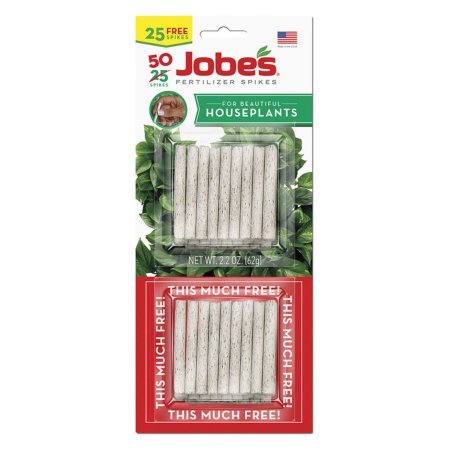
Jobe's Organics Houseplant Fertilizer Spikes, 50-Count
| Item Form | Sticks |
|---|---|
| Application Method | Insert the spikes into the soil |
| Coverage | Medium |
| Mixing Ratio | 13:4:5 |
| Unit Count | 50 Count |
Jobe's Organics houseplant fertilizer spikes are pre-measured sticks you push into potting mix to deliver a slow-release 13-4-5 feed directly to roots. They are typically used for indoor potted plants and work well when you want a low-maintenance feeding schedule: insert spikes around the root zone and they dissolve gradually, releasing nutrients without liquid mixing or frequent dosing. Notable features include an organic formulation and a medium coverage claim, and the 50-count pack covers many pots or multiple feed cycles. Practical benefits are convenience and consistent nutrient delivery that reduces the chance of overfertilizing compared with liquid concentrates. Limitations are that spikes give less control over precise dosing and timing than water-soluble fertilizers, and they are not ideal for plants needing specific micronutrient blends or rapid correction of deficiencies. For performance-focused users, spikes simplify routine feeding but require monitoring plant response and occasional supplementation for specialized needs.
Best for: Buyers who prioritize steady, low-effort feeding for a collection of indoor potted plants and want to reduce time spent measuring and mixing fertilizers.
Less Ideal for: Growers who need tight control over nutrient schedules, fast corrective feeding, or custom micronutrient blends for high-performance specimens.
- Pre-measured slow-release sticks simplify feeding without mixing or measuring
- Organic formula suitable for routine houseplant maintenance
- Large 50-count pack covers many pots or multiple applications
- Direct root-zone placement reduces surface nutrient loss
- Less precise control of nutrient timing and concentration compared with liquid or granular feeds
- Not suited for quickly correcting acute nutrient deficiencies
Verdict: A convenient, low-maintenance way to deliver steady nutrition to houseplants when you want reliable results with minimal hands-on feeding.
RAINFLOW Slow-Release Plant Fertilizer Sticks (90 Count)

| Number of Items | 90 |
|---|---|
| Item Form | Sticks |
| Application Method | Insert into soil |
| Specific Uses For Product | Plant Growth |
These RAINFLOW fertilizer sticks deliver a slow-release nutrient mix in a stick form that you insert into potting soil for low-effort feeding. They are intended for indoor plants including orchids, succulents, cacti, foliage, herbs and potted vegetables and release nutrients over an extended period so you do not need to fertilize frequently. Use is straightforward: moisten soil, push a stick fully into the soil (or pre-drill if compacted), and follow the suggested stick count per pot size; the maker recommends reapplying every three months in spring and summer and every four months in cooler seasons. Notable features include a gentle no-burn formula with primary macro and micronutrients listed in the ingredients and a bulk 90-count supply that suits multiple small pots or seasonal maintenance. Practical benefits are clean, measured dosing and reduced time spent mixing liquid feeds. Limitations are that stick dosing is less flexible for custom nutrient schedules and you must follow the manufacturer guidance for stick counts to avoid under- or over-feeding in atypical pot sizes.
Best for: Best for houseplant owners who want a low-maintenance, tidy way to keep many small and medium potted plants regularly fed without weekly attention.
Less Ideal for: Not a good choice for growers who need precise, adjustable nutrient programs or who manage large outdoor beds and landscapes.
- Slow-release formula feeds plants for months to reduce application frequency
- Simple insert-into-soil application for clean, low-mess feeding
- Includes primary macro and micronutrients (N, P, K plus Ca, Mg, Fe, Zn) for balanced nutrition
- Bulk 90-count package supports many small pots or seasonal top-ups
- Fixed stick dosing offers less fine control than liquid or granular regimens
- Instructions rely on pot diameter guidance which may not match nonstandard containers
Verdict: If you want a simple, low-maintenance way to keep many indoor potted plants fed for months, these slow-release fertilizer sticks are a practical time-saver.
Miracle-Gro Plant Food Spikes, 6-12-6, 1.1 oz (24 spikes)

| Item Form | Sticks |
|---|---|
| Application Method | Insert into soil |
| Target Species | all indoor plants |
| Mixing Ratio | 6:12:6 |
These plant food spikes turn routine houseplant feeding into a simple, low-effort task. Each spike is a 6-12-6 fertilizer stick you push into moist potting soil where it slowly releases nutrients and micronutrients over about two months, so you do not need to measure liquid feedings. They are intended for a wide range of indoor plants such as ferns, pothos, and spider plants and are applied by making a small hole and inserting the spike near the root zone. The practical benefits are convenience for busy or forgetful plant owners and predictable, steady feeding that reduces the chance of over- or under-fertilizing. Limitations are that spikes deliver a fixed NPK ratio and timing, so you cannot easily adjust feeding strength or schedule for plants with special needs, and one-pack coverage is described as medium so heavy feeders may need more frequent replacement. For budget-conscious buyers these spikes are economical per application and remove the hassle of mixing and measuring liquid fertilizers.
Best for: Ideal for houseplant owners who want a simple low-maintenance feeding solution and prefer predictable, set-and-forget care over frequent liquid fertilizing.
Less Ideal for: Not a good fit for growers who need custom nutrient ratios, strict timing control, or who manage many heavy-feeding plants in larger collections.
- Pre-measured spikes provide steady, continuous feeding for up to two months
- Very easy application—insert into moist soil, no mixing or measuring
- Formulated with micronutrients suitable for a wide range of indoor plants
- Fixed 6-12-6 NPK ratio cannot be adjusted for plants with special nutritional needs
- Described coverage is medium so heavy-feeding plants may require additional spikes
Verdict: Choose these spikes when you want an inexpensive, no-mess way to keep indoor plants fed for about two months without measuring or mixing.
Jobe's Organics Flowering Plant Fertilizer Spikes 10-10-4, 5 Pack

| Item Form | Sticks |
|---|---|
| Specific Uses For Product | Flowering Plants |
| Application Method | Push spikes into the soil |
| Coverage | Medium |
| Mixing Ratio | 10-10-4 |
Jobe's Organics Flowering Plant Fertilizer Spikes deliver an easy, low-effort feed for flowering plants using pre-measured sticks with a 10-10-4 NPK balance. Use them by pushing the spikes into the root zone, watering after placement, and replacing every eight weeks through the growing season. The spike form eliminates mixing or measuring and reduces the chance of over-application compared with granular or liquid feeds. Because they are targeted at flowering species and provide medium coverage, a few spikes per plant supply a steady nutrient release rather than a quick surge. Important practical limits are that coverage is not specified precisely and spikes must be positioned correctly to reach the root zone, so they are less flexible for large beds or uneven root spreads. Also they require periodic replacement and safe storage out of reach of children. For gardeners who want dependable, mess-free feeding for individual flowering plants, these make routine care straightforward.
Best for: Gardeners who prioritize reliable, low-maintenance feeding for individual flowering plants and want a no-mess solution that removes mixing and measuring.
Less Ideal for: People managing large beds, mixed-species borders, or plants with wide, shallow roots that need more customizable or broadcast feeding methods.
- Pre-measured sticks remove mixing and reduce dosing errors
- Formulated for flowering plants with a balanced 10-10-4 NPK ratio
- Simple push-in application and water-activated release
- Organic formula suitable for routine seasonal feeding
- Medium coverage may require multiple spikes for larger plants or clumped beds
- No precise coverage area provided so spacing must be judged by the user
Verdict: A reliable, no-mess spike feed that simplifies seasonal fertilizing for flowering plants.
Miracle-Gro Indoor Plant Food Spikes, 48 Spikes (2-Pack)

| Item Form | Sticks |
|---|---|
| Application Method | Insert into soil |
| Target Species | all indoor plants |
| Unit Count | 48 Count |
| Mixing Ratio | 6:12:6 |
These Miracle-Gro Indoor Plant Food Spikes are a convenient, low-effort way to feed potted croton and other houseplants. Each stick is pushed into moist potting soil with the included aerator; the spikes dissolve slowly and release nutrients for up to two months, so feeding becomes a twice-seasonal task rather than a weekly chore. The 6-12-6 NPK mix supports foliage and flowering, which is helpful for crotons that benefit from steady nutrients to maintain leaf color. Practical benefits include tidy application with minimal mess, predictable slow release that reduces the risk of overfertilizing, and compatibility with a wide range of indoor plants. Limitations are that spikes do not allow precise, adjustable dosing for small or newly rooted plants, and they do not address soil pH or drainage issues that also affect croton health. For growers who want targeted micronutrients or a quick corrective feeding, a soluble fertilizer may be preferable.
Best for: A cautious indoor gardener who prefers set-and-forget feeding for decorative houseplants like croton and values predictable, low-risk care routines.
Less Ideal for: Plant parents who need precise dosing for seedlings, recently repotted specimens, or who require immediate nutrient correction should consider soluble or targeted fertilizers instead.
- Continuous slow-release feeding for up to two months reduces maintenance frequency
- Easy, mess-free insertion with the Miracle-Aerator tool
- Formulated NPK 6-12-6 supports both foliage and flowering
- Suitable for a wide range of indoor plants including croton
- Not suitable for fine-tuning nutrient levels or for very small/petite pots
- Does not correct soil pH or drainage problems that affect plant uptake
Verdict: Use these spikes when you want an easy, low-risk way to keep croton foliage vibrant with twice-monthly to monthly set-and-forget feeding.
Miracle-Gro Indoor Plant Food Spikes, 48 Count

| Item Form | Sticks |
|---|---|
| Application Method | Insert spike into soil |
| Coverage | Full |
| Target Species | Houseplants |
| Unit Count | 48 Count |
These Miracle-Gro indoor plant food spikes are sticks of slow-release NPK fertilizer designed for low-effort feeding of houseplants, including peace lilies. You use the included aerator to make a small hole, press a spike into the soil, and water as normal; each spike delivers nutrients for up to two months so you do not need frequent dosing. The pack of 48 covers many pots and the dosing guidance scales with pot size, which makes it simple to treat multiple plants on a budget. Practical benefits include tidy, mess-free application and predictable feeding that reduces the risk of over- or under-fertilizing compared with liquid mixes. Limitations are that spikes are a fixed NPK formulation so you cannot tailor ratios to a specific plant need, and they are intended for routine maintenance rather than correcting major nutrient deficiencies. Also coverage varies by pot size so very large containers require multiple spikes.
Best for: Budget-minded houseplant owners who want an easy, low-maintenance fertilizer for regular feeding of peace lilies and other indoor plants without measuring liquids.
Less Ideal for: People who prefer to tailor fertilizer formulas to specific deficits or who need a concentrated corrective treatment for severely deficient plants.
- Feeds houseplants for up to two months per spike for low-maintenance care
- Pack of 48 provides enough spikes to treat many pots without frequent repurchase
- Simple, mess-free application using an aerator reduces fiddly measuring
- Clear coverage guidance by pot size makes dosing straightforward for multiple plants
- Fixed NPK formulation cannot be adjusted for specific nutrient imbalances
- Not designed to correct serious deficiencies or replace targeted treatments
Verdict: A cost-effective, no-fuss way to keep peace lilies fed on a regular schedule without measuring or mixing plant food.
Choosing the Right Plant Fertilizer Spikes: Key Factors to Consider
Nutrient Formulation and Ratios
Different plants require different balances of nitrogen, phosphorus, and potassium. Ornamental foliage plants often prefer higher nitrogen for leafy growth, while flowering and fruiting plants need higher phosphorus and potassium to support blooms and fruit set. The exact N-P-K ratio on the spike determines whether it feeds for vegetative growth, flowering, or general maintenance.
Check the minor nutrients as well. Spikes that include secondary nutrients like magnesium and calcium and trace elements such as iron and manganese can prevent common deficiencies, especially in container-grown plants that rely entirely on supplied nutrients. A clear ingredient list helps you match spikes to the plants you grow and avoid overapplication of a single nutrient.
Release Duration and Feeding Frequency
Spikes are formulated to release nutrients over a span of weeks to months. Longer-release spikes reduce the need for repeat applications but may not be ideal if you need quick correction of a deficiency. Shorter-duration spikes let you adjust feeding seasonally or respond to growth changes more quickly.
Consider how often you want to tend containers or beds. For high-maintenance, fast-growing plants you might prefer a shorter release to avoid nutrient lock-in. For vacation coverage or low-maintenance plantings, longer-release spikes provide convenience. Also factor soil temperature and moisture, which influence release rates; spikes may work faster in warm, wet conditions.
Spike Size, Shape, and Pot Compatibility
Spike physical dimensions determine how well they fit different containers and how close the nutrients sit to roots. Thin, tapered spikes suit small pots and crowded root balls, while larger, bulkier spikes are better for deep planters and landscape beds where more material is needed per plant.
Pay attention to recommended pot size on packaging. Using spikes too large for a small pot can deliver concentrated nutrients that stress roots, while spikes that are too small for a large container will underfeed. The shape also affects ease of insertion and root contact; some designs fragment or crumble more readily and may distribute nutrients unevenly.
Ease of Application and Handling
One of the main advantages of fertilizer spikes is convenience. Look for spikes that are easy to insert at a consistent depth and that do not require special tools. Packaging that includes clear counts and dosing guidance speeds correct use, especially when treating groups of potted plants with different sizes.
Consider whether the spikes are brittle or robust. Fragile spikes can break during insertion and leave powder on hands, while overly hard spikes can be difficult to push into compacted soil. Child- and pet-safety considerations for handling and disposal may also influence your choice.
Release Consistency and Soil Contact
Spikes depend on good soil contact to deliver nutrients evenly. If the spike formulation releases too quickly at the surface or remains too intact without dissolving, plants may receive uneven feeding. Uniform release across spikes ensures predictable plant response across similar pots.
Think about mulched beds and densely planted containers where spike-soil contact could be inconsistent. In those situations stagger placement around the root zone and ensure the spikes are in firm contact with moist soil to promote steady nutrient diffusion.
Labeling, Dosing Instructions, and Storage
Clear labeling reduces the risk of over- or underapplication. Look for straightforward dosing recommendations by pot size or plant type and explicit reapplication intervals. Packaging that separates doses or includes dispensers makes it easier to treat many plants accurately.
Storage instructions matter because moisture or humidity can degrade some spike formulations. A resealable container or moisture barrier prolongs shelf life and preserves spike integrity between seasons.
Matching Spikes to Plant Types
Different plant groups respond better to specific spike formulations. For foliage-heavy houseplants and leafy ornamentals, choose spikes with a higher nitrogen share. For flowering and fruiting plants, select spikes with elevated phosphorus and potassium to encourage blooms and yields.
For mixed containers or combination plantings, use a balanced general-purpose spike or place different spikes near plants with distinct needs. When treating vegetables, especially fruiting crops, check for an N-P-K that supports both steady foliage and fruit production without excessive vegetative vigor at the expense of flowers.
- Houseplants: higher nitrogen for lush leaves
- Flowering containers: higher phosphorus and potassium
- Vegetables: balanced formula tuned to fruiting stage
Application Best Practices
Insert spikes at the recommended depth into moist soil and space them around the root zone rather than directly at the stem. For containers, place spikes near, but not touching, the main stem to avoid root burn. When working in garden beds, stagger spikes around the root spread for even nutrient distribution.
Avoid inserting spikes into dry, compacted soil. Water the pot or bed lightly before or after insertion to initiate nutrient release. Record the application date and the expected reapplication window so you do not overfeed later in the season.
- Water lightly after inserting to start nutrient release
- Space spikes according to pot size or plant root spread
- Keep spikes away from direct stem contact to prevent burn
Safety and Environmental Considerations
Fertilizer spikes concentrate nutrients in a small zone. Keep them away from children and pets and follow disposal instructions to prevent accidental ingestion. Wear gloves if spikes are brittle and prone to powdering during insertion.
Overuse of spikes in landscape beds can contribute to nutrient runoff during heavy rains. Use the lowest effective dosing and avoid placing spikes where runoff directly enters storm drains or water bodies. Consider supplementing with compost or slow-release granular amendments when building long-term soil fertility in beds.
- Store spikes in a dry, sealed container
- Follow label directions to minimize runoff risk
- Wear gloves if handling brittle formulations
Timing Applications Through the Season
Plan spike applications around growth cycles. Early spring or the start of active growth is a good time for balanced spikes. For plants entering a flowering or fruiting phase, apply spikes formulated for bloom support shortly before the expected bloom window so nutrients are available when plants need them most.
Avoid applying long-duration spikes late in the season when plants are preparing for dormancy, especially for woody ornamentals. Excess late-season nitrogen can delay hardening off and reduce winter resilience.
- Apply balanced spikes at the start of active growth
- Use bloom-focused spikes before flowering period
- Skip heavy nitrogen spikes as plants go dormant
Using Spikes in Containers Vs Landscape Beds
Containers have limited soil volume and higher nutrient concentration risk, so follow pot-size dosing guidance closely. Smaller pots may require half or quarter dosages to avoid burn. Reapply according to shorter intervals for small pots because nutrients deplete faster with frequent watering.
In landscape beds, spikes can be used for targeted feeding near shrubs or perennials but are less effective as a substitute for building soil organic matter. Use spikes for seasonal boost or correction, and pair them with mulches and compost when improving long-term soil fertility.
- Reduce dose for small pots to avoid root burn
- Expect faster nutrient depletion in frequently watered containers
- Use spikes as a boost in beds, not as sole soil amendment
How We Chose the Best Plant Fertilizer Spikes
We focused on features that matter in real garden and container situations rather than marketing claims. Our selection filters prioritized nutrient formulations appropriate for common ornamental and edible plants, documented release duration to match application schedules, and spike sizes that suit small pots up to larger containers and border plantings. We also looked for ease of insertion and handling, consistency of nutrient delivery across multiple spikes, and packaging that supports straightforward dosing. Excluded from consideration were atypical or single-use spikes designed solely for herbicides, transplant starters, or pest control. We also excluded products without clear ingredient or release-time information. The resulting criteria emphasized formulation clarity, release longevity, physical dimensions and insertion ease, consistency of nutrient delivery, and packaging and labeling transparency. These same dimensions inform the scorecard metrics used alongside each product entry.
FAQ
How long do fertilizer spikes usually last?
Release durations vary by formulation but often range from four weeks up to several months. Warm, wet conditions accelerate release, so actual longevity depends on soil temperature and moisture.
Can I use spikes for both indoor and outdoor plants?
Yes. Many spikes are suitable for both indoor containers and outdoor planters, but check dosing recommendations and ensure good soil contact. For houseplants in small pots, reduce the dose to avoid overfeeding.
Are spikes safe around pets and children?
Spikes contain concentrated nutrients and should be kept out of reach. Follow label safety instructions, store them sealed, and avoid placing spikes where pets or children can access them.
What do I do if a plant shows signs of overfeeding?
If you see leaf burn or stalled growth, stop applying additional fertilizer. Flush the pot with water to leach excess salts and repot into fresh medium if the problem persists. For garden beds, water deeply to dilute concentrated nutrients.
Can I use spikes with newly potted or transplanted plants?
Be cautious with newly transplanted plants. Young roots can be sensitive to concentrated nutrients. Wait a few weeks for plants to establish before inserting spikes, or use lower-dose formulations designed for transplants.
Do spikes replace regular soil amendments like compost?
Spikes provide targeted nutrient boosts but do not replace organic matter. Compost and mulches improve soil structure, water retention, and long-term fertility, which spikes cannot replicate.
Final Verdict
Choose spikes that match your plants and your maintenance rhythm. Prioritize a nutrient formulation suited to the plant type, an appropriate release duration for your watering and climate, and spike size that fits the container or bed. Clear labeling and easy application reduce the risk of over- or underdosing. Recognize the tradeoff between convenience and long-term soil building. Use fertilizer spikes for targeted feeding and seasonal boosts, but rely on compost and cultural practices to build lasting soil health. With the right spike selection and sensible application, you can keep containers and garden plantings well fed without frequent liquid feedings.
