

Note: This article contains affiliate links. If you click on these links and make a purchase, I may earn a small commission at no extra cost to you. This helps support my research and content. Read my full affiliate disclosure here.
When evening time in your yard is cut short by biting insects, the right backyard insect killer can restore comfort and extend outdoor living. You want a solution that suits your yard size, targets the pests you actually see, and fits the way you maintain your outdoor space. This guide covers the top shortlisted backyard insect killers for typical home yards and patios, with practical notes on coverage, durability, and safety. We evaluated options across gardener-focused criteria like effective coverage area and ease of maintenance to help you pick the best match for your backyard setup. Read on to see which types perform best for different yard sizes and usage patterns.
Top Picks at a Glance
| Best Overall The best all-around choice for most situations | Quali-Pro Bifenthrin I/T 7.9F Insecticide, 1 Gallon |  |
| Best Quality Built to a higher standard if you want something more solid | Talstar One Insecticide Concentrate, 1 Gallon |  |
| Best Value The sweet spot between price and what you get | Cutter Backyard Bug Control Combo Pack with Hose‑End Spray Concentrate and Outdoor Fogger |  |
| Best Budget The cheapest option that still gets the job done reliably | Spectracide Triazicide Insect Killer for Lawns & Landscapes, 32 oz |  |
| Highest Rated A top-rated pick with lots of positive feedback | Ortho BugClear Insect Killer for Lawns & Landscapes Ready-to-Spray (3-Pack) |  |
| Most Popular A crowd favorite that many people choose with confidence | Atticus Talak 7.9% Bifenthrin Indoor/Outdoor Insecticide Concentrate, 32 oz |  |
| Best Seller A high-volume bestseller chosen again and again | Cutter Backyard Bug Control Spray Concentrate, 32 oz (2 pack) |  |
Quali-Pro Bifenthrin I/T 7.9F Insecticide, 1 Gallon

| Item Form | Spray |
|---|---|
| Target Species | Termites, Carpenter Ants |
| Liquid Volume | 1 gallons |
| Active Ingredients | Bifenthrin |
This one-gallon Quali-Pro Bifenthrin I/T 7.9F is a flowable pyrethroid designed for preventive and residual control of a broad range of pests in lawns and landscaped areas. It is typically mixed and applied as a spray to turf, ornamental beds, foundations and around structures to suppress termites, carpenter ants, fleas, ticks, mites and similar pests. Key features include a long-lasting residual, compatibility with many turf and ornamental tank-mix partners, and a no-odor, non-irritating formulation that dries without visible residue. In practice it provides dependable knockdown and weeks of protection when applied at recommended rates, making it suited for routine perimeter treatments and spot-control of persistent infestations. Important limitations are that it is a concentrated professional-style product requiring careful dilution, protective equipment, and adherence to label directions for safe use around people, pets and desirable plants. It is not a ready-to-use consumer spray and should be used only where labeled.
Best for: Buyers who prioritize a reliable, long-lasting perimeter or spot-treatment solution for recurring or hard-to-control outdoor pests and who are comfortable following label directions and using concentrated products.
Less Ideal for: Casual users who want a simple ready-to-use spray for occasional bug bites or very small lawns should consider consumer-grade aerosols or hose-end products instead.
- Long-lasting residual control effective against termites, carpenter ants and other pests
- Compatible with herbicides, fungicides, insecticides and liquid fertilizers for tank mixes
- No-odor, non-irritating formula that dries with no visible residue
- Available in a one-gallon concentrated flowable for multiple applications
- Concentrated product requires dilution and protective equipment for safe handling
- Not intended as a ready-to-use consumer spray and may be overkill for very small yards
Verdict: Choose this product when you need a dependable, long-lasting concentrated insecticide for routine perimeter and spot treatments in lawns and ornamentals.
Talstar One Insecticide Concentrate, 1 Gallon

| Active ingredient | Bifenthrin 7.9% |
|---|---|
| Formulation | Concentrate, water-based |
| Coverage intent | Perimeter and structural applications |
| Pest range | Controls 75+ pests including ticks |
Talstar One is a professional-strength bifenthrin concentrate designed to provide broad-spectrum control of ants, spiders, roaches, fleas, ticks, mosquitoes, and many other pests. You mix the concentrate with water and apply it as a perimeter spray around foundations, doors, and windows or to targeted cracks and crevices indoors. Notable features include a water-based, low-odor formula that dries clear and a residual effect that reduces the need for frequent reapplications on lawns, ornamentals, shrubs, and structural surfaces. For yards with tick pressure, treating perimeters and vegetation provides a dependable barrier that helps reduce tick encounters when applied according to label directions. The product is concentrated so one gallon treats large areas, which makes it efficient for seasonal maintenance across multiple structures. Important limitations are that it is a pesticide that requires careful handling and strict adherence to label rates and application restrictions, and it is not a ready-to-use spray so you will need appropriate mixing and application equipment for safe, effective coverage.
Best for: Buyers who prioritize reliable, residual pest control for yards and perimeters and who are comfortable using concentrated pesticides with proper safety practices.
Less Ideal for: Casual users who want a ready-to-use product or those unwilling to follow pesticide label precautions and use appropriate application equipment.
- Broad-spectrum control that includes ticks and common yard pests
- Concentrated formula covers large areas and is cost-efficient for seasonal treatments
- Water-based, low-odor formula dries clear and is suitable for outdoor living spaces
- Suitable for both perimeter and targeted indoor/structural applications
- Concentrate requires proper mixing and application equipment for safe use
- Contains bifenthrin so users must follow label precautions to protect people, pets, and beneficial insects
Verdict: Choose Talstar One when you need a concentrated, long-lasting perimeter treatment that reliably reduces tick pressure across yards and structures.
Cutter Backyard Bug Control Combo Pack with Hose‑End Spray Concentrate and Outdoor Fogger

| Item Form | Spray |
|---|---|
| Target Species | Insects |
| Unit Count | 1 Count |
| Liquid Volume | 1 |
This Cutter combo pack combines a hose‑end spray concentrate for treating lawns and landscaped beds with a separate outdoor fogger for quick contact control around patios, decks and picnic areas. The hose‑end sprayer lets you treat large turf and landscape areas without measuring bottles, and the formula claims long residual control on listed pests so you can treat ahead of high activity. The fogger provides fast knockdown of mosquitoes and other biting insects in outdoor gathering spots where a broadcast spray is impractical. Practical benefits include easy activation with the quick‑flip sprayer, dual application methods for targeted or broad treatments, and coverage suitable for typical backyard use. Important limitations are that active ingredients are standard synthetic insecticides so you must follow label safety instructions and avoid treating flowering plants or occupied outdoor spaces; the fogger is for short‑term knockdown rather than season‑long protection by itself. For someone looking to reduce biting insects around a yard and entertaining areas, this combo covers both routine perimeter treatment and spot fogging.
Best for: Homeowners who want a practical, two‑part approach to reduce mosquitoes and other biting insects around a typical backyard and outdoor entertaining areas and who prefer straightforward, hands‑on treatments.
Less Ideal for: People seeking only long‑term, low‑toxicity or organic pest control solutions or those unwilling to follow chemical safety precautions should consider alternative methods.
- Includes both hose‑end concentrate and outdoor fogger for flexible application
- Hose‑end quick‑flip sprayer simplifies treating lawns and landscapes
- Fogger gives rapid knockdown of mosquitoes around patios and gathering spots
- Claims extended residual control on listed pests when applied as directed
- Contains synthetic insecticide actives that require careful handling and label compliance
- Fogger provides temporary relief rather than long‑term area protection
Verdict: Buy this if you want a no‑frills, dual‑method kit that treats lawns and quickly fogs patios to reduce biting insects around a backyard.
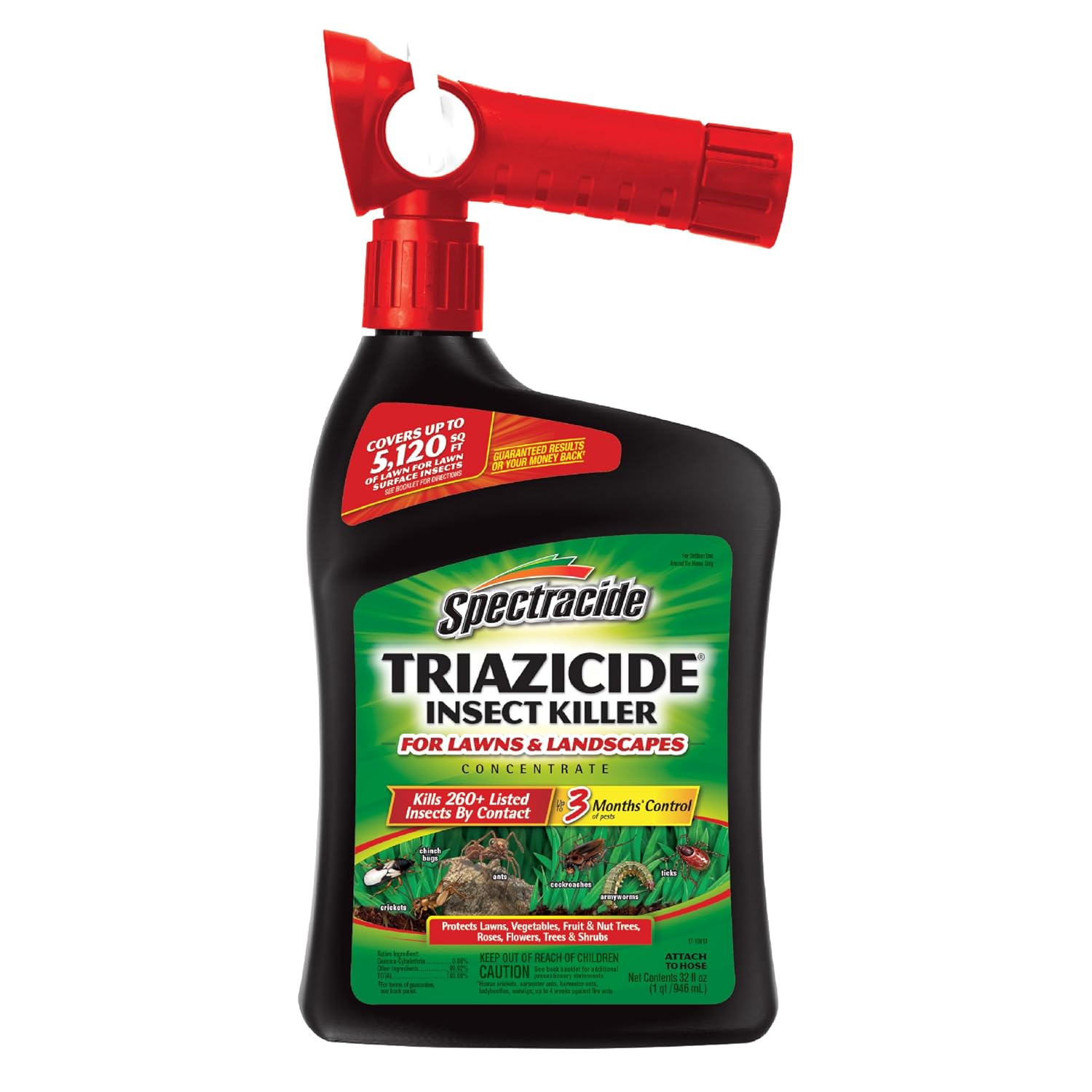
Spectracide Triazicide Insect Killer for Lawns & Landscapes, 32 oz
| Unit Count | 32 Ounce |
|---|---|
| Item Form | Spray |
| Target Species | Insects |
| Active Ingredients | Gamma-Cyhalothrin (0.08%) |
Spectracide Triazicide is a 32-ounce concentrate formulated to control more than 260 listed insects on lawns, flower beds, trees, shrubs and around vegetables. You mix the concentrate with water and apply it with a tank or hose-end sprayer; the ready-to-spray variant can attach to a garden hose for quicker application. The active ingredient, gamma-cyhalothrin, delivers fast contact kill for pests such as fleas, ticks, Japanese beetles and many surface insects, and the label claims protection for up to three months in some uses. It is non-staining when used as directed and can treat large areas, making it practical for whole-yard applications and targeted mound treatments like fire ants. Important limitations include toxicity to fish and bees, so it must not be applied near water or blooming plants, and the product requires careful handling and adherence to safety directions. Follow mixing rates and timing recommendations for best results and to minimize environmental risk.
Best for: Buyers who need an affordable, large-area solution to knock down common lawn and landscape pests and prefer a concentrate that stretches coverage when mixed.
Less Ideal for: People with small ornamental gardens near ponds, homeowners who prioritize pollinator-safe products, or those unwilling to follow pesticide safety precautions should consider gentler or targeted alternatives.
- Concentrate covers large areas so a single bottle treats many square feet when mixed correctly
- Fast-acting contact kill for a wide range of listed insects including fleas, ticks and Japanese beetles
- Versatile use on lawns, flower beds, trees, shrubs and around vegetables
- Non-staining when used as directed and available in hose-end ready-to-spray format for easier application
- Highly toxic to aquatic life and bees so it cannot be used near water or blooming plants
- Requires careful mixing and protective handling due to chemical toxicity
Verdict: A cost-effective, fast-acting concentrate for treating broad lawn and landscape pest problems when used with care and proper precautions.
Ortho BugClear Insect Killer for Lawns & Landscapes Ready-to-Spray (3-Pack)

| Item Form | Aerosol |
|---|---|
| Scent Name | Unscented |
| Indoor Outdoor Usage | Outdoor |
| Number of Items | 3 |
| Item Volume | 32 fluid ounces |
Ortho BugClear Ready-to-Spray is a hose-attachment insecticide designed to treat lawns, home perimeters and ornamentals without mixing. You attach a bottle to your garden hose, spray target areas and the product kills listed pests on contact while leaving a non-staining, unscented residue that continues to control insects for days. The bundle includes three 32 fl. oz. containers and each bottle is marketed to cover large square-footage areas for lawns, foundations and foliage, which makes it practical for multi-zone yards. Notable features are the ready-to-use hose connection, broad listed insect spectrum (mosquitoes, ticks, ants, fleas, spiders and more) and an unscented, non-staining formula. For someone who wants a straightforward, low-fuss perimeter and lawn treatment, it saves time versus mixing concentrates. Important limitations are that it is a contact/ residual pesticide so coverage and correct application matter for effectiveness, and label directions must be followed closely for use on ornamentals and listed vegetables and fruit trees.
Best for: Homeowners who prioritize a reliable, low-effort solution for keeping lawns and yard perimeters free of common outdoor pests and who prefer a product that is easy to apply with a hose.
Less Ideal for: Gardeners seeking organic or contact-free pest control or those who need systemic, plant-internal protection for edible crops should consider alternative approaches.
- Ready-to-spray hose-attachment eliminates measuring and mixing
- Covers large areas per bottle, suitable for whole-yard treatments
- Broad spectrum: kills many common outdoor pests including mosquitoes, ticks and ants
- Unscented and non-staining formula for use around ornamental plants and home perimeters
- Effectiveness depends on thorough application and proper coverage rather than systemic protection
- Not intended for indoor use and label restrictions apply for certain edible plants
Verdict: A simple, ready-to-spray hose-on insect killer that reliably treats large lawns and perimeters with minimal setup for dependable outdoor pest control.
Atticus Talak 7.9% Bifenthrin Indoor/Outdoor Insecticide Concentrate, 32 oz

| Active Ingredient | Bifenthrin |
|---|---|
| Formulation | Suspension Concentrate |
| Liquid Volume | 32 fluid ounces |
| Length of Control | Up to three months |
| Target Species | Insects |
Talak 7.9% is a liquid concentrate for treating lawns, landscaping, outdoor living areas and indoor perimeter spots like baseboards and cabinets. You dilute the concentrate with water to create a spray for barrier treatments, spot applications or lawn mixes; label rates explain how much to mix per gallon depending on the use. The product uses bifenthrin, a proven broad-spectrum active ingredient, and the manufacturer states it controls over 75 species and can give residual control for as long as three months. Its water-based formula dries clear, leaves no odor or visible residue, and is not phytotoxic on plants when used per label. Practical benefits include flexible indoor and outdoor use, clear drying, and a bottle designed for easier pouring. Important limitations are that solutions should be mixed only for same-day use, it is not registered for sale in a few states, and it is not approved for fogger application, so professional-style misting methods are not appropriate.
Best for: Buyers who want a single, reliable product to protect yards, patios and building perimeters from a wide range of common pests and prefer conservative, label-driven application practices.
Less Ideal for: People seeking ready-to-use sprays or fogger-compatible products or those in states where this formulation is not registered should look at alternatives.
- Broad-spectrum control listed for 75+ indoor and outdoor pest species
- Water-based formula that dries clear and leaves no odor or residue
- Flexible label directions for lawns, landscapes, hardscapes and indoor perimeter treatments
- Long residual activity up to three months when applied at recommended rates
- Mixed spray solutions cannot be stored and must be used the same day
- Not approved for fogger application and not available for sale in some states
Verdict: A versatile, water-based bifenthrin concentrate that delivers long-lasting, broad-spectrum outdoor (and perimeter indoor) control when used according to the label.
Cutter Backyard Bug Control Spray Concentrate, 32 oz (2 pack)

| Unit Count | 64 Fluid Ounces |
|---|---|
| Item Form | Spray |
| Target Species | Insects |
| Active Ingredients | Lambda Cyhalothrin |
This Cutter Backyard Bug Control Spray Concentrate is a hose‑end applicator concentrate designed to treat lawns, shrubs and other outdoor surfaces to reduce mosquitoes and a range of listed insects. You attach the QuickFlip hose‑end sprayer, walk the area and apply as a cover spray; the ready‑to‑mix nozzle meters water automatically so you do not need separate measuring. The formula lists lambda‑cyhalothrin as an active ingredient and claims up to 12 weeks of control and coverage for up to 5,000 sq ft per bottle, which makes it suitable for seasonal perimeter treatments and spot landscape applications. Practical benefits include easy application with the flip‑on nozzle, thorough foliar coverage when used as directed, and long residual control that reduces repeat treatments. Important limitations are that it is a pesticide so you must keep children and pets out of treated areas until dry, follow label restrictions for vegetables and sensitive areas, and avoid applications before rain or near drains or water bodies.
Best for: Buyers who want a simple, ready‑to‑use perimeter treatment to reduce mosquitoes and common yard insects across lawns and landscaped beds without frequent reapplication.
Less Ideal for: People who need an organic, pet‑safe, or water‑safe option for insect control or those who require frequent spot treatments in small container gardens.
- Hose‑end QuickFlip sprayer for fast, no‑mix application over large areas
- Claims up to 12 weeks of residual control, reducing the need for frequent reapplications
- Covers up to 5,000 sq ft per bottle for single‑treatment perimeter protection
- Works on lawns, shrubs and outdoor surfaces for flexible use around the yard
- Contains a synthetic pesticide ingredient and requires strict adherence to safety and label restrictions
- Not intended for use where runoff could reach water bodies or drains
Verdict: A convenient hose‑end concentrate that delivers broad yard coverage and long‑lasting mosquito and insect control with minimal setup.
Choosing the Right Backyard Insect Killer: Key Factors to Consider
Coverage Area and Yard Size
Match the device's rated coverage to the size and layout of your backyard. A tool that lists a large square-footage may perform well in an unobstructed open lawn, but trees, hedges, and structures create sheltered pockets where insects hide. Measure high-use zones such as patios, seating areas, and play spaces and prioritize coverage where people spend time.
Underestimating coverage leads to dashed expectations: a machine sized for a small patio will not protect a large lawn. Conversely, oversizing can waste energy and create unnecessary maintenance. Look for adjustable-range settings or units that allow you to focus control on concentrated areas.
Target Pest Species and Control Method
Different devices are optimized for different insects. Some systems use attractants and light to draw flying pests, others use CO2 or scent lures for blood-feeding mosquitoes, and a few rely on residual sprays or traps for multiple species. Identify the pests you most commonly encounter-biting mosquitoes, nuisance flies, or stinging insects-and choose a control method proven for those targets.
Consider seasonality and life cycle too. Traps that remove adults reduce immediate annoyance but may not stop breeding if larvae are present in standing water. Integrated use with source reduction, such as draining breeding sites, improves outcomes regardless of method.
Safety Considerations for Families and Pets
Assess the product's safety profile around children, pets, and pollinators. Devices that emit chemicals or aerosols require careful placement and may have label restrictions about exposure times. Traps and zappers that use light or electric grids present physical hazards for curious hands and paws unless they are enclosed or mounted out of reach.
Also weigh the risk to beneficial insects. Products that indiscriminately attract all flying insects can reduce pollinator activity near garden beds. If you have pollinator-friendly plantings, favor targeted approaches or position devices away from flowering areas.
Durability and Weather Resistance
Outdoor insect control gear faces sun, wind-driven rain, humidity, and temperature swings. Materials and protective housings determine how long a unit will last before plastic fades, seals fail, or electrical components corrode. Check for weather-rated enclosures, rust-resistant metals, and straightforward replacement parts for rubber seals and filters.
Durability affects long-term cost and reliability. A sturdier unit may be more expensive up front but requires fewer repairs and replacements. Also consider storage and winterizing steps if you live in an area with freezing temperatures.
Ease of Maintenance and Ongoing Costs
Maintenance burden influences whether a product remains effective season after season. Some systems need emptying and cleaning weekly, others require periodic cartridge replacements or attractant refills. Consider how messy the maintenance is and whether parts are user-serviceable.
Also think about consumable availability and frequency. Products with rare or proprietary cartridges can be frustrating; those using simple, widely available attractants or passive traps are often easier to keep running. Factor in how comfortable you are with routine upkeep when choosing a solution.
Placement Flexibility and Power Options
Where you can place a unit matters for both effectiveness and convenience. Battery-powered and solar options offer flexible placement but may deliver less continuous power than mains-connected systems. Hardwired or plug-in units may provide steady performance but tie you to nearby outlets or require extension solutions.
Consider mounting options, stake placements for lawn installations, and how wind or vegetation may affect lure distribution. The ability to move a device seasonally or to relocate it for events can add practical value.
Types of Backyard Insect Control
Backyard insect control comes in several practical forms: light-based traps that attract and electrocute or trap flying insects, CO2 or lure-based mosquito traps that mimic human breath, residual surface treatments applied around structures, and passive mechanical traps for localized nuisance control. Each type behaves differently in a garden setting and has tradeoffs in range, target specificity, and maintenance.
Light-based traps are best for general nuisance flying insects near patios or decks, while CO2-based units are better for reducing mosquito populations across a yard. Residual treatments can protect structural perimeters and high-traffic entry points but require careful application and reapplication intervals.
- Consider the common pests you encounter before choosing a control type
- Think about how placement affects lure dispersion and exposure to weather
- Combine methods when necessary: source reduction plus trapping often gives the best results
Placement Strategies for Best Results
Correct placement greatly improves performance. Position traps downwind of seating areas so attractant plumes draw insects away from people, not toward them. Mount devices at the height where target insects fly: mosquito traps are often set 1 to 3 feet above ground, while flying nuisance traps can be higher for broad coverage.
Avoid placing units near flowering plants to reduce catches of pollinators. For yards with mixed uses, consider multiple smaller devices to cover zones instead of a single central unit that leaves sheltered corners untreated.
- Place devices downwind of activity zones
- Keep traps away from flowering beds
- Use multiple units for complex or obstructed yards
Maintenance Routines That Keep Equipment Effective
Regular upkeep keeps traps performing and reduces smells and buildup. Empty collection containers on a schedule recommended by the manufacturer and rinse or scrub components that accumulate debris. Replace attractants and cartridges at manufacturer intervals or when catches drop noticeably.
Seasonal maintenance matters too. Clean and inspect seals before storing equipment for the off-season, and ensure batteries are removed or charged according to storage guidelines. Simple habits like rinsing off dust and checking wiring prevent many performance problems.
- Establish a simple weekly or biweekly check during peak season
- Document refill schedules for attractants and replace when efficacy drops
- Inspect weather seals and wiring at the start and end of each season
Integrating Insect Control With Garden Care
Insect control is most effective when it complements garden hygiene. Eliminating standing water, clearing clogged gutters, and maintaining proper drainage prevent mosquito breeding. Regularly rake leaf litter and keep compost bins sealed to avoid attracting nuisance flies and wasps.
Design planting and landscape features to reduce sheltered breeding areas. Group seating away from dense vegetation when possible and use lighting choices that lessen attraction of nuisance insects, such as warm-spectrum fixtures.
- Address breeding sites as part of a control plan
- Use landscape layout and lighting to reduce insect pressure
- Combine mechanical, physical, and chemical measures for long-term improvement
Seasonal Timing and Expectations
Expect control needs to vary through the year. Spring and early summer are often when populations ramp up, and late season rains or heat waves can create spikes. Start preventive measures early, and increase monitoring during peak months when insect activity is highest.
No single device eliminates every insect in a backyard. Set realistic expectations: many systems reduce biting pressure and nuisance activity so outdoor enjoyment is possible, but local ecology and weather cycles influence results.
- Begin preventive steps before peak season
- Monitor catches to adjust placement or maintenance frequency
- Accept that multiple interventions may be needed in high-pressure seasons
How We Chose the Best Backyard Insect Killer
We shortlisted devices and systems that demonstrate reliable insect control in real backyard scenarios, focusing on criteria gardeners care about. Key evaluation dimensions included coverage area, because a product must protect the scale of the lawn or patio it is marketed for; control method effectiveness, meaning the mechanism used to attract and eliminate target species; safety and non-target impact, covering child and pet considerations and effects on beneficial insects; durability and weather resistance, since outdoor equipment must handle sun, rain, and temperature swings; and ease of maintenance, covering how often traps or cartridges need service and how easy cleaning is. We excluded indoor-only devices, handheld dousing tools, and products whose primary function is plant protection rather than general backyard insect control. We also filtered out options that require specialized installation beyond typical homeowner capability. The final list reflects products that balance real-world coverage, predictable removal of common backyard pests, and straightforward upkeep. These same dimensions informed our per-item scoring criteria and are the basis for recommendations.
FAQ
How large an area will a typical backyard insect control device protect?
Coverage varies by type and model. Many units specify a square-foot range for open areas, but real-world coverage depends on wind, vegetation, and obstacles. Expect reduced effective range in heavily landscaped yards and plan placement accordingly.
Are CO2 or lure-based mosquito traps safer than chemical sprays?
CO2 and lure traps target adult mosquitoes without broadcasting chemicals, which reduces direct exposure risks. Safety still depends on placement and cartridge chemistries for attractants. They are often a lower-exposure option compared with area-wide sprays but are not a complete substitute for source control.
Will insect zappers harm pollinators in my garden?
Light-based zappers can attract and kill non-target insects, including some pollinators, especially if positioned near flowering plants. To protect pollinators, avoid placing these devices close to beds in bloom and favor targeted traps for nuisance species when pollinator activity is important.
How often do traps need maintenance during peak season?
Maintenance frequency depends on local insect pressure and the device. In busy months, many units benefit from weekly to biweekly emptying and cleaning. Check collection containers and attractant levels regularly and adjust the schedule if catches increase.
Can I use multiple control methods together?
Yes. Combining source reduction, targeted traps, and judicious treatments can give the best results. Use complementary approaches so that one method addresses immediate adult populations while others reduce breeding sites or protect high-use zones.
Do solar-powered units work as well as plug-in devices?
Solar-powered devices add placement flexibility and lower operating cost but may provide less continuous power, which can reduce attractant dispersal or trap performance. They work well in sunny locations and for supplemental control, but mains-powered units often deliver steadier results for continuous high-pressure needs.
Final Verdict
Choosing the right backyard insect killer comes down to matching control method, coverage, and maintenance to your yard and lifestyle. Prioritize where you spend time outdoors and select a solution sized for that area, while considering safety around children, pets, and pollinators. Expect to combine thoughtful placement, regular maintenance, and basic habitat fixes for the most reliable reduction in biting and nuisance insects. Focus on proven control dimensions like coverage area, target specificity, and upkeep burden when comparing options. That approach will help you pick a backyard insect control strategy that delivers comfortable evenings outside without undue hassle.
