

Note: This article contains affiliate links. If you click on these links and make a purchase, I may earn a small commission at no extra cost to you. This helps support my research and content. Read my full affiliate disclosure here.
Getting the right fertilizer for new sod matters more than an extra mow or two. Newly laid turf needs nutrients that encourage root establishment without overstimulating top growth or risking fertilizer burn. The wrong product can slow rooting, invite disease, or force frequent corrective work. This guide covers seven carefully shortlisted fertilizers suited for new sod situations. We evaluate each pick using practical, garden-tested decision points gardeners rely on, including nutrient balance, application timing, and ease of use. Read on to find an option that fits your soil, irrigation, and maintenance approach.
Top Picks at a Glance
| Best Overall The best all-around choice for most situations | The Andersons Premium New Lawn Starter Fertilizer (20-27-5) |  |
| Best Quality Built to a higher standard if you want something more solid | Lawn Synergy Starter Fertilizer 15-20-10 (18 lb) |  |
| Best Value The sweet spot between price and what you get | Simple Lawn Solutions Extreme Growth Booster Liquid Fertilizer (32 oz) with Humic Acid |  |
| Best Budget The cheapest option that still gets the job done reliably | Central Sod Starter Fertilizer 10-10-10 — Covers 600 sq ft |  |
| Highest Rated A top-rated pick with lots of positive feedback | Espoma Turf-Tone Lawn Starter Organic 4-6-3 Fertilizer, 30 lb |  |
| Most Popular A crowd favorite that many people choose with confidence | Scotts Turf Builder Starter Food for New Grass, 15 lb |  |
| Best Seller A high-volume bestseller chosen again and again | Jonathan Green Green-Up Lawn Food for Seeding & Sodding, 12-18-8 (15 lb) |  |
The Andersons Premium New Lawn Starter Fertilizer (20-27-5)

| Item Form | Granules |
|---|---|
| Specific Uses For Product | Lawn |
| Coverage | 5000 |
| Mixing Ratio | 20:27:5 |
This starter fertilizer is designed for establishing new turf and works the way a buyer planting sod or seed would expect. It supplies a high phosphorus ratio to promote root development plus a blend of quick- and slow-release nitrogen to feed seedlings immediately and over several weeks. The granules include 1% iron for deeper greening and are labeled safe for all turf types, with directions to work the product into the top 2 to 3 inches of soil before spreading seed or laying sod. Practical benefits include broad 5,000 sq ft coverage per bag and reduced need for an immediate follow-up feed thanks to the slow-release nitrogen. Trade-offs to consider are that it is a broadcast granular product so you will need a spreader for even application and it requires watering and soil contact to activate, so timing with irrigation or rain is important. Follow the package directions for best seasonal timing, especially in spring or fall, and keep it away from children and pets until incorporated into the soil.
Best for: Homeowners installing new sod or overseeding who want a single starter product to promote root development and steady early growth.
Less Ideal for: Gardeners looking for a liquid foliar feed, a long-term all-season fertilizer, or small-plot users who prefer very small single-use packaging.
- High phosphorus (20-27-5) formulation to encourage strong root establishment for new sod and seed
- Combination of quick- and slow-release nitrogen provides immediate and sustained feeding
- Covers up to 5,000 sq ft per bag for large-area applications
- Contains 1% iron to improve early-season greening
- Granular form requires a spreader and proper incorporation into soil for best results
- Not formulated for purpose beyond establishment so additional maintenance feeds will be needed later
Verdict: Choose this starter fertilizer when you need a high-phosphorus granular formula that promotes strong root establishment and provides both immediate and sustained feeding for new sod.
Lawn Synergy Starter Fertilizer 15-20-10 (18 lb)

| Mixing Ratio | 15:20:10 |
|---|---|
| Item Form | Granules |
| Specific Uses For Product | Plant Growth, Root Development, Seed Development |
| Coverage | Up to 4,500 sq.ft. |
This Lawn Synergy 15-20-10 starter fertilizer is built to help new lawns and freshly laid sod establish strong roots and reliable early growth. It combines XCU polymer-sulfur coated slow-release nitrogen for up to 10 weeks of steady feeding with ammonium sulfate for quicker color response, plus phosphorus to encourage root development and micronutrients for stress resilience. Use it with a broadcast or rotary spreader at the recommended rate before or right after seeding or sodding, then water lightly to move nutrients into the soil. The granules are uniform and flow well through spreaders for even coverage across a lawn. As a professional-grade blend, it gives a performance-oriented result for faster germination and more consistent establishment than single-source fertilizers. Keep in mind it is a concentrated starter formula intended specifically for establishment stages, so it should be followed by regular maintenance feeds once the turf is established and handled with standard safety precautions during application.
Best for: Gardeners and contractors focused on rapid, reliable lawn establishment who want a professional-grade starter that balances immediate and sustained nutrition for new seed or fresh sod.
Less Ideal for: Homeowners looking for an all-season or maintenance fertilizer for established lawns should choose a general-purpose lawn feed instead.
- Dual-source nitrogen (XCU slow-release plus ammonium sulfate) provides both steady long-term feeding and quick early green-up
- High phosphorus ratio supports strong root development in new seed and sod
- Uniform granules flow cleanly through spreaders for even application
- Includes micronutrients to aid seedling stress tolerance and color during establishment
- Formulated specifically for establishment, so not intended as a long-term maintenance fertilizer
Verdict: Choose this product when you need a performance-focused starter fertilizer that combines quick response and long-lasting nutrition to get new sod and seed established fast.
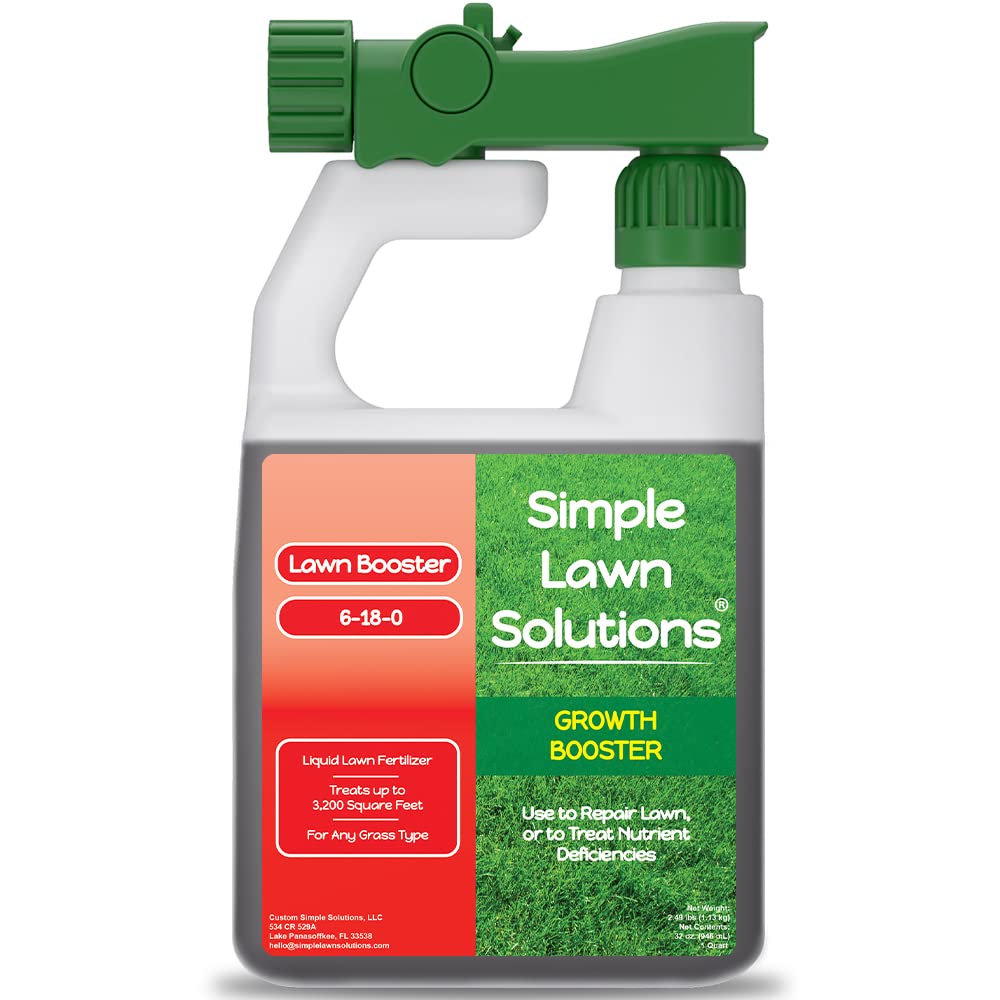
Simple Lawn Solutions Extreme Growth Booster Liquid Fertilizer (32 oz) with Humic Acid
| Item Form | Liquid |
|---|---|
| Specific Uses For Product | Establishing lawn with sod or seed, Boosting vertical and lateral growth, Addressing phosphorus nutrient deficiencies |
| Application Method | Spray |
| Coverage | 3,200 square feet |
| Target Species | all grass types |
This 32 oz ready-to-spray Growth Booster is a liquid fertilizer blended with humic acid and a 6-18 N-P ratio to help establish new sod and improve seedling vigor. You attach the hose-end sprayer and apply evenly over the lawn; the label says one bottle covers up to 3,200 square feet when mixed per instructions. The higher phosphorus content supports root development while the humic acid helps nutrient uptake and soil mineral availability, which is useful in early-stage turf establishment. For practical use it is handy because it is pre-mixed in a hose applicator and targets both vertical and lateral growth, so you can expect quicker root anchoring and thicker stands after seeding or sodding. Limitations are that it is a short-term starter treatment rather than a complete feeding program and it contains a measured N-P formulation so you may still need follow-up fertilizers tailored to seasonal needs or soil test results. Also users with very small plots may find the coverage excessive for single-application use.
Best for: Homeowners installing new sod or overseeding who want a convenient, phosphorus-rich starter treatment that speeds root establishment without complicated mixing.
Less Ideal for: Gardeners managing long-term fertility based on soil tests or those needing balanced season-long feeding should consider a dedicated program rather than a single starter concentrate.
- Ready-to-spray hose applicator simplifies application over large areas
- Contains 18% phosphorus to promote strong root development for new sod and seed
- Includes humic acid to improve nutrient uptake and soil mineral availability
- Coverage up to 3,200 square feet per bottle when used as directed
- Formulation is a starter boost only and not a full-season fertilizer plan
- May be more product than needed for small lawns or spot treatments
Verdict: A convenient, phosphorus-focused starter spray that speeds root and shoot establishment for new sod and seeded lawns.
Central Sod Starter Fertilizer 10-10-10 — Covers 600 sq ft

| Item Form | Granules |
|---|---|
| Application Method | spread |
| Coverage | 600 square feet |
| Mixing Ratio | 10-10-10 |
| Target Species | grass |
This Central Sod 10-10-10 granular fertilizer is a starter blend designed for use before laying new sod or seed. It delivers a balanced quick-release nutrient mix intended to encourage root establishment and early growth for both warm- and cool-season grasses. Typical use is straightforward: spread the product evenly over the soil with a rotary or broadcast spreader, then install sod immediately on top; there is no need to work it into the soil. The 600 square foot coverage per bag matches one pallet of sod, making it easy to measure quantities for small installs or to multiply for larger jobs. Practical benefits include immediate nutrient availability for young turf and a formulation that is safe for seed and most grass types. Limitations are that it is a quick-release formula rather than slow-release, so nutrients are available up front and will not provide long-term feeding, and the single-bag size may require buying multiple units for larger lawns.
Best for: Buyers installing new sod or seeding small lawns who want an affordable, easy-to-measure starter fertilizer that promotes early root establishment.
Less Ideal for: Homeowners looking for a long-term feeding program or a single product to cover large properties without buying multiple bags should consider other options.
- Balanced 10-10-10 formula suited for establishing new sod or seed
- Covers 600 square feet per bag, matching a standard pallet of sod for easy measurement
- Granular form works with rotary or broadcast spreaders for even application
- Quick-release nutrients provide immediate availability to young grass
- Quick-release formulation does not provide extended feeding over time
- Single 600 sq ft bag is small for larger lawns and may require multiple purchases
Verdict: A simple, budget-friendly starter fertilizer sized to match a 600 sq ft sod pallet and deliver immediate nutrients for new turf establishment.
Espoma Turf-Tone Lawn Starter Organic 4-6-3 Fertilizer, 30 lb

| Item Form | Granules |
|---|---|
| Application Method | Drop or broadcast spreader |
| Target Species | Lawn Grass |
| Mixing Ratio | 4:6:3 |
Espoma Turf-Tone Lawn Starter is an organic granular starter fertilizer designed specifically for establishing new turf, overseeding, and new sod installations. You apply it with a drop or broadcast spreader over newly seeded or sodded areas; the 4-6-3 N-P-K ratio supplies phosphorus to support root development while the Bio-tone formula and organic inputs help build soil biology. The product covers up to 3,000 sq ft per 30 lb bag and contains feather meal and poultry manure as primary ingredients, which release nutrients more slowly than synthetic starters. That slower release supports steady early growth and reduces the risk of burning young grass, but it also means you may see results over weeks rather than days. It is straightforward to use and well suited to gardeners who prefer natural inputs and predictable, low-risk establishment for new lawns. If you need very rapid green-up or a synthetic quick-release boost, pair this with an appropriate supplement instead of expecting instant results from the organic starter alone.
Best for: Buyers who prioritize reliable, low-risk establishment of new sod or seed and prefer organic, soil-building inputs for steady early root development.
Less Ideal for: Homeowners who need immediate, high-contrast green-up or who prefer fast-release synthetic fertilizers for quick visual results should consider a different product or use a supplemental quick-release feed.
- Formulated for new lawns with a starter 4-6-3 nutrient analysis to support root development
- Organic ingredients and Bio-tone formula that help build soil biology
- Granular form works with standard drop or broadcast spreaders for even application
- Covers a large area (up to 3,000 sq ft) from a single 30 lb bag
- Slower nutrient release typical of organic materials means slower visible green-up compared with synthetic starters
- Contains animal-based ingredients which may not suit strictly plant-only organic preferences
Verdict: A dependable organic starter fertilizer that promotes steady root establishment for new sod while supporting long-term soil health.
Scotts Turf Builder Starter Food for New Grass, 15 lb

| Item Form | Powder |
|---|---|
| Mixing Ratio | 24-25-4 |
| Application Method | spreader |
| Coverage | 5000 square feet |
| Specific Uses For Product | Starting |
Scotts Turf Builder Starter Food for New Grass is a 24-25-4 granular starter fertilizer designed for use when planting seed, laying sod, or installing plugs and sprigs. You apply it with a broadcast or drop spreader at planting and again 2–4 weeks later to feed roots during the first critical weeks of establishment. The high phosphate ratio is intended to promote root formation, and the bag claims coverage of up to 5,000 square feet, which makes it suitable for mid-size lawns. Typical use involves following spreader settings printed on the bag, keeping the soil surface consistently moist until seedlings reach about 2 inches, and switching to a regular lawn food after about eight weeks. Practical benefits are straightforward: stronger root development, denser turf faster than unfed turf, and compatibility with all grass types. Important limitations are that it is a powdered granular product that requires an appropriate spreader for even application and repeat application for best results, and it does not include weed control, so separate weed management may be needed.
Best for: Homeowners installing new sod or reseeding who want a proven starter fertilizer to speed root establishment and thicken turf during the first two months.
Less Ideal for: People who want a combined weed-and-feed solution or who need a liquid or no-spreader application method should consider different products.
- High phosphate 24-25-4 formula targets early root development.
- Covers up to 5,000 sq. ft. per 15 lb. bag, suitable for mid-size lawns.
- Safe for use on any grass type and can be applied at planting or immediately after.
- Simple two-application schedule (at planting and 2–4 weeks later) aligns with common lawn-establishment routines.
- Requires a broadcast or drop spreader for even coverage.
- Does not provide weed control so additional products may be needed for weed-prone sites.
Verdict: Choose this starter food if you need a straightforward, high-phosphate granular fertilizer to establish strong roots and thicker turf on newly sodded or seeded lawns.
Jonathan Green Green-Up Lawn Food for Seeding & Sodding, 12-18-8 (15 lb)

| Item Form | Granules |
|---|---|
| Application Method | spreader |
| Target Species | Grass species |
| Mixing Ratio | 12-18-8 |
| Coverage | Full |
Jonathan Green Green-Up is a granular starter fertilizer designed specifically for seeding, overseeding, and laying sod. With a 12-18-8 analysis it supplies a high phosphorus boost to encourage root formation and faster establishment of new grass. The bag includes humates and iron to improve nutrient availability and deep greening, and the granules are intended for broadcast, drop, or hand-held spreader application the same day you seed or sod. A single 15 lb bag is rated to cover up to 5,000 sq ft and feeds for about two months, which makes scheduling follow-up feedings straightforward. Practical limitations are that it contains phosphorus, so you must check local regulations before use in areas with restrictions, and it is targeted at new plantings rather than maintenance feeding for established lawns. For gardeners who want a dependable, purpose-built starter fertilizer, this product simplifies getting new sod or seedlings started quickly.
Best for: Homeowners installing new sod or overseeding who want a reliable, easy-to-apply starter fertilizer that focuses on rapid root establishment and straightforward follow-up care.
Less Ideal for: Gardeners looking for an all-season maintenance fertilizer for established lawns or for those in areas where phosphorus applications are prohibited should choose a different product.
- High phosphorus 12-18-8 formula formulated to encourage strong root development for new seedings and sod
- Granular form works with rotary, drop, or hand-held spreaders for even application
- Contains humates to improve nutrient availability and iron for deeper greening
- Feeds for up to about two months, reducing the need for immediate repeat applications
- Contains phosphorus which may be restricted by local regulations and could limit where it can be used
Verdict: Choose this high-phosphorus starter fertilizer when you need a dependable, easy-to-apply product that helps new sod and seed develop strong roots quickly.
Choosing the Right Fertilizer for New Sod: Key Factors to Consider
Nutrient Ratio and Starter Phosphorus
The balance of nitrogen, phosphorus, and potassium dictates how the sod allocates resources between top growth and root development. Higher starter phosphorus helps seedlings and transplants develop roots quickly, which is critical for sod that must knit into the soil below. Too much quick-release nitrogen can push blade growth at the expense of roots and increase mowing and disease pressure.
Look for products that list an identifiable starter phosphorus component and a reasonable nitrogen level for initial establishment. If your soil test shows adequate phosphorus, factor that into the final choice so you do not overapply.
Release Type and Feeding Schedule
Fertilizers can be quick-release, slow-release, or a blend. Quick-release materials deliver an immediate nutrient boost but raise burn risk and may require more frequent applications. Slow-release formulations provide steady feeding that supports root growth over several weeks, lowering the chance of a nutrient spike that stresses new turf.
Consider your watering routine and how often you can apply fertilizer. Slow-release or polymer-coated products are more forgiving if you cannot reapply frequently, while soluble starters work well when you plan precise, regular watering.
Formulation and Application Method
Fertilizers come as granules, water-soluble powders, or liquids. Granules are convenient for broadcast spreaders and are often easier for homeowners to store and measure. Soluble or liquid starters can give faster root-zone contact when watered in but require mixing equipment or a hose-end applicator.
Choose a format that matches your application tools and comfort level. Also consider spreader settings and calibration; inconsistent application can cause patchy rooting and uneven color.
Soil Type and pH Considerations
Soil texture and pH influence nutrient availability. Clay soils hold nutrients but can limit root penetration, while sandy soils drain quickly and may leach starter nutrients before roots can use them. Soil pH affects phosphorus availability strongly; phosphorus becomes less available in very acidic or alkaline soils.
If you have not tested your soil recently, a quick soil test will guide whether you need a phosphorus boost or pH adjustment. Adjust fertilizer selection to the soil's ability to hold and supply nutrients to avoid waste and achieve steady root development.
Application Safety and Burn Risk
New sod is more susceptible to fertilizer burn because roots are shallow and plant tissue is tender. The labeled application rate, particle solubility, and whether the product requires dilution are all factors in safety. Overapplication or applying a fast-acting, high-salt fertilizer without adequate irrigation can scorch new turf.
Follow label rates, calibrate spreaders, and plan to water in any granular or soluble product as recommended. Products that offer low-solubility or controlled-release nitrogen generally reduce the chance of burn when used correctly.
Compatibility With Watering and Lawn Care Plan
Your irrigation schedule, mowing frequency, and whether you plan to overseed or traffic the area affect which fertilizer works best. If you can maintain light, frequent watering for the first few weeks, a soluble starter can be effective. If irrigation is limited, a slow-release formulation that sustains supply over time is preferable.
Also consider how soon you will mow and how much foot traffic the new lawn will receive; some formulations tolerate early mowing better because they focus on root rather than shoot flushes.
When to Apply Fertilizer After Laying Sod
Timing matters. Many experienced gardeners apply a starter fertilizer at the time of installation or within the first week once the sod is in firm contact with the soil. This encourages roots to grow down into the soil rather than staying in the sod layer. Avoid applying anything too strong immediately if you see sod that is already stressed or very dry.
- Apply light, starter-focused feeding at installation or within 7 days.
- Water in granular starters lightly after application to move nutrients into the root zone.
- Delay any heavier nitrogen feeding until the sod shows new root growth and consistent leaf turgor.
How to Calibrate and Use a Spreader
Proper spreader calibration prevents patchy feeding and reduces burn risk. Use the spreader setting recommended by the fertilizer label and weigh a trial application on a small area to confirm coverage. Walk at a consistent pace and overlap passes correctly to avoid stripes.
- Follow label spreader settings and check distribution pattern before full application.
- Use lighter settings for new sod and increase only when the turf is established.
- Clean the spreader after use to prevent corrosion and maintain accuracy.
Watering Strategies That Aid Establishment
Irrigation is essential for establishing new sod and for helping fertilizer reach the root zone. In the first two weeks, aim for frequent, light waterings that keep the turf moist but not saturated. That encourages downward root growth without puddling or wash-off. Adjust the schedule for weather, soil type, and slope to prevent runoff.
- Start with several short waterings per day to keep sod moist.
- Reduce frequency and increase depth as roots reach down into the soil.
- Avoid heavy single waterings right after a concentrated granular application unless the label directs thorough irrigation.
Interpreting a Soil Test for Starter Needs
A basic soil test will tell you phosphorus and pH levels, which are crucial for deciding whether a separate starter treatment is necessary. If phosphorus is already adequate, choose a balanced establishment program and do not add more phosphorus than the test recommends. If the soil is deficient, a starter with accessible phosphorus will make a real difference.
- Collect samples from several areas and follow the lab instructions for sampling depth.
- Use the test to adjust both fertilizer type and rate, and to identify any pH amendments needed.
- Re-test periodically to track how quickly the new lawn is changing soil nutrient status.
Environmental and Local Regulations to Watch
Many areas have rules limiting phosphorus application or timing of fertilizer use to protect waterways. Check local regulations before applying any starter fertilizer, since restrictions can dictate the types of products and timing you are allowed to use. Even where regulations are lenient, good practice is to match applications to actual turf need rather than routine schedules.
- Avoid applying phosphorus where it is not needed or where runoff risk is high.
- Follow any seasonal or buffer-zone restrictions in your region.
- Keep records of applications in areas with regulatory requirements.
How We Chose the Best Fertilizer for New Sod
We prioritized products and formulations that explicitly support root establishment and gentle early growth, focusing on specifications gardeners can verify on packaging and labels. Key evaluation criteria included nutrient ratio and starter phosphorus levels, granule or liquid formulation and how that affects application, release type and timing for steady feeding, and carrier additives such as wetting agents or humates that improve early root contact. Application safety and burn risk were assessed based on recommended rates and solubility. We also considered ease of measurement and spreader compatibility so that homeowners and pros can apply the product accurately. We excluded any formulations intended only for established lawns, high-nitrogen turf fertilizers meant for late-season greening, and products that require specialist licensing or complex mixing. Products missing clear application instructions or nutrient guarantees were not considered. The picks reflect options suitable for a range of soils and irrigation setups, with an eye toward predictable rooting outcomes and practical handling in a real yard.
FAQ
Can I use a regular lawn fertilizer on newly laid sod?
Often it depends. Regular maintenance fertilizers can be too high in quick-release nitrogen for new sod. Choose products formulated or indicated for establishment with a starter phosphorus level or use a blended program that avoids excessive nitrogen early on.
How soon after installing sod can I water and mow?
Water immediately after installation to remove air pockets and keep the root zone moist. Mowing is usually safe once the sod is firmly rooted and the blades reach the recommended height. Avoid heavy mowing in the first couple of weeks to reduce stress on young roots.
Will a starter fertilizer prevent transplant shock for sod?
A starter fertilizer with accessible phosphorus and appropriate nitrogen can reduce transplant stress by promoting root growth. It does not eliminate all stressors; proper soil contact, watering, and handling of the sod are also necessary for successful establishment.
Do I need to adjust fertilizer choice for sandy soil?
Yes. Sandy soils leach nutrients more quickly, so a fertilizer with some slow-release nitrogen or split applications will help maintain supply. Also consider soil amendments that improve water and nutrient retention alongside your fertilizer strategy.
Is phosphorus always necessary for new sod?
Not always. Phosphorus supports root development, but if a soil test shows sufficient phosphorus, additional amounts offer little benefit and can contribute to runoff issues. Use test results to guide whether a starter phosphorus boost is necessary.
How much risk is there of burning new sod with fertilizer?
There is moderate risk if a high-salt, quick-release fertilizer is overapplied or not watered in properly. Following label rates, using controlled-release formulations, and ensuring light irrigation after application minimize burn risk.
Final Verdict
Choose a fertilizer for new sod that prioritizes root establishment, predictable nutrient release, and application safety. Match starter phosphorus to your soil test, prefer formulations that fit your watering routine, and keep early nitrogen modest to avoid excessive top growth. Balancing these tradeoffs will help the sod root in quickly while minimizing risk of burn or disease. Focus on the practical criteria discussed here to pick a product that fits your soil, irrigation capacity, and timeline for a healthy, established lawn.
