

Note: This article contains affiliate links. If you click on these links and make a purchase, I may earn a small commission at no extra cost to you. This helps support my research and content. Read my full affiliate disclosure here.
Choosing the right lawn seed fertilizer matters because the first few weeks after seeding determine how dense and durable your new turf becomes. The right formula helps seeds sprout quickly, protects fragile seedlings from stress, and supplies nutrients in the pattern young grass needs. This guide highlights six top options that gardeners commonly shortlist for seeding or overseeding projects. We evaluate products on how they affect germination rate, early root development, and nutrient delivery during that critical establishment window. Scroll on for focused guidance to match a fertilizer to your soil, climate, and seeding method.
Top Picks at a Glance
| Best Overall The best all-around choice for most situations | Scotts Turf Builder Starter Food for New Grass, 15 lb |  |
| Best Quality Built to a higher standard if you want something more solid | Scotts Turf Builder Thick'R Lawn Sun & Shade, 40 lb |  |
| Best Value The sweet spot between price and what you get | Scotts EZ Seed Patch & Repair Sun and Shade, 3.75 lb |  |
| Best Budget The cheapest option that still gets the job done reliably | Pennington Kentucky 31 Tall Fescue Grass Seed, 3 lb |  |
| Highest Rated A top-rated pick with lots of positive feedback | Lawn Synergy Starter Fertilizer 15-20-10 (50 lb) for New Seed and Sod |  |
| Most Popular A crowd favorite that many people choose with confidence | Scotts Turf Builder Grass Seed Sun & Shade Mix, 5.6 lb |  |
Scotts Turf Builder Starter Food for New Grass, 15 lb

| Item Form | Powder |
|---|---|
| Application Method | spreader |
| Coverage | 5000 square feet |
| Specific Uses For Product | Starting |
| Mixing Ratio | 24-25-4 |
Scotts Turf Builder Starter Food for New Grass is a granular starter fertilizer formulated specifically for use when planting new lawns, installing sod, or seeding patches. Its 24-25-4 NPK mix emphasizes phosphate to encourage root development from day one. Typical use is two light applications: at planting and again 2–4 weeks later, applied with a broadcast or drop spreader and followed by regular watering to keep the seedbed moist. In practice the product covers up to 5,000 sq. ft. per 15 lb bag and is easy to broadcast with common spreaders using the settings recommended on the bag. The clear instructions and seed-safe formula make it a low-risk choice for beginners and experienced gardeners alike. Limits to keep in mind are that it is a starter-specific feed designed for the first 6–8 weeks of establishment rather than long-term maintenance fertilizer, and you will need to switch to a regular lawn food after establishment for ongoing feeding. Also it is a dry granular product so even coverage depends on correct spreader setup and application technique.
Best for: Homeowners planting a new lawn or repairing seeded areas who want a proven, easy-to-use starter fertilizer to speed establishment and build stronger roots.
Less Ideal for: Gardeners looking for a year-round feeding product or those who need a liquid or slow-release maintenance fertilizer for established lawns.
- High-phosphate 24-25-4 formula to promote early root development
- Designed for immediate use at planting and safe for all grass types
- Covers up to 5,000 sq. ft. per 15 lb bag, suitable for mid-size lawns
- Clear spreader settings and straightforward two-application schedule
- Widely used and well-documented directions for seeding success
- Intended only as a starter feed so it is not a complete long-term lawn fertilizer
- Performance depends on even application with a spreader and proper watering
Verdict: Use this starter food when planting seed or sod to give new grass a strong, phosphate-rich boost for faster, thicker establishment.
Scotts Turf Builder Thick'R Lawn Sun & Shade, 40 lb

| Included Components | Grass Seed, Plant Fertilizer |
|---|---|
| Item Type Name | Thick'R Lawn Sun and Shade |
| Unit Count | 640 Ounce |
| Sunlight Exposure | Full Sun |
| Soil Type | Loam Soil |
Scotts Turf Builder Thick'R Lawn Sun & Shade is a ready-to-use overseeding product that mixes seed, fertilizer, and soil improver for one-pass application to thin lawns. It is typically applied with a broadcast spreader after mowing and raking, then watered daily until seedlings establish. Notable features include the integrated fertilizer for faster greening and a soil-improver component aimed at better root development, plus coverage sufficient for larger yards when applied at the recommended rate. In practice this simplifies renovation projects because you do not need separate seed and starter fertilizer products and instructions guide timing and watering for best results. Important limitations are that success depends heavily on prep and consistent watering for the first two weeks, and it is intended for overseeding rather than establishing a brand-new lawn from bare soil. Users should also plan to use a calibrated spreader for even distribution and expect variable results depending on existing turf condition and local climate.
Best for: Buyers focused on measurable lawn improvement who want a simplified, performance-oriented overseeding solution to thicken existing turf in sun and partial shade.
Less Ideal for: Not the best choice for people starting a brand-new lawn from bare soil or those who cannot commit to daily watering and lawn prep during establishment.
- 3-in-1 formula combines seed, fertilizer, and soil improver for one application
- Formulated for sun and shade areas so it suits mixed-light lawns
- Covers a large area per 40 lb bag, reducing trips to purchase multiple products
- Requires daily watering for about two weeks to achieve germination and good results
- Designed for overseeding thin turf rather than starting a new lawn from bare ground
Verdict: Choose this product when you want a single, performance-focused overseeding treatment that combines seed and fertilizer to thicken an existing lawn with minimal product juggling.
Scotts EZ Seed Patch & Repair Sun and Shade, 3.75 lb

| Item Form | plant_seed |
|---|---|
| Unit Count | 64 Ounce |
| Coverage | Covers up to 85 sq. ft. |
Scotts EZ Seed Patch & Repair combines sun-and-shade grass seed, continuous-release lawn food, and a super-absorbent mulch in a single 3-step kit for repairing bare spots. You prep the bare area, sprinkle the mix so seed and bare soil are both visible, then water until the mulch darkens; the mulch expands to surround seeds, signals when to water, and the tackifier helps reduce seed wash-away. The included fertilizer feeds new seedlings for steady early growth and the protectant aims to reduce disease risk. This product is intended for targeted patching rather than full-lawn overseeding, and works best when temperatures are consistently 60 to 80°F. Practical benefits include simple application, built-in moisture retention that lowers frequency of watering, and coverage for sun, dense shade, high-traffic spots, and slopes. Limitations are that the jug is sized for small repair areas only and success still depends on proper site prep and follow-up watering and foot traffic control while seedlings establish.
Best for: People who want a quick, low-fuss solution to repair small bare patches and are focused on efficient, practical lawn maintenance.
Less Ideal for: Homeowners planning to overseed an entire lawn or those who prefer granular seed-only mixes for custom overseeding strategies should consider other options.
- All-in-one formula with seed, timed-release fertilizer, mulch and tackifier for easier patching
- Mulch changes color to indicate when to water, helping establish consistent moisture
- Formulation designed for both sun and dense shade and for high-traffic areas and slopes
- Pack size is intended for spot repairs and does not replace a full overseeding product
- Requires proper soil prep and consistent watering to achieve best results
Verdict: Buy this if you want a simple, all-in-one patch-and-repair product that makes fixing small bare spots fast and reliable.
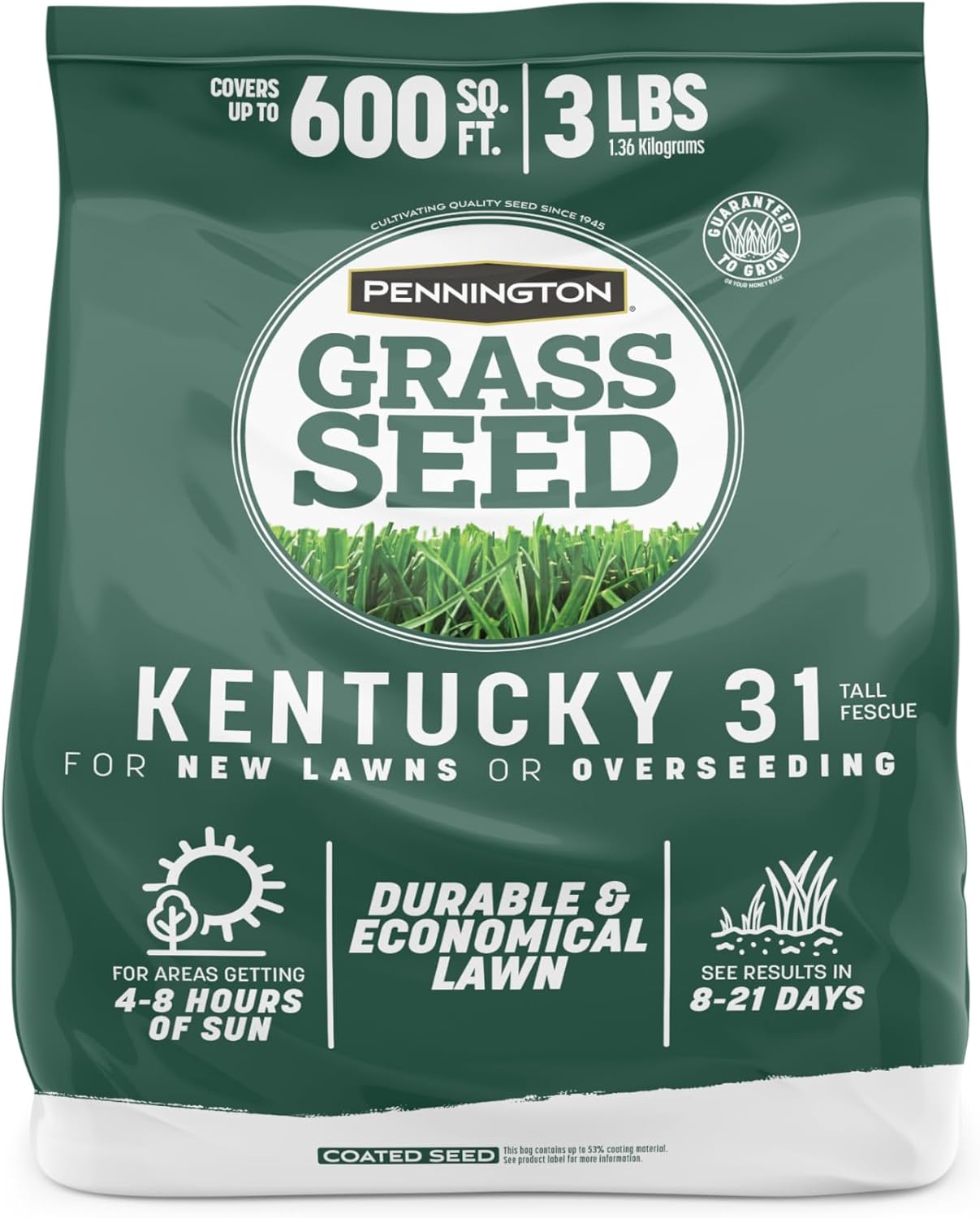
Pennington Kentucky 31 Tall Fescue Grass Seed, 3 lb
| Seed Treatment Method | Coated |
|---|---|
| Sunlight Exposure | 4-8 Hours of Sun |
| Moisture Needs | Regular Watering |
| USDA Hardiness Zone | 1, 2, 3, 4, 5, 6, 7, 8 |
| Expected Planting Period | Spring |
Pennington Kentucky 31 is a straightforward tall fescue seed for establishing or overseeding cool-season lawns. It is typically sown in early spring or early fall and germinates within roughly 8 to 21 days, making it useful for patching bare spots or covering larger areas. The seed is penkoted, which helps handling and establishment, and the variety is noted for heat, drought, and traffic tolerance so it performs well with regular but not excessive care. The bag size covers up to 4,000 sq. ft. for overseeding or 1,660 sq. ft. for a new lawn, so one purchase can stretch across modest yards. Limitations include that Kentucky 31 is a coarser, traditional tall fescue that can look less fine-textured than newer turf-type fescues and it prefers 4 to 8 hours of sun, so very shady sites will be a poor match. Expect a durable, low-maintenance lawn rather than a manicured, golf-course appearance.
Best for: Buyers who want an economical, durable seed to repair or overseed cool-season lawns and prioritize hardiness and low maintenance over a fine-textured look.
Less Ideal for: Gardeners seeking a fine-textured, ornamental turf or working with dense shade should consider finer turf-type fescues or shade-specific mixes instead.
- Penkoted seed simplifies spreading and improves establishment chances
- Good tolerance for heat, drought, and heavy foot traffic
- Covers large areas from a single 3 lb bag for overseeding or patching
- Works in a wide USDA zone range (Zones 1–8)
- Coarser texture compared with modern turf-type tall fescues, so less fine lawn appearance
- Performs best with 4–8 hours of sun and regular watering, so not ideal for deep shade
Verdict: A cost-conscious choice for homeowners who need a tough, low-maintenance tall fescue to repair or overseed cool-season lawns.
Lawn Synergy Starter Fertilizer 15-20-10 (50 lb) for New Seed and Sod

| Mixing Ratio | 15:20:10 |
|---|---|
| Item Form | Granules |
| Application Method | broadcast spreader |
| Coverage | 12,000 sq.ft. |
| Specific Uses For Product | Plant Growth, Root Development, Seed Development |
This Lawn Synergy 15-20-10 starter fertilizer is built for establishing new grass from seed or fresh sod by delivering a high-phosphorus blend plus a mix of slow- and fast-release nitrogen. It is applied with a broadcast or rotary spreader at about 5 lbs per 1,000 sq ft and lightly watered to move nutrients into the root zone. Notable features include XCU polymer-and-sulfur coated slow-release nitrogen for steady feeding up to 10 weeks, ammonium sulfate for quick early green-up, and added micronutrients to help young turf handle stress. The practical benefit is predictable, staged nutrition during the critical germination and root-development window so seedlings get both immediate and sustained nutrient availability. Limitations to note are the product form and application method: as a granule it requires an appropriate spreader for even coverage and handling a 50 lb bag can be bulky for small properties. Also this formula is specifically a starter blend and is not intended as a long-term maintenance feed.
Best for: Homeowners and landscapers who want a reliable, staged nutrient program to establish new lawns from seed or fresh sod and prioritize a predictable early-season response.
Less Ideal for: People who need an all-season maintenance fertilizer or who prefer liquid or pelletized feeds for spot treatments should look at alternate products.
- High phosphorus 15-20-10 ratio supports early root growth and strong germination
- XCU slow-release nitrogen provides up to 10 weeks of steady feeding
- Includes fast-acting ammonium sulfate for quick color and initial growth response
- Contains micronutrients to improve seedling stress tolerance and even establishment
- 50 lb bag is bulky to handle and may be inconvenient for very small yards
- Granular form requires a broadcast or rotary spreader for consistent application
Verdict: Choose this starter fertilizer when you need dependable, staged nutrition to get seed or sod established quickly and with steady early growth.
Scotts Turf Builder Grass Seed Sun & Shade Mix, 5.6 lb

| Indoor Outdoor Usage | Outdoor |
|---|---|
| Other Special Features of the Product | Medium Drought Tolerant, combination seed fertilizer soil improver |
| Sunlight Exposure | Full Sun |
| Expected Planting Period | Spring |
| Seed Treatment Method | Scotts Spreader |
Scotts Turf Builder Sun & Shade Mix is a ready-to-use lawn seed blend that also includes fertilizer and soil-improving ingredients to help new lawns or overseeded turf establish faster. You spread it with a broadcast or hand spreader, lightly rake it into the topsoil, and keep the area consistently moist; germination is expected in about 6 to 12 days with visible fill-in by five to seven weeks. The mix includes several cool-season grasses aimed at sun and partial shade, and the Root-Building Nutrition helps seedlings develop deeper roots for greater durability and medium drought tolerance. Practical benefits include built-in feed so you do not need a separate starter fertilizer and label guidance for spreader settings to get even coverage. Limitations are that it is optimized for spring or fall applications within a specific temperature range and requires regular watering and follow-up care to achieve the advertised results. Coverage figures are provided on the bag so you can plan how many bags you need for new lawn versus overseeding projects.
Best for: Homeowners who want a low-fuss seed option that pairs seed with starter nutrition and clear application guidance, especially for repairing or overseeding cool-season lawns in spring or fall.
Less Ideal for: Those planting warm-season grasses, gardeners who cannot water daily during establishment, or buyers needing instant erosion control on steep slopes.
- Combination formula: seed plus fertilizer and soil improver reduces need for separate starter products
- Root-Building Nutrition promotes deeper root development for improved durability
- Formulated for both full sun and moderate shade so it works across varied yard light conditions
- Clear application guidance and spreader settings on the label for even coverage
- Requires consistent watering and specific temperature windows for best germination
- Coverage per bag may be insufficient for larger lawns, requiring multiple bags
Verdict: Choose this mix if you want a bundled seed plus starter nutrition that helps establish deeper roots for a thicker cool-season lawn in sun and partial shade.
Choosing the Right Lawn Seed Fertilizer: Key Factors to Consider
N-P-K Ratio and Starter Nutrients
The N-P-K ratio is the fastest way to gauge whether a fertilizer is suited for seeding. Young grass benefits from higher phosphorus relative to mature turf because phosphorus supports root initiation and early root growth. Look for starter blends that emphasize available phosphorus while keeping nitrogen moderate to prevent excessive top growth before roots establish.
Secondary nutrients like calcium and magnesium matter when soil tests show deficiencies. Micronutrients such as iron and manganese are useful in small amounts to promote color but are not substitutes for a proper starter N-P-K profile. A clear label with guaranteed analysis helps you match the product to your soil and seeding goals.
Controlled Release Versus Quick-Release
Controlled-release carriers smooth nutrient delivery over several weeks, reducing the risk of burning fragile seedlings and limiting nutrient spikes that favor leaf over root. For seeding, a blend that offers an initial readily available fraction plus a slower-release portion often works best. The quick-release portion helps seedlings get an early dose, while the controlled-release maintains supply until you can transition to regular lawn feeders.
Avoid formulations that are pure fast-acting salts unless the instructions explicitly say they are safe for new seed. The balance between soluble and coated nutrients determines both safety and the frequency of follow-up feeding.
Salt Index and Seedling Safety
New grass seedlings have limited tolerance for soluble salts in fertilizer. Products with a high salt index can draw moisture away from young roots and damage emerging leaves. That effect is especially pronounced in warm, dry conditions or sandy soils that drain quickly.
Choose seed-friendly formulations with low-soluble-salt claims or ones designed for starter use. If you must use a conventional fertilizer, reduce the application rate and water lightly after spreading to dilute salts and protect seedlings.
Particle Size and Spreadability
Uniform coverage at the recommended application rate is critical when seeding large areas. Pellet size and granule uniformity affect how evenly a spreader distributes product. Very coarse or irregular granules can cause patchy nutrient distribution, which translates into uneven germination and growth.
Consider whether you will use a broadcast spreader, drop spreader, or hand application. Some seed-and-fertilizer blends are designed to combine with seed and require specific spreader settings. Packaging that lists spreader settings by model or by grams per square meter simplifies accurate application.
Application Timing and Compatibility with Seed
Timing determines whether nutrients are available when seedlings need them most. Many starter fertilizers are designed to be applied at seeding or immediately after sowing to ensure roots encounter nutrients as they germinate. In some cases, a light topdressing after sowing prevents seed-to-fertilizer contact that can harm seedlings.
Compatibility with your chosen seed species is also important. Cool-season grasses and warm-season grasses have different early growth dynamics and nutrient needs. Follow guidance for seed type and consider splitting applications: a starter at seeding and a follow-up feed a few weeks later once shoots and roots have established.
Preparing Soil Before Seeding
Testing your soil pH and nutrient levels before seeding removes guesswork and helps you choose the right starter fertilizer. Most turf grasses prefer slightly acidic to neutral pH; if pH is far outside the optimum range, fertilizer alone will not correct root issues.
Incorporate organic matter and correct major deficiencies before sowing. If compaction is present, core aeration followed by topdressing creates better seed-to-soil contact and allows fertilizer nutrients to reach emerging roots more effectively.
- Take a soil test 4 to 6 weeks before seeding
- Adjust pH and major nutrient gaps prior to sowing
- Fix compaction and improve seedbed with light tilling or aeration
Application Methods for Seeding
There are two common approaches: broadcast an even layer of starter fertilizer across the seedbed, or mix a proportionate amount with the seed before spreading. Broadcasting reduces direct seed-to-fertilizer contact but requires careful calibration of your spreader.
If mixing with seed, use only products explicitly labeled for seed-and-fertilizer mixes and follow recommended ratios. After applying fertilizer, water gently to settle seed and begin germination without washing nutrients away.
- Use spreader settings or weight-based rates for accuracy
- Avoid over-application near walkways and foundations
- Water lightly and consistently after application
Watering Strategies During Establishment
New seed needs consistent moisture to germinate. Shallow, frequent watering keeps the seed zone moist without causing runoff. As seedlings emerge, gradually transition to deeper, less-frequent watering to encourage root penetration.
Monitor weather and soil moisture. In hot, dry spells increase watering frequency; in cool, wet periods reduce it to prevent rot and disease. Proper watering works hand-in-hand with fertilizer choice: too much water can leach soluble nutrients, while too little can concentrate salts around tender roots.
- Keep top 1/4 to 1/2 inch of soil consistently moist until seedlings establish
- Move to longer, deeper cycles as roots reach 2 to 3 inches
- Water in the early morning when possible to reduce disease risk
Starter Fertilizer and Overseeding
When overseeding an existing lawn, you need to balance feeding new seedlings without overstimulating established grass. Choose blends with moderate nitrogen and adequate phosphorus to support root growth for the new plants while minimizing excess top growth on older turf.
Adjust application rates downward when overseeding to avoid smothering seed with too much fertilizer or creating a harsh salt environment. Light raking after application helps seed make contact with the soil and improves establishment.
- Reduce rates compared with full renovation seeding
- Focus on even distribution to avoid bare patches
- Consider split applications: light starter at seeding, follow-up feed after establishment
Environmental Considerations and Runoff Risk
Fertilizer applied to lawns can run off into storm drains and waterways if applied before heavy rain or used in excessive amounts. Use slow-release formulas and follow local guidelines for timing to minimize environmental impact.
Leave a buffer strip near water bodies and paved surfaces and sweep any granules off hard surfaces back onto the lawn. Responsible application preserves water quality and reduces waste of product while still supporting healthy turf establishment.
- Avoid application before heavy rain
- Use low-solubility formulations near slopes and water
- Follow local fertilizer ordinances and recommendations
How We Chose the Best Lawn Seed Fertilizer
We prioritized criteria that directly affect seed-start success and early turf health. Germination support was a top filter, favoring products with nutrient ratios and starter blends formulated to encourage quick sprouting and initial leaf growth. Root development and phosphorus availability were assessed because strong early roots reduce transplant shock and improve drought resistance. Nutrient release pattern was a third criterion: slow-release carriers or controlled-release components reduce burn risk and provide steady feed during establishment. Ease of application and coverage calculations mattered for real-world lawn projects where uniform spreading is needed. Finally, salt index and seedling safety were considered to exclude high-salt or overly concentrated formulations that can inhibit delicate seedlings. We excluded products intended only for established lawns, turf fungicides, or mixes formulated for ornamental beds rather than grass. We also filtered out fertilizer blends lacking clear N-P-K profiles or instructions for seeding use. The remaining picks met the practical needs of gardeners starting lawns: clear application guidance, seedling-safe nutrient balances, and formulations aimed at supporting both germination and early root growth.
FAQ
When should I apply starter fertilizer relative to sowing seed?
Apply starter fertilizer at sowing or immediately after spreading seed so nutrients are available as roots begin to form. If you are concerned about seed-to-fertilizer contact, broadcast the fertilizer first or use a light topdressing to separate seed from granules.
Can I use regular lawn fertilizer for new seed?
Sometimes, but many regular lawn fertilizers are formulated for established turf and may be too high in soluble salts or nitrogen for seedlings. Use products labeled for starter use or reduce the application rate and water well after applying to reduce salt stress.
How often should I feed new grass after the initial starter application?
Typically plan a follow-up feeding four to eight weeks after the starter, once seedlings have developed a stronger root system. The exact timing depends on the fertilizer release pattern and how quickly the grass is growing.
Does phosphorus always improve seedling establishment?
Phosphorus supports root development and often helps establishment, but its benefit depends on existing soil levels. If a soil test shows adequate phosphorus, additional phosphorus offers little advantage and could be unnecessary.
How much fertilizer will I need for a typical yard?
Required amounts depend on product concentration and coverage rates. Check the label for pounds per 1,000 square feet or grams per square meter and calculate your lawn area. Using spreader settings or weight-based measurements ensures accurate coverage.
Final Verdict
Focus on matching a seed-safe nutrient profile and an appropriate release pattern to the scale and timing of your seeding project. Prioritize formulations that encourage root development, have a low salt index, and offer clear application guidance so you can apply uniformly. Balance early nutrient support with careful watering and soil preparation to give new grass the best chance to establish quickly and evenly.
