

Note: This article contains affiliate links. If you click on these links and make a purchase, I may earn a small commission at no extra cost to you. This helps support my research and content. Read my full affiliate disclosure here.
If you mow medium to large lawns or struggle with fatigue on slopes, a self driven lawn mower can make yard care faster and less tiring. This guide focuses on the best self driven lawn mowers for typical residential and large suburban yards, highlighting models that reduce physical effort while delivering a consistent cut. We shortlisted seven top options and evaluated them on cutting performance, drive system reliability, handling on slopes, and maintenance needs. Read on to understand the practical tradeoffs and which mower features will matter most for your lawn and routine.
Top Picks at a Glance
| Best Overall The best all-around choice for most situations | EGO POWER+ 21" Select Cut Self-Propelled Cordless Lawn Mower (LM2135SP) with 7.5Ah Battery |  |
| Best Quality Built to a higher standard if you want something more solid | Greenworks 80V 21" Self-Propelled Lawn Mower with 4.0Ah Battery and Charger |  |
| Best Value The sweet spot between price and what you get | Wild Badger Power 40V 21" Cordless Self-Propelled Lawn Mower with Two 40V 4.0Ah Batteries |  |
| Best Budget The cheapest option that still gets the job done reliably | Rodiuiu 131cc Self-Propelled Foldable Gas Lawn Mower, 18-inch 3-in-1 |  |
| Highest Rated A top-rated pick with lots of positive feedback | Bdujhit 20-inch Self-Propelled Gas Lawn Mower, 140cc OHV Engine, 3-in-1 |  |
| Most Popular A crowd favorite that many people choose with confidence | SENIX 201cc 22" 3-in-1 Variable Speed Self-Propelled Gas Lawn Mower |  |
| Best Seller A high-volume bestseller chosen again and again | Greenworks 60V 21" Self-Propelled Lawn Mower with (2) 4.0Ah Batteries |  |
EGO POWER+ 21" Select Cut Self-Propelled Cordless Lawn Mower (LM2135SP) with 7.5Ah Battery

| Power Source | Battery Powered |
|---|---|
| Number of Positions | 7 |
| Maximum Adjustable Cutting Height | 4 inches |
| Minimum Adjustable Cutting Height | 1.25 inches |
| Battery Included | 7.5Ah 56V |
The EGO POWER+ LM2135SP is a battery-powered, self-propelled walk-behind mower designed for homeowners who want gas-level performance without the fuss of fuel. It uses a 56V 7.5Ah ARC Lithium battery and a brushless motor to deliver up to 7.0 ft-lbs of cutting torque and about 60 minutes of runtime on a single charge. The Select Cut system includes interchangeable lower blades for mulching, bagging, or extended runtime, and an upper blade for consistent finish. Touch Drive technology lets you engage and vary ground speed with a fingertip dial and palm pressure for easier control on slopes or larger yards. Practical touches include eight height positions from 1.25 to 4 inches, a two-bushel grass collection bag, LED headlights for low-light mowing, and a rapid charger that refills the battery in about an hour. The mower is metal-built and comes with a five-year limited warranty. Trade-offs are typical for cordless mowers: runtime depends on grass conditions and using higher torque settings or bagging will reduce run time, and the unit is heavier than basic push mowers because of the battery and self-propel system.
Best for: Homeowners who want a capable, low-maintenance mower that balances power, runtime, and user-friendly controls for regular front- and back-yard maintenance.
Less Ideal for: People with very small yards who prefer a lightweight push mower or users who need continuous all-day mowing for large commercial properties.
- Strong cutting torque and high-efficiency brushless motor for near gas-level performance
- Select Cut multi-blade system allows quick switching between mulching, bagging, and longer-run blades
- Touch Drive self-propel system with fingertip speed control improves maneuverability and reduces fatigue
- Included 7.5Ah battery and rapid charger deliver about 60 minutes runtime and fast recharge
- LED headlights and a two-bushel collection bag add convenience for early or late mowing sessions
- Actual runtime varies by grass height, terrain, and cut mode so heavy jobs may need a second charge or slower pace
- Heavier than basic push mowers due to battery and self-propel mechanism
Verdict: Choose the EGO LM2135SP if you want a cordless, self-propelled mower that delivers near-gas power with flexible cutting options and convenient fingertip speed control.
Greenworks 80V 21" Self-Propelled Lawn Mower with 4.0Ah Battery and Charger

| Power Source | Battery Powered |
|---|---|
| Battery Average Life | 2 hours |
| Number of Positions | 7 |
| Cutting width | 20.28 inches |
This Greenworks 80V self-propelled mower delivers gas-equivalent cutting power without the noise and fuss of a gas engine. The brushless motor provides strong torque for slicing through thick or overgrown grass, while the 21" steel deck and 7-position height adjustment let you tailor the cut from low to tall turf. It is typically used for weekly mowing of up to roughly half an acre on varied terrain; the rear-wheel drive and variable speed control help maintain traction and control on slopes. Notable features include the included 4.0Ah battery and rapid charger, LED headlight for low-light starts, and a 4-in-1 cutting system that supports mulching, side discharge, and bagging. Practical benefits are quieter operation, compatibility with the 80V battery ecosystem, and reduced maintenance compared with gas mowers. Important limitations are battery runtime will vary with grass conditions and the stated 2-hour average life depends on battery capacity and load, and the unit is heavier than comparable push mowers which may affect storage and handling.
Best for: A homeowner who prioritizes strong, reliable cutting performance and wants a cordless, low-maintenance replacement for a gas mower for medium-sized lawns and varied terrain.
Less Ideal for: Budget buyers who need a lightweight, ultra-compact push mower or those with very large properties who prefer extended run time without swapping batteries.
- Brushless 80V motor for higher torque and efficient cutting
- Self-propelled rear-wheel drive with variable speed for easier maneuvering on slopes
- Includes 4.0Ah battery and rapid charger so it is ready to use out of the box
- 21" steel deck with 7-position height adjustment for versatile cutting options
- LED headlight enables early morning or evening mowing
- Actual runtime depends on grass density and terrain so larger lawns may require spare batteries
- Heavier than typical push mowers which can make lifting and transporting more awkward
Verdict: Choose this mower if you want near-gas power and easy self-propelled handling in a quieter, cordless package that works with an 80V tool ecosystem.
Wild Badger Power 40V 21" Cordless Self-Propelled Lawn Mower with Two 40V 4.0Ah Batteries

| Power Source | Battery Powered |
|---|---|
| Cutting width | 21 inches |
| Number of Positions | 7 |
| Maximum Adjustable Cutting Height | 3.55 inches |
| Includes Batteries | 2× 40V 4.0Ah |
The Wild Badger Power 40V 21" self-propelled mower is built to cover medium-to-large yards with less effort. Its 21-inch brushless deck and 3,200 RPM motor reduce the number of passes, while the variable-speed self-propelled drive lets you match forward speed to your walking pace for easier work on longer runs and gentle slopes. The mower includes two 40V 4.0Ah batteries and a fast charger so you can swap packs for extended runtime and mow roughly up to 6,500 sq ft under typical conditions. Seven height positions (1.18 to 3.55 inches) and four grass-handling modes (bag, mulch, side and rear discharge) give real flexibility for seasonal changes and different cleanup needs. Practical buyers will appreciate the brushless motor durability and the dual-battery system that supports other 40V tools. Expect the unit to be heavier than push-only models and that actual runtime will vary with grass density and terrain, so very large or extremely hilly properties may need additional battery capacity or staged charging.
Best for: Practical homeowners who want to finish medium-to-large lawns faster with less physical effort and value interchangeable battery power that can be used across tools.
Less Ideal for: People with very small yards who prioritize minimal storage weight or users with steep, rugged terrain where a more powerful gasoline mower might be preferable.
- 21-inch brushless deck covers more ground per pass for faster mowing
- Self-propelled variable-speed drive reduces pushing effort on long runs and gentle slopes
- Includes two 40V 4.0Ah batteries and fast charger for extended runtime without buying extras
- Seven cutting heights and 4-in-1 clipping options for flexible lawn finishes
- Relatively heavy compared with push-only electric mowers which can make loading or storage harder
- Runtime and area per charge vary significantly with grass conditions and terrain
Verdict: A practical self-propelled 21-inch cordless mower that speeds up mowing on medium-to-large lawns while cutting effort with a two-battery system.
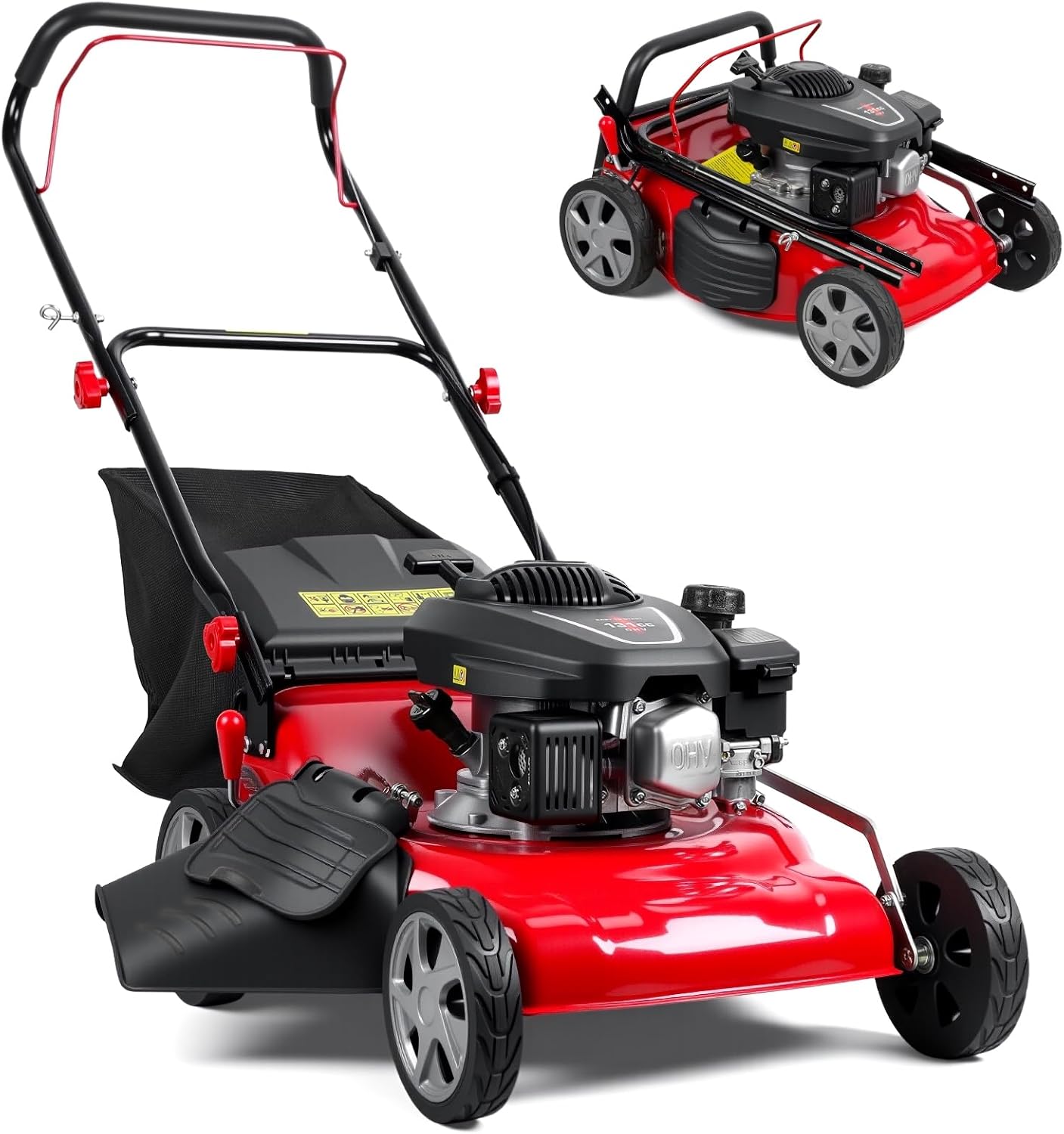
Rodiuiu 131cc Self-Propelled Foldable Gas Lawn Mower, 18-inch 3-in-1
| Power Source | Gas Powered |
|---|---|
| Cutting width | 18 inches |
| Number of Positions | 8 |
| Operation Mode | Automatic |
This Rodiuiu mower is a value-oriented, self-propelled gas mower built around a 131cc OHV 4-stroke engine and an 18-inch 3-in-1 steel deck. It is typically used for routine lawn maintenance on small to medium yards where a compact, gas-powered machine is preferred over battery models. Notable features include a foldable frame for easier storage and transport, an 8-position single-lever height adjustment to change cut from about 1 to 3 inches, and a large 50L grass bag for longer runs between stops. Practical benefits are reliable continuous power without recharging, reasonably wide cutting width for quicker passes on modest lawns, and the convenience of mulching, side discharge, or bagging depending on season and grass conditions. Important limitations are its smaller 18-inch cutting width compared with commercial mowers, which makes it slower on large properties, and the usual maintenance demands of gas engines such as fuel, oil, and periodic tune-ups. Expect straightforward performance for budget-focused homeowners who need a gas mower that stores compactly.
Best for: Buyers looking for a low-cost, gas-powered self-propelled mower for small to medium yards who prioritize continuous power and compact storage over premium features.
Less Ideal for: Owners of large properties or commercial users who need wider cutting decks and faster coverage should consider larger or professional models instead.
- 131cc OHV 4-stroke engine provides continuous gas-powered performance without battery limits
- Self-propelled drive reduces effort on slopes and longer lawns
- Foldable design saves storage space and eases transport
- 3-in-1 steel deck allows mulching, side discharge, or rear bagging for seasonal flexibility
- Single-lever 8-position height adjustment lets you change cutting height quickly
- 18-inch cutting width makes mowing large lots slower than wider commercial models
- Gas engine requires regular fuel, oil, and maintenance
Verdict: A compact, budget-friendly self-propelled gas mower that delivers reliable continuous power and easy storage for small to medium yards.
Bdujhit 20-inch Self-Propelled Gas Lawn Mower, 140cc OHV Engine, 3-in-1

| Power Source | Gas Powered |
|---|---|
| Cutting width | 20 inches |
| Maximum Adjustable Cutting Height | 3.2 inches |
| Minimum Adjustable Cutting Height | 1 inches |
| Number of Positions | 8 |
This Bdujhit self-propelled mower is built to handle typical residential lawns with a 140cc 4-stroke OHV engine that delivers usable power for thick or overgrown grass. It is used as a walk-behind mower with a 20-inch steel deck and a manual drive system that helps reduce operator effort on medium-size yards. Key features include a 3-in-1 cutting system for mulching, bagging, or rear discharge, an 8-position single-lever height adjuster (1 to 3.2 inches), and a 1.7-bushel grass bag for longer runs between emptying. The steel construction and solid wheel size contribute to durability, while the relatively large collection bag and onboard fuel and oil tanks support longer continuous use. Expect straightforward assembly and simple maintenance typical of gas mowers, but plan for routine oil, spark plug, and air filter care. The mower is heavier than some alternatives, so storage and maneuvering in tight spaces require consideration, and gas engines need seasonal upkeep and fuel management compared with electric models.
Best for: People who prioritize a durable, no-frills gas mower for regular upkeep of medium to large yards and want a machine that stays working with routine maintenance.
Less Ideal for: If you need a lightweight, low-maintenance electric or battery mower for small yards or want zero-emission operation, this gas model is not the best choice.
- Reliable 140cc 4-stroke OHV engine that handles thick grass
- 3-in-1 steel deck offers mulching, bagging, and rear discharge flexibility
- 8-position single-lever height adjustment for quick changes
- Large 1.7-bushel grass bag and onboard fuel/oil capacity for longer continuous mowing
- Steel and sturdy wheel construction that favors durability
- Heavier unit which can be harder to store and maneuver in tight yards
- Manual operation requires hands-on control rather than variable-speed electronic drive
Verdict: A solid, workmanlike self-propelled gas mower that delivers reliable power and versatile cutting options for homeowners who value dependability.
SENIX 201cc 22" 3-in-1 Variable Speed Self-Propelled Gas Lawn Mower

| Power Source | Gas Powered |
|---|---|
| Cutting width | 22 inches |
| Operation Mode | Automatic |
| Number of Positions | 6 |
| Material Type | Stainless Steel |
The SENIX 201cc self-propelled mower is built for homeowners who need a durable gas machine to cover medium to large yards. Its 201cc OHV engine provides steady power and the 22-inch steel deck reduces passes compared with smaller models. The rear-wheel drive and 11-inch wheels make it easier to maintain traction on slopes and uneven ground while the single-lever, six-position height adjustment (1.25 to 4 inches) lets you change cut height quickly for different grass types or seasons. The three-in-one cutting system allows bagging, mulching or side discharge depending on clippings and cleanup preferences. Expect strong routine performance and simpler handling than a push mower, but plan for regular gasoline, oil, and spark-plug maintenance and somewhat louder operation than electric options. Assembly and occasional tuning may be needed to keep peak performance, and the heavier build makes it less convenient to move around or store compared with compact mowers.
Best for: Homeowners who prioritize reliable gas power and strong traction for medium to large yards and want a versatile cutting system for different lawn conditions.
Less Ideal for: People who need a quiet, low-maintenance mower for small urban yards or those who prefer lightweight, battery-powered models for easy storage and upkeep.
- Powerful 201cc OHV engine for steady cutting performance on medium to large lawns
- 22-inch steel cutting deck covers more ground per pass than typical 20-inch mowers
- Rear-wheel self-propelled drive with 11-inch wheels improves traction on slopes and uneven terrain
- 3-in-1 bagging, mulching and side discharge gives flexible grass-clipping management
- Single-lever, six-position height adjustment enables quick changes between 1.25 and 4 inches
- Gas engine requires regular maintenance and produces more noise than electric mowers
- Heavier overall weight makes lifting, transporting, and storage less convenient
Verdict: Choose this mower if you want a rugged, gas-powered self-propelled machine that covers ground quickly and handles slopes reliably.
Greenworks 60V 21" Self-Propelled Lawn Mower with (2) 4.0Ah Batteries

| Power Source | dc |
|---|---|
| Number of Positions | 7 |
| Maximum Adjustable Cutting Height | 4 inches |
| Minimum Adjustable Cutting Height | 1 inches |
This Greenworks 60V self-propelled mower is aimed at homeowners who want gas-like power without the maintenance and noise. It uses a brushless 60V motor and two 4.0Ah batteries with auto switchover to run long enough to cover about 3/4 acre on a charge. Typical use includes guided mowing on lawns with slopes and thicker grass where rear-wheel drive and adjustable self-propulsion make the job easier than a push-only mower. Notable features include seven cutting heights, LED headlights for low-light starts, a 4-in-1 system (mulch, bag, side discharge, turbo pickup), EZ fold handles for compact storage, and IPX4-rated water resistance for working in damp conditions. Practical benefits are quieter operation than gas, lower upkeep, and battery compatibility with other Greenworks 60V tools. Important limitations are the reliance on battery runtime for larger properties and the plastic-heavy construction, which may feel less rugged than some metal-bodied professional mowers.
Best for: Homeowners who prefer a low-maintenance, quieter alternative to gas mowers and want reliable, easy-to-use self-propulsion for typical suburban lawns up to about three quarters of an acre.
Less Ideal for: Users with very large properties, commercial mowing needs, or those who prioritize the heaviest-duty metal construction should consider more industrial options.
- Dual 4.0Ah batteries with auto switchover for extended continuous runtime
- Brushless 60V motor gives strong, gas-like cutting performance with lower noise
- Self-propelled rear-wheel drive eases mowing on slopes and through thick grass
- Seven-position height adjustment and 4-in-1 cutting system for versatile lawn care
- EZ fold handles and LED lights improve storage and early-morning use
- Plastic-heavy construction may not feel as durable as steel commercial mowers
- Battery runtime still limits continuous mowing time on very large properties
Verdict: A low-maintenance, near-gas-performance cordless mower with self-propelled drive and interchangeable batteries that makes weekend lawn care easier and quieter.
Choosing the Right Self Driven Lawn Mower: Key Factors to Consider
Cutting Deck Size and Blade Configuration
Deck size determines how much lawn you cut per pass and affects maneuverability. Larger decks cover ground faster on open turf but can be harder to navigate around trees, beds, and tight corners. Blade configuration matters too; mulching blades produce finer clippings that return nutrients to the soil, while standard high-lift blades move clippings into a bagger more efficiently.
For self driven mowers, choose a deck size that balances mowing speed with access to landscape features. Also consider whether the machine offers an easy way to change blade types and whether blade engagement is robust and easy to service.
Drive System Type and Control
Self driven mowers use mechanical, hydrostatic, or electronic drive systems. Mechanical systems are simple and reliable but may feel less smooth when adjusting speed. Hydrostatic or variable electronic drives allow finer speed control and smoother engagement, which reduces jerking and makes the mower easier to manage on slopes.
Controls should be intuitive and adjustable to your walking pace. Look for systems with easy forward/reverse engagement, clear control feedback, and a safety interlock that prevents unintended movement. Reliable drive components reduce the chance of mid-season repairs and maintain consistent performance as lawns resist the blades.
Traction and Stability on Slopes
Traction affects safety and the quality of your cut, especially on hills and uneven ground. Wider rear tires offer better grip and reduce turf scuffing, while tread pattern influences lateral slip. A lower center of gravity and balanced weight distribution improve stability and reduce the risk of wheel spin or tipping.
If you have slopes or bumpy terrain, prioritize models with proven traction features and clear manufacturer guidance on safe slope angles. Consider tire size, tread, and whether the drive system copes with sudden changes in incline without bogging down.
Engine or Powertrain Durability
How the mower is powered affects long-term reliability and maintenance. Small gasoline engines are common and deliver consistent torque for thicker grass, but they need regular fuel-system and oil care. Battery-electric powertrains are quieter and need less mechanical maintenance but require attention to battery health and charging cycles.
Think about the expected lifespan and serviceability of the powertrain. Access to filters, belts, and service points makes routine checks and repairs easier. Durability matters more the larger your lawn and the tougher the mowing conditions.
Comfort and Ergonomics
Comfort reduces fatigue and improves control during long sessions. Handle height, grip shape, and vibration damping influence how comfortable the mower feels when steering and guiding. A self driven system that closely matches your walking speed and has smooth engagement reduces strain on your arms and back.
Also check for easy reach of controls and clear, stable handles that maintain their position while mowing. Ergonomic design helps you maintain consistent speed and line of cut, improving final appearance and reducing the time you spend on yard work.
Serviceability and Parts Access
Routine maintenance like blade changes, belt inspections, and air-filter service should be straightforward. Access panels, tool-free adjustments, and clear service points save time and reduce the chance of accidental damage during maintenance.
Consider how easy it is to source replacement belts, blades, and drive components locally. Mowers that expose service items without disassembling major components make seasonal upkeep less hassle and keep the equipment in reliable working order.
When a Self Driven Mower Makes the Most Sense
Self driven mowers are most beneficial when you have a lawn that is large enough to make repeated pushes tiring or when your site includes gentle slopes and obstacles that require frequent speed changes. They cut physical effort and let you maintain a steadier walking pace, which often results in a more even cut.
They are also useful if you mow frequently and want to reduce fatigue over multiple passes. For small, tight urban yards the extra complexity might not be worth it, but for medium to large suburban lawns the drive assistance often saves time and strain.
- Best for lawns where push-mowing becomes tiring
- Helps maintain consistent speed and cut quality
- Less beneficial for very small or highly intricate yards
Practical Tips for Mowing with a Self Driven Unit
Start by setting a comfortable drive engagement so the mower moves at the same pace you walk. Practice in a flat area to get a sense for response time when the grass thickens or you change direction. Keep an eye on blade height changes when moving from thin to thick turf and adjust speed if the engine or motor strains.
When tackling slopes, mow across the slope rather than straight up and down when possible and avoid sudden acceleration. Regularly inspect tires and belt tensions since these components take more wear on assisted-drive units.
- Set drive speed to match your natural walking pace
- Avoid aggressive throttle changes on inclines
- Check belts and tires after heavy work
Maintenance Schedule That Keeps a Self Driven Mower Reliable
Follow a seasonal checklist: blade sharpening or replacement, air filter changes for gas engines, battery care for electrics, and belt inspections. Lubricate pivot points and check tire pressure monthly during the season. For battery models, monitor capacity over time and follow recommended storage practices to prolong lifespan.
Keep a simple log of maintenance tasks so you can spot early trends such as increased belt wear or drive slippage. Timely minor maintenance prevents failures that would degrade the self-propel performance.
- Sharpen blades every 20 to 50 hours of use depending on turf conditions
- Inspect belts and pulleys each season
- Store batteries in cool, dry conditions and check charge periodically
Adapting a Mowing Plan to Your Property
Design mowing routes that minimize tight turns and repeated stops. Wider arcs and consistent lines allow the self driven mechanism to maintain momentum and reduce stress on the drive. Group areas by grass height so you can set an appropriate speed and deck height for each zone.
If you have wet areas or slopes, schedule mowing for times when turf is drier to maintain traction and avoid ruts. For properties with multiple grass types or ornamental zones, use a tool checklist so you can quickly switch blade types and adjust deck settings.
- Plan routes to avoid constant speed changes
- Mow wetter/tougher zones separately with adjusted settings
- Use blade and deck settings specific to each lawn zone
Battery Vs Gas Options for Self Driven Mowers
Battery-powered self driven mowers offer lower vibration, quieter operation, and simpler routine care, but you must match battery capacity to lawn size and consider charging times and battery aging. Gas models typically give longer run times between refueling and deliver stronger torque for very thick grass, but they need more mechanical upkeep.
Think about noise restrictions in your neighborhood, storage space for fuel or chargers, and seasonal cold-weather impacts on batteries. Both systems can provide reliable self-propel performance if maintained properly.
- Battery: quieter, less mechanical maintenance
- Gas: longer continuous run time, stronger torque for dense turf
- Match power source to lawn size and local conditions
How We Chose the Best Self Driven Lawn Mower
We focused on attributes that matter for everyday mowing in real yards. Primary evaluation criteria included cutting quality, drive system reliability, handling and traction on mixed terrain, engine or powertrain durability, and ease of maintenance. Each candidate was judged for how well it delivers an even cut across typical turf types, how reliably the self-propel mechanism engages and adapts to walking speed, and how it behaves on slopes, uneven ground, or through thicker grass. We prioritized practical durability over gimmicks, excluding options that require frequent, specialized repairs or those designed only for very small or commercial properties. We also filtered out models with unclear maintenance requirements or limited parts availability. Our goal was to surface mowers that perform dependably in real gardens, require reasonable upkeep, and make mowing noticeably less strenuous.
FAQ
Are self driven lawn mowers safe on slopes?
They can be safe on moderate slopes if you follow manufacturer slope limits and use correct technique. Always mow across the slope when practical, keep a slow steady speed, and avoid sudden acceleration. Extremely steep terrain is best avoided or handled with a different tool.
How much maintenance does a self driven mower need compared with a push mower?
Maintenance is similar for basic items like blades and belts, but self driven units add drive belts, pulleys, or electronic drive components that need inspection. Battery models require battery care and charging; gas models need fuel-system attention. Overall maintenance is modestly higher due to the extra drive components.
Will a self driven mower reduce mowing time?
Often it will, particularly on larger lawns where assisted forward motion reduces fatigue and allows you to keep a steadier pace. Time savings depend on lawn layout and your comfort with the controls rather than the drive feature alone.
Can I convert a push mower to be self driven?
Conversions are generally not recommended because drive systems must be engineered to match the mower's weight, deck, and drivetrain. Retrofitting can create safety and reliability issues. If you need assisted drive, consider models designed for that purpose.
How do I choose the right deck width for my property?
Choose a deck width that balances mowing speed and maneuverability. Larger decks cover more ground but can struggle around obstacles. Measure common mowing corridors and gates to ensure the mower fits easily into storage and can access all areas.
Final Verdict
Focus on the features that match your lawn and routine. Prioritize cutting quality and a drive system that matches the terrain you mow most often. If you have slopes or thick grass, give extra weight to traction and powertrain durability; for quieter suburban settings, battery options may be preferable. Balance comfort and maintenance expectations against mowing frequency. With the right tradeoffs, a self driven lawn mower can significantly reduce effort and produce a more consistent finish across your lawn.
