

Note: This article contains affiliate links. If you click on these links and make a purchase, I may earn a small commission at no extra cost to you. This helps support my research and content. Read my full affiliate disclosure here.
A good walk behind lawn mower makes regular yard care quicker and gives a cleaner, more consistent cut across different turf types. Whether you have a small suburban lawn, mixed grasses, or uneven terrain, the right mower reduces fatigue, saves time, and improves lawn health by cutting at the correct height and dispersing clippings well. This guide shortlists the top picks across common homeowner needs and evaluates them on practical garden-focused criteria like cutting performance, handling, and maintenance. Read on to see which types of walk behind mowers match your yard size, terrain, and storage needs, and what to expect from each category.
Top Picks at a Glance
| Best Overall The best all-around choice for most situations | EGO POWER+ 21" Cordless Lawn Mower with 6.0Ah Battery (LM2114) |  |
| Best Quality Built to a higher standard if you want something more solid | Honda HRX-BE 21-Inch Battery-Powered Self-Propelled Lawn Mower |  |
| Best Value The sweet spot between price and what you get | SENIX 21" 144cc 3-in-1 Gas Push Lawn Mower |  |
| Best Budget The cheapest option that still gets the job done reliably | American Lawn Mower Company 1204-14 14-Inch 4-Blade Reel Push Mower |  |
| Highest Rated A top-rated pick with lots of positive feedback | Greenworks 80V 21" Push Lawn Mower with 4.0Ah Battery and Rapid Charger |  |
| Most Popular A crowd favorite that many people choose with confidence | Greenworks 40V 16-inch Push Lawn Mower with 4.0Ah Battery and Charger |  |
| Best Seller A high-volume bestseller chosen again and again | LawnMaster MEB1114K Corded Electric Lawn Mower, 15-Inch |  |
EGO POWER+ 21" Cordless Lawn Mower with 6.0Ah Battery (LM2114)

| Power Source | Battery Powered |
|---|---|
| Cutting width | 21 inches |
| Battery Average Life | 55 minutes |
| Number of Positions | 7 |
| Maximum Adjustable Cutting Height | 4 inches |
The EGO POWER+ LM2114 is a 21-inch cordless push mower built for ordinary residential lawns that need dependable, quiet power without gasoline. It uses an included 56V 6.0Ah battery and a brushless motor to deliver up to 55 minutes of run time and roughly 6.0 ft-lbs of cutting torque so it can handle regular mowing, mulching, bagging, or side discharge. Setup and use are straightforward: insert the battery, choose one of seven height positions (1.25 to 4 inches), and mow; LED headlights help with early morning or late evening jobs. The metal deck and a two-bushel collection bag make it durable for seasonal use, and compatibility with EGO 56V batteries means the battery can cross-power other tools. Important trade-offs are that this model is a push mower rather than self-propelled, so larger or very hilly yards require more effort, and the 55-minute runtime can be limiting on expansive properties unless you have spare batteries. For homeowners with small to medium lawns who prioritize low noise, simple maintenance, and cordless convenience, this is a well-rounded option.
Best for: Homeowners with small to medium-sized lawns who want a quiet, low-maintenance cordless mower that delivers consistent, gas-comparable cutting for regular yard upkeep.
Less Ideal for: Owners of very large properties, steep or frequently hilly yards, or those who prefer a self-propelled mower for less physical effort should consider other models.
- Cordless brushless motor with up to 55 minutes runtime for quiet, low-maintenance mowing
- Seven cutting height positions (1.25 to 4 inches) for flexible lawn appearance
- Included 6.0Ah battery that is compatible with other EGO 56V tools
- Metal deck and two-bushel bag for durable, everyday residential use
- LED headlights improve visibility for dawn or dusk mowing
- Push-only operation may be tiring on larger or sloped lawns
- Runtime depends on battery charge and mowing conditions so long sessions may need a spare battery
Verdict: A quiet, low-maintenance 21" cordless push mower that delivers gas-like cutting power and sensible runtime for small to medium lawns.
Honda HRX-BE 21-Inch Battery-Powered Self-Propelled Lawn Mower

| Power Source | Battery Powered |
|---|---|
| Cutting width | 21 inches |
| Number of Positions | 7 |
| Item Highlight | 12AH Variable Speed Self Propelled, 2 Battery Bays, 2.2 Bushel Capacity |
The Honda HRX-BE is a performance-focused 21-inch battery walk-behind mower that combines strong electric torque with versatile mowing modes. It uses a Honda motor and MicroCut twin-blade system to deliver a fine, even cut and supports 4-in-1 Versamow operation for mulching, bagging, side discharge, or leaf shredding without extra attachments. Typical use is for medium-size lawns where you want gas-level cutting performance but prefer cordless operation. Notable features include two battery bays (one 12Ah battery included, second sold separately) for extended run time, an e-Select drive with variable speed up to 4 mph for precise pacing, and a dual-lever 7-position height adjustment for 0.75 to 4 inches. Practical benefits are strong hill and thick-grass performance, reduced vibration compared with small push mowers, and an easy-off 2.2 bushel grass bag. Important limitations are the unit weight and mower size that make it less maneuverable in very tight yards and the need to buy a second battery for longer runtimes on larger properties. Serviceability and a five-year residential warranty support long-term ownership.
Best for: Buyers who prioritize cutting performance and reliable, gas-comparable results from a cordless mower and who maintain medium-sized lawns where runtime can be managed by swapping batteries.
Less Ideal for: If you need a lightweight, ultra-compact mower for very small or highly intricate yards or you want maximum runtime out of the box without buying extra batteries, consider other options.
- Honda motor and MicroCut twin-blade system for consistent, gas-like cutting performance
- Versamow 4-in-1 mulch, bag, discharge and leaf shred capability without extra attachments
- e-Select variable-speed self-propelled drive for precise pace control up to 4 mph
- Two battery bays allow doubled runtime when a second battery is added
- Dual-lever 7-position height adjustment for quick, accurate deck changes
- Heavier and bulkier than many cordless push mowers, which affects storage and tight-turn maneuvering
- Single 12Ah battery included may only cover small to medium lawns without purchasing a second battery
Verdict: Choose the HRX-BE if you want cordless mowing that delivers near-gas performance with versatile mulching and precise self-propelled speed control.
SENIX 21" 144cc 3-in-1 Gas Push Lawn Mower

| Power Source | Gas Powered |
|---|---|
| Engine | 144 cc 4-stroke OHV |
| Cutting width | 21 inches |
| Number of Positions | 6 |
| Includes | 1.7 bushels grass bag |
The SENIX 21" 144cc 3-in-1 gas push mower is a ready-to-use package for routine residential lawn care. It ships with engine oil and the basic attachments so you can start mowing right away; the 144cc 4-stroke OHV engine delivers steady power for thicker turf while keeping vibration and fuel draw modest. The steel deck supports three modes—rear bagging, side discharge, and mulching—so you can change how clippings are handled seasonally, and the included 1.7-bushel grass catcher reduces trips to empty. Dual-lever, six-position height adjustment covers common cut heights from 1.25 to 3.75 inches, and relatively large front and rear wheels improve stability on uneven yards. Practical features such as a vortex tunnel to limit grass buildup and a pre-filled oil engine simplify maintenance. Expect typical push-mower physical effort on larger properties and occasional upkeep on the carburetor and blade like any gas model. For homeowners seeking a straightforward, versatile gas mower, this model balances power and convenience, with a two-year limited warranty for added reassurance.
Best for: Homeowners who want a practical, no-frills gas mower that starts ready to use and adapts to bagging, mulching, or side discharge for regular yard upkeep.
Less Ideal for: People with very large lawns, steep terrain, or those who prefer low-maintenance electric or self-propelled options should consider alternatives better suited to heavier use.
- 144cc 4-stroke engine provides consistent power for thick grass and quick startup with pre-filled oil
- 3-in-1 deck (mulch, bag, side discharge) adapts to seasonal mowing needs
- Six-position height adjustment covers common lawn heights from 1.25" to 3.75"
- Includes 1.7-bushel grass bag and necessary attachments for out-of-box use
- Vortex tunnel design and larger wheels improve deck cleanliness and maneuverability on uneven terrain
- Push operation can be physically demanding on larger properties compared with self-propelled models
- Some long-term maintenance is required for gas engines such as carburetor and fuel-system care
Verdict: A practical, ready-to-run 21" gas push mower that delivers solid cutting power and flexible 3-in-1 deck options for routine residential lawn care.
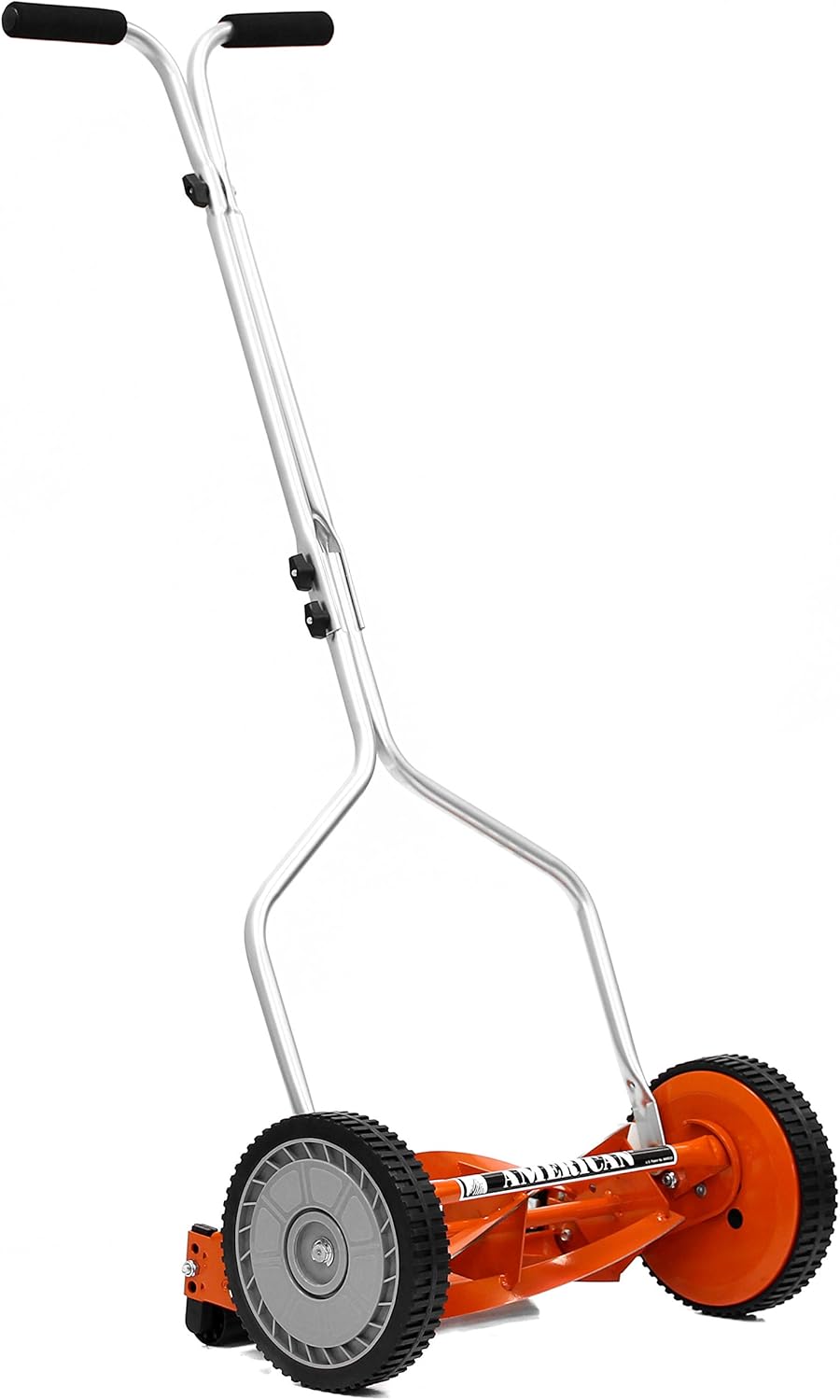
American Lawn Mower Company 1204-14 14-Inch 4-Blade Reel Push Mower
| Power Source | Manual |
|---|---|
| Cutting width | 14 inches |
| Maximum Adjustable Cutting Height | 4.45 inches |
| Minimum Adjustable Cutting Height | 1.3 inches |
| Material Type | Alloy Steel |
The American Lawn Mower 1204-14 is a manual reel push mower designed for small yards and simple, low-cost maintenance. It uses a 4-blade reel to shear grass with a scissor-like action, producing a cleaner cut than many rotary mowers while operating quietly and without fuel or electricity. Typical use is straightforward: walk it across a well-maintained lawn, adjusting one of three height positions to suit turf between about 0.5 and 1.75 inches. The mower’s alloy steel blades and 8.5-inch wheels keep the unit light and easy to push, and its low-maintenance design means no spark plugs, oil changes, or batteries. Important limitations are that it is best on regularly mowed, shorter grass and can struggle with very tall or thick turf; it also has no grass catcher included and requires blade maintenance over time. For homeowners focused on a simple, eco-friendly mowing routine, this mower delivers efficient, quiet cuts at a low ongoing cost, but it is not a replacement for a powered mower on large or overgrown lawns.
Best for: Homeowners with small, regularly maintained lawns who prioritize low running costs and an eco-friendly, quiet mower for routine trimming.
Less Ideal for: Large properties, infrequently mowed or overgrown turf, and users who need rapid mowing or grappling with heavy weeds.
- Quiet, emission-free manual operation that requires no fuel or electricity
- Scissor-like 4-blade reel produces a clean cut that is gentler on turf
- Lightweight construction for easy pushing and maneuvering on small lawns
- Simple, low-maintenance design with no engine upkeep
- Less effective on very tall, thick, or wet grass compared with powered mowers
- No grass catcher included, so clippings are left on the lawn unless an accessory is added
Verdict: A budget-friendly, eco-conscious reel mower that delivers quiet, clean cuts for small, well-kept lawns.
Greenworks 80V 21" Push Lawn Mower with 4.0Ah Battery and Rapid Charger

| Power Source | Battery Powered |
|---|---|
| Operation Mode | Manual |
| Maximum Adjustable Cutting Height | 3.75 inches |
| Minimum Adjustable Cutting Height | 1.38 inches |
| Number of Positions | 7 |
This Greenworks 80V 21" push mower aims to deliver near-gas performance while staying cordless and low maintenance. It uses an 80V brushless motor that supplies strong torque for thick or wet grass and a 21" steel deck that handles standard residential lawns; the package includes a 4.0Ah battery and rapid charger so you can mow about a half acre per charge under typical conditions. The mower offers a single-lever, seven-position height adjustment and a 4-in-1 system for mulching, bagging, side discharge, or turbo leaf pickup, which makes it flexible across seasons. LED headlights and foldable handles help with storage and early-evening work. As a push mower it keeps things simpler and lighter than self-propelled models, but that means you should expect more effort on steeper slopes or larger properties. Buyers who prioritize reliability will appreciate the brushless motor design and the multi-tool 80V ecosystem, though runtime depends on battery size and tougher lawns may need a higher-capacity battery for uninterrupted mowing.
Best for: A homeowner who wants a low-maintenance, gas-free mower that reliably handles typical residential lawns and values durable motor technology and a supported battery ecosystem.
Less Ideal for: People with very large properties, frequent steep slopes, or those who need a self-propelled mower for easier handling should consider other models.
- Brushless 80V motor for consistent torque and longer motor life
- Includes 4.0Ah battery and rapid charger for immediate use
- 4-in-1 cutting system (mulch, bag, side-discharge, turbo leaf pickup) for seasonal versatility
- Single-lever 7-position height adjustment for quick changes
- LED headlight and folding handles improve usability and storage
- Push operation may be tiring on steep or very large lawns
Verdict: Buy this mower if you want a dependable, low-maintenance cordless push mower with a brushless 80V motor and included battery that covers most suburban lawns.
Greenworks 40V 16-inch Push Lawn Mower with 4.0Ah Battery and Charger

| Power Source | Battery Powered |
|---|---|
| Battery Average Life | 35 minutes |
| Number of Positions | 5 |
| Maximum Adjustable Cutting Height | 3.75 inches |
The Greenworks 40V 16-inch push mower is a lightweight, battery-powered mower designed for small to medium lawns. It starts with a push-button, runs on a 4.0Ah 40V battery and offers about 35 minutes of run time per charge under typical conditions. The 16-inch poly deck supports a 2-in-1 system for rear bagging or mulching and a single-lever five-position height adjuster makes switching cutting heights quick. Included charger and battery integrate with Greenworks' 40V ecosystem so the battery works with other tools in the line. Practical benefits include much quieter operation than gas mowers, no oil or fuel maintenance, easy maneuverability on slopes because of its lighter weight, and collapsible handles for more compact storage. Limitations are the modest 16-inch cutting width and the runtime that may require a second charge on larger yards; heavier turf or very tall grass will need slower passes. The mower is made of plastic components that keep weight down but may feel less rugged than steel-deck models over many seasons.
Best for: Buyers who want a low-maintenance, quieter alternative to gas mowers for small to medium lawns and value compatibility with a 40V battery tool ecosystem and easy storage.
Less Ideal for: Not the best choice for owners of large properties, commercial mowing needs, or those who prioritize the durability of a steel deck over lightweight plastic construction.
- Cordless 40V battery power for gas-free, push-button starts
- Lightweight design improves maneuverability and makes it easier on slopes
- Includes 4.0Ah battery and charger compatible with 40V Greenworks tools
- 5-position single-lever height adjustment for quick deck changes
- 2-in-1 mulch or rear bagging system for flexible grass management
- 16-inch cutting width is small for larger lawns so more passes are required
- Approximate 35-minute battery life may be insufficient for larger or dense yards
Verdict: A lightweight, easy-to-use cordless mower ideal for small to medium lawns that need quiet, low-maintenance performance and 40V battery compatibility.
LawnMaster MEB1114K Corded Electric Lawn Mower, 15-Inch

| Power Source | Corded Electric |
|---|---|
| Cutting width | 15 inches |
| Number of Positions | 6 |
| Maximum Adjustable Cutting Height | 3 inches |
| Material Type | Metal |
The LawnMaster MEB1114K is a lightweight corded electric push mower aimed at homeowners with small to medium lawns who prefer a simple, low-maintenance machine. It delivers 3,300 RPM power through a 15-inch cutting deck and uses a corded connection so there is no need to manage batteries or gasoline. Height is adjusted across five positions (about 1.4 to 3 inches) to handle different grass lengths, and a 7-gallon collection bag keeps clippings contained for tidier results. The mower’s compact folded handles and relatively small rear wheels make storage easy and help with maneuvering around tight beds and walkways. Expect quieter, cleaner operation than gas mowers and minimal ongoing maintenance beyond blade care. The main limitations are the corded power source, which restricts range unless you use an extension, and the modest cutting width that increases mowing time on larger properties. For risk-averse buyers who value predictable, straightforward operation, this mower offers a reliable, low-complication option.
Best for: Buyers who want a fuss-free, low-maintenance mower for a small to medium yard and who prioritize predictable, plug-in operation over battery or gas systems.
Less Ideal for: Those with large properties, long driveways, or who need cordless mobility should consider wider or battery/gas alternatives with longer range and faster coverage.
- Corded electric power avoids fuel and battery upkeep
- Compact and lightweight design for easy storage and handling
- Adjustable cutting height with five positions to suit different turf lengths
- Included grass collection bag keeps clippings contained
- Simple manual operation is easy to use and maintain
- Corded power limits reach and requires careful cord management
- 15-inch cutting width is small for larger lawns so mowing takes longer
Verdict: A straightforward, low-maintenance corded mower that is ideal for risk-averse owners with small yards who want reliable plug-in performance.
Choosing the Right Walk Behind Lawn Mower: Key Factors to Consider
Cut Quality and Deck Construction
How a mower cuts and how the deck moves air are fundamental to lawn appearance and health. A well-shaped deck encourages even airflow and prevents scalping on uneven ground. Blade material and mounting stability affect how cleanly grass is sheared rather than torn, which influences disease susceptibility and recovery rate. Deck width and cutting height ranges determine how fast you can finish the job and how well you can adapt to different grass heights and seasons.
Also consider deck material and build. Steel decks are common and durable but can dent and rust over time if not cared for. Composite decks resist corrosion and are lighter, but their long-term durability varies. Look for easy access to the blade area for sharpening and inspection. The deck should also allow dependable height adjustment across the range you need for your turf type.
Power Source and Reliability
Walk behind mowers come with gas engines, electric corded motors, or battery-electric drivetrains. The power source affects runtime, noise, maintenance, and starting. Gas engines offer extended run time and high torque for heavy grass, but require fuel, oil changes, and winter storage attention. Battery-electric models simplify startup and routine care and are quieter, but battery capacity and recharge speed determine how much yard you can mow in one session.
Consider how often you mow and the typical workload. If your yard has thick, damp grass or frequent heavy growth, choose a mower with more torque or longer runtime. Check manufacturer guidance on service intervals and the accessibility of routine checks like air filters and spark plugs or battery access and swap procedures.
Maneuverability and Drive Type
How a mower handles around trees, beds, and tight corners determines both speed and fatigue. Smaller decks are easier to turn but increase mowing time. Self-propelled options reduce physical strain and make mowing slopes and larger areas more manageable. Look at wheel size and tread: larger rear wheels roll over bumps and soft ground better, while front wheel casters can improve turning radius.
Also evaluate the drive engagement and control layout. Smooth, adjustable speed control and comfortable handles reduce wrist and back strain during extended jobs. Consider transport and storage, including whether handles fold down easily and whether the mower is light enough to lift for garage placement.
Clippings Management and Versatility
How a mower handles grass clippings affects cleanup, lawn nutrition, and user habits. Options typically include side discharge, rear bagging, and mulching. Mulching blades and inserts finely chop clippings so they decompose on the lawn and return nutrients. Rear bagging keeps the lawn tidy and is useful when clippings will be disposed of or composted. Side discharge clears heavy growth without clogging the bag.
Choose a machine that offers the clipping options you use most often, or that can be adapted with accessories. Easy attachment and removal of bags or mulch plugs save time. Also consider whether the mower's airflow and blade design support consistent discharge at your usual mowing height.
Maintenance Needs and Service Access
Routine maintenance keeps a mower running and prevents breakdowns in peak season. For gas models this includes oil changes, spark plug checks, air filter cleaning, and carburetor attention when sitting long. Battery models need battery care, storage tips, and periodic balancing if applicable. Ease of access to service points shortens downtime and reduces the need for professional servicing.
Look for clearly labeled service points, user-friendly owner manuals, and whether common maintenance tasks can be completed with basic tools. Consider blade removal procedures, deck cleaning access, and whether the fuel system or battery is straightforward to winterize.
Durability and Build Quality
A mower is a long-term garden tool, so construction quality matters for lifespan and resale. Inspect materials used for key components like the deck, wheels, transmission, and handle assembly. Reinforced mounting points and corrosion-resistant finishes prolong service life in humid or coastal environments. Durability also affects how well the machine survives rough use around driveways, curbs, and hidden stumps.
Think about warranty terms and the availability of replacement parts when assessing durability. A slightly heavier but sturdier unit may outlast a lighter machine that needs frequent repairs, which is often a better long-term investment for gardeners with uneven or debris-prone yards.
Which Drive Type Suits Your Yard
Choosing between push, self-propelled, and variable-speed drive systems depends on yard size, slope, and how much physical effort you want to expend. Push mowers are lighter and work well for small, flat lawns. Self-propelled mowers greatly reduce effort on larger properties or hilly terrain and can be front- or rear-wheel drive, which changes traction and steering feel.
If you have steep slopes or soft ground, rear-wheel drive or high-traction tires can help maintain forward motion without bogging down. For tight spaces, a lighter push model or a mower with a tight turning radius will save time navigating around beds and obstacles.
- Push models: lighter, lower maintenance, best for small yards
- Self-propelled models: reduce strain, better for larger yards and slopes
- Variable-speed controls: help match walking pace for comfort
Gas Vs Electric: Practical Tradeoffs
Gas mowers offer longer continuous run times and strong torque for heavy or tall grass, but require regular engine upkeep and careful winter storage. They are also noisier and produce more vibration. Electric corded mowers are quiet and simple but limit range to the length of an extension cord and are better for small, tidy lawns.
Battery-electric models hit a middle ground with quiet operation and low maintenance, but battery capacity governs how much yard you can cover. For larger properties consider models with quick-swap batteries or higher amp-hour ratings. Also factor in charging time and whether you can conveniently store and charge batteries.
- Gas: long run times and torque, requires engine maintenance
- Corded electric: quiet and low-maintenance, limited by cord
- Battery electric: quiet, low upkeep, runtime depends on battery
Optimizing Cutting Patterns and Height
Effective mowing is more than a single pass. Overlapping passes, alternating directions week to week, and mowing at the right height for your grass species keep the lawn healthy. Set the deck height high in spring and during heat stress to promote deep roots, and lower it slightly for consistent appearance during active growing seasons.
Use a mowing pattern that reduces scalping on low spots and avoids repeatedly stressing the same grass blades. A wider deck reduces passes but can increase the chance of missed spots near obstacles. Smaller decks handle complex landscapes better.
- Alternate mowing directions to prevent grain and compaction
- Raise deck during heat or drought to protect roots
- Match blade sharpness and speed to cutting height for clean cuts
Tips for Winterizing and Storage
Preparing a walk behind mower for storage prolongs its life and keeps it ready for the next season. For gas engines drain or stabilize fuel, change the oil if due, and fog or otherwise protect internal parts per manufacturer guidance. Remove the battery from electric models and store it in a cool, dry place at recommended charge levels.
Clean the underside of the deck to remove clippings that can trap moisture and promote corrosion. Sharpen the blade and inspect fasteners so the mower is service-ready. Store the mower on a level surface in a dry spot, and cover it to keep dust and pests out.
- Drain or stabilize fuel for gas models
- Store batteries in a cool, controlled environment
- Clean deck and sharpen blade before storage
Accessory Options That Improve Use
Accessories can tailor a mower to your workflow. Common add-ons include mulching kits, catcher bags, side-discharge chutes, and higher-traction tires. A mulching kit is useful if you want to return nutrients to the lawn, while a catcher bag simplifies cleanup for formal lawns or composting.
Also consider practical accessories like tool-free blade removal kits, lift handles for easier blade access, and rain-resistant storage covers. Choose accessories that are simple to attach and remove so you actually use them during different seasons.
- Mulching kits for nutrient return
- Catcher bags for neat lawns and composting
- High-traction tires for slopes and soft ground
How We Chose the Best Walk Behind Lawn Mower
We prioritized features and real-world performance traits that matter to gardeners who use a walk behind mower frequently. Selection focused on cutting system characteristics, including blade quality and deck design, because clean, even cuts directly affect lawn health. We also weighed engine or motor reliability and starting ease, since dependable power determines daily usability in wet or dry conditions. Maneuverability and handling were another key filter, with attention to wheel size, steering geometry, and self-propelled drive options for slopes and obstacles. Maintenance demands and access to routine service points informed our picks to keep ownership simple. Finally, mulching, bagging, and side discharge versatility were considered because clippings management affects cleanup and mulching benefits. We excluded specialized commercial-only equipment, robotic mowers, and tools intended solely for athletic turf. Products had to be appropriate for homeowner and light-pro use and offer clear documentation on maintenance and safety. The evaluation emphasized measurable specs and gardener-facing features rather than marketing claims, so entries reflect practical workability in typical yards.
FAQ
How often should I sharpen the mower blade?
Usually every 20 to 25 hours of mowing is a good rule, but frequency depends on contact with debris and the type of grass. Inspect the blade for nicks and tearing; a dull blade shreds grass and harms lawn health, so sharpen sooner if cuts look ragged.
Can I use a walk behind mower on slopes?
Yes, many walk behind mowers handle moderate slopes, especially self-propelled rear-wheel drive units. Avoid steep slopes and follow safety guidance from the manufacturer. Move carefully and mow across the slope rather than straight up and down when possible.
Is mulching better than bagging clippings?
It depends on your lawn and goals. Mulching returns nutrients and reduces disposal needs, which benefits healthy turf. Bagging gives a cleaner finish and is useful when grass is overly long or diseased material needs removal. Both have valid uses in different situations.
How do I choose the right deck width?
Match deck width to yard size and obstacle density. Wider decks cut more quickly on open lawns but are harder to maneuver around trees and beds. For small or intricate yards choose a narrower deck for better control; for larger, open lawns prefer wider decks for efficiency.
What maintenance does a battery mower need?
Battery mowers require far less engine maintenance but need battery care. Keep batteries charged per storage guidance, avoid extremes of temperature, and inspect connectors for corrosion. Periodic balancing or conditioning may be recommended by the battery maker.
Final Verdict
Choosing a walk behind lawn mower comes down to matching drive type, power source, and deck characteristics to your yard size, terrain, and how much maintenance you want to perform. Prioritize cutting quality, maneuverability, and clippings management for the best day-to-day experience. If you value low upkeep and quiet operation, electric or battery models are attractive; for heavy or extended mowing tasks, gas models still offer unmatched runtime and torque. Balance the tradeoffs and pick the configuration that saves effort while protecting your lawn.
