

Note: This article contains affiliate links. If you click on these links and make a purchase, I may earn a small commission at no extra cost to you. This helps support my research and content. Read my full affiliate disclosure here.
Pests can damage plants, invade patios, and show up inside the house when you least expect them. Picking the right exterminator bug spray matters because knockdown speed, residual protection, and target pest spectrum all change how effectively you can protect beds, containers, lawn edges, and entry points. This guide covers seven shortlisted options and explains the practical performance gardeners should expect in yards, vegetable plots, and around foundations. We evaluated sprays for quick control, how long treated surfaces stay protected, safety and reentry considerations, and ease of application. Read on to see which characteristics matter most for different outdoor uses and which sprays suit routine preventive work versus spot treatment.
Top Picks at a Glance
| Best Overall The best all-around choice for most situations | Ortho Home Defense Max Bed Bug, Flea & Tick Killer, 1 gal. |  |
| Best Quality Built to a higher standard if you want something more solid | Atticus Talak 7.9% Bifenthrin Indoor/Outdoor Insecticide Concentrate, 1 gal |  |
| Best Value The sweet spot between price and what you get | Ortho Home Defense Insect Killer Refill, 1.33 gal. |  |
| Best Budget The cheapest option that still gets the job done reliably | Spectracide Triazicide Insect Killer Concentrate, 32 oz |  |
| Highest Rated A top-rated pick with lots of positive feedback | Envu Tempo SC Ultra Insecticide Concentrate, 240 ml |  |
| Most Popular A crowd favorite that many people choose with confidence | Ortho Home Defense Insect Killer for Indoor & Perimeter, 1.33 gal. with Comfort Wand |  |
| Best Seller A high-volume bestseller chosen again and again | Atticus Talak 7.9% Bifenthrin Indoor/Outdoor Insecticide Concentrate (32 oz) |  |
Ortho Home Defense Max Bed Bug, Flea & Tick Killer, 1 gal.

| Volume | 1 gal |
|---|---|
| Application | Ready-to-use with Comfort Wand |
| Target pests | Bed bugs, bed bug eggs, fleas, ticks |
| Use frequency | Apply every 2 weeks when bedbugs are present |
| Manufacturer | The Scotts Company LLC |
This one-gallon Ortho Home Defense Max is a ready-to-use indoor insect spray intended for spot treatments where bed bugs hide. It comes with a battery-powered Comfort Wand that helps reach seams, tufts, baseboards, and other tight spaces and delivers a targeted spray rather than a broad broadcast. The formula claims to kill pyrethroid-resistant bed bugs plus eggs and also works on fleas and ticks, making it useful when you need a single product for multiple indoor pests. Typical use is to apply as a room treatment every two weeks while bed bugs are present and to combine it with detection traps and crack-and-crevice products for a complete approach. Practical benefits include easy application with the wand, a large volume for multiple treatments, and an indoor-focused label that highlights areas to treat. Important limitations are that it is a spot-treatment product not intended for whole-home broadcast use and surfaces must be protected from overspray; it also requires caution around people, pets, and finished surfaces until sprays dry.
Best for: Buyers who want a practical, DIY indoor treatment to target visible bed bug activity and other pests and who plan to follow a multi-step control routine rather than rely on a single broadcast application.
Less Ideal for: People looking for a quick whole-home fogging or broadcast solution or those who need a product safe for immediate reentry of children or pets around treated surfaces.
- Includes battery-powered Comfort Wand for precise application in seams and crevices
- Labeled to kill pyrethroid-resistant bed bugs as well as eggs, fleas, and ticks
- Large 1-gallon ready-to-use container supports multiple spot treatments
- Designed for indoor use with guidance for bed frames, mattress seams, baseboards and other hiding spots
- Formulated for spot and room treatments only, not for whole-home broadcast application
- Requires precautions to avoid contact with finished surfaces and to keep people and pets away until dry
Verdict: A large ready-to-use indoor spray with a comfort wand that gives precise spot control of bed bugs, their eggs, fleas, and ticks for homeowners following a stepwise treatment plan.
Atticus Talak 7.9% Bifenthrin Indoor/Outdoor Insecticide Concentrate, 1 gal

| Unit Count | 128 Fluid Ounces |
|---|---|
| Formulation | Suspension Concentrate |
| Active Ingredients | Bifenthrin |
| Specification Met | EPA |
Talak 7.9% is a water-based bifenthrin concentrate intended to kill a wide range of indoor and outdoor pests on contact and provide residual control for up to three months. You dilute the concentrate with water and apply it with a pump sprayer to lawns, landscape plants, hardscapes, eaves, foundation perimeters, or indoor baseboards and other surfaces. The formulation lists control for more than 75 pests including ants, ticks, spiders, mosquitoes, roaches, and mites, and the label gives specific dilution rates for turf, landscapes, surface barriers and mosquito work. Practical benefits include a clear, low-odor spray that the brand says will not leave residue or phytotoxicity on plants and that allows people and pets to re-enter once surfaces are dry. The product is versatile enough to handle mound drenches for fire ants and perimeter barrier treatments around structures. Important limitations are that mixed solutions should not be stored beyond the day of mixing and the product is not registered for sale in some states, so check local restrictions and follow label directions carefully.
Best for: Buyers who want a performance-focused, multipurpose insecticide to manage large areas and perimeter treatments with professional-style residual control.
Less Ideal for: People seeking an immediate ready-to-use product for spot indoor cleanup or those who cannot follow concentrated-pesticide handling and dilution procedures.
- High-concentration bifenthrin formula targets 75+ common indoor and outdoor pests
- Water-based concentrate dilutes easily and dries clear with minimal odor
- Label provides specific dilution rates for turf, landscapes, surfaces and mosquito control
- Long residual control claimed for up to three months per application
- Bottle design includes pre-marked pour section for easier measuring and handling
- Mixed spray solutions cannot be stored and must be used the same day
- Not approved for use in foggers and has state sale restrictions in some states
Verdict: Choose Talak 7.9% when you need a high-strength, versatile concentrate that delivers long-lasting, professional-level indoor and outdoor pest control.
Ortho Home Defense Insect Killer Refill, 1.33 gal.

| Unit Count | 170.24 Fluid Ounces |
|---|---|
| Liquid Volume | 1.33 gallons |
| Item Form | Spray |
| Target Species | Insects |
This 1.33 gallon Ortho Home Defense refill is designed to top up the brand's Comfort Wand applicator and treat both indoor trouble spots and outdoor perimeters. It is used as a barrier treatment around doors, windows, foundations and in kitchens or bathrooms; instructions recommend spraying a band until slightly wet and allowing treated areas to dry before re-entry. The formula targets a long list of common household pests and advertises up to 12 months of residual control for ants, roaches and spiders on non-porous indoor surfaces. Practical features include an Invisi-Shield formula that dries clear with no noticeable fumes and the convenience of refilling a reusable wand rather than buying multiple ready-to-use bottles. Limitations are that the 12-month claim applies only to specific insects and surface types and that proper dilution/application and safety precautions are required when using a concentrated refill. This product suits homeowners who want a durable perimeter barrier and prefer maintaining a single applicator for repeated treatments.
Best for: Homeowners who want a practical, long-lasting perimeter and indoor barrier and prefer refilling a single reusable applicator to maintain ongoing pest control.
Less Ideal for: People who need immediate, single-use solutions or who do not want to handle concentrated refills should consider ready-to-use sprays or professional services.
- Large 1.33 gallon refill reduces packaging waste and the need to buy multiple ready-to-use bottles
- Compatible with the Comfort Wand for continuous spray without bending or hand fatigue
- Invisi-Shield formula dries clear and gives off no noticeable fumes during application
- Provides a long-lasting barrier for common indoor and perimeter pests when applied as directed
- 12-month residual protection is limited to ants, roaches and spiders on non-porous indoor surfaces and not guaranteed for all pests or outdoor conditions
- Product is a refill concentrate that requires proper handling and transfer to an applicator before use
Verdict: Buy this refill if you want a cost-effective way to maintain a long-lasting indoor and perimeter insect barrier using a reusable Comfort Wand.
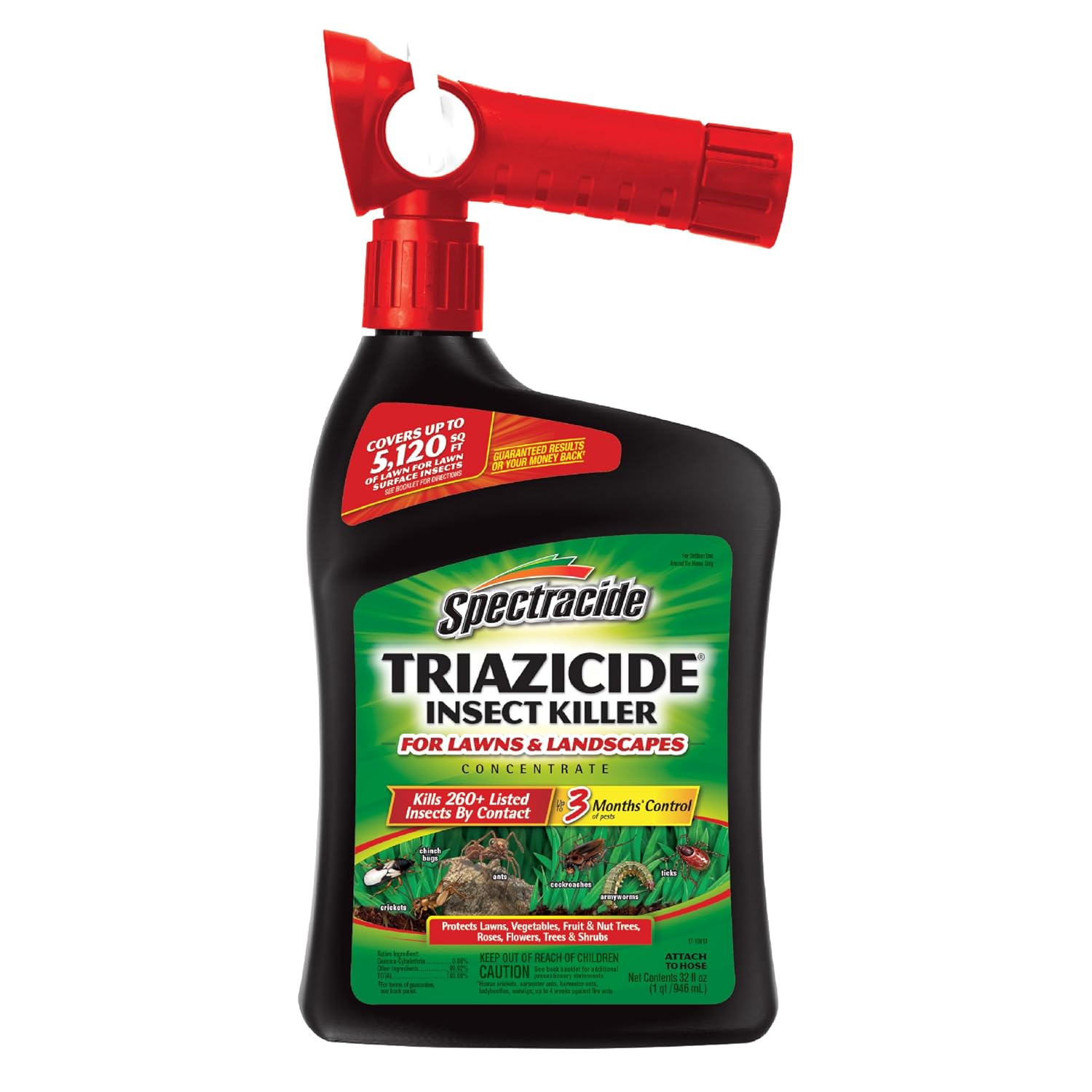
Spectracide Triazicide Insect Killer Concentrate, 32 oz
| Unit Count | 32 Ounce |
|---|---|
| Item Type Name | Lawn Insect Killer |
| Item Form | Spray |
| Active Ingredients | Gamma-Cyhalothrin (0.08%) |
| Liquid Volume | 32 fluid ounces |
Spectracide Triazicide is a fast-acting concentrate designed to protect lawns, flower beds, shrubs, trees and even vegetable patches from more than 260 listed pests. You mix the 32-ounce bottle with water and apply it with a tank sprayer or hose-end applicator to treat surface and soil insects, including grubs, ants, fleas, deer ticks and Japanese beetles. The formula is non-staining when used as directed and claims residual control for up to three months, which is helpful if you want fewer repeat treatments. Practical benefits include broad-spectrum control, the option to cover large areas from a single bottle and clear directions for spot and mound treatments like fire ants. Important limitations are typical for concentrates: you must measure and mix correctly, use personal protective measures, and avoid drift or runoff because the product is highly toxic to fish and to bees when applied to blooms. It is not an off-the-shelf ready-to-spray bottle for casual spot use unless you pair it with a hose-end tool.
Best for: Buyers who need an economical, broad‑spectrum insect control for lawns and landscapes and are comfortable mixing concentrates and taking standard pesticide safety precautions.
Less Ideal for: People who want a simple, no-mix spot treatment or who need a bee-safe or aquatic-friendly option should look for alternative formulations.
- Broad-spectrum concentrate that lists over 260 target insects including ticks, fleas, grubs and Japanese beetles
- Covers large areas when mixed correctly, reducing the number of purchases for bigger yards
- Non-staining when used as directed, making it suitable for use near homes and hardscapes
- Flexible application options: tank sprayer or hose-end for convenience
- Contains a potent active ingredient that is highly toxic to fish and bees and requires careful handling
- Requires measuring and mixing before use, which adds setup time compared with ready-to-spray products
Verdict: A cost-effective, high‑coverage concentrate for homeowners who want broad insect control across lawns and landscapes and are willing to mix and apply responsibly.
Envu Tempo SC Ultra Insecticide Concentrate, 240 ml

| Item Volume | 240 ml |
|---|---|
| Item Form | Liquid |
| Target Species | Ants, flies, cockroaches, crawling pests, and ticks |
| Scent Name | Chalk-like |
| Ingredients | Beta-Cyfluthrin |
Tempo SC Ultra is a suspension concentrate insecticide designed for perimeter and spot treatments around homes. Mixed with water per label directions, it is applied as a general surface, crack-and-crevice, or mist treatment to foundations, doorways, garages and other harborage areas. The formula uses beta-cyfluthrin, which provides quick knockdown plus residual activity so treated surfaces continue to reduce crawling insect activity after application. As a concentrate it treats large areas from a small bottle and the low-odor, non-staining formulation makes it reasonable to use near entryways and basements. Because it is a professional-style concentrate, correct dilution and application are essential and it is not a ready-to-use pump spray. Practical limitations are the need for proper protective gear and strict adherence to label instructions, and that it controls crawling pests rather than flying insects as a primary function.
Best for: Buyers who prioritize reliable, long-lasting perimeter control and are willing to mix a concentrate and follow label directions for professional-style results.
Less Ideal for: Casual users who want a ready-to-use spray or those who need a dedicated solution for flying insects rather than crawling pests.
- Broad-spectrum activity against common crawling pests including ants, spiders, cockroaches and ticks
- Concentrated liquid covers large areas when diluted, reducing how often you need to buy product
- Residual formulation offers ongoing control after application for perimeter and crack treatments
- Low-odor and non-staining formula suitable for use near living areas when label directions are followed
- Requires dilution and proper PPE so it is less convenient than ready-to-use sprays
- Not targeted primarily at flying insects so additional products may be needed for full control
Verdict: Choose this concentrated insecticide if you want a low-odor, residual perimeter treatment that delivers professional-style control of crawling pests when mixed and applied correctly.
Ortho Home Defense Insect Killer for Indoor & Perimeter, 1.33 gal. with Comfort Wand

| Item Form | Spray |
|---|---|
| Target Species | Insects |
| Liquid Volume | 1.33 gallons |
| Active Ingredients | Bifenthrin 0.05%, Zeta-Cypermethrin 0.0125% |
This Ortho Home Defense formula is a ready-to-use spray designed for both indoor spot treatments and outdoor perimeter applications. It targets a wide range of pests including ants, roaches, spiders, fleas, ticks and more, and the manufacturer says it can create a barrier that lasts up to 12 months on non-porous indoor surfaces. The included battery-powered Comfort Wand delivers a continuous spray that makes treating foundations, door frames and baseboards easier and reduces user fatigue compared with manual pump sprayers. The formula dries clear and is marketed as having no fumes, which helps for indoor use in kitchens and bathrooms once surfaces have dried. Active ingredients listed are bifenthrin and zeta-cypermethrin, professional-grade actives that provide fast contact kill and residual control. Important limitations are that it is a chemical pesticide so follow safety directions around children and pets and avoid overapplication on porous surfaces where long-term protection claims do not apply. Also this product is specific to surface and perimeter treatments and not intended as a fumigant or for direct application to people or pets.
Best for: Buyers who want a proven, easy-to-apply insect barrier for homes and perimeters and who prioritize established performance and user-friendly application over organic or non-chemical options.
Less Ideal for: People seeking non-chemical, organic pest control or solutions for treating large landscape areas where specialized concentrates or professional services are more appropriate.
- Ready-to-use formula requires no mixing and includes a battery-powered Comfort Wand for continuous spray application
- Broad-spectrum labeled for many household pests including ants, roaches, spiders, fleas and ticks
- Creates a residual barrier that can provide up to 12 months protection on non-porous indoor surfaces
- Dries clear with no noticeable fumes, making indoor use more practical after drying
- Contains synthetic pyrethroid active ingredients which require careful handling around children, pets and sensitive plants
- Long-term protection claim applies to non-porous indoor surfaces and may not hold on porous or weather-exposed outdoor surfaces
Verdict: A ready-to-use, broad-spectrum insect spray with a continuous-spray wand that offers long-lasting indoor perimeter protection for homeowners who want reliable chemical control.
Atticus Talak 7.9% Bifenthrin Indoor/Outdoor Insecticide Concentrate (32 oz)

| Active Ingredients | Bifenthrin |
|---|---|
| Formulation | Suspension Concentrate |
| Liquid Volume | 32 fluid ounces |
| Target Species | Insects |
| Specification Met | EPA |
Talak 7.9% is a liquid concentrate designed to be diluted and sprayed around homes, lawns, and landscape beds to control a broad range of insects. You mix small amounts with water and apply it as a perimeter barrier, treat turf, or spray around baseboards and other indoor hiding spots. The product highlights a 7.9% bifenthrin active ingredient that delivers quick knockdown and residual control for up to three months, and the water-based formula is described as odor-free, dries clear, and will not harm plants when used as directed. Practical benefits include flexible use across many surfaces, clear dosing guidance for different applications, and a bottle with a pour spout for easier measuring. Important limitations are that concentrate must be mixed fresh each day and it is not approved for foggers; follow label directions carefully and observe state restrictions where applicable. Use requires basic spray equipment and attention to safety and re-entry times until treated surfaces are dry.
Best for: Buyers who want a dependable, long‑lasting perimeter insecticide they can apply themselves for both outdoor living areas and indoor perimeter treatments and who prioritize predictable, proven control.
Less Ideal for: People unwilling to handle concentrated pesticides, those who prefer ready-to-use aerosol products, or gardeners in states where this product is not registered should consider alternatives.
- Broad-spectrum control covering more than 75 indoor and outdoor insect pests
- Long residual activity with up to three months of control per application
- Water-based formula that dries clear, leaves no residue, and is odor-free
- Versatile for lawns, landscapes, hardscapes, and indoor perimeter treatments
- Must be mixed fresh each day and mixed-to-use only, so you cannot store prepared solution
- Not labeled for use in foggers and requires a sprayer for application
Verdict: Choose Talak 7.9% when you need a proven, water‑based bifenthrin concentrate that delivers flexible indoor and outdoor perimeter control with long residual protection.
Choosing the Right Exterminator Bug Spray: Key Factors to Consider
Knockdown Speed and Visible Control
How quickly a spray immobilizes or kills visible pests determines whether it is useful for urgent infestations. Fast knockdown helps stop feeding damage and reduces the chance that pests will escape treated areas. In a garden context, rapid control is important for soft-bodied pests that can quickly defoliate tender seedlings or for stinging insects near entertaining spaces.
Keep in mind that knockdown speed can vary by pest species and life stage. Products advertised for rapid knockdown may still require follow-up treatments for eggs or protected life stages, so expect to monitor plants after initial application.
Residual Protection Duration
Residual protection is how long treated surfaces continue to repel or kill pests after application. Longer residuals reduce how often you need to reapply and are helpful on perimeter treatments, porch steps, and fence lines. For garden beds, residual activity can prevent reinfestation from soil-dwelling or wandering pests during an active season.
However, long residuals can increase exposure risk to beneficial insects and non-target organisms. Choose a residual strength appropriate to the area treated and the presence of pollinators or pets, and follow label guidance on reentry intervals and where not to spray.
Spectrum of Target Pests
Different sprays control different groups of insects. Some are broad-spectrum and affect a wide range of chewing and sucking pests, while others are formulated primarily for crawling insects or flying pests. Knowing the likely pests in your yard, such as aphids, beetles, ants, or mosquitoes, helps you pick a product that will address the real problem rather than wasting effort on the wrong active ingredient.
Consider whether you need ovicidal activity to reduce egg populations or whether multiple treatments timed to pest lifecycles will be needed. Selecting a spray with the right spectrum helps avoid repeated misapplications.
Safety, Label Restrictions, and Reentry Guidance
Safety covers human and pet reentry times, whether treated edible plants require a preharvest interval, and any respiratory or dermal precautions. Always follow label directions for personal protective equipment during mixing and application. For home gardeners, a clear, homeowner-friendly label with explicit reentry and harvest intervals makes a product far easier to use safely.
Also watch for restrictions about spraying near water, pollinator habitats, or desirable wildlife. A product that requires complex PPE or has long no-entry times may not be practical for casual gardeners who need quick, low-effort spot treatments.
Application Method and Ease
How you apply a spray affects coverage and convenience. Ready-to-use trigger bottles, hose-end sprayers, and concentrate bottles that require mixing all have tradeoffs. A quality nozzle that produces a consistent spray pattern helps get even coverage on foliage and surfaces. For larger yards, concentrates with hose-end or pump sprayers are more efficient, but they require careful measuring and mixing.
Ease of application also includes storage stability and clear dilution instructions. Products that clog nozzles or separate in storage add frustration and can lead to inconsistent results in the garden.
Environmental Persistence and Non-target Impact
Environmental persistence addresses how long residues last in soil and on surfaces and the likelihood of runoff or drift. While persistence can be useful for long-lasting control, it can also harm beneficial insects, earthworms, and aquatic life if misapplied. Choose application timing and placement to minimize exposure to pollinators, and avoid spraying flowering plants when bees are active.
Look for products with guidance about buffer zones near water and strategies to reduce non-target impact. Shorter persistence can be preferable in sensitive planting areas and near vegetable gardens where repeated harvests occur.
Where to Use Exterminator Bug Spray in the Yard
Sprays can be applied to perimeter zones, fence lines, patio and deck surfaces, and directly to plant foliage. Perimeter treatments help reduce indoor incursions by targeting points where pests cross into structures. On garden plants, use targeted sprays for concentrated pest spots rather than blanket applications to protect beneficial insects.
For lawns, focus on borders, under shrubs, and entryways rather than mowing strips. When working near edible plants, follow label harvest intervals and consider spot-treating pests rather than spraying the entire bed.
- Perimeter and foundation treatments limit indoor pest pressure.
- Targeted foliage sprays reduce impact on pollinators.
- Avoid spraying blooming plants during pollinator activity.
Timing Applications for Best Results
Apply sprays in the early morning or late evening when bees and other pollinators are less active. Many sprays work best on calm days to reduce drift and ensure they reach the intended surfaces. For pests with specific life cycles, time follow-up sprays to hit vulnerable stages such as newly hatched nymphs or larvae.
Avoid treating during rain events or immediately before watering, which can wash away residuals. For long-residual products, plan applications when rainfall is not expected for the stated protection window.
- Treat when pollinators are inactive.
- Avoid windy or rainy conditions.
- Time repeat treatments to pest life stages.
Minimizing Impact on Beneficial Insects
Beneficial insects like predatory beetles, lacewings, and pollinators are important allies in gardening. Use targeted applications and spot treatments to reduce non-target exposure. When possible, avoid spraying open flowers and choose product placement on lower leaf surfaces or soil lines where pests hide.
Consider integrating physical controls, hand removal, and cultural practices to reduce chemical dependency. If a treatment is necessary, select times and methods that reduce contact with beneficials.
- Spot treat problem areas rather than blanket spraying.
- Apply to lower foliage and ground-level hiding spots.
- Combine chemical control with cultural practices for balance.
Mixing and Storage Best Practices
For concentrates, measure carefully and mix in a well-ventilated area using the recommended protective equipment. Label mixed containers with the date and concentration and use them within the time frame on the product label. Improper mixing can reduce effectiveness or increase risks to people and plants.
Store unused product in original containers, tightly closed, away from children, pets, and extreme temperatures. Dispose of rinsate and leftover diluted spray according to label instructions and local regulations.
- Measure and mix precisely.
- Store in original, labeled containers.
- Follow disposal guidance for rinsate and containers.
Integrating Sprays with an Integrated Pest Management Plan
Exterminator bug sprays are one tool within an integrated pest management approach. Start with inspection and identification, then use cultural controls such as sanitation, plant selection, and habitat modification. Apply sprays judiciously to reduce outbreaks and rotate modes of action where appropriate to slow resistance development.
Use monitoring and thresholds to decide when chemical intervention is necessary, and combine sprays with biological and mechanical controls for long-term stability.
- Inspect and identify before treating.
- Use cultural controls to reduce pest pressure.
- Rotate control methods to minimize resistance.
How We Chose the Best Exterminator Bug Spray
We focused on attributes that matter in real-world garden and home pest control. Key evaluation criteria included knockdown speed, measured by how fast visible activity stops after application; residual protection, meaning how long treated surfaces prevent reinfestation; spectrum of control, covering which common garden and household pests a spray affects; and user safety and reentry guidance, which reflects label instructions and precautions for people, pets, and edible plants. We also considered application practicality, including spray nozzle quality and dilution flexibility for different tasks, and environmental persistence to balance efficacy with non-target exposure. Products were excluded if labeled only for industrial use, lacked clear homeowner instructions, or were restricted for sale to licensed applicators. The shortlist favors products with clear labels, versatile application options, and documented performance against the kinds of pests gardeners most often encounter.
FAQ
Can I use exterminator bug spray on vegetable plants?
It depends on the label. Some sprays have explicit preharvest intervals and are labeled for edible crops, while others are not. Always read the label for harvest wait times and only apply products that list edible plants if you plan to harvest soon after treatment.
How soon can people and pets reenter a treated area?
Reentry intervals vary by product and application. Many homeowner sprays allow reentry after treated surfaces dry, but others require longer no-entry times. Check the label for specific reentry and drying guidance and keep pets away until the product instructs it is safe.
Will one application prevent future infestations?
Usually not. One application can reduce an active population but preventing reinfestation often requires follow-up treatments, cultural controls, and addressing habitat that attracts pests. Residual protection can reduce frequency of repeat treatments, but vigilance is still needed.
Are hose-end sprayers or ready-to-use bottles better for home gardens?
Each has pros and cons. Ready-to-use bottles are convenient for small, targeted jobs and reduce mixing errors. Hose-end sprayers and concentrates are more efficient for larger areas but require careful measuring and mixing. Choose based on the size of the area you plan to treat and your comfort with mixing concentrates.
How do I avoid harming pollinators when using sprays?
Apply sprays in the early morning or late evening when pollinators are less active, avoid spraying open flowers, and focus on lower leaves and the ground where pests hide. Spot treatments and nonchemical controls also reduce the reliance on sprays.
Final Verdict
Prioritize the characteristics that match your situation: rapid knockdown for urgent infestations, longer residuals for perimeter protection, or a narrower spectrum for targeted pest problems. Balance efficacy with safety by following label directions, timing treatments to avoid pollinators, and using spot treatments when possible. With attention to application method and timing, you can choose an exterminator bug spray that fits your garden scale and pest pressures while minimizing non-target impacts.
