

Note: This article contains affiliate links. If you click on these links and make a purchase, I may earn a small commission at no extra cost to you. This helps support my research and content. Read my full affiliate disclosure here.
Spiders in and around the home are a common nuisance and, for some people, a health concern. Picking the right bug spray for spiders matters because knockdown speed, residual protection, and safe application zones determine how effectively you reduce webs and encounters over time. This guide covers the top shortlisted options for targeted spider control in indoor and outdoor settings and explains the performance factors we tested on paper. We evaluated products for knockdown effectiveness, how long they keep working, and how easy they are to apply and live with in a yard or around a house. Read on to see which spray characteristics fit your situation.
Top Picks at a Glance
| Best Overall The best all-around choice for most situations | Ortho Home Defense Insect Killer Refill, Indoor & Perimeter, 1.33 gal |  |
| Best Quality Built to a higher standard if you want something more solid | MGK Onslaught FastCap Spider and Scorpion Insecticide, 16 fl oz |  |
| Best Value The sweet spot between price and what you get | Spectracide Bug Stop Home Barrier Ready-to-Use Spray, 32 oz (3-pack) |  |
| Best Budget The cheapest option that still gets the job done reliably | HOT SHOT Ant, Roach & Spider Killer Spray, 17.5 fl oz (Crisp Linen) |  |
| Highest Rated A top-rated pick with lots of positive feedback | Aromovial Peppermint Oil Spider Repellent Spray, 16 oz |  |
| Most Popular A crowd favorite that many people choose with confidence | Ortho Home Defense Insect Killer for Indoor & Perimeter, 1.33 gal. with Comfort Wand |  |
| Best Seller A high-volume bestseller chosen again and again | Mighty Mint Peppermint Oil Insect Repellent Spray, 16 oz |  |
Ortho Home Defense Insect Killer Refill, Indoor & Perimeter, 1.33 gal

| Unit Count | 170.24 Fluid Ounces |
|---|---|
| Liquid Volume | 1.33 gallons |
| Item Form | Spray |
| Target Species | Insects |
This Ortho Home Defense refill is a concentrated ready-to-mix insect spray meant to refill the Comfort Wand applicator and treat both indoor surfaces and home perimeters. It is typically used by applying a band around doors, windows, kitchens, bathrooms and the foundation perimeter to create a residual barrier; indoors it claims up to 12 months of protection against ants, roaches and spiders on non-porous surfaces. The formula is marketed as low-odor and dries clear, which makes it convenient for use on visible trim and along baseboards without leaving stains. Practical benefits include broad-spectrum control of many crawling and flying insects and the economy of a large refill that supports multiple reapplications. Important limitations are that the 12-month residual claim applies only to certain pests and indoor non-porous surfaces, and correct application technique is required to avoid over-wetting surfaces. Also, this product is for barrier treatments rather than spot treatment of active infestations deep inside walls.
Best for: Homeowners who want a single, economical product to establish long-lasting indoor and perimeter barriers against common household insects and prefer reusable applicators and low-odor formulas.
Less Ideal for: People needing quick knockdown for heavy infestations inside wall voids or those who want an all-purpose spot-treatment aerosol for hard-to-reach cracks and crevices.
- Large 1.33 gallon refill supports multiple treatments and reduces refill frequency
- Designed for both indoor and perimeter use so you can treat baseboards, doors and foundation edges
- Invisi-Shield formula dries clear and gives off no noticeable fumes during application
- Compatible with the Comfort Wand for continuous-spray application that reduces bending and hand fatigue
- 12-month residual protection is limited to specific pests and non-porous indoor surfaces
- Needs correct application (spray until slightly wet) to be effective and avoid surface soaking
Verdict: Buy this refill if you want an economical, low-odor spray to create long-lasting indoor and perimeter barriers against common household insects.
MGK Onslaught FastCap Spider and Scorpion Insecticide, 16 fl oz

| Unit Count | 16 Fluid Ounces |
|---|---|
| Item Form | Spray |
| Target Species | Insects |
| Active Ingredients | Esfenvalerate, Prallethrin, Piperonyl Butoxide |
MGK Onslaught FastCap is a pint of concentrated spray formulated for fast knockdown of spiders, scorpions, and a wide list of household and perimeter pests, with residual activity on surfaces after application. It is mixed into a pump sprayer at 0.5 to 1.0 fl oz per gallon, so a small bottle produces many gallons of ready-to-use spray for treating baseboards, cracks, foundation perimeters, patios, and landscaping. The product lists active ingredients (esfenvalerate, prallethrin and piperonyl butoxide) that deliver quick contact kill and ongoing control on treated areas. Practical benefits include a low use rate that stretches one pint into 16 to 32 gallons of spray, flexible indoor and outdoor application, and clear label directions for mixing and target sites. Important limitations are that it is a synthetic insecticide requiring careful handling, keeping people and pets away until surfaces dry, and it does not replace integrated pest measures like exclusion or sanitation for heavy infestations.
Best for: Buyers who prioritize strong, fast-acting control and want a concentrated product that covers both indoor trouble spots and outdoor perimeters with minimal mixing.
Less Ideal for: People seeking organic or non-chemical spider control or those unwilling to follow insecticide safety and reentry precautions should consider alternatives.
- Concentrated formula stretches one pint into 16–32 gallons of ready-to-use spray
- Labeled for spiders, scorpions and a long list of common household and perimeter pests
- Provides both quick knockdown on contact and residual control on treated surfaces
- Suitable for indoor crack-and-crevice treatment and outdoor perimeter and landscaping use
- Contains synthetic active ingredients that require careful handling and drying time before reentry
- Not a standalone solution for severe infestations where professional remediation may be needed
Verdict: Choose this concentrated fast-acting spray if you want potent, residual spider and perimeter pest control that stretches a small bottle into many gallons of treatment.
Spectracide Bug Stop Home Barrier Ready-to-Use Spray, 32 oz (3-pack)

| Item Form | Spray |
|---|---|
| Target Species | Ants, Roaches, Spiders, Fleas, Ticks & More |
| Liquid Volume | 32 fluid ounces |
| Active Ingredients | Gamma-Cyhalothrin |
Spectracide Bug Stop Home Barrier is a ready-to-use spray intended for both indoor crack-and-crevice work and outdoor perimeter treatments. It kills on contact and lists ants, roaches, spiders, fleas, and ticks among its targets, and the clear, water-based formula dries without staining or leaving an oily residue. Typical use is spraying baseboards, window and door frames, porch edges and other insect entry points; the label also claims up to 12 months control for cockroaches on non-porous surfaces. The spray is convenient because it needs no mixing and comes in a three-pack of 32 oz cans for repeat treatments around a home. Important limitations are that long residual claims are specific to non-porous surfaces and indoor cracks, so results on porous outdoor materials or heavy infestation sites may be shorter lived. Also the active ingredient is a synthetic pyrethroid which is effective on many pests but should be used with care around pollinators, pets, and aquatic areas following label directions.
Best for: Homeowners who want a convenient, no-mix perimeter and indoor spot-treatment that controls common household pests and reduces the need for frequent reapplication.
Less Ideal for: People seeking an organic, pollinator-safe solution or those treating large commercial infestations should consider professional services or alternative formulations.
- Ready-to-use spray requires no mixing and is easy to apply around entry points.
- Water-based clear formula dries without odor or oily residue, suitable for indoor use in visible areas.
- Targets a broad range of pests including spiders, ants, roaches, fleas and ticks.
- Three 32 oz containers provide enough product for multiple treatments around a typical home.
- Extended residual up to 12 months is specified only for cockroaches on non-porous surfaces and may not apply to all pests or outdoor porous surfaces.
- Contains a synthetic pyrethroid active ingredient which requires careful use around pets, beneficial insects, and water.
Verdict: A convenient, ready-to-use spray that provides broad, indoor and outdoor spider control with a non-staining formula ideal for homeowners who prioritize easy perimeter and spot treatments.
HOT SHOT Ant, Roach & Spider Killer Spray, 17.5 fl oz (Crisp Linen)

| Item Form | Spray |
|---|---|
| Target Species | Insects |
| Liquid Volume | 17.5 fluid ounces |
| Active Ingredients | Imiprothrin, Lambda-Cyhalothrin |
This aerosol from HOT SHOT is a general-purpose insect killer formulated to knock down ants, roaches, spiders and several other common pests both indoors and outdoors. You use it as a spot treatment: shake the can, hold about 6 to 8 inches from cracks, baseboards, doorframes or entry points, and spray until surfaces are damp. The formula lists two active pyrethroid ingredients that deliver fast contact kill plus residual control for treated areas for weeks to months, and the manufacturer notes a crisp linen scent and no oily residue. In practice it is convenient for quick spot treatments around kitchens, garage door thresholds and window frames and for perimeter work to reduce spider entry. Important limitations are that it is a spray only (not a bait or long-range barrier), it contains standard pesticide actives that require keeping children and pets away during application, and repeated indoor use should follow label directions to limit exposure. For people wanting an affordable, ready-to-use spot spray for spiders and other crawling insects, it is a practical choice.
Best for: Budget-minded homeowners who need an easy, no-mix spot spray to reduce spiders and other crawling insects around entry points and common indoor hotspots.
Less Ideal for: People looking for long-term professional pest control plans, bait-based solutions for roach colonies, or non-chemical approaches should consider alternatives.
- Ready-to-use aerosol for quick spot treatments indoors and outdoors
- Fast knockdown on contact with residual activity for treated areas
- Leaves a light crisp linen scent and no oily residue
- Covers a range of common crawling insects including spiders, ants and roaches
- Contains pyrethroid active ingredients that require careful use around children and pets
- Spray format is not a bait or systemic solution for hidden infestations
Verdict: A low-effort, budget-friendly aerosol that kills spiders and other crawling insects on contact and provides lasting residual control for treated areas.
Aromovial Peppermint Oil Spider Repellent Spray, 16 oz

| Net volume | 16 oz |
|---|---|
| Active ingredients | Peppermint oil, geraniol |
| Intended use | Indoor and outdoor spider repellent |
| Ready to use | Yes |
This 16 oz Aromovial peppermint oil spider spray is a ready-to-use, natural repellent intended for targeted indoor and outdoor spot treatment. You rotate the nozzle and spray corners, doorways, window frames, garages and patios where spiders hide or travel; the peppermint and geraniol formulation delivers a minty scent people find pleasant while discouraging spiders. It is marketed as pet- and family-friendly and avoids strong chemical fumes, so it is a reasonable choice for use in living spaces when applied as directed. The product is simple to use and provides lingering scent-based deterrence that can reduce spider activity between treatments. Expect the fastest results on exposed surfaces and entry points; like all contact or repellent sprays it will be less effective against established webs deep in voids or heavily cluttered areas and may require repeat applications after rain outdoors. For buyers prioritizing a low-toxicity option, this spray balances ease of use and everyday spider control without harsh residues.
Best for: Buyers who want a low-toxicity, easy-to-use spider deterrent for everyday indoor and perimeter use and who prioritize safety and predictable, repeatable application routines.
Less Ideal for: People needing a long-term eradication solution for severe infestations or professional structural pest control should consider stronger, targeted treatments instead.
- Uses natural active ingredients (peppermint oil and geraniol) instead of synthetic insecticides
- Ready-to-use spray bottle for quick, targeted application around entry points and corners
- Marketed as pet- and family-friendly with low fumes for indoor use
- Minty scent leaves a pleasant odor for people while deterring spiders
- Repellent action is scent-based and may require frequent reapplication, especially after rain or cleaning
- Less effective against spiders hidden deep inside walls, attics, or dense clutter where direct contact is limited
Verdict: A convenient, low-toxicity peppermint oil spray that gives reliable, easy-to-apply spider deterrence for everyday home and perimeter use.
Ortho Home Defense Insect Killer for Indoor & Perimeter, 1.33 gal. with Comfort Wand

| Item Form | Spray |
|---|---|
| Target Species | Insects |
| Liquid Volume | 1.33 gallons |
| Active Ingredients | Bifenthrin 0.05%, Zeta-Cypermethrin 0.0125% |
Ortho Home Defense is a large ready-to-use insect spray designed for both indoor spot treatments and outdoor perimeter applications. It comes with a battery-powered Comfort Wand that delivers continuous spray, making it easier to apply bands around doors, windows, foundations, patios and decks without bending or pumping. The formula lists bifenthrin and zeta-cypermethrin as active ingredients and promises up to 12 months of barrier protection against ants, roaches and spiders on nonporous indoor surfaces. In practice the product is convenient for preventative use and for treating recurring insect problems around entry points and baseboards. The spray dries clear with minimal odor, and the wand reduces user fatigue on larger jobs. Important limitations are that it is a chemical insecticide so users must follow safety directions around children, pets and treated plants, and its long-term effectiveness depends on correct application and surface type; porous surfaces will not hold the barrier as well as nonporous ones.
Best for: Buyers who want an easy-to-apply, professional-style perimeter and indoor barrier to prevent and reduce spider activity and other common household insects while valuing convenience and documented effectiveness.
Less Ideal for: People seeking organic or non-chemical spider control or those who need a solution specifically formulated for use directly on flowering plants or vegetables should consider alternatives.
- Ready-to-use 1.33 gallon container for multiple treatments
- Comfort Wand continuous-spray applicator reduces bending and hand fatigue
- Targets a wide range of common household insects including spiders, ants and roaches
- Invisi-Shield formula dries clear with low fumes for indoor use
- Contains synthetic pyrethroid active ingredients that require careful handling around children, pets and edible plants
- Barrier performance is best on nonporous surfaces and may be reduced on porous materials
Verdict: Choose this product if you want a convenient, long-lasting indoor and perimeter spray that simplifies application and helps keep spiders and other common household insects away.
Mighty Mint Peppermint Oil Insect Repellent Spray, 16 oz
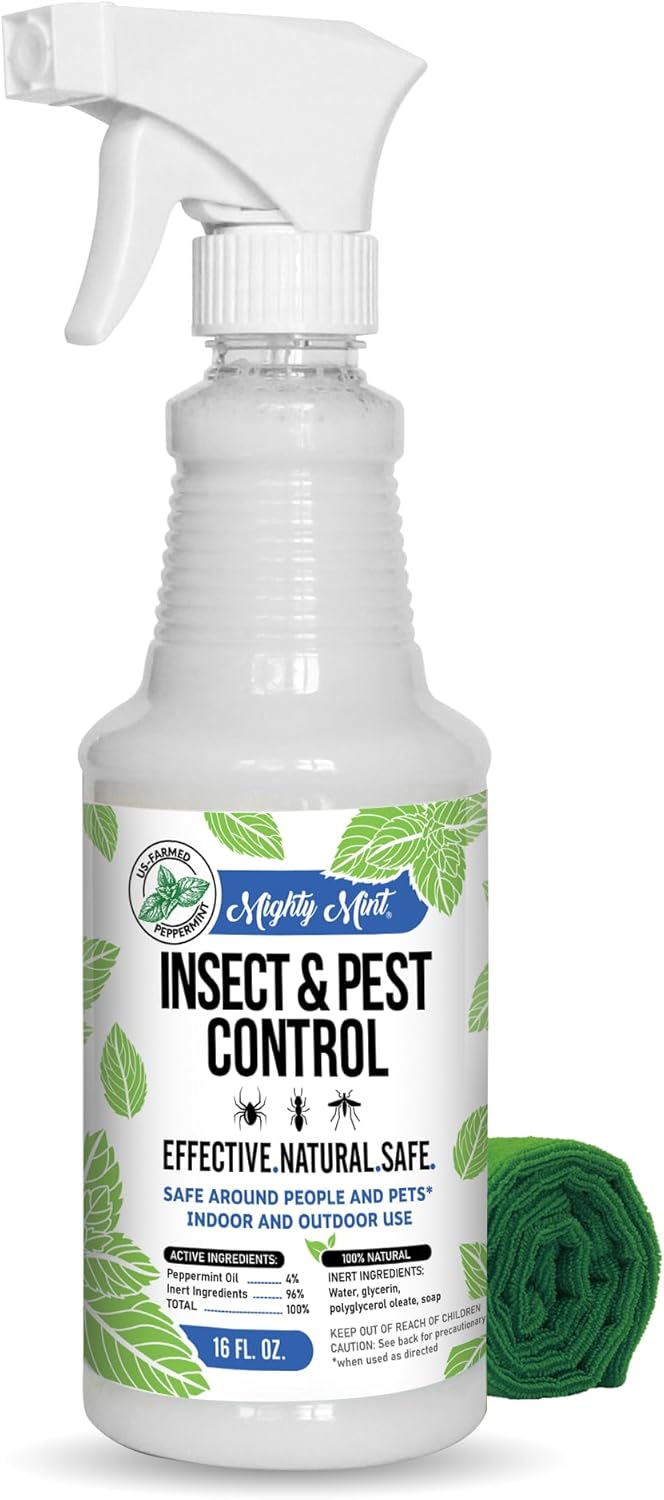
| Ingredients | Water, Glycerine, Polyglycerol oleate, Soap, Peppermint oil |
|---|---|
| Intended use | Indoor & Outdoor pest repellent |
| Formulation | Ready-to-use spray |
| Target pests | Spiders, ants, roaches and other common insects |
Mighty Mint Peppermint Oil Insect Repellent is a 16 oz ready-to-use spray that relies on concentrated peppermint oil to deter spiders, ants, roaches and other common pests. You use it by spraying problem areas—baseboards, entryways, patios and around windows and doors—and the label recommends reapplying a couple times per week for persistent pressure. The formula is plant-based and free of synthetic fragrances, so it leaves a minty scent rather than harsh chemical odor and is marketed as safe around people and pets when used as directed. Notable features include simple spray application, a list of mild surfactants for surface safety, and clear directions for indoor and outdoor spots. Practical benefits are quick targeted treatments without mixing, a pleasant scent, and a nonstaining formula for visible surfaces. Important limitations are that it is a repellent rather than a kill-all pesticide so heavy or established infestations may need professional control, and the scent can be strong for scent-sensitive users until it dries. Follow safety notes to avoid applying when pollinators are present and keep away from eyes and mouth.
Best for: Buyers who prioritize low-toxicity, family- and pet-friendly pest control for routine prevention and spot treatments around the home and entry points.
Less Ideal for: People facing large or entrenched infestations, commercial users, or anyone who needs an immediate kill-focused pesticide rather than an ongoing repellent.
- Plant-based peppermint formula that repels spiders and common household insects
- Ready-to-use 16 oz spray for targeted, no-mix application
- Works indoors and outdoors on baseboards, entryways, patios and other pest entry points
- Nonstaining formulation and mild ingredients suitable for visible surfaces when used as directed
- Designed as a repellent rather than a strong insecticide, so it may not eliminate established infestations
- Contains a concentrated peppermint oil scent that can be irritating to some sensitive people until it dries
Verdict: A user-friendly peppermint oil spray for everyday spider prevention and spot treatments when you want a gentler, low-toxicity approach.
Choosing the Right Bug Spray for Spiders: Key Factors to Consider
Knockdown Speed and Immediate Effect
How quickly a spray incapacitates or kills spiders matters when you need to remove visible infestations or limit immediate bites. Fast knockdown reduces the chance of spiders scattering into wall voids or other hiding spots, which is especially useful for indoor treatments where quick results are visible and reassuring.
Look for products with clear claims about rapid activity and label guidance for spot treatments. In practice, knockdown speed interacts with the application method: a fine aerosol that reaches web corners delivers faster visible results than a coarse stream that misses crevices.
Residual Control Duration
Residual control is the length of time treated surfaces remain toxic or repellent to spiders after application. For many gardeners and homeowners, a longer residual means fewer repeat treatments on eaves, foundations, and garage interiors. Residual performance depends on the active ingredient, formulation, and the treated surface.
Porous materials, heavy dust, or regular moisture exposure reduce residual effectiveness faster than sealed, dry surfaces. Consider where you will treat and how often those spots get wet or disturbed when judging the needed residual duration.
Application Method and Reach
How you apply the spray affects both efficacy and convenience. Aerosols, pump sprayers, hose-end applicators, and ready-to-use trigger bottles each behave differently. For targeting spiders in tight corners, cracks, and webs, a product that produces a fine spray or has an extension tube is often more effective than wide-pattern sprays.
Also assess how easy the applicator is to control for spot treatments versus treating foundation perimeters. For outdoor perimeters, a spray that covers more area per pass can save time, while indoor spot treatments need precision to avoid over-application.
Surface Compatibility and Adherence
Different surfaces hold residues differently. Painted siding, concrete, wood, and interior drywall vary in texture and porosity, which affects how well an active ingredient adheres and remains effective. Formulations that stick to vertical surfaces and resist flaking or dust abrasion prolong residual action.
If you plan to treat screens, porches, or plant pots, check label guidance for surface restrictions and whether residues can be wiped or washed away by rain. For high-touch or delicate surfaces, choose applicators and formulations that minimize staining and buildup.
Safety Precautions and Label Instructions
Balancing effective spider control with safety is essential around children, pets, and edible gardens. Read label directions for re-entry times, pet-safe waiting periods, and any restrictions for use near food or vegetable beds. Some sprays are designed for perimeter and structural use only and explicitly forbid application to edible plants.
Labels also highlight protective equipment needs and recommended distances from treated surfaces. For many homeowners, a product with clear, simple instructions and conservative safety margins is preferable to one with complex or risky application requirements.
Weather Resistance and Outdoor Durability
If you plan perimeter or eave treatments, the product must tolerate sunlight, rain, and temperature swings to maintain residual control. UV degradation and rainfall can significantly reduce how long a treatment remains active.
Consider whether the product is labeled for exterior use and whether it recommends reapplication after heavy rain or seasonal change. For seasonal spider hotspots, plan for periodic retreatment in line with the product's outdoor durability guidance.
Best Places to Treat for Spider Control
Focus treatments where spiders build webs and where insects enter the home. Common spots include eave undersides, garage corners, window and door frames, and basement perimeters. Treat both exterior and interior hiding places when you see persistent activity.
Indoors, target dark corners, behind furniture, and along baseboards. Outdoors, treat foundation lines, under porch overhangs, and under outside lighting where prey insects gather. Spot-treat webs directly when feasible.
- Use extension tubes or pinpoint applicators for cracks and crevices.
- Avoid broadcast spraying on blooms or vegetable beds unless product label permits.
- Reapply after heavy rain if the product label indicates loss of residual activity.
Integrating Sprays with Nonchemical Measures
Chemical sprays are most effective when combined with basic exclusion and sanitation. Seal gaps in windows and doors, repair screens, and reduce outdoor clutter that creates spider habitat. Removing webs and reducing insect prey sources lowers spider pressure and extends the time between chemical treatments.
Use targeted sprays as a supplement to physical methods rather than relying on chemicals alone. Sticky barriers, regular sweeping of eave undersides, and humane relocation for single indoor spiders all help reduce overall reliance on sprays.
- Trim back vegetation that touches the house to reduce bridge points.
- Reduce outdoor lighting that attracts insects during evening hours.
- Keep storage areas dry and decluttered to limit hiding spots.
Timing Treatments for Best Results
Apply sprays when spiders are most active or when prey insects are present. Many species are more active at dusk and dawn, but treating webs and resting sites during daylight ensures residues are in place before nocturnal hunting begins. For exterior treatments, choose dry periods without rain forecast for at least 24 hours.
Seasonal timing matters. Late spring and early summer often see increased spider activity as juveniles disperse. For overwintering spiders in attics or basements, late fall spot treatments to entry points can reduce indoor winter populations.
- Avoid applying during windy conditions to prevent drift.
- Schedule perimeter treatments before heavy foliage growth obscures treated zones.
- Consider repeat applications based on residual duration specified on the label.
Safe Application Around People and Pets
Follow label guidance for re-entry intervals and keep people and pets away from treated areas until residues have dried and the specified waiting period has passed. For indoor use, ventilate treated rooms and avoid treating pet bedding or high-touch surfaces.
If you have aquariums, edible plants, or water features, shield them during application and rinse any accidental overspray according to label directions. When in doubt, choose a product with conservative safety statements and clear cleanup instructions.
- Remove pet food and water bowls from application area until surfaces are dry.
- Store sprays out of reach and in original containers with labels intact.
- Wear basic protective gear such as gloves and eye protection when applying indoors or in tight spaces.
Preparing Treated Areas for Better Results
Before applying, clean away dense webs, dust, and debris so residues make contact with the surface rather than old webs. Wiping or sweeping corners improves adherence and allows you to assess whether populations decline after treatment.
For exterior treatments, clear around foundation perimeters so sprays reach the base of walls and cracks. If treating crawlspace vents or attics, ensure good access and follow ventilation guidance to minimize exposure.
- Remove loose debris before treating so residues adhere to solid surfaces.
- Mark treated areas with discreet tape if multiple people share maintenance duties.
- Keep records of application dates to plan reapplication according to residual claims.
How We Chose the Best Bug Spray for Spiders
We selected sprays that deliver targeted spider control and are intended for use in and around homes, garages, and patios. Our editorial filters prioritized products formulated or marketed specifically for spider knockdown and residual activity rather than broad-spectrum insect aerosols with no documented spider efficacy. Evaluation focused on performance attributes gardeners and homeowners care about in real outdoor-living use. Key evaluation criteria included knockdown speed against common house spiders, length of residual control on typical surfaces, application method suitability for corners and voids, and safety guidance for use around people, pets, and edible plantings. We also considered formulation stability for outdoor exposure and label directions for targeted treatments versus broadcast spraying. Products that relied solely on repellency without measurable residual control were excluded, as were formulations with application methods unsuitable for common home treatment sites. The final shortlist balances rapid control, lasting protection, practical application, and clear safety instructions for everyday garden and yard scenarios.
FAQ
How often should I reapply a spider spray outdoors?
It depends on the product's residual claim and local weather. Many labels suggest reapplying after heavy rain or every few weeks to months for continuous control. Check the product instructions for recommended intervals based on surface and exposure.
Can I use spider sprays around vegetable gardens?
Usually you must follow label directions closely. Many sprays are not labeled for use directly on edible plants. If label guidance allows, avoid spraying blooms and harvest intervals and rinse produce before eating. When in doubt, keep treatments off edible areas and focus on perimeter barriers.
Are natural or botanical sprays effective against spiders?
Some botanical formulations can repel or temporarily deter spiders, but they often lack long residual control compared with synthetic options. These products can be useful for low-pressure situations or where chemical use is restricted, but expect more frequent reapplication.
Will spraying reduce spiders inside my home long term?
Targeted treatments can reduce indoor populations, especially when combined with exclusion and sanitation. Residual sprays on entry points and wall voids help prevent reinfestation, but sealing gaps and reducing indoor prey are important for sustained results.
Is it safe to spray near pets and children?
Safety depends on the specific product and how it is used. Follow label instructions for re-entry times and pet-safe waiting periods. Keep kids and pets away from freshly treated areas until residues are dry and the label-specified period has passed.
Final Verdict
Choosing the right bug spray for spiders comes down to balancing immediate knockdown with the length of residual protection you need for the treated surfaces and setting. Prioritize sprays with applicators suited to the spaces you will treat, clear safety guidance for people and pets, and labels that match your planned use areas. Combine chemical treatments with exclusion and habitat reduction to reduce repeat applications and get the most durable control for your home and yard.
