

Note: This article contains affiliate links. If you click on these links and make a purchase, I may earn a small commission at no extra cost to you. This helps support my research and content. Read my full affiliate disclosure here.
A good spinning compost bin turns kitchen scraps and yard trimmings into usable compost faster and with less physical strain. For backyard gardeners who want quick results without constant turning, a spinning barrel-style compost bin can cut labor and help keep materials aerobic. This guide covers six shortlisted spinning compost bins suited to common garden setups. We evaluate each option on the practical features that matter in real gardens: capacity and how easy the unit is to turn, ventilation and pest resistance, and how well it handles different feedstocks. Read on for a clear comparison of features and real-world tradeoffs before you pick the right tumbler for your space.
Top Picks at a Glance
| Best Overall The best all-around choice for most situations | Cozurra 45‑Gallon Dual‑Chamber Compost Tumbler |  |
| Best Quality Built to a higher standard if you want something more solid | Miracle-Gro Dual Chamber Compost Tumbler (2 × 18.5 gal) |  |
| Best Value The sweet spot between price and what you get | Nazhura 43‑Gallon Dual‑Chamber Compost Tumbler |  |
| Best Budget The cheapest option that still gets the job done reliably | Saturnpower Dual-Chamber 43 Gallon Tumbling Compost Bin |  |
| Highest Rated A top-rated pick with lots of positive feedback | JupiterForce 53 Gallon Dual-Chamber Compost Tumbler with Steel Frame |  |
| Most Popular A crowd favorite that many people choose with confidence | VIVOSUN Outdoor Dual-Chamber Tumbling Composter, 43 Gallon |  |
Cozurra 45‑Gallon Dual‑Chamber Compost Tumbler

| Capacity | 45 gallons |
|---|---|
| Material Type | Polypropylene (PP) |
This Cozurra compost tumbler is a dual‑chamber, 45‑gallon spinner built to make backyard composting straightforward. You use one chamber for fresh scraps while the other side breaks down, so you can produce compost continuously without waiting to empty a single bin. Rotation is easy thanks to the 360° tumbling system and interior mixing ribs that break up clumps and improve aeration; adjustable vents further help control moisture and odors. The unit snaps together for tool‑free assembly and sits on a reinforced steel frame for stability when turning. Constructed from BPA‑free polypropylene, it resists weathering and is sized to handle kitchen waste, grass clippings, and leaves for an average household. Limitations to note are that plastic construction can feel less heavy‑duty than metal alternatives and the two smaller 22.5‑gallon chambers may require frequent turning in very large gardens to keep decomposition active. The tumbler works best when you follow recommended turning and moisture guidelines to speed composting and avoid smells.
Best for: A gardener who wants an easy, low‑effort system to convert kitchen and yard waste into usable compost on a regular schedule and values continuous output over maximum single‑load capacity.
Less Ideal for: Large properties or commercial users who need very high single‑batch capacity or a metal industrial tumbler should consider heavier duty alternatives.
- Dual 22.5‑gallon chambers allow continuous composting without downtime
- 360° tumbling with internal mixing ribs makes turning simple and improves breakdown
- Adjustable vents and airflow control reduce odors and help regulate moisture
- Snap‑together assembly and ergonomic openings simplify setup and loading
- Weather‑resistant BPA‑free polypropylene on a reinforced steel frame for year‑round outdoor use
- Plastic body is less robust than heavy gauge metal and may be more prone to UV wear over many years
- Total capacity split across two chambers means each chamber fills faster than a single large drum
Verdict: Choose this dual‑chamber Cozurra tumbler if you want a simple, weather‑resistant spinner that makes continuous home composting easy and low maintenance.
Miracle-Gro Dual Chamber Compost Tumbler (2 × 18.5 gal)

| Capacity | 37 gallons |
|---|---|
| Material Type | Alloy Steel |
| Chambers | 2 x 18.5 gallons |
| UV Protection | UV-protected plastic |
The Miracle-Gro Dual Chamber Compost Tumbler is a heavy-duty, easy-turn outdoor composter built for gardeners who want a steady supply of finished compost without manual turning. It uses two 18.5 gallon chambers so you can load fresh scraps in one side while the other side cures, which supports continuous composting for back-to-back batches. The tumbling design and smooth rotation make mixing and aeration simple—just rotate every few days—and the manufacturer says it yields finished compost in roughly 4 to 6 weeks under good conditions. Construction combines UV-protected, food-grade plastic with a galvanized steel base and side-locking mechanisms to keep pests out and hold the unit steady. Practical benefits include easier loading and unloading compared with stationary bins, faster decomposition from regular tumbling, and a compact footprint for small yards. Limitations: total capacity is moderate at 37 gallons, so very large yields require multiple units or more frequent emptying, and the hexagonal shape and assembly may need occasional tightening to prevent wobble over time.
Best for: Gardeners who prioritize reliable, fast compost production and want a low-effort system that delivers regular batches without manual pile turning.
Less Ideal for: Large-scale landscapers or gardeners who need very high-volume compost from a single unit should consider larger or multi-unit systems instead.
- Dual-chamber design lets you compost continuously by curing one side while filling the other
- Tumbling mechanism and easy-turn handle promote faster aeration and decomposition
- UV-protected, food-grade plastic and galvanized steel base improve durability and pest resistance
- Compact footprint suitable for small yards or patios
- 37 gallon total capacity may be small for large vegetable gardens
- Requires occasional manual rotation and basic maintenance to keep seals and fasteners tight
Verdict: Choose this tumbler if you want a compact, dual-chamber spinner that makes producing frequent batches of finished compost easy and low-effort.
Nazhura 43‑Gallon Dual‑Chamber Compost Tumbler

| Capacity | 43 gallons |
|---|---|
| Material Type | Plastic and Galvanized Steel |
| Manufacturer Warranty Description | 1 Year |
The Nazhura dual‑chamber compost tumbler is a compact outdoor bin that uses two side‑by‑side rotating chambers to accelerate breakdown and allow continuous use. You load kitchen scraps and yard waste into one chamber while the other heats and matures, then rotate the barrel periodically to mix materials and introduce oxygen. The unit is made from molded plastic with galvanized steel supports, holds about 43 gallons, and has a slide‑open access door for removing finished compost. Practical features include the dual compartments for staging fresh and curing material, a design that helps retain heat for faster decomposition, and simple rotation that reduces manual turning labor. Limitations are typical for plastic tumblers: capacity may be small for very large gardens, and faster composting still requires proper greens/browns balance and occasional monitoring of moisture and aeration. Assembly and stable placement on level ground are important for smooth rotation and longevity.
Best for: Buyers who want a low‑effort, continuous composting solution that speeds breakdown with staged batches and minimal manual turning.
Less Ideal for: Not the best choice for landscapers or very large properties that produce large volumes of yard waste and need bulk composting capacity.
- Dual chambers let you load fresh waste while another batch composts, enabling near‑continuous use
- Rotating barrel and internal mixing accelerate aeration compared with static bins
- Slide‑open door gives quick, tool‑free access to finished compost
- Plastic construction with galvanized steel frame resists rust and reduces maintenance
- 43‑gallon capacity may be small for very large or high‑volume gardens
- Plastic tumbler design can require careful placement and occasional maintenance to keep rotation smooth
Verdict: A practical dual‑chamber tumbler that speeds composting and keeps a steady supply of finished compost for gardeners who want continuous, low‑effort recycling.
Saturnpower Dual-Chamber 43 Gallon Tumbling Compost Bin

| Capacity | 43 gallons |
|---|---|
| Material Type | PP + steel |
This dual‑chamber tumbling compost bin is built for simple, hands‑off backyard composting. The rotating barrel with internal fins and adjustable vents helps break up clumps and mix oxygen into the pile, while the sliding access door makes adding kitchen scraps and removing finished compost straightforward. Because it has two chambers you can let one batch finish while you add to the other, which speeds continuous compost production for a small garden. Construction combines PP plastic with steel framing so the unit feels sturdy for outdoor use, and the 43 gallon capacity is large enough for typical household waste without taking excessive space. Assembly and operation are basic: put scraps in, rotate the barrel every few days, and use the vents to control airflow. Limitations to note are modest size for larger properties and a mostly plastic drum that may be less insulating than heavier all‑metal models in cold climates. For the price and features it offers a practical, low‑maintenance way to turn food and yard waste into usable compost.
Best for: Budget‑minded gardeners who want an easy, low‑effort way to produce steady batches of compost for small to medium garden beds.
Less Ideal for: Large properties or composters who need high‑volume processing or winter performance that benefits from heavier insulated drums should consider larger or all‑metal models.
- Dual‑chamber design lets you process two batches at once for continuous composting
- Tumbling barrel with internal fins improves mixing and aeration without manual turning
- Steel‑reinforced PP construction offers durability for outdoor placement
- Sliding access door provides easy loading and retrieval of finished compost
- 43 gallon capacity may be small for large yards or heavy composters
- Plastic barrel offers less thermal mass than heavier metal designs
Verdict: A cost‑effective dual‑chamber tumbling composter that delivers continuous, low‑maintenance composting for small to medium gardens.
JupiterForce 53 Gallon Dual-Chamber Compost Tumbler with Steel Frame

| Capacity | 53 gallons |
|---|---|
| Material Type | Polypropylene (PP) |
| Model Number | JF90 |
This JupiterForce compost tumbler is built for continuous, low-effort backyard composting. The 53 gallon dual-chamber drum lets you keep one side active while you add new material to the other, so you can maintain an ongoing composting cycle without frequent manual turning. The barrel rotates 360 degrees on a powder-coated steel frame, which simplifies mixing and reduces the need to dig or rake the pile. Sliding air vents and internal mixing fins help airflow and break up clumps, which supports more even decomposition and helps control odors. Panels are polypropylene, so the unit is weather resistant and lighter than all-metal designs, while the reinforced frame gives it stable support in typical garden conditions. The package includes gloves, basic tools, and an instruction booklet to ease setup. Limitations to note are that polypropylene panels may be less impact-resistant than heavy-gauge metal and the size requires a dedicated outdoor footprint, so it is not ideal for very small patios.
Best for: Gardeners who want a reliable, low-effort system to produce compost continuously and prioritize consistent operation and durability over compact size.
Less Ideal for: People with very small outdoor spaces or those who prefer a compact or purely metal heavy-duty tumbler for maximum impact resistance.
- Dual 53 gallon chambers allow continuous composting by alternating sides
- 360° tumbling design makes mixing compost easy without manual turning
- Adjustable sliding vents and internal fins improve airflow and reduce clumping
- Powder-coated steel frame provides stable, weather-resistant support
- Includes gloves, installation tools, and instructions for easier setup
- Polypropylene panels are less impact-resistant than heavy-gauge metal
- Relatively large footprint that may not fit very small patios or balconies
Verdict: A dependable dual-chamber tumbler that keeps composting continuously with easy 360° tumbling and adjustable airflow for steady backyard compost production.
VIVOSUN Outdoor Dual-Chamber Tumbling Composter, 43 Gallon
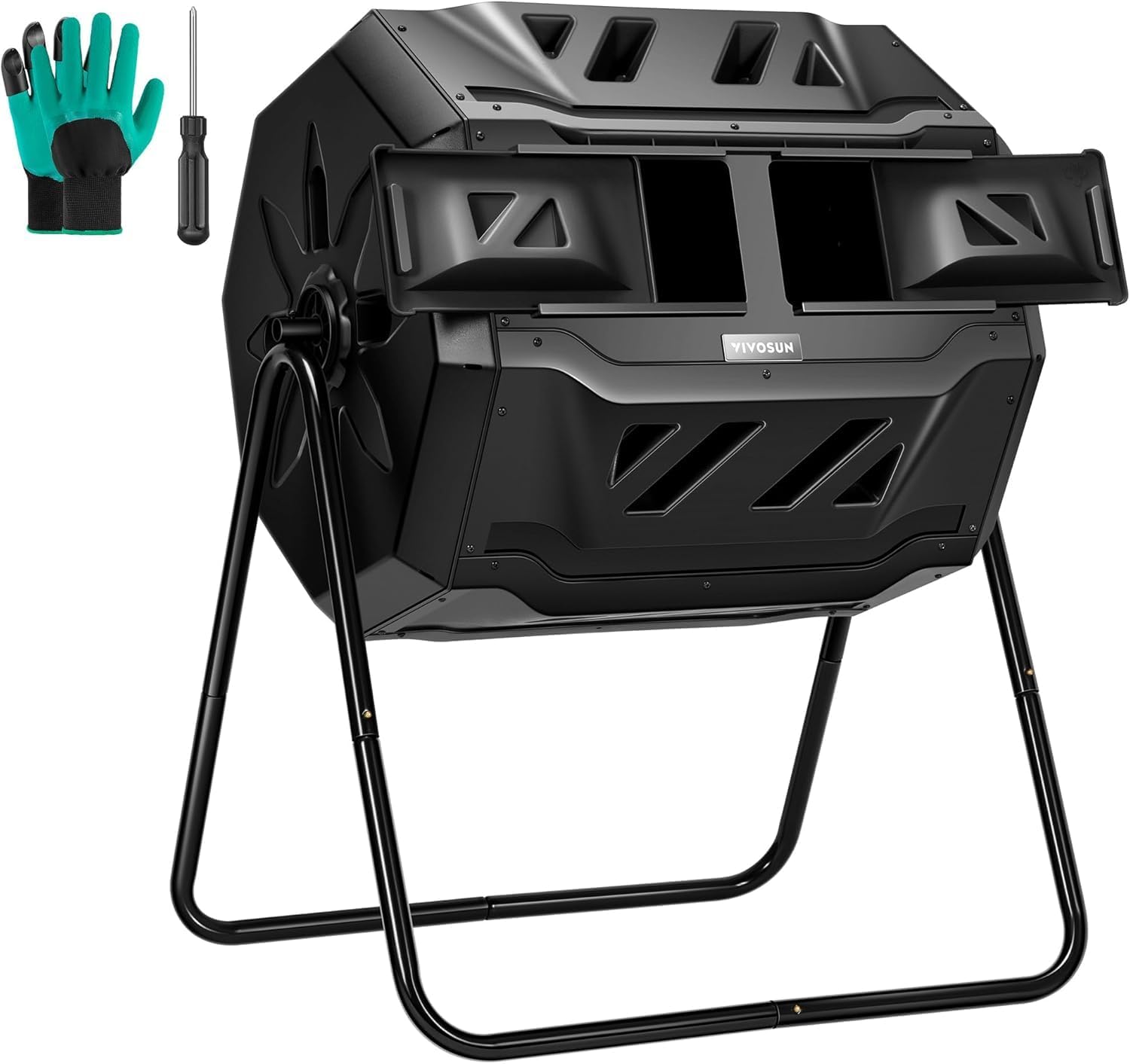
| Capacity | 43 gallons |
|---|---|
| Material Type | galvanized steel and PP plastic |
| Shape | Octagonal |
The VIVOSUN dual-chamber tumbling composter is designed to keep composting active and low-effort by letting one side mature while you load the other. You load kitchen scraps and yard waste into either chamber, close the door, and rotate the octagonal drum to mix contents without digging or turning by hand. The 360 degree tumbling design and deep internal fins break up clumps and improve aeration, while vents help maintain oxygen flow for faster, less smelly fermentation. Construction pairs a galvanized steel frame with a PP plastic body for weather resistance and sturdiness, and the included waterproof gloves with digging claws are a useful add-on for handling material. Expect assembly and occasional tightening of fasteners for long-term durability, and note the 43 gallon capacity suits small to medium households rather than large yards. Because the drum is plastic, extreme UV exposure over many seasons may eventually cause wear, so placement in partial shade will prolong life. For backyard gardeners who want a hands-off, continuous compost supply, this unit delivers an efficient, space-saving solution.
Best for: Buyers who want a low-maintenance way to turn kitchen and yard scraps into usable compost on a regular basis and who value social proof and proven performance when choosing garden gear.
Less Ideal for: Not optimal for very large properties or landscapers who need high-volume commercial composting capacity; those users should consider larger stationary or industrial options.
- Dual chambers let you add fresh waste while another batch finishes for a continuous supply of compost
- 360° tumbling mechanism with internal fins mixes material without manual digging
- Air vents and fins improve aeration for faster, less odorous decomposition
- Galvanized steel frame with PP plastic drum offers weather resistance and a sturdy feel
- Includes waterproof garden gloves with digging claws for safer, cleaner handling
- 43 gallon capacity is modest for large properties with heavy yard waste
- Plastic drum may degrade under prolonged, direct UV exposure over many seasons
Verdict: Choose this dual-chamber tumbling composter if you want a proven, low-effort system that delivers continuous compost by rotating one chamber while the other finishes.
Choosing the Right Spinning Compost Bin: Key Factors to Consider
Capacity and Household Throughput
How much material a spinning compost bin holds directly affects how often you need to empty and reload it. Larger drums can process more kitchen scraps and yard waste between harvests, but they also become heavier and harder to turn when full. Consider how many people are in your household, how much vegetable waste you produce, and whether you want to compost larger items like small branches.
If you plan to compost for a vegetable garden, aim for a bin size that balances volume with manageable rotation force. Too-small bins require frequent attention, while overly large drums can be awkward without mechanical advantage built into the axle or handle design.
Ease of Rotation and Mechanical Advantage
A spinning composter is only useful if you can turn it easily. Look at axle design, handle placement, and gearing or bearing systems that reduce friction. Smooth rotation encourages regular turning, which speeds decomposition and prevents anaerobic pockets. Poorly balanced drums or stiff bearings increase the physical effort and make use less consistent.
Also consider how the unit behaves as it fills: some designs become harder to spin when partially full because contents slosh or jam. A good spinner maintains balance and a low effort threshold from empty to full.
Aeration, Internal Baffles, and Mixing Action
Proper airflow and internal mixing are key to a healthy, fast composting process. Spinning designs should encourage tumbling of the materials to expose fresh surfaces to oxygen while keeping moisture even. Internal fins or paddles that repeatedly lift and separate material during each rotation speed up breakdown.
Insufficient aeration leads to slow, smelly decomposition while over-dry pockets slow microbial activity. Choose a design that promotes consistent mixing and has vents that protect against pests while allowing air exchange.
Access for Adding and Harvesting Material
Practical access affects how easily you add scraps and remove finished compost. Wide hatches or doors let you toss in kitchen scraps without spilling and make it simpler to reach in when harvesting. Some spinner designs allow partial unloading while keeping the rest of the batch undisturbed, which is useful for continuous composting systems.
Also note how secure the closures are: tight seals prevent pests and excess moisture, while awkward or small openings discourage regular use.
Durability and Outdoor Weather Resistance
Spinning compost bins sit outdoors and face sun, rain, and freeze-thaw cycles. Materials that resist UV degradation, rust, and cracking will last longer and maintain performance. Plastic drums should be thick and UV-stabilized; metal frames should be powder-coated or made from stainless materials to avoid corrosion.
Check how easily moving parts can be serviced or replaced. Durable construction reduces long-term maintenance and prevents sudden failures that can spill compost or jam rotation.
Sizing for Different Garden Types
Match the bin size to your gardening goals and waste stream. Small urban plots or balcony gardeners who compost kitchen scraps only can use a modest-capacity spinner, while family vegetable gardens or small orchards will benefit from a larger drum that reduces the frequency of turning and emptying.
Consider whether you want one larger tumbling bin or two mid-size units to run batches in parallel. Two smaller spinners let you keep one batch finishing while you fill the other, which smooths supply of finished compost.
- Balcony/Patio: prioritize compact footprint and pest-proof vents
- Small yard: mid-size bin for weekly kitchen and yard waste
- Large garden: larger capacity or dual drums for continuous supply
Placement and Installation Tips
Place the spinner on firm, level ground that allows easy access from where you carry kitchen buckets or yard waste. Keep it near a water source if you plan to adjust moisture.
Ensure there is clearance for rotating the drum and that the base is stable. Some models benefit from a slight elevation or foundation to improve drainage and prevent the frame from sitting in mud.
- Allow 18 to 36 inches of clearance around the unit for full rotation
- Avoid low-lying soggy spots that collect water and attract pests
- Orient openings away from prevailing winds if odor is a concern
Managing Moisture and Feedstock Mix
Spinning bins process material faster when the carbon-to-nitrogen balance and moisture are right. Aim for a mix of green (kitchen scraps, fresh grass clippings) and brown (dry leaves, shredded paper) materials. If compost is too wet or smelly, add more browns and turn more frequently.
Rotate the drum after adding new material to incorporate it and prevent layers that stay dry or anaerobic. Check moisture by squeezing a handful: it should feel like a wrung-out sponge, damp but not dripping.
- Add coarse browns to improve airflow and reduce compaction
- Chop larger items to speed breakdown and make turning easier
- Monitor moisture after heavy rain and adjust with dry material
Pest Prevention and Odor Control
A sealed spinning design helps keep rodents and larger scavengers out, but vents and access points must be secure. Avoid putting meat, dairy, or oily foods into outdoor spinners unless the design explicitly handles them, as these attract pests and cause odors.
Regular turning and the right carbon ratio reduce odors. If you notice persistent smells, add browns, increase ventilation by adjusting material density, and ensure the unit is draining properly.
- Use enclosed vents or fine mesh to block rodents while allowing airflow
- Avoid adding attractants that feed pests
- Harvest finished compost promptly to free capacity and prevent overfilling
Winter Care and Year-round Use
Cold weather slows microbial activity, so expect reduced decomposition rate in winter. Insulating the drum with a removable blanket or placing the bin in a sunnier spot can help maintain activity. Some gardeners keep a separate indoor batch for kitchen scraps during deep freezes.
Turn the drum occasionally in winter to prevent compaction and to mix warmer interior material with colder outer layers. When temperatures rise, normal activity will resume and the spinning bin will regain speed of breakdown.
- Prevent freeze-lock by tipping material into the sun-exposed side before cold snaps
- Empty and store smaller units if you plan to stop composting in winter
- Keep moving parts lubricated with a garden-safe product to prevent seizing
How We Chose the Best Spinning Compost Bin
We prioritized criteria that reflect actual use in backyard and patio composting. Capacity and turning effort were primary filters because they determine how much material you can process and how easy the tumbler is to operate for gardeners of varying strength. Aeration and internal mixing were assessed to ensure efficient decomposition and to reduce odor problems. Durability of the drum and frame mattered for long-term use outdoors, including resistance to UV, corrosion, and wear from daily handling. Access and maintenance features such as hatch size, how easy it is to remove finished compost, and whether the design allows adding new material while composting were included. Stability and pest resistance were considered to keep rodents and raccoons out while maintaining safe tipping and rotation. We excluded simple bin-only designs that require manual pitchfork turning, stationary wire cages, and very small countertop units that do not match backyard throughput needs. The final selection favors spinner-style composters that combine manageable turning effort, reasonable capacity for a household, and practical access for harvesting finished compost.
FAQ
How often should I spin a tumbling compost bin?
Usually turning every two to three days accelerates breakdown, but frequency depends on temperature and materials. In warm weather and with a balanced mix, more frequent spinning speeds composting; in cool weather, less frequent turning is fine.
Can I compost yard waste and kitchen scraps together in a spinner?
Yes. Mixing green kitchen scraps with browns from yard waste balances moisture and carbon. Shredding or chopping larger yard material helps the drum tumble evenly and prevents jams.
Will a spinning compost bin keep rodents away?
Enclosed spinners with secure latches and small vent openings reduce rodent access compared with open bins. However, any unit can attract pests if you add meat, dairy, or oily foods, so avoid those materials to minimize problems.
How do I know when compost is ready to harvest?
Finished compost is dark, crumbly, and earthy-smelling with no recognizable food pieces. In a spinner, you may mix and remove partly finished material; fully finished compost usually takes several weeks to months depending on conditions.
Is a dual-drum setup better than a single large drum?
Dual drums let you run batches in parallel so one can finish while you fill the other, providing a steady supply. A single large drum can process more at once but may require more effort to turn and manage.
How do I handle a drum that becomes hard to spin?
Check for overload, wet compaction, or material caught near the axle. Remove some material, add dry browns to absorb moisture, and inspect bearings or handles for rust or debris that may impede rotation.
Final Verdict
Choose a spinning compost bin that matches how much organic waste you produce and how much effort you want to invest in turning. Prioritize manageable rotation mechanics and sufficient aeration to keep decomposition fast and odor-free. Consider capacity and access features that fit your workflow, and weigh durability if the unit will sit outdoors year-round. Balancing these tradeoffs will let you pick a spinner that reduces labor while producing usable compost reliably. Focus on ease of rotation, pest-resistant construction, and practical access so you can compost regularly and confidently.
